What's inside
As an Amazon Associate I earn from qualifying purchases. This post may contain affiliate links at no extra cost to you.
widgetverdict.com is reader-supported. When you buy through links on our site, we may earn an affiliate commission.
A music video is three minutes of controlled exaggeration. The warehouse is smokier than any warehouse, the singer’s kitchen is lit like a stage, and the camera has to survive both — plus a drummer, a strobe and a director who wants one more take at 2 a.m. Choosing the best cameras to shoot music videos is therefore less about resolution charts than about which bodies keep their composure when the light drops, the haze thickens and the playback restarts for the fortieth time.
Six cameras made this list, and they divide by temperament. Two are 12-megapixel low-light specialists whose stills are honestly their weak side — that trade is stated in their own sections, not whispered. Two are full-frame hybrids that balance video ambition with autofocus a solo director can trust. One is Blackmagic’s manual-focus cinema instrument, repeated from our documentary guide because music videos are the other genre it was born for. And one is Sony’s Super 35 Cinema Line body, the budget door into professional music-video rigs.
A warning that applies to every section: log profiles and wide-gamut recording are costs as much as features. They demand grading time, monitoring discipline and storage. A camera that shoots beautiful flat footage for a director who never grades is a camera half-used, and this guide will keep pointing at the cameras that look good straight out of the body for exactly those directors.
One more framing before the picks: a music video camera is also a relationship instrument. Independent artists commission directors they trust with their image, and the kit that director carries signals how the work will feel — the cinema rig that says feature film, the compact creator body that says fast and current, the familiar hybrid that says safe hands. None of those signals is the substance, but productions run on trust before they run on footage, and the camera over your shoulder is part of the first conversation. Choose a body whose working method matches the promise you actually make to artists, and the rest of the production gets easier in ways no specification can measure.
Key Takeaways
- Sony’s a7S III is the low-light reference here — a full-frame 12MP-class body whose stills are its acknowledged weak side.
- Sony’s ZV-E1 states its recipe openly: 12.1MP full-frame sensor, 4K up to 60p and 5-axis IBIS in a creator body.
- Panasonic’s S5II answers with 24.2MP full-frame stills, phase hybrid AF, active stabilisation and unlimited 4:2:2 10-bit recording, as listed.
- Canon’s EOS R6 Mark II is the balanced hybrid: 24.2MP full-frame for stills and serious video in one RF body.
- The Blackmagic Pocket Cinema 6K Pro returns as the manual-focus, grading-first cinema choice — no continuous AF, no in-body stabilisation.
- Sony’s FX30 gives Super 35 Cinema Line discipline to directors building their first real music-video rig.
Quick Picks
| Pick | Badge | Why it made the cut |
|---|---|---|
| Sony Alpha a7S III | Best low-light specialist | A full-frame body built around sensitivity — the club, warehouse and night-street camera. |
| Sony ZV-E1 | Best compact full-frame creator body | 12.1MP full-frame, 4K up to 60p and 5-axis IBIS, as its listing states. |
| Panasonic Lumix S5II | Best value full-frame video hybrid | Phase hybrid AF, active stabilisation and unlimited 4:2:2 10-bit recording, per the listing. |
| Canon EOS R6 Mark II | Best balanced Canon hybrid | 24.2MP full-frame stills and video capability in one dependable RF body. |
| Blackmagic Pocket Cinema Camera 6K Pro | Best grading-first cinema body | The independent director’s manual-focus instrument for a crafted, graded look. |
| Sony FX30 | Best cinema-line starter rig | Super 35 Cinema Line body with a 20.1MP movie-effective sensor for growing directors. |
How We Chose These Picks
Music-video selection starts with the genre’s defining condition: darkness with colour in it. Stages, clubs, neon streets and candlelit rooms dominate the form, so sensitivity and colour integrity under mixed, saturated light outranked headline resolution. Cameras were credited for what their listings actually state — a sensor size, a frame rate, a stabilisation claim, a recording specification — and never for the low-light folklore that surrounds famous models. Where a title is silent about sensitivity, this guide discusses the physics of sensor size qualitatively and invents no figures.
Autofocus philosophy was the second axis, because music videos split into two production styles. Performance pieces with a roaming singer reward cameras that track a face through haze and strobe; narrative and aesthetic pieces reward manual control and a body that stays exactly where the director put it. Both philosophies appear below, labelled, because recommending one to the other’s director is how budgets die.
Stabilisation and rig-ability formed the third axis. Handheld energy is a music-video language of its own, and in-body stabilisation — where a listing states it — serves the solo director shooting a singer in one flowing take. Cinema bodies, conversely, were credited for rigging cleanly onto gimbals, tripods and shoulder mounts, where stabilisation is the support’s job.
Finally, the stills question was answered honestly per camera. Music-video directors increasingly shoot the single’s cover, the press shots and the behind-the-scenes stills on the same body. Two picks here are 12-megapixel-class specialists whose stills ceiling is real; pretending otherwise to complete a ranking would betray the hybrid buyers this guide also serves.

Sony Alpha a7S III — Best low-light specialist
The a7S III’s listing is almost austere: a full-frame mirrorless body in black with an Exmor R BSI CMOS sensor. The austerity suits the camera’s legend, because the S line’s fame rests on a single, deliberate trade — a full-frame sensor with a modest pixel count, which makes each pixel large and light-hungry. The consequence filmmakers care about is sensitivity: this is the body directors reach for when the location is a real bar, a real street, a real warehouse, and the lighting budget is a few practicals and nerve.
Now the honesty the brief for this guide insists on, in the camera’s own section where it belongs: stills are this body’s weak side. A 12-megapixel-class sensor produces stills that are perfectly serviceable for web and social use and genuinely limited for large prints or aggressive cropping. A director who also shoots cover art at print quality should read the S5II and R6 Mark II sections twice. The a7S III makes no secret of that trade, and neither does this guide.
Within video, the specialisation pays in a specific working freedom: you light for mood instead of for the camera. Practical bulbs can stay practicals; the neon sign can be the key light; the singer can step out of the lit pool without the image collapsing into noise. Directors coming from hungrier bodies describe the first night shoot on an S-series camera as a change of religion, and while this guide will not print sensitivity figures the listing does not state, the qualitative claim — this class of sensor exists to see in the dark — is the product’s entire documented identity.
E-mount membership adds the practical layer: fast primes, the lenses night work demands, exist across every price tier, and the same lens bag serves the FX30 and FX3 elsewhere in this guide if a production grows into a two-camera Sony unit. Music videos are often shot on borrowed glass; borrowing is easiest inside the deepest ecosystem.
Buy it as a video specialist and it will not disappoint; buy it as an all-round camera and the stills ceiling will find you. Directors whose work lives after dark can check the a7S III on Amazon — and should price a fast prime in the same breath, because that pairing is the actual product.
- Sensor: full-frame Exmor R BSI CMOS, per the listing title
- Type: mirrorless camera body, black, per the listing title
- Stills resolution: modest by design (12MP class) — the line’s known trade; verify exact figures with the manufacturer documentation
- Maximum sensitivity: Not stated in the listing title — verify with the manufacturer documentation
- Video specification: Not stated in the listing title — verify with the manufacturer documentation
- Stabilisation: Not stated in the listing title — verify with the manufacturer documentation
Strengths
- The low-light specialist of this list — built to film in real locations at night.
- Large-pixel full-frame design favours sensitivity over resolution, deliberately.
- E-mount gives unmatched access to the fast primes night shoots demand.
Trade-offs
- Stills are the weak side: limited for large prints and heavy cropping.
- Specialist pricing buys little for daytime, well-lit productions.
- Listing states few specifications — documentation homework is required.
Best for: a director shooting clubs, night streets and practical-lit interiors where sensitivity is the whole job.
Not suited for: a hybrid creator who needs print-grade stills from the same body.
A working night with this body has a particular rhythm. Because the camera tolerates darkness, the director stops negotiating with it and starts negotiating with the location: which practical stays, which neon sign plays, how much haze the room can hold before faces soften. That shift of attention — from equipment anxiety to scene design — is the true product a specialist body sells. Directors feel it as creative freedom; producers feel it as fewer lighting rentals; artists feel it as a set that looks like the song sounds.
Two-camera music-video units often pair this body with a higher-resolution sibling for the wide master, letting the S camera prowl for the dark close work it does best. Even alone, though, its discipline is clarifying: it asks the director to commit to motion, to sensitivity, to the night — and rewards the commitment every single take.
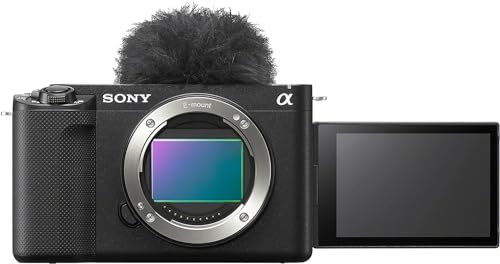
Sony ZV-E1 — Best compact full-frame creator body
The ZV-E1’s listing, unlike its sibling’s, actually itemises its recipe: a 12.1MP full-frame Exmor R CMOS sensor, BIONZ XR processing, 4K recording up to 60p, E-mount and 5-axis in-body stabilisation. Read those lines together and the camera’s intent is unmistakable — the a7S philosophy of a large-pixel, sensitivity-first full-frame sensor, repackaged in a compact creator body with the stabilisation a solo director needs to shoot handheld performance pieces.
That stabilisation, stated plainly in the title, changes the working method. A singer performing to playback in a stairwell, a corridor, a rooftop: the ZV-E1 can follow in one breathing, handheld take whose micro-movement reads as energy rather than error. Solo directors — and most music videos at independent level are shot by one or two people — gain a whole visual language without renting a gimbal or growing a second operator.
4K up to 60p, as stated, covers the genre’s slow-motion staple: hair, fabric, water and confetti at half speed during the chorus. Sixty frames per second is the working threshold for that look, and the listing puts it in writing. Directors planning heavy slow-motion beyond that should verify higher frame rates in the documentation rather than assume them; this guide claims only what is printed.
The 12.1MP sensor carries the family trade in full: stills are the weak side, serviceable for social and web, limited for print and cropping. A creator whose channel needs thumbnails and behind-the-scenes stills will never notice; a director moonlighting as the band’s press photographer will. The ZV-E1 also inherits the creator-body philosophy — streamlined controls aimed at video first — which photographers raised on dials may find spare.
Judged as a music-video instrument for small crews, the package is remarkably complete: full-frame sensitivity, stated stabilisation, stated 60p, compact body. Creators shooting their own bands or their first client videos can see the ZV-E1 on Amazon and weigh it directly against the larger a7S III above.
- Sensor: 12.1MP full-frame Exmor R CMOS, per the listing title
- Processor: BIONZ XR, per the listing title
- Video: 4K up to 60p, per the listing title
- Stabilisation: 5-axis IBIS, per the listing title
- Mount: Sony E-mount, per the listing title
- Stills: 12.1MP class — web and social grade, limited for large prints
Strengths
- Full-frame low-light sensor in a compact, solo-friendly body.
- Stated 5-axis stabilisation enables handheld performance takes.
- Stated 4K 60p covers the genre’s slow-motion chorus shots.
Trade-offs
- Stills share the 12MP-class ceiling of the a7S line.
- Creator-first controls may feel spare to traditional photographers.
- Higher frame rates beyond 60p are not stated — verify before planning.
Best for: a solo director or creator shooting handheld performance videos in available light.
Not suited for: a print-first photographer who films occasionally and needs stills resolution most.
Consider the one-person performance video, the format the creator economy runs on. The artist performs to a phone speaker in a bedroom studio; the ZV-E1 sits on a small gimbal or even a steady hand, circling slowly; the full-frame sensor keeps the room’s single lamp romantic instead of murky, and the stated stabilisation irons the circle into a glide. That entire production — which once needed a crew — now fits in a backpack, and the camera’s specification reads like it was written from that backpack’s packing list.
The creator-body compromises should be scheduled honestly too. Long, complex shoots with external everything — monitors, recorders, audio rigs — are the Cinema Line’s home ground, and the ZV-E1’s compact creator form is happiest travelling lighter than that. Directors whose sets grow rigging should graduate within the same mount, keeping every lens, which is precisely the ladder Sony’s ecosystem is designed to provide.

Panasonic Lumix S5II — Best value full-frame video hybrid
Panasonic wrote this listing like an argument, and the argument lands: a 24.2MP full-frame mirrorless camera with phase hybrid autofocus, new Active I.S. technology and unlimited 4:2:2 10-bit recording. Every clause answers a music-video anxiety. Phase hybrid AF answers the roaming singer. Active stabilisation answers the handheld tracking shot. Unlimited recording answers the long performance take and the forty-minute live session. And 24.2 megapixels answers the stills question that eliminates the two Sonys above for hybrid buyers.
Unlimited recording deserves its emphasis in this genre specifically. Music videos are shot in takes, but the modern independent director also films live sessions, acoustic versions and concert content for the same artists — formats measured in tens of minutes, where a camera that stops becomes a production incident. A listing that prints the word unlimited is making a promise the director can plan a day around, and this guide credits promises printed in titles far above rumours repeated in forums.
The 4:2:2 10-bit specification is the colourist’s clause. Music videos live on saturated colour — gels, neon, stage wash — and saturated colour is where thin codecs tear first, banding gradients and smearing reds. Ten-bit 4:2:2 material holds those gradients through a grade, which means the look a director designs on set survives the edit. Paired with the honesty rule of this guide — log-style footage still needs grading time, and that time is a real cost — the S5II’s specification is best read as capability with a homework assignment attached.
Phase hybrid autofocus matters historically as well as practically: Panasonic’s contrast-based systems were the line’s old weakness for video, and the listing’s prominent phase claim announces its correction. For a director tracking a performer through haze, autofocus that acquires and holds without hunting is the difference between a usable take and a beautiful near-miss.
Full-frame L-mount lenses complete the ownership picture, shared with a growing alliance of bodies. For the director who wants one camera for videos, sessions and stills — and wants the key promises printed in the listing — the S5II is this guide’s value anchor. Such directors can check the Lumix S5II on Amazon and compare its stated specification line by line.
- Sensor: 24.2MP full-frame, per the listing title
- Autofocus: phase hybrid AF, per the listing title
- Stabilisation: Active I.S. technology, per the listing title
- Recording: unlimited 4:2:2 10-bit, per the listing title
- Model: DC-S5M2BODY — body only, per the listing title
- Frame rates: Not stated in the listing title — verify with the manufacturer documentation
Strengths
- The most complete stated specification in this guide, clause by clause.
- Unlimited recording suits live sessions as well as staged takes.
- 24.2MP stills keep hybrid buyers out of the 12MP compromise.
Trade-offs
- Body only — L-mount lenses are a second budget line.
- 10-bit log-style workflows still demand grading time and skill.
- Full-frame depth of field needs focus discipline on moving singers.
Best for: an independent director shooting videos, live sessions and stills on one full-frame body.
Not suited for: a director who never grades and wants finished colour with zero post work.
The live-session scenario shows the S5II at its most complete. A band plays a thirty-minute set in a studio, three cameras roll — and the director’s own body must simply not stop, not hunt for focus as the singer leans into the microphone, and not shake apart during the handheld number. The listing’s three promises map onto those three fears one by one. Specifications are usually abstract; read against a real session, these read like a checklist written by the last director who got burned.
Value framing completes the section. Full-frame video with this stated depth — phase autofocus, active stabilisation, unlimited 10-bit 4:2:2 — historically arrived at higher tiers of the market. A director assembling a first serious kit can put the savings toward the fast prime and the audio recorder that the video will be judged by, which is the correct order of spending in this genre every time.

Canon EOS R6 Mark II — Best balanced Canon hybrid
Canon’s listing for the R6 Mark II is the most modest here — a full-frame mirrorless body with a 24.2 megapixel CMOS sensor and photo and video capabilities — and the modesty is almost a brand statement. The R6 line’s reputation was built not on a single headline specification but on balance: a body that professional hybrid shooters trust to do everything well, in an ecosystem, RF, whose lenses and colour science a generation of music photographers already own.
For music videos, balance has a specific meaning. The director of an independent video is usually also the stills photographer, the behind-the-scenes shooter and sometimes the live photographer for the same artist. A 24.2MP full-frame sensor serves the press shots; the video side serves the commission; and one bag serves the relationship. Cameras that force a choice between those roles — including the brilliant specialists at the top of this list — cost the hybrid director either money or goodwill. The R6 Mark II declines to force it.
Canon colour deserves its customary sentence in any music context: skin tones under stage light are Canon’s home turf, and singers are, photographically, skin tones with choreography. Directors who grade lightly — the majority at independent level, whatever they claim — benefit disproportionately from colour that starts close to finished. That is a workflow argument, not a specification, and for time-poor directors it may be the strongest one in this section.
Discipline requires noting what the listing does not state: no frame rates, no recording specification, no stabilisation claim is printed in the title, so none is asserted here. Buyers comparing codecs and slow-motion ceilings should take those figures from Canon’s documentation. What the title does establish — full-frame, 24.2MP, hybrid intent — plus the line’s standing is the honest basis of the recommendation: the safe pair of hands.
Artists’ regular photographers becoming video directors are this camera’s natural owners. If that is your trajectory, look at the EOS R6 Mark II on Amazon and judge it as the long-term system anchor it is designed to be.
- Sensor: 24.2 megapixel full-frame CMOS, per the listing title
- Type: mirrorless camera, body only, per the listing title
- Use: photo and video capabilities, per the listing title
- Mount: Canon RF system
- Video specification: Not stated in the listing title — verify with the manufacturer documentation
- Stabilisation: Not stated in the listing title — verify with the manufacturer documentation
Strengths
- Genuine hybrid balance: press-grade stills and serious video in one body.
- Canon colour flatters performers under mixed stage light.
- RF ecosystem suits directors growing from stills into video.
Trade-offs
- Title states no video specifications — codec homework is on the buyer.
- Jack-of-all-trades brief means specialists beat it in their niches.
- Body only, with RF lenses a significant second investment.
Best for: a band’s regular photographer stepping into directing their videos as well.
Not suited for: a low-light absolutist who wants the a7S-class sensitivity trade.
There is an apprenticeship argument for this body that stills-first directors underrate. Shooting a band’s stills teaches framing; directing their video teaches time — and the R6 Mark II’s balanced brief means the apprentice director learns on one menu system, one lens set and one colour pipeline instead of two. Skills compound faster inside a single ecosystem, and the second video is visibly better than the first for reasons that have nothing to do with talent. Consistency of tools is a teaching aid.
Resale and rental geography quietly favour the mainstream choice as well. RF bodies and lenses circulate widely; a director can rent the exotic lens for the one shoot that needs it and borrow a second body for the live session, because the system is everywhere. Exotic systems may charm, but the working director’s calendar rewards the camera the local rental house stocks three of.

Blackmagic Pocket Cinema Camera 6K Pro — Best grading-first cinema body
It returns in this guide for the same reason it anchors the documentary list, with the same two facts stated up front, because music-video buyers deserve them no less: the Pocket Cinema Camera 6K Pro has NO continuous autofocus and NO in-body stabilisation. Focus is pulled by hand; steadiness comes from rigs, gimbals and tripods. A director shooting a chaotic live performance alone should choose almost any other pick here. A director shooting a crafted, storyboarded video with a small crew has found the genre’s favourite instrument.
Music videos, more than any other short form, are graded objects. The look — crushed blacks, halated highlights, a colour palette borrowed from a film still — is the product as much as the song’s visuals. Blackmagic’s whole design philosophy serves that reality: footage intended as raw material for a serious grade, in a body priced for independent productions. Directors who think in looks rather than takes consistently rate this camera above hybrids with longer feature lists, because its priorities match theirs.
Manual focus, in a storyboarded video, is rarely the burden it is in vérité. Shots are rehearsed, marks are taped, the singer hits the same position on the same lyric across takes — the controlled environment of a music video is precisely where a focus puller’s craft, or a director-operator’s practiced hand, delivers repeatable precision. The absence of continuous AF removes a safety net that staged production mostly does not need.
Stabilisation follows the same logic: a music video’s camera movement is usually designed — a gimbal orbit, a slider push, a locked-off wide — rather than improvised handheld. Support gear is already on the call sheet, so the body’s lack of internal stabilisation costs this genre less than it costs documentary or events work. What it demands is honesty in budgeting: the rig is part of the camera’s price, as this guide noted in the documentary context and repeats here without apology.
The listing title states only the camera’s name and model code, so formats, mount and sensor figures are left to Blackmagic’s documentation, as before. The recommendation rests on identity and method-fit: for directors who grade seriously, shoot deliberately and crew their shoots, this is the music-video body with a cult following for rational reasons. Those directors can check the Pocket Cinema Camera 6K Pro on Amazon with its two limitations understood as design, not defect.
- Model: Blackmagic Design Pocket Cinema Camera 6K Pro (CINECAMPOCHDEF06P), per the listing title
- Autofocus: NO continuous autofocus — manual focus workflow
- Stabilisation: NO in-body stabilisation — external support required
- Recording formats: Not stated in the listing title — verify with the manufacturer documentation
- Mount: Not stated in the listing title — verify with the manufacturer documentation
- Sensor specification: Not stated in the listing title — verify with the manufacturer documentation
Strengths
- Grading-first image philosophy matches the music video’s crafted look.
- Manual operation suits rehearsed, storyboarded production perfectly.
- Independent directors’ proven favourite in this price class.
Trade-offs
- No continuous AF — live, chaotic performance capture is hard work.
- No in-body stabilisation — support gear is a mandatory budget line.
- Footage expects grading; straight-from-camera directors will be disappointed.
Best for: a director with a small crew shooting storyboarded, heavily graded videos.
Not suited for: a solo shooter filming unrehearsed live performances handheld.
A storyboarded day clarifies the camera’s pleasures. Morning wide shots on sticks, the room dressed and hazed; afternoon close work on a gimbal whose operator has rehearsed the orbit; evening inserts — hands on strings, a boot on a pedal, vinyl spinning — each framed deliberately and focused by hand. Nothing in that day asks the camera to chase, guess or stabilise internally, and everything in it rewards colour depth and operator intent. The Pocket body is not a compromised hybrid; it is a specialised instrument in its element.
Directors should also price the discipline it teaches as an asset. A generation of filmmakers raised on this line learned exposure, focus and grading as crafts rather than menu options, and those crafts transfer to every larger camera they will ever rent. Buying the Pocket body is partly buying a film school that fits in a case — provided the student actually wants the curriculum.

Sony FX30 — Best cinema-line starter rig
The FX30 closes this list as it opened the documentary one: a Sony Cinema Line Super 35 body, grey, with a 20.1MP Exmor R APS-C sensor effective for movies. For music-video directors, its pitch is professional formation. This is the camera that teaches cinema method — rigging, monitoring, deliberate focus and lighting — inside Sony’s Cinema Line ecosystem, at the entry point of that line, with the Super 35 format that music-video lenses and habits have used for decades.
Super 35 deserves a genre-specific defence. Music videos are full of faces at close range, and the format’s moderate depth of field forgives a singer’s sway in a way full-frame at wide aperture does not, while still separating subject from background with a fast prime. Solo directors pulling their own focus — most independent music videos — quietly depend on that forgiveness. The format is not a budget apology; it is a working choice that many established directors keep after they could afford larger sensors.
Cinema Line ergonomics shape the shoot day. A body designed for rigs accepts the monitor, the follow focus, the matte box and the audio gear of a real production without improvisation, and it behaves identically on take forty as on take one. Music videos are repetition machines — the chorus performed identically for the wide, the close and the insert — and equipment that stays predictable across repetitions is worth more than a headline specification used once.
The E-mount lens library, shared with the a7S III and ZV-E1 above, gives the growing director a rental-and-ownership ladder inside one system: start with the FX30 and an affordable prime, borrow the fast glass for the big shoot, graduate the body to B-camera when an FX3-class body arrives. Music-video careers are built exactly that way, rung by rung.
Stills are not this body’s story — its sensor is specified effective for movies, per the listing — and hybrid directors should choose accordingly. As a first cinema camera for a director whose future is motion, it remains the reference recommendation. Aspiring directors can see the Sony FX30 on Amazon and start speccing the rig it will grow into.
- Line: Sony Cinema Line, per the listing title
- Sensor: Super 35 / APS-C Exmor R, 20.1MP effective for movies, per the listing title
- Mount: Sony E-mount (Cinema Line standard)
- Colour: grey finish, per the listing title
- Video specification detail: Not stated in the listing title — verify with the manufacturer documentation
- Stabilisation: Not stated in the listing title — verify with the manufacturer documentation
Strengths
- Cinema Line method and rigging at the line’s entry point.
- Super 35 focus forgiveness suits solo directors pulling their own focus.
- E-mount ladder lets the whole kit grow one rung at a time.
Trade-offs
- Movies-first design — stills shooters should choose a hybrid instead.
- Low-light ceiling below the full-frame specialists in this list.
- Expects a rig; not a pocket or grab-and-go body.
Best for: an aspiring director building a first Cinema Line rig for storyboarded videos.
Not suited for: a hybrid creator needing strong stills and video in a single body.
The FX30 also serves as the documentary crossover in this list: the same body anchors our documentary recommendations, because interviews, sessions and behind-the-scenes films share its strengths. A director building one kit for an artist’s whole media life — videos, sessions, tour diaries — can rationally start here and add a stills-strong hybrid later, rather than buying a compromised all-rounder first. Sequencing purchases around real work beats buying for imagined work, in music as in everything.
Finally, a note on taste: Super 35 footage intercuts gracefully with the full-frame bodies above in a grade, especially at the moderate apertures working directors actually use. Multi-camera music videos mix formats constantly in professional practice. The fear of mixing sensors is a forum anxiety, not a production one — light the scene consistently and the audience will never know, or care.
Comparison
| Camera | Sensor (as listed) | Stated headline | Defining strength |
|---|---|---|---|
| Sony a7S III | Full-frame Exmor R BSI CMOS | Low-light specialist design | Night and practical-light mastery; stills are the trade |
| Sony ZV-E1 | 12.1MP full-frame | 4K up to 60p, 5-axis IBIS | Compact handheld full-frame for solo directors |
| Panasonic Lumix S5II | 24.2MP full-frame | Unlimited 4:2:2 10-bit, phase hybrid AF | Most complete stated video specification |
| Canon EOS R6 Mark II | 24.2MP full-frame | Photo and video hybrid | Balanced system anchor for photographer-directors |
| Blackmagic Pocket 6K Pro | Cinema body | No continuous AF, no in-body stabilisation | Grading-first manual cinema instrument |
| Sony FX30 | Super 35 / APS-C | 20.1MP effective for movies | Cinema Line formation for growing directors |
What Does Low Light Actually Demand From a Music-Video Camera?
Less folklore, more arithmetic. A camera sees a dark club through three variables: sensor area, lens aperture and the sensitivity it can use before noise eats the image. Full-frame bodies hold an inherent advantage in the first and third, which is why four of these six picks are full-frame — but the lens is the variable directors control cheapest. A fast prime transforms any body here more than a body upgrade transforms a slow zoom. Budget for glass with the same seriousness as the body, or the low-light argument collapses at the first rehearsal.
Haze and strobe complicate the picture in ways sensitivity cannot solve. Haze eats contrast and confuses autofocus; strobes turn rolling exposures into banded frames. Experienced music-video directors shoot tests in the actual location, at the actual lighting states, before the performance day — a discipline worth more than any camera choice in this guide. The bodies above differ in how gracefully they handle these insults, but none repeals them.
And a discipline note on figures: this guide prints no sensitivity numbers, because the listings state none. When you compare cameras elsewhere, treat any unsourced low-light claim — including nostalgic claims about famous models — as marketing until a specification or a test in your own location confirms it. Your warehouse, your singer, your haze machine: that is the only laboratory whose results will screen.
Grading deserves its own honest economics before the how-to begins. A serious grade of a music video consumes hours to days: conforming takes, balancing cameras, building the look, rendering versions for the label, the platform and the artist’s phone. Directors who shoot log-style footage on the S5II or the Pocket body are signing that invoice in advance — willingly, usually, because the finished look is the entire point — but the invoice exists either way and it always comes due. Directors on a same-week turnaround should cost it honestly before choosing a capture format, not after the footage is already flat, the artist is already asking, and the deadline is already loud.
Monitoring is the grade’s first instalment, paid on set. What the director sees while shooting should predict the finished look — through a viewing LUT, a trusted monitor, or a baked-in profile chosen deliberately. Every camera in this guide can work inside such a discipline; none supplies the discipline itself. The cheapest professional habit in music video is deciding the look before the first take and lighting to it, rather than discovering a look in post and lighting for a different one by accident.
How Should a Solo Director Shoot a Performance Video?
Plan for repetition, because playback gives you the song as many times as the artist’s patience allows. Shoot the wide master first, complete and steady, so the edit always has a home. Then move in: mediums for verses, close work for the chorus, inserts of hands, instruments and details last. A solo director with a stabilised body — the ZV-E1’s stated 5-axis system, the S5II’s stated Active I.S. — can roam within a take; a director on a rigged cinema body should let the artist’s movement provide the energy inside a disciplined frame.
Focus strategy follows the body. Autofocus hybrids can track a singer’s advance toward the lens; manual bodies need marks, rehearsal and a singer who understands that hitting the mark is part of the performance. Communicate that early and kindly — artists respect craft they can see, and a director who has taped the floor has already earned the room.
Sound on the day is playback, not recording — but record a scratch track on camera anyway, every take, because the edit syncs to it. And shoot the last chorus one final time after you believe you have it; music videos are remembered for their final thirty seconds, and fatigue makes directors accept endings they would reject at noon.
Coverage planning is the solo director’s insurance policy, and it is written before the shoot, not improvised during it. List the shots the edit cannot live without — the master wide, the singer’s chorus close-up, one insert per instrument, the final shot — and shoot them in an order that survives the day collapsing. Artists tire, locations evict, haze machines empty; a director who banks the essential coverage first can improvise the garnish with whatever time remains. Every body in this guide rewards that ordering equally, because it is a property of the director, not the camera.
Wardrobe and set colour belong in a camera guide for one reason: they decide how hard the sensor works. Saturated reds and magentas under saturated light are where codecs and colour pipelines suffer most visibly, and a wardrobe test under the actual lighting — ten minutes, one chorus — reveals problems while they are still cheap. Directors who test look meticulous; directors who discover banding in the grade look unlucky. It is the same ten minutes, spent at different ends of the production.
Colour temperature discipline is the quiet skill underneath all of it. Music locations mix tungsten practicals, neon, LED stage wash and daylight from a door that will not stay shut — four colours of light in one frame. A director who sets a fixed white balance and lights toward it produces footage that grades as one world; a director who lets the camera chase auto balance through every setup produces footage that must be reconciled shot by shot. The bodies in this guide all allow the discipline; the discipline itself is free, and it is worth more than the price difference between any two of them.
Exposure for skin under saturated light deserves the same deliberateness. Red and magenta washes clip channels and turn faces waxy long before the histogram complains, so experienced directors expose a touch conservatively for the face and let the grade lift the scene. It feels timid on set and looks wise in post, which is the usual exchange rate of professional caution in this genre.
Common Mistakes
Buying a 12MP specialist as an only camera, then discovering the label wants print stills. The a7S III and ZV-E1 are magnificent at their job and limited at that one; the mistake is not reading their sections’ honesty as a real constraint. Hybrid directors have two excellent answers above in the S5II and R6 Mark II.
Shooting log and never grading. Flat footage is an intermediate, not a look. Directors without grading time should shoot a baked-in colour profile and spend their post hours on the edit, where audiences actually live. The cameras here all offer respectable direct colour; using it is professionalism, not surrender.
Under-buying lenses. A flagship body behind a slow kit zoom loses to a mid-tier body behind a fast prime on every night shoot ever staged. The lens budget is not what remains after the body; it is half the purchase, planned simultaneously.
Ignoring the playback workflow. Music videos are shot to a track, with sync, marks and repetition. Directors who arrive with a camera but no playback discipline — no speaker, no scratch audio plan, no take log — waste the artist’s best performances on technical confusion. The camera is the easy part of the day.
Forgetting the artist’s experience. A technically perfect shoot that exhausts the singer by take twelve will screen worse than a simpler shoot that kept the performance alive. Camera setups that reset quickly, bodies that do not overheat the schedule with fuss, and directors who protect the artist’s energy are production values too — invisible in the credits, visible in every frame of the final chorus.
Chasing resolution while the location stays ugly. A prettier room at 4K beats a dull room at any resolution. Spend on the location, the haze and the wardrobe before spending on pixels; audiences remember the world of the video, not its pixel count.
Final Recommendation
Match the body to the production style you actually run. Night-owning specialists should take the a7S III and accept its stills ceiling with open eyes; solo creators get the same sensitivity philosophy plus stated stabilisation in the ZV-E1. The S5II is the thinking hybrid’s default — stated unlimited 10-bit recording, phase autofocus and real stills — while the R6 Mark II anchors Canon photographers crossing into direction. The Pocket 6K Pro belongs to graded, storyboarded craft with a crew, and the FX30 to directors forming professional habits inside Sony’s cinema line. Choose for the shoots on your calendar, light for mood, grade what you shot log — and let the last chorus be the one you planned for.
A last piece of buying logic applies across all six: rent before you commit when the production allows it. One weekend with a body on a real shoot teaches more than a month of comparison charts — how its menus behave at midnight, whether its autofocus temperament suits your singer, whether its files please your grading habits. The ecosystems here are all deep enough that a rental is findable in any serious city, and the cost of the weekend is trivial against a decade inside the wrong mount. Directors are empiricists by trade; buy like one.
And if the budget truly forces a single compromise, compromise on the body before the lens, and on the lens before the lighting. Audiences forgive a mid-tier sensor lit beautifully; they do not forgive a flagship sensor lit carelessly. The ordering sounds austere, but it is simply the genre’s physics restated as shopping advice — and every pick above becomes the right pick when the light in front of it is right.
Frequently Asked Questions
Why do two picks here have only around 12 megapixels?
Deliberate design. The a7S III line and the ZV-E1 — whose listing states 12.1MP — trade pixel count for pixel size on a full-frame sensor, buying sensitivity for night and low-light video. The cost, paid in the stills department, is real: fine for web, social and video thumbnails, limited for large exhibition prints and aggressive cropping later. It is a video specialist’s deliberate bargain, stated plainly and without apology in both of their sections above.
Is the Blackmagic Pocket 6K Pro hard to use for music videos?
For rehearsed, storyboarded videos, no — marks, playback and repetition suit its manual focus perfectly, and support gear handles the stabilisation it lacks internally. For unrehearsed live performance, yes: no continuous autofocus and no in-body stabilisation make chaotic capture genuinely difficult. The genre of your shoot decides whether its design is a feature set or an obstacle course.
What does unlimited recording matter for a three-minute video?
Directors rarely only shoot the video. Live sessions, acoustic versions, behind-the-scenes and concert content run long, and the S5II’s listing states unlimited 4:2:2 10-bit recording outright. Even within a video shoot, long playback rehearsals and full-band run-throughs are captured whole rather than in anxious fragments.
How many cameras does a music video need?
One, used well, for most independent work today — the multi-camera look is usually one camera across repeated playback takes, which is the genre’s founding trick. Two bodies help for live sessions and one-take events, and the pairings inside this list (FX30 beside FX3-class bodies, S5II beside a second hybrid) exist because working directors standardise on one mount for exactly that growth.
Do I need full-frame for music videos?
No — the FX30’s Super 35 format has shot decades of them, and its focus forgiveness helps solo directors. Full-frame earns its premium in the darkest locations and the shallowest looks. Choose by your actual locations, your lighting budget and your focus method, not by format prestige or by the largest sensor on the shelf.
Can one camera shoot the video and the live session?
Yes, comfortably, if its recording stamina and autofocus genuinely suit long takes — the exact brief the S5II’s listing answers most explicitly with unlimited 4:2:2 10-bit recording and phase hybrid AF. The cinema bodies in this list shoot sessions beautifully too, but as crew-operated instruments rather than set-and-trust ones. Match the session’s actual crew reality on the day, not its poster or its press release.
Which lens should I buy first?
A fast prime in a moderate focal length, in whichever mount you finally choose after testing. It will shoot the night rehearsal, the cramped club scene and the tight portrait insert that a kit zoom simply cannot, and it teaches the director more about light, distance and honest exposure in a single month of real shoots than any body upgrade teaches in an entire year of ownership. Zooms earn their place second, for coverage, speed and safety on larger shoots where the schedule, rather than the light, is the thing most likely to run out first.
Should I shoot in a log profile?
Only if you will grade — really grade, properly, with reserved time in the schedule and a screen you trust. Log and wide-gamut recording are serious commitments with real schedules attached, not casual upgrades to tick on a settings page; ungraded log footage, left flat, looks noticeably worse than a camera’s considered baked-in colour. Directors on tight turnarounds should shoot a pleasing direct profile, protect the skin tones on the day, and invest the saved hours in performance, coverage and the edit itself, where audiences actually spend their attention.
Post-production honesty closes the guide, because the camera decision echoes there longest. Name your files by take and lyric, log the artist’s preferred performances while the day is still memorable, and back up before anyone sleeps — music videos are shot in a day and lost in a night more often than the industry admits. The six bodies above all produce footage worth protecting; the protecting is a habit, and it belongs to the director rather than the device. Build the habit with whichever camera you choose, and the work survives to be graded, released and remembered.
Finally, remember what the audience actually receives: not your sensor, not your codec, but three minutes in which a song becomes visible. Every camera here can deliver that transformation in competent hands. The differences this guide has laboured over are real — sensitivity, stabilisation, focus philosophy, grading depth — but they are differences in how the work feels to make, and in which locations and methods each body forgives. Choose the forgiveness your productions need, and go make the video.
Related Guides
The talking-head half of a musician’s media life is covered in our interview camera guide, where reliability outranks drama. Product stills for the merch table follow in our point-and-shoot product photography picks, and the wider world of print gear begins with our UV printer recommendations for creators pressing their own designs.


