What's inside
- Key Takeaways
- Quick Picks
- How Did We Choose These Six Interpretation Kits?
- Why Does Simultaneous Interpretation Need Channels Instead of One Broadcast?
- What Should You Count Before Choosing a Kit Size?
- The Six Interpretation Systems, Pick by Pick
- How Does the Interpreter’s Position Shape the Whole System?
- What Do Frequency Band and Channel Planning Mean in a Real Building?
- How Should Earpieces and Hygiene Be Handled Across a Season?
- What Should a Pre-Event Test Actually Include?
- Which Interpretation Kit Fits Your Room? A Side-by-Side Look
- How Do You Run an Interpreted Session Without Losing Receivers?
- What Can These Portable Systems Not Do?
- What Mistakes Do First-Time Interpretation Buyers Make?
- Final Recommendation
- Frequently Asked Questions
- Related Guides
As an Amazon Associate I earn from qualifying purchases. This post may contain affiliate links at no extra cost to you.
widgetverdict.com is reader-supported. When you buy through links on our site, we may earn an affiliate commission.
Where to buy: Amazon stocks all six interpretation kits reviewed below, from a compact single-transmitter set for one language pair up to a four-transmitter system feeding a hundred receivers.
Simultaneous interpretation is the hardest job in group audio, because the listener is not waiting for a pause. The interpreter hears the speaker, renders the sentence into another language while the speaker keeps talking, and the audience member hears that rendering through an earpiece a breath behind the original voice. The best headsets for simultaneous interpretation are therefore not really headsets in the call-centre sense at all: they are small radio systems, built from transmitters the interpreters speak into and receivers the audience wears, and the quality that matters most is how cleanly those two halves stay connected when a room fills with people, phones, and other wireless traffic.
That framing changes what a sensible buyer compares. A tour leader needs one voice reaching a walking group. An interpretation buyer needs channels — one per language — plus enough receivers for every seat that expects that language, plus a charging routine that returns a hundred small devices to full before the next session. The six kits below were chosen because their listings state those working numbers openly: transmitter counts, receiver counts, channel counts, charge-case sizes, and, in one case, a receiver light enough at 18 grams to wear through a full conference day. Two brands dominate the field, EXMAX and Retekess, with AGJ offering a deliberately simpler single-transmitter alternative.
One caution before the picks. Several of these model families are sold in multiple configurations, and the configuration is the product. A Retekess TT106S bundled with four transmitters and sixty receivers is a different purchase from the same receiver family bundled with one transmitter and fifteen receivers, even though the family name matches. Throughout this guide, the transmitter and receiver counts quoted are the counts in each listing’s own title, and you should treat any other bundle of the same model as a separate kit with its own arithmetic.
Key Takeaways
- Interpretation kits are radio systems, not personal headsets: interpreters transmit, audiences receive, and the channel count decides how many languages can run at once.
- Transmitter count is your language count in practice — the two four-transmitter kits here can feed more simultaneous language channels than the single-transmitter options.
- Receiver count is seat count: the Retekess T130S bundle reaches 100 receivers, while the EXMAX ATG-100T serves a six-person table.
- Charge cases matter at scale; five of the six listings include a slotted charging case, and the slot count tells you how the kit is stored and recharged between sessions.
- The Retekess TT106S receiver weighs 18g per its listing, the only kit here that publishes a receiver weight — relevant when delegates wear one all day.
- Channel IDs in the thousands (9999 on two listings) are about keeping neighbouring systems separate, not about running thousands of languages.
Quick Picks
| Pick | Badge | Why it earns its place |
|---|---|---|
| EXMAX EXD-6824 2.4G Interpretation System | The established two-language workhorse | Two transmitters and thirty receivers on 2.4G with a 9999 channel ID and a 32-slot charge case for organised turnaround. |
| EXMAX ATG-100T Tour Guide System (195MHz) | The small-room starter kit | One transmitter and six receivers at 195MHz — a panel discussion or boardroom scale, not a conference floor. |
| Retekess T130 Tour Guide System (2 TX, 30 RX) | The dual-mic mid-size kit | Two transmitters, thirty receivers and fifty earpieces, with two wireless microphones for the interpreter positions. |
| Retekess T130S Tour Guide System | The hundred-seat scale pick | Four transmitters and one hundred receivers with both 32-slot and 64-slot charging cases in the listing. |
| Retekess TT106S Translation System (4 TX, 60 RX) | The featherweight receiver kit | Four transmitters, sixty receivers at 18g each, 200M range and a 9999 channel system on 2.4G. |
| AGJ 8510T Tour Guide System (1 TX) | The keep-it-simple single channel | One transmitter, easy operation and long battery life claimed in plain terms for churches and courts running one language. |
How Did We Choose These Six Interpretation Kits?
We started from the interpreter’s chair rather than the audience’s seat. A kit earned consideration only if its listing described a complete working system — transmitters and receivers together, or a transmitter package clearly meant to anchor one — because interpretation buyers cannot assemble a reliable event from loose parts ordered on hope. We then weighted the numbers an event organiser actually plans around: how many transmitters (and therefore interpreter positions or language feeds) the bundle carries, how many receivers come in the box, whether a slotted charge case is included, and what frequency band the system occupies, since a 195MHz system and a 2.4G system behave differently in a building full of other radios.
We also favoured listings that publish operational details instead of adjectives. The TT106S states a receiver weight and a working range; the T130S states a standby time; the EXD-6824 states its channel ID capacity. Where a listing stays silent — the AGJ 8510T gives no receiver count in its title, for instance — the pick sections below say so plainly rather than filling the gap with a guess, and the spec boxes mark the omission so you can check the manufacturer’s own documentation before committing an event to it.
Why Does Simultaneous Interpretation Need Channels Instead of One Broadcast?
In a single-language event, one transmitter can serve everybody, because there is only one voice worth hearing. Interpretation breaks that simplicity. Each language needs its own audio path from its own interpreter, and each listener must be able to select the path that matches the language they understand. That is what channels are for. A receiver set to the French channel hears the French interpreter and nobody else; the delegate beside them, set to Spanish, hears a completely different voice describing the same speech a moment behind the podium.
This is also why transmitter count deserves more attention than it usually gets in listings. Two transmitters can mean two interpreters spelling each other on one language — interpreters typically rotate every twenty to thirty minutes because the work is exhausting — or two languages running in parallel. Four transmitters open up either more languages or proper rotation on two languages with a spare. When you read the picks below, read the transmitter number as a staffing decision, not a spec-sheet trophy: it fixes how many interpreter positions your event can run before someone has to share a microphone or a language has to go dark.
Latency is the other invisible variable. Simultaneous interpretation already inserts a human delay — the interpreter must hear enough of a sentence to begin rendering it — so the radio link should add as little further delay as it can. None of the six listings publishes a latency figure in its title, so this guide does not invent one; what we can say is that all six are analogue or digital voice systems designed for live speech rather than store-and-forward audio, and that anyone staging interpretation for broadcast or recording should test the chosen kit against their mixing desk before the event, because that is where delay becomes audible as echo against the floor feed.
What Should You Count Before Choosing a Kit Size?
Count seats per language, not seats in the room. A 300-delegate conference where 40 people need interpretation needs 40-odd receivers plus spares, not 300. Then count interpreter positions per language: professional practice pairs interpreters so they can rotate, which doubles the transmitter demand for that language unless the kit’s transmitters can be handed over mid-session — a workable but less graceful arrangement. Finally, count charging slots. A kit whose receivers return to a slotted case gets counted, charged, and audited by the case; a kit without one gets counted by hand, usually at midnight, usually by you.
There is also a count nobody puts in the spreadsheet: languages promised. Registration forms and event pages create obligations — if the programme says interpretation will be provided in two languages, then two staffed channels are a commitment, not an aspiration, and the kit must cover both even on the day only a handful of delegates choose the second language. Conversely, do not let a kit’s capacity write cheques your staffing cannot cash: a four-transmitter system tempts organisers to advertise four languages, but four languages mean four interpreter teams, four channels to test, and four sets of expectations to meet. The arithmetic that matters is the smallest of three numbers — receivers per language, transmitters per language, and interpreters you can actually engage — and a well-run event is planned to that minimum.
Spares deserve their own line in the budget. Receivers get lost in seat cushions, carried out in coat pockets, and dropped on concrete. A working rule among event technicians is to hold ten percent beyond the expected headcount, rounded up, and to treat the charge case’s slot count as the honest capacity of the kit: the T130S listing’s pairing of 32-slot and 64-slot cases, for example, tells you the charging side of that system was designed around roughly a hundred receivers in rotation, which matches its 100-receiver bundle. When the case slots and the receiver count tell the same story, turnaround between sessions stays boring — and boring is exactly what you want from event logistics.
The Six Interpretation Systems, Pick by Pick

EXMAX EXD-6824 2.4G Interpretation System — The established two-language workhorse
The EXD-6824 is the kit in this roundup that reads most like a purpose-built interpretation system rather than a tour system pressed into service. Its listing leads with the interpretation use case, specifies 2.4G hands-free audio, and backs that with a 9999 channel ID — the identifier space that lets multiple systems, or multiple language channels, coexist in one venue without stepping on each other. The bundle is two transmitters and thirty receivers, which maps neatly onto the most common real-world setup: two interpreters rotating on a single language, or one interpreter each on two languages, serving a mid-size audience.
Consider how the EXD-6824 behaves across a recurring calendar, because that is where mid-size kits earn or lose their cost. A congregation interpreting every Sunday hands out the same thirty receivers to roughly the same families; a training company running bilingual safety courses repeats the same two-language pattern weekly. In both rhythms, the system’s virtues compound: the case lives in one cupboard, the channel assignments never change, the interpreters learn the transmitters’ quirks, and the whole setup collapses into a fifteen-minute routine a volunteer can own. Kits twice this size would add inventory nobody needs; kits half this size would force a waiting list. The EXD-6824’s bundle sits at the size where a standing interpreted audience actually lives.
The 32-slot charge case deserves as much attention as the radios. Thirty receivers plus two transmitters is thirty-two devices, and the case holds thirty-two — the bundle and its storage were plainly designed together. That matters at the end of a session, when receivers come back in handfuls and the case turns an audit into a glance: an empty slot is a missing receiver, visible immediately rather than discovered at the next event. For a house of worship running weekly interpretation or a conference venue with a recurring multilingual meeting, that closed loop of issue, return, and charge is the difference between a system that survives a year and one that slowly sheds parts.
- Band: 2.4G wireless
- Transmitters / receivers: 2 TX, 30 RX
- Channel ID capacity: 9999
- Charging: 32-slot charge case included
- Stated roles: simultaneous interpretation, tour guiding
Strengths
- Bundle arithmetic is coherent — 2 TX and 30 RX fill the 32-slot case exactly, so returns are self-auditing.
- 9999 channel ID gives large headroom for separating this system from neighbouring wireless in a busy venue.
- Interpretation is the headline use in the listing, not an afterthought added to a tour product.
Trade-offs
- Thirty receivers cap the interpreted audience; a plenary session larger than that needs a second system or a bigger bundle.
- The listing title does not publish a working range figure, so large halls should be walked and tested before the event.
- Two transmitters cannot cover three languages at once with rotation — the third language would run a single interpreter without relief.
Best for: a church, court, or conference room running one interpreted language with paired interpreters, or two languages without rotation, for audiences up to about thirty.
Not suited for: an organiser planning three or more simultaneous languages, because the two-transmitter bundle physically limits interpreter positions no matter how the channels are assigned.
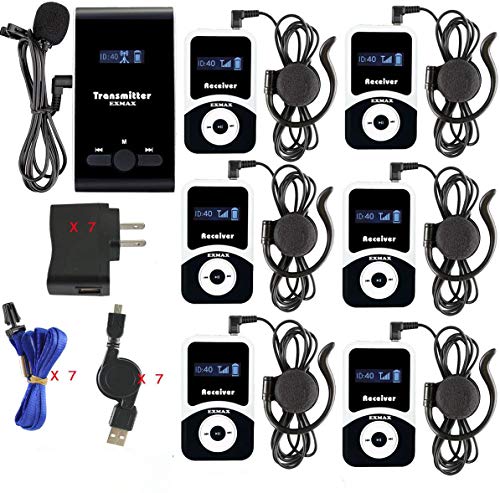
EXMAX ATG-100T Tour Guide System (195MHz) — The small-room starter kit
The ATG-100T operates at the opposite end of the scale: one transmitter, six receivers, and a 195MHz carrier instead of 2.4G. Read honestly, this is interpretation for a table — a board meeting with one director joining through an interpreter, a small congregation where a handful of members need translation, a deposition with a witness and a few observers. Six receivers is not a limitation to apologise for at that scale; it is the reason the kit can be the inexpensive, low-administration answer, with almost nothing to lose, misplace, or recharge.
The 195MHz band is the interesting technical decision. The 2.4G band is crowded with Wi-Fi, Bluetooth, and every other small radio in a modern building; a 195MHz system works in quieter spectrum, where signals also bend around obstacles and bodies differently. For a single room with a modest headcount, that can mean a link that simply stays up. The listing names church translation and teaching among its uses, which fits: those are fixed rooms, known distances, and a congregation or class that returns every week, where a simple one-transmitter routine — hand out six receivers, collect six receivers — is a virtue rather than a compromise.
- Band: 195MHz wireless
- Transmitters / receivers: 1 TX, 6 RX
- Stated roles: church translation, interpretation, teaching, conferences, trips
- Charge case: the listing title does not mention a slotted charging case for this bundle
- Receiver weight: not published in the listing title — consult EXMAX documentation if all-day wear is planned
Strengths
- Six receivers match small-room interpretation exactly, with almost no inventory to manage.
- 195MHz operation sidesteps the congestion of the 2.4G band in Wi-Fi-saturated buildings.
- One transmitter means one interpreter position to staff, brief, and seat — the simplest possible workflow.
Trade-offs
- No rotation is possible on a single transmitter unless the interpreters hand the unit over mid-session.
- A seventh listener has no receiver; headcount growth means replacing the kit, not extending it.
- Only one language can be served, full stop — a second language needs a second complete system.
Best for: a small congregation, boardroom, or classroom where one interpreter serves a known group of six or fewer listeners in one fixed room.
Not suited for: any event where attendance might swell past six interpreted listeners, because the bundle’s receiver count is a hard ceiling rather than a starting point.

Retekess T130 Tour Guide System (2 TX, 30 RX) — The dual-mic mid-size kit
The Retekess T130 bundle pairs two transmitters with thirty receivers and fifty earpieces, and its listing adds a detail the EXMAX kit does not spell out: two wireless microphones. In interpretation work that detail is practical rather than decorative. Interpreter positions are often a booth, a corner table, or the back row of a hall — places where a transmitter worn or held with a proper microphone gives the interpreter a consistent voice level, instead of a voice that fades whenever they turn toward their notes or their partner.
Fifty earpieces against thirty receivers is the other quietly sensible number here. Earpieces are the consumable of audience systems: they are the part that touches every listener, the part that should be swapped or sanitised between users, and the part that disappears into pockets. Shipping twenty spare earpieces with the kit acknowledges that reality. The 32-slot charge case completes the picture — the same closed-loop storage as the EXD-6824, sized to the bundle. Retekess markets the T130 at plant tours and large groups as well as interpretation, and that dual identity is honest: mechanically, a two-transmitter audience system does not care whether the voice it carries is a guide’s narration or an interpreter’s rendering, which is why this kit suits venues that genuinely do both across a week.
- Transmitters / receivers: 2 TX, 30 RX
- Earpieces included: 50
- Microphones: 2 wireless mics for the transmitter positions
- Charging: 32-slot charge case included
- Band: the listing title does not state the frequency band for this bundle — check the Retekess specification before mixing it with other systems
Strengths
- Two wireless microphones give interpreter positions a steadier voice level than a transmitter’s built-in pickup alone.
- Twenty spare earpieces beyond the receiver count cover hygiene swaps and the inevitable pocket losses.
- The 32-slot case matches the 2 TX + 30 RX bundle, keeping the return-and-charge loop closed.
Trade-offs
- Like the EXD-6824, thirty receivers set the audience ceiling, and two transmitters set the staffing ceiling.
- The listing does not headline a channel ID figure, so venues running several systems should confirm channel separation with Retekess.
- Fifty earpieces still run out across a long season; budget for replacements as a consumable, not an accessory.
Best for: a venue splitting its week between guided groups and interpreted sessions, with up to thirty listeners and two staffed voice positions.
Not suited for: a conference that must publish a guaranteed channel plan for multiple simultaneous languages, since the listing title leaves channel capacity unstated.

Retekess T130S Tour Guide System — The hundred-seat scale pick
Scale changes the problem, and the T130S is the bundle here built for scale: four transmitters, one hundred receivers, and charging cases in both 32-slot and 64-slot sizes listed together. A hundred receivers is a plenary audience, not a breakout room. Four transmitters support the staffing patterns real interpretation requires — two languages with paired interpreters rotating, or one language with rotation plus a roving transmitter for questions from the floor. The listing also states a 20-hour standby time, a figure that matters less for a two-hour service than for a three-day conference where receivers are issued in the morning and expected to survive until the closing session without a midday charge.
The twin case sizes tell their own logistical story. A 64-slot case and a 32-slot case together give ninety-six slots against one hundred receivers — close enough that the organiser should decide in advance where the overflow four live and charge, rather than discovering the mismatch during setup. That is the kind of unglamorous detail this guide exists to surface: at a hundred units, interpretation stops being about audio quality and becomes about inventory discipline, and the T130S’s listing at least gives you the numbers to plan that discipline with. Retekess names classrooms, churches, and large factory tours among its uses, and the bundle serves all three for the same reason — many listeners, several voice positions, and a charging system designed as furniture rather than an afterthought.
- Transmitters / receivers: 4 TX, 100 RX
- Standby time: 20H as stated in the listing
- Charging: 32-slot and 64-slot charging cases listed
- Stated roles: classroom, church, large factory tour, interpretation
- Working range: described as long range in the listing, without a distance figure in the title — walk-test large halls before relying on it
Strengths
- One hundred receivers cover a plenary audience without renting a second system.
- Four transmitters allow genuine interpreter rotation on two languages at once.
- A published 20-hour standby figure helps plan multi-day events where midday charging is impossible.
Trade-offs
- Case slots total ninety-six against one hundred receivers — four units need an agreed charging home.
- A hundred receivers demand issue-and-return staffing; the kit solves charging, not crowd management.
- The bundle is oversized for a single-language small room, where its cases and inventory become pure overhead.
Best for: a conference, large church, or training centre interpreting for up to a hundred listeners across one or two languages with proper interpreter rotation.
Not suited for: a two-room venue hoping to split the bundle across simultaneous separate events, because the four transmitters and shared cases are one system, not two independent ones.

Retekess TT106S Translation System (4 TX, 60 RX) — The featherweight receiver kit
The TT106S bundle is the one listing here that publishes a receiver weight — 18 grams — and for interpretation that number is not trivia. A delegate wearing a receiver from the opening keynote to the closing panel is wearing it for eight hours; a receiver light enough to forget is a receiver that stays in ears instead of migrating to pockets and table tops, where its audio is wasted. The ear-hook wearing style supports the same goal, sitting on the ear without a headband to fight with hairstyles, glasses, or the lanyards every conference already imposes.
Around that receiver, the bundle is serious: four transmitters, sixty receivers, a 9999 channel system on 2.4G, a stated 200-metre range, and a 64-slot charge case. Sixty receivers against sixty-four slots is the right direction of mismatch — every receiver has a home, with four slots to spare. The 200M figure is the only explicit range number among the four-transmitter kits here, and it suits the walking-tour and factory-visit work Retekess also names: interpretation at a trade fair or a plant, where the group moves and the interpreter moves with it, is exactly where an ear-hook receiver and a long link earn their keep. Note that this 4 TX / 60 RX bundle is its own kit; the TT106S family also appears in smaller bundles elsewhere, and those are different purchases with different arithmetic.
- Band: 2.4G wireless, ear-hook receivers
- Transmitters / receivers: 4 TX, 60 RX
- Receiver weight: 18g per the listing
- Range: 200M as stated in the listing
- Channel capacity: 9999 channels; charging via 64-slot charge case
Strengths
- 18g ear-hook receivers are built for all-day delegate wear, the wearing scenario interpretation actually involves.
- Sixty-four case slots cover all sixty receivers with spares space — the audit loop closes cleanly.
- A stated 200M range supports moving groups, not just seated rooms.
Trade-offs
- Sixty receivers sit between the thirty-seat kits and the hundred-seat T130S; a growing plenary can outgrow it.
- Ear-hook fit is personal — a minority of wearers dislike on-ear hooks over a full day, and there is no headband alternative in the bundle.
- The 2.4G band is shared with venue Wi-Fi; the 9999 channel space mitigates, but a pre-event channel check is still wise.
Best for: conferences and interpreted walking tours where up to sixty listeners wear a receiver for hours and the group may move between spaces.
Not suited for: a seated plenary that already knows it needs more than sixty interpreted seats, since the bundle’s receiver count — not its range — is the binding limit.

AGJ 8510T Tour Guide System (1 TX) — The keep-it-simple single channel
The AGJ 8510T makes a different promise from the Retekess flagships: easy operation, long range, long battery life, one transmitter. Its listing names churches and courts, two settings where the person running the system is often not a technician at all — a volunteer, a clerk, a coordinator with eleven other jobs that morning. For a single interpreted language in a single room, operational simplicity is a real feature: fewer transmitters to assign, fewer channels to mis-set, fewer ways for the morning to go wrong before the session starts.
Honesty about this listing matters, because its title withholds numbers the other five publish. It does not state a receiver count, a channel figure, a range distance, or a battery duration in hours — “long range” and “long battery life” are claims without figures attached. That does not disqualify the kit; it defines the buyer’s homework. If your need is one interpreter, one room, and a modest known audience, the AGJ’s simplicity may be worth more than a spec sheet. But the receiver count is the single most important number in this entire category, and you should obtain it from AGJ’s documentation and confirm the bundle contents before this kit is assigned to any event with a fixed headcount.
- Transmitters: 1 TX with wireless microphone and headsets per the listing
- Stated qualities: easy operation, long range, long battery life (no figures in the title)
- Stated roles: church and court interpretation and translation
- Receiver count: not given in the listing title — obtain the bundle contents from AGJ documentation before planning headcount
- Charge case: not mentioned in the listing title
Strengths
- Single-transmitter operation is the easiest workflow in this roundup for non-technical staff to run correctly.
- Church and court use is named directly, matching small fixed-room interpretation rather than touring.
- Long battery life is at least a stated design aim, relevant to all-day court schedules.
Trade-offs
- The listing title omits the receiver count, so capacity planning cannot start from the listing alone.
- One transmitter means one language and no interpreter rotation without a handover.
- Unquantified range and battery claims cannot be checked against a venue’s dimensions from the listing.
Best for: a court or congregation running one language in one room, operated by staff who value a one-transmitter routine over published specifications.
Not suited for: an organiser who must guarantee a specific interpreted headcount in advance, because the listing itself does not state how many receivers the bundle contains.
How Does the Interpreter’s Position Shape the Whole System?
Buyers tend to shop from the audience backwards — receivers first, transmitters as an afterthought — but the interpreter’s position is where the system’s quality is actually decided. The interpreter needs to hear the floor speaker cleanly, at a level they control, without the room’s echo and shuffling; they need a microphone that stays at a constant distance from their mouth while they read notes, glance at a colleague, and turn pages; and they need to hand over to their partner without an audible scramble. Every kit in this roundup feeds the interpreter’s voice out to the audience, but the listings differ in how deliberately they equip that position: the Retekess T130 names two wireless microphones outright, while the others describe transmitters with headsets or microphones in less detail.
Placement matters as much as equipment. An interpreter seated at the back of the hall hears the speaker late and through the room’s noise; an interpreter near the front with a feed from the speaker’s microphone hears the words as the audience’s front rows do. None of the six listings describes a booth or a console feed — these are portable systems, and their honest working pattern is an interpreter positioned where they can hear the floor directly, speaking into the transmitter that their assigned channel carries. If your venue already has a PA system, ask whether the interpreter can listen to its output on a spare receiver tuned to a floor channel while transmitting on the language channel; several of these systems make that trick possible simply because transmitters and receivers are separate units, and it is the cheapest audio upgrade an interpreted event can get.
Rotation discipline belongs in this section too, because it is an equipment decision disguised as a staffing one. When interpreters rotate, the incoming interpreter should already be listening to the floor before taking the microphone, so the handover lands on a sentence boundary rather than in a silence. That requires the rotation pair to share a channel and to pass one transmitter between them — or, more smoothly, requires enough transmitters that the incoming interpreter is already equipped. This is the practical reason the four-transmitter bundles exist, and why a buyer planning paired interpretation on a single transmitter should rehearse the handover until it is boring.
What Do Frequency Band and Channel Planning Mean in a Real Building?
A conference venue is an RF crowd even when the room looks empty. Wi-Fi access points, Bluetooth devices in every pocket, wireless microphones on the stage, hearing loops, and the tour group in the corridor all occupy spectrum, and your interpretation system has to hold its channels inside that crowd for hours. The two bands represented here behave differently in that environment. The 195MHz ATG-100T works in comparatively quiet spectrum, where fewer consumer devices compete, and where a single fixed room is a controlled problem. The 2.4G systems — the EXD-6824 and the TT106S — work in the busiest band in the building, and compensate with enormous channel or ID spaces: 9999 identifiers is how a 2.4G system guarantees that your French channel is yours alone even when three other systems are running down the hall.
Channel planning, in practice, is a fifteen-minute job done the day before. List every wireless system the event will run — yours, the venue’s, the AV contractor’s — assign each a channel or ID well away from its neighbours, write the assignments on the setup sheet, and tape a copy inside the charge-case lid. Then test under load: a link that works in an empty room at 8 a.m. can fray at 10 a.m. when three hundred phones arrive, so the honest test is a receiver walked to the worst seat during a break in a full room. The kits with published channel capacity give you room to manoeuvre when a conflict appears; the kits whose listings stay silent on channels deserve a question to the manufacturer before they are booked into a multi-system venue.
Range figures need the same realism. The TT106S’s stated 200M is a working claim worth having, but every range in this category shrinks through bodies, glass, and masonry, and interpretation rarely needs raw distance anyway — it needs unbroken coverage of a defined seating area. Buy for the seats, test at the seats, and treat any range number as headroom rather than as a promise about your particular hall.
How Should Earpieces and Hygiene Be Handled Across a Season?
The receiver gets the attention, but the earpiece does the intimate work, and it is the component your audience will judge the system by. An earpiece that hurts after twenty minutes makes a delegate take the receiver off, and a delegate who takes the receiver off has, for practical purposes, left the interpreted event. The T130’s bundle of fifty earpieces for thirty receivers is the only listing here that confronts this directly, and it points at the right policy: treat earpieces as semi-consumables. Between events they should be wiped down or swapped for fresh tips where the design allows, inspected for wax and damage, and replaced on a schedule rather than on failure. Budget a small recurring line for them, the way you would for batteries or printed programmes.
Wearing style interacts with hygiene and comfort together. Ear-hook receivers like the TT106S’s sit on the ear without entering it deeply, which many delegates tolerate for hours and which simplifies cleaning between users. Earpieces worn in the ear can seal better in a noisy hall — valuable when the interpretation competes with a loud floor language — but they are the more personal component and the one to manage most carefully in a shared fleet. Either way, the setup routine should include a listening check of a sample of receivers from the case, not just a power check: a receiver that lights up but delivers a distorted earpiece passes a glance test and fails the only test that matters, which is a delegate hearing a clean voice at 9 a.m. on the first morning.
Storage closes the loop. Receivers returned to a slotted case are protected, charged, and counted in one motion; receivers returned to a tote bag are none of those things. If you buy a kit without a slotted case, replicate the discipline with a labelled tray and a written count, and assign the count to the same person who issues the receivers. Fleets do not usually die in dramatic failures; they erode, two receivers a month, until the day the headcount exceeds the fleet. The case, or an honest substitute for it, is what stops the erosion.
What Should a Pre-Event Test Actually Include?
Test the event you are about to run, not an easier one. Charge the full fleet the night before and confirm every slot reports as it should. In the room, place the transmitters where the interpreters will actually sit — not where testing is convenient — and walk a receiver through every seating block, including the seats behind pillars, under balconies, and beside the glass wall that the architect loved. Listen on each language channel in turn, with a colleague speaking at the level the floor speaker will use, and note any seat where the voice thins, crackles, or drops; those seats get flagged for the seating plan or fixed by moving a transmitter before doors open, not explained afterwards.
Then rehearse the human system. Run a five-minute mock session: floor speaker talks, interpreters interpret, rotation happens once, a delegate asks a question. Confirm the interpreters can hear the floor clearly at their position, confirm the handover is inaudible to the audience, and confirm the collection routine — who stands at which door, where the bin is, what the chair says from the stage. Most interpretation failures at real events are not radio failures at all; they are a flat transmitter nobody charged, a channel nobody set, a receiver bin nobody manned. A twenty-minute rehearsal is what converts a box of equipment into an interpreted event, and it is cheaper than any upgrade you could buy instead.
Which Interpretation Kit Fits Your Room? A Side-by-Side Look
| Kit | Transmitters | Receivers | Band / channels | Charging |
|---|---|---|---|---|
| EXMAX EXD-6824 | 2 | 30 | 2.4G, 9999 channel ID | 32-slot case |
| EXMAX ATG-100T | 1 | 6 | 195MHz | Not stated in listing title |
| Retekess T130 | 2 | 30 | Band not stated in title; 2 wireless mics | 32-slot case |
| Retekess T130S | 4 | 100 | 20H standby stated | 32-slot + 64-slot cases |
| Retekess TT106S | 4 | 60 | 2.4G, 9999 channels, 200M | 64-slot case |
| AGJ 8510T | 1 | Not stated in listing title | Figures not published in title | Not stated in listing title |
How Do You Run an Interpreted Session Without Losing Receivers?
Assign the receivers to a person, not to the room. One named volunteer or technician should own the case from the moment it opens: receivers go out against a simple count or a sign-out sheet at the door, and the same person collects them at the same door as delegates leave. The slotted charge case makes this workable — an empty slot at collection time names the problem while the delegate is still in the building, not after the taxi has left. Build the collection into the event itself: a slide on the screen, a line from the chair, and a receiver bin positioned where people must pass it.
Brief the delegates, too — thirty seconds from the chair saves a hundred whispered questions. Tell the room which channel carries which language, where receivers are returned, and what to do if a receiver misbehaves mid-session: raise a hand, and an usher swaps the unit rather than the delegate troubleshooting in the dark. Print the channel numbers on the programme in the languages themselves, so a delegate who cannot follow the chair’s announcement can still find their channel by matching words. Interpretation is an act of hospitality as much as of technology; the delegate who feels looked after forgives the occasional crackle, while the delegate left to guess remembers the event as the one where they could not understand anything.
Set the channels before the audience arrives, and label everything. Receivers should be switched to the correct language channel during setup, tested from the furthest seat, and marked — a small coloured dot per language saves a hundred confused delegates from scrolling through channels they cannot identify. Brief the interpreters on the rotation rhythm and on microphone discipline: a consistent distance from the mic keeps their level steady for every listener at once. Finally, walk the room with a receiver during the break before doors open, listening at the seats furthest from the transmitters and behind pillars or glass, because those are the seats where a marginal link announces itself — and where your most important guest will inevitably be sitting.
What Can These Portable Systems Not Do?
Setting expectations honestly protects both the buyer and the event. These six kits are one-way systems: the audience listens, and only the transmitter positions speak. A delegate who wants to ask a question in their own language cannot do it through their receiver — questions need a roving microphone, a floor mic passed by an usher, or a transmitter handed over deliberately, and the event’s chair should explain that arrangement at the start so nobody feels silenced by the technology. If your format is a discussion rather than a presentation — a workshop where interpreted participants must talk back constantly — plan for more transmitters and a chair who manages turns, or accept that a portable audience system is the wrong tool and a conference microphone system is the right one.
They are also not recording or broadcast chains. None of the six listings describes an output for a mixing desk, a streaming feed, or an archive recording of the interpreted channels. Venues that must stream or record interpretation should treat that as a separate requirement, discussed with the manufacturer or an AV contractor, rather than assuming a receiver held against a microphone will do — it will not, at any quality worth archiving. Similarly, none of these listings promises hearing-assistance compliance or induction-loop integration; a venue with accessibility obligations should verify how interpreted audio and assistive listening coexist before the event, not during it.
Finally, they do not supply the interpreters. That sounds obvious, yet the most common disappointment in this category is a well-chosen kit undermined by a single untrained bilingual volunteer asked to interpret for three hours straight. The equipment decisions in this guide — transmitter counts for rotation, microphones for consistent voice level, channels per language — only pay off when the humans are staffed to the same standard. Buy the kit that matches the team you can actually field, and field the team the kit assumes.
What Mistakes Do First-Time Interpretation Buyers Make?
The commonest error is buying for the room’s capacity instead of the interpreted headcount, which inflates cost in one direction — or, worse, the reverse: counting total attendance, assuming a fraction will need interpretation, and discovering at the door that the fraction was optimistic. A second mistake is treating transmitter count as a spare-parts question rather than a staffing one; interpreters fatigue, quality falls off a cliff when a tired interpreter pushes through, and a kit that cannot support rotation quietly degrades the very service it was bought to provide. A third is ignoring the charge case until the first event ends in a tangle of loose receivers and flat batteries the following morning.
Buyers also conflate model families with kits. As noted at the top of this guide, the same receiver family sold with different transmitter and receiver counts is a different working system; ordering “the TT106S” without fixing the bundle is how a venue ends up with fifteen receivers for a sixty-seat session. And a subtler mistake: assuming interpretation and tour guiding need different hardware, then buying twice. Several kits here serve both, so a venue that runs weekday tours and Sunday interpretation may need one well-chosen system and a clear booking diary, not two systems gathering dust in alternation.
Final Recommendation
For most interpreted events — one or two languages, a room of up to thirty listeners, staff who need the setup to be routine — the EXMAX EXD-6824 is the balanced buy: its bundle, its case, and its channel capacity were plainly designed as one system. Step up to the Retekess T130S when the audience is genuinely plenary-sized, and to the TT106S bundle when listeners wear receivers all day or the group moves. Keep the ATG-100T in mind for the six-person table it was made for, and the AGJ 8510T where a single language and a non-technical operator matter more than published figures. A congregation that starts with the right-sized kit, labels its channels, and guards its receivers at the door will still be running the same system, complete, years from now.
Frequently Asked Questions
How many transmitters does one language actually need?
One transmitter can carry one language, but professional interpreters rotate in pairs because sustained simultaneous work degrades quickly. A two-transmitter kit therefore serves either one language with proper rotation or two languages with one interpreter each; a four-transmitter kit covers two languages with rotation. Match the transmitter count to your staffing plan, not just your language list.
Can these kits also work as ordinary tour guide systems?
Yes — the mechanics are identical, one or more voices transmitted to many receivers, and several listings name tour guiding alongside interpretation. The difference is in how you deploy them: tours use one channel and one voice, while interpretation assigns channels per language and staffs each channel with interpreters who rotate.
What does a 9999 channel ID actually give you?
It gives separation. A large channel or ID space lets your system operate distinctly from other wireless systems in the same building — another organisation’s tour group, a neighbouring conference — without your audience hearing their audio or yours leaking into their receivers. It does not mean you can run thousands of languages; practical language count is set by transmitters and interpreters.
Why do the charge cases matter so much in this category?
Because receivers are small, numerous, and issued to strangers. A slotted case charges the fleet, stores it as one object, and turns losses into visible empty slots at collection time. Kits without a slotted case can still work well, but the organiser must replace that discipline with a manual count and a separate charging routine.
Is 2.4G or 195MHz better for interpretation?
Neither is universally better. The 195MHz EXMAX ATG-100T works in less congested spectrum and suits a fixed small room. The 2.4G systems here offer the large channel spaces and the bigger bundles, and suit conferences and moving groups. Your building, your other wireless equipment, and your event size should decide — ideally after a walk-test in the actual room.
How long do receivers need to last on a conference day?
Plan around the full day, not the longest single session. A delegate issued a receiver at registration may wear it through keynotes, breakouts, and a closing panel — eight hours of intermittent use with no natural charging moment. Only one listing here publishes a time figure, the T130S’s 20-hour standby, and standby is not the same as hours of continuous listening, so treat published times as planning headroom. The practical defences are procedural: charge the fleet fully the night before, swap in a fresh receiver at lunch for anyone reporting a low battery, and keep a handful of charged spares at the help desk.
What should I verify before ordering the AGJ 8510T?
The receiver count above all, since its listing title does not state one, followed by the bundle contents, the charging arrangements, and figures for the range and battery life it describes in words. For a fixed-headcount event, those numbers are the purchase; obtain them from AGJ’s documentation first.


