What's inside
- Where Do Sim Racers Buy a Headset That Lasts a Stint?
- Key Takeaways
- Quick Picks
- How Did We Choose Headsets for the Sim Rig?
- Why Is Racing Audio a Different Discipline From Shooter Audio?
- How Do You Set Up a Headset for League Night?
- Which Six Headsets Belong at a Sim Rig?
- How Does a Headset Fit Around Glasses, Caps, and Long Stints?
- What Should a League Racer Listen for in a Test Stint?
- How Do You Care for a Rig Headset So It Survives Seasons?
- The Racing Six Compared, Feature by Feature
- Does the Room Around the Rig Change What You Should Buy?
- What Mistakes Do Sim Racers Make With Headsets?
- Final Recommendation
- Frequently Asked Questions
- Related Guides
As an Amazon Associate I earn from qualifying purchases. This post may contain affiliate links at no extra cost to you.
**[widgetverdict.com] is reader-supported. When you buy through links on our site, we may earn an affiliate commission.**
Where Do Sim Racers Buy a Headset That Lasts a Stint?
Amazon stocks every headset featured in this guide, and a quick clarification before anything else: this guide is about home sim racing — a wheel, a screen, and a league that meets online — not about pit-lane communications at a real circuit. The best gaming headsets for racing are therefore judged on stint-length comfort, voice chat clarity for league nights, and compatibility with the PC or console your rig runs. If your working day runs on the same voice as your racing, Best Jabra Headsets for Work and Calls covers the office-first side of that life.
Racing asks different things of a headset than any other genre in this series. Sessions are measured in hours rather than rounds, the soundscape is a continuous mechanical roar rather than a sequence of cues, and your hands are occupied — which makes mute gestures, charging discipline, and a headset that stays exactly where it was placed at lights-out into competitive features rather than conveniences.
One standard governs the judgements below: everything is assessed at race distance. A feature that matters for ten minutes and fades is marketing; a feature that is still working for you in the final stint of a league night is equipment, and this list was built to tell the two apart.
Key Takeaways
- Stint comfort is the racing brief: judge every headset over two hours, not two minutes.
- The RIG 800 PRO HX pairs a 60-hour battery claim with a base station for permanent Xbox rigs.
- The R8 SPECTRE PRO HS is the PlayStation-first wireless answer, charging base included.
- The R5 Spear MAX HD serves PC purists with graphene drivers, a USB-C DAC, and a wire.
- All three EKSA models are budget USB picks whose 7.1 is software processing — useful, and labelled honestly.
- Voice chat is league infrastructure: detachable and noise-canceling mics recur here for a reason.
Quick Picks
| Headset | Badge | Case in one line |
|---|---|---|
| RIG 800 PRO HX | Endurance Flagship for Xbox Rigs | A 60-hour battery claim, Dolby Atmos, and a charging base station built for a permanent sim rig. |
| RIG R5 Spear MAX HD | Wired PC Precision Pick | 40mm GrapheneQ drivers and a USB-C DAC on a wired frame for PC racers who want signal purity. |
| RIG R8 SPECTRE PRO HS | Wireless for PlayStation Rigs | Graphene drivers, 3D audio, and a charging base on the PlayStation-facing side of the RIG range. |
| EKSA E900 Pro USB Gaming Headset | Budget USB With Detachable Mic | A detachable noise cancelling mic and 50mm driver bring the racing brief to a budget USB headset. |
| EKSA E1000 USB PC Gaming Headset | RGB Desk-and-Rig Pick | USB convenience, noise cancelling mic, and RGB lighting for racers whose rig is also their desk. |
| EKSA USB Gaming Headset | Simplest EKSA for PC Rigs | The range’s straightforward USB model with a detachable mic and 50mm driver for no-fuss PC racing. |
How Did We Choose Headsets for the Sim Rig?
The first screen was endurance evidence: battery claims measured in tens of hours, charging bases that make readiness automatic, memory foam where titles named it, and designs whose whole philosophy assumes a permanent installation. Racing sessions expose weak comfort faster than any other genre, because there is no lobby, no round break, and no natural moment to reseat a headset that has started to ache — the stint simply continues, and so does the ache, into your braking points.
The second screen was voice. League racing is a social discipline run through microphones: race control, incident apologies, coaching, and the ordinary fellowship of a season. Every pick here carries a microphone story in its title — flip-mute, detachable, noise-canceling — because a racing headset without a voice plan is a pair of headphones with ambitions. The third screen was platform truth: Xbox licensing, PlayStation-first design, and PC-first USB are all stated in the titles, and this guide sorted by them rather than pretending one headset serves every rig equally. Fit questions that cut across platforms are handled in Best Gaming Headsets for Large Heads and its companion for smaller heads.
Finally, the budget tier was given its full share of the list — three of six picks — because that is where most league racers actually shop, and because the pool for this article made the same judgement. The EKSA models are differentiated from each other as carefully as the RIG flagships are, and their shared limitation, processed surround, is stated in every section it touches rather than once in a footnote.
Why Is Racing Audio a Different Discipline From Shooter Audio?
A shooter’s soundscape is sparse and event-driven: silence, then a cue that matters. A racing soundscape is dense and continuous: your own engine as a permanent foreground, wind, tyres, rivals, and a spotter, all at once, for an hour. The headset’s job inverts accordingly. In a shooter it must reveal quiet things; in a race it must keep loud things separated, so that the one element that changes — the rival alongside, the tyre giving up — remains distinguishable inside a roar that never pauses to let you listen.
That density is why spatial processing and driver control matter here in their own right, and why fatigue is the hidden metric. A presentation that blends the roar into a single mass forces your brain to do the separation work, and brains tire across a stint in a way that shows up as missed cues in the final laps — exactly when endurance races are decided. A headset that keeps the elements placed and distinct is not a luxury in this genre; it is a concentration device, and it should be evaluated over race distance rather than over a demo lap.
Your own engine note is also an instrument, not a soundtrack. Experienced sim racers drive partly by ear — shift points, wheelspin, the kerb’s report — and a headset that reproduces the mechanical palette faithfully is feeding the driving itself. This is the honest core of the graphene and big-driver claims in this list: not spectacle, but the legibility of a machine you are operating at its limit, for hours, with your hands full.
How Do You Set Up a Headset for League Night?
Charge or connect before the rig is even switched on, and make that order a ritual: headset readiness is part of the pre-race checklist alongside tyre pressures and fuel. Wireless owners should let the base station own this ritual — a headset that lives on its charger has no battery question to answer. Wired owners should route the cable once, properly, so that full wheel rotation in either direction never pulls it, and then never think about it again; a cable arranged mid-race is a cable arranged badly.
Set your voice before you set your audio. Record a test message in your league’s voice channel, listen to yourself at the volume your rivals will hear, and adjust gain so that a normal speaking voice — the one you will have at lap forty, tired — arrives clearly without clipping at lap one. Practise the mute gesture until it is free: flip, button, or detach, it should cost no attention, because the moment you need it will be a moment your attention is already fully spent on the car beside you.
Then run one full stint in practice before judging anything. Racing comfort and racing audio both reveal themselves at distance, and a headset that charms over ten minutes may argue with you at ninety. Keep the packaging until that stint is done. Drivers who test at race distance buy once; drivers who test at demo distance buy twice, and the second purchase is always the one they should have made first.
Which Six Headsets Belong at a Sim Rig?

RIG 800 PRO HX — Endurance Flagship for Xbox Rigs
A sim rig is a permanent installation, and the RIG 800 PRO HX is the headset in this list designed like one. Its multi-function base station gives the headset a fixed home beside the wheel, the title claims a 60-hour battery, and Dolby Atmos handles the spatial side of engine notes, rival cars, and spotter calls. For an Xbox-centred rig, the official licensing in the title closes the compatibility question before it opens: this headset was built for the console your rig is probably running.
The battery figure deserves translation into racing terms. Sixty hours is not a specification, it is a calendar: weeks of evening practice sessions, a full league season’s qualifying nights, endurance events that run longer than most players’ weekends. A headset that needs charging monthly behaves like part of the rig; a headset that needs charging nightly behaves like a guest. The base station completes that permanence by making the charged state the stored state, so the headset you grab at lights-out is always the ready one.
Dolby Atmos in a racing context earns its place differently from shooters. The information that matters is positional in a mechanical way: a rival’s engine note moving from your left mirror to your right, the spotter’s voice cutting through your own engine, the subtle audio of tyres at the limit. Atmos processing is there to keep those elements separated and placed rather than blended into a wall of noise, and across a two-hour stint that separation is a fatigue issue as much as an information one — blended audio makes brains work harder.
The flip-mute microphone suits league racing’s social rhythm. Stints are long, households are near, and a driver needs a mute that is physical and certain when a door opens mid-race. Flipping the boom is a gesture you can perform without looking, without a menu, and without taking a hand off the wheel for longer than a gear change. In a discipline where a stray open mic can ruin thirty drivers’ concentration, that certainty is sportsmanship as much as convenience.
Judge the 800 PRO HX as rig equipment and its price class makes sense; judge it as a portable headset and it will seem excessive, because the base station philosophy only pays out where a rig lives permanently. Xbox and PC racers with a dedicated corner should put it at the top of their list. Racers who fold their wheel stand into a cupboard after every session should read the R5 and R8 sections first, because their headset needs to travel the same journey the stand does.
One ownership note: a base station rewards a tidy cable run. Give the station its permanent place during your rig’s next rebuild rather than balancing it on the PC case, and the whole system — wheel, screen, headset — becomes a single appliance you switch on, which is the quiet luxury this model is actually selling.
- Connection: wireless, with multi-function base station
- Battery: 60 hour (per listing title)
- Audio: Dolby Atmos 3D Audio (per listing title)
- Microphone: flip-mute
- Licensing: officially licensed for Xbox Series X|S, Xbox One, PC
Strengths
- 60-hour battery claim turns charging into a monthly event
- Base station makes the stored state the charged state
- Official Xbox licensing settles console compatibility outright
Trade-offs
- Base station philosophy suits permanent rigs, not foldaway setups
- Xbox-centred design gives PlayStation racers nothing
- Flagship tier buys permanence that casual racers may not need
Best for: Xbox and PC league racers with a permanent rig and long weekly stints.
Not suited for: PlayStation racers, and anyone whose wheel stand folds away after each session.
If your rig has a postcode, the RIG 800 PRO HX listing describes its headset.
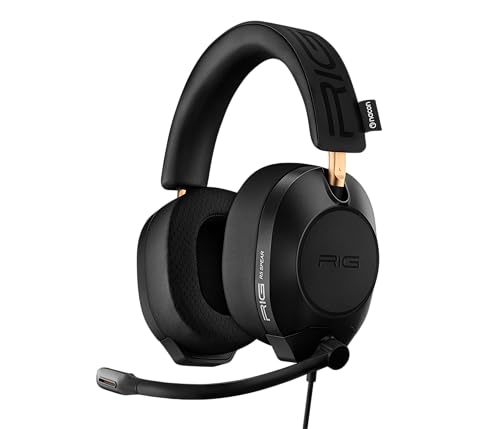
RIG R5 Spear MAX HD — Wired PC Precision Pick
The R5 Spear MAX HD is the PC purist’s entry in this list: a wired headset whose title leads with its driver material and its DAC rather than with wireless convenience. The 40mm GrapheneQ drivers bring the graphene story — stiffness, speed, precision — to a racing brief, where the sounds worth hearing precisely are mechanical: the edge of tyre grip, a rival’s throttle application, the kerb strike that tells you the car is placed. A USB-C audio DAC in the chain keeps the conversion deliberate rather than whatever the motherboard felt like providing.
Dolby Atmos appears here in wired form, which will matter to racers who distrust wireless on principle. Their argument is not really about measurable delay; it is about eliminating variables during competition. A wired headset cannot drop a pairing, cannot die mid-stint, and cannot be interfered with by the thirty other devices in a league household. The R5 is built for that temperament, and its dual connection — USB-C through the DAC, or plain 3.5mm — lets it serve the race PC properly and still plug into a controller or laptop when needed.
The detachable noise-canceling microphone fits the same philosophy of controlled variables. It is present and purposeful for league voice chat, absent for solo practice, and replaceable in a way sealed microphones are not. Memory foam cushions handle the endurance side, because a wired headset’s cable already asks something of the wearer; the least the cups can do is ask nothing more. Across a long stint, the R5’s comfort case rests on that foam and on the frame’s discipline rather than on any single headline.
Position it honestly against the 800 PRO HX above. The flagship buys freedom and permanence; the R5 buys purity and simplicity. A racer whose rig is PC-only, whose sessions are competitive, and whose temperament runs to checking tyre pressures three times will recognise themselves in the R5’s priorities. A racer who values walking to the kitchen between stints without removing their headset will not, and should not pretend otherwise for the sake of a driver material.
The graphene headline also invites a fair question this guide will answer straight: driver material is a means, not a result. What reaches the driver is a chain — DAC, tuning, the game’s own mix — and the R5’s title is reassuring precisely because it names the chain’s links rather than asking the material to carry the whole argument. That completeness is what separates a considered wired pick from a cheap one with a fashionable diaphragm.
Buy the R5 if your rig is a PC, your league is serious, and your idea of luxury is a signal path you can describe in one sentence. It is the connoisseur’s racing headset in this list, and connoisseurs know exactly why they chose it.
- Connection: wired, USB-C and 3.5mm
- Drivers: 40mm GrapheneQ (per listing title)
- Audio: USB-C audio DAC, Dolby Atmos 3D Audio (per listing title)
- Microphone: detachable, noise-canceling (per listing title)
- Cushions: memory foam
Strengths
- GrapheneQ drivers plus a named USB-C DAC complete the signal story
- Wired connection removes battery and pairing variables entirely
- Detachable noise-canceling mic suits league voice discipline
Trade-offs
- A cable at a wheel rig needs routing discipline
- No wireless freedom between stints
- Xbox and PlayStation racers are outside its PC-first brief
Best for: PC league racers who value a pure, describable signal path over wireless freedom.
Not suited for: console racers and anyone who leaves the seat mid-stint without removing their headset.
Trace your current audio path; if it embarrasses you, the R5 listing is the tidy answer.

RIG R8 SPECTRE PRO HS — Wireless for PlayStation Rigs
The R8 SPECTRE PRO HS is the PlayStation household’s answer to the 800 PRO HX’s Xbox flagship: a wireless RIG with graphene drivers, 3D audio, a noise-canceling microphone, and a charging base, aimed by its title at PlayStation first with PC, Switch, and mobile in support. That platform order matters. PlayStation racers are used to being the afterthought in headset lineups, and this model reverses the courtesy, which makes it the natural first read for a PS5 rig.
Graphene drivers in a racing headset serve the same mechanical listening as in the R5: tyre, engine, and surface cues are transient-rich sounds, and a stiff, light diaphragm reproduces their edges cleanly. The 3D audio claim pairs with that precision to place rivals around the car rather than inside your head. Across a long online race, the combination aims at the two things a driver actually needs from audio — information about the cars nearby, and a presentation that does not fatigue across an hour of engine note.
The charging base imports the flagship philosophy to this tier: the headset lives somewhere, and that somewhere keeps it ready. RIG clearly believes the base is not a luxury but the correct way to own a wireless headset, and after a season of never once finding your headset dead before a league night, most owners come around to the belief. Bluetooth alongside the wireless USB connection lets the same headset take a phone call or a handheld session without a second device, which suits the household reality around most PlayStation rigs.
Compare it with its own family before buying, because RIG has given you a genuine choice. The 800 PRO HX is Xbox-licensed with the bigger battery story; the R5 is the wired PC purist’s tool; the R8 is the PlayStation wireless all-rounder with the base included. Choosing by platform first and philosophy second will land almost every racer on the right RIG, and choosing by headline features alone is how a PlayStation driver ends up admiring an Xbox headset.
The noise-canceling microphone serves league etiquette on this side of the console divide as well. PlayStation racing communities run on voice — race control, apologies, protests — and a mic that keeps the room out of the channel is a contribution to the league, not just to yourself. Detachability is not claimed in this title, so treat the boom as a permanent resident and judge the headset as a dedicated racing instrument rather than a pair of travel headphones.
Choose the R8 if your rig runs PlayStation, your sessions are long, and your household would benefit from one wireless headset that also covers the Switch and the phone. It is the most complete PlayStation-first package in this article, and it knows it.
- Connection: wireless USB and Bluetooth
- Drivers: graphene (per listing title)
- Audio: 3D audio (per listing title)
- Microphone: noise-canceling (per listing title)
- Extras in title: charging base
- Platforms named in title: PlayStation, PC, Switch, mobile
Strengths
- PlayStation-first wireless design with PC, Switch, and mobile in support
- Graphene drivers and 3D audio serve mechanical cue listening
- Charging base keeps league-night readiness automatic
Trade-offs
- Xbox racers should choose the licensed sibling instead
- Microphone is not described as detachable in the title
- Base still asks for a permanent spot near the rig
Best for: PlayStation league racers wanting wireless freedom with a charged home base.
Not suited for: Xbox-first households, for whom the 800 PRO HX was literally licensed.
PlayStation drivers: the R8 listing was written with your console named first.

EKSA E900 Pro USB Gaming Headset — Budget USB With Detachable Mic
The E900 Pro is where the racing brief meets a budget, and its title is more thoughtful than its tier requires. A detachable noise cancelling microphone is a genuinely useful feature for a sim racer — present for league chat, removed for solo practice, replaceable if it fails — and many pricier headsets omit it. The 50mm driver matches the size class of headsets costing far more, and the USB connection gives PC racers a simple digital path without any DAC shopping.
Now the honesty this guide applies to every budget pick, stated once and clearly: the 7.1 surround in this title is software processing, not seven discrete channels, and its spatial presentation will be a processed approximation rather than the equal of the Dolby Atmos implementations above. For racing, that processing can still help separate a rival’s engine from your own, but it should be bought as assistance, not as Atmos by another name. EKSA’s microphone and build quality likewise sit at their tier — serviceable, not refined — and a buyer who knows that in advance is a buyer who will be satisfied.
What the E900 Pro gets right for racing specifically is the shape of the whole package. USB simplicity at the PC, a mic that comes off, a big driver, and a price that lets a new league racer join voice chat this month rather than after a season of saving. Racing communities run on participation, and the headset that gets a rookie onto voice comms early does more for their development than a flagship bought a year later, because spotters, coaches, and rivals teach through that microphone.
Its platform list reaches toward consoles and office use as well, which suits the racer whose PC headset doubles for work calls and the family console. Treat those as secondary theatres: the USB-first design is a PC citizen, and its happiest life is at a desk or rig with a laptop nearby. Within that life, it asks little — no charging, no pairing, no base station furniture — and gives back a complete, if modest, version of everything this article has discussed.
There is also a spare-headset argument, as there was in the footsteps guide for its budget tier. A rig with an E900 Pro in the drawer has a guest headset, a backup for the night the flagship fails, and a loaner for the friend considering league racing. Rigs accumulate these supporting roles over years, and the E900 Pro fills all of them at a cost that makes the accumulation painless.
Buy it as the working racer’s tool: complete in shape, honest in tier, and priced so that the money saved can go where racing sims always need it — the next pedal upgrade, the next league entry, the next season.
- Connection: wired USB
- Driver: 50mm
- Sound: 7.1 surround (processing, per listing title)
- Microphone: detachable, noise cancelling (per listing title)
- Platforms named in title: PC, PS4/PS5, Xbox One, laptop, office use
Strengths
- Detachable noise cancelling mic is rare thoughtfulness at this tier
- 50mm driver matches the size class of pricier racing picks
- USB simplicity suits PC rigs with no extra hardware
Trade-offs
- 7.1 surround is software processing, not discrete channels
- Microphone and build refinement match the budget honestly
- Console use is secondary to its PC-first USB design
Best for: new league racers and PC drivers wanting full voice capability on a budget.
Not suited for: drivers expecting Atmos-grade spatial processing from a processed 7.1 label.
Price your priorities: if voice participation comes first, the E900 Pro listing delivers it early.

EKSA E1000 USB PC Gaming Headset — RGB Desk-and-Rig Pick
The E1000 is the E900 Pro’s desk-dwelling sibling, and the RGB lighting in its title is the tell: this headset expects to be seen, in a setup that is part racing rig, part workspace, part backdrop. For the growing number of racers who stream their league nights or simply take pride in a lit rig corner, that presentation is a legitimate part of the purchase, and EKSA builds it around the same USB simplicity and noise cancelling microphone brief as its sibling.
The racing substance underneath the lighting is the familiar budget shape, with the same honesty attached. The 7.1 surround is processing; the microphone is a tier-appropriate tool for league chat and, as the title suggests, call-centre-style work; the connection is USB and therefore PC-first. A racer whose evenings alternate between league races and a day job’s calls, on the same machine and the same chair, will find the E1000’s dual citizenship more relevant than any refinement it lacks.
Choosing between the two EKSA models is a genuine fork rather than an upsell. The E900 Pro’s detachable microphone serves the racer who removes it often — solo practice, media use, a cleaner desk. The E1000’s fixed presentation serves the racer whose headset stays dressed for camera and calls. Neither is the better headset in the abstract; they are two answers to the question of what your headset does when you are not racing, and your honest answer to that question should make the choice in about ten seconds.
Endurance thinking applies at this tier too. Long stints punish small discomforts at every price, and a budget headset’s padding and clamp deserve the same full-session trial as a flagship’s. The E1000’s saving grace is that its simplicity leaves little to configure wrongly: plug in, set the processing if you use it, and spend your attention on the trial that matters. If it passes a two-hour stint, it has earned its place at the rig regardless of what its tier supposedly permits.
Streamers should note the social side of the microphone claim. A noise cancelling mic at this tier will not produce broadcast polish, but league streams and Discord calls ask for intelligibility, not polish, and intelligibility is achievable here. Pair it with sensible gain settings and a quiet-ish room and the E1000 carries a stream’s voice track without embarrassing it — a sentence that could not be written about the unbranded headsets below this tier at all.
Buy the E1000 if your rig is also your stage or your office, and let the E900 Pro go to the racer who wants the detachable mic instead. Sibling choices made on lifestyle rather than on spec sheets are the ones owners stay happy with.
- Connection: wired USB
- Sound: 7.1 surround (processing, per listing title)
- Microphone: noise cancelling (per listing title)
- Extras: RGB light
- Platforms named in title: PC, PS4, PS5, laptop, call center use
Strengths
- RGB presentation suits streamed rigs and lit desk setups
- USB simplicity with a noise cancelling mic for races and calls alike
- Same honest budget shape as its sibling, tuned for desk life
Trade-offs
- Surround is processing, and microphone polish is tier-appropriate
- Fixed mic design lacks the E900 Pro’s detachable flexibility
- Lighting will not suit racers who prefer an understated rig
Best for: racers who stream or work from the same desk their wheel is clamped to.
Not suited for: drivers who remove the microphone constantly for solo practice and media.
Decide by your evenings: if the rig is on camera, the E1000 listing is the dressed one.

EKSA USB Gaming Headset — Simplest EKSA for PC Rigs
This third EKSA model is the range’s plain-spoken option: a USB gaming headset with a detachable noise cancelling microphone, a 50mm driver, and processed 7.1 surround, listed for PC first with consoles, laptops, and work in support. If the E900 Pro and E1000 are siblings with personalities, this one is the family member who shows up, does the job, and declines to discuss lighting. For a racer who finds even the modest theatre of RGB a distraction, that plainness is the feature.
Its racing case is the budget case in its purest form. Voice chat for the league, a big driver for the engine notes, a mic that detaches for solo running, and a connection that asks nothing of the PC it plugs into. The processed surround should be understood exactly as it was for its siblings — assistance with separation, not a discrete-channel system — and the build should be expected to match the tier. Within those honest bounds, there is very little here to be disappointed by, because very little was overpromised.
Why does this list carry three EKSA models at all? Because the budget tier is where most racing headsets are actually bought, and pretending otherwise would make this guide a flagship catalogue with a token cheap pick. The three models divide the budget buyer honestly: detachable mic with the widest platform story, RGB desk presentation, or this plain USB workhorse. A reader at this tier deserves the same careful differentiation the flagship readers got, and the differences, while small, are real in daily use.
The work-use mention in its title deserves a nod for the same dual-citizenship reason as the E1000. A headset that races on Saturday and takes Monday’s calls without a swap is a headset that justifies its drawer space in a small home. Its microphone will serve a meeting adequately and a league race properly, and adequacy across two lives beats excellence in one life and absence in the other for many households.
Longevity at this tier is about expectations and spares. Treat the detachable mic gently, route the USB cable so the rig’s wheel rotation never traps it, and the headset will repay ordinary care with ordinary, reliable service. When it eventually tires, it will have cost little enough that its replacement is a errand rather than a decision — and by then its owner will know, from seasons of use, exactly which flagship feature is actually worth upgrading to.
Buy it if you want the racing brief with the fewest decisions attached: plug in, detach or attach the mic, race. Simplicity is a specification too, and this model is the list’s clearest proof.
- Connection: wired USB
- Driver: 50mm
- Sound: 7.1 surround (processing, per listing title)
- Microphone: detachable, noise cancelling (per listing title)
- Platforms named in title: PC, PS4/PS5, Xbox One, laptop, work use
Strengths
- Plain USB design removes every setup decision but the racing
- Detachable mic covers league chat and solo practice cleanly
- Budget tier makes it an easy spare or first league headset
Trade-offs
- Processed surround and tier-level build, as with its siblings
- No wireless or base-station conveniences at all
- Presentation is deliberately unadorned
Best for: PC racers wanting a no-fuss USB headset for league voice and long stints.
Not suited for: drivers seeking flagship spatial audio or a wireless rig life.
For the fewest decisions between you and the grid, start at this EKSA listing.
How Does a Headset Fit Around Glasses, Caps, and Long Stints?
Racing seats hold a head still in a way other genres do not, and stillness changes what comfort means. A shooter player shifts, leans, and reseats constantly, giving pressure points small holidays; a driver in a bucket seat at full lock holds one posture for an hour, and every gram and every seam reports for duty the whole time. Glasses arms under earcups are the classic example: tolerable in a lobby, a genuine ache by lap fifty. Memory foam, where the titles name it, forgives frames best, and drivers who wear glasses should run their full-stint trial with the exact frames they race in, not a spare pair with different arms.
Caps and headsets are another rig reality, whether the cap is team kit on a stream or simply habit. A band worn over a cap sits higher and tighter than the same band on hair, so drivers who race capped should set their fit capped and leave it there. Consistency is the theme of this whole section: the stint punishes variables, so eliminate them in practice — same seat position, same frames, same cap or none — and let the headset be one more constant in a discipline that rewards constants above almost everything.
What Should a League Racer Listen for in a Test Stint?
Run the test on a track you know with a full field around you, because empty-track audio flatters every headset in this list. Listen for three separations. First, your own engine against the rival alongside: can you hold both in your attention without effort? Second, the spotter against the engine at full throttle: does the voice arrive as a voice, or as another texture in the roar? Third, your tyres against the surface: the subtle layer that tells you what the car is doing before the wheel does. A headset that keeps those three separations at race distance has passed the only examination this genre sets.
Then test the social layer with equal rigour. Ask a teammate to judge your voice at your tired, end-of-stint volume rather than your fresh one, and practise one apology for contact — the sentence league racers say most — until it comes out clear at a mumble. Racing headsets are bought for the car sounds and kept for the voice, and a test stint that ignores the microphone has examined only half the purchase.
How Do You Care for a Rig Headset So It Survives Seasons?
Rig headsets live harder lives than desk headsets: they are grabbed with gloved or sweaty hands, knocked by wheel rims, and stored in the warm neighbourhood of a working PC. Wipe the cushions after long stints and let them dry before the headset goes back on its base or hook, because foam that lives damp ages in months rather than seasons. Keep the charging contacts of base-station models clean and seated fully; a headset that almost-docks every night is a battery problem disguised as a ritual. Route wired cables away from pedal travel and chair castors, the two predators that end more rig cables than any amount of audio use.
Once a season, audit the whole arrangement the way you would the rig itself: battery behaviour, mic clarity judged by a teammate, cushion condition, cable integrity at both ends. Racing people understand scheduled maintenance instinctively — they would never run a season on unexamined tyres — and the headset deserves a line on the same checklist. Equipment maintained on a schedule fails in the workshop; equipment maintained on vibes fails on lap forty of the championship round.
The Racing Six Compared, Feature by Feature
| Model | Connection | Signature | Rig home |
|---|---|---|---|
| RIG 800 PRO HX | Wireless with base station | 60-hour battery claim, Dolby Atmos | Xbox and PC |
| RIG R5 Spear MAX HD | Wired USB-C and 3.5mm | GrapheneQ drivers, USB-C DAC | PC |
| RIG R8 SPECTRE PRO HS | Wireless USB and Bluetooth | Graphene drivers, charging base | PlayStation-led |
| EKSA E900 Pro | Wired USB | Detachable mic, 50mm driver | PC-led |
| EKSA E1000 | Wired USB | RGB presentation, calls-friendly | PC desk |
| EKSA USB Gaming Headset | Wired USB | Plain workhorse, detachable mic | PC-led |
The table divides by household before it divides by hardware. RIG’s three models are one philosophy at three addresses — permanent wireless for Xbox, wired purity for PC, wireless breadth for PlayStation — while EKSA’s three are one budget at three lifestyles: detachable, presentable, plain. Decide your address and your lifestyle first, and the table collapses to a single row. Decide by driver size or lighting alone and you will own a fine headset for somebody else’s rig.
Does the Room Around the Rig Change What You Should Buy?
More than racers expect. A rig in a dedicated room can run any headset in this list at its best, because the environment adds nothing the headset must fight. A rig in a living room adds a television, a family, and a door that opens at the worst moments, and that environment promotes features that look minor on a specification sheet: the certain mute, the noise-canceling microphone, the wireless freedom to stand and stretch without undressing the whole setup. A rig in a shared bedroom adds a sleeping person’s interests to the league’s, which is an argument for closed, well-sealed cups and against any audio leaking into the room at midnight.
Read your own room into the table above before you read the prices into it. The flagship that suits a dedicated room can be the wrong flagship for a family one, and the budget model with the right mute and the right mic can out-serve it nightly. Racing rewards the driver who sets up for the conditions that exist rather than the conditions in the brochure, and the headset is part of the setup like any other.
What Mistakes Do Sim Racers Make With Headsets?
Testing comfort over ten minutes
Racing is the genre where this error costs most, because the stint gives discomfort time to become a driving input. A headset that presses at minute ten is steering your head by minute ninety. Run the full-distance trial described above, at race pace, in your actual seat, before the return window becomes a memory.
Believing every 7.1 label means the same thing
The EKSA titles’ surround is software processing; the RIG flagships carry Dolby Atmos. Both can help separate a rival’s engine note, but they are not the same technology at different prices, and buying the label rather than the mechanism is how a racer ends up disappointed in a headset that honestly described itself. This guide has flagged the distinction in every section it touches; honour it in the basket.
Letting the cable meet the wheel
A wired headset at a rig lives beside a rotating wheel, pedals, and a chair that moves. Route the cable once with full lock in both directions tested, clip it where it cannot migrate, and treat any tug you feel mid-race as a setup failure to fix that evening — not as a characteristic of wired headsets generally. The R5’s purity is only available to drivers whose cable discipline matches it.
Neglecting the mute until it matters
The first time you need a certain, instant mute will be mid-incident, with race control listening. Drivers who have not practised the gesture fumble it, and the league hears the fumble. Flip-mute and detachable designs recur in this list because the gesture matters; whichever you buy, rehearse it during practice until it costs nothing.
Do one final walk around your rig before ordering: note where the headset will live, where its cable or charger will run, and what your hands will be doing when you need the mute. The model that fits that walk — not the model with the longest title — is the one that will still be at your rig in three seasons, charged, intact, and entirely forgotten until the moment you reach for it.
Finally, tell your league what you bought and why. Racing communities accumulate equipment knowledge the way they accumulate setup sheets, and a headset verdict from a driver whose stints resemble yours is worth a dozen anonymous reviews. Your purchase, honestly reported after a season, becomes part of the next driver’s shortlist — which is how good equipment earns its reputation in this discipline.
Final Recommendation
Match the headset to the rig’s address. Xbox rigs: the RIG 800 PRO HX, whose battery and base station were designed for exactly your corner. PlayStation rigs: the R8 SPECTRE PRO HS, PlayStation-first with the base included. PC purists: the R5 Spear MAX HD and its describable signal path. PC racers on a budget: the E900 Pro for its detachable mic, the E1000 if the rig is also a stage or an office, and the plain EKSA USB model if you want the fewest decisions in the article.
At the end of a long stint, the best racing headset is the one you remove with the same reluctance as the gloves — part of the kit, forgotten in the doing, and remembered only when you imagine racing without it.
Whatever you choose, give it the courtesy of a full-distance trial before the season does. Rigs are built by iteration — a pedal angle here, a screen height there — and the headset is one more component to be dialled in with the same patience. The drivers who treat it that way stop thinking about their headset entirely, which, at 300 kilometres an hour in the company of thirty rivals, is exactly where a headset belongs: nowhere in your thoughts at all.
Frequently Asked Questions
Is this guide about real motorsport communications?
No. It covers home sim racing — wheels, screens, and online leagues — as the pool note for this article specifies. Pit-lane and in-helmet systems for real racing are professional safety equipment with entirely different requirements, and nothing here should be read as advice about them. Everything below assumes a driver seated at home, racing other people over the internet.
Do I need wireless at a sim rig?
Not necessarily, and the list is split deliberately. Wireless with a base station suits permanent rigs and drivers who move around between stints; wired suits purists and budgets, and removes battery management entirely. What you need is a considered answer for your own rig’s geography — where you sit, how far the PC or console is, whether the headset ever leaves the corner — rather than a default in either direction.
What does Dolby Atmos add to racing?
Spatial separation inside a continuous soundscape. Engine, tyres, rivals, and spotter can occupy distinct positions instead of blending into one roar, which helps both information and fatigue across a stint. The RIG flagships carry it; the EKSA models’ 7.1 is software processing with a similar aim and a more modest result, and this guide keeps that distinction visible wherever it matters.
How long should a racing headset’s battery last?
Long enough that charging leaves your weekly routine. The 800 PRO HX’s title claims 60 hours, which at typical league usage is a monthly event, and its base station makes even that automatic. Judge other wireless models by whether their rhythm fits yours, and remember that a charging base changes the question entirely: a headset that lives on its charger is always at full, whatever its rated hours.
Can a budget headset really serve a league racer?
Yes, with expectations set where this guide sets them. The EKSA models provide voice chat, big drivers, and processed surround at a tier where participation beats refinement. Leagues are social systems, and the rookie on a budget headset with a working microphone is better equipped than the rookie saving silently for a flagship. Upgrade later, when a specific limitation has named itself across a season.
Which headset suits a foldaway wheel stand?
Avoid the base-station philosophy, which assumes permanence. The wired R5 or any of the EKSA models pack away with the stand, and the R8’s Bluetooth breadth helps if the headset also lives a second life away from the rig. Match the headset’s storage story to the stand’s, because equipment that stores together gets used together.
Can I use one of these for other games too?
Certainly — nothing in these headsets is racing-locked. The RIG models are complete gaming headsets whose racing case rests on endurance, voice, and platform fit, and the EKSA models are general USB headsets with a racing-friendly shape. The specialisation in this article is about which qualities were prioritised, not about restrictions, and a headset that survives a two-hour stint will find a forty-minute shooter session entirely comfortable.
Should I match my headset brand to my wheel brand?
There is no technical reason to, and the titles here make no such partnerships. Compatibility in this list runs by platform — Xbox licensing, PlayStation-first design, PC USB — not by accessory brand. Choose the wheel for your hands and the headset for your ears and your console, and let each be excellent at its own job.
What if my head is larger or smaller than average?
Racing stints amplify fit problems, so solve size before features. The companion guides linked in this article — the large-head selection and Best Gaming Headsets for Small Heads — apply the fit-first method at both ends of the range, and several mechanisms discussed there, like suspension bands and memory foam, matter even more over two hours than they do over twenty minutes.
Related Guides
Racers whose headset doubles as their work equipment should read Best Jabra Headsets for Work and Calls next, drivers at the extremes of fit will find their dedicated treatment in Best Gaming Headsets for Large Heads, and smaller-headed drivers sharing a family rig should consult Best Gaming Headsets for Small Heads before the household buys one headset for everyone.


