What's inside
- Where Do You Buy a Headset Your Colleagues Will Thank You For?
- Key Takeaways
- Quick Picks
- How Did We Rank One Office Brand’s Range?
- MS Teams or UC: What Does the Variant on the Box Mean for You?
- How Do You Choose Between Wireless Freedom and Wired Certainty?
- Which Jabra Headsets Earn Their Places, Model by Model?
- How Do You Set Up a Work Headset So Colleagues Hear Your Best Voice?
- What Does a Week of Meetings Reveal That a First Call Cannot?
- How Should a Team or Family Standardise Without Forcing One Model on Everyone?
- How Do You Keep an Office Headset Serving for Years?
- Jabra’s Office Six at a Glance
- Does It Matter That Colleagues Judge Your Headset, Not You?
- What Mistakes Do Jabra Buyers Keep Making?
- What Is the Sensible Upgrade Path Inside This Range?
- Final Recommendation
- Frequently Asked Questions
- Related Guides
As an Amazon Associate I earn from qualifying purchases. This post may contain affiliate links at no extra cost to you.
**[widgetverdict.com] is reader-supported. When you buy through links on our site, we may earn an affiliate commission.**
Where Do You Buy a Headset Your Colleagues Will Thank You For?
All six headsets in this guide are available through Amazon, and the best jabra headsets share a single-brand discipline similar to the one explored in Best Logitech Headsets: every model here is a Jabra, organised by the working life it serves — flagship focus, hybrid travel, the all-week desk, the call specialist, the sensible starter, and the proven elder. Jabra’s range rewards readers, because its titles state configurations, certifications, and battery figures plainly, and this guide repeats only what those titles state.
A note on scope before the details: this is the office family. Nothing here chases gaming features, and the microphones, certifications, and connection choices below were all designed around meetings, calls, and concentration. If your headset must also survive a gaming rig, treat this list as the work half of a two-headset life rather than as a compromise candidate for both.
One evaluative habit runs through everything below: judge each model by a week of your real meetings, in your real room, through your colleagues’ ears. Office audio is a social technology, and the social test is the only one whose results you cannot argue with.
Key Takeaways
- Buy by working life first: fixed desk, hybrid travel, or calls all day.
- The Evolve2 85 is the over-ear flagship for concentration in noisy places, in a Teams configuration.
- The Evolve2 65 Flex folds for travel and adds Hybrid ANC with ClearVoice and Teams certification.
- The Evolve2 65 USB-C claims up to 37 hours of battery and includes its adapter.
- Wired still wins call days: the 40 SE’s three-microphone design never needs charging.
- Variants are labelled honestly — MS or UC, adapter type — so read the title as the contract.
Quick Picks
| Headset | Badge | Case in one line |
|---|---|---|
| Jabra Evolve2 85 | Flagship Focus Pick | The over-ear flagship of the Evolve2 line, in a USB-C Microsoft Teams stereo configuration. |
| Jabra Evolve2 65 Flex | Best Hybrid-Worker Pick | Hybrid ANC, ClearVoice noise-cancelling, and a folding design certified for Microsoft Teams. |
| Jabra Evolve2 65 (USB-C) | The All-Day Battery Pick | Up to 37 hours of battery in the title, a USB-C adapter included, and dual-ear comfort for calls and music. |
| Jabra Evolve2 40 SE | Best Wired for Call Quality | Three-microphone call technology on a wired USB-C/A headset that never needs charging. |
| Jabra Evolve2 30 SE | The Sensible Wired Starter | A dual-ear wired USB headset with both USB-A and USB-C cable, built for meeting-platform days. |
| Jabra Evolve 65 Wireless Headset | The Proven Previous Generation | The original Evolve 65 with its Link 370 adapter — the design that defined this category, still serving. |
How Did We Rank One Office Brand’s Range?
With brand and build philosophy held constant, the ranking questions become biographical: where do you work, what platform runs your meetings, and is your voice your instrument or merely your transport? We sorted the six by those questions rather than by price or novelty. The flagship leads because its brief — concentration plus calls in hostile noise — is the hardest to serve; the elder closes the list not from weakness but because its role, continuity, is a different virtue from leadership. Every model between them owns a working life outright.
Certifications and configurations were read literally. Where a title says certified for Microsoft Teams, the section says so; where it says works with Teams or declares UC and all platforms, the section preserves that distinction, because in procurement those phrases are not synonyms and buyers acting on them should not treat them as such. Battery figures appear only where titles print them — the Evolve2 65’s up to 37 hours — and the other models’ sections argue from design rather than borrowing numbers the listings did not offer.
The gaming reader who wandered in should know this list deliberately excludes Jabra’s other lives and every rival brand; its companion guides handle fit for gaming heads in Best Gaming Headsets for Large Heads and the matching small-head treatment, and the office brief here is unapologetically narrow. Narrowness is what makes a brand guide useful: six models, one philosophy, and differences that are all about your week rather than about marketing seasons.
MS Teams or UC: What Does the Variant on the Box Mean for You?
Jabra sells many of these headsets in two allegiances, and choosing the wrong one is the most common Jabra buying error. An MS configuration is built around Microsoft Teams: its controls, its button behaviours, and its certification assume Teams is the meeting platform of your life. A UC configuration is platform-neutral, aimed at the worker whose week crosses several softphones. Neither is better; they are answers to different calendars, and the titles in this list state each pick’s allegiance so the choice can be made with eyes open.
The practical test is a glance at last week’s calendar. If nearly every meeting wore the same platform’s icon, buy that platform’s variant and enjoy the alignment. If your week was a patchwork — a client on one system, a partner on another, an interview on a third — the UC models, notably the wired SE pair, are your natural home. Workers who guess at this choice tend to guess toward their employer’s platform and forget their clients’; the calendar, not the org chart, is the honest witness.
How Do You Choose Between Wireless Freedom and Wired Certainty?
The wireless models in this list sell movement and tidiness: no cable across the desk, the freedom to stand during a long call, a headset that travels between rooms and, in the Flex’s case, between cities. Their costs are rituals — charging, pairing, the occasional connection mystery at the worst moment — and the Evolve2 65’s long battery figure and included adapter exist precisely to shrink those rituals to a size a busy week can ignore. For most knowledge workers, modern wireless has earned its default status honestly.
The wired models sell the absence of failure modes. The 40 SE and 30 SE cannot be flat, unpaired, or left in another room, and for call-heavy work that absence is a professional safeguard rather than a missing feature. Their cost is a radius: the desk becomes the workplace in a literal sense. Workers whose calls are their product should weigh certainty highest; workers whose day is a mixture of calls, focus, and movement should weigh freedom highest. The list is built so that both temperaments can shop without feeling like the other’s afterthought. (Gaming households splitting one budget across both lives should start from the fit end, in Best Gaming Headsets for Small Heads, and return here for the working half.)
Which Jabra Headsets Earn Their Places, Model by Model?

Jabra Evolve2 85 — Flagship Focus Pick
The Evolve2 85 sits at the top of Jabra’s office range, and its proposition is concentration as a purchasable good. It is the line’s over-ear flagship, sold here in its USB-C Microsoft Teams stereo configuration, and it addresses the worker whose problem is not hearing calls but surviving the environment around them: the open-plan floor, the busy household, the airport lounge that doubles as an office. Where the rest of this list optimises for the call itself, the 85 optimises for the hours of focus work between calls as well.
Its dual identity is printed in the title — headset and music headphones — and that pairing is the flagship’s real brief. Knowledge work alternates between communication and concentration all day, and a device that is excellent at one and tolerable at the other forces a two-headset life. The Evolve2 85 aims to be worn from the first standup to the last document, with the call hardware ready when needed and the music side good enough that the headset never comes off in between. Continuity of wear is a productivity feature, and it is the one this model sells hardest.
The Teams configuration deserves a word for buyers outside that ecosystem. An MS variant is tuned and certified around Microsoft’s platform, with its controls and behaviours aligned to Teams; workers whose day runs on other platforms should weigh the UC-oriented models lower in this list, or at least buy the 85 knowing which ecosystem its buttons call home. Jabra’s habit of selling clearly labelled variants is a kindness to buyers — the title tells you the allegiance before the basket does.
Set the class expectation plainly: this is the premium end of an office catalogue, and its price buys the flagship’s combination of over-ear presence, wireless freedom, and the range’s most complete brief. It does not buy magic, and workers in quiet home offices may find its concentration powers surplus to requirements — the Evolve2 65 models below exist for them. But for the worker whose environment is the problem, the 85 is the model Jabra built as the answer, and its position at the head of this list reflects that clarity of purpose.
Ownership of a flagship office headset has a rhythm worth adopting from day one: it lives on the desk, charged and paired, and it is the single audio device the working day is allowed to use. That discipline is what converts its capabilities into outcomes — every call taken on the good microphone, every focus hour protected by the same familiar fit. Workers who split their day across earbuds, a speakerphone, and a headset get the worst of each; the 85 rewards the loyalist.
Choose it if your workday is a war for concentration fought in a noisy place, and if your platform is Teams. It is the most complete office headset in this article, and completeness, at the top of a working week, is worth more than any single specification inside it.
- Connection: wireless, USB-C (per listing title)
- Configuration: MS Teams stereo variant
- Form: over-ear headset and music headphones (per listing title)
- Colour in title: black
Strengths
- Over-ear flagship brief covers calls and focus work in one device
- Teams configuration aligns controls with the platform it names
- Dual headset-and-music identity supports all-day wear
Trade-offs
- Premium tier buys concentration powers quiet offices may not need
- MS configuration suits Teams households best
- Title is spare on technical detail, so verify specifics before ordering
Best for: professionals in noisy shared spaces whose platform is Microsoft Teams.
Not suited for: quiet home-office workers paying flagship prices for silence they already have.
If your environment is the opponent, start at the Evolve2 85 listing and work down only if it over-serves you.

Jabra Evolve2 65 Flex — Best Hybrid-Worker Pick
The Evolve2 65 Flex is the Evolve2 line redesigned around the hybrid worker’s actual geography: a desk at home, a desk at the office, a table in between, and a bag that connects all three. The Flex name announces the folding design, and folding is not a cosmetic trick at this tier — it is the difference between a headset that travels daily and one that lives at whichever desk it was left on, which for a hybrid worker means it is absent half the week by definition.
Its title is the most informative in this article. Hybrid ANC handles the noise of whichever environment the day has chosen; the microphone carries Jabra’s ClearVoice branding with noise-cancelling intent, aimed at keeping your voice intelligible from kitchens and concourses; and the whole package is certified for Microsoft Teams, which settles the compatibility question for the platform most hybrid workers actually live on. Three of the hybrid worker’s four anxieties — noise, voice, platform — are answered in one title, and the fourth, portability, is answered by the hinge.
Understand hybrid ANC as a traveller’s tool rather than a flagship’s crown. The Evolve2 85 above is the concentration instrument for a fixed noisy post; the Flex is the instrument for noise that changes address daily, where adaptability and packability outrank the last increment of isolation. Workers who split their week should value that ordering instinctively, because they already apply it to everything else in the bag: the laptop, the charger, the notebook are all chosen for the journey as much as for the destination.
The ClearVoice microphone story deserves its moment, because hybrid work made voice quality a professional signal. A worker who sounds clear from a train platform reads as prepared; a worker who sounds submerged reads as distracted, fairly or not. A headset whose title leads with its microphone technology is a headset that understands what decade it is. For client-facing and team-leading hybrid workers, that understanding may be worth more than every other feature in this article combined.
Buy the Flex if your week has more than one workplace and your platform is Teams. It is the only model here designed around movement as a first principle, and hybrid workers will feel that design decision every single day — in the bag, on the train, and in the first call from the place they did not expect to be working from.
- Connection: wireless, Bluetooth
- Noise control: Hybrid ANC (per listing title)
- Microphone: noise-cancelling ClearVoice technology (per listing title)
- Certification: certified for Microsoft Teams (per listing title)
- Design: Flex — folding form
Strengths
- Folding Flex design makes daily travel realistic
- Hybrid ANC adapts across home, office, and in-between noise
- ClearVoice microphone and Teams certification answer the hybrid anxieties directly
Trade-offs
- Hinges ask for reasonable care in a daily-carried bag
- ANC serves changing noise rather than rivalling the flagship’s focus brief
- Bluetooth life means charging joins the travel routine
Best for: hybrid workers splitting the week between home, office, and everywhere between.
Not suited for: fixed-desk workers who never carry a headset and can spend the Flex premium on a stationary model.
Count your workplaces this week; if there are two or more, the Evolve2 65 Flex listing is your first read.
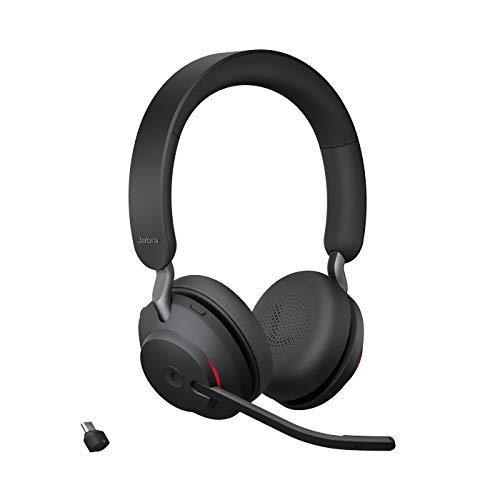
Jabra Evolve2 65 (USB-C) — The All-Day Battery Pick
The Evolve2 65 in this USB-C configuration is the line’s dependable centre: a dual-ear wireless headset for calls and music whose title leads with the two facts a working week runs on — an included USB-C adapter and up to 37 hours of battery. That battery figure translates into the only unit that matters, which is working days: a headset charged on Monday morning that is still serving on Friday has removed itself from the list of things a busy week can go wrong with.
The included adapter is a small line in the title with large consequences. Bluetooth pairing to a laptop’s built-in radio can be a lottery of drivers and dropouts; a manufacturer-supplied dongle makes the connection the vendor’s problem, pre-paired and predictable, and it gives the headset a consistent home across machines. Workers who hot-desk or alternate between a personal laptop and a work one will feel this benefit weekly. It also future-proofs the purchase against the next laptop’s Bluetooth temperament, which nobody can predict and everybody eventually meets.
Dual-ear stereo is the right default for this class, and worth defending against the one-ear alternative some offices prefer. Two ears give music its due during focus work, give calls a natural presence, and give the wearer a mild but real isolation from the room. Workers who must hear the door, the children, or the office around them should note the wired models below share the stereo brief, and consider honestly whether full dual-ear wear suits a job that includes listening for the world as well as for the meeting.
Against its Flex sibling, the plain 65 trades the folding travel design for straightforward all-week service at a home or office desk. Against the 85, it trades the flagship’s over-ear concentration brief for a lighter, simpler daily tool. Those trades place it exactly where most full-time remote and office workers actually live, which is why this model, in its various adapter configurations, is the Evolve2 the working world bought in the largest numbers. The pool’s warning applies here in reverse: variants of this model with different dongles are one pick, and this USB-C version is the one on the table.
Choose the Evolve2 65 USB-C if you want the line’s core promise — clear calls, long battery, painless connection — without the flagship’s price or the Flex’s travel engineering. It is the recommendation this article would hand to the median professional, and medians, in office equipment, are usually where the wisdom is.
- Connection: Bluetooth wireless, USB-C adapter included
- Battery: up to 37 hours (per listing title)
- Microphone: noise-cancelling (per listing title)
- Compatibility in title: works with Microsoft Teams
- Form: dual-ear stereo
Strengths
- Up to 37 hours of battery covers a working week between charges
- Included USB-C adapter makes laptop connection predictable
- Dual-ear stereo serves calls and focus music equally
Trade-offs
- No folding design for daily travellers
- No hybrid ANC story for hostile noise environments
- Teams alignment is stated as works-with rather than the Flex’s certification
Best for: full-time remote and office workers wanting one dependable headset for the whole week.
Not suited for: daily travellers who need a headset engineered to fold and ride in a bag.
If your week is one desk and forty meetings, the Evolve2 65 USB-C listing is the sensible centre of this list.

Jabra Evolve2 40 SE — Best Wired for Call Quality
The Evolve2 40 SE makes the wired case with the strongest microphone claim in this article: three-microphone call technology, in a headset whose title also promises noise-cancelling performance, a USB-C/A cable that fits old ports and new, and a UC, all-platforms allegiance. For a worker whose entire professional reputation travels down a microphone — support leads, trainers, account managers, anyone whose day is calls — that microphone array is not a feature. It is the product, and everything else here is packaging around it.
Wiredness itself is the second feature, and in call work it compounds. A wired headset cannot die before the difficult call, cannot drop its pairing during the client’s presentation, and cannot be forgotten in the other room’s charger. Its latency is a cable’s latency, which is to say none that a meeting will ever notice. Call-centre veterans learned these virtues decades ago, and the 40 SE exists because the virtues never expired; they merely fell out of fashion among buyers who were not on calls all day.
The UC designation matters for platform nomads. Where the Teams-configured models above align themselves with Microsoft’s ecosystem, this SE declares for all platforms, which suits the worker whose week crosses Teams, Zoom, Webex, and whatever a client insists on. The dual USB-C/A cable extends that neutrality to hardware generations: the same headset serves the new laptop and the ageing desktop in the corner, which in real offices is not an edge case but Tuesday.
Its limits are the honest price of its virtues. The cable sets a radius around the machine, so kitchen-and-back pacing during calls is out, and there is no ANC story here for the wearer’s own concentration — the noise-cancelling in the title serves the microphone’s side of the conversation. Workers who need to move, or who need silence for themselves as well as for their callers, should look up the list to the wireless models and accept their charging rituals as the cost.
Buy the 40 SE if your day is measured in calls and your voice is your instrument. Among wired office headsets it is the one whose title argues hardest for the microphone, and in a profession of talkers, that is the argument that should win.
- Connection: wired, USB-C/A cable
- Microphone: 3-microphone call technology (per listing title)
- Noise control: noise-cancelling (per listing title)
- Variant: 2026 version, UC, all platforms (per listing title)
- Form: wired stereo
Strengths
- Three-microphone call technology headlines the range’s voice case
- Wired connection removes battery and pairing failures from call days
- USB-C/A cable and UC allegiance cover platforms and port generations
Trade-offs
- Cable radius ends pacing during calls
- No ANC for the wearer’s own focus
- Stereo wired design is desk-bound by definition
Best for: call-heavy professionals whose voice quality is their professional reputation.
Not suited for: workers who pace, present standing, or move rooms during long calls.
If your calendar is calls end to end, read the Evolve2 40 SE listing’s microphone line twice.

Jabra Evolve2 30 SE — The Sensible Wired Starter
The Evolve2 30 SE is the entry point to the Evolve2 wired line, and its title keeps the promise modest and complete: a dual-ear USB headset with both USB-A and USB-C on its cable, made for computer-based meetings across the standard platforms. For organisations equipping many seats, and for individuals buying their first serious work headset, that modesty is the appeal — every essential is present, nothing is decorative, and the price of admission to a professional audio standard stays sane.
Dual-ear coverage at this tier deserves emphasis, because the cheapest corner of the office market still sells one-ear designs that leave music, focus, and natural call presence behind. The 30 SE’s stereo form means the same headset serves the meeting, the training video, and the concentration playlist, which is how real working days actually alternate. A worker equipped with one honest stereo headset is better served than a worker with a mono call tool and a pair of earbuds borrowed for everything else.
The dual-connector cable is the other quietly adult decision in this design. Offices are archaeological sites of port generations, and a headset that plugs into both the new laptop and the inherited desktop without an adapter hunt is a headset that never misses a meeting for a stupid reason. IT departments notice such things, and so do home workers whose machines span a decade of purchases. Compatibility is not glamorous, and it is the difference between equipment and clutter.
Expect the tier’s honest limits: the microphone and materials serve meetings well without reaching the 40 SE’s three-microphone argument or the wireless models’ freedom, and there is no noise-cancelling headline in this title to lean on. Judge the 30 SE as the floor of professional respectability — the headset below which a worker is improvising, and above which every additional spend buys a specific, nameable improvement elsewhere in this list.
That framing makes it a genuinely useful purchase rather than a compromise. Buy it to establish the standard — dual-ear, wired-reliable, platform-neutral — and let a season of real meetings tell you whether your next step is the 40 SE’s microphone, the 65’s wireless week, or contentment. Many workers discover the standard was the destination, and their 30 SE simply serves for years.
It is also the easiest model here to buy for someone else: a new starter, a home-working relative, a small team being equipped at once. Its neutrality — of platform, of port, of fuss — makes it the gift and the fleet purchase of the article, roles that flagships, for all their virtues, are too opinionated and too priced to fill.
- Connection: wired, USB-A and USB-C cable
- Variant: 2025 version (per listing title)
- Form: dual-ear stereo with microphone
- Compatibility in title: works with online meeting platforms
Strengths
- Dual-ear stereo at the line’s entry tier
- USB-A and USB-C cable covers every port generation in the building
- Platform-neutral brief suits mixed meeting ecosystems
Trade-offs
- Microphone story is quieter than the 40 SE’s three-mic design
- No noise-cancelling headline in the title
- Wired radius, as with all desk-bound models here
Best for: workers and teams establishing a professional standard on a sane budget.
Not suited for: call specialists who need the strongest microphone argument in the range.
For a first serious work headset, the Evolve2 30 SE listing is the floor worth standing on.
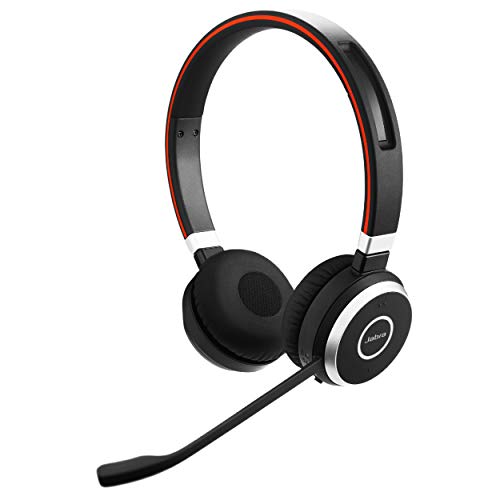
Jabra Evolve 65 Wireless Headset — The Proven Previous Generation
The original Evolve 65 is the elder of this list, and its presence is not nostalgia. This is the model that taught the market what a wireless office headset should be — Bluetooth with a proper USB adapter in the box, an advanced noise-cancelling microphone, all-day battery, and a stereo MS configuration — and a design does not hold its place in a catalogue for this long without continuing to earn it in offices that value the proven over the novel.
The Link 370 adapter is the detail that explains its longevity. Like the dongle in the Evolve2 65’s box, it makes the laptop connection Jabra’s responsibility rather than the laptop’s, and across a decade of machines that consistency has kept these headsets in service while Bluetooth fashions changed around them. Workers inherit these headsets from predecessors, find them in drawers, plug them in, and discover they simply work — a reputation no launch event can buy and no specification sheet can fully convey.
Its title’s confidence — industry-leading wireless performance, all day battery — belongs to its era’s marketing voice, and this guide repeats those phrases as the claims they are rather than as measurements. What can be said without folklore is structural: the feature set that the Evolve2 line now sells as its centre was assembled here first, and the newer models’ improvements are refinements of range, battery, and noise control rather than a different idea. A buyer choosing the elder is choosing the idea in its original, debugged form.
The honest trade is generational. The Evolve2 models bring longer battery figures, newer noise technologies, USB-C-era connections, and current certifications; the Evolve 65 counters with maturity, familiarity, and a price class that reflects its seniority. For a worker equipping a home office today, the newer 65 is the default recommendation of this article. For a worker replacing a beloved Evolve 65, or equipping a spare desk, the original’s continuity is a rational purchase rather than a sentimental one.
There is a sustainability footnote worth stating in an office context: proven designs with long catalogue lives are the equipment least likely to become e-waste on a fashion cycle. A headset bought from a line that supports its elders is a headset whose pads, adapters, and knowledge base remain findable. Organisations that standardised on this model years ago are still being served by that decision, which is the strongest testimony any office product can earn.
Choose the Evolve 65 if you value the debugged original, are replacing one, or are equipping a secondary workspace where the category’s founding feature set is entirely sufficient. It is the list’s elder statesman, and it has earned the chair.
- Connection: Bluetooth wireless, Link 370 USB adapter included
- Microphone: advanced noise-cancelling (per listing title)
- Battery: all day (per listing title)
- Configuration: MS stereo variant
- Wireless claim in title: industry-leading wireless performance
Strengths
- Link 370 adapter makes laptop connection dependable across machines
- The category-defining feature set, fully debugged by years of service
- Advanced noise-cancelling microphone and all-day battery claims in title
Trade-offs
- Previous generation beside the Evolve2 line’s refinements
- Battery and connection standards predate the USB-C era
- New buyers are usually better served by the Evolve2 65 default
Best for: workers replacing a trusted Evolve 65 or equipping a spare desk with proven kit.
Not suited for: first-time buyers who should take the current generation’s refinements instead.
If you already know and trust this design, its listing is the continuity purchase of the article.
How Do You Set Up a Work Headset So Colleagues Hear Your Best Voice?
Setup for a work headset is mostly microphone discipline. Position the boom so the capsule sits at the corner of your mouth rather than in front of it, which keeps breath noise out while keeping consonants — the part of speech that carries meaning — fully captured. Then record yourself in the actual platform you use, from the actual room you use, at the speaking volume you use when you are tired, because that recording is the product your colleagues receive. Adjust gain until that tired voice is clear without clipping, and then stop adjusting; a work headset configured once, properly, outperforms one tweaked nervously before every important call.
Choose the connection path deliberately as well. Where an adapter is included, use it rather than the laptop’s built-in Bluetooth, because the adapter is the path the manufacturer tested and the one whose behaviour will stay constant across your machines. Keep the headset’s firmware and your meeting platform’s audio settings boring and current. None of this is technical heroism; it is the office equivalent of the sim racer’s pre-race checklist, and it converts the capabilities printed in this article’s titles into the voice your team actually hears.
What Does a Week of Meetings Reveal That a First Call Cannot?
The variety of a real week is the only honest test environment for office audio. The one-to-one with your manager tests intimacy and low volume; the twelve-person project call tests whether your voice survives a crowded channel; the client presentation tests projection without shouting; the call taken from the kitchen tests every noise-cancelling claim in this article at once. A headset that charms in the first context and fails in the fourth has not passed, whatever its title promised, and a week is the shortest interval in which all four contexts reliably occur.
Comfort reveals itself on the same schedule. A headset is not comfortable because it feels fine at 9 a.m.; it is comfortable if your ears and crown have forgotten it by the fourth meeting of the fourth day. That is why this guide keeps returning to dual-ear fit, weight discipline, and the all-day brief of models like the Evolve2 85 and 65. Judge across the week, keep the packaging until the week is done, and let Friday afternoon cast the deciding vote.
How Should a Team or Family Standardise Without Forcing One Model on Everyone?
Standardise the platform decisions, not the hardware. A team that agrees its allegiance — Teams or UC — and its adapter policy can let individuals choose their row of the table by role: the call-heavy specialist takes the 40 SE, the hybrid manager takes the Flex, the settled analyst takes the 65, and everyone remains mutually intelligible and mutually supportable. Forced uniformity buys a small IT convenience at the price of several people’s daily comfort, and the people paying that price are rarely the people who chose it.
Families sharing a home office should apply the same logic with a smaller cast. One household headset is a negotiation; two, chosen by working life, are a system. The sensible pairing this article suggests most often is a wireless all-week model for the partner who moves, and a wired SE for the partner whose day is calls — each borrowed occasionally, neither resented daily. Equipment peace in a shared home office is a real productivity feature, and it is bought by respecting different weeks rather than by winning an argument about a single model.
How Do You Keep an Office Headset Serving for Years?
Office headsets die of neglect in drawers and of kindness withheld, rarely of hard use. Give the headset one home — a hook, a stand, a specific desk corner — because a device with a home gets charged, found, and handled consistently. Wipe the cushions weekly in heavy meeting seasons, keep the boom’s hinge free of the desk-edge knocks that loosen it, and treat the adapter as part of the headset rather than as a stray dongle, ideally stored with it or permanently in the main machine. For wired models, the cable’s entry point is the lifespan: never let the headset hang by it, and route it so chairs cannot roll over it, because chair castors are the natural predator of every wired headset ever made.
Once a year, run the recording test again and compare it honestly with your memory of the first month. Microphones and cushions age gradually enough that decline hides inside familiarity, and a colleague’s offhand comment about your audio is data worth acting on. Jabra’s long catalogue support for lines like the Evolve family means the knowledge and parts to refresh a headset usually exist; the owner’s annual ten minutes is what turns that support into extra years of service.
Jabra’s Office Six at a Glance
| Model | Connection | Allegiance | Signature |
|---|---|---|---|
| Jabra Evolve2 85 | Wireless, USB-C | MS Teams | Over-ear flagship focus brief |
| Jabra Evolve2 65 Flex | Bluetooth wireless | Certified for Teams | Folding design, Hybrid ANC, ClearVoice |
| Jabra Evolve2 65 (USB-C) | Bluetooth, USB-C adapter | Works with Teams | Up to 37-hour battery claim |
| Jabra Evolve2 40 SE | Wired USB-C/A | UC, all platforms | 3-microphone call technology |
| Jabra Evolve2 30 SE | Wired USB-A and USB-C | Meeting platforms generally | Dual-ear entry standard |
| Jabra Evolve 65 | Bluetooth, Link 370 adapter | MS | The proven previous generation |
The glance table is organised the way a week is organised: connection first, because it decides your rituals; allegiance second, because it decides your buttons; signature last, because it is the pleasure after the practicalities are settled. Most readers will find their row by the second column. The reader who cannot — the genuine hybrid between platforms and places — is the Flex’s natural owner, and the table’s breadth is exactly the problem that model was designed to absorb.
Does It Matter That Colleagues Judge Your Headset, Not You?
An office headset is the rare purchase whose quality is experienced mainly by other people. You hear your own voice through bone and habit, muffled and familiar; your colleagues hear the microphone’s version, which is the version that represents you in every negotiation, interview, and difficult conversation of your career. That asymmetry should change how the purchase is evaluated: the microphone column of the table above deserves the weight a buyer would give a camera they will be photographed by, because functionally, that is what it is.
It also suggests the single most useful test in this entire article. After a week with a new headset, ask two colleagues who hear you daily — one friendly, one blunt — whether you sounded different, and how. Their answers will integrate more variables than any review can: your room, your platform, your voice, your habits. Jabra built its reputation on passing that test in other people’s ears, and every model in this list is an attempt to pass it at a different price and in a different working life.
What Mistakes Do Jabra Buyers Keep Making?
Buying the wrong platform variant
An MS headset in a Zoom-and-Webex life, or a UC headset in a Teams monoculture, works — and nags forever in small ways. The variant is printed in every title in this list, and the calendar test above takes one minute. There is no excuse for the most avoidable disappointment in office equipment, and yet it remains the most common, because buyers shop by model name and stop reading one word too early.
Counting dongle variants as different headsets
The Evolve2 65 exists with different adapters for different ports, and marketplaces list them as though they were different products. They are one headset with different keys for different doors. Choose by the ports on your machines — USB-C here — and do not let a listing’s enthusiasm persuade you that you have discovered a seventh model or, worse, buy two variants imagining an upgrade.
Sending a wired worker a wireless gift, and the reverse
Headset preferences are workflow facts, not tastes. The call specialist who trusts a cable experiences a wireless headset as a new failure mode with a battery gauge; the pacing presenter experiences a cable as a leash. Equip people — including yourself — according to the work’s shape, and let the recipient’s calendar, not the giver’s enthusiasm, choose the column of the table.
Judging a work headset by its first call
Microphone processing, fit, and rituals all reveal themselves across a week of varied meetings: the quiet one-to-one, the chaotic group call, the client presentation. Keep the packaging for that week, test the headset where it will actually live, and remember that your colleagues’ ears are the review that matters — ask them, directly, how you sounded on Thursday compared with the week before.
What Is the Sensible Upgrade Path Inside This Range?
The range is built as a ladder with honest rungs, and knowing the ladder prevents both under-buying and over-buying. Start on the wired SE rung if your needs are unproven: the 30 SE establishes the standard, and the 40 SE waits if your calls turn out to be your career. Move to the Evolve2 65 when the cable, not the audio, becomes the daily complaint, because wireless is a lifestyle upgrade before it is an audio one. Take the Flex when travel joins the complaint list, and the 85 when noise does. Each step answers a named frustration, and a buyer who cannot name the frustration is not ready for the step — a sentence that will save more money than any discount in this category.
Notice what the ladder never requires: leaving the brand, relearning controls, or renegotiating platform allegiance mid-path. That continuity is the quiet argument for a single-brand office catalogue, and it is why this guide could be written as one article rather than six. Your future self, upgrading in two years with a clearer calendar, will thank the present self for staying inside a system whose logic they already understand.
Before ordering, glance once more at last week’s calendar and at the room you actually work in, and let those two witnesses choose the row of the table. A headset matched to a real week survives contact with the next hundred weeks; a headset matched to an imagined week becomes the expensive resident of a drawer. Jabra’s range is honest enough to reward that honesty in kind.
There is a reason this guide ends where the range begins, with the working week rather than with a specification. Headsets in this catalogue will be worn for thousands of hours by people whose jobs happen inside them, and at that scale the differences that matter are the ones this article kept returning to: the variant that matches the calendar, the connection that never fails the meeting, the microphone that represents you faithfully to people who cannot see your face. Get those three right and the model name takes care of itself, because every model in this list was built by a company that understands exactly those stakes.
Final Recommendation
Default to the Evolve2 65 USB-C if your life is one desk, one platform, and a week of meetings: its battery claim and included adapter make it the range’s centre of gravity. Step up to the Evolve2 85 when noise is your enemy and Teams is your platform, sideways to the 65 Flex when your workplace changes address daily, and down to the wired SE models when calls are your product — the 40 SE for its microphone, the 30 SE for the standard it sets at its tier. Keep the original Evolve 65 for continuity purchases and spare desks, where its proven design remains entirely sufficient.
A work headset is judged by other people’s ears and by your own at 4 p.m. on a Friday — and the right Jabra is the one that, by then, has made you sound like the professional you were at 9 a.m. on Monday.
Frequently Asked Questions
What is the difference between the Evolve2 65 and the 65 Flex?
The Flex is the travel-engineered sibling: a folding design with Hybrid ANC and ClearVoice microphone technology, certified for Microsoft Teams, per its title. The plain Evolve2 65 in this list is the desk-centred version, leading with its up to 37-hour battery claim and included USB-C adapter. Hybrid workers who carry a headset daily should choose the Flex; settled desk workers should choose the 65 and its battery story.
Are MS Teams variants usable with other platforms?
They are built and certified around Teams, so their controls and behaviours align with that platform first. The UC models — the Evolve2 40 SE declares UC and all platforms in its title — are the deliberate choice for mixed-platform weeks. This guide preserves each title’s exact allegiance language so you can match the variant to your calendar rather than to a guess.
Why would anyone choose a wired headset now?
Because call work punishes failure modes that wireless introduces: flat batteries, dropped pairings, a headset left charging in another room. The wired SE models remove all three permanently, and the 40 SE adds the range’s strongest microphone claim. For workers whose day is calls, certainty is not nostalgia; it is risk management with a cable.
How long does the Evolve2 65’s battery last?
Its title claims up to 37 hours, which in office terms is a working week of meetings and music between charges for most users. The other wireless models’ titles in this list do not print figures, and this guide does not borrow numbers for them; if battery is your deciding factor, the 65’s printed claim is the firmest evidence available here.
Is the original Evolve 65 still worth buying?
For continuity, yes: replacing a trusted unit, or equipping a spare desk with the design your household already knows. Its Link 370 adapter and noise-cancelling microphone remain a coherent package. First-time buyers building a primary setup should generally take the Evolve2 generation’s refinements, which is why the elder closes this list as a specialist in familiarity rather than as the default.
Can these headsets serve for music and focus work too?
That dual life is the range’s founding idea. The Evolve2 85’s title literally describes it as headset and music headphones, and the stereo models throughout are built to alternate between meetings and concentration. Workers whose focus hours matter as much as their call hours should weight the over-ear flagship and the dual-ear models accordingly, rather than treating music as an afterthought the office range forgot.
Can I use one headset for two computers?
The adapter-based wireless models make this practical: move the included dongle, or keep the headset paired to the machine that matters and use the adapter on the other, and the connection follows the hardware rather than a pairing menu. Wired models are simpler still — the SE pair’s dual USB-C/A cables exist for exactly this two-machine life. Decide which computer owns the headset’s home port, and let the other be the guest.
What should I buy first: a better headset or a quieter room?
Treat the room first where you can — a door, a rug, a different corner cost little and help every device you own. But rooms are not always negotiable, and that is precisely the case the flagship and hybrid ANC models in this list exist for. Buy the room you can, then buy the headset for the room that remains, in that order, and the combination will serve better than either purchased alone.
Which Jabra suits a call-centre-style working day?
The Evolve2 40 SE, for its three-microphone call technology, wired permanence, and UC allegiance across platforms. The 30 SE serves the same shape of day at the entry tier where fleets are equipped. Both keep the worker’s voice — the product, in that job — at the centre of the design, which is why the wired end of this catalogue remains its professional conscience.
Related Guides
Office readers who also game will find the fit-first gaming selections in Best Gaming Headsets for Large Heads and its companion Best Gaming Headsets for Small Heads, while brand-catalogue shoppers comparing across makers should read Best Logitech Headsets for the gaming side of the single-brand method this guide applied to Jabra.


