What's inside
- Where to Buy
- Introduction
- Key Takeaways
- Quick Picks
- How We Chose These Picks
- Comparison
- How to Choose a Wedding Camera
- Can One Body Really Cover Both Stills and a Wedding Film?
- Why Does This Guide Refuse to Promise Dual Card Slots?
- Is 24 Megapixels Enough for Wedding Albums and Prints?
- Common Mistakes When Choosing a Wedding Camera
- Final Recommendation
- Frequently Asked Questions
- Related Guides
As an Amazon Associate I earn from qualifying purchases. This post may contain affiliate links at no extra cost to you.
widgetverdict.com is reader-supported. When you buy through links on our site, we may earn an affiliate commission.
Where to Buy
All six bodies below are sold through Amazon as body-only listings, and each name here links to its own page. The Canon EOS R6 Mark II opens the set — open its listing to see the live figure before comparing it with anything else on this page. The Nikon Z6 III sits beside it, and its Amazon page carries today’s number for the black USA model. Video-leaning shooters can pull up the Panasonic Lumix S5II and read its cost there, while the Nikon Z8 occupies the professional shelf — its listing is the place to confirm the current ask. The Canon EOS R5 Mark II and the original Canon EOS R5 close the list; check each one’s page in the same sitting, because the gap between the two generations moves around more than either price does alone.
Introduction
The best mirrorless cameras for wedding photography share a burden no other genre imposes quite so completely: nothing at a wedding can be asked to happen twice. The kiss, the confetti, the father’s expression during the speech — each arrives once, in light the photographer did not choose, on a schedule somebody else wrote. That is why this guide is built entirely from full-frame bodies, why resolution and video ceilings are read straight from each listing title, and why the silences in those titles are treated as seriously as the claims.
Two silences deserve stating before any review begins, because wedding folklore treats both as guaranteed. First, card slots: not one of the six listing titles below states how many memory card slots its camera carries. Working professionals rightly regard dual slots as insurance, but this guide will not promise a slot count that the listing in front of you does not print — each spec box records the gap, and the point must be settled in manufacturer documentation before a booking depends on it. Second, stabilisation: only Panasonic’s title names an in-body system outright. Everything else here is reported exactly as far as its title goes, and no further.
What the titles do confirm is substantial. Every body is full-frame. Resolutions run from 24.2 megapixels to the R5’s 45. Video ceilings reach 8K on both Canon flagships and 6K internal RAW on the Nikon Z6 III. Those are the verified bones of the comparison; the reviews hang judgement on them and on the working realities — low light, long days, mixed stills-and-film briefs — that decide whether a camera earns its place in a wedding bag.
One further planning note belongs in every wedding budget drawn from this page: weather. Outdoor ceremonies meet rain without asking the photographer’s permission, which is why the neighbouring guide on sealed bodies is linked at the foot of this one. No title in the present set makes a sealing claim this guide can quote, so treat weather resistance as another documentation check to file beside the slot count, and let the sealed-bodies shortlist inform the second-body choice for outdoor-heavy seasons.
Key Takeaways
- All six picks are full-frame mirrorless bodies sold body only; lenses are a separate and significant part of every budget here.
- No listing title in this guide states a memory card slot count, so dual-slot insurance must be verified in manufacturer documentation before a paid booking relies on it.
- Only the Panasonic Lumix S5II title names an in-body stabilisation system — its New Active I.S. Technology; other titles stay silent on the point.
- Resolution splits the field into two camps: 24.2 megapixel bodies built for speed and low light, and the 45 megapixel R5 line built for large prints and cropping.
- Video ceilings are unusually strong across the set: 8K on both Canon R5 bodies, 6K/60p internal RAW on the Z6 III, unlimited 4:2:2 10-bit recording on the S5II.
Quick Picks
| Pick | Badge | Why it earns a place |
|---|---|---|
| Canon EOS R6 Mark II | The working all-rounder | 24.2 megapixel full-frame sensor with photo and video capabilities in Canon’s RF system. |
| Nikon Z6 III | Video power at the mid shelf | Full-frame stills and video with 6K/60p internal RAW recording in a USA model. |
| Panasonic Lumix S5II | Hybrid shooter’s tool | Phase Hybrid AF, named Active I.S. and unlimited 4:2:2 10-bit recording. |
| Nikon Z8 | Professional hybrid flagship class | Nikon’s professional full-frame stills and video hybrid in a USA model body. |
| Canon EOS R5 Mark II | Newest Canon flagship | RAW video at 8K and 4K (S-RAW) on a new full-frame sensor generation. |
| Canon EOS R5 | Resolution value, first generation | 45 megapixel sensor, 8K video, DIGIC X processor and up to 12 fps. |
How We Chose These Picks
The first filter was the full-frame sensor, applied without exceptions. Weddings are shot in candlelit barns, winter churches and reception rooms lit for mood rather than for cameras, and the larger sensor’s low-light headroom and shallow-focus look are the genre’s visual signature. Cropped-sensor bodies can and do shoot fine weddings, but a guide answering this keyword at this level should start where working professionals start, and every title below confirms the format outright.
The second filter was the hybrid brief. Modern wedding work is rarely stills alone: couples ask for highlight films, venues ask for content, and many photographers now sell both from one bag. Each body here states a photo-and-video capability in its title — several state it in so many words — and the video ceilings were compared as seriously as the stills specifications. A body that treated film as an afterthought would not survive this pass, whatever its sensor.
Title discipline did the third pass. Every claim in the reviews traces to a listing title, and the two famous wedding anxieties — card redundancy and stabilisation — are reported as unstated wherever the title is silent, which is nearly everywhere. That may read as pedantry. It is instead the difference between a buying guide and a rumour: a professional staking a booking on a specification deserves to know which numbers were printed by the seller and which were assumed by the internet.
Finally, the set had to span the working range of the profession: the dependable mid-shelf bodies that most full-time wedding photographers actually carry in pairs, the hybrid specialist, and the flagship tier for studios whose deliverables include very large prints. Six bodies, three mounts, two resolution philosophies — the reviews now take them one at a time.

Canon EOS R6 Mark II — The working all-rounder
If one camera in this guide matches the shape of an ordinary professional wedding practice, it is the R6 Mark II. Canon’s title is almost austere — a full-frame body, a 24.2 megapixel CMOS sensor, photo and video capabilities — and that austerity is the point. Twenty-four megapixels is the resolution working shooters choose when files must move fast, edit fast and store cheaply across a season of forty weddings, while still printing beautifully at album sizes. Nothing in the confirmed specification chases a headline; everything in it serves a Saturday.
The RF mount behind the body carries the practical argument. Canon’s fast RF primes and the standard professional zooms give a wedding kit its familiar spine — a wide zoom for the dance floor, a fast standard zoom for the ceremony, a portrait prime for the couple session — and a second R6-class body as backup shares batteries, menus and muscle memory. Photographers build systems, not camera collections, and this body is priced and positioned as the brick from which a two-body wedding system is most sensibly built.
Suits the full-time professional shooting twenty or more weddings a year, and the serious part-timer building toward that calendar. Its 24.2 megapixel files suit album and standard print deliverables exactly, and the full-frame sensor delivers the low-light behaviour that December ceremonies and candlelit receptions demand. Couples booking this photographer’s eye are buying consistency across a ten-hour day, and consistency is what a mid-resolution, mid-shelf flagship-class body is engineered to provide.
The spec box below shows the discipline this guide applies. The title does not state a card slot count, a burst rate, a stabilisation system or a video ceiling, so none of those is claimed here. For many buyers those figures are the purchase — a professional who needs written confirmation of dual slots for a venue contract, or of a specific recording format for a film deliverable, must take them from Canon’s documentation rather than from this listing. That is a verification errand, not a defect, but it is a mandatory one before money moves.
Think about the second body while you are at it. Wedding economics punish the single-camera professional the first time a shutter fails during a ceremony, and the R6 Mark II’s shelf position makes owning two a realistic plan rather than a studio fantasy. Buy the pair across a season if the budget requires it — one now, one before the busiest month — and let every other specification debate wait until the redundancy question is closed.
- Sensor: 24.2 Megapixel CMOS, full-frame
- Format: Full-frame mirrorless body only
- Brief: Photo and video capabilities
- Memory card slots: Not stated in the listing title — verify with the manufacturer documentation
- In-body stabilisation: Not stated in the listing title — verify with the manufacturer documentation
- Video ceiling: Not stated in the listing title — verify with the manufacturer documentation
Strengths
- A 24.2 megapixel full-frame sensor sized for fast wedding workflows and album prints.
- Photo and video capabilities are both confirmed in the title.
- The RF mount supports a complete professional wedding lens system.
Trade-offs
- The title states no card slot count, so redundancy must be verified elsewhere.
- No burst rate is printed in the title for confetti-and-exit moments.
- Resolution trails the 45 megapixel R5 bodies for very large wall prints.
Best for: a working wedding professional building a two-body Canon RF system for a full season. Not suited for: a contract that requires a stated dual-card recording specification from the listing itself, because the title prints no slot count and the point must be settled in Canon’s documentation.
Judge this body against your deliverables list, not against the flagships below it. If your couples take albums, online galleries and prints up to the sizes living-room walls accept, the R6 Mark II’s confirmed specification already covers the work, and the money saved against an R5-class body buys the second body or the fast prime that will actually change your photographs. When you are ready to price that plan, open the R6 Mark II listing on Amazon and note its current figure beside the cost of one RF portrait lens — the pair is the real unit of purchase.
Reception work deserves a mention in its own right, because it is where mid-shelf bodies earn or lose their reputations. The dance floor compresses every difficulty into one room: near-darkness broken by coloured moving lights, subjects who will not hold a pose, and a couple whose best expressions last a second. A full-frame 24.2 megapixel sensor is the format decision that carries a photographer through that room — the sensitivity headroom to keep shutter speeds honest, the file size to keep a thousand-frame evening editable before the preview gallery is due. The R6 Mark II’s confirmed specification is aimed at that room as surely as at the ceremony.

Nikon Z6 III — Video power at the mid shelf
Nikon’s Z6 III makes the loudest video claim in the middle of this line-up: 6K/60p internal RAW recording, printed in the title of a full-frame stills and video camera sold as a USA model. Internal RAW matters to a wedding filmmaker for a practical reason — the colour grade. Reception lighting is a soup of tungsten, LED and window daylight, and RAW footage gives the editor the latitude to pull those mixed sources into one believable skin tone in a way compressed footage resists. A body that records it internally, without an external recorder and its cables, simplifies the run-and-gun reality of a wedding day considerably.
The stills side of the title is quieter — full-frame mirrorless, black finish, USA model — and no megapixel figure is printed, a silence the spec box records honestly. That omission shapes how the camera should be bought: on its confirmed video strength and its system, with stills resolution verified from Nikon’s documentation by any photographer whose print sizes depend on the number. The Z mount behind it is a mature professional system now, with the standard wedding zooms and fast primes a working kit requires.
Suits the hybrid shooter whose bookings increasingly pair stills with a highlight film, and the Nikon loyalist upgrading from the DSLR era into mirrorless without abandoning a lifetime of menu memory. A one-person studio selling both photographs and a five-minute film from the same day is this camera’s natural owner: the stills brief is covered by the full-frame format, and the film brief is covered by a recording specification that several pricier bodies in this guide do not state at all.
Hold the same discipline here as with the Canon above. The title states no card slot count, no stabilisation system and no burst rate. A professional whose insurance or whose second shooter’s workflow depends on simultaneous backup recording must verify the slot arrangement in Nikon’s documentation before the season starts, not in the week before a wedding. The 6K RAW workflow also carries a storage consequence worth costing now: RAW video consumes cards and drives at a rate that dwarfs stills, and the editing machine must be ready for it.
There is a creative dividend to the video ceiling beyond the deliverable itself. A body that can hold 6K RAW can also be trusted with the speeches, the first dance and the ceremony in one continuous professional format, which frees the shooter to compose film and stills as one assignment rather than two competing ones. Studios moving into hybrid packages will feel that simplification in their scheduling before they feel it in their footage.
- Format: Full-frame mirrorless stills/video camera
- Video: 6K/60p internal RAW recording
- Model: USA Model, black
- Sensor resolution: Not stated in the listing title — verify with the manufacturer documentation
- Memory card slots: Not stated in the listing title — verify with the manufacturer documentation
- In-body stabilisation: Not stated in the listing title — verify with the manufacturer documentation
Strengths
- 6K/60p internal RAW recording is confirmed in the title, rare at this shelf.
- A full-frame stills and video brief in one body serves hybrid packages.
- Sold as a USA model, which keeps regional support straightforward.
Trade-offs
- No megapixel figure is printed in the title for print-size planning.
- Card slot count is unstated, so backup recording must be verified.
- RAW video files demand serious card and drive capacity on a wedding day.
Best for: a Nikon-system hybrid shooter selling stills plus a graded highlight film from one body. Not suited for: stills-only work planned around a megapixel count confirmed on the listing, because the title prints none.
Budget the workflow, not just the body. Cards fast enough for the top recording mode, drives to hold a season of RAW footage and an editing setup that plays it back without stutter are part of this camera’s real cost, and they are worth it precisely when the film side of the business is growing. If that is your trajectory, check the Z6 III’s current price on its Amazon listing and set it against the cost of the external recorder it lets you leave at home.
Still photographers sometimes underrate what a strong video specification does for their own craft. A body engineered for long, stabilised, well-tracked recording tends to bring disciplined heat management, confident subject tracking and screens that stay readable outdoors — all of which serve the stills shooter at a summer ceremony. The Z6 III’s title tells the film story loudest, but the working photographer should hear the stills implications underneath it: this is a body built for continuous professional output rather than for brief demonstration bursts, and weddings are marathons of exactly that output.

Panasonic Lumix S5II — Hybrid shooter’s tool
The S5II’s title is the most forthcoming in this guide, and wedding shooters should notice what it chooses to confirm: a 24.2 megapixel full-frame sensor, Phase Hybrid AF, a named stabilisation system — New Active I.S. Technology — and unlimited 4:2:2 10-bit recording. Each of those answers a real wedding anxiety. Phase Hybrid AF is the focusing system a ceremony demands, where the subject walks toward the camera down an aisle and focus must track rather than hunt. The named stabilisation steadies handheld footage during vows and speeches. And the word unlimited in front of the recording specification removes the clip-length dread that haunts anyone filming a ceremony in one take.
That recording specification deserves a paragraph of its own. A wedding ceremony runs twenty minutes on a short day and far longer in many traditions; a camera that stops at a fixed limit forces either a second body rolling in overlap or a prayer. Unlimited 4:2:2 10-bit recording, as printed in this title, is therefore not a spec-sheet flourish but the difference between offering full-ceremony films and declining them. The 10-bit colour depth supports the mixed-light grading problem described in the Nikon review, in compressed files a working editor can actually manage.
Suits the one-person hybrid studio most completely of any body here. The L-Mount system it joins is shared across several manufacturers, widening the lens pool, and the confirmed specification reads like a checklist written by somebody who has actually filmed a wedding: tracking autofocus, stabilisation, no recording ceiling. Photographers who lead with stills will find the same 24.2 megapixel full-frame class as the R6 Mark II; photographers who lead with film will find the strongest stated video brief in the middle of this guide.
The honesty ledger still applies. No card slot count is printed, so the redundancy question goes to Panasonic’s documentation like everywhere else in this guide. No burst rate is stated for the confetti moment. And the L-Mount lens catalogue, while broad, asks a Canon or Nikon veteran to relearn a rental market — check that your region’s hire shops stock the mount before committing a season to it, because wedding professionals rent more glass than they admit.
There is also a stamina argument. A body whose confirmed strengths cluster around continuous recording and stabilised handheld work suits the documentary style of wedding coverage — following the day rather than staging it — and that style is where the genre’s centre of gravity has moved. Posed-formal photographers will weigh other picks more heavily; the photojournalists of the wedding world should start their shortlist here.
- Sensor: 24.2MP full frame
- Autofocus: Phase Hybrid AF
- Stabilisation: New Active I.S. Technology
- Video: Unlimited 4:2:2 10-bit recording
- Memory card slots: Not stated in the listing title — verify with the manufacturer documentation
- Burst rate: Not stated in the listing title — verify with the manufacturer documentation
Strengths
- Unlimited recording is stated outright — full ceremonies in one take.
- Phase Hybrid AF addresses aisle-walk focus tracking directly.
- It is the only title here that names its stabilisation system.
Trade-offs
- Card slot count is not printed, so backup workflow needs verification.
- The L-Mount rental pool is thinner than Canon’s or Nikon’s in many regions.
- No continuous shooting rate is stated for fast stills sequences.
Best for: a solo hybrid shooter filming complete ceremonies and receptions on one stabilised body. Not suited for: a studio whose hire-shop workflow depends on Canon or Nikon rental glass being available locally at short notice.
Price the system honestly before the season. The body is the entry ticket; the standard L-Mount wedding zooms and a fast prime complete the kit, and their combined figure is the one to compare with the Canon and Nikon systems flanking this review. If the documentary style is your signature, look at the S5II on Amazon and check what its listing asks today — then spend the saved deliberation time verifying that card slot question in Panasonic’s documentation, where this guide has deliberately left it.
The L-Mount’s shared nature deserves one more consideration for wedding buyers. Because several manufacturers build bodies and lenses for the same mount, the system offers unusual resilience: a second body from a partner brand can share your lenses in an emergency, and the used market aggregates glass from multiple makers. For a solo professional whose entire business fits in two bags, that resilience is a form of insurance no single specification provides. It does not outweigh the rental question raised above, but the two belong on the same page of the notebook when the mount decision is made.

Nikon Z8 — Professional hybrid flagship class
Nikon’s title for the Z8 spends its words on positioning rather than numbers: a professional full-frame mirrorless stills and video hybrid camera, USA model. Read plainly, that is a promise about class rather than a specification sheet, and the review follows the title’s lead — this is the body for the studio whose work is judged against the best in its market, bought for the depth of the professional system around it as much as for any single figure. The Z mount’s flagship glass, the service network and the rental pool are the substance behind the word professional.
For wedding work specifically, the hybrid designation is the operative claim. A flagship-class hybrid is built to be the one body a lead photographer carries when the day includes everything: preparations in a dim hotel room, a noon ceremony in hard sun, portraits at dusk, speeches under tungsten and a dance floor lit by a DJ’s moving colours. Versatility across that range, without swapping bodies, is what the flagship shelf sells, and the Z8’s title stakes exactly that claim.
Suits the established studio and the lead shooter whose name is the brand. It also suits the photographer pairing stills leadership with serious film deliverables, where the body’s professional positioning supports flagship pricing to clients. Assistants and second shooters in such a studio typically carry the Z6-class body reviewed above, and the two-tier arrangement — flagship in the lead’s hands, mid-shelf in the second’s — is the standard architecture of a Nikon wedding practice.
Now the discipline, applied at full strength because the stakes are highest here. The title prints no megapixel count, no video ceiling, no card slot count and no stabilisation system. A buyer at this level will of course read Nikon’s full documentation, and must: print sizes, recording formats and redundancy arrangements are contractual matters on a wedding booking, and none of them can be sourced to this listing. The spec box below is therefore mostly a map of what to verify, and that map is the most useful thing this review can give a flagship buyer.
Weight and presence belong in the ledger too, in general terms any flagship buyer understands. Professional hybrid bodies are built to be carried all day by people who train for it, paired with large-aperture zooms of similar seriousness. A slight shooter working twelve-hour days should handle the system in a shop before the season, because the best camera in this guide is still the one whose owner can hold it steady at hour ten of a wedding.
- Format: Professional full-frame mirrorless
- Brief: Stills/video hybrid camera
- Model: Nikon USA Model
- Sensor resolution: Not stated in the listing title — verify with the manufacturer documentation
- Memory card slots: Not stated in the listing title — verify with the manufacturer documentation
- Video ceiling: Not stated in the listing title — verify with the manufacturer documentation
Strengths
- Professional flagship positioning within Nikon’s Z system.
- A stills and video hybrid brief stated in the title itself.
- Full-frame format confirmed for low-light wedding work.
Trade-offs
- The title prints almost no numbers; every key figure needs documentation.
- Flagship pricing demands flagship bookings to justify itself.
- Its professional build class is a full-day carry with pro zooms fitted.
Best for: an established Nikon studio’s lead photographer shooting stills and film at flagship level. Not suited for: an ordering process that requires megapixel, slot-count or recording figures confirmed on the listing page, because this title states none of them.
Buy this class of body against a business plan. The studios that thrive with flagships charge for them, insure them and schedule around them; the specification verification this review keeps insisting on is simply what professional purchasing looks like at this tier. When the plan is ready, the Z8’s Amazon listing will show the current figure for the USA model — read it alongside Nikon’s documentation, with the contract requirements of your next season open on the desk.
Flagship ownership also changes the client conversation in ways studios quietly value. Couples may not read specification sheets, but planners, venues and other vendors read equipment lists, and a current flagship body signals a practice investing at the top of its craft. That signal should never be the reason for the purchase — the deliverables argument in this review stands on its own — yet it is a real secondary return on the flagship shelf, and studios at this level are entitled to count it among the returns when the business plan is written.

Canon EOS R5 Mark II — Newest Canon flagship
Canon’s second-generation R5 leads its title with film: you can record RAW video at 8K and 4K (S-RAW) resolution, on a new full-frame generation. For the wedding studio that sells cinema as a headline product, that sentence carries the pitch. 8K RAW capture gives an editor reframing room — a wide ceremony frame can yield both the wide shot and a punched-in exchange of vows from one camera position — and RAW colour latitude answers the mixed-light grading problem that reception venues specialise in creating.
The stills resolution is, strikingly, not printed in this title, which instead spends its words on the new sensor generation and the video formats. The R5 name carries a high-resolution reputation from the original model reviewed next, but this guide does not transfer numbers between generations: the spec box records the omission, and print-led buyers should take the figure from Canon’s documentation. What the title does confirm — new full-frame sensor generation, flagship R5 lineage, body in black — positions the camera as the current top of Canon’s wedding-capable range.
Suits the Canon studio whose deliverables have grown into cinema and large-format print, and the lead photographer standardising on one flagship body for both. It also suits the future-proofing buyer: a studio purchasing a body to anchor five seasons of work rationally buys the newest generation, letting the original R5 class serve as the second body. In that two-tier Canon architecture, this is the camera in the lead’s hands during the ceremony and the couple session — the moments where failure is unforgivable.
The costs of the flagship tier are workflow costs as much as purchase costs. 8K RAW footage consumes storage at a rate that rewrites a studio’s drive budget, demands fast cards in quantity, and asks the editing suite to be specified for it. None of that appears in any title, but all of it follows from the two letters RAW beside the number 8K, and a wedding business should cost the pipeline before the body arrives. Card slot count, again, is not stated here and must be verified in Canon’s documentation before a booking relies on simultaneous backup.
There is a quieter wedding argument for the newest generation: longevity of support. A flagship bought at the start of its cycle receives firmware attention, accessory development and rental-market depth for the longest possible span, and a wedding practice amortises a body across hundreds of events. Spread over five seasons, the generational premium narrows considerably against the original R5 — which is precisely the calculation the next review complicates.
- Format: New full-frame sensor generation, body only
- Video: RAW video at 8K and 4K (S-RAW)
- Sensor resolution: Not stated in the listing title — verify with the manufacturer documentation
- Memory card slots: Not stated in the listing title — verify with the manufacturer documentation
- In-body stabilisation: Not stated in the listing title — verify with the manufacturer documentation
- Colour: Black
Strengths
- 8K RAW video is confirmed in the title for cinema-grade deliverables.
- The newest Canon full-frame generation anchors a long service life.
- 4K S-RAW gives a lighter RAW option for long-form ceremony recording.
Trade-offs
- No megapixel figure is printed, despite the line’s resolution reputation.
- 8K RAW rewrites card, storage and editing budgets across a season.
- Slot count and stabilisation are unstated in the title.
Best for: a Canon flagship studio selling 8K-capable cinema alongside stills at the top of its market. Not suited for: a stills-led practice whose editing computers and drive budget are sized for compressed files, because 8K RAW volumes will overwhelm that pipeline within one wedding.
Sequence the purchase around the pipeline. Drives, cards and editing capacity first or alongside, never after — a flagship that arrives before its workflow is a bottleneck wearing a halo. If the studio is ready, check the R5 Mark II’s price on Amazon today and compare it honestly with the original below, because the right answer depends on whether your clients are buying cinema or photographs this season.
Ceremony light is the other half of the R5 Mark II’s working brief. Churches and register offices mix dim ambient gloom with bright window shafts, and a current-generation full-frame sensor is bought precisely for that dynamic punishment: shadow detail in the congregation, highlight discipline on a white dress in a sunbeam, from the same exposure. The title does not print the figures behind that behaviour, so this review claims the class rather than the numbers — but the class is the newest Canon offers, and wedding photographers buy classes of low-light behaviour the way they buy lenses, for the rooms they know are coming.
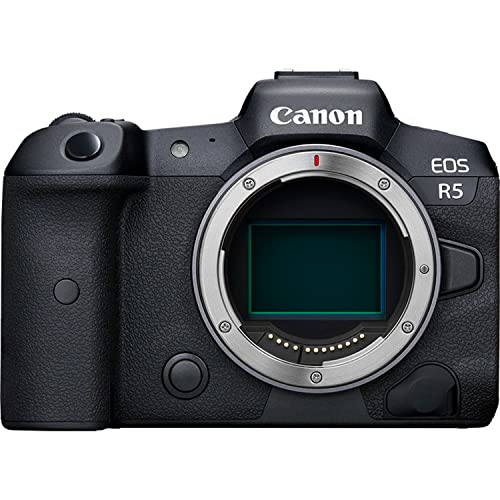
Canon EOS R5 — Resolution value, first generation
The original R5 remains the most completely specified camera in this guide, and its title shows what a forthcoming listing looks like: a full-frame hybrid camera with 8K video, a 45 megapixel CMOS sensor, the DIGIC X image processor, up to 12 frames per second, and the RF mount, in black. Every one of those numbers answers a wedding question. Forty-five megapixels is album spreads, wall prints and the freedom to crop a loose ceremony frame into a tight one. Twelve frames per second is the confetti throw, the bouquet toss and the dip at the end of the first dance. 8K video, even if rarely delivered at 8K, is reframing insurance for a single-camera ceremony.
Generational value is the review’s real subject. A superseded flagship keeps its sensor, its processor class and its mount; what it loses is only novelty. For a wedding business, that trade is often the smartest money on the page — the deliverables a couple receives, a 45 megapixel file and a beautiful film, do not carry a generation label. Studios equipping two shooters can field a pair of these for the territory of one newest flagship, and redundancy across two bodies beats brilliance in one for any genre where moments cannot repeat.
Suits the print-led photographer first: the 45 megapixel files serve the large-format end of the wedding market — framed enlargements, album spreads across two pages, exhibition prints for the studio wall. It also suits the value-minded professional building a matched pair, and the second shooter whose body must match the lead’s files closely enough that editing stays uniform across a thousand frames a day.
The standard cautions close the set. Card slot count is not printed in this title either, nor is a stabilisation system, so the verification errand applies to the best-specified camera here exactly as to the least. High-resolution files carry their own tax: a 45 megapixel workflow doubles the storage and backup discipline of the 24 megapixel bodies, and a full wedding at this resolution is a serious evening of ingest and culling. Buy the resolution because your prints need it, not because the number is the largest on the page.
Longevity, finally, cuts in this camera’s favour in one specific way. A mature model has a mature accessory and repair ecosystem, a deep used market for a matching second body, and a known character that a season of reviews and working reports has mapped thoroughly. The newest generation is a promise; this one is a record. Wedding professionals, whose entire trade is the management of unrepeatable risk, tend to respect records.
- Sensor: 45 Megapixel CMOS, full-frame
- Processor: DIGIC X Image Processor
- Video: 8K Video
- Burst: Up to 12 FPS
- Mount: RF Mount
- Memory card slots: Not stated in the listing title — verify with the manufacturer documentation
Strengths
- 45 megapixels serve wall prints, album spreads and aggressive cropping.
- Up to 12 fps is printed for confetti, tosses and dance-floor peaks.
- The title confirms 8K video and the DIGIC X processor outright.
Trade-offs
- 45 megapixel files double storage and culling effort versus 24MP bodies.
- Card slot count is unstated, like every other title in this guide.
- It is the previous generation, so firmware attention now favours its successor.
Best for: a print-led Canon wedding practice wanting 45 megapixel files, possibly as a matched pair. Not suited for: a high-volume studio whose same-night turnaround promise cannot absorb the ingest and culling time that 45 megapixel weddings impose.
Do the pair arithmetic before dismissing the older flagship. Two of these, sharing lenses and batteries, give a studio redundancy, matched files and a spare for the assistant — the architecture that survives a dropped body in a church doorway. If that architecture fits your practice, the original R5’s Amazon listing carries its current price; set it against a single newest-generation body and let your booking calendar, not the calendar year, decide.
A final note on the original R5’s place in a modern kit concerns editing. Forty-five megapixel files reward a deliberate culling discipline: shoot the day fully, then edit like a photojournalist rather than an archivist, because the couple wants the two hundred frames that tell the story, not the two thousand that document your attendance. Studios that master that discipline find the resolution pays for its storage tax in print sales; studios that deliver everything they shoot will feel the tax without collecting the dividend, whatever body they choose.
Comparison
| Pick | Sensor from title | Video from title | Stabilisation from title | Card slots from title |
|---|---|---|---|---|
| Canon EOS R6 Mark II | 24.2MP full-frame | Photo and video capabilities | Not stated in the listing title | Not stated in the listing title |
| Nikon Z6 III | Full-frame, resolution not stated | 6K/60p internal RAW | Not stated in the listing title | Not stated in the listing title |
| Panasonic Lumix S5II | 24.2MP full frame | Unlimited 4:2:2 10-bit | New Active I.S. Technology | Not stated in the listing title |
| Nikon Z8 | Full-frame, resolution not stated | Stills/video hybrid | Not stated in the listing title | Not stated in the listing title |
| Canon EOS R5 Mark II | Full-frame, resolution not stated | RAW at 8K and 4K (S-RAW) | Not stated in the listing title | Not stated in the listing title |
| Canon EOS R5 | 45MP full-frame | 8K Video | Not stated in the listing title | Not stated in the listing title |
The final column is the most instructive in this guide. Six professional cameras, six listings, and not one printed slot count — the single specification wedding folklore treats as sacred is the one the marketplace leaves to documentation. Let that column recalibrate how you shop: titles confirm format, resolution class and recording ceilings; contracts and insurance arrangements must be built on the manufacturers’ own documents.
Elsewhere the table divides cleanly. Resolution belongs to the original R5. Stated recording endurance belongs to the S5II. Stated RAW ceilings belong to the Z6 III and the R5 Mark II. The working middle — R6 Mark II and the two Nikons — sells system, balance and professional depth rather than any single printed number.
How to Choose a Wedding Camera
Start with your deliverables, written down. Albums and online galleries point to the 24.2 megapixel bodies; wall prints and aggressive cropping point to 45 megapixels; full-ceremony films point to the S5II’s unlimited recording; graded cinema points to the RAW ceilings of the Z6 III and R5 Mark II. A camera bought against a written deliverables list rarely disappoints, because the list, not the launch cycle, does the choosing.
Plan the pair, not the body. Professional wedding coverage is a two-body discipline — one in the hands, one as insurance — and the budget should be built as a system total: two bodies, the standard zooms, a fast prime, cards, batteries and insurance. Under that accounting, two mid-shelf bodies frequently beat one flagship for a working practice, while a flagship plus a mid-shelf second body is the architecture of the established studio.
Verify the unprinted before you sign a season. Card slot counts, stabilisation figures, burst rates and recording limits that the titles omit must come from manufacturer documentation, checked model by model — including the difference between the two R5 generations, whose titles emphasise different strengths. Do this verification in the quiet month, not the week before the first booking, and file the documents with your contracts.
Finally, weigh the mount as a business asset. Rental availability in your region, second-shooter compatibility, service turnaround and the used market all attach to the system rather than the body. Wedding photographers change bodies every few seasons and systems almost never; the six cameras here represent three long-term commitments wearing similar specification sheets.
Can One Body Really Cover Both Stills and a Wedding Film?
Yes, and this line-up exists because the hybrid brief has become the genre’s default. Every title here claims photo and video capability, and three of them — the S5II with unlimited 10-bit recording, the Z6 III with internal RAW, the R5 Mark II with 8K RAW — state film credentials that would have headlined a dedicated cinema camera not long ago. A skilled solo operator can deliver a gallery and a highlight film from any of the six.
The honest limit is attention, not equipment. One person cannot be in two places during the vows, and switching between stills composition and film composition at the ceremony’s peak moments means one of the two crafts gets the leftovers. Studios solve this with people, not bodies: a second shooter, or a locked-off second camera for the ceremony. Buy the hybrid body for its flexibility across the day’s quieter stretches, and staff the peaks.
Why Does This Guide Refuse to Promise Dual Card Slots?
Because none of the six listing titles states a slot count, and a buying guide that prints unverified redundancy claims is gambling with somebody else’s wedding. Dual-slot recording is genuinely important — a card failure during an unrepeatable ceremony is the professional’s nightmare scenario — which is exactly why the specification must be sourced from the manufacturer’s documentation for the exact model, not inherited from forum consensus or a sibling model’s reputation.
The practical routine is simple. Shortlist from this guide on format, resolution class and recording ceiling, all of which the titles do confirm. Then open each maker’s documentation, confirm the slot arrangement and the simultaneous-recording modes, and only then sign contracts that promise backup-protected delivery. Treat any seller, guide or marketplace page that states a slot count without a source the way you would treat a venue that promises parking it does not own.
Is 24 Megapixels Enough for Wedding Albums and Prints?
For the deliverables most couples actually order, yes. Album pages, gallery files and prints at the sizes that hang in homes are served completely by the 24.2 megapixel files of the R6 Mark II and S5II class, with room for sensible cropping. The resolution also pays a workflow dividend across a season: smaller files ingest faster, cull faster and back up cheaper, which is why so many high-volume professionals choose this class deliberately rather than settling for it.
The 45 megapixel case is specific, not general. Choose it when your market buys large wall prints, when your style crops hard — shooting loose for safety and composing in the edit — or when album spreads regularly run a single frame across two pages. The original R5 states that resolution in its title, which makes it the verifiable high-resolution pick here; the Mark II’s figure must be confirmed in Canon’s documentation before a print-led buyer relies on it.
Common Mistakes When Choosing a Wedding Camera
Assuming a slot count the listing never printed. All six titles here omit it. Verify redundancy in manufacturer documentation before a contract depends on it.
Buying resolution your deliverables never use. Forty-five megapixels double your storage and culling load. If your couples order albums and galleries, the 24.2 megapixel class is the professional’s own choice.
Ignoring the second body. One flagship and no backup is a risk posture, not a kit. The pair arithmetic belongs in the first budget, not after the first failure.
Treating a video ceiling as a video workflow. 8K RAW and 6K RAW are storage and editing commitments. Cost the cards, drives and computer before the body arrives.
Switching mounts for one specification. A single headline number rarely repays relearning menus, replacing lenses and abandoning a rental network mid-career.
Final Recommendation
Match the body to the business you actually run. The working professional’s default is the Canon EOS R6 Mark II class — 24.2 megapixels, full-frame, system depth — with the Panasonic Lumix S5II as the hybrid specialist whose title confirms the ceremony-filming brief most completely. Nikon shooters split by ambition between the Z6 III’s stated RAW video and the Z8’s flagship positioning. Print-led Canon studios take the 45 megapixel R5, in whichever generation their pipeline and budget prefer.
Whichever body leaves this page with you, let its first wedding be a second-shooting day beside an experienced lead rather than a solo booking — the camera will have proved itself, and so will the slot-count homework this guide kept assigning, before a couple’s one unrepeatable day depends on either.
Frequently Asked Questions
Do wedding photographers really need full-frame cameras?
At the professional level this guide covers, the full-frame format is the working standard for its low-light headroom and shallow-focus look, and all six titles here confirm it. Smaller formats shoot successful weddings too, but they answer a different budget brief than this keyword asks about.
Which of these is best for filming a whole ceremony?
On what the titles confirm, the Panasonic Lumix S5II: unlimited 4:2:2 10-bit recording is printed in its listing, which removes the clip-length question entirely. The RAW bodies offer higher ceilings for shorter, graded work, at far greater storage cost.
How many memory cards should a wedding kit carry?
More than the day seems to need, in fast capacities matched to your recording modes — RAW video especially consumes cards at a rate stills shooters underestimate. The slot count of your chosen body must come from its manufacturer documentation, since no title here states one.
Is the original R5 still worth buying?
For print-led work, its title makes the case plainly: 45 megapixels, 8K video, DIGIC X and up to 12 fps on the RF mount. As one of a matched pair it can be the smartest professional money in this guide.
What lens should a first wedding body be paired with?
The working pattern is a fast standard zoom for the ceremony and reception, a fast prime for portraits and low light, and a wide zoom for dance floors and venues. Choose within your mount, and price the lenses into the same budget as the body from the start.
Related Guides
Wedding work leans on two neighbouring crafts. Outdoor ceremonies and storm-lit receptions make our roundup of the best mirrorless cameras with weather sealing, and what sealing titles actually confirm essential reading before the season turns. The film side of the hybrid brief continues in the best mirrorless vlogging cameras, whose creator tools translate directly to wedding-day content. And the compact second body a lead carries for candids is covered by the best mirrorless street cameras for discreet, all-day documentary work.


