What's inside
- Key Takeaways
- Quick Picks
- How Did We Rank Adapters for Trips That Actually Happen?
- Why Is the Voltage Warning Worth Repeating in Every Review?
- How Many Watts Does a Traveller Actually Need?
- Which Adapter Earns the Only Socket in a Strange Hotel Room?
- What Do Travellers Forget, Break or Misjudge Most Often?
- How Should You Pack a Charging Kit That Never Lets You Down?
- How Does Charging Change Across a Multi-Country Journey?
- What Is the Right Relationship Between a Travel Adapter and a Power Bank?
- How Should Families Divide One Adapter Without Dividing Themselves?
- What Changes for the Traveller Who Works From the Road?
- Why Do Airports Deserve Their Own Charging Strategy?
- How Long Should a Good Travel Adapter Stay in Service?
- What Should You Check in the First Hotel Room of a Trip?
- Which Small Habits Separate Powered Travellers From Hopeful Ones?
- How Do You Choose Between Two Adapters That Look Identical on Paper?
- What Should You Do When an Adapter Fails Far From Home?
- Final Recommendation
- Frequently Asked Questions
- Related Guides
As an Amazon Associate I earn from qualifying purchases. This post may contain affiliate links at no extra cost to you.
widgetverdict.com is reader-supported. When you buy through links on our site, we may earn an affiliate commission.
Where to buy: every adapter below links to a checked Amazon listing; two Ceptics kits at 35W and 45W for the methodical traveller, a 70W EPICKA and a 70W MOMAX for the multi-device expedition, Anker’s compact Nano adapter for the light packer, and a Baseus unit with a retractable cable between them cover the world’s sockets without pretending to convert voltage.
The best cords and chargers for travel are really a system disguised as a shopping list: one adapter that fits the world’s wall sockets, enough USB output to feed a phone, a tablet, a watch and a camera from a single hotel outlet, and cables that survive being wound, stuffed and sat on across a dozen time zones. The six products reviewed here are all universal travel adapters — the plug-shape half of that system — chosen across a useful spread of wattage, from Ceptics’ 35W kit with its included cable to three separate 70W GaN designs that can keep a laptop alive alongside everything else.
One warning must precede all enthusiasm, because it is the most consequential sentence in this guide: a travel adapter changes the shape of a plug, not the voltage of the supply. Several listings here say so explicitly, and the reviews repeat it where it matters. Devices with modern switching power supplies — phones, laptops, cameras, tablets — generally accept the world’s voltages and need only the adapter. Devices that heat, spin or were built for one market, such as many hair dryers and kettles, are a different and riskier conversation that no adapter in this roundup should be asked to settle.
Key Takeaways
- Adapters change plug shape, not voltage; check every device’s voltage range before its first foreign socket.
- Total USB wattage is shared across ports, so a 70W adapter feeds a laptop well alone and a crowd more gently.
- GaN designs have shrunk the high-output universal adapter from a brick to a pocketable block.
- An included or retractable cable removes the most commonly forgotten item in travel charging.
- Surge protection and proper certification matter more in unfamiliar wiring than at home.
- One strong adapter plus disciplined cables beats a bag of single-country chargers on every trip.
Quick Picks
| Pick | Badge | Why it earns its place |
|---|---|---|
| Ceptics 35W International Travel Adapter Kit | The complete starter kit | Two USA sockets, USB-A and USB-C, a 35W PD port and a cable included, surge protected and ETL tested. |
| Ceptics 45W GaN Universal Travel Adapter | The balanced all-rounder | Three USB-A and two USB-C ports with PD 45W across Type A, C, G and I plug regions. |
| EPICKA GaN 70W Universal Travel Adapter | The multi-device workhorse | Seventy watts of GaN output across three USB-C and two USB-A ports for EU, US, UK and AU travel. |
| Anker Nano Travel Adapter 5-in-1 | The light packer’s choice | A compact 20W adapter for more than 200 countries, with smart temperature control and two USB-C ports. |
| MOMAX 70W GaN Universal Travel Adapter | The five-port flagship | Seventy watts across three USB-C PD and two USB-A ports, covering UK, EU, US, AU and JP plug types. |
| Baseus 70W Universal Travel Adapter | The retractable-cable traveller | A 70W six-in-one adapter with a built-in retractable cable for more than 200 countries. |
How Did We Rank Adapters for Trips That Actually Happen?
We imagined three journeys and staffed each one. The first is the business overnight: a laptop, a phone, one hotel socket hidden behind a bed, and a presentation in the morning. The second is the family fortnight: two phones, a tablet, a watch, a camera and a rental apartment with eccentric wiring. The third is the long backpacking arc through several plug regions, where weight is audited gram by gram and a lost cable is a genuine event. An adapter earned its place by serving at least one of those journeys excellently and none of them badly.
Output tiers sorted the field. Twenty watts serves a phone-centred traveller; 35W and 45W add a tablet or a gentle laptop top-up; 70W is where one adapter honestly runs a modern ultrabook while still feeding a phone. Port counts and mixes came next, because a family cannot eat dinner through one USB-C port, and the presence of USB-A still matters for watches, older cameras and the cables already living in people’s bags. Home charging remains a separate discipline, covered in our guide to best android fast chargers, and the two systems should be bought with different expectations.
Certification and candour formed the final filter. Ceptics names its ETL testing and surge protection; Anker states plainly that its adapter is not a voltage converter. Listings that are honest about the single most dangerous misunderstanding in the category earned our trust on everything else they claimed.
Why Is the Voltage Warning Worth Repeating in Every Review?
Because the failure mode is not slow charging; it is a dead appliance and, in the worst tellings, a scorched hotel bathroom. Much of the world supplies roughly twice the voltage of a North American socket. A phone charger built for global travel accepts that range by design and merely needs its pins reshaped. A single-voltage device accepts it once, briefly, and then does not. The adapter between them is entirely innocent and entirely unable to help, which is why the honest listings repeat the warning and why this guide does the same.
Reading a device’s own label takes ten seconds: look for an input range that spans both worlds, phrased as a wide voltage interval, rather than a single figure. Every device in a typical technology kit — phone, laptop, tablet, e-reader, camera, electric toothbrush charger — almost certainly qualifies as dual-voltage in the modern era. The risky minority is thermal and mechanical: hair dryers, straighteners, kettles, some older game consoles and anything with a motor or a heating element bought for one market. Those deserve a converter conversation, a dual-voltage replacement, or the hotel’s own loaner, in that order of preference.
Surge protection, present in the Ceptics kit, addresses a different risk: unfamiliar wiring and storm-prone grids can deliver spikes that a bare adapter passes through. It is not a substitute for voltage compatibility, and no listing here claims it is. Think of the adapter system in layers — shape first, voltage second, protection third — and check them in that order for every device you pack.
How Many Watts Does a Traveller Actually Need?
Fewer than the marketing suggests and more than the smallest adapters offer. A phone alone is satisfied by 20W-class delivery, which is why the Anker Nano’s modest figure is a considered choice rather than a deficiency: it is aimed at the phone-first traveller and sized accordingly. Add a tablet and the honest requirement climbs; add a laptop that must work while it charges and only the 70W trio in this guide can hold the whole system together from one socket, with the 45W Ceptics as the thoughtful middle for lighter laptops and slower overnight replenishment.
Remember that the headline figure is a shared budget. A 70W adapter feeding a laptop at full draw has little left for the phone, and the same adapter at night, when the laptop sleeps, can divide its output generously among everything on the nightstand. Smart travellers therefore choreograph rather than merely plug: laptop first during the working evening, everything else across the night, and the phone on the fastest port during the morning’s short window. Our guide to best android wireless chargers covers the home version of that choreography for readers who like their nightstands cable-free between trips.
Cables complete the arithmetic. A cable that cannot carry the adapter’s output, or a tired cable with a loose connector, taxes the whole system invisibly. The Ceptics kit and the Baseus answer this by including or building in a cable; the other four assume the traveller’s own, which makes a pre-trip cable audit part of buying them. Pack cables you have tested at home, in the lengths the trip actually needs, and one spare beyond the count.

Ceptics 35W International Travel Adapter Kit — The complete starter kit
Ceptics sells this product as a kit, and the word is earned. The listing describes a 35W universal travel adapter kit with two USA sockets, USB-A and USB-C ports, one PD 35W USB-C port and a USB-C cable included, surge protection, plugs for the EU, UK, China, Australia and Japan, ETL testing, and intended devices spanning laptops, phones and cameras. For a first-time international traveller, that single box answers the questions beginners do not yet know to ask: sockets for a laptop brick, USB for the phone, a cable in case theirs is forgotten, and protection for unfamiliar wiring.
Thirty-five watts of PD is a phone-and-tablet tier with gentle laptop abilities rather than a workstation supply, and the kit’s honesty lies in not pretending otherwise. The two pass-through sockets are its quiet superpower, because they let an ordinary home charger or laptop supply ride along and work anywhere the kit’s plugs fit, multiplying the system’s flexibility beyond its own USB budget. Travellers whose laptops sip modestly will find the whole arrangement sufficient for most trips.
Ceptics has built its reputation in exactly this niche, and the ETL testing named in the listing is the kind of detail that separates a travel staple from a souvenir-shop gamble. As the foundation purchase for a household beginning to travel internationally, the kit is the easiest recommendation in this guide to defend: complete, protected, certified and modestly powered in a way that matches what most travellers actually plug in.
- Type: universal adapter kit with plug set
- USB output: PD 35W USB-C, plus USB-A and USB-C ports
- Sockets: two USA outlets
- Protection: surge protected, ETL tested per the listing
- Cable: USB-C cable included
Strengths
- The kit format answers a beginner’s whole checklist in one purchase.
- Two pass-through sockets let home chargers and laptop bricks travel unchanged.
- Named surge protection and ETL testing suit unfamiliar wiring.
Trade-offs
- Thirty-five watts will not run a hungry laptop and a phone at full pace together.
- A multi-piece plug kit is bulkier than the sliding-pin all-in-one designs.
- Serious multi-device families will outgrow its USB budget quickly.
Best for: first-time international travellers wanting a complete, protected foundation.
Not suited for: a digital nomad running a laptop and three devices from one socket nightly.
See the Ceptics 35W kit on Amazon if this is your first trip beyond your home plug shape.

Ceptics 45W GaN Universal Travel Adapter — The balanced all-rounder
The second Ceptics moves from kit to integrated GaN design. Its listing describes a 45W universal travel adapter with three USB-A and two USB-C ports, a universal input socket, Type A, C, G and I plugs covering the major regions, and PD 45W fast charging. Five USB ports is a generous census for a single adapter, and the mix respects the real contents of a travel bag, where USB-A cables for watches and older devices still outnumber their successors.
Forty-five watts shared across that crowd means the adapter’s talent is breadth with a respectable peak rather than outright speed: one device can take a meaningful PD charge, while a nightstand full of smaller devices can all sip simultaneously. GaN construction keeps the body manageable despite the port count, and the universal input socket preserves the Ceptics kit’s best trick — letting a home plug ride through — in a more compact form.
For couples and small families, this may be the sweet spot of the entire roundup: enough ports to end the nightly rotation, enough peak output for a phone’s fast charge or a light laptop’s keep-alive, and a maker whose specialism is this exact product. Only travellers whose laptop must work at full draw from the same socket need to step up to the 70W designs below.
- Type: universal adapter, integrated plugs
- Total USB output: 45W with PD
- Ports: three USB-A, two USB-C
- Plug types: A, C, G and I per the listing
- Socket: universal input for a home plug
Strengths
- Five USB ports serve a couple’s complete kit from one outlet.
- The USB-A majority respects the cables travellers already own.
- GaN sizing keeps a broad adapter realistically packable.
Trade-offs
- Peak output is shared, so a working laptop leaves little for the rest.
- No cable is bundled, so the cord audit falls to the buyer.
- Japan’s specific fit should be confirmed against the plug list before a dedicated trip.
Best for: couples and light families wanting breadth and a respectable peak in one block.
Not suited for: a solo power user whose laptop draws heavily while peripherals charge.
Look at the Ceptics 45W GaN adapter on Amazon when five ports sound like peace.
EPICKA GaN 70W Universal Travel Adapter — The multi-device workhorse
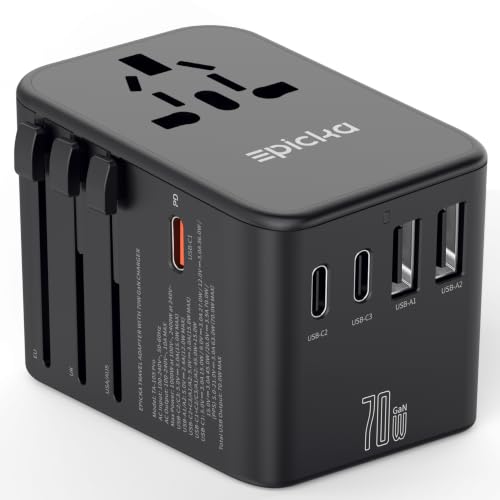
EPICKA’s adapter, model TA-105 Pro in the listing, steps into the 70W class with a port layout built for modern bags. The listing describes a 70W GaN PD universal travel adapter with three USB-C and two USB-A ports, an international power adapter for the EU, US, UK and Australia, and PD fast charging for multi-device travel, in black. Three USB-C ports is the detail that dates it correctly: this is an adapter for households whose phones, tablets, laptops and earbuds have largely completed the migration to the newer connector.
Seventy watts changes what one socket can promise. A modern ultrabook can work and charge while a phone takes a respectable share, or the whole output can flood a single hungry device when the evening demands it. EPICKA has been a familiar name in travel adapters for years, and the Pro framing here is justified by the combination of GaN density and that port census rather than by any single figure.
Its limits are the class limits: the total is shared, the very largest laptops will still prefer their own supplies under heavy load, and no cable is bundled to rescue a forgetful packer. Within those honest boundaries, the EPICKA is the workhorse pick for a family or a two-laptop couple who refuse to fight over the one reachable hotel socket ever again.
- Type: universal adapter, GaN
- Total output: 70W PD
- Ports: three USB-C, two USB-A
- Regions named: EU, US, UK, AU
- Model: TA-105 Pro, black
Strengths
- Three USB-C ports match the connector mix of a modern travel kit.
- Seventy watts honestly covers a working ultrabook plus a phone.
- GaN construction keeps the flagship tier from becoming a brick.
Trade-offs
- Shared output still thins when every port is occupied at once.
- Workstation-class laptops exceed its comfortable remit under load.
- Cables are the buyer’s responsibility throughout.
Best for: modern multi-device travellers and couples sharing one socket.
Not suited for: a minimalist packer carrying a phone and nothing else electronic.
Check the EPICKA 70W adapter on Amazon if your bag has gone mostly USB-C.

Anker Nano Travel Adapter 5-in-1 — The light packer’s choice
Anker’s Nano adapter is the minimalist entry, and its listing is admirably blunt about the brief. It describes a Nano travel adapter in a one-pack, a five-in-one design with two USB-C ports and 20W, a two-pin AC European-style plug arrangement, smart temperature control, compatibility across more than 200 countries, an explicit statement that it is not a voltage converter, and a framing as travel essentials. Twenty watts will not impress the wattage collectors, and that is precisely the point: this adapter is engineered for the traveller whose entire electronic life is a phone, earbuds and perhaps an e-reader.
For that traveller, smallness is a performance figure. The Nano disappears into a wash bag or a jacket pocket, weighs next to nothing in the hand-luggage audit, and still fast-charges a phone at the tier most phones actually use during a hotel evening. Smart temperature control is a thoughtful inclusion in a body this compact, where heat has nowhere to hide. Anker’s support network, the strongest in this roundup, stands behind a product that will be used in unfamiliar wiring on several continents.
The boundaries are equally clear. There is no meaningful laptop story here, no crowd of ports, and the two-pin emphasis suits European-style sockets best within its broad country list, so travellers should confirm the plug configuration for their specific destinations on the product page. Bought with its brief understood, the Nano is the adapter most likely to still be in the bag — rather than left at home as too bulky — on the trip where it is needed.
- Type: compact universal adapter
- Output: 20W
- Ports: two USB-C
- Coverage: more than 200 countries per the listing
- Note: explicitly not a voltage converter
Strengths
- Minimal size and weight suit hand-luggage-only travel perfectly.
- Twenty watts is honestly matched to a phone-first kit.
- Temperature control and Anker support suit a compact, hard-working body.
Trade-offs
- Laptops are outside its remit beyond the gentlest top-up.
- Two ports cap the household it can serve at one socket.
- Plug configuration per destination deserves a check before departure.
Best for: light packers whose travel electronics begin and end with a phone.
Not suited for: a working traveller who must run a laptop from the same adapter.
View the Anker Nano travel adapter on Amazon when every gram is negotiated.

MOMAX 70W GaN Universal Travel Adapter — The five-port flagship
MOMAX matches the EPICKA’s 70W with a similar five-port philosophy and its own regional emphasis. The listing describes a 70W GaN universal travel adapter, an all-in-one travel charging design compatible with UK, EU, US, AU and JP plug types, with three USB-C PD ports and two USB-A ports for laptops, phones and more. The explicit inclusion of Japan in the headline regions will catch the eye of travellers whose itineraries include it, since Japanese sockets and their grounding quirks are the detail other listings leave vague.
In service, the MOMAX plays the same flagship role as the EPICKA: one adapter, one socket, a working laptop and a supporting cast of devices fed across the evening and night. The choice between the two flagships is a matter of regional lists, port preferences and brand familiarity rather than of capability, and this guide declines to invent a gap the specifications do not show. Both represent the current state of the universal adapter art: GaN-dense, port-rich and honest about sharing.
MOMAX’s broader accessory catalogue gives its owners a reasonable expectation of support and of matching cables and cases within one ecosystem. As with its rival, no cable is bundled and the 70W is a shared estate, so the choreography advice from earlier in this guide applies unchanged. For a Japan-inclusive, multi-device itinerary, the MOMAX makes its case about as strongly as the category allows.
- Type: universal adapter, GaN, all-in-one
- Total output: 70W
- Ports: three USB-C PD, two USB-A
- Regions named: UK, EU, US, AU, JP
- Stated fit: laptops, phones and more
Strengths
- Japan appears explicitly in its regional compatibility.
- Five ports with a USB-C majority suit modern mixed kits.
- Seventy watts covers the working-laptop scenario from one socket.
Trade-offs
- It duplicates the EPICKA’s concept, so owners need only one of the pair.
- Shared output rewards choreography rather than simultaneous maximal charging.
- No bundled cable leaves the commonest travel failure unaddressed.
Best for: multi-device travellers whose routes include Japan.
Not suited for: a phone-only packer who would carry the Nano’s smaller body gladly.
See the MOMAX 70W adapter on Amazon if your itinerary crosses several plug regions.

Baseus 70W Universal Travel Adapter — The retractable-cable traveller
Baseus adds the one feature the other flagships lack: a cable that cannot be left behind. The listing describes a 70W universal travel adapter, a six-in-one international plug adapter and worldwide wall charger with a retractable cable, USB-C fast charging for the USA, EU, UK and Australia and more than 200 countries, under the name Enercore CG11. A retractable cable sounds like a small mercy until the first trip where it matters — the night a separate cable is discovered, at midnight in a foreign hotel, to still be in another country.
The 70W output places the Baseus in the flagship working class beside the EPICKA and MOMAX, able to run a laptop and feed a phone from one socket with the usual sharing etiquette. Six-in-one language describes its combination of socket, ports and cable. The retractable mechanism deserves the same gentle handling advised for retractable car chargers elsewhere in this batch: pull by the connector, guide the return, and never use the extended cable as a handle for the whole adapter.
Baseus has grown into a substantial accessories maker, and the CG11’s design shows a traveller’s priorities understood in the right order: power first, ports second, and the cable — the component experience proves is most often missing — built into the body where forgetfulness cannot reach it. For the chronically cable-forgetful, that single decision may outweigh every other distinction in this roundup.
- Type: universal adapter with retractable cable
- Total output: 70W
- Design: six-in-one per the listing
- Coverage: more than 200 countries, USA/EU/UK/AUS named
- Model: Enercore CG11
Strengths
- The built-in retractable cable eliminates the classic forgotten-cable failure.
- Flagship 70W output matches the strongest rivals here.
- Broad country coverage suits multi-region itineraries.
Trade-offs
- The retractable mechanism rewards careful handling across years of trips.
- A built-in cable’s length is fixed, unlike a separate cord chosen per trip.
- Port census details should be confirmed on the listing for exact mixes.
Best for: travellers whose cables have a history of being left in other countries.
Not suited for: a user who prefers separate, replaceable cables of chosen lengths.
Browse the Baseus 70W adapter on Amazon when the cable must travel inside the charger.
Which Adapter Earns the Only Socket in a Strange Hotel Room?
| Adapter | Total USB output | Ports | Cable answer | Signature strength |
|---|---|---|---|---|
| Ceptics 35W kit | 35W PD | USB-A and USB-C, plus 2 sockets | Included | Complete protected kit |
| Ceptics 45W GaN | 45W PD | 3 USB-A, 2 USB-C | Bring your own | Port breadth |
| EPICKA 70W | 70W PD | 3 USB-C, 2 USB-A | Bring your own | Modern multi-device power |
| Anker Nano | 20W | 2 USB-C | Bring your own | Minimal size |
| MOMAX 70W | 70W | 3 USB-C, 2 USB-A | Bring your own | Japan named in regions |
| Baseus 70W | 70W | Multi-port, six-in-one | Retractable, built in | Cable cannot be forgotten |
The table’s lesson is that wattage is only one column. The Ceptics kit’s sockets, the Baseus cable and the Nano’s size each win trips that a wattage ranking would misjudge. Drivers building a complete mobile power picture should also read our guide to best flexible solar chargers, because the traveller who leaves the road network needs a different answer to the same question.
What Do Travellers Forget, Break or Misjudge Most Often?
The cable league table of loss is headed by the cable itself, followed by the adapter left in the hotel socket at checkout — an error best prevented by a departure sweep that includes the wall behind the bed — and by the assumption that a destination’s sockets match a neighbouring country’s. Regions share plug families imperfectly, and grounding pins are the usual surprise. Check the specific country list for every stop, including the boring layover where a phone will need feeding in an airport corner.
Voltage remains the expensive misjudgement, and it is joined by its cousin: plugging a high-draw appliance into an adapter whose socket rating was never meant for it. Adapters in this class are built for electronics; the kettle conversation belongs elsewhere. Breakage, meanwhile, is mostly cable fatigue at the connector, which is why tested spares and gentle winding — loose loops, no sharp folds — appear in every experienced traveller’s routine. Finally, many travellers misjudge time: a 20W adapter is a delight across a long evening and a disappointment across a forty-minute layover, so match the adapter to the trip’s shortest charging window, not its longest.
How Should You Pack a Charging Kit That Never Lets You Down?
Build it as a permanent pouch rather than as a per-trip improvisation. The adapter lives in the pouch. The cables live in the pouch, tested and labelled by device. A spare cable lives in the pouch too, because the pouch’s entire philosophy is that its contents are not borrowed for home use between trips. Add the small citizens of travel power: a short cable for power banks and airport counters, a longer one for hotel rooms where the socket hides behind furniture, and a note listing which of your devices are dual-voltage, written once and trusted thereafter.
Rehearse at home before the first trip with a new kit. Charge everything you will travel with, from the adapter you will travel with, through the cables in the pouch. That single evening exposes the missing port, the short cable and the laptop that wants more than the adapter’s shared budget while all three can still be fixed with a click rather than from a foreign hotel room at midnight.
How Does Charging Change Across a Multi-Country Journey?
Each border can change the socket, the voltage emphasis and the quality of the wiring in the walls, and a universal adapter’s real job is to make those changes boring. Travellers crossing several regions in one trip should favour the all-in-one sliding designs here over multi-piece kits where luggage discipline is tested daily, and should perform the socket check as part of the arrival ritual in every new room: find the outlets, note which are switched and which are live, and place the charging pouch where the morning departure cannot leave it behind.
Long journeys also change the devices’ rhythm. On a two-week arc, everything eventually needs charging on the same evening, and the adapter’s shared budget becomes the trip’s quiet scheduling problem. Rotate the hungry devices, let the laptop take the early evening, and keep a power bank in the system as the buffer that absorbs the crowd. Travellers who master that rotation stop thinking about power entirely by the second week, which is the true destination of every product in this guide.
Border regions and older buildings deserve a final mention. Sockets in historic hotels and rural guesthouses can be worn, recessed or placed with a creativity that defeats bulky adapters; a short extension or a compact adapter like the Nano earns its space in such rooms. Carry the small option even when the flagship travels too, because geography occasionally votes against wattage.
What Is the Right Relationship Between a Travel Adapter and a Power Bank?
They are partners in a relay. The adapter owns the hours when a wall is available; the bank owns the hours when it is not — the train, the trail, the long museum afternoon. Charged from the adapter each night, a modest bank multiplies the adapter’s value by carrying its work into the day, and it rescues the short-window problem: forty minutes in a departure lounge fills the bank at the fastest port while the phone sips from the bank at leisure during the flight.
Size the bank for one full phone day plus a margin, and keep it in the charging pouch so the relay never breaks for want of a participant. Travellers heading beyond reliable walls altogether should extend the relay with the panels in the solar guide, but for the world’s ordinary journeys — cities, trains, hotels, family homes — adapter plus bank is the complete and sufficient system, and the six adapters above are its possible captains.
How Should Families Divide One Adapter Without Dividing Themselves?
By schedule rather than by argument. The devices with the earliest morning duties — the parents’ phones, which carry the alarms, the tickets and the maps — take the overnight priority, while tablets and cameras, whose deadlines are softer, take the evening shift while the family is out at dinner and the room’s sockets are otherwise idle. A written rotation sounds excessive for a holiday until the first morning a child’s tablet is full and a parent’s phone is not; after that morning, the rotation writes itself.
Port-rich adapters like the Ceptics 45W, EPICKA and MOMAX exist precisely to shrink this problem, because five devices sipping simultaneously across a night will all arrive at morning adequately fed even if none of them ever saw the adapter’s peak. Families should also distribute the cables by person rather than by device: each traveller owns a labelled cable in the pouch, and the pouch’s spare covers the inevitable casualty. The system survives a lost cable, a forgotten phone and a changed plan, which is more than can be said for the single-charger households this guide is trying to retire.
What Changes for the Traveller Who Works From the Road?
The laptop stops being a passenger and becomes the office, and the adapter must be chosen accordingly: the 70W class, a socket that lets the laptop’s own supply ride through as a backup, and a desk ritual in each new room that establishes power before the first call rather than during it. Remote workers should also carry the discipline of the home office into the kit — a spare cable, a bank for the café hours, and a photograph of the working setup in each kind of room, so the arrangement can be rebuilt in minutes after every move.
Time zones add a charging dimension office workers rarely consider: the working day may end when the home country’s day begins, and devices must be ready for both. The overnight budget therefore matters more, not less, and the adapter with the broadest honest sharing — or the wisdom to charge the laptop during the local evening while its owner explores — becomes a professional tool rather than a holiday accessory. Judge the 70W trio by that standard if your salary travels with you.
Why Do Airports Deserve Their Own Charging Strategy?
Because airport time is the scarcest charging time in any journey: short windows, contested sockets and devices that must board the plane alive. The strategy is triage. The phone takes the fastest available port, the power bank takes the second, and everything else waits for the hotel, because the phone carries the boarding pass, the messages and the map of the city waiting at the other end. A traveller who boards with a full phone and a filling bank has won the layover regardless of what the tablet believes.
Carry the adapter in hand luggage, always, and keep one short cable in the same pocket as the passport wallet if your bag allows it. The number of journeys saved by that pocket is out of all proportion to its size. And be a citizen of the departure lounge: share the socket when your devices are fed, coil your cables out of the walkway, and leave the corner cleaner than the airline did. Travel charging is a small commons, and the six adapters in this guide are at their best in the hands of travellers who treat it as one.
How Long Should a Good Travel Adapter Stay in Service?
Years, and across many trips, provided its moving parts are treated as moving parts. Sliding pins should still slide with conviction, sockets should still grip a plug firmly, and the body should show no cracking around the points where it meets the wall. An adapter that sits loosely in sockets, loses connection when the cable moves, or grows warm at loads it once handled coolly has begun its retirement conversation, and the middle of a foreign night is the wrong place to finish that conversation. Replace on evidence gathered at home.
The standards beneath these adapters change slowly, which is the category’s kindness to its owners: USB-C has consolidated the device side, the world’s plug families are not being redesigned, and a 70W GaN adapter bought today should serve the next several phones and laptops its owner carries. When a new device arrives with a new appetite, test the existing adapter against it across one ordinary week before shopping. Continuity is a travel virtue in itself, because the adapter you know — its quirks, its fit in worn sockets, its place in the pouch — is worth more on the road than a marginally stronger stranger.
What Should You Check in the First Hotel Room of a Trip?
Arrive like an electrician for the first five minutes. Find every socket, including the ones behind the bed and inside the desk furniture, and note which are controlled by the room’s master switch or key-card slot, because a charging system plugged into a socket that dies when the lights go out will deliver a memorably empty morning. Test the adapter in the socket you intend to trust overnight, watch the first device begin charging, and only then unpack the rest of the evening around that small, confirmed fact.
Place the pouch where departure cannot forget it — beside the door, on top of the bag that will leave first, anywhere except plugged into a hidden socket behind furniture. More adapters are donated to hotels by placement than by any failure of memory, and the donation is always discovered at the exact distance where returning for it stops being possible. The five-minute ritual prevents the donation, confirms the voltage story in practice, and turns an unfamiliar room into a powered base within minutes of arrival.
There is a particular pleasure, known to every seasoned traveller, in the first evening of a trip going entirely to plan: bags down, adapter in, everything charging, and the city outside the window still entirely unexplored. That pleasure is not luck. It is the compound interest of a pouch packed once and packed properly, an adapter chosen for the journey’s real devices, and a traveller who checked the voltage labels at home where checking them was easy. The six products above are six ways of buying that evening; the rest of this guide has been an argument for deserving it.
Which Small Habits Separate Powered Travellers From Hopeful Ones?
They charge opportunistically and without embarrassment. A café lunch with a socket beside the table is a charging session; a train with seat power is a charging session; the hour spent reading in the room before dinner is the most valuable charging session of the day and the one hopeful travellers waste by leaving everything unplugged until bedtime. Powered travellers also keep their devices’ appetites modest on the move: brightness managed, downloads deferred to the hotel connection, and the map cached for the neighbourhood before leaving it. An adapter, however strong, partners best with a traveller who does not spend charge carelessly and then bill the wall for the difference.
They also travel with a single source of truth. One pouch, one adapter system, cables that belong to the pouch and return to it, and a departure sweep that touches the socket, the bathroom and the bedside before the door closes. Nothing in that system is expensive, and every element of it is a decision made once, at home, in calm conditions — which is why it survives the tired, delayed, rained-upon evenings when improvised systems come apart.
How Do You Choose Between Two Adapters That Look Identical on Paper?
By the trip, not by the table. The EPICKA and the MOMAX illustrate the problem honestly: same wattage class, same port philosophy, different regional emphases and different makers. If Japan anchors the itinerary, the MOMAX’s explicit listing of it is a rational tiebreak. If the route runs through the regions the EPICKA names and its Pro model’s ecosystem is familiar, that familiarity is an equally rational one. When specifications tie, choose by the journey’s map, by the maker’s support reach in the countries involved, and by which unit’s plug mechanism you would rather operate at midnight in an unfamiliar room — a genuinely practical criterion that no benchmark captures.
The same logic resolves the wider field. The Baseus beats both flagships for the cable-forgetful despite any marginal paper difference, and the Nano beats all three for the traveller whose bag is measured in litres. Paper rankings assume a generic traveller; this guide assumes a specific one, and invites you to be specific back. Name the devices, name the countries, name the shortest charging window, and the correct adapter usually names itself from the six above.
Specificity is the whole method, and it scales beyond this category. The traveller who can name their devices, countries and windows can buy charging equipment once and correctly; the traveller who shops for a generic best will buy it three times, in three airports, at three regrettable prices. Let this purchase be the first kind. The world’s sockets are various but they are not mysterious, and neither, after this guide, is the kit that tames them.
Taming, in practice, looks undramatic: the same pouch in the same pocket of the same bag, the same adapter greeting sockets on four continents with the same quiet competence, and a traveller whose attention is free for the journey itself because the power was arranged before the journey began. That freedom is what the wattage figures and port counts in this guide are ultimately selling, and it is worth buying properly, once.
Once is the operative word. Buy the adapter that fits the life you actually travel, rehearse it at home, house it in its pouch, and then let years of departures pass without the subject arising again — except at the occasional foreign socket, where it will arise, briefly, and be settled by the small block already in your hand.
What Should You Do When an Adapter Fails Far From Home?
Stay calm and work the chain in order. Confirm the socket lives — hotel sockets are switched, key-carded and occasionally simply dead, and the room’s lamp is a perfectly good tester. Confirm the cable with a second device. Confirm the device with a different power source, even a laptop’s port or a borrowed charger in a café. Most field failures resolve at one of those three steps, because adapters themselves are simple, sturdy objects whose apparent deaths are usually murders committed by their surroundings.
If the adapter is truly gone, replace it like a traveller rather than like a collector: an electronics shop near a station, an airport store whose markup buys you certainty, or a hotel’s lost-property drawer of donated adapters, which front desks will often lend from with a smile. Buy for the remainder of the trip rather than for the decade, and let the considered purchase happen at home. Then record the failure in the pouch’s note — what died, where, and what replaced it — because the next trip’s packing deserves the benefit of this one’s evidence.
Evidence, accumulated trip by trip, is what turns a pouch into a system and a traveller into the person companions quietly rely on when their own phones fade. Accept the role gracefully. It costs one spare cable’s weight, one adapter chosen with care, and the habit of the departure sweep — and it returns, on every journey, the rarest travel commodity of all: an evening with nothing left to solve.
Nothing left to solve is the standard to hold the purchase to. Not the highest wattage, not the longest country list, not the smallest body — although the six above compete honourably on all three — but the quiet confidence, repeated across borders, that everything you brought will be ready when you need it.
Readiness of that kind is portable wealth. It weighs a few hundred grams, it fits in a pouch, and it spends itself in every country at the same generous rate. Choose the adapter that issues it for your particular travelling life, and guard the pouch the way you guard the passport it so often sits beside.
Beside the passport is, in the end, the correct mental shelf for this entire category. Documents get you across the border; power gets you through everything after it. Treat the second with a fraction of the care you give the first, and the world’s sockets will never again be the part of the journey you remember for the wrong reasons.
Wrong reasons belong to journeys without a system. Yours, after this purchase, will be remembered for its reasons instead: the work done, the people met, the photographs taken on a phone that was, at every necessary moment, alive to take them.
Alive at every necessary moment: hold the six candidates in this guide against that sentence, and the one that answers it for your devices, your countries and your habits is the one that belongs in the pouch.
The pouch, once it holds that answer, should be closed and left closed between trips. Its stillness is its virtue: nothing borrowed, nothing lent, nothing quietly promoted to home duty and forgotten there on the morning of departure.
Departure mornings reward exactly that kind of stillness. While other travellers are auditing drawers and interrogating family members about a cable last seen in March, the owner of a sealed, rehearsed pouch simply picks it up and leaves.
Leaving calmly is an underrated travel skill, and like most skills it is mostly preparation wearing the disguise of temperament. Prepare the power, and the temperament follows the traveller through every timezone the itinerary can invent.
Every timezone, in the end, has the same two features: a socket of some shape, and a traveller who needs what flows from it. Match them once, properly, and the rest is just geography.
Geography, met on those terms, is a pleasure rather than a problem.
Pack for the pleasure, then.
Final Recommendation
First-time travellers should buy the Ceptics kit and travel in certified, protected completeness. Couples should take the Ceptics 45W for its port breadth, modern multi-device households the EPICKA or the MOMAX at 70W, and the forgetful should let the Baseus carry their cable for them. Light packers should take the Nano and enjoy the empty space where a brick used to live. In a guesthouse above a Lisbon courtyard, the right adapter is the one already in the pouch, already understood, quietly feeding everything you brought.
Frequently Asked Questions
Does a travel adapter convert voltage for my hair dryer?
No. These adapters reshape plugs so they fit foreign sockets; they do not change the voltage delivered. A single-voltage hair dryer or similar heating appliance needs a proper converter, a dual-voltage model, or the hotel’s own appliance. Electronics such as phones and laptops are normally dual-voltage and need only the adapter.
Can one 70W adapter really charge my laptop and phone together?
Yes, with sharing. The 70W is a total budget: a working ultrabook takes the larger share and the phone a smaller one, and both charge respectably. Under the laptop’s heaviest loads the phone’s pace will soften, which is why the evening choreography in this guide gives the laptop first claim and the phone the faster overnight hours.
Which plug types cover most of the world?
The adapters here organise the world mainly into Type A, C, G and I families, with regional lists that add Japan and others by model. That quartet covers the Americas, most of Europe, the UK and Ireland, Australia, New Zealand and China between them. Always confirm the specific countries on your route against the listing for the adapter you choose.
Is surge protection worth having in a travel adapter?
It is a sensible layer for unfamiliar wiring, older buildings and storm-prone regions, and the Ceptics kit includes it. Surge protection guards against spikes; it does not convert voltage and does not replace checking a device’s own voltage range, which remains the traveller’s first duty at any new socket.
Why pack my own cables if hotels have USB sockets?
Hotel USB sockets are often slow, occasionally unpowered, and impossible to rely on for a laptop or a fast phone charge. Your own adapter and tested cables deliver a known system in every room, which is the entire philosophy of the charging pouch: certainty carried with you rather than luck discovered nightly.
What should I do the night before a trip with a new adapter?
Run the rehearsal described in this guide: charge every travelling device from the new adapter through the packed cables, confirm the plug configuration for your first destination, and check the voltage label of anything with a heating element. Twenty minutes at home prevents the category’s every classic failure.
Related Guides
Complete the travel shelf with best android fast chargers for home speed, best android wireless chargers for the nightstand, and best flexible solar chargers for power beyond the last socket.