What's inside
- Key Takeaways
- Quick Picks
- How Did We Judge Comfort Without a Single Lab Coat?
- Why Does Weight Matter More Than Padding After Hour Two?
- What Does a Suspension Headband Actually Do Differently?
- How Much Does Earpad Material Change a Long Session?
- How Should You Fit a Headset for a Four-Hour Session?
- Which Is Kinder for Glasses Wearers and Sensitive Scalps?
- How Do the Six Rank When the Session Runs Past Midnight?
- What Do Comfort Shoppers Most Often Get Wrong?
- How Do You Keep Pads and Straps Comfortable for Years?
- How Does Clamp Force Feel Different From One Head to Another?
- What Role Does the Cable Play in Wired Comfort?
- How Should You Test Comfort During the Return Window?
- Why Do Streamers and Desk Workers Judge Comfort Differently?
- What Should You Spend the Money You Save on, Instead?
- Final Recommendation
- Frequently Asked Questions
- Related Guides
As an Amazon Associate I earn from qualifying purchases. This post may contain affiliate links at no extra cost to you.
widgetverdict.com is reader-supported. When you buy through links on our site, we may earn an affiliate commission.
Where to buy: Amazon stocks every headset compared here, and the comfort story splits cleanly down the middle: three wireless or premium-leaning designs that treat padding and weight as headline features, and three wired models that earn their comfort through foam, light frames, and cables that never need charging.
Finding the best comfortable gaming headsets sounds simple until you have worn a bad one for three hours. Comfort in a gaming headset is not softness alone. It is the sum of clamp pressure spread across the headband, earcup depth that keeps drivers off your ears, weight low enough that your neck forgets the device, and materials that stay pleasant when a summer evening turns a long session warm. A headset can sound magnificent and still fail this test by the second hour, which is why this guide reads every listing through the lens of the wearing experience first and the audio specification second.
The six picks below approach that problem from genuinely different directions. Logitech fields three models: the G325 Lightspeed, which names all-day comfort in its own title and pairs it with a battery rated beyond a full day; the G733, built around a suspension headband that floats the frame on a fabric strap; and the G335, a wired design with memory foam earpads and a flip-to-mute microphone. HyperX brings the Cloud II, the memory foam veteran of this category, with an aluminium frame and virtual surround sound. Razer answers with the BlackShark V2 X, whose title leads with a weight figure of 240 grams, and NUBWO closes the list with the HG04L, a 250-gram wired headset with soft memory earmuffs. If your sessions regularly stretch past two hours, or if you are comparing these against best folding gaming headsets for a travel bag, the details below separate the genuinely easy-wearing designs from the merely padded ones.
Key Takeaways
- Two picks publish their weight in the title itself: the Razer BlackShark V2 X at 240 grams and the NUBWO HG04L at 250 grams, the lightest stated figures here.
- Memory foam appears in four titles, on the HyperX Cloud II, the Logitech G335, the NUBWO HG04L, and implicitly through the G325’s all-day comfort brief.
- The Logitech G733 uses a suspension headband, a fundamentally different load path from a padded band pressing directly on the crown.
- Only the Logitech G325 and G733 are wireless; the other four picks are wired and never need a charging cable.
- The G325 states battery life beyond 24 hours and 24-bit audio, the strongest endurance claim among the wireless pair.
- Every pick here covers PC, and most add PlayStation, Xbox, or Switch support for households that share one headset.
Quick Picks
| Pick | Badge | Why it earns its place |
|---|---|---|
| Logitech G325 Lightspeed Wireless Gaming Headset | The all-day wireless pick | Its title promises all-day comfort outright, with Lightspeed wireless, a noise-reducing built-in mic, and battery life past 24 hours. |
| HyperX Cloud II Gaming Headset | The memory foam veteran | Memory foam ear pads over a durable aluminium frame, with 7.1 surround sound and the broadest console list among the wired picks. |
| Logitech G733 Lightspeed Wireless Gaming Headset | The suspension strap pick | A suspension headband carries the weight on fabric rather than foam, with Blue VO!CE microphone processing and PRO-G audio. |
| Razer BlackShark V2 X Gaming Headset | The featherweight wired pick | At a stated 240 grams it is the lightest headset in this guide, with noise-isolating earcups and a cardioid microphone. |
| Logitech G335 Wired Gaming Headset | The flip-to-mute comfort pick | Memory foam earpads, a microphone that mutes when flipped up, and a plain 3.5mm connection that works almost everywhere. |
| NUBWO HG04L Wired Gaming Headset | The soft earmuff value pick | Soft memory earmuffs on a 250-gram frame with 40mm speakers and a clear unidirectional microphone for gaming and work. |
How Did We Judge Comfort Without a Single Lab Coat?
Comfort claims are easy to print and hard to verify, so this guide graded only what each listing title actually states and treated everything else as unknown. Weight counted when a title published it, which only Razer and NUBWO chose to do. Padding counted when a title named the material, and memory foam earned more credit than generic cushioning because it distributes pressure instead of merely softening contact. Headband architecture counted heavily: a suspension strap, like the one on the G733, changes where the load lands, while a conventional padded band concentrates it on the crown. Clamp force, earcup depth, and glasses compatibility appear in none of these titles, so no pick was credited or punished for them; the sections below flag those gaps honestly wherever they matter.
The second filter was session realism. A headset worn for forty minutes of casual play can be almost anything. A headset worn through a four-hour raid night, a long strategy campaign, or a work-from-home day that slides into gaming needs low weight, breathable contact points, and a microphone arrangement that does not dig, swing, or demand constant adjustment. Picks were also checked for platform honesty: every title here names its platforms, and the guide reports exactly those lists, because a comfortable headset that cannot connect to your machine is not comfortable at all. Readers whose priority is positional audio over padding should also look at best gaming headsets for first person shooters, where the ranking logic runs the other way.
Why Does Weight Matter More Than Padding After Hour Two?
Padding dominates the first impression of any headset because it is what your hands and ears feel in the first minute. Weight dominates the third hour, because your neck and the top of your head have been carrying the device the whole time, and small differences compound. The two stated weights in this guide, 240 grams for the Razer and 250 grams for the NUBWO, sit at the light end of what full-size gaming headsets weigh, and both manufacturers chose to print the figure in the title, which tells you they consider it a selling point worth leading with. Heavier designs can still be comfortable when their weight is distributed intelligently, which is precisely the G733’s suspension argument and the G325’s all-day brief, but a light headset starts the evening with an advantage that no foam can fully replicate.
Weight also interacts with movement. Players who lean, turn, check a second screen, or play in a chair that reclines will feel a heavy headset shift and re-seat itself, and each shift breaks concentration slightly. A lighter frame stays where it was put. This is why competitive players, who move sharply and play long, gravitate toward the featherweight end of the market, and why the two lightest picks here are both wired: removing the battery and radio is the simplest weight cut in headset design, and both Razer and NUBWO took it.
What Does a Suspension Headband Actually Do Differently?
A conventional headband is a padded arc that rests its load on the crown of your head through a foam cushion. A suspension headband, the design Logitech uses on the G733, hangs a flexible strap beneath a rigid outer frame, so the strap conforms to your head’s shape and spreads the load across a broad, soft contact patch. The practical differences are threefold. Pressure points soften because the strap yields where a padded arc cannot. Fit becomes partly self-adjusting, since the strap stretches to different head sizes without sliding detents. And the top of the head breathes a little better, because the contact is fabric under tension rather than foam under compression.
Suspension is not automatically superior for everyone. Players with very short hair or sensitive crowns usually love it. Players who wear headsets over caps, or who frequently pull one earcup off to hear the room, sometimes find a strap design less predictable than a firm band. The honest summary is that the G733 offers a genuinely different wearing experience from the other five picks, and if conventional headbands have always given you a sore spot at the crown after long sessions, that difference alone justifies its place near the top of a comfort shortlist.
How Much Does Earpad Material Change a Long Session?
Earpads are the headset’s tyres: the only part in constant contact, and the part that determines how the whole machine feels. Memory foam, named by HyperX, Logitech’s G335, and NUBWO, compresses slowly and moulds to the shape around your ear, which spreads clamp pressure over a wider area and improves the seal without extra force. That seal matters for comfort in an indirect way too, because a well-sealed earcup delivers fuller sound at lower volume, and lower volume over four hours is itself a comfort feature your ears will thank you for the next morning.
The trade-offs live in heat and maintenance. Foam under a leatherette-style cover seals beautifully and can warm up in summer; fabric covers breathe better and seal slightly less. None of these titles specifies the pad cover material, so buyers in hot climates should check the full listing photographs before deciding. Pads are also the first component to wear out on any headset, flattening after a year or two of daily use, and a model whose pads start as generous memory foam tends to age more gracefully than one that starts thin. When a pad flattens, clamp pressure concentrates, sound leaks, and a headset that was comfortable becomes tiring for reasons owners often misdiagnose as the drivers failing.

Logitech G325 Lightspeed Wireless Gaming Headset — The all-day wireless pick
Most headsets bury their comfort claim in marketing copy. The G325 puts the words all-day comfort directly in its listing title, next to the technical claims, which makes it the thesis statement of this entire guide: a wireless headset designed to be worn for the length of a working day and then a gaming evening. Around that promise the title assembles a coherent package. Lightspeed is Logitech’s low-latency wireless system for PC play, Bluetooth rides alongside for phones and other devices, the built-in microphone carries noise reduction for chat and calls, the audio is described as 24-bit, and the battery is rated beyond 24 hours, which means a full day of wear does not end with a charging cable.
The built-in microphone deserves a sentence of its own, because boom-free designs change the wearing experience. There is nothing to swing into your peripheral vision, nothing to knock when you drink, and nothing to detach and lose. For players whose gaming blends into video calls and desk work, that seamlessness is a comfort feature in the broadest sense. The honest limitation is that the title publishes no weight figure, and for a guide organised around wearing comfort that omission matters: buyers comparing grammes should weigh the Razer’s stated 240 against this model’s unspecified number and consult Logitech’s documentation. What can be said from the title is that Logitech positioned this headset explicitly for duration, and duration is the hardest comfort test there is.
- Connection: Lightspeed wireless plus Bluetooth
- Comfort brief: all-day comfort, stated in the listing title
- Microphone: built-in, with noise reduction
- Audio: 24-bit, as stated
- Battery: more than 24 hours, as stated
- Weight: the figure does not appear in the listing title; Logitech’s own documentation is where a buyer should confirm it before comparing grammes
Strengths
- An explicit all-day comfort brief backed by battery life that outlasts any realistic session.
- Built-in microphone removes the boom from your face, your desk, and your peripheral vision.
- Lightspeed wireless plus Bluetooth covers PC gaming and everyday devices in one headset.
Trade-offs
- No weight figure in the title, so gramme-led comparisons require a detour to documentation.
- A built-in microphone rarely matches a good boom for voice isolation in loud rooms.
- Wireless ownership still means a charging routine, however infrequent the long battery makes it.
Best for: a PC player whose headset stays on from morning work through evening gaming and who wants one wireless device for both. Not suited for: a gramme-counting shopper comparing published weights, since this title leaves that number to the documentation.
Read the G325 listing on Amazon for the all-day comfort details, and keep Logitech’s specification page open beside it for the weight figure.

HyperX Cloud II Gaming Headset — The memory foam veteran
The Cloud II has been the default answer to the comfortable headset question for so long that its design choices read like the category’s founding document: memory foam ear pads, a durable aluminium frame, and a fit tuned for hours rather than minutes. Its title adds 7.1 surround sound and a platform list that runs across PC, PS4 and its Pro variant, and both generations of Xbox One named in the listing. That breadth is part of its comfort story in the ownership sense: one headset that follows you between machines never needs to be re-bought, re-fitted, or re-learned.
The aluminium frame is the detail to dwell on. Plastic frames creak, flex unevenly, and eventually crack at the yoke; an aluminium structure holds its clamp force consistently, which means the pressure you feel in month twelve resembles the pressure you approved in week one. Consistency is an underrated comfort virtue, because ears adapt to a stable fit and rebel against a changing one. The surround sound is virtual processing rather than discrete drivers, a distinction worth knowing: it widens the presentation for films and atmospheric games, while competitive players often prefer the plain stereo image. The title does not publish a weight, joining the G325 in asking documentation-led buyers to look further, and the wired connection means the cable is a permanent companion, short and manageable at a desk, less welcome on a distant sofa.
- Earpads: memory foam, stated in the listing title
- Frame: durable aluminium
- Audio: 7.1 surround sound, virtual processing
- Platforms named: PC, PS4, PS4 Pro, Xbox One, Xbox One S
- Connection: wired
- Weight: absent from the listing title; HyperX documentation carries the published figure for buyers who need it
Strengths
- Memory foam pads and a metal frame deliver a fit that stays consistent over years of use.
- The widest console coverage among the wired picks here, spanning both PlayStation and Xbox generations named.
- Virtual surround widens films and story games without extra hardware.
Trade-offs
- The cable rules out sofa-distance play unless your setup brings the jack within reach.
- Weight is not stated in the title, frustrating direct comparison with the two published figures here.
- Virtual surround is a taste; players who dislike processing get no alternative mode from the title’s description.
Best for: a multi-console player who wants the proven memory foam fit and a frame built to hold its shape for years. Not suited for: a wireless-first living-room player whose seating sits metres from every available jack.
The Cloud II listing on Amazon shows the aluminium frame and pad construction clearly, which is where this model’s argument lives.

Logitech G733 Lightspeed Wireless Gaming Headset — The suspension strap pick
The G733 attacks the crown-pressure problem at its root by replacing the padded arc with a suspension headband, a fabric strap that carries the headset’s weight across a broad, yielding contact area. Players who finish long sessions with a tender spot on top of the head should read that sentence twice, because it describes the only structural solution among these six picks rather than a thicker version of the same cushion. Around the strap, the title lists Lightspeed wireless, a microphone with Blue VO!CE processing for broadcast-flavoured voice tuning, PRO-G audio drivers, and compatibility spanning PC, PS5, PS4, and Switch.
Blue VO!CE is worth understanding as a comfort feature for your teammates rather than for you: it applies real-time filters that keep your voice level and intelligible, so you stop repeating callouts and stop shouting over game audio, both of which tire everyone involved. The G733’s platform list is the broadest among the wireless picks here, reaching the Switch that the G325’s title does not name. Its gaps are the familiar ones for this guide: no weight in the title despite the design’s lightweight reputation, and no battery figure stated, so endurance comparisons against the G325’s published claim must go through Logitech’s documentation. Neither gap erases the strap, which remains the single most distinctive comfort mechanism in this roundup.
- Headband: suspension design, stated in the listing title
- Connection: Lightspeed wireless
- Microphone: Blue VO!CE processing
- Audio: PRO-G drivers
- Platforms named: PC, PS5, PS4, Switch
- Battery endurance: the listing title does not give a figure; consult Logitech’s documentation before comparing against the G325’s stated claim
Strengths
- The suspension strap directly addresses crown pressure, the commonest long-session complaint.
- Blue VO!CE processing keeps your voice clear without raising your volume.
- Four named platforms, including Switch, make it the most portable wireless pick here.
Trade-offs
- Neither weight nor battery appears in the title, so two headline comparisons need documentation.
- Strap fit feels different from a firm band, and cap wearers may prefer a conventional arc.
- Wireless means eventual charging, unlike the four wired picks that never ask.
Best for: a player whose crown aches under ordinary headbands and who games across PC, PlayStation, and Switch. Not suited for: a specification-led buyer unwilling to leave the listing title for battery and weight figures.
Look at the G733 listing photographs on Amazon before anything else, because the strap design explains itself visually in seconds.

Razer BlackShark V2 X Gaming Headset — The featherweight wired pick
Razer printed the number the others withheld: 240 grams. In a comfort guide, that figure is the headline, because it makes the BlackShark V2 X the lightest stated headset here by a clear margin, and every gramme saved is carried by your neck for the whole session. The rest of the title supports the long-session brief intelligently. TriForce Titanium drivers at 50mm handle the audio, a HyperClear cardioid microphone focuses on your voice from the front while rejecting sound from the sides and rear, the earcups are described as noise-isolating, and the 3.5mm connection covers PC, PS5, PS4, and Switch as named.
Noise-isolating earcups contribute to comfort in a way players underestimate: by sealing the room out passively, they let you play at lower volumes, and lower listening levels across a four-hour session are the difference between ears that feel fresh and ears that ring faintly at bedtime. The cardioid microphone applies the same philosophy to your voice, gathering it from where your mouth is and ignoring the television behind you. The trade-offs are the wired ones, plus one nuance: the title names memory foam nowhere, so the pad material is a question for the full listing rather than an assumption to make. Players who know they love memory foam specifically should verify that detail; players who simply want the lightest stated frame in the guide already have their answer.
- Weight: 240 grams, stated in the listing title, the lightest figure here
- Drivers: TriForce Titanium, 50mm
- Microphone: HyperClear cardioid
- Earcups: noise-isolating design
- Connection: 3.5mm wired
- Platforms named: PC, PS5, PS4, Switch
Strengths
- The published 240-gram weight is the strongest single comfort credential in this guide.
- Passive isolation supports lower, kinder listening volumes across long sessions.
- A cardioid microphone pattern suits shared rooms where televisions and family compete.
Trade-offs
- Pad material is not named in the title, so foam loyalists must check the full listing.
- The wired connection tethers you to the device or controller within cable reach.
- Xbox support is not named in this title, unlike several rivals here.
Best for: a weight-sensitive player on PC or PlayStation who plays long and listens at sensible volumes. Not suited for: an Xbox-first player needing the platform named in the listing before buying.
The BlackShark V2 X listing on Amazon leads with the same weight figure, and its photographs show how slim the frame achieving it is.
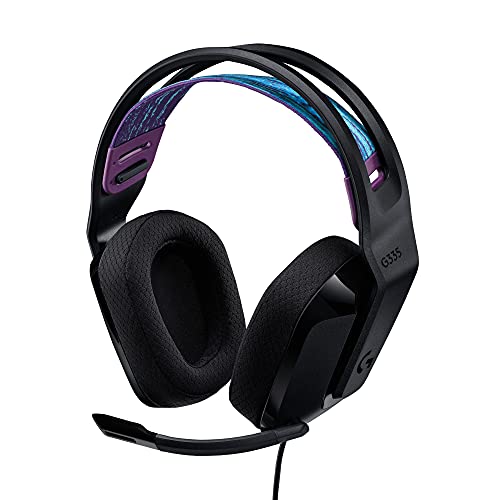
Logitech G335 Wired Gaming Headset — The flip-to-mute comfort pick
The G335 is Logitech’s wired comfort argument, and its title keeps the recipe legible: memory foam earpads, a flip-to-mute microphone, a 3.5mm audio jack, and compatibility with PC, PlayStation, Xbox, and Nintendo Switch, the full four-platform sweep that no other pick in this guide matches exactly. Where its wireless siblings sell architecture and endurance, the G335 sells simplicity worn lightly: plug in, flip the boom down, play for as long as you like, and never think about a battery, a pairing menu, or a firmware prompt.
Flip-to-mute deserves its reputation as the politest microphone gesture in gaming. Rotating the boom upward silences you with a motion your hand learns in a day, which means the doorbell, the coughing fit, and the private aside to someone in the room never reach your squad. Comfort is partly social, and a mute you trust changes how relaxed you are wearing the headset. The memory foam pads handle the physical side with the moulding, pressure-spreading behaviour discussed earlier in this guide. What the title withholds is weight, a recurring theme that buyers should resolve through Logitech’s documentation if the Razer’s published figure has set their expectations. As a wired, four-platform, foam-padded design with the friendliest mute in the list, the G335 is the pick most likely to be recommended to a friend without caveats.
- Earpads: memory foam, stated in the listing title
- Microphone: flip-to-mute boom
- Link to your machine: a plain 3.5mm wired plug
- Systems covered: PC, PlayStation, Xbox, Nintendo Switch
- Battery: none, by design
- Weight: not published in the listing title; Logitech’s documentation is the place to confirm it
Strengths
- All four major platforms are named, the complete sweep in this guide.
- Memory foam pads plus a flip-to-mute boom cover physical and social comfort together.
- No battery, no pairing, no charging: the ownership routine is simply plugging in.
Trade-offs
- The cable is always present, which desk players forget and sofa players cannot.
- Weight goes unstated in the title, complicating the lightest-headset comparison.
- It offers no wireless upgrade path within the same purchase for later.
Best for: a four-platform household wanting one wired headset with foam pads and an instinctive mute. Not suited for: a cable-averse player whose chair sits far from the console or PC.
Check the G335 listing on Amazon for its pad and boom photographs, since those two parts carry its whole comfort case.
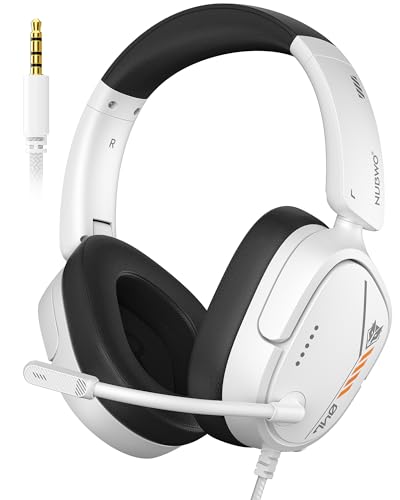
NUBWO HG04L Wired Gaming Headset — The soft earmuff value pick
The HG04L closes the list by combining the two credentials this guide values most in one modest package: a stated weight of 250 grams, only ten grammes above the Razer, and soft memory earmuffs named directly in the title. Its remaining specifications are workmanlike in the best sense: 40mm speakers, a clear unidirectional microphone that picks up voice from the front, a 3.5mm jack, and a platform list covering PC, PS5 and PS4, and both Xbox Series machines and the Xbox One. The title even adds gaming and work as its intended uses, a small honesty that suits a headset many buyers will wear for calls before they wear it for games.
A unidirectional microphone is the right pattern for most homes, gathering your voice while declining the room’s, and pairing it with soft memory foam creates a headset tuned for being worn rather than admired. The 40mm speakers are the smallest stated drivers in this guide, which buyers should register without panic: driver diameter is not a quality score, and for chat-heavy gaming, strategy titles, and work calls, clarity in the voice band matters more than cinematic scale. What the HG04L asks in return for its light weight and soft fit is acceptance of the wired life and of specifications stated plainly rather than lavishly. For a second headset, a work-and-play headset, or a first serious headset for a younger player, that exchange is easy to defend.
- Weight: 250 grams, stated in the listing title
- Earmuffs: soft memory foam
- Speakers: 40mm
- Microphone: clear unidirectional
- Plug: a standard 3.5mm wired jack
- Compatibility as titled: PC, PS5, PS4, Xbox Series X and S, Xbox One
Strengths
- Stated 250-gram weight plus memory earmuffs is a rare pairing at the simple end of the market.
- Unidirectional microphone suits real rooms for both gaming chat and work calls.
- Platform coverage spans PC, PlayStation, and Xbox generations in one wired design.
Trade-offs
- The 40mm speakers concede driver size to the 50mm designs elsewhere in the guide.
- Wired connection only, with no wireless variant implied by the title.
- Switch support is not named, unlike the Logitech and Razer picks.
Best for: a buyer wanting a light, soft, do-everything wired headset for gaming sessions and work calls alike. Not suited for: a Switch player who needs that platform confirmed in the listing title.
The HG04L listing on Amazon states its weight and earmuff material up front, which makes comparison shopping unusually easy.
How Should You Fit a Headset for a Four-Hour Session?
Fit the headset before the session, not during it. Extend the band so the earcups sit centred over your ears rather than resting on them, then let the pads settle for a minute before judging; memory foam in particular needs a short while to mould before its pressure distribution becomes honest. The top of the band or strap should carry its share without a single hot spot, and if one appears within ten minutes it will be a genuine ache by hour three, so adjust early and without embarrassment. Glasses wearers should slide the arms over the pads deliberately and check the seal again, because a frame leg breaking the pad’s contact is the commonest cause of both discomfort and mysteriously thin sound.
Then set your listening level with the same deliberateness. Choose the quietest volume at which dialogue and footsteps remain clear in your noisiest regular game, and treat that as your ceiling rather than your starting point. A well-sealed, comfortable headset rewards this discipline because its isolation does the work that volume otherwise would. Finally, schedule your own breaks. Even the best-fitting headset in this guide benefits from being lifted off during loading screens and lobby waits, letting air reach your ears and the foam recover its shape. Comfort across an evening is a rhythm, not a purchase, and the players who finish long sessions fresh are the ones who manage both.
Which Is Kinder for Glasses Wearers and Sensitive Scalps?
No title in this guide claims a glasses-specific design, so this section reasons from mechanisms rather than promises. Glasses arms suffer where clamp force is high and pads are stiff; memory foam pads, fitted on the Cloud II, G335, and HG04L, yield around the arms more forgivingly than firm foam, which is a genuine if modest advantage. The G733’s suspension strap helps a different group: players whose scalps resent pressure at the crown, since the strap spreads load across fabric instead of a padded arc’s narrow contact line. The two lightest stated headsets, the Razer and the NUBWO, help everyone a little, because total load is the sum that all these mechanisms merely redistribute.
If you wear glasses and play long, the practical order of experiments is: try a memory foam model first, fit it with the care described above, and only then consider whether the remaining discomfort is a pad problem, a clamp problem, or a weight problem. Each cause has a different cure in this list, and misdiagnosing it is how players end up owning three headsets that all hurt in the same place. Readers who split time between a desk and a console should also see best headsets for pc and ps5, where several of these comfort questions reappear in a two-machine setting.
How Do the Six Rank When the Session Runs Past Midnight?
| Headset | Connection | Stated weight | Comfort mechanism |
|---|---|---|---|
| Logitech G325 | Lightspeed wireless plus Bluetooth | Not stated in title | All-day comfort brief, built-in mic |
| HyperX Cloud II | Wired | Not stated in title | Memory foam pads, aluminium frame |
| Logitech G733 | Lightspeed wireless | Not stated in title | Suspension headband |
| Razer BlackShark V2 X | Wired 3.5mm | 240 grams | Featherweight frame, isolating earcups |
| Logitech G335 | Wired 3.5mm | Not stated in title | Memory foam pads, flip-to-mute boom |
| NUBWO HG04L | Wired 3.5mm | 250 grams | Soft memory earmuffs |
Read the table as three different answers to one question. The wireless pair answer with endurance and architecture: the G325 with an all-day brief and a battery that outlasts the day, the G733 with a strap that changes where weight lands. The foam trio answer with contact quality, moulding memory foam against your head in three different frames. The light pair answer with arithmetic, publishing weights low enough that distribution matters less. Midnight does not care which answer you chose, only that you chose deliberately; every headset here can finish a long session on the right head, and every one can fail on the wrong head for a reason its title honestly disclosed.
What Do Comfort Shoppers Most Often Get Wrong?
The commonest mistake is judging a headset in the first ninety seconds. Showroom comfort is pad softness; midnight comfort is weight, clamp consistency, and heat, none of which declare themselves quickly. The second mistake is assuming a heavier headset must be the better-built one. The two published weights here belong to respected designs, and lightness in this category is engineering, not cheapness. Third, buyers fixate on earpads and ignore the headband entirely, then wonder why the top of the head aches while the ears feel fine; the G733’s strap exists precisely because that complaint is so common.
Fourth, players buy wireless for comfort and then sit tethered to a charging cable because they never built a charging habit, achieving the worst of both worlds; the G325’s long battery forgives this more than most, but the wired four never face it at all. Fifth, shoppers treat comfort as universal, ordering the model a streamer praised without asking whether that streamer’s head, glasses, climate, and session length resemble their own. Fit is the most personal specification in gaming hardware, and the honest guides are the ones, like this one, that describe mechanisms and let you match them to your own head.
How Do You Keep Pads and Straps Comfortable for Years?
Wipe earpads weekly with a cloth barely dampened with water, and let them dry fully before the next session; sweat and skin oils are what crack pad covers and flatten foam prematurely. Rotate the headset off your head during breaks rather than wearing it around your neck, which stretches pads and bands in directions they were not shaped for. Store the headset on a stand or hook instead of under books or inside a crowded drawer, since a frame stored under pressure slowly becomes a frame shaped by pressure. Suspension straps reward the same respect: keep the G733’s strap untwisted and unknotted, and it will keep its tension honest for years.
When pads eventually flatten, and on a daily-worn headset they will, judge the headset before replacing it in anger. Flattened pads raise clamp pressure, thin the sound, and make a good headset feel tired; the frame, drivers, and microphone underneath are usually still sound. Owners who understand that pads are consumables get a second life from headsets that other owners discard, and the memory foam models here, which start with generous padding, tend to announce their wear gradually enough to plan around.
How Does Clamp Force Feel Different From One Head to Another?
Clamp force is the inward squeeze that keeps a headset sealed and stationary, and it is the comfort variable players describe worst, because the same force reads as reassuringly secure on one head and as a slow headache on another. Narrower heads experience a given clamp as stronger, since the band flexes less to fit them and returns more of its spring. Wider heads spread the pads further, which can soften the squeeze while stretching the band’s shape. None of the six titles here publishes a clamp figure, and no honest guide can rank them on it, which is exactly why the mechanisms matter as proxies: memory foam forgives clamp by moulding under it, the G733’s strap removes the crown from the equation, and the two lightest headsets simply give the clamp less mass to hold in place.
There is also a break-in truth worth knowing before you judge any new headset harshly. Bands relax slightly and pads soften across the first weeks of use, so a headset that feels assertive on day one often feels settled by day twenty. The reverse never happens; a loose, sloppy fit does not tighten with age. If you are between two picks in this guide and one feels marginally firm in early impressions while the other feels marginally vague, history favours the firm one. Players who share a headset between household members should expect the fit to drift toward the widest head in the house, and should re-check their own fit after a teenager has borrowed it for a weekend.
What Role Does the Cable Play in Wired Comfort?
Four of these six headsets are wired, and their comfort story is incomplete without the cable, because a cable is a physical relationship between you and your machine. A cable routed badly drags at the left earcup, catches on armrests, and reminds you of itself every time you turn. The same cable routed with a little slack, dropped behind the desk edge or clipped loosely to a shirt, disappears from consciousness within minutes. Desk players can make almost any wired headset in this guide feel weightless at the ear by managing that slack once, deliberately, instead of fighting the cable nightly by accident.
Cable weight also tugs asymmetrically, which is why some wired players develop a one-sided ache they blame on the pads. Rotating your seating position, changing which side the cable falls on where the design allows, or simply giving the lead a supported path removes that quiet bias. Console players plugging into a controller hold the cable’s other end in their hands, which shortens the free length and largely solves the routing question by geometry. None of this appears in any listing title, yet it decides whether the Cloud II, the BlackShark, the G335, and the HG04L feel like the light, simple tools they are or like tethered compromises. The wired life rewards five minutes of setup more than any other category in gaming audio.
How Should You Test Comfort During the Return Window?
Use the return window as a laboratory with a protocol, not as a vague reassurance. On the first evening, wear the headset for your longest typical session, in your usual chair, playing your usual game, and note the time when you first become aware of wearing it; that awareness point is your personal comfort score. On the second evening, repeat the test with glasses if you ever play in them, and with the room at its warmest, because heat is the variable most likely to ambush a foam-padded model in July. On the third, test the social side: a full evening of voice chat, muting and unmuting as life demands, because a microphone arrangement that irritates you will quietly shorten every future session.
Keep notes like a reviewer rather than impressions like a shopper. Write down where pressure gathered, whether your ears felt hot, whether the top of your head complained, and whether the cable or the charging routine interrupted anything. If the notes point at the crown, this guide’s strap design is your next experiment. If they point at weight, the published figures here give you two lighter destinations. If they point at heat, shorter breaks and a fabric-friendly routine may rescue the headset you already own. A headset that passes your own three evenings will not surprise you in month six, and surprises, in comfort shopping, are almost never pleasant.
Why Do Streamers and Desk Workers Judge Comfort Differently?
A streamer wears a headset the way a presenter wears a microphone: for a fixed, intense block, under lights, while performing. A desk worker wears one the way office workers wear shoes: all day, mostly forgotten, until the moment it hurts. Those two lives rank this guide’s six picks differently, and recognising your own pattern prevents buying for someone else’s day. The performer values the G733’s voice processing and the Razer’s isolation, because the broadcast cares about the delivered sound and the room’s noise. The all-day wearer values the G325’s stated endurance and boom-free face, because a microphone parked in front of your mouth from nine until nine becomes a presence, and presences accumulate.
Hybrid players, whose workday slides into a gaming evening on the same chair, are the fastest-growing audience for this category and arguably its best served. The HG04L names work in its title without embarrassment, the G325 names all-day comfort with the same directness, and the G335’s four-platform plug covers the office laptop and the evening console with one cable. If that description matches your furniture, weight your shortlist toward the picks that speak about duration and dual duty, and treat pure gaming flourishes, surround processing and titanium driver materials, as pleasant extras rather than the decision itself. Comfort bought for the day you actually live is comfort that survives contact with your calendar.
What Should You Spend the Money You Save on, Instead?
Comfort shopping has a useful heresy: the headset is only half the wearing experience, and the chair, the room temperature, and the screen height decide the other half. A player who buys the G335 or the HG04L rather than a flagship wireless model keeps a meaningful sum unspent, and some of it earns more comfort invested in a chair that supports a neutral neck, a small fan that keeps a summer room humane, or a monitor arm that raises the screen so the head stops tilting forward into the headset’s clamp. Posture multiplies fit: the best-padded headset in this guide will still ache on a player folded toward a low screen for four hours.
This is not an argument against the premium picks, whose straps, processing, and wireless freedom solve real problems money legitimately buys. It is an argument for sequencing. Fix the room and the chair first if they are broken, because no headset outruns its environment, then choose the mechanism in this list that matches the discomfort that remains. Players who shop in that order report the strange satisfaction of a mid-priced headset feeling luxurious, because it was asked to solve only the problem a headset can solve.
Final Recommendation
Choose by the discomfort you actually know. If your crown aches under ordinary bands, the G733’s suspension strap is the structural answer. If your neck tires and your sessions run long, the Razer’s published 240 grams and the NUBWO’s 250 are the honest arithmetic. If you want one headset from morning work to midnight gaming with no cable at all, the G325 was titled for exactly that day. If your household spans consoles and wants proven foam in a metal frame, the Cloud II remains the veteran’s choice, and if you want that foam with a flip-to-mute boom across all four platforms, the G335 is the simplest recommendation in this guide. Comfort is personal, but it is not mysterious: match the mechanism to your own head, test it across three honest evenings in your own chair, and any of these six will still feel right when the session runs long and the room has gone quiet around you.
Frequently Asked Questions
Which of these headsets is the lightest?
Of the titles that publish a weight, the Razer BlackShark V2 X is lightest at a stated 240 grams, with the NUBWO HG04L close behind at 250 grams. The other four titles do not state a weight, so their makers’ documentation is the route to a complete comparison.
Is a suspension headband really more comfortable?
For players who get a sore spot at the crown, usually yes, because the G733’s strap spreads the load across flexible fabric instead of a padded arc. Players who prefer a firm, predictable band fit may still favour a conventional design, which is why both architectures appear in this guide.
Do memory foam earpads make a headset hotter?
They can feel warmer than open fabric because foam that moulds closely also seals closely, and seal traps some heat. In return you get gentler pressure and fuller sound at lower volume. In hot rooms, regular short breaks keep any of the foam models here pleasant.
Wireless or wired for pure comfort?
Wireless removes the cable’s tug and lets you stand, stretch, and fetch drinks mid-session, which many players experience as comfort itself. Wired removes the battery’s weight and the charging routine. The G325 and G733 argue the first case; the four wired picks argue the second.
How long should a comfortable headset stay comfortable?
A well-fitted model should feel nearly forgettable for two to three hours at a stretch, with short breaks extending that across an evening. If a headset hurts within the first hour, the cause is fit, clamp, weight, or pads, and each cause points to a different pick in this guide.
Does a lighter headset always sound worse?
No, and this guide’s own list disproves the assumption. The 240-gram Razer carries 50mm titanium drivers, a specification plenty of heavier headsets would happily claim, while the 250-gram NUBWO covers the voice band that dominates chat and strategy gaming with smaller speakers used efficiently. Weight lives in frames, batteries, and materials; sound lives in drivers and tuning. The two budgets overlap, but neither dictates the other, which is why this guide refuses to treat grammes as a quality score in either direction.
Should I size up if I have a larger head?
Headsets do not come in sizes, so the equivalent move is choosing mechanisms that forgive. A suspension strap stretches to fit without detents, memory foam yields where firm foam resists, and a metal frame like the Cloud II’s holds a wider fit without feeling strained. Extend any band fully before judging it, centre the cups carefully, and give foam a minute to mould; many supposedly small headsets are simply unadjusted ones, and the fitting routine earlier in this guide exists to separate the two.
Can one headset here serve both gaming and work calls?
Yes. The NUBWO HG04L names work in its title, the G325’s built-in noise-reducing microphone suits calls as readily as chat, and the G733’s Blue VO!CE processing was designed to make voices sound tidy anywhere. Any of the three crosses over gracefully. The deciding detail is usually the microphone’s manners across a full day of meetings: a flip-to-mute boom like the G335’s gives you a physical privacy gesture between calls, while a boom-free design like the G325’s keeps your face clear for video. Pick the gesture your working day will repeat most often.
Related Guides
- best folding gaming headsets
- best gaming headsets for first person shooters
- best headsets for pc and ps5


