What's inside
- Key Takeaways
- Quick Picks
- How Did We Assemble This Six-Headset Field?
- Comms Headset or Protective Muff — Why Does the Difference Matter on the Field?
- Connectors, PTT Buttons, and Radios — What Must Match What?
- How Do You Run Comms Well Once the Headset Is On?
- How Do These Airsoft Communication Headsets Stack Up?
- CQB, Woodland, or Milsim — How Does Your Game Format Reorder the Priorities?
- Batteries, Spares, and Storage — What Keeps a Squad Audible All Season?
- What Does the Whole Field Look Like in One View?
- What Does a Well-Run Squad Net Actually Sound Like?
- What Mistakes Silence More Airsoft Players Than Bad Radios Do?
- Final Recommendation
- Buying for a Whole Squad? How Does the Arithmetic Change?
- Frequently Asked Questions
- Related Guides
As an Amazon Associate I earn from qualifying purchases. This post may contain affiliate links at no extra cost to you.
widgetverdict.com is reader-supported. When you buy through links on our site, we may earn an affiliate commission.
Where to buy: Amazon stocks all six headsets compared here, but airsoft comms gear punishes careless ordering more than most kit — the plug standard on the headset has to match the radio in your vest, so confirm the connector named in each listing title against your own radio before the box is opened, not after.
The best communication headsets airsoft players can buy sit at the crossing of two different product families, and understanding that crossing is the whole game. From one side come electronic ear muffs, built to manage loud sound while letting speech and ambient cues through. From the other come radio headsets, built to move your voice onto a team’s channel through a push-to-talk button and a microphone that survives being shouted into through a mask. A proper airsoft comms headset is both at once: it carries your radio traffic, keeps your ears covered on a field where pyrotechnics and close-quarters noise are real, and does it all under a helmet, over hours, in weather. This guide compares six headsets that live at that crossing, and it is deliberately blunt about the one entry that does not: a headset with no noise reduction function is a radio accessory wearing a muff’s shape, and it is labelled as such below.
Compatibility is the second blunt topic. Airsoft radios speak through connectors, and the titles here name names: the EARMOR M32X declares itself Kenwood/Baofeng compatible, the Hearangel specifies a K 2 Pin PTT — the Kenwood-style two-pin family — and the Pdflie lists a parade of Motorola professional models for its U94 PTT. A headset that cannot plug into your radio is not a bargain at any quality level; it is a costume. The third topic is protection honesty. Three titles here state an NRR of 22dB and one states 26dB; the ATAIRSOFT title states, with unusual candour, that it has no noise reduction function at all. This guide reports those positions exactly as printed and promises nothing beyond them. Players building a full loadout may also find the desk-side comms thinking in Best USB-C Headsets useful for the wired hours, but the field is a different country, and it starts here.
Key Takeaways
- Four of the six titles state a noise figure — three at NRR 22dB and one at 26dB — and one title states plainly that it offers no noise reduction.
- Radio compatibility is named, not implied: Kenwood/Baofeng on the M32X, a K 2 Pin PTT on the Hearangel, and a Motorola model list on the Pdflie.
- Helmet integration splits the field: the M32 Plus is helmet ready, and the M32X mounts to ARC rails directly.
- Only the M32X states a waterproof grade in its title, IPX-5.
- The Retevis EH080K is the amplification outlier, claiming 5X sound amplification and wireless connectivity alongside its radio role.
- Every pick carries a microphone and a comms purpose; none is a passive muff with a radio sticker.
Quick Picks
| Pick | Badge | Why it earns its place |
|---|---|---|
| EARMOR M32 Plus | The helmet-ready all-rounder | Stated NRR 22dB electronic protection with a microphone, pitched for airsoft and helmet use alike. |
| EARMOR M32X Helmet Headset | The ARC rail specialist | Rail-mounted, IPX-5 in the title, and Kenwood/Baofeng compatibility declared up front. |
| Retevis EH080K | The amplified radio muff | Stated NRR 22 dB, 5X sound amplification, and a walkie-talkie brief from a radio-first brand. |
| ATAIRSOFT Tactical Headset | The honest comms-only shell | A microphone headset whose title admits no noise reduction — comms and coverage, nothing more claimed. |
| Pdflie 26dB Tactical Headset with U94 PTT | The Motorola professional bridge | A stated 26dB figure and a U94 PTT wired for a named list of Motorola professional radios. |
| Hearangel Tactical Headset | The K-plug field pick | Sound pickup with noise reduction and a K 2 Pin PTT, finished in coyote brown for field kit. |
How Did We Assemble This Six-Headset Field?
The first requirement was a microphone and a comms pathway in the title itself. Airsoft is full of handsome earmuffs that protect passively and communicate never; they belong in a different guide. Each pick here either names a radio ecosystem, a PTT arrangement, or a walkie-talkie purpose outright. The second requirement was protection candour in either direction: titles that state a figure get quoted, and the one title that disclaims noise reduction entirely was kept deliberately, because a comms-only headset honestly labelled serves the player whose field is quiet and whose budget is spoken for elsewhere — pretending it protects would be the only real failure. The third screen was helmet reality. Airsoft headgear is a system — helmet, rails, straps, mask, goggles — and headsets that ignore that system get sold on within a season, so rail mounting and helmet readiness earned their places in the final six.
The final screen was brand logic. EARMOR appears twice because its two models answer genuinely different questions — headband versatility versus rail integration — and Retevis earns its slot as the radio-native manufacturer in a field of muff natives, a difference in design ancestry that shows in its feature list. The Pdflie and Hearangel represent the wired PTT tradition at two different radio ecosystems, and the ATAIRSOFT holds the honest-budget corner. Together the six map the actual decision a player faces: which radio you own, how your helmet is built, and how much sound management your field’s noise genuinely demands.
Comms Headset or Protective Muff — Why Does the Difference Matter on the Field?
Strip the category to first principles and two jobs emerge. Job one is moving information: your callouts onto the channel, your squad’s voices into your ears, clearly enough that a whispered grid reference survives wind, movement, and a mask. Job two is managing the acoustic environment: covering the ears against the crack of a nearby pyro, the rattle of a gas pistol at arm’s length, and the general percussion of a busy CQB site, while still hearing the marshal, the footsteps on gravel, and the opponent who thinks they are being quiet. A pure radio headset does job one and leaves your ears bare or thinly covered. A pure protective muff does job two and leaves you shouting. The headsets in this guide exist because experienced players refuse to choose, but they refuse in different proportions — and the proportions are the comparison.
The electronic entries — both EARMORs and the Retevis — add a third capability on top: active listening. Their microphones sample the environment and reproduce it at managed levels, so the covered ear still gathers intelligence. That is the same awareness principle the range world prizes, explored at length in the hearing protection guide, and on an airsoft field it translates to hearing movement through a doorway your eyes have not cleared yet. The wired PTT entries take a different bargain: simpler electronics, a physical button your thumb finds by memory, and compatibility with the professional radios some teams standardise on. Neither philosophy is the correct one; the correct one is the philosophy your squad already runs, because comms gear is a team purchase wearing an individual price tag. A player joining an established squad should buy the headset that speaks to the squad’s radios, and only then optimise within that constraint — a lesson the ride-to-the-field crowd in Best Bluetooth Headsets for Cycling would recognise, since group gear always outvotes personal preference.
Connectors, PTT Buttons, and Radios — What Must Match What?
The compatibility chain has three links, and a break at any of them silences you. Link one is the plug family. The Kenwood-style two-pin arrangement — the K plug — is the airsoft default, carried by Baofeng and Kenwood radios and a sea of clones; the Hearangel’s K 2 Pin PTT and the M32X’s Kenwood/Baofeng declaration both live in this world. Motorola’s professional radios use their own arrangements, and the Pdflie’s title does the buyer the courtesy of naming the exact models its U94 PTT serves — a list worth reading character by character against the radio in your kit, because near-matches in plugland are still mismatches. Link two is the PTT itself: the button unit that keys the radio. A U94-style PTT is a chunky, glove-friendly brick worn on the chest or shoulder, pressed by feel; integrated and inline PTTs are smaller and easier to lose under kit. Choose the button your gloved hand can find at a run, in the dark, without looking.
Link three is the one players forget: the wiring path from headset to PTT to radio has to survive your loadout. Cables route under straps, across plate carriers, and past sling hardware, and every connector is a snag point and a sweat point. Before a game day, dress-rehearse the whole chain in your full kit — helmet on, mask on, vest loaded — and transmit to a teammate across the room. Discover the crackle, the reversed plug, and the PTT that hides under your sling in the kitchen, not in the first firefight. Teams standardising from scratch should standardise deliberately: one radio family, one plug family, spare PTTs in the team box. The cheapest comms failure to fix is the one prevented by that single boring decision.
How Do You Run Comms Well Once the Headset Is On?
Hardware is half the discipline; the other half is talking like a person whose channel is shared. Keep transmissions short, structured, and closed: who you are, what you see, where it is, then stop. The grid reference or the doorway colour beats the excited paragraph every time, and the squad that agrees its brevity codes before the game — contact, moving, holding, hit — speaks a private language that stays intelligible under adrenaline. Transmit discipline also means knowing when silence is the message: a channel full of chatter masks the one call that matters, so experienced squads keep social talk for the safe zone and let the net breathe during play.
Volume and microphone placement decide whether that discipline is audible. A boom mic wants to sit at the corner of the mouth, not in front of it, catching consonants without catching breath; a mic buried in a mask muffles the callout the whole system exists to carry. Set radio volume in the staging area against real field noise, not in a quiet kitchen, and re-check after the first engagement, because adrenaline reliably makes players shout into systems that were already loud enough. Finally, build the failure drill: headsets die, plugs work loose, batteries fade. A squad with agreed hand signals and a rally point treats a dead channel as an inconvenience; a squad without them treats it as a collapse. The headsets in this guide are good tools, and good tools deserve a team that can still function the day one of them stops.
How Do These Airsoft Communication Headsets Stack Up?
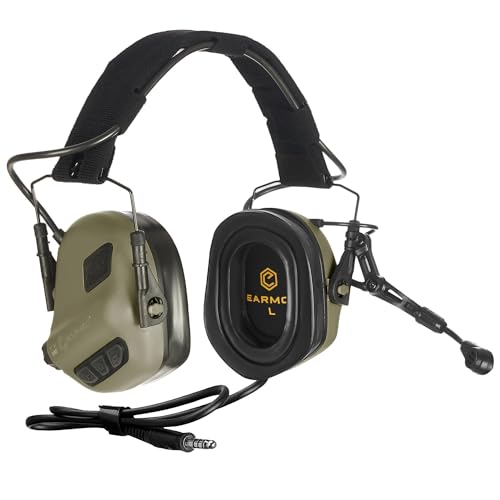
EARMOR M32 Plus — The helmet-ready all-rounder
The M32 Plus is the reference design of modern airsoft comms: an electronic earmuff with a stated NRR 22dB, noise cancelling language in its title, a microphone fitted as standard, and a stated readiness for military helmet use that tells you exactly which head it expects to share space with. Its title ranges across shooting, gun range, hunting, and airsoft without embarrassment, and that breadth is credible here because the core feature set — electronic ambient management plus a comms mic — genuinely is the shared requirement of all four activities. For the airsoft player, the helmet-ready claim is the operative one: a muff that coexists with a helmet’s straps and profile instead of fighting them is a muff still being worn in game three.
Against its sibling below, the Plus is the flexible form: where the M32X commits to ARC rails, the Plus keeps the conventional muff architecture that moves between helmet, cap, and bare head across a player’s different game formats — milsim weekends under a helmet, casual CQB under a cap, range days under neither. That flexibility is worth money to players whose kit changes with the event. What the title does not name is a radio ecosystem, so the buyer must confirm the Plus’s plug and PTT arrangement against their own radio in the listing details and documentation — EARMOR’s ecosystem is broad, but broad is not the same as universal, and this guide’s standing rule applies: the connector decides, not the brand.
As the squad-standard candidate, the Plus also benefits from being the design its rivals imitate: gel-cup upgrades, rail kits, and accessories in the wider market tend to appear for the popular pattern first. A player building a first serious comms setup around a Kenwood-family radio could do far worse than start here and specialise later.
One more consideration separates the Plus from its rail-mounted sibling in daily life: lending. A headband headset can be handed to a guest, a new squad member, or a borrowed helmet without tools or mounting decisions, and squads that recruit constantly — which is to say, healthy squads — feel that flexibility monthly. The Plus is the headset that lives equally well on the owner’s head and in the team’s circulation, and circulation is where comms culture is actually built: one borrowed game with working comms converts more sceptics than a season of advocacy.
- Stated rating: NRR 22dB, printed in the listing title
- Ambient handling: electronic ear protection with noise cancelling language
- Helmet fit: described as military helmet ready, with microphone
- Radio pairing: confirm the plug and PTT arrangement for your radio in the listing details
- Intended use per title: shooting, gun range, hunting, and airsoft
Strengths
- Electronic awareness and a stated rating in one helmet-friendly package.
- Moves between helmet, cap, and bare-head play without rail commitment.
- The pattern’s popularity means a deep accessory and spares ecosystem.
Trade-offs
- The title names no radio family, so compatibility homework is mandatory.
- Headband-style wear under some helmets still demands careful strap routing.
- No waterproof grade is stated in the title for wet-weather players.
Best for: players building a first serious electronic comms setup that must serve several game formats. Not suited for: rail-committed helmet builds that want the headset mounted, not worn.

EARMOR M32X Helmet Headset — The ARC rail specialist
The M32X takes the M32 formula and bolts it — literally — to the helmet. ARC rail mounting replaces the headband entirely: the cups attach to the rails on the helmet’s sides, which removes the strap-under-helmet pressure point that gives players a headache by midday and makes the headset part of the helmet system rather than a guest under it. For the committed helmet player, that integration is transformative in a way spec sheets undersell; a headset that lives on the helmet gets donned with the helmet, every time, with zero separate decisions. The title backs the format with substance: NRR 22dB stated, noise canceling ear protection language, an IPX-5 waterproof grade — the only stated waterproof figure in this guide — and Kenwood/Baofeng compatibility declared in plain words.
That compatibility line deserves its prominence. The Baofeng-and-clones ecosystem is airsoft’s de facto radio standard at club level, and a headset that names it in the title removes the compatibility lottery entirely for the majority of players. The IPX-5 grade likewise answers the British-weather, Pacific-Northwest, and monsoon-season players whose games do not cancel for rain: splashing and jets of water are the rating’s territory, and a rail-mounted headset cannot be quickly pocketed when the sky opens, so the sealing is not decorative. The costs of specialisation are real and should be accepted knowingly: off the helmet, the M32X has no casual second life as a range muff, and a player who changes helmets changes mounting hardware with them. Within its chosen role, though, this is the most completely specified pick in the guide.
Teams building a standard helmet for every player — the milsim unit look with functional teeth — will find the M32X the easiest standardisation decision here: one helmet pattern, one radio family, one headset, spares that fit everyone. Standardisation is a competitive advantage disguised as a shopping choice.
- Mounting: ARC rail helmet headset with microphone
- Stated rating: NRR 22dB
- Waterproof grade: IPX-5, stated in the title
- Radio pairing: Kenwood/Baofeng compatible, stated in the title
- Intended use per title: airsoft, military, and hunting
Strengths
- Rail mounting ends headband-under-helmet pressure for good.
- The only stated waterproof grade in the guide suits all-weather fields.
- Declared Kenwood/Baofeng pairing removes the plug lottery for most club players.
Trade-offs
- Rail commitment means no casual off-helmet second life.
- Changing helmet platforms means changing mounting hardware too.
- Players outside the Kenwood/Baofeng world gain nothing from its headline pairing.
Best for: helmet-first milsim players on Kenwood-family radios who play in all weather. Not suited for: cap-and-headband players who rarely wear a helmet at all.

Retevis EH080K — The amplified radio muff
Retevis arrives at this category from the opposite direction to everyone else: it is a radio company that built a muff, where the others are muff companies that added radios. The EH080K’s title shows the ancestry — a noise-reducing communication headset with hearing protection, for shooting, with wireless connectivity, a walkie-talkie headset with ENC, a stated NRR 22 dB, and 5X sound amplification in an over-the-head format. The 5X amplification figure is the headline act: amplified ambient listening strong enough to be quantified in the title, aimed at the player who treats hearing as reconnaissance. Footsteps, brush, a magazine change behind a barrier — amplification is the feature that turns a protective muff into a sensor.
ENC — environmental noise cancellation, in the radio world’s usage — speaks to the transmit side: your voice cleaned up for the channel, which matters in wind and beside a running vehicle at a milsim staging area. The wireless connectivity phrase is the title’s vaguest element, and buyers should pin down in the documentation exactly what it connects to and how, since a radio headset’s value lives in its wired relationship with a specific radio. That homework aside, the EH080K is the pick for the player whose squad already runs Retevis radios and whose play style rewards aggressive ambient listening. Its over-the-head format keeps it in the conventional wearing world — no rail commitment — and its stated rating matches the EARMOR pair, so the decision between them is genuinely about amplification philosophy and radio ancestry rather than protection figures.
There is a team-logic bonus here as well: a squad standardised on one radio brand’s ecosystem gets coherent accessories, coherent spares, and a single support channel when something crackles. The EH080K is the natural standard for a Retevis-radio squad in the same way the M32X is for a Baofeng one.
The amplification headline deserves one practical translation before a buyer commits to it. Five-times ambient gain, used well, is a woodland and CQB sense organ: it stretches the distance at which movement announces itself and makes a cautious opponent’s small noises arrive early. Used carelessly — gain high, attention low — it floods the wearer with their own breathing, their own kit’s creaks, and the wind’s opinion of every leaf. The skill is in the dial, and the EH080K’s buyer should budget their first two games to learning it: start moderate, raise it in quiet phases, lower it in loud ones, until the setting becomes as reflexive as a safety catch.
- Stated rating: NRR 22 dB
- Ambient handling: 5X sound amplification, stated in the title
- Transmit feature: ENC on the walkie-talkie link
- Format: over-the-head communication headset
- Connectivity detail: wireless connectivity is claimed in the title — confirm its exact role in the documentation
Strengths
- The strongest amplification claim in the guide, quantified in the title itself.
- Radio-native design ancestry shows in the ENC transmit treatment.
- Stated rating matches the category’s electronic mainstream.
Trade-offs
- The wireless connectivity claim needs documentation to interpret precisely.
- No helmet-rail or helmet-ready language appears in the title.
- Over-the-head wear shares the strap-routing homework of all headband designs.
Best for: Retevis-radio squads and players who hunt by ear with amplification high. Not suited for: rail-helmet builds wanting the headset mounted to the shell.

ATAIRSOFT Tactical Headset — The honest comms-only shell
Every guide needs one product that tests the reader’s honesty, and the ATAIRSOFT is it. Its title describes a tactical airsoft headset with a microphone, waterproof, for hunting and shooting headphones use — and then states, in plain capital-letter energy, no noise reduction function. That sentence is the most trustworthy line in this entire comparison, because it tells you exactly what the product is not. What it is: a muff-shaped communications headset that puts your radio in your ears and your voice on the channel, covers your ears against weather and knocks, and makes no claim whatsoever about managing loud sound. On a field where the loudest event is a spring pistol and the pyro policy is strict, that can be a legitimate tool.
The failure mode to avoid is buying it for the wrong field. A player heading to a site where blank-fire, thunder flashes, or close gas-gun fire are routine needs genuine sound management, and no microphone quality compensates for its absence. Read in its correct role, though, the ATAIRSOFT serves the budget squad, the loaner-kit box, and the quiet-field regular — and its waterproof claim, while ungraded in the title, at least signals weather intent that several electronic rivals do not state at all. It also serves as this guide’s standing reminder to read titles the way contracts are read: the ATAIRSOFT’s maker told the truth in the headline, and the buyer who skims past it has only themselves to blame. Players whose fields are loud should treat the electronic entries above as the real shortlist and this one as the exception that proves the rule — a comms accessory, honestly sold, for quiet work.
Squads outfitting a loaner pool for new players will recognise the niche precisely: a headset that gets a guest onto the channel, keeps their ears covered against the day’s bumps, and costs the club little when it inevitably gets dropped, soaked, or lost. Every team box needs one product nobody cries over.
Label it, though. The loaner headset’s worst enemy is ambiguity about what it is: a guest handed the ATAIRSOFT at a loud site, believing the muff shape promises protection the title never claimed, has been failed by the squad, not by the product. A strip of tape on the cup — comms only, quiet fields — turns the maker’s honesty into the team’s honesty, and costs eleven seconds.
- Sound management: none — the title states no noise reduction function
- Comms: headset with microphone for radio use
- Weather claim: waterproof, with no grade stated in the title
- Format: muff-style tactical headset
- Intended use per title: airsoft, hunting, and shooting contexts
Strengths
- Complete candour in the title about what it does not do.
- Puts a whole squad on the channel at loaner-kit cost and risk.
- Covers the ears against weather and knocks while carrying comms.
Trade-offs
- No noise reduction at all — wrong tool for pyro-heavy or loud fields.
- No electronic amplification, so covered ears gather no intelligence.
- The waterproof claim carries no stated grade to rely on.
Best for: quiet fields, loaner kits, and budget squads that need channels more than sound management. Not suited for: any field where pyrotechnics or close loud fire are part of the day.
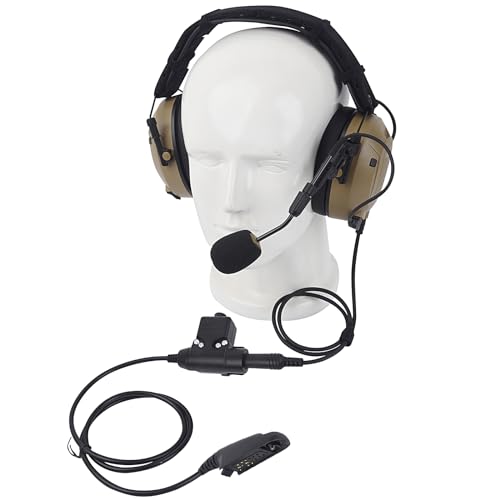
Pdflie 26dB Tactical Headset with U94 PTT — The Motorola professional bridge
The Pdflie exists for a specific and under-served player: the one whose team runs professional Motorola radios — the GP and HT series iron that flows from surplus, security work, and serious milsim organisations — and who discovers that consumer airsoft headsets simply do not plug into them. Its title leads with a stated 26dB noise cancelling figure, the highest number in this guide, and then does something admirably unglamorous: it lists the radios. GP328, GP338, GP340, GP380, HT750, HT1250, HT1550, MTX8250, MTX9250, PR860, PRO5150 — that litany is the product, because for the owner of one of those radios, compatibility is not a feature among features; it is the gate through which every other virtue must pass.
The U94 PTT is the other half of the proposition. The U94 pattern is the chunky, chest-worn push-to-talk brick that professional and military users standardised on: big enough to key with gloves, positive enough to feel through a vest, and mounted where a thumb or a palm heel finds it without a glance. For milsim players replicating professional loadouts — or professionals themselves moonlighting on the airsoft field — that interface authenticity is functional, not cosmetic. The stated 26dB figure should be read as the title presents it, a noise cancelling claim attached to a comms headset rather than a laboratory NRR in the electronic muffs’ format, and buyers should weigh it accordingly. But for its intended reader, the calculation is already done: if your radio is on that list, this is your headset, and the rest of this guide is a tour of other people’s ecosystems.
There is a broader lesson in the Pdflie’s existence about how comms markets actually segment: not by quality tiers but by connector tribes. The wisest airsoft purchase order is radio first, headset second, accessories third — and the Pdflie is what the second step looks like when the first step was a professional one.
- Stated figure: 26dB noise cancelling, as printed in the title
- PTT: U94 push-to-talk with microphone
- Radio pairing: a named Motorola professional list — GP, HT, MTX, and PRO series models in the title
- Format: military airsoft communication tactical comms headset
- Amplification: no ambient amplification claim appears in the listing headline
Strengths
- Serves the professional Motorola ecosystem that consumer headsets ignore.
- U94 PTT is the glove-friendly, feel-it-through-the-vest professional standard.
- The highest stated sound figure in the guide at 26dB.
Trade-offs
- Useless to Baofeng and Kenwood owners — its virtue is its narrowness.
- The 26dB claim is a cancelling figure, not directly comparable to the NRRs above.
- No electronic ambient amplification is claimed in the title.
Best for: milsim players and professionals running the named Motorola radios. Not suited for: club players on Baofeng or Kenwood radios, who should shop the K-plug entries.
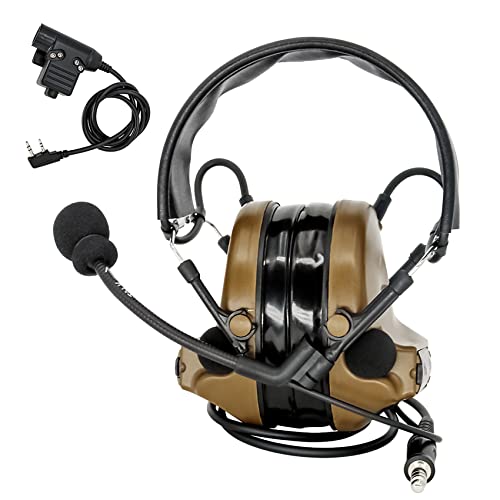
Hearangel Tactical Headset — The K-plug field pick
The Hearangel closes the guide with the classic club-level formula, stated without ornament: a tactical headset with sound pickup and noise reduction, a K 2 Pin PTT, built for airsoft activities, finished in coyote brown. Sound pickup is the field term for the ambient listening that the electronic muffs call amplification — the headset’s microphones gather the environment so covered ears stay informed — and pairing it with noise reduction language places the Hearangel in the electronic camp conceptually, even though its title states no NRR figure for this guide to quote. The K 2 Pin PTT is its compatibility signature: the Kenwood two-pin family that Baofeng and the club-radio mainstream speak, making this the straightforward plug-into-the-squad’s-radios choice for the majority ecosystem.
Coyote brown is a small detail that signals its intended reader precisely — the field player whose kit is built in earth tones for woodland and outdoor sites, where black gear outlines itself against brush. CQB players in dark interiors will care less; woodland regulars will read the colour as evidence the maker knows their field. What the title leaves open is the depth of its electronics — no amplification multiple, no rating, no waterproof grade — so the Hearangel asks for the documentation check this guide keeps prescribing, and rewards it by being the uncomplicated middle of the category: electronic listening, standard plug, field finish, no ecosystem surprises. For a player equipping a first helmet-or-headband setup around a Baofeng, it is the low-drama option, and low drama is an underrated virtue in gear that must simply work on Sunday.
It is also the natural second headset — the one that lives in the kit bag for the friend who finally accepts the invitation, already speaking the squad’s plug language. Guest-proofing a squad’s comms is how squads grow, and headsets like this are the growth medium.
- Ambient handling: sound pickup with noise reduction language in the title
- PTT: K 2 Pin push-to-talk
- Radio pairing: the Kenwood-style two-pin family, per the K plug designation
- Finish: coyote brown
- Stated rating: the listing headline prints no NRR figure — verify in the documentation
Strengths
- Sound pickup keeps covered ears gathering field intelligence.
- K two-pin PTT matches the club-radio mainstream out of the box.
- Field-toned finish suits woodland kit rather than fighting it.
Trade-offs
- No stated NRR in the title for rating-led buyers to weigh.
- Electronics depth — amplification strength, sealing — needs documentation to confirm.
- Motorola-ecosystem players are outside its plug family entirely.
Best for: woodland and club players on Kenwood-family radios wanting electronic listening without drama. Not suited for: professional-radio users, whose ecosystem the Pdflie serves instead.
CQB, Woodland, or Milsim — How Does Your Game Format Reorder the Priorities?
Close-quarters battle is the headset stress test: distances collapse, pyro and gas fire happen at arm’s length, and communication becomes a staccato of room calls where a half-second of clarity is a won corridor. CQB argues for electronic sound management first — the field is loud in bursts and information-dense between them — and for the lowest, tightest wearing profile your helmet allows, because doorframes and barricades tax every protruding cup. The rail-mounted M32X and the amplification-led Retevis both speak CQB fluently, one through integration and the other through hearing. Woodland inverts the day: hours of quiet movement punctuated by contacts at range, where the headset’s job is mostly listening — to the channel’s sparse traffic and to the brush itself. Amplification and sound pickup dominate the woodland brief, weather sealing matters because the sky is the ceiling, and the Hearangel’s field-toned formula and the M32X’s stated IPX-5 both read as woodland answers.
Milsim adds the dimension the other formats only flirt with: duration and doctrine. Events run long, radios run to squad nets with real discipline, and loadouts replicate professional patterns down to the PTT brick on the chest. That is the Pdflie’s home ground and the M32 family’s helmet-integrated heartland, where the headset is judged as part of a system worn for a weekend rather than a toy used for an afternoon. The honest cross-format conclusion is that no pick here wins all three games; the player who rotates formats should buy for the format they play most and forgive the headset its compromises in the others, while the committed single-format player should buy with both hands and no apology.
Batteries, Spares, and Storage — What Keeps a Squad Audible All Season?
Comms gear fails at the margins of ownership, not in the showroom. Electronic headsets eat batteries on a schedule their owners forget, so the squad that sounds professional in month six is the squad with a battery calendar: fresh cells or a full charge before every game day, spares in a labelled pouch in the team box, and a hard rule that a headset showing low-battery behaviour gets fed before it gets worn. Cables and connectors are the second margin. Inspect the run from cup to PTT to radio monthly for fraying at the strain reliefs, seat every plug with a deliberate push rather than a hopeful one, and treat intermittent crackle as a cable obituary being drafted — replace the lead in the workshop, not in the safe zone with the game already running.
Storage is the third margin and the cheapest. Headsets stored dry, uncompressed, and out of the damp kit bag keep their cushions, their contacts, and their dignity; headsets stored under a plate carrier in a wet bag grow corrosion and contempt in equal measure. Keep the loaner unit — every squad ends up owning one, and this guide’s ATAIRSOFT is shaped for the role — in the same dry discipline, because a loaner that crackles teaches new players that comms are unreliable, which is the opposite of the lesson the loaner exists to teach. None of this appears on a spec sheet, and all of it decides whether the spec sheet ever gets a chance to matter.
What Does the Whole Field Look Like in One View?
| Pick | Stated sound figure | Radio world | Helmet approach | Defining trait |
|---|---|---|---|---|
| EARMOR M32 Plus | NRR 22dB | Confirm plug per listing | Helmet ready, conventional wear | Flexible all-rounder |
| EARMOR M32X | NRR 22dB | Kenwood/Baofeng | ARC rail mounted | IPX-5 stated, fully integrated |
| Retevis EH080K | NRR 22 dB | Retevis walkie-talkie ecosystem | Over-the-head | 5X amplification |
| ATAIRSOFT Tactical | None — no noise reduction | Microphone headset | Conventional muff wear | Honest comms-only shell |
| Pdflie with U94 PTT | 26dB cancelling claim | Motorola professional list | Conventional wear | Professional bridge |
| Hearangel Tactical | Not stated in title | K 2 Pin PTT | Conventional wear | Sound pickup, field finish |
Read the table column by column and the category’s logic appears. The radio-world column is the true first sort — it eliminates half the table for any given player before quality is even discussed. The stated-figure column is the second sort, with the ATAIRSOFT’s honest blank teaching more than several numbers do. Helmet approach is the third: rail, ready, or regular. A player who sorts in that order — ecosystem, sound, mounting — will land on the right row of this table in about ninety seconds, and the remaining work is confirming details rather than choosing direction.
What Does a Well-Run Squad Net Actually Sound Like?
Listen to a good net for one game and its grammar becomes obvious. Calls are addressed before they are sent — a name or callsign first, so the right ears attend. Information travels in the order a moving player needs it: what, where, how many, what it is doing. Acknowledgements are single words. Silence stretches long between transmissions, and into that silence the important calls land like stones into still water. Now listen to a bad net: unaddressed excitement, three players narrating the same corridor, a running commentary on one player’s entire game, and — underneath it all — the one quiet call about the flank that nobody heard. The headsets in this guide are all capable of carrying the first net. None of them can create it. That is built in staging, in the five minutes where the squad agrees callsigns, two or three brevity codes, and the rule that the channel is for the team, not for the highlight reel.
The practical test for a new setup is therefore not a range test but a rehearsal: five minutes of staged calls in the car park, each player transmitting once from their actual position in the stack, with the actual masks and gloves on. Squads that run that rehearsal discover their dead plug, their buried PTT, and their mumbler while the stakes are zero. Squads that skip it discover the same list at the worst available moment, every single season, and call it bad luck.
What Mistakes Silence More Airsoft Players Than Bad Radios Do?
The classic failure is buying the headset before the radio, or worse, buying both from different ecosystems in the same optimistic order. Plug families are not a detail; they are the product. The second mistake is skipping the full-kit rehearsal: a headset that transmits beautifully on the kitchen table crackles under a sling, hides its PTT under a chest rig, or collides with a mask’s lower mesh the first time the player shoulders their replica. The third is microphone neglect — a boom left pointing at a cheek or buried in a mask, reducing the clearest radio on the field to underwater mumbling. Ninety seconds of placement in staging outperforms any hardware upgrade.
Fourth, players over-trust a stated figure and under-respect their field: a 22dB title claim is a product specification, not a personal guarantee, and the player whose site runs heavy pyro should think in layers and habits, not in a single number. Fifth, squads let the channel rot — no brevity codes, no callsigns, social chatter during play — then blame the headsets for a discipline problem. Sixth, owners store comms gear in a damp kit bag with batteries ageing inside, then act surprised by corrosion in spring. Dry storage, batteries checked on a calendar, and a spare PTT in the team box: the unglamorous trinity that keeps a squad audible season after season. Players who also ride to games may enjoy the group-communication parallels in Best USB Gaming Headsets Under $150 — different hardware, same truth that the channel is a team asset.
Final Recommendation
Sort by your radio and the rest follows. Baofeng and Kenwood players building around a helmet should take the M32X and be done — rails, stated rating, stated waterproofing, declared compatibility. The same players in mixed headgear should weigh the M32 Plus’s flexibility or the Hearangel’s straightforward K-plug field formula, while Retevis-radio squads and aggressive listeners take the EH080K and its 5X amplification. Motorola professionals have exactly one door in this guide and it is labelled Pdflie. And the ATAIRSOFT holds its honest corner for quiet fields and loaner boxes. Whichever row of the table is yours, rehearse in full kit before the first game — the headset that has survived a kitchen firefight with your actual loadout is the one that will still be talking in the last game of the day, when the light is low, the field is loud, and the call that matters finally comes.
And if the budget forces one compromise, let it be finish, colour, or brand romance — never the plug, and never the rehearsal. A modest headset correctly matched to its radio outperforms a flagship shouting into the wrong socket, and a squad that understands that sentence owns the only statistic that matters on the field: everybody heard, everybody understood, nobody guessing.
Buying for a Whole Squad? How Does the Arithmetic Change?
Individual logic buys the best headset; quartermaster logic buys the best system, and the two diverge quickly. A squad of six does not need six identical top-tier headsets — it needs a standard that every radio in the team box speaks, a loaner tier for guests, and spares where failure actually happens: PTTs and cables, not cups. The pattern that works is a mainstream electronic standard for regulars — the M32 family or the EH080K, depending on the squad’s radio ancestry — one or two honest comms-only units in the ATAIRSOFT’s mould for the guest box, and a spares pouch that travels to every game. Standardising the plug family across all of it matters more than standardising the model: a guest headset that speaks the squad’s plug language is worth three superior headsets that do not.
The quartermaster should also buy for the team’s actual radio future, not its nostalgic past. A squad drifting from club Baofengs toward professional Motorolas — a common milsim trajectory — should weight the Pdflie’s ecosystem as next season’s standard and avoid deepening the K-plug bench beyond the regulars who will keep using it. Gear benches are path-dependent; every purchase is a small vote about what the squad will be running in two years, and the teams that vote deliberately spend half as much on adapters, compromises, and regret.
Frequently Asked Questions
Will a Kenwood-plug headset work with a Motorola radio?
Not directly — plug families are physical standards, and the K two-pin arrangement does not seat in Motorola’s professional sockets. That is precisely why the Pdflie exists with its named Motorola list, and why this guide insists on matching the title’s declared ecosystem to the radio in your vest before anything else is compared.
Do I need electronic amplification for airsoft?
Need is strong, but the advantage is real: sound pickup and amplification let covered ears keep gathering footsteps, movement, and marshal calls, turning protection into intelligence. Players on quiet, open fields feel the benefit least; CQB and woodland players, where threats announce themselves by sound before sight, feel it most.
Is a stated NRR of 22dB enough for airsoft?
That figure is a product specification quoted from the titles, not a promise this guide makes about any individual’s experience. Airsoft’s loud events are mostly pyrotechnics and close-range gas replicas; players at pyro-heavy sites commonly layer habits and positioning on top of their headsets. Judge your field’s actual noise, and treat the stated figure as one input among several.
Headband or helmet rail — which mounting is better?
Rail mounting wins for dedicated helmet players: no under-helmet pressure, and the headset dons with the helmet. Headband designs win for everyone else, moving between caps, helmets with careful routing, and bare heads. The M32X and M32 Plus are this guide’s cleanest expression of the two philosophies from one maker.
Do I need a licence for the radios these headsets serve?
That depends on the radio and the country, not the headset — the headset is a passive accessory to whatever transmitter it serves. Many club radios operate in licence-free allocations, while some professional and higher-power sets carry licensing duties that fall on the operator. Check your radio’s own documentation and your local rules; the headset choice in this guide neither creates nor removes those obligations. When a squad travels to an event in another region, the radio question travels with it, so the quartermaster’s checklist should include the allocation question alongside batteries and plugs.
Can I use these headsets for shooting as well?
Several titles say so themselves — both EARMORs and the Retevis name shooting or the gun range in their intended uses. The exception that must not cross over is the ATAIRSOFT: a headset whose title disclaims noise reduction has no business at a live-fire range, whatever its shape suggests.
What should a first-time comms buyer purchase first?
The radio, if the squad has a standard — because the headset must speak to it — and the headset immediately after, from the ecosystem the radio dictates. Buying in the other order is how players end up owning a beautiful headset and an adapter cable held together by hope. If your squad has no standard yet, the Kenwood-family mainstream is the safest harbour: it is where the M32X’s declared compatibility, the Hearangel’s K plug, and the widest accessory market all live.
How do I stop my PTT from going missing under my kit?
Mount it where your hand falls naturally — chest or shoulder, on the side of your support hand — then rehearse finding it with gloves, eyes forward, a dozen times in staging. A U94-style brick like the Pdflie’s is the easiest pattern to find by feel; smaller inline buttons demand a fixed, practised home and a cable route that cannot migrate.
Related Guides
One closing habit costs nothing and pays every single game: after the last engagement, while the kit is still on, ask your squad one question — did everybody hear everything that mattered? The answers, gathered while the day is fresh, are the finest comms audit ever devised, and they will tell you whether next month’s money belongs in headsets, in batteries, or in five minutes of staging-area discipline. Players rounding out their kit may also want Best Bluetooth Headsets for Cycling for the ride to the field, Best USB-C Headsets for wired desk and dispatch hours, and Best USB Gaming Headsets Under $150 for the squad’s other battlefield, the evening one.


