What's inside
- Key Takeaways
- Quick Picks
- How Did We Choose These TV Headsets?
- Which Connection Type Suits Your Television?
- Why Does Personal Volume Matter More Than Loudness?
- Which of the Six Picks Fits Your Sofa?
- How Do the Six TV Listening Systems Differ Side by Side?
- How Should You Set Up a TV Headset Without Lip-Sync Frustration?
- What Mistakes Do TV Headset Buyers Keep Making?
- How Much Do Charging Habits Decide Long-Term Satisfaction?
- What Should You Know About Comfort Across a Full Film?
- Why Do Some Programmes Sound Clear and Others Still Mumble?
- How Do You Share One Television Between a Headset Listener and the Room?
- What Does a Sensible Troubleshooting Order Look Like?
- How Do the Three Transmission Families Behave Across a Real Week?
- What Should Gift Buyers Check Before Wrapping a TV Headset?
- How Long Should a TV Headset Last, and What Wears Out First?
- Which Details Separate a Good Evening From a Great One?
- How Should You Think About Sound Quality in a Television Headset?
- What About Households Where the Television Is Also the Music System?
- How Do You Run a Fair First-Week Test of a New Set?
- What Changes When the Viewer Wears Hearing Aids?
- Where Should the Transmitter Live in a Tidy Room?
- Final Recommendation
- Frequently Asked Questions
- Related Guides
As an Amazon Associate I earn from qualifying purchases. This post may contain affiliate links at no extra cost to you.
widgetverdict.com is reader-supported. When you buy through links on our site, we may earn an affiliate commission.
Where to buy: each set in this roundup ships as a complete listening kit with its own transmitter or base, so the shopping decision is less about hunting accessories and more about matching a transmission method to your television and your sofa.
The best headsets to use with tv viewing solve a domestic problem before they solve an audio one: two people share a room, they want different volumes, and the television speakers force a compromise nobody enjoys. A dedicated TV headset gives one listener a private volume while the set itself stays low or even silent, which changes late-night films, early-morning news and hard-to-follow dialogue from negotiations into simple choices. Every pick here arrives with the hardware that gets sound out of the television, because a bare Bluetooth headphone paired directly to a set often brings lip-sync lag, pairing menus and volume quirks that a purpose-built transmitter avoids.
Three transmission families appear in this group, and the differences matter more than brand badges. The Sennheiser uses a radio-frequency link through its own charging transmitter, the 1Mii set uses a 2.4G connection through a charging base, and the remaining four lean on Bluetooth transmitters that plug into optical, RCA or 3.5mm outputs. Radio links tend to wander through walls and let you fetch a drink without silence, while Bluetooth sets trade some of that roaming freedom for earbud form factors, noise cancelling and smaller charging docks. Neither family is automatically better; the right answer depends on your room, your ears and who else is watching.
One framing note before the picks: these are listening products, not medical devices. Several listings speak to seniors and to viewers who struggle with dialogue, and the honest way to read those claims is that personal volume, left-right balance and clear-voice tuning make television easier to follow at your own level. Nothing here diagnoses, treats or replaces a hearing assessment, and anyone whose difficulty extends beyond the sofa should treat that as a separate conversation with a professional. What these sets legitimately offer is control — your volume, your balance, your late-night session — without asking the whole room to share it.
Key Takeaways
- A transmitter in the box is the defining feature: optical, RCA or auxiliary feeds from the television beat a bare Bluetooth pairing for lip-sync and reliability.
- Radio-frequency and 2.4G sets, represented by the Sennheiser and the 1Mii, roam further from the sofa than Bluetooth earbuds typically manage.
- Form factor splits the field: two over-ear and on-ear options, three earbud sets, and one Avantree box that includes both a headphone and earbuds.
- Dialogue help comes from personal volume, channel balance and voice-focused tuning rather than from raw loudness alone.
- Charging docks double as transmitters on several picks, which keeps the nightly routine to dropping the headset back on its base.
- Check your television outputs before ordering: an optical-only set and a set with only analogue inputs are not interchangeable.
Quick Picks
| Pick | Badge | Why it earns its place |
|---|---|---|
| Sennheiser RS 120-W | The radio-link classic | An on-ear headphone whose transmitter doubles as its charger, built for wandering beyond the sofa. |
| Avantree Medley Pebble | Open-ear earbud set | Bluetooth 5.3 earbuds with a transmitter and charging dock, tuned toward clear voice for TV listening. |
| Avantree D4169 Dual Headphones & Earbuds Set | Two listeners in one box | A headphone and an earbud set sharing one Bluetooth transmitter, each with personalised volume control. |
| HomeSpot ANC Earbuds TV Set | Noise-cancelling earbuds | True wireless earbuds with active noise cancelling and a Bluetooth transmitter made for TV listening. |
| SIMOLIO TV Headphones | Balance and bypass controls | Bluetooth earphones with left-right balance, independent volume and an optical bypass toward a soundbar. |
| 1Mii ClearLinkTV H3 | The long-session 2.4G set | A 2.4G low-latency headphone with a transmitter charging base and a headline play time figure of 75 hours. |
How Did We Choose These TV Headsets?
We started from the transmitter, because that component decides whether a TV headset feels effortless or fiddly. Each pick includes one in the box, and we favoured sets whose connection menu covers the outputs real televisions actually offer: optical digital, RCA and 3.5mm auxiliary. A headset that sounds wonderful but cannot plug into your set is furniture, so connection coverage carried as much weight as driver talk. We also separated plug-and-play kits, which pair at the factory and simply work when powered, from sets that ask you to manage Bluetooth pairing on a television menu — a meaningful difference for a gift purchase.
Latency was the second filter. Dialogue that trails moving lips by even a small margin becomes exhausting within minutes, so listings that state a low-delay design or a no-audio-delay claim earned attention, while we treated those claims as manufacturer statements rather than laboratory measurements. Battery and charging routines came third: a dock that is also the transmitter removes a cable from the ritual, and headline play-time figures were recorded from listing titles without converting them into promises about your viewing week. Finally, we deliberately mixed form factors and transmission families so the six picks answer different households instead of repeating one design six times. Readers comparing setups for a shared production space may also find the crew-focused thinking in Best Headsets for Theater and Stage Crews useful, even though that guide covers intercom systems rather than home listening.
Which Connection Type Suits Your Television?
Optical output is the cleanest feed most modern televisions offer, and several picks here accept it directly. Its one trap is format: a set that outputs Dolby-encoded audio over optical can leave a simple stereo transmitter silent until the television audio menu is switched to PCM. That single menu change fixes a large share of “my new headset has no sound” returns across the whole category, so make it your first check with any optical kit. RCA and auxiliary outputs are older, analogue and forgiving; they work on sets that predate optical ports, and they often stay live while the television speakers play, which suits households where one person listens through a headset and another through the room speakers.
Bluetooth transmitters add a second decision: which devices pair, and in what order. The Avantree and HomeSpot kits handle this by shipping earbuds already matched to their transmitter, so the television never enters a pairing menu at all. That design is the strongest argument for buying a set rather than assembling parts. The Sennheiser and 1Mii sidestep Bluetooth entirely with their own radio links, which is why they behave more like appliances: switch on, sit down, listen. If your household already juggles phones, tablets and a soundbar around the television, fewer shared Bluetooth relationships usually means fewer mysterious evenings.
Why Does Personal Volume Matter More Than Loudness?
Dialogue intelligibility rarely fails because a programme is quiet overall; it fails because music and effects sit louder than speech, or because one ear hears better than the other. That is why the SIMOLIO’s left-right balance control and independent volume are substantive features rather than garnish, and why the Avantree D4169’s personalised volume on each of its two listening devices matters for couples. A headset that lets a viewer raise speech without raising the explosion that follows it solves the actual problem. Turning everything up equally just moves the compromise closer to your head.
Hearing comfort also has a time dimension. Earbuds concentrate sound at the ear canal and can feel intense over a three-hour film, while the on-ear Sennheiser spreads pressure differently and the open-ear Pebble design deliberately leaves the canal unsealed so room conversation remains possible. None of these approaches is universally kinder; they suit different sensitivities. The practical test is a full film, not a two-minute demo, and buyers should use the return window honestly if a form factor irritates them by the second evening.
Which of the Six Picks Fits Your Sofa?

Sennheiser RS 120-W — The radio-link classic
The RS 120-W is the elder statesman of this group: an on-ear wireless headphone paired with a transmitter that also serves as its charging cradle. That combined base is the design’s quiet genius. The headphone lives on the transmitter between sessions, so it is charged by habit rather than by intention, and the radio link it uses was built for exactly one job — carrying television sound around a home. Radio-frequency transmission does not care much about a wall between you and the set, which makes this the pick for viewers who wander to the kitchen during adverts and dislike their programme vanishing at the doorway.
On-ear pads keep the headphone light and let some room sound through, a trade that suits shared rooms: a partner can still get your attention without waving. The compromise is isolation and low-end weight; this is a clear, speech-friendly presentation rather than a cinematic rumble machine, and action films will sound tidier than they feel. Controls sit on the headphone itself, and the whole system avoids apps, accounts and pairing rituals. For a household that wants television listening to behave like a kettle — filled, switched on, forgotten — that simplicity is the product.
- Form: on-ear wireless headphone
- Base: transmitter and charger combined in one unit
- Link: dedicated radio connection to its own transmitter
- Charging routine: headphone rests on the base between sessions
Strengths
- The charging transmitter removes nightly cable management entirely.
- Radio transmission keeps audio alive when you leave the room briefly.
- On-ear lightness suits long news, sport and film sessions.
Trade-offs
- Open on-ear fit leaks some sound and admits some room noise.
- Bass weight is modest next to sealed cinematic headphones.
- The base needs a permanent home near the television.
Best for: a viewer who roams the house during programmes and wants the headphone charged by default on its stand.
Not suited for: a film fan chasing sealed, cinema-style isolation, because the on-ear design deliberately lets the room stay audible.
For current availability on the RS 120-W, see its Amazon listing.

Avantree Medley Pebble — Open-ear earbud set
The Medley Pebble takes the opposite physical approach: small open-ear Bluetooth 5.3 earbuds, a transmitter and a charging dock. Open-ear buds rest outside the canal rather than sealing it, so the wearer hears dialogue at a personal level while still catching a doorbell, a kettle or a partner’s question. Avantree positions the tuning toward clear voice, and the listing states a play time of ten hours, which covers an evening of viewing with room to spare but asks for the dock overnight rather than offering multi-day stamina.
This is the set to consider when headphones feel like too much apparatus — too warm in summer, too enclosing for someone who dislikes pressure on the ears, or awkward over certain hairstyles and hearing aids worn behind the ear, though fit with any personal device should be checked individually rather than assumed. The transmitter handles the television side, so setup stays in kit territory instead of television-menu territory. Sound will not pressurise like a sealed earbud; speech clarity is the currency here, and the open design spends bass to buy awareness of the room.
- Form: open-ear true wireless earbuds
- Link: Bluetooth 5.3 through the included transmitter
- Extras: charging dock included in the box
- Play time: ten hours as stated in the listing title
Strengths
- Open-ear fit keeps household sounds and conversation reachable.
- Voice-focused tuning aims squarely at dialogue-heavy programmes.
- The dock gives the buds a fixed home beside the television.
Trade-offs
- Ten-hour stamina means daily docking for heavy viewers.
- Open fit cannot hush a noisy room during quiet scenes.
- Small buds are easier to misplace than a full headphone.
Best for: a viewer who dislikes sealed earbuds and wants speech-forward sound while staying aware of the room.
Not suited for: a household with a loud open-plan kitchen beside the sofa, because the unsealed fit offers no shelter from competing noise.
Availability and dock details for the Medley Pebble are on its Amazon page.
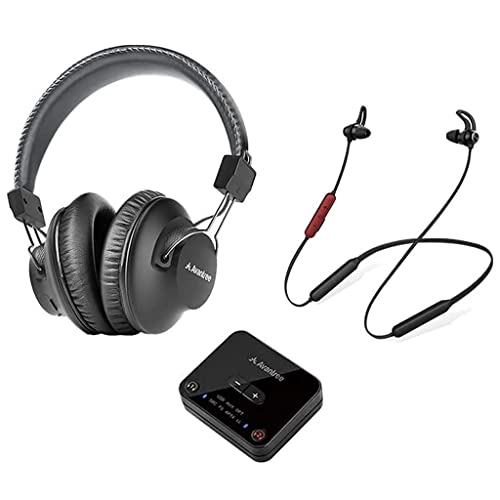
Avantree D4169 Dual Headphones & Earbuds Set — Two listeners in one box
The D4169 is the only pick that answers two different viewers at once: the box contains a wireless headphone and a set of earbuds, both fed by one Bluetooth transmitter. That pairing solves a recognisable domestic pattern — one partner likes a headphone, the other prefers buds, or one listener wants immersion while the other wants to keep an ear on the house. Personalised volume control on each side means neither listener’s level dictates the other’s, which is the entire point of private TV audio.
Avantree describes the set as plug-and-play with no audio delay, and the shared-transmitter design is what makes that plausible in practice: both devices are matched to the same source at the factory. The compromise is that this is a two-device household commitment; the transmitter serves this pair, and adding a third listener later is not the design’s promise. Think of it as a matched set for a specific sofa rather than the seed of a growing system. For couples who watch together nightly at mismatched volumes, few products in this roundup speak so directly to the actual friction.
- Contents: one wireless headphone plus one earbud set
- Source: single shared Bluetooth transmitter
- Volume: personalised control for each listener
- Setup: described by the maker as plug-and-play
Strengths
- Two form factors let each viewer wear their preference.
- Independent levels end the shared-volume negotiation.
- One transmitter keeps the television connection simple.
Trade-offs
- The pair is a closed set, not an expandable system.
- Two devices mean two charging routines to maintain.
- A single viewer pays for hardware they may never use.
Best for: a couple who watch together nightly but need different volumes and different wearing styles.
Not suited for: a solo viewer, because half the box exists to serve a second listener who is not there.
The D4169’s Amazon listing shows the full contents of the dual set.

HomeSpot ANC Earbuds TV Set — Noise-cancelling earbuds
HomeSpot’s entry pairs true wireless earbuds with a Bluetooth transmitter and adds the feature the Pebble deliberately omits: active noise cancelling. In a TV context, ANC earns its keep against steady household noise — a dishwasher cycle, an air conditioner, a fan — by lowering that floor so dialogue can sit at a gentler personal volume. The earbuds seal the canal, which also brings passive isolation before the electronics do anything, making this the most enclosed listening experience among the earbud picks.
The trade is awareness. A sealed, cancelling earbud is the wrong tool for a viewer who needs to hear a child in the next room or a partner beside them, and some listeners simply dislike the pressure sensation ANC can produce. Fit also becomes decisive: an earbud that seals well for one ear may work loose in another during a long film, and the included tip selection matters more than any specification. Buyers who already enjoy true wireless earbuds for music will find the habits transfer; buyers new to the format should expect a short adjustment period.
- Form: sealed true wireless earbuds
- Feature: active noise cancelling stated in the listing title
- Source: Bluetooth transmitter included for the television
- Fit: in-ear seal provides passive isolation as well
Strengths
- Noise cancelling lowers steady household noise under dialogue.
- Sealed fit keeps personal volume lower for the same clarity.
- Familiar earbud format for anyone coming from music listening.
Trade-offs
- Isolation blocks household sounds some viewers must hear.
- Seal quality varies with ear shape and tip choice.
- ANC pressure bothers a minority of listeners over hours.
Best for: a viewer whose living room competes with appliances and who wants dialogue without raising personal volume.
Not suited for: a parent monitoring children in another room, because sealed cancelling earbuds are designed to shut that awareness out.
See the HomeSpot set’s Amazon page for its transmitter and tip contents.

SIMOLIO TV Headphones — Balance and bypass controls
The SIMOLIO listing reads like a checklist written by someone who has answered support calls: clear dialogue emphasis, independent volume, left-right balance, an ambient sound mode, and an optical bypass that passes audio through to a soundbar. The bypass deserves emphasis. Many televisions stop feeding one output when another is used, or households want the soundbar for shared viewing and the headset for solo sessions without re-cabling; a pass-through design keeps both paths alive and makes the headset a layer on the system rather than a replacement for it.
Balance control is the other genuinely personal feature here. Ears are rarely symmetrical, and a viewer whose left ear needs more level than the right gains something no global volume knob can offer. The listing states a range figure of 164 feet, which should be read as a clear-line claim rather than a through-walls guarantee, and it also mentions use as a sound amplifier with a phone. Keep the framing honest: these are convenience controls for television listening, presented in the listing’s own language, not clinical functions. The ambient mode, meanwhile, acknowledges that total isolation is not always the goal at home.
- Controls: independent volume plus left-right balance
- Connection: optical with bypass toward a soundbar
- Mode: ambient sound setting for room awareness
- Range: 164 feet as stated in the listing title
Strengths
- Balance adjustment serves viewers with uneven hearing between ears.
- Optical bypass keeps an existing soundbar in daily use.
- Ambient mode restores room awareness without removing the earphones.
Trade-offs
- The control set asks for a short learning period.
- Headline range will shrink through walls and floors.
- Soundbar households must plan the bypass cabling once, carefully.
Best for: a viewer with one stronger ear who also runs a soundbar for shared viewing.
Not suited for: a minimalist who wants two buttons and nothing else, because the balance, bypass and ambient controls reward a listener willing to set them up.
The SIMOLIO listing on Amazon details its bypass and balance features.

1Mii ClearLinkTV H3 — The long-session 2.4G set
The ClearLinkTV H3 builds its case on endurance and connection breadth. Its listing states a play time of 75 hours, a 2.4G low-latency link, and compatibility with television optical, auxiliary and RCA outputs, all through a transmitter that doubles as the charging base. Even allowing for headline figures being best-case, a set that measures stamina in days rather than evenings changes behaviour: charging stops being a nightly ritual and becomes an occasional one, which is exactly what less technical households need from a gift purchase.
The 2.4G link follows the Sennheiser’s philosophy — a private channel to its own base rather than a Bluetooth relationship with the television — so pairing drama is designed out. Output breadth matters at setup: between optical, RCA and auxiliary, very few televisions from the last two decades lack a workable feed, and that coverage makes the H3 a safer recommendation when the buyer cannot inspect the set in advance. The headphone format keeps controls large and the fit familiar. If the RS 120-W is the classic expression of the dedicated-base idea, the H3 is its stamina-first modern cousin.
- Link: 2.4G low-latency connection to its own base
- Play time: 75 hours as stated in the listing title
- Inputs: optical, auxiliary and RCA television outputs
- Base: transmitter and charging base combined
Strengths
- Long headline stamina suits forgetful charging habits.
- Three input types cover nearly any television in service.
- A private 2.4G link avoids television pairing menus.
Trade-offs
- Headline hours assume favourable volume and conditions.
- The base claims a permanent spot by the television.
- Viewers wanting earbuds get a full headphone instead.
Best for: a gift buyer who cannot check the recipient’s television outputs in advance and wants charging to be rare.
Not suited for: a viewer set on earbuds, because the H3 commits fully to an over-headphone design with a desktop base.
Confirm the H3’s input cables on its Amazon listing before ordering.
How Do the Six TV Listening Systems Differ Side by Side?
| Pick | Form | Link | Defining feature |
|---|---|---|---|
| Sennheiser RS 120-W | On-ear headphone | Radio to own transmitter | Transmitter doubles as charging cradle |
| Avantree Medley Pebble | Open-ear earbuds | Bluetooth 5.3 via transmitter | Clear-voice tuning, charging dock |
| Avantree D4169 | Headphone plus earbuds | Bluetooth via shared transmitter | Personalised volume for two listeners |
| HomeSpot ANC Set | Sealed earbuds | Bluetooth via transmitter | Active noise cancelling |
| SIMOLIO TV Headphones | Earphones | Bluetooth, optical feed | Balance control, soundbar bypass |
| 1Mii ClearLinkTV H3 | Headphone | 2.4G to charging base | Optical, auxiliary and RCA inputs |
Read the table by household rather than by specification. A single roaming viewer belongs in the first or last row; a couple belongs in the D4169 row; a noisy room points at HomeSpot; uneven ears point at SIMOLIO; an earbud-averse listener who wants awareness points at the Pebble. Households building a volunteer media rota may recognise a similar matching exercise in Best Wireless Headsets for Churches, where crew size rather than sofa size drives the choice.
How Should You Set Up a TV Headset Without Lip-Sync Frustration?
Begin with the television powered on and showing speech, not a menu. Connect the transmitter to the output you intend to keep — optical if available — then open the television’s audio settings and set digital output to PCM before judging anything. Power the headset, confirm the factory pairing, and watch a news presenter for a full minute: faces reveal delay that music hides. If speech trails lips, check whether the television has its own Bluetooth enabled and competing; the transmitter path should be the only wireless relationship in play. Then set the television volume to the level your household uses for shared viewing and adjust personal volume on the headset itself, so the two controls stop fighting.
Finish with the physical routine. Park the base where the headset will actually be returned to — a dock behind the television is a dock that will be skipped — and run the cable path once, neatly, because a transmitter that gets unplugged for vacuuming will eventually be unplugged forever. Test the walk-away range honestly by visiting the rooms you genuinely visit mid-programme. Readers who train with structured audio checks, such as the students addressed in Best Headsets for Flight Training, will recognise the principle: verify in the real environment, not at the shop counter.
What Mistakes Do TV Headset Buyers Keep Making?
The most common error is buying a well-reviewed Bluetooth headphone with no transmitter and expecting the television to behave like a phone. Some sets pair beautifully; many pair slowly, drop the connection when inputs change, or introduce delay that dialogue exposes mercilessly. The second error is ignoring the optical format setting, then blaming the headset for silence that a PCM switch would have cured. Third comes form-factor optimism: ordering sealed earbuds for a viewer who has never tolerated anything in the ear canal, or an on-ear headphone for someone who wanted total hush. The product is rarely the failure in those stories; the match is.
A fourth mistake is shopping on range figures alone. Every range number in this category is measured kindly, and the honest variable is your home: brick walls, metal shelving and a transmitter buried behind a large panel all tax a signal. Place the base with a clear-ish path to the seating area and most sets behave; bury it and even a strong link complains. Finally, buyers forget the second listener. If a partner will plausibly join within the year, the D4169’s two-device box or a soundbar-friendly bypass like the SIMOLIO’s is cheaper than replacing a solo set later.
How Much Do Charging Habits Decide Long-Term Satisfaction?
Ask owners of abandoned TV headsets why the device left rotation and the answer is rarely sound quality; it is a dead battery at the moment a film starts. That is why the charging architecture deserves as much scrutiny as the driver size. The Sennheiser and the 1Mii fold charging into the transmitter base, so the resting place and the charging place are the same object. The Avantree Pebble’s dock performs the same trick at earbud scale. Sets that charge by cable demand a deliberate act every few days, and deliberate acts are exactly what evening routines shed. When you compare picks, picture the hundredth evening, not the first: which design will still be charged when you are tired, the programme is starting, and nobody wants to troubleshoot?
Headline play-time figures need translating into household rhythm rather than taken literally. The Pebble’s stated ten hours means a heavy viewer docks nightly; the H3’s stated seventy-five hours means a light viewer might dock weekly. Both are workable, but they suit different temperaments, and the honest comparison is against your own viewing load. A sports household running long weekend broadcasts consumes a charge cycle differently from a news-at-breakfast listener. Match the stamina to the ritual you actually keep, and treat every figure as the maker’s best case measured under friendly conditions.
What Should You Know About Comfort Across a Full Film?
Comfort failures arrive slowly. A headphone that feels fine during a shop demo can build a hot spot on the crown by minute ninety, and an earbud that seals proudly at the start can ache by the credits. Weight distribution explains much of it: on-ear designs press the pinna, over-ear designs spread load around it, and earbuds move the entire burden to the canal and concha. The RS 120-W’s on-ear approach trades isolation for lightness; the Pebble’s open-ear rest avoids canal pressure altogether; the HomeSpot’s seal concentrates both its isolation and its demands in one small contact area.
Glasses wearers should think harder than most. Temple arms trapped under an on-ear pad create a pressure sandwich that grows teeth over an evening, while earbuds ignore spectacles entirely. Viewers who recline against a cushion add another variable, since a bulky rear housing can push against the headrest and shift the fit. None of this appears in specification tables, which is why the return window is part of the product: use it deliberately, watch one full-length film in your real seat, and judge at the credits rather than at the unboxing.
Why Do Some Programmes Sound Clear and Others Still Mumble?
A headset cannot remix a programme. Modern film mixes bury dialogue under score and effects by artistic choice, and streaming platforms add their own compression, so even excellent hardware inherits muddy material. What a good TV headset changes is the listening geometry: the sound arrives at a fixed, close distance, room reflections disappear, and personal volume can rise without consequence. Voice-forward tuning, like the Pebble’s stated clear-voice aim or the SIMOLIO’s dialogue emphasis, tilts the balance further toward speech frequencies. Television features help too — many sets offer a dialogue or clear-voice mode that pairs well with a headset, and enabling both is not cheating; it is the system working as intended.
Subtitles deserve an honest mention in any clarity discussion. A viewer who follows most dialogue but loses names, accents and whispered lines may find captions plus a moderate headset volume more relaxing than maximum volume alone. The headset’s job is to make listening comfortable and private; captions handle the residue. Framing the purchase that way keeps expectations healthy and satisfaction high, because no product in this roundup — or any roundup — can unmix a soundtrack.
How Do You Share One Television Between a Headset Listener and the Room?
Three patterns cover most homes. In the first, the headset listener watches alone while others sleep or read; the television can go fully silent and any pick works. In the second, a partner listens through the speakers at low volume while the headset wearer takes a higher personal level; this needs an output arrangement where the speakers stay alive, which analogue feeds often allow and the SIMOLIO’s soundbar bypass supports in soundbar homes. In the third, two headset listeners watch together at separate levels, which is the D4169’s home ground. Identify your pattern before ordering, because the wrong pattern cannot be fixed by a better headphone — only by different plumbing.
Volume etiquette follows from the same thinking. A headset wearer who cannot hear the room at all may speak too loudly during shared moments, which is where the SIMOLIO’s ambient mode and the Pebble’s open fit earn quiet credit: both let the wearer stay socially present. Households that talk through programmes — sport, news, family viewing — should weight that awareness nearly as heavily as clarity itself.
What Does a Sensible Troubleshooting Order Look Like?
When a TV headset misbehaves, work from the television outward. First, confirm the set is outputting sound at all by raising its own speakers. Second, check the digital format setting and set PCM. Third, reseat the transmitter cable and confirm its power light, because a base fed by a television USB port may sleep when the set sleeps — a switched socket or a separate adapter removes that variable. Fourth, re-pair or power-cycle the headset itself. Fifth, move the base out from behind the panel and test again; large metal-framed screens are effective signal obstacles, and a base peeking past the screen’s edge often transforms a crackling link into a clean one.
Keep notes during the first week. Which input you used, which menu setting changed, where the base finally sat — these details turn a future fault from an evening of guessing into a two-minute restoration. It sounds fussy; it is actually the difference between a gadget that serves for years and one that retires to a drawer after its first bad evening.
How Do the Three Transmission Families Behave Across a Real Week?
Living with a radio-link set like the RS 120-W feels closest to living with a landline telephone: the connection simply exists, indifferent to which other gadgets the household owns. There is no pairing list to corrupt, no phone that can steal the audio path, and no firmware conversation to be had. The cost of that purity is that the headphone speaks only to its own base; it will not double as your train headphone or take a call. Buyers who already own several Bluetooth devices sometimes find that single-purpose nature restful rather than limiting, because the television corner of their home stays permanently solved.
The 2.4G approach of the ClearLinkTV H3 occupies the same appliance philosophy with a different radio band and a much larger stated battery. In practice the two families differ less in sound than in the details around them: base design, input coverage, control layout and stamina. That is why our recommendation between them leans on logistics — the H3’s three input types and rare charging against the Sennheiser’s long-established on-ear design and cradle. Either way, the household gains a system that a guest can operate without instruction, which is an underrated virtue in a product often bought for parents and grandparents.
Bluetooth transmitter kits — both Avantree sets, the HomeSpot and the SIMOLIO — trade a slice of that appliance simplicity for physical variety. Only Bluetooth makes the earbud picks possible, and only Bluetooth brings features like the HomeSpot’s noise cancelling or the SIMOLIO’s ambient mode into a television product at this level. The pairing is factory-managed in these kits, so the traditional Bluetooth friction is mostly designed out; what remains is a slightly longer first setup and a dependence on the transmitter staying powered. Households comfortable with earbuds from phone use will feel at home immediately.
What Should Gift Buyers Check Before Wrapping a TV Headset?
A gift headset fails socially before it fails technically: it must be usable by its recipient without the giver present. That argues for a charging base, factory pairing and controls that can be found by touch. It also argues for a reconnaissance visit. Photograph the back of the recipient’s television, note which outputs are free, and check whether a soundbar already occupies the optical port — the SIMOLIO’s bypass exists for exactly that collision. If the set is old enough to offer only analogue outputs, the H3’s RCA and auxiliary coverage becomes the deciding feature rather than a footnote.
Consider the recipient’s habits with equal care. A viewer who falls asleep in the chair may prefer an on-ear headphone that stays put over earbuds that vanish into cushions. A viewer who wears the headset while moving around the kitchen needs the roaming confidence of a radio link. A viewer who watches with a spouse needs either the D4169’s second device or a setup that leaves the speakers alive. The most appreciated gift in this category is rarely the most advanced; it is the one that required no return trip and no apology.
How Long Should a TV Headset Last, and What Wears Out First?
The electronics in these kits usually outlive their soft parts. Ear pads compress and their coverings eventually crack, earbud tips lose their seal, and batteries gradually surrender capacity across years of nightly cycles. Buyers can slow every one of those clocks: store the headphone on its base rather than on a sofa arm, keep earbuds in their dock instead of a pocket, and wipe skin oils from pads before they migrate into foam. A headset treated that way should serve through several television generations, since the transmitter concept survives even when the panel changes — only the input cable conversation repeats.
That longevity reframes the purchase. Spread across years of evenings, the difference between a merely adequate set and the right set is measured in thousands of comfortable hours versus a drawer of good intentions. It is worth an extra evening of deliberation, one full-film comfort test, and honest use of the return window. The category rewards buyers who treat fit and routine as specifications, because in daily life they are the specifications that matter.
Which Details Separate a Good Evening From a Great One?
Control placement sounds trivial until you are in the dark, mid-scene, trying to lower volume by touch. Raised buttons with distinct shapes beat smooth touch panels for television use, because the viewer’s eyes are busy and the room is dim. A volume wheel or a large rocker can be operated by memory; a capacitive strip asks for a glance and a prayer. When you audition a set, perform the three actions you will repeat nightly — volume down, volume up, power — without looking at your hand. If any of them needs eyes, that friction will repeat thousands of times.
Standby behaviour matters in the same quiet way. A base that wakes instantly when the headphone lifts encourages use; a system that needs a button sequence discourages it. Similarly, a transmitter that draws power from a wall adapter stays ready around the clock, while one fed from a television USB socket may boot with the set and take a few seconds to offer sound. None of these details headline a listing, yet together they decide whether the headset feels like part of the room or like a project. During your first week, notice every moment you think about the hardware; a well-matched set should disappear from thought entirely.
How Should You Think About Sound Quality in a Television Headset?
Television sound is mostly voices, and voices live in the midrange. A headset that flatters film scores with heavy bass can actually work against dialogue, because low-frequency energy masks the consonants that carry meaning. That is why several picks here emphasise clarity over spectacle, and why a flatter, speech-centred presentation often satisfies more over a month of viewing than an exciting first impression. Judge a set with the material you watch most: a panel show for speech, a nature documentary for narration over ambience, and one action sequence to confirm that effects stay composed at your preferred level.
Stereo imaging still matters at the sofa. A headset that places a presenter’s voice dead centre and lets a crowd spread naturally around it makes busy scenes easier to parse, because your brain uses position to separate sources. Balance controls, like the SIMOLIO’s, let you correct a mix — or your own hearing — when centre dialogue drifts perceptually to one side. Listeners who watch alone can tune entirely for themselves, which is a luxury no shared speaker system offers, and it is the deepest reason this category exists at all.
What About Households Where the Television Is Also the Music System?
Some homes run everything through the television: streaming music, radio apps, concert films. A headset fed from the set inherits all of it, which quietly extends the value of any pick here beyond programmes. The roaming listener cooking to a concert broadcast will appreciate the radio-link sets most, while the seated listener analysing a live recording may prefer the HomeSpot’s sealed quiet. Be honest about which share of your listening is moving versus seated; that ratio predicts satisfaction better than any single feature list, and it explains why two neighbours can buy the same set and report opposite experiences.
How Do You Run a Fair First-Week Test of a New Set?
Give the headset a structured trial instead of a vague impression. Night one: set up, switch the television to PCM if you use optical, and watch thirty minutes of dialogue-heavy programming at your normal seat. Note whether setup needed the manual more than once. Night two: watch a full film and record comfort at the halfway point and at the credits, honestly, on a scale you invent. Night three: test the rooms you actually visit during a programme and note where the link thins. Night four: hand the controls to the least technical person in the house and watch whether they can start a session unaided. Night five: run your shared pattern — speakers plus headset, or two headsets — and confirm the household arrangement works as planned.
Score the week against the problem you bought the set to solve. If late-night volume freedom was the goal, did the room truly stay quiet while you heard every line? If dialogue clarity was the goal, did you reach for the volume less often? A set that passes its own brief earns its place even if a specification elsewhere looks larger. A set that fails its brief should go back inside the return window without sentimentality, because the second-best outcome in this category is a quick exchange — the worst is a charged, working headset that nobody wears.
One last calibration: judge the transmitter’s indicator lights in a dark room. A base that glows like a landing strip will annoy light-sensitive sleepers in a bedroom setup, while a set with a discreet status light disappears. Small annoyances compound nightly; the trial week exists to catch them while changing your mind is still free.
What Changes When the Viewer Wears Hearing Aids?
Many television headset buyers also wear hearing aids during the day, and the interaction between the two deserves plain language rather than assumptions. Over-ear and on-ear headphones may fit over some behind-the-ear aids and clash with others; earbuds occupy the canal that in-ear aids use; open-ear designs leave the ear’s furniture undisturbed, which is one reason the Pebble’s format interests this audience. Feedback squeal can occur when a headphone cup seals over an aid’s microphone, and the only reliable test is the individual’s own combination at home.
Keep the boundary clear: a television headset is a convenience for enjoying programmes at a personal volume, and the listings in this roundup are written in that spirit even when they address seniors directly. They are not calibrated to an audiogram, they do not claim to restore hearing, and they should never delay a hearing assessment for someone whose difficulty shows up in conversation, on the telephone and across daily life. Used in its proper place — the sofa, in the evening, for pleasure — a set from this page can still transform how much a viewer enjoys the programmes they love, and that is a worthwhile, honest promise.
Where Should the Transmitter Live in a Tidy Room?
Interior tidiness and signal quality pull in opposite directions: the hidden base performs worst, the visible base performs best. A workable compromise puts the transmitter beside the television rather than behind it, at roughly seated head height, with its front facing the seating. Avoid stacking it on a warm set-top box or inside a closed cabinet whose door becomes a nightly obstacle. Cable runs should follow the television’s existing path so the new kit inherits an already-solved route. Spend ten minutes on this placement once and every evening afterwards inherits the benefit; rush it and you will re-litigate the setup every time the link crackles during a finale.
Final Recommendation
Choose by transmission family first and by wearing style second. If the headset is a gift for someone who values appliances over gadgets, the 1Mii ClearLinkTV H3’s broad inputs, charging base and long headline stamina make it the safest single recommendation in this group, with the Sennheiser RS 120-W as the choice when radio roaming around the house matters most. Couples should skip straight to the Avantree D4169 and end the volume negotiation properly. For individual viewers, let your ears arbitrate: open awareness from the Medley Pebble, sealed quiet from the HomeSpot set, or the SIMOLIO’s balance and bypass controls when one ear or one soundbar complicates the picture. A quiet room, a clear voice and a volume that belongs to you alone — that is the whole promise, and the right pick here delivers it nightly without asking anyone else to turn their evening down.
Frequently Asked Questions
Can other people still hear the television while I use a headset?
Often, yes, and the wiring decides it. Analogue outputs on many televisions stay live alongside the speakers, and the SIMOLIO’s optical bypass exists precisely to keep a soundbar fed. Optical connections on some sets mute internal speakers, so check your model’s behaviour if shared listening matters.
Why does my optical headset stay silent?
The likeliest cause is the television sending an encoded digital format the transmitter cannot decode. Switch the digital audio output to PCM in the sound menu and test again before suspecting faulty hardware; this single setting resolves the majority of silent setups.
Do these headsets work for late-night gaming as well?
They can, provided the console or television feeds the transmitter and the game’s audio follows the same path as broadcast sound. Latency-sensitive competitive play is a stricter test than film dialogue, so casual gaming suits these sets better than tournament play.
How do I clean earbuds and on-ear pads used nightly?
Wipe pads and bud housings with a barely damp cloth and let them dry fully before docking; remove earbud tips periodically to clear wax from the mesh with a dry brush. Avoid soaking any part, and never dock a damp headset, because charging contacts dislike moisture.
What should I check before buying for an older relative?
Confirm the television’s outputs, favour a charging base over loose cables, and pick controls that are large and few. Then be present for the first setup: the PCM setting and the dock position are five-minute jobs that decide whether the gift gets used.
Is a longer stated range always better?
No. Stated range is measured in friendly conditions, and most viewers need reliable coverage of two or three rooms, not a headline number. Base placement and transmission family predict real roaming behaviour better than the largest figure on a box.
Related Guides
Keep exploring the headset shelf: Best Headsets for Flight Training covers cockpit audio for student pilots, Best Headsets for Theater and Stage Crews looks at production intercom systems, and Best Wireless Headsets for Churches matches intercom kits to volunteer media teams.


