What's inside
- Key Takeaways
- Quick Picks
- How Did We Shortlist These Six Electronic Muffs?
- How Does Electronic Hearing Protection Actually Handle Sound?
- When Is a Plain Passive Muff Still the Right Answer?
- What Should You Weigh Before Buying Electronic Muffs?
- Which Electronic Hearing Protection Headsets Line Up Best?
- Range, Field, or Jobsite — How Does Your Loudest Hour Change the Choice?
- What About Doubling Up, Glasses, and the Other Practical Questions?
- Which Electronic Hearing Protection Headsets Earn Their Place in Your Kit?
- How Should You Read a Stated Rating Without Fooling Yourself?
- How Do You Get the Fit and Seal Right Every Time?
- What Mistakes Do Buyers Make With Electronic Muffs?
- How Should a First Session With New Electronic Muffs Go?
- Final Recommendation
- Frequently Asked Questions
- Related Guides
As an Amazon Associate I earn from qualifying purchases. This post may contain affiliate links at no extra cost to you.
widgetverdict.com is reader-supported. When you buy through links on our site, we may earn an affiliate commission.
Where to buy: Amazon lists all six electronic muffs compared here, and the detail worth double-checking on the listing page is the exact variant — several of these lines are sold in Bluetooth and non-Bluetooth versions under near-identical names, and the connected version is the one this guide is about.
The best electronic hearing protection headsets solve a contradiction that plain foam plugs and passive muffs cannot: a shooting range, a hunting field, and a construction site are all places where you need the sharp sounds turned down and the human sounds left audible. A range officer’s command, a hunting partner’s whisper, a reversing vehicle’s beeper — awareness is not a luxury layered on top of protection, it is half the job. Electronic muffs approach the contradiction with microphones and processing: ambient sound is picked up, passed through or amplified at safe listening levels, and the electronics react when a sudden loud impulse arrives. This guide compares six Bluetooth-equipped electronic muffs on the three axes that decide daily satisfaction — how well they keep you aware, how well they handle communication and audio, and how comfortably they wear across a long session.
A note on numbers, because this category invites sloppy reading. A Noise Reduction Rating appears in this guide only where a product’s own listing title states one: the PROHEAR 030 at 22dB NRR, the Peltor Sport Tactical 500 at 25 dB NRR, the 3M WorkTunes Connect at a 26 dB noise reduction rating, and the Mossy Oak muff at NRR 22dB. The Walker’s Razor Digital X-TRM and the ZOHAN 035 titles state no NRR, so none is quoted for them, and their spec boxes say so plainly. No guide can promise what a muff will do for an individual’s hearing — fit, condition, and environment all intervene — so this comparison sticks to what each product claims for itself and how its design behaves in use. Readers who need comms-forward headsets for team play rather than the range should also see Best Communication Headsets for Airsoft, where several designs borrow this category’s electronic awareness for radio work.
Key Takeaways
- Four of the six titles state an NRR — 22dB, 25 dB, 26 dB, and 22dB — and two state none, which is itself useful buying information.
- Every pick pairs electronic sound management with Bluetooth, so calls and audio arrive without removing the muffs.
- Sound amplification or ambient pass-through appears across the group; hearing the range and the field is the category’s founding idea.
- Comfort engineering is explicit in several titles: slim low-profile cups, gel earpads, and a mesh headband all get named.
- Power splits the field: the Mossy Oak is rechargeable, the Walker’s ships with 2 AAA batteries, and the rest leave power details to their documentation.
- Only the 3M WorkTunes title frames itself beyond shooting, toward work — mowing, construction, and jobsite listening.
Quick Picks
| Pick | Badge | Why it earns its place |
|---|---|---|
| PROHEAR 030 Bluetooth | The slim range regular | Stated 22dB NRR, sound amplification, and a slim low-profile cup shaped for long guns and long sessions. |
| Walker’s Razor Digital X-TRM Bluetooth | The comfort-first flagship | Gel earpads and a mesh headband headline a sound-enhancing muff that ships with its first set of batteries. |
| Peltor Sport Tactical 500 Bluetooth | The stated-25 dB all-rounder | A 25 dB NRR in the title and a brief spanning shooting, hunting, mowing, construction, and concerts. |
| 3M WorkTunes Connect | The jobsite listener | A stated 26 dB noise reduction rating — the highest figure in any title here — on a work-first Bluetooth protector. |
| ZOHAN 035 Bluetooth | The Bluetooth 6.0 entry | The newest connection standard in the group, active noise canceling language, and sound amplification in green. |
| Mossy Oak Rechargeable Electronic Ear Protection | The rechargeable field muff | Stated NRR 22dB, dual-mic ambient amplification, a folding frame, and no disposable batteries to feed it. |
How Did We Shortlist These Six Electronic Muffs?
The entry ticket was electronics plus Bluetooth. Passive muffs are a fine, simple technology, but they cannot amplify a whispered conversation or take a phone call, and this guide exists for buyers who need awareness and communication, not silence. Requiring Bluetooth in the title also kept the comparison honest: every pick can receive audio and calls, so the differences that remain are the interesting ones — amplification approach, stated ratings, comfort engineering, and power. The second screen was title candour. Products whose titles state their NRR earned a quotable figure; products whose titles do not were still eligible, but they are presented here without a borrowed number, because inventing or importing a rating for a safety-adjacent product is exactly the kind of shortcut this guide refuses.
The third screen was scenario spread. A range regular, a hunter, and a contractor mowing commercially all wear muffs for hours, but they punish different weaknesses: the range regular punishes bulky cups that foul a rifle stock, the hunter punishes poor ambient directionality and cold-stiff headbands, the contractor punishes short battery thinking and sweat. The final six were kept because each speaks clearly to at least one of those lives in its own title — slim profile, gel comfort, work framing, field folding — rather than six interchangeable black shells. Finally, anything making medical promises was excluded on principle: these are consumer products described in consumer language, and the guide keeps them there.
How Does Electronic Hearing Protection Actually Handle Sound?
The mechanism is easier to follow than the marketing suggests. Microphones on the cups listen to the environment continuously. Quiet and moderate sounds — voices, footsteps, a dog’s movement in brush, range commands — are reproduced inside the cups, in several of these designs amplified, so the wearer hears the world at a managed level rather than through the muffled wall passive cups create. When a sudden loud impulse arrives, the electronics clamp the output rapidly, and the physical cup and seal do their passive work at the same time. The wearer experiences this as continuity: conversation never stops, and the bang arrives diminished rather than raw. The quality differences between models live in the details of that pipeline — how naturally voices render, how quickly the clamp reacts, whether amplified sound preserves the direction it came from.
That last point, directionality, is where the Mossy Oak’s dual-microphone design earns its mention: two microphones, one per side, are the minimum hardware for the brain to keep left and right straight, and hunters who have worn single-mic muffs know the eerie flatness of sound that seems to come from everywhere and nowhere. Amplification level matters in the opposite direction too — in a quiet wood, boosted ambient sound turns twigs and leaves into information, while on a loud indoor range the same boost must stay composed when the lane beside you fires. None of this is measurable from a listing title, which is why the guide treats amplification claims as design intent and reserves its firmer language for the stated facts: ratings where printed, battery arrangements where named, and physical design where described. Bluetooth then rides on top of the whole system as a separate convenience — the muff becomes the headset for your phone, your podcast, or your range timer app without ever breaking the seal, a point the work-focused entries exploit hardest. The cycling world reached a similar awareness-first conclusion from the opposite direction, as Best Bluetooth Headsets for Cycling shows with open-ear designs that never seal at all.
When Is a Plain Passive Muff Still the Right Answer?
Honesty requires a paragraph for the technology this guide passed over. A passive muff has no batteries to die, no electronics to fail in the rain, and a price of entry that lets a club or a family outfit everyone at once. For the occasional shooter who fires a box of shells twice a year under an instructor’s eye, or the homeowner who runs an angle grinder for one weekend project, passive protection honestly fitted is a rational purchase, and foam plugs remain the unbeatable spare to keep in every bag. The electronic premium buys awareness and communication — the amplified voice, the taken call, the directional rustle — and it buys them for people whose loud hours are frequent, long, or social. If your loud hours are none of those, the simple tool is the right tool, and no amount of Bluetooth changes that arithmetic.
Where the calculus flips is repetition. The tenth range day, the fortieth shift, the third hunting season: at that tempo the awareness features stop being luxuries and become the reasons the protection is worn consistently, fitted carefully, and kept in service. This guide’s six picks were chosen for that reader — the regular — and the regular should read the passive alternative as the control group their purchase must beat, not as a temptation. If the electronic muff will genuinely be worn more, heard through more, and maintained better, it has already justified itself before a single specification is compared.
What Should You Weigh Before Buying Electronic Muffs?
Begin with your loudest regular environment and be literal about it. An outdoor range, an indoor range, a duck blind, and a mower deck are four different acoustic problems. Indoor ranges are the most punishing, with reflected impulse noise arriving from every lane; that is the scenario where a stated rating deserves the closest attention and where doubling up with plugs underneath remains a common, sensible practice among frequent indoor shooters. Hunters should weight ambient quality and cold-weather wear — a muff that renders a deer’s approach directionlessly is a muff that gets left in the truck. Workers should weight the audio side: if the muff is also your eight-hour entertainment and call headset, Bluetooth behaviour and comfort are not features, they are the product.
Then examine the seal, because every electronic claim rides on it. A muff’s electronics manage sound that reaches the microphones; the seal manages sound that reaches your ears directly, and a seal broken by glasses arms, a hat brim, or a poor fit undermines the whole system regardless of the circuitry. Gel earpads, named in the Walker’s title, are one engineering answer, moulding around spectacle arms more forgivingly than stiff foam. Cup profile is the shooter’s version of the same question: slim, low-profile cups — the PROHEAR’s stated design — clear a rifle or shotgun stock where deep cups collide with it at the worst moment. Power is the last practical filter. A rechargeable muff folds charging into a weekly habit; a battery muff trades that habit for the certainty of swapping cells in the field, and the Walker’s inclusion of its first AAA pair is a small, honest convenience. Decide which routine fits your life before the first flat battery decides for you.
Which Electronic Hearing Protection Headsets Line Up Best?
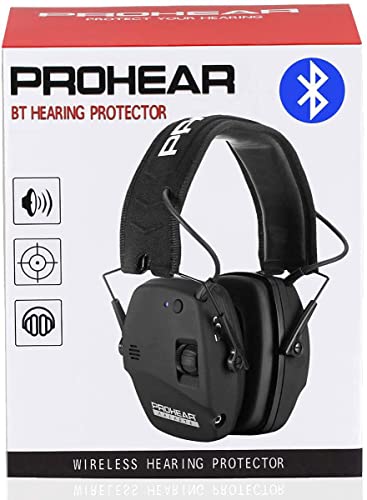
PROHEAR 030 Bluetooth — The slim range regular
The PROHEAR 030 states its case in the order a range regular would rank it: Bluetooth, shooting ear protection for the gun range, electronic hearing protection with sound amplification, slim low-profile ear muffs, hunting suitability, noise reduction, and a 22dB NRR printed in the title where anyone can check it. The slim profile is the design decision with daily consequences. Long-gun shooters mount a stock against the cheek hundreds of times in a session, and a deep cup that kisses the stock on every mount teaches the shooter to break position — or to leave the muffs on the bench. A low-profile cup is the difference between protection worn and protection carried.
Sound amplification is the second half of its brief, and on a range amplification is a safety feature in the plainest sense: ceasefire calls, a coach’s correction, and the metallic wrongness of a squib load all arrive through the amplified channel rather than being guessed at through foam. For hunters, the same amplification turns a quiet sit into a listening exercise, with the slim cup also slipping more comfortably under a hood or cap. The 030 is not the comfort flagship of this group — it makes no gel or mesh claims — nor the highest stated rating; it is the balanced, range-shaped answer, and its title’s willingness to print its NRR up front sets the candour standard the rest of the guide is measured against.
Ownership of a muff like this settles into a rhythm quickly: it lives in the range bag, the amplification becomes the reason plugs feel primitive by comparison, and the Bluetooth earns its keep on the drive-home call and the between-relays podcast. Buyers whose sessions are measured in whole days rather than hours should still read the Walker’s comfort engineering below with envy, and price their own tolerance honestly.
- Stated rating: 22dB NRR, printed in the listing title
- Ambient handling: sound amplification
- Cup design: slim, low profile
- Connection: Bluetooth
- Intended use per title: gun range shooting and hunting
Strengths
- Slim cups clear a long-gun stock instead of fighting it on every mount.
- The NRR is stated in the title itself, so the headline claim is checkable at a glance.
- Amplification keeps range commands and coaching audible without lifting a cup.
Trade-offs
- No gel-pad or headband comfort claims appear in the title for marathon sessions.
- Its stated rating sits below the Peltor and 3M figures quoted in this guide.
- Power arrangement is not described in the title, so battery routine needs a documentation check.
Best for: range regulars and hunters who mount long guns and want amplification without cup interference. Not suited for: indoor-range devotees chasing the highest stated rating in the group.

Walker’s Razor Digital X-TRM Bluetooth — The comfort-first flagship
Walker’s Razor line is the name most American shooters already know, and the X-TRM’s title spends its words on the two things that decide whether a known name stays on your head: gel earpads and a mesh headband. Gel pads matter beyond softness. They deform around the arms of shooting glasses instead of being levered off the skin by them, which protects the seal — and the seal is where a muff’s real-world performance is won or lost. The mesh headband addresses the other long-session enemy, heat: a November range day is forgiving, but a July one turns a solid headband into a sweat band in the worst sense, and mesh is the straightforward engineering answer.
The title calls the electronics sound-enhancing, Walker’s phrase for the amplification approach, and includes 2 AAA batteries in the box — a small line item that deserves more respect than it gets, because it means the muff works the day it arrives and its power routine is the simplest in shooting: cells you can buy anywhere, swapped in seconds, no cable discipline required. What the title does not state is an NRR, and this guide will not supply one from sibling models or brand reputation; buyers for whom a printed rating is a requirement should note the omission and weigh the Peltor and 3M entries accordingly. What the X-TRM sells instead is the complete wearing experience from a specialist brand, and for shooters who measure sessions in hundreds of rounds, wearing experience is not a soft metric.
There is a generational point here too. The Razor family’s ubiquity means a new shooter will find these on the heads of the people teaching them, and there is practical comfort in owning the muff the local range culture already understands — borrowed advice, spare familiarity, zero learning curve. The X-TRM is the premium expression of that familiarity, with the comfort hardware to justify it.
- Ambient handling: sound-enhancing electronics
- Comfort hardware: gel earpads, mesh headband
- Power: 2 AAA batteries included in the box
- Connection: Bluetooth
- Stated rating: the listing headline prints no NRR — check Walker’s documentation if a figure is required
Strengths
- Gel earpads seal around shooting glasses instead of being pushed off by them.
- Mesh headband sheds heat across long summer sessions.
- Batteries included and universally replaceable — the simplest power routine here.
Trade-offs
- No NRR is stated in the title, which rating-led buyers will count against it.
- Disposable-cell running costs accumulate for very heavy users.
- The title gives no slim-profile claim, so stock clearance is less emphasised than the PROHEAR’s.
Best for: high-volume shooters who wear muffs for whole days and feel comfort as performance. Not suited for: rating-first shoppers, for whom an unprinted NRR ends the conversation.

Peltor Sport Tactical 500 Bluetooth — The stated-25 dB all-rounder
Peltor is 3M’s shooting line, and the Tactical 500’s title behaves like a product from a company that writes specifications for a living: Bluetooth hearing protection ear muffs, 25 dB NRR stated outright, electronic hearing protection for shooting — and then a use list that keeps going where rivals stop: hunting, mowing, construction, concerts, and more. That breadth is a positioning statement. The Tactical 500 is pitched as the one muff a household buys for the range bag and the garage alike, and the stated rating gives the pitch a number to stand on: 25 dB sits above the 22dB figures elsewhere in this guide.
The concert mention deserves a sentence of its own, because it reveals the design’s centre of gravity. Electronic muffs that handle music sensibly — passing the performance through at a managed level rather than treating a stadium as a malfunction — are muffs whose amplification pipeline was tuned for fidelity, not just for speech. A shooter benefits from that tuning every time a range command arrives rendered as a voice rather than a squawk. The trade for the all-rounder’s breadth is specialisation: the title claims neither the PROHEAR’s slim stock-clearing profile nor the Walker’s gel-and-mesh comfort hardware, so the shooter who lives behind a rifle or the shooter who lives in muffs all weekend should weigh those specialists seriously. As the single-muff household answer with a printed rating and a famous parent, though, the Tactical 500 is the easiest recommendation in this guide to defend.
It is also the natural gift and first-muff purchase in the group, for a practical reason: a new shooter handed a Tactical 500 gets a product whose claims they can read, whose brand the range will recognise, and whose talents extend to the leaf blower the following weekend. Versatility is a genuine virtue in a first purchase, before a buyer’s own specialisation has declared itself.
- Stated rating: 25 dB NRR, printed in the listing title
- Connection: Bluetooth
- Format: electronic ear muffs
- Intended use per title: shooting, hunting, mowing, construction, concerts
- Brand line: Peltor Sport, from 3M
Strengths
- A stated 25 dB NRR gives rating-led buyers a firm, checkable figure.
- The widest stated use range in the guide, from range to jobsite to concert hall.
- Specialist shooting-line heritage under a major manufacturer’s name.
Trade-offs
- No slim-profile claim in the title for shooters worried about stock contact.
- No gel-pad or mesh comfort claims for the longest sessions.
- Power details are left to the documentation rather than the headline.
Best for: households wanting one rated, Bluetooth muff for range, yard, and jobsite alike. Not suited for: specialists who want the slimmest cup or the plushest pads above all else.

3M WorkTunes Connect — The jobsite listener
The WorkTunes Connect inverts this category’s usual priorities, and its title says so: a wireless hearing protector with Bluetooth, sold on a 26 dB noise reduction rating — the highest figure stated anywhere in this guide — under a name that promises tunes with your work. Where the shooting muffs treat Bluetooth as a bonus on top of awareness electronics, the WorkTunes treats connected audio as the main event and protection as the professional foundation beneath it. The buyer in its sights spends the day behind a mower, a saw, or a tractor, and measures a protector by whether the shift’s podcasts, calls, and radio arrive clearly while the machinery’s roar is held at the stated rating.
That framing clarifies what the WorkTunes is not. Its title makes no amplification or sound-enhancement claim, so the hunter’s and range shooter’s favourite trick — boosted ambient listening — is not part of its stated brief; the worker who needs to hear a shouted warning relies on the managed audio environment rather than an amplified one. For the enormous population whose loud hours are working hours, that trade is usually correct, and the 3M name carries the weight of a company whose protectors are standard issue across industry. Desk-based readers pairing a work muff with a wired desk setup for calls may also want Best USB-C Headsets for the hours when the machinery stops.
Consider the WorkTunes the guide’s reminder that hearing protection is worn far more hours at work than at sport. A muff that makes an eight-hour shift pass pleasantly will be worn for all eight hours; a marginally better protector that bores or isolates its wearer gets hung on a nail by lunchtime. Compliance through enjoyment is the WorkTunes’ whole thesis, and the stated 26 dB figure means the thesis is not bought with a weak rating.
- Stated rating: 26 dB noise reduction rating, the highest figure in any title here
- Connection: Bluetooth wireless
- Design brief: audio and calls during work
- Ambient amplification: no amplification claim appears in the listing headline
- Intended use per title: work environments
Strengths
- The strongest stated rating in the guide, printed plainly in the title.
- Bluetooth audio built for full shifts, not occasional calls.
- 3M’s industrial protector heritage behind the design.
Trade-offs
- No stated ambient amplification, which hunters and range users prize.
- Shooting-specific shaping like slim stock-clearing cups is not its brief.
- Entertainment-first framing may underplay features a range regular wants.
Best for: contractors, grounds crews, and home renovators whose loud hours are working hours. Not suited for: hunters who depend on amplified ambient sound to follow game.
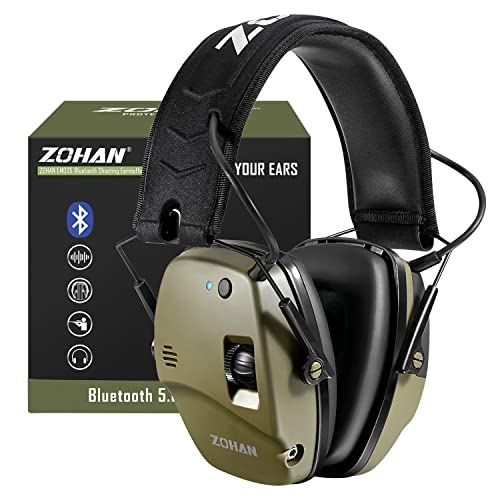
ZOHAN 035 Bluetooth — The Bluetooth 6.0 entry
The ZOHAN 035 leads with the newest radio in the room: Bluetooth 6.0, a generation ahead of the unspecified Bluetooth in its rivals’ titles. Newer Bluetooth generations generally bring more stable connections and better power behaviour, and in a product worn outdoors, at distance from the phone in a pocket or range bag, connection stability is not a footnote — it is the difference between audio that follows you and audio that stutters every time you turn your head. The title pairs that radio with active noise canceling language and hearing protection with sound amplification, in a green finish that hunters will read as deliberate.
The active noise canceling phrase needs careful handling, because it means something different here than on an airliner. In electronic muffs, cancellation language describes electronic management of sound — the amplification-and-clamping pipeline this guide has described — rather than the steady-state drone cancellation of travel headphones. Buyers should read the claim as ZOHAN’s name for its electronics, not as a promise of silence. What the title does not provide is an NRR, placing the 035 alongside the Walker’s in the group whose ratings live in documentation rather than headlines. For the buyer who shops by connection quality and amplification and treats the printed-rating question as a documentation errand, the 035 is the modern-radio option; for the buyer who wants the number before anything else, the stated-rating entries above are the honest competition.
ZOHAN’s presence in this guide also reflects a real market shift: value brands now ship the full electronic feature set — amplification, Bluetooth, active sound management — that was specialist territory a generation ago. The 035 is the pick for the buyer who wants that full set with the freshest connection standard and is comfortable verifying the rating paperwork themselves.
- Connection: Bluetooth 6.0
- Ambient handling: sound amplification, with active noise canceling language in the title
- Format: shooting ear protection earmuff
- Finish: green
- Stated rating: the listing headline prints no NRR — consult ZOHAN’s documentation for the figure
Strengths
- The newest Bluetooth generation in the group, aimed at connection stability outdoors.
- Amplification included, keeping range and field awareness in the feature set.
- Field-friendly green finish rather than range-only black.
Trade-offs
- No NRR stated in the title, so rating verification is a documentation errand.
- Cancellation wording invites misreading and needs the careful interpretation given above.
- No comfort hardware claims — no gel or mesh language — in the headline.
Best for: buyers who prioritise a modern, stable Bluetooth link and amplification in one muff. Not suited for: shoppers who want the rating printed in the listing before anything else.

Mossy Oak Rechargeable Electronic Ear Protection — The rechargeable field muff
Mossy Oak’s name arrives from the hunting woods, and this muff’s title is written for that reader: rechargeable electronic ear protection with Bluetooth, NRR 22dB stated, dual-mic ambient sound amplification, foldable ear muffs, and a stated brief of shooting, hunting, and outdoor work. Each element answers a field complaint. Rechargeable power ends the disposable-battery errand and the flat-cell surprise at the trailhead — the muff charges alongside the phone and the headlamp in the modern hunter’s nightly ritual. Folding cups travel in a pack without dictating its shape. And the dual microphones serve the hunter’s core need, directional awareness: amplified sound that keeps its left and right straight, so a rustle behind the left shoulder stays behind the left shoulder.
The stated NRR 22dB matches the PROHEAR’s figure, and the comparison between those two is instructive: the PROHEAR spends its design budget on a slim cup for the range, the Mossy Oak on field logistics — folding, recharging, directional mics. Neither is wrong; they are answers to different days. Outdoor work is the third leg of its brief, and the rechargeable-plus-Bluetooth combination travels well from the deer stand to the firewood pile to the tractor, making this the other strong one-muff candidate for a rural household. What the title does not discuss is long-session comfort hardware, so the buyer planning dawn-to-dusk sits should weigh the Walker’s gel-and-mesh pitch against this one’s logistics and decide which discomfort they actually fear: a flat battery at first light, or a sore seal by noon.
There is a stewardship angle to the rechargeable choice that field users increasingly mention: a season of hunting and outdoor work on disposable cells is a small but real stream of batteries, and a muff that simply plugs in removes it. Combined with the fold-flat travel shape, the Mossy Oak reads as the muff designed by people who pack for the woods rather than drive to a facility.
- Stated rating: NRR 22dB, printed in the listing title
- Ambient handling: dual-mic ambient sound amplification
- Power: rechargeable
- Connection: Bluetooth
- Format: foldable ear muffs for shooting, hunting, and outdoor work
Strengths
- Dual microphones preserve the direction of amplified sound for field awareness.
- Rechargeable power folds into the nightly charge-everything routine.
- Folding frame packs flat for the truck, the bag, and the stand.
Trade-offs
- A flat rechargeable cell in the field cannot be swapped like an AAA.
- No gel or mesh comfort claims in the title for the longest sits.
- Stated rating matches rather than beats the group’s mid-pack figures.
Best for: hunters and rural all-rounders who want directional amplification, folding travel, and no battery errands. Not suited for: high-volume range shooters who prefer instantly swappable cells.
Range, Field, or Jobsite — How Does Your Loudest Hour Change the Choice?
Put the three scenarios side by side and the six picks sort themselves with surprising neatness. The range is a social, instructional environment disguised as a loud one: commands, coaching, timers, and conversation flow constantly, and the shooter’s body is in repeated contact with a stock. That is why the range shortlist in this guide is the PROHEAR for its slim cup and the Walker’s for its seal-friendly gel — one solves the mechanical problem, the other the physiological one — with the Peltor as the range’s generalist. The field reverses the priorities. A hunter’s loud moments are rare and sudden, while the quiet hours between them are the actual hunt, conducted by ear. Amplification quality and directionality dominate, cold hands must work the controls, and the muff travels in a pack — the Mossy Oak’s exact brief, with the PROHEAR’s amplification as the range-bred alternative.
The jobsite is the marathon scenario: eight to ten hours, weather, dust, and a worker whose entertainment and communication both arrive through the muff. There the WorkTunes’ stated rating and audio-first design are the home team, and its rivals’ shooting virtues — slim cups, amplification tuned for whispers — matter less than shift-long composure. The honest complication is that many buyers live two of these lives: the contractor who hunts, the range regular who mows commercially. For them the Peltor’s breadth or a deliberate two-muff answer — one specialist per life, each excellent at its own day — beats a single compromise worn resentfully in both. A muff resented is a muff removed, and removal is the only outcome this entire category exists to prevent.
What About Doubling Up, Glasses, and the Other Practical Questions?
Doubling up — plugs worn under electronic muffs — deserves a clear-eyed paragraph, because it is common practice in the loudest settings and confuses newcomers. The combination is additive in effect, not multiplicative: plugs and muffs together do not sum their figures, but they do layer, and the electronic muff retains its awareness advantages on top, amplifying voices through the whole arrangement. Frequent indoor-range shooters and anyone working beside sustained industrial noise are the usual adopters. The cost is convenience and a slightly more deliberate donning routine; the benefit is margin in the environments where margin is the point. Glasses, already discussed at the seal, deserve their practical footnote: thin-armed shooting glasses disturb a seal least, and gel cushions forgive thicker arms — one more reason the Walker’s hardware matters beyond comfort.
Hats and hearing aids generate the remaining friction. A headband worn over a cap changes fit enough to check in a mirror the first time; a muff over hearing aids can squeal or crowd, and wearers in that position should trial carefully and favour generous cup volume. Storage is the quiet determinant of lifespan: muffs stored compressed in a hot truck cab age their cushions years early, while muffs hung uncompressed in a cool, dry place keep their seal’s memory. Sweat is the other slow enemy — wipe cushions after summer work, let them dry before the case closes, and treat replacement pads as scheduled maintenance rather than failure. None of this is glamorous, and all of it decides whether the muff you bought is the muff still working three seasons from now.
Which Electronic Hearing Protection Headsets Earn Their Place in Your Kit?
| Pick | Stated rating | Ambient approach | Power | Defining trait |
|---|---|---|---|---|
| PROHEAR 030 Bluetooth | 22dB NRR | Sound amplification | Not stated in title | Slim low-profile cups |
| Walker’s Razor Digital X-TRM Bluetooth | Not stated in title | Sound-enhancing | 2 AAA, included | Gel earpads, mesh headband |
| Peltor Sport Tactical 500 Bluetooth | 25 dB NRR | Electronic pass-through | Not stated in title | Broadest stated use range |
| 3M WorkTunes Connect | 26 dB rating | No amplification claim in title | Not stated in title | Jobsite audio-first design |
| ZOHAN 035 Bluetooth | Not stated in title | Amplification, active canceling language | Not stated in title | Bluetooth 6.0 |
| Mossy Oak Rechargeable | NRR 22dB | Dual-mic amplification | Rechargeable | Folding field format |
The table’s most honest column is the first one, because it shows the category’s split personality: four manufacturers print a rating in the headline and two do not. Neither behaviour is proof of superiority — ratings are measured under standard conditions that no Saturday range reproduces exactly — but the printed figure at least anchors a comparison, while the unprinted one asks for a documentation errand before judgement. Read across the rows by your dominant scenario instead: the range shooter lives in the ambient and cup-profile columns, the worker in the power and audio columns, the hunter in the ambient and format columns. The muff that wins your row is the muff that wins.
How Should You Read a Stated Rating Without Fooling Yourself?
A Noise Reduction Rating is produced by a standardised laboratory method: fitted subjects, controlled noise, averaged results. It is a legitimate comparison tool between products tested the same way, and it is simultaneously a poor prediction of any one afternoon, because afternoons contain glasses, sweat, movement, and haste. Read the figures in this guide comparatively — 26 against 25 against 22 tells you how the manufacturers’ own measurements order these products — and read them humbly, as claims about a test rather than promises about your ears. The moment a rating is treated as a force field, it has stopped informing and started misleading.
The same discipline applies to the category’s softer vocabulary. Amplification describes a feature, not a fidelity grade; sound-enhancing is a brand’s name for its pipeline, not a measurement; active noise canceling on a muff borrows the aura of travel headphones for a different mechanism entirely. None of that makes the words dishonest — it makes them headlines, and headlines are read for direction, then verified in documentation and in wear. A buyer who holds that line — numbers as comparisons, words as directions, fit as the deciding experiment — will choose well from this guide’s six and, more importantly, will use what they chose correctly.
How Do You Get the Fit and Seal Right Every Time?
Electronic sophistication cannot rescue a bad seal, so the donning routine deserves the same seriousness as the purchase. Start with hair and hats: hair tucked under a headband and thick hat brims both channel sound past the cups, so arrange hair flat and choose headwear that the band can sit over or under cleanly. Seat the cups fully over the ears — not perched on the jaw or clipped at the back of the ear — then run a hand around each cup’s edge feeling for gaps, paying special attention where glasses arms exit; gel-padded models forgive this junction, standard foam demands more care. Adjust the headband until the pressure feels even rather than tight: an over-tightened muff fatigues its wearer into removing it, which is the only truly failed state.
Then test with the electronics working for you. Power on the amplification at a moderate level and have a partner speak at conversational volume from several directions; you should localise their voice naturally, and on dual-mic designs the direction should feel true rather than smeared. Clap sharply near — not beside — the muff and notice the electronics’ reaction; the amplified world should dip and recover without drama. Finally, build the habit loop: muffs on before entering the loud zone, every time, with no exceptions for a quick look. Loud environments do their damage on the quick looks as readily as on the long sessions, and the wearer whose routine is automatic is the wearer the equipment actually serves. Store muffs uncompressed in a dry place, wipe the cushions after sweaty work, and inspect the pads each season — a cracked, hardened cushion is a seal waiting to fail, and replacement cushions are the cheapest performance upgrade in this entire category.
What Mistakes Do Buyers Make With Electronic Muffs?
The first mistake is treating a stated NRR as a guarantee about an individual’s ears. A rating is a laboratory figure under fitted conditions; real protection depends on seal, fit, duration, and the environment itself, which is why this guide quotes ratings as product claims and refuses to convert them into promises. The second mistake is buying amplification for the wrong war — a hunter who purchases a work muff without ambient pass-through, or a worker who purchases a hunter’s muff and misses shift-long audio polish. The third is neglecting the seal for the spec sheet: glasses, hats, and hair defeat more muffs than electronics ever save, and five minutes spent on fit outperforms a spec upgrade.
Fourth, buyers let batteries become the product’s reputation — the muff that is always flat is always hated — so choose the power system your habits will actually feed, swappable cells or a charging ritual, and then feed it. Fifth, shooters mount long guns at home in silence and declare the cups fine; the stock-clearance question only answers honestly at the range, in position, at speed. Sixth, new owners crank amplification to maximum and conclude the muffs are noisy; boosted ambient sound at full gain makes a quiet room hiss with its own air, and the correct level is the lowest one that keeps voices and cues clear. Start low, walk it up, and let the environment set the dial.
How Should a First Session With New Electronic Muffs Go?
Treat the first outing as a fitting appointment rather than a debut. Arrive with the power question already settled — cells installed or charge confirmed the night before — and spend the first ten minutes in a quiet area simply listening through the amplification: walk, talk, turn your head, and learn how your own footsteps and voice render inside the cups. Set the ambient level where conversation is clear without the world sounding amplified for its own sake, and note the control positions with gloves on if gloves are part of your sport or work. Only then step into the loud zone, and for the first session keep it short: an hour teaches you the seal’s behaviour, the headband’s patience, and the stock’s opinion of the cups, which are the three verdicts that predict whether this muff becomes your muff.
Afterwards, do the unglamorous debrief while it is fresh. Where did the seal break — glasses, hat, hair? Did the amplification stay composed beside a louder neighbour, or did the day argue for a different gain habit? Did the power routine fit the day, or is a spare set of cells joining the range bag? Write nothing down if you like, but answer honestly, because every one of those small frictions compounds across a season and evaporates if addressed in week one. The shooters and workers who love their muffs in year three are not the ones who bought perfectly; they are the ones who fitted deliberately at the start.
Final Recommendation
Match the muff to the loud hours you actually live. Range regulars behind long guns start with the PROHEAR 030’s slim cups and stated 22dB; high-volume shooters who feel every hour should weigh the Walker’s gel-and-mesh comfort and accept its documentation errand on rating. The household buying one muff for everything lands on the Peltor Tactical 500’s stated 25 dB breadth, and the buyer whose loud hours are paid hours lands on the WorkTunes and its stated 26 dB. Hunters who navigate by ear take the Mossy Oak’s dual mics and folding frame; connection-led buyers take the ZOHAN’s Bluetooth 6.0. Whichever you choose, the muff that protects is the muff that gets worn — so favour the one whose fit, power routine, and sound you will still be content with in the fortieth hour, not just the first.
And keep the receipt-era humility this category teaches everyone eventually: no muff, at any rating, substitutes for judgement about the environment itself. Step back from the loudest sources when the task allows, keep the loud sessions’ lengths honest, and let the equipment be one layer of a sensible routine rather than a licence to linger. The wearers who keep their hearing across a lifetime of loud hobbies are, without exception, the ones who treated protection as a practice — fitted, powered, worn every time — and the six muffs above are simply the best current tools for building that practice around your own loud hours.
Frequently Asked Questions
Does a higher stated NRR always mean the better muff?
No. The figure is one laboratory measurement, quoted here only where a title states it, and real-world performance hinges on fit and seal at least as much. A well-sealed muff with a modest stated figure will serve its wearer better than a poorly sealed muff with a higher one, which is why this guide weighs comfort and cup design alongside the numbers.
Can I take phone calls without removing electronic muffs?
Yes — that is the practical core of every pick here, since all six carry Bluetooth in their titles. Calls arrive inside the cups while the seal stays intact, which matters most for workers and range officers who would otherwise choose between hearing a caller and staying protected through a conversation.
The habit worth forming is to decide in advance which calls interrupt the loud work and which wait. A muff makes it technically easy to chat through an entire range session or saw shift, and technically easy is not the same as wise: the amplification exists to keep your attention on the environment, and a long call parks that attention elsewhere. Let the muff carry the calls that matter — the crew, the household, the range officer — and let the rest accumulate for the quiet drive home, when the cups come off and the day can be reviewed at leisure.
Why do two of the six list no NRR in their titles?
Because manufacturers choose what to headline. The Walker’s X-TRM leads with comfort hardware and the ZOHAN 035 with its Bluetooth generation; their ratings, whatever they are, live in documentation rather than the listing title. This guide quotes only what titles state and flags the gap rather than filling it from other models.
Are electronic muffs suitable for indoor ranges?
Indoor ranges are the most demanding common environment, with impulse noise reflecting from every surface. Many frequent indoor shooters wear plugs under their electronic muffs as a belt-and-braces habit, keep sessions’ loudest activities in mind, and choose from the stated-rating entries when a figure matters to them. When in doubt about a specific environment, conservative layering beats optimistic minimalism.
How long do the batteries or charges last?
Only two power facts appear in these titles: the Mossy Oak is rechargeable, and the Walker’s includes 2 AAA batteries. Endurance hours are not stated in the other titles, and this guide will not invent them — check the documentation for the model you favour, and judge the power system by whether its routine fits your habits.
Will Bluetooth audio distract from the amplified ambient sound?
That depends on the model and the moment, and it deserves a deliberate habit rather than a hopeful one. Many wearers keep entertainment audio for the solitary hours — the mower, the tractor, the walk to the stand — and mute it when the environment turns social or instructional, letting the amplification own the cups on the firing line or beside a crew. Treat the two channels as shifts rather than layers: when awareness is the job, awareness gets the headset, and the podcast can wait for the drive home.
Can children use these electronic muffs?
These are adult-sized products described for adult uses in their titles, and fit is the whole game with any muff — a cup that does not seal on a smaller head is decoration. Families should shop dedicated youth-sized protection rather than scaling down an adult pick from this guide.
Related Guides
Fit first, features second, and the rating as a comparison rather than a creed — that order will serve every reader of this guide well. Readers kitting out adjacent hobbies may also want Best Communication Headsets for Airsoft for electronic muffs crossed with radios, Best Bluetooth Headsets for Cycling for awareness-first listening in motion, and Best USB-C Headsets for the wired desk hours between loud ones.


