What's inside
- Key Takeaways
- Quick Picks
- How Did We Choose These Six for the Road?
- Why Does Bone Conduction Suit Cycling So Well?
- Solo Headset or Group Intercom — Which Does Your Riding Actually Need?
- Wind, Sweat, and Helmet Straps — What Decides Whether a Headset Survives Real Rides?
- What Separates the Six Cycling Headsets in One Table?
- How Do You Set Up a Riding Headset So It Works on the First Ride?
- Commuting, Training, or Touring — How Does the Ride Type Reorder the Shortlist?
- How Do the Six Compare Where It Counts?
- Charging, Sweat, and Storage — What Keeps a Riding Headset Alive for Seasons?
- What Mistakes Do Cyclists Make When Buying Riding Audio?
- What About the Rules — Riding With Audio, Legally and Socially?
- Final Recommendation
- Frequently Asked Questions
- Related Guides
As an Amazon Associate I earn from qualifying purchases. This post may contain affiliate links at no extra cost to you.
widgetverdict.com is reader-supported. When you buy through links on our site, we may earn an affiliate commission.
Where to buy: Amazon carries all six headsets in this comparison, and cycling audio is a category where the variant details matter — pack size on the intercom models and colour on the bone conduction ones — so read the exact listing configuration before ordering rather than assuming the headline photo is the box you will get.
The best bluetooth headsets for cycling are chosen by a rule that inverts ordinary headphone logic: on a bike, the sound you must never lose is the sound the headset does not make. Traffic approaching from behind, a shouted warning from a riding partner, the change in tyre noise that announces gravel — a cyclist’s ears are safety instruments first and entertainment receivers second. That is why this guide is dominated by open-ear bone conduction designs, which sit on the cheekbones and leave the ear canal entirely open, and why the two intercom systems included here exist for the other half of cycling sound: the voices of the group you are riding with. Sealed earbuds, however musical, were excluded on principle. A headset that isolates a cyclist from the road has failed before its battery or its bass is even discussed.
Three distinct jobs divide the six. The SHOKZ trio — OpenRun Pro 2, OpenRun, and OpenMove — are solo-rider bone conduction headsets in descending order of flagship ambition, built for music, podcasts, and calls with the world still audible. The J-TREK BH03 and the Bluetooth 6.0 Bicycle Intercom System are group tools: multi-rider or two-rider intercoms with stated ranges of 1000m and 520m, for clubs, couples, and families who ride in formation and coordinate by voice. The Raycon bone conduction model closes the list as the mainstream alternative in the open-ear solo camp. Specifications in this guide come only from the listing titles: where a title states a waterproof grade or a battery figure, it is quoted; where it does not, the spec box says so rather than borrowing a sibling’s numbers. Riders who finish the day at a desk may also want Best USB-C Headsets for the wired hours, but the road makes its own demands, and they come first here.
Key Takeaways
- Every pick leaves the ear canal open — four by bone conduction, two by helmet-style intercom design.
- Only the SHOKZ OpenRun states both a waterproof grade, IP67, and a battery figure, 8 hours, in its title.
- The J-TREK BH03 is the group-ride outlier: an 8-way intercom with a stated 1000m range, sold as a dual pack.
- The Bluetooth 6.0 Bicycle Intercom System pairs the newest radio here with a stated 520m range and IPX5.
- The OpenRun Pro 2 is the flagship solo pick, the only title here promising deep bass and a reflective strip.
- No pick in this guide seals the ear; situational awareness is the entry ticket, not a feature.
Quick Picks
| Pick | Badge | Why it earns its place |
|---|---|---|
| SHOKZ OpenRun Pro 2 | The flagship open-ear | Bone conduction with deep bass claims, a smart mic, sweat resistance, and a reflective strip for dark miles. |
| SHOKZ OpenRun | The stated-spec all-rounder | IP67 and 8 hours of battery stated in the title, bundled with a sweat headband, aimed at running and cycling. |
| SHOKZ OpenMove | The entry SHOKZ | The open-ear formula at the line’s simplest pitch: sweatproof bone conduction for running and workouts. |
| J-TREK BH03 Helmet Intercom | The group-ride system | An 8-way cycling intercom with a stated 1000m range and noise cancelling, in a dual pack. |
| Bluetooth 6.0 Bicycle Intercom System | The two-rider link | Bluetooth 6.0, a stated 520m bike-to-bike range, IPX5, and an AI voice assistant for two riders. |
| Raycon Bone Conduction Headphones | The mainstream alternative | Open-ear bone conduction with a microphone and sweat and water resistance from a consumer-audio name. |
How Did We Choose These Six for the Road?
The first screen was the open ear, applied without exceptions. Any design that seals or plugs the ear canal was excluded regardless of its audio quality, because the cyclist’s ambient hearing is not a preference to be traded against bass; it is the sense that detects the overtaking car, the dog off the lead, and the partner’s warning shout. The second screen was honesty about role. Solo headsets and group intercoms answer different questions, and a guide that mixed them without distinction would mislead both audiences — so the final six keep a clean three-and-two split, with the Raycon as the solo camp’s alternative brand, and each pick’s section states its job before its virtues.
The third screen was title candour about the two specifications cyclists actually plan around: water and endurance. A headset’s waterproof grade decides whether a caught rainstorm is an anecdote or a warranty claim, and its battery figure decides which ride lengths are realistic — yet only one title in this guide states both. Rather than discard the silent titles, which include the flagship of the category, the guide quotes what is stated and flags what is not, in every spec box, so a buyer planning a century ride in November rain can see at a glance which purchases need a documentation detour first. The final screen was wearability with a helmet: straps, sunglass arms, and a headset frame all compete for the same few centimetres of head, and designs whose titles speak the language of sport fit — secure, lightweight, sweat-managed — earned the benefit of the doubt.
Why Does Bone Conduction Suit Cycling So Well?
Bone conduction moves sound through the cheekbones to the inner ear, bypassing the ear canal entirely. The canal stays open, so the world’s sound arrives by the ordinary air route at natural volume and direction, while music, navigation prompts, and calls arrive by the bone route layered on top. The cyclist hears both because the two streams use different doors. This is not a subtle advantage dressed as a feature; it restructures what a headset is allowed to do on a bike. A rider can hold a conversation with a companion, hear a podcast, and still localise the car approaching from the rear-left, because none of those sounds ever had to fight for a single sealed channel.
The technology’s trade-offs are equally structural and should be bought knowingly. Bone conduction cannot match a sealed earbud’s bass physicality — the OpenRun Pro 2’s deep bass claim is best read as the flagship’s effort against that ceiling — and in loud environments the open ear admits competition that a sealed design would exclude; beside a motorway, the podcast loses to the lorries, and that is arguably the correct outcome for a safety-first device. Wind is the other tax: at descending speeds, wind noise over the ears masks both routes at once, and no headset in this guide claims a cure, because there isn’t one — there is only the judgement to lower the volume and let the road have the channel when the road is loudest. Within those honest limits, bone conduction is the only listening technology whose failure mode on a bike is hearing too much of the world, and that is the failure mode a cyclist should choose every time.
Solo Headset or Group Intercom — Which Does Your Riding Actually Need?
Answer with your calendar, not your aspirations. The solo headset serves the rider whose miles are mostly alone: commutes, training rides, long weekend loops with a podcast for company and navigation prompts for guidance. Its communication need is the occasional phone call, handled by a built-in microphone, and its social need is zero — the group ride happens twice a year and hand signals survive it fine. The intercom serves the opposite calendar: the club run every Sunday, the couple that tours in formation, the parent riding behind a teenager, the ski-and-climb crossover household the J-TREK title also names. For those riders, voice coordination is not entertainment; it is how the group calls hazards, rotates the paceline, and keeps a dropped rider from becoming a lost one.
The middle case — the mostly-solo rider with a regular partner — is where the two-rider intercom earns its examination, because riding two-up with a live link changes the texture of shared miles more than any other upgrade in this guide: conversation at conversational volume, warnings in real time, no shouting into the wind or sprinting to deliver a message. The costs are systemic rather than financial. Intercoms are ecosystems; both riders need compatible units, charged, paired, and worn, and a group of mixed brands discovers that intercom standards are brand dialects. Choose the intercom as a household or a club would — together, once, standardised — or choose the solo headset and keep the simplicity. The worst purchase is the lone intercom, bought hopefully, waiting for a partner who buys a different brand.
Navigation deserves its sentence in this argument, because it is the solo headset’s quiet superpower. Turn prompts delivered into an open ear — while the eyes stay on the road and the phone stays in a pocket — transform unfamiliar routes from a sequence of stopped consultations into a continuous ride. Explorers, tourers riding solo days between group days, and commuters rerouted by roadworks all live on that prompt stream, and it asks nothing of the headset but a phone connection and a battery that outlasts the route. Score it as a point for the solo camp that group riders rarely remember to count.
Wind, Sweat, and Helmet Straps — What Decides Whether a Headset Survives Real Rides?
Three unglamorous forces grade every cycling headset in the field. Wind grades the microphone: a mic that renders your voice clearly in a kitchen drowns it at thirty kilometres an hour, which is why the intercom titles here make noise cancelling claims and the OpenRun Pro 2 names a smart mic — the transmit side of a cycling headset works harder than the receive side, and a rider whose calls home are unintelligible will stop making them. Sweat grades the materials and the claims: every pick here states some form of sweat resistance, but only two state a waterproof grade, and the rider who trains through winter should treat the graded entries — IP67 on the OpenRun, IPX5 on the bicycle intercom — as the shortlist for genuinely wet work, with the ungraded entries verified in documentation before they are trusted in a storm.
Helmet straps grade the fit. A bone conduction frame shares the head with sunglass arms and sits near strap lines; the secure-fit and lightweight claims in the SHOKZ titles exist because a frame that migrates on a climb or rattles on a descent gets left at home by the third ride. The fitting ritual that predicts happiness is dull and decisive: put on your own helmet, your own glasses, and the headset, then ride your bumpiest local kilometre. If the trio coexists there, it coexists anywhere. Cyclists who also crew on the water will recognise the same wear-it-or-leave-it logic in Best Boat Headsets, where headsets face the identical tribunal of wind, spray, and long hours — the tribunal is universal, and spec sheets never sit on its panel.
What Separates the Six Cycling Headsets in One Table?

SHOKZ OpenRun Pro 2 — The flagship open-ear
The OpenRun Pro 2 is where SHOKZ spends its flagship budget, and its title advertises the spending: bone conduction in an open-ear Bluetooth design for running and workouts, sweat resistant, a secure comfortable fit, deep bass, a smart mic, and a reflective strip. Read that list as a diary of rider complaints addressed in order. Deep bass answers bone conduction’s oldest criticism — thin low end — with the line’s most ambitious tuning claim. The smart mic answers the call-quality complaint, the commuter trying to be understood by a colleague over street noise. The reflective strip is the detail that reveals the design’s centre of gravity: it does nothing for the audio at all, and everything for the rider on unlit roads at dawn, which is where this headset expects to live.
What the flagship’s title withholds is equally instructive: no waterproof grade and no battery figure are stated, on the most expensive pitch in the solo camp. A buyer whose rides are long or wet should treat that silence as homework, not as an oversight to be waved through on brand faith — SHOKZ publishes the figures in its documentation, and the century rider needs them before the purchase, not after the first flat battery at kilometre one hundred and thirty. Within its stated brief, though, the Pro 2 is the solo pick for the rider who wants the category’s best shot at music that feels like music, calls that land clearly, and a frame that stays put and stays visible. It is the headset for the rider whose solo miles are the main event of their week, and who outfits them accordingly.
There is a commuter sub-case worth naming: the rider whose route mixes cycle path, city street, and office, and who takes two or three calls a ride. The smart mic and the open ear are, together, exactly that rider’s specification — audible to the world, intelligible to the caller — and the Pro 2 is the only solo title here that names the microphone as a headline feature.
The reflective strip deserves a second thought as well, because it marks a philosophy: safety equipment that only works when remembered will eventually be forgotten, while safety built into the object you already wear works on your worst, tiredest, darkest morning. A strip on the headset cannot replace lights or a vest, and this guide does not pretend otherwise — but as a marginal gain that costs the rider nothing, it is the kind of detail that separates a flagship designed by cyclists from one designed by a marketing calendar.
- Design: bone conduction, open-ear Bluetooth
- Audio claim: deep bass
- Microphone: smart mic, named in the title
- Visibility: reflective strip
- Waterproof grade and battery hours: neither figure appears in the listing headline — check SHOKZ documentation before long or wet rides
Strengths
- The line’s most ambitious audio claim answers bone conduction’s bass criticism head-on.
- A named smart mic serves the call-heavy commuter’s actual day.
- The reflective strip is a genuine safety detail rivals’ titles omit.
Trade-offs
- No stated waterproof grade, despite the flagship position.
- No stated battery figure for endurance planning.
- Bone conduction’s bass ceiling remains, however ambitious the tuning.
Best for: solo riders and commuters who want the strongest music and call performance the open-ear format offers. Not suited for: riders who need a stated waterproof grade and battery figure before buying anything.

SHOKZ OpenRun — The stated-spec all-rounder
If the Pro 2 is the flagship’s promise, the OpenRun is the engineer’s receipt. Its title states the two numbers a planner craves — IP67 water resistance and 8 hours of battery — and then keeps going with the practical bundle: a sweat headband included, open-ear comfort, a lightweight and secure fit, and an intended-use line that names running and cycling outright. IP67 is the strongest water claim in this guide: dust-tight and immersion-rated in the standard’s terms, it is the grade that lets a rider stop thinking about rain altogether. Eight stated hours covers the overwhelming majority of real rides — club runs, commutes, long training days — with the honest caveat that a full imperial century at a social pace will test its edges.
The bundled sweat headband is a small masterclass in knowing the customer: sweat management is the unglamorous daily friction of sport audio, and including the accessory in the box removes a separate purchase and a separate excuse. Against its flagship sibling, the OpenRun trades the deep-bass ambition and the smart-mic headline for specification certainty — and a great many riders should take that trade happily, because certainty is what planning runs on. The OpenRun is also the natural household answer when one headset must serve the runner and the cyclist in the same family, its title claiming both sports without hedging. For the buyer who reads spec boxes first and marketing second, this is the most legible product in the guide, and legibility at this level of candour deserves to win often.
Endurance riders should still do the arithmetic honestly: eight stated hours at moderate volume is the claim, and cold weather and high volume both spend batteries faster in every manufacturer’s world. The rider planning a dawn-to-dusk epic should either plan a café-stop top-up or step to the intercom camp’s different compromises — but for the ninety-nine percent of rides that end before lunch, the OpenRun’s stated figures simply close the question.
- Design: bone conduction, open-ear Bluetooth, black
- Stated waterproof grade: IP67 water resistance
- Stated battery: 8 hours
- In the box per title: sweat headband bundle
- Intended use per title: running and cycling
Strengths
- The only title here stating both a waterproof grade and a battery figure.
- IP67 ends the rain question rather than managing it.
- The bundled sweat headband removes a friction most rivals leave to the buyer.
Trade-offs
- No deep-bass or smart-mic headline claims against the flagship.
- Eight hours bounds the longest epics without a charging stop.
- A single stated colour in the title — black — limits the match-my-kit shopper.
Best for: planners, all-weather riders, and runner-cyclist households who buy by stated specification. Not suited for: dawn-to-dusk epic riders unwilling to plan a mid-ride charge.
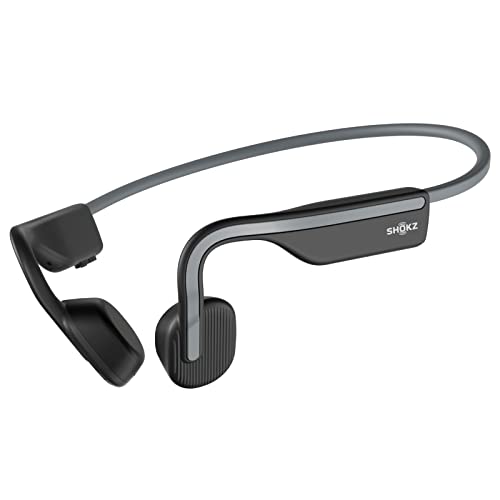
SHOKZ OpenMove — The entry SHOKZ
The OpenMove is the doorway into the SHOKZ world, and its title keeps the pitch deliberately plain: open-ear Bluetooth sport headphones, bone conduction wireless earphones, sweatproof for running and workouts, with a sticker pack, in grey. Plainness is the strategy. The OpenMove exists for the rider who has heard the open-ear argument, is not yet sure the format suits them, and wants the genuine technology — real bone conduction, real open ear, the real safety logic — without flagship money riding on the experiment. Every essential of the category is present; what is trimmed is the specification theatre: no waterproof grade is stated beyond the sweatproof claim, no battery figure is printed, and no audio superlatives are promised.
That trimming defines both its audience and its limits. As a first open-ear headset, a second headset for the commuting bike, or the household spare, the OpenMove’s honesty is complete. As a primary headset for an all-weather, long-distance rider, its unstated figures demand the same documentation errand as the flagship’s — with less flagship compensation at the end of it. The sticker pack, easy to mock, is a tell about the intended reader: younger athletes, gift purchases, and families, for whom a headset is also a piece of sporting identity. Grey as the stated colour keeps it neutral across kits. Riders who discover through the OpenMove that bone conduction is their format will upgrade within the line with their eyes open; riders who discover it is not have learned the lesson at the line’s gentlest price of admission. That is exactly what an entry model is for, and the OpenMove performs the role without pretending to be more.
It also makes the most sensible gift in the solo camp, for a structural reason: a gift’s worst outcome is an unused flagship, and its best is a used doorway. The OpenMove gets worn — on runs, on commutes, on the school run by bike — and worn gear is the only gear that ever justified itself.
- Design: bone conduction, open-ear Bluetooth, grey
- Sweat claim: sweatproof for running and workouts
- In the box per title: sticker pack
- Waterproof grade: no graded figure appears in the listing headline — the claim is sweatproof
- Battery hours: the headline is silent on endurance, so the manual is the place to look
Strengths
- The genuine open-ear format at the line’s most accessible pitch.
- Sweatproof claim covers the training use it is aimed at.
- An ideal first bone conduction headset for the format-curious.
Trade-offs
- No graded waterproof figure for committed wet-weather riders.
- No stated battery hours for endurance planning.
- Heavy users will outgrow its plain specification within a season or two.
Best for: first-time open-ear buyers, second-bike headsets, and sporting households. Not suited for: all-weather endurance riders who need graded, stated specifications.

J-TREK BH03 Helmet Intercom — The group-ride system
The BH03 changes the subject from listening to talking. Its title describes a Bluetooth 5.4 helmet headphone running an 8-way group cycling communication system with a stated 1000m range, noise cancelling, a microphone, and a dual pack in black — pitched at biking, skiing, and climbing alike. Eight-way is the figure that reorganises a club: not a pair chatting, but a whole paceline on one net, with the ride leader calling hazards, the sweep confirming the dropped rider, and the group holding together as a group rather than as a rumour. A stated kilometre of range covers a stretched-out club run on open road, where the front and the back of a long line can be separated by exactly that order of distance.
The dual pack framing matters commercially and socially: intercoms are bought in systems, and a two-pack is the seed crystal from which a club standard grows — two riders equipped today, the rest of the Sunday group persuaded by demonstration next week. The helmet-headphone format suits the safety-geared rider who never rides bare-headed, and the ski-and-climb crossover in the title gives the household a second and third season of use, which is how intercom money justifies itself in a way solo headsets never have to. Noise cancelling here serves the microphone’s war against wind, the standing enemy of every transmitted word at speed. What the title does not state is a waterproof grade or a battery figure, and a club riding through winters should verify both before standardising — a system purchase multiplies every unanswered question by the number of riders wearing it.
Standardisation cuts the other way too, as this guide noted for squad gear generally: a club that commits to the BH03 buys spares, familiarity, and mutual troubleshooting knowledge along with the headsets. For an established group ride with a helmet culture, this is the most consequential purchase in the guide, and it should be made the way clubs make everything — by trying one dual pack on two regulars for a month before the fleet order.
- Group size: 8-way group communication system
- Stated range: 1000m
- Connection: Bluetooth 5.4
- Pack: dual pack, black
- Waterproof grade and battery hours: the headline offers neither number, so a club should confirm both before standardising
Strengths
- Eight-way grouping serves a whole club run, not just a pair.
- A stated kilometre of range covers a stretched paceline.
- Dual pack seeds a club standard, with ski and climb seasons as a bonus.
Trade-offs
- An intercom’s value collapses if your group rides another brand’s system.
- No stated waterproof grade for winter club riding.
- Helmet format assumes a helmet culture some riders do not have.
Best for: club runs, group tours, and multi-sport households that ride in formation. Not suited for: solo riders, for whom eight channels are seven too many.

Bluetooth 6.0 Bicycle Intercom System — The two-rider link
Where the J-TREK scales to a club, this system scales to a pair — and states its case with a completeness the bigger system might envy: Bluetooth 6.0, a two-way bicycle-to-bicycle intercom, a stated 520m range, IPX5 water resistance, a noise-canceling microphone, and an AI voice assistant, for cycling, skiing, and outdoor activities. Two-rider is not a diminished specification; it is the exact shape of the couple that tours, the parent-and-teenager pair, and the two training partners who ride every mile together. For those pairs, a 520m stated range covers every realistic separation short of a wrong turn, and IPX5 — protection against water jets — answers the rain question with a grade rather than an adjective.
Bluetooth 6.0 is the newest connection standard in this guide, and in an intercom its virtues are practical: connection stability between two moving riders and efficient power behaviour across a long day. The AI voice assistant is the title’s curiosity — hands-free control is genuinely valuable on a bike, where every button press is a hand off the bars — though buyers should confirm in the documentation what the assistant actually does, since the phrase covers everything from simple voice dialling to fuller control. The noise-canceling microphone fights the same wind war as its rivals. For the dedicated pair, this system’s stated-spec completeness — range graded, water graded, radio newest — makes it the easiest intercom here to buy on paper, and its two-rider ceiling is a feature precisely as long as the pair stays a pair.
The honest boundary is growth: a pair that becomes a trio, or joins a club running another system, outgrows it completely, because two-way systems do not stretch. Buy it as a couple’s instrument and it is perfectly fitted; buy it as a down payment on a group and it is a future resale listing.
There is also a teaching dividend unique to the two-rider format: a parent riding behind a teenager, or an experienced rider shepherding a nervous beginner, can coach in real time — gear choices before the climb, line choices before the junction, encouragement at the exact gradient where encouragement is a physical force. That dividend never appears in a specification table, and for family riders it may be worth more than every stated figure in this guide combined.
- Group size: 2-way bicycle-to-bicycle intercom
- Stated range: 520m
- Stated waterproof grade: IPX5 water resistance
- Connection: Bluetooth 6.0
- Extras per title: noise-canceling mic, AI voice assistant
Strengths
- The most completely stated intercom specification in the guide.
- IPX5 grades its rain answer instead of adjectiving it.
- Newest Bluetooth generation for a stable two-rider link.
Trade-offs
- Two riders is a hard ceiling with no group growth path.
- The AI assistant’s actual abilities need documentation to pin down.
- No stated battery figure appears in the title for tour planning.
Best for: couples, parent-and-teen pairs, and inseparable training partners. Not suited for: club riders who need the whole paceline on one net.

Raycon Bone Conduction Headphones — The mainstream alternative
Raycon built its name on mainstream wireless earbuds, and its bone conduction entry brings that consumer-audio sensibility to the open-ear camp: bone conduction headphones described as open-ear running headphones and Bluetooth earbuds, sweat and water-resistant, with a microphone, in gray. The dual naming — running headphones and earbuds in one breath — is the tell: this is the pick for the buyer who shops audio by brand familiarity and lifestyle rather than by sport specialisation, and who wants the open-ear safety logic without joining a specialist ecosystem. The microphone keeps calls in the feature set, and the sweat and water resistance claim covers training weather in general terms.
General terms are, however, where its title stops: no waterproof grade is stated, no battery figure is printed, and no cycling-specific claim is made at all — running carries the title’s sporting brief. The cyclist buying the Raycon is therefore buying the format and the brand, and should run the same documentation checks as the flagship SHOKZ demands, with the difference that the Raycon’s pitch never pretended otherwise. Within the solo camp it plays a useful role as the alternative for the rider who has tried the SHOKZ frame shape and wants a different fit philosophy, or who simply prefers buying from the name already in their gym bag. Fit, in a category worn for hours against the cheekbones, is a legitimate deciding vote — the best open-ear headset is the one whose pressure points are not yours.
It is also the pick most likely to be bought by the runner who occasionally cycles, rather than the cyclist who occasionally runs — the mirror image of the OpenRun’s stated dual brief. Households divide along exactly that line, and this guide’s job is to name it rather than to judge it.
- Design: bone conduction, open-ear, gray
- Microphone: included, per the title
- Water claim: sweat and water-resistant, with no grade stated in the title
- Battery hours: endurance goes unmentioned in the headline; Raycon’s own documentation carries it
- Sporting brief per title: running headphones
Strengths
- A mainstream audio brand’s take on the open-ear format.
- Microphone included, keeping calls in the solo feature set.
- An alternative fit philosophy for riders the SHOKZ frame does not suit.
Trade-offs
- No stated waterproof grade behind the water-resistant claim.
- No stated battery figure for ride planning.
- Its title’s sporting brief is running, with cycling left implicit.
Best for: brand-loyal mainstream buyers and runner-first athletes adding cycling. Not suited for: spec-led cyclists who buy by graded, stated numbers.
How Do You Set Up a Riding Headset So It Works on the First Ride?
Pairing day should happen in the kitchen, not the kerb. Charge the headset fully, pair it to the phone you actually ride with, and set the two volume relationships separately: media volume for your quietest road, and call volume against a partner speaking from another room. Bone conduction fit is a placement skill — the transducers want to sit on the cheekbones just in front of the ears, and a frame riding too far back or perched on the ears themselves loses both bass and clarity; spend the unglamorous minute in the mirror getting the position repeatable, because you will reproduce it by feel at every café stop. Then layer the kit in riding order: headset, glasses arms over or under the frame as your head prefers, helmet last, straps adjusted after everything else is in place. Most fit misery is an ordering problem wearing a hardware costume.
Intercom pairs and groups add one ritual: the pairing rehearsal. Link every unit at home, assign the order or channels the system expects, and run a voice check across the house before the first group ride depends on it — intercom pairing sequences are exactly the kind of thing that refuses to be learned in a windy car park with six riders watching. On the road, agree the net’s grammar in advance: hazard calls in a fixed format, the leader’s word for stopping, the sweep’s confirmation habit. And build the mid-ride check into the first outing: at the first stop, ask the only question that audits everything — could everybody hear what they needed to hear? Adjust volumes, positions, and pairings there, while the evidence is fresh and the tools are out.
Commuting, Training, or Touring — How Does the Ride Type Reorder the Shortlist?
The commute is a communication ride wearing a training costume: calls, navigation prompts, and traffic awareness in dense streets, twice a day, in all the weather the year owns. It rewards the smart mic, the graded waterproofing, and the battery that shrugs at five days of ninety minutes — the Pro 2’s call polish and the OpenRun’s stated IP67 divide that rider’s vote between them. Training is the solo purist’s ride: structured hours, a podcast or a playlist for company, and no patience for gear that demands attention. The OpenRun’s stated eight hours and the OpenMove’s set-and-forget simplicity are the training answers, with the Raycon serving the runner-cyclist whose training week is mostly on foot.
Touring is where the intercoms stop being optional. Multi-day riding in company runs on coordination — navigation disagreements settled at conversational volume, mechanicals announced before the group strings out over a climb, the simple morale of talk across empty country. The BH03’s eight-way net serves the tour group; the Bluetooth 6.0 pair system serves the touring couple with the tightest stated specification in the guide. The rider whose year contains all three ride types should buy for the commute first, because it happens two hundred times a year, and forgive the headset its touring compromises on the six days they matter — frequency is the most honest weighting in all of gear selection, and the daily ride outvotes the epic one.
How Do the Six Compare Where It Counts?
| Pick | Role | Stated water grade | Stated battery or range | Defining trait |
|---|---|---|---|---|
| SHOKZ OpenRun Pro 2 | Solo | Sweat resistant, no grade in title | Not stated in title | Deep bass, smart mic, reflective strip |
| SHOKZ OpenRun | Solo | IP67 | 8 hours | Fully stated specifications |
| SHOKZ OpenMove | Solo | Sweatproof, no grade in title | Not stated in title | Entry point to the format |
| J-TREK BH03 | Group intercom | Not stated in title | 1000m range, 8-way | Club-scale grouping |
| Bluetooth 6.0 Bicycle Intercom | Pair intercom | IPX5 | 520m range, 2-way | Newest radio, graded specs |
| Raycon Bone Conduction | Solo | Water-resistant, no grade in title | Not stated in title | Mainstream brand alternative |
The table’s pattern is the guide’s argument in miniature: role divides first, stated specification second. A solo rider comparing the OpenRun’s IP67 against the intercoms’ ranges is comparing answers to questions they do not have. Within the solo camp, the OpenRun is the planner’s pick, the Pro 2 the performer’s, the OpenMove the beginner’s, and the Raycon the brand loyalist’s. Within the intercom camp, group size is destiny — eight-way or two-way, club or couple — and the stated ranges and grades then arbitrate. Let your calendar choose the column, and the row chooses itself.
Charging, Sweat, and Storage — What Keeps a Riding Headset Alive for Seasons?
Cycling headsets die of salt and neglect more often than of defects. Sweat is a salt solution with ambitions, and it works on charging contacts, frame joints, and transducer housings across a summer of rides. The countermeasures are embarrassingly cheap: wipe the headset down after hot rides, let it dry before it goes into a bag or a drawer, and keep charging contacts clean and bright, because a corroded contact presents as a dead battery months before the battery itself is guilty. Store the frame unbent and unloaded — not crushed under a helmet in the kit bag — and the bone conduction arms will keep the clamping geometry they were tuned with.
Battery stewardship is the second discipline. A headset charged the night before every ride lives a shallow, happy cycling life; a headset repeatedly run to flat and left there ages in dog years. Intercom households should charge as a unit — both or all headsets on the same evening ritual — because a group system with one flat member is a group system with a silent rider, and the silent rider is always the one who needed the hazard call. Keep the charging cable that lives with the bike kit separate from the household’s general cable economy, labelled if necessary. None of this is technical, and all of it is the difference between the headset that is simply there, working, every Saturday for three years, and the drawer of almost-working audio gear every cyclist eventually owns and nobody admits to starting.
What Mistakes Do Cyclists Make When Buying Riding Audio?
The gravest mistake is sealing the ear for better bass: an isolating earbud on a bike trades the sense that detects traffic for low-end that wind noise mostly cancels anyway, the worst bargain in cycling. The second is buying the intercom alone — one unit, one brand, a partner who owns another — and discovering that intercom ecosystems are dialects, not a language. The third is trusting ungraded water language for graded weather: sweatproof and water-resistant are honest claims about sweat and splashes, and the rider who wears them into a November storm on the strength of the adjectives has misread the contract the title actually offered.
Fourth, cyclists crank volume to defeat wind, defeating the purpose instead — when the road is loud, the correct move is less audio, not more, and the rider who treats the headset as a fair-weather companion rather than an all-conditions entitlement keeps both the music and the awareness. Fifth, buyers skip the helmet-and-glasses fitting rehearsal and discover the frame-strap conflict at kilometre forty. Sixth, owners charge nothing and blame everything: a headset’s battery is a ride plan, and the rider who treats charging like fuelling — done the night before, checked before rolling — never meets the flat battery at the far point of the loop. The evening gaming crowd makes the same discovery about session gear in Best USB Gaming Headsets Under $150, where the uncharged, unfitted, unrehearsed setup fails at the identical moment: exactly when it is needed.
What About the Rules — Riding With Audio, Legally and Socially?
The legal landscape for riding audio varies by jurisdiction and leans, almost everywhere, in one direction: against sealing both ears. Some places restrict earbuds outright for cyclists; open-ear bone conduction, which leaves the canal unobstructed, sits on the right side of the spirit of those rules and frequently of their letter — but the letter is local, and the touring rider crossing jurisdictions should check rather than assume. This guide offers no legal advice beyond that caution, because the honest answer is a postcode, not a paragraph. The social rules are simpler and universal. On shared paths, your audio should never be the reason you missed a bell, a call of passing, or a child’s wobble into your line; in a group, the rider streaming a podcast at volume has left the group socially before leaving it physically.
Etiquette has a mechanical expression too: pause or strip the headset for the café stop conversation, keep one conversation — the road’s or the phone’s — at a time, and remember that the intercom net, like the airsoft squad’s channel, is a shared asset whose discipline is the group’s reputation. Riders who hold those lines find that audio adds miles to their year; riders who do not eventually get the talk from a ride leader, a partner, or a magistrate, in ascending order of expense.
Final Recommendation
Choose by the shape of your riding life. The solo rider who plans by specification takes the OpenRun and its stated IP67 and eight hours; the solo rider who plans by experience takes the Pro 2’s audio ambition and smart mic, having first checked its unstated figures; the format-curious take the OpenMove’s honest doorway; the brand loyalist takes the Raycon. The club takes the BH03 as a standard, trialled by two regulars before the fleet commits; the couple takes the Bluetooth 6.0 pair system and its graded, stated completeness. In every case, keep the volume humble, the ears open, and the charging routine sacred — the best bluetooth headsets for cycling are the ones still on your head, still charged, still letting the road speak first, at the top of the last climb of the season.
One final test before any of these earns your money, and it costs an afternoon: borrow the format before you buy the model, if a riding friend owns any bone conduction headset at all. Twenty minutes on your own roads will teach you more about cheekbone fit, wind behaviour, and your personal tolerance for the technology’s bass ceiling than any review — this one included — can type. Riders who pass that test buy with confidence and keep what they buy; riders who skip it occasionally discover a fundamental format mismatch at flagship prices. The format is the decision. The model is merely its expression, and this guide’s six expressions cover the honest range of what the format currently offers a cyclist.
Frequently Asked Questions
Is bone conduction safe for cycling?
Its safety logic is the strongest in cycling audio: the ear canal stays open, so traffic and warnings arrive naturally while audio layers over them. No headset makes a rider safe by itself — volume discipline and attention do that — but bone conduction is the only format whose design never asks the rider to surrender ambient hearing in the first place.
Can I hear traffic properly with music playing?
At sensible volumes, yes — that coexistence is the format’s purpose. At high volumes on loud roads, any audio competes with the world, and the wise rider treats volume as a variable the road sets: quieter on the fast descent and the busy arterial, freer on the empty lane and the cycle path.
Which of these survives heavy rain?
Two titles grade their answer: the OpenRun at IP67 and the bicycle intercom at IPX5. The other four claim sweat or water resistance without a grade in their titles, which supports training sweat and light splashes as stated, and sends the committed all-weather rider to the documentation before trusting them in a downpour.
Whatever the grade, give any soaked headset the same aftercare: shake the water off, wipe it down, and let it dry fully before it meets its charging cable. Water and charging contacts are enemies with a long memory, and the rider who dries first and charges second keeps the same headset through many winters of weather that lesser routines would not survive.
Do the intercoms work with any brand of partner headset?
Assume they work within their own systems, and treat any cross-brand promise with the scepticism reserved for weather forecasts in the mountains. Intercom grouping is brand territory — the J-TREK’s 8-way net is a J-TREK net — so riding partners should standardise before buying, exactly as this guide advises for any group communication gear.
How long do the batteries last?
Only one title here states a figure: the OpenRun’s 8 hours. The other five leave endurance to their documentation, and this guide will not fill the silence with estimates. Match the documentation figure to your longest regular ride, with margin for cold days and high volume.
Do bone conduction headsets work with glasses and a helmet?
Generally yes, and the combination is the design’s home turf — but the layering order and the frame’s pressure decide individual happiness, which is why this guide prescribes the bumpiest-kilometre rehearsal in your own helmet and glasses. Riders with heavier spectacle frames should take particular care at the fitting stage, since the headset’s arms and the glasses’ arms negotiate for the same real estate above the ear.
Can I take calls on these while riding?
The solo headsets all carry microphones — the Pro 2 names a smart mic — and the intercoms are built around voice. Wind remains the tax on every transmitted word, so expect kitchen-clear calls at climbing pace and abbreviated ones at descending pace, and pull over for anything that matters. A short call taken at a standstill, somewhere sensible, is worth three shouted ones taken at speed — for the caller’s comprehension, for your own composure, and for the road’s opinion of everyone sharing it.
Related Guides
Fit the format to your head, the model to your calendar, and the volume to the road in front of you, and any of these six will serve. Keep the charging cable with the bike, the headset with the helmet, and the whole arrangement boring in its reliability — because on the morning of the big ride, boring reliability is the only luxury that matters, and every headset in this guide is capable of providing it to the rider who builds the habit. Riders building out the rest of their setup may also want Best USB-C Headsets for desk recovery hours, Best USB Gaming Headsets Under $150 for the indoor season’s other screen, and Best Boat Headsets for the crew-communication version of the same open-ear philosophy, afloat, where the hazards approach by water instead.


