What's inside
- Key Takeaways
- Quick Picks
- How We Chose These Picks
- Why Does Filtration Matter More in a Mini-ITX Build?
- Should You Filter the Exhaust Side Too?
- Does a Filtered Case Need Different Fans Than an Unfiltered One?
- What Happens Inside an Unfiltered Small Case, Month by Month?
- How Do Filters Change a Small Case’s Noise?
- How Do the Six Compare Side by Side?
- What Should You Check Before Choosing a Filtered Mini-ITX Case?
- How Do You Keep a Small Filtered Build Clean Over Time?
- What Are the Most Common Mistakes When Buying a Filtered Small Case?
- How Fine Should a PC Dust Filter Actually Be?
- Final Recommendation
- Frequently Asked Questions
- Related Guides
As an Amazon Associate I earn from qualifying purchases. This post may contain affiliate links at no extra cost to you.
widgetverdict.com is reader-supported. When you buy through links on our site, we may earn an affiliate commission.
Where to buy: three of the six cases below carry verified Amazon links from our pool; the other three are covered as prose-only picks because we could not verify a listing for them, and each is labelled so you always know which is which before you start shopping.
Small cases have a dust problem that big towers can postpone. Squeeze a gaming build into a compact box and every fan sits close to every component, the internal volume shrinks to a few lungfuls of air, and the same household dust that would take a year to matter in a full tower starts coating heatsinks within a season. That is why the search for the best air filtered pc cases mini itx builders can actually buy matters more than the equivalent search for a big case: in a small chassis, filtration is not a convenience feature. It is the difference between a machine that runs at its build-day temperatures for years and one that slowly cooks inside a felt blanket of its own making.
Honesty is required before the picks, because this category is full of loose language. Many small cases advertise “dust protection” that turns out to be a mesh panel with holes large enough to read through — that is a grille, not a filter. A real filter is a fine layer, foam or fine mesh, sitting on an intake path, fine enough to catch household dust and pet hair, and removable enough that you will actually clean it. Judged by that standard, the true sub-20-litre mini-ITX world is thinly stocked, and this guide says so rather than pretending otherwise. Two of our three linked picks are compact micro-ATX cases that accept mini-ITX boards and filter properly; they are the practical answer for most builders. The prose-only picks cover the genuine small-form-factor alternatives, including one famous case included specifically to warn you that it does not filter at all.
Key Takeaways
- A mesh panel is not a dust filter; look for a fine, removable filter layer on every intake path.
- The best-filtered compact options that accept mini-ITX boards are currently compact micro-ATX cases like the AP201 and Montech AIR 100.
- True small-form-factor cases mostly treat filtration as optional — the Fractal Terra, notably, has no dust filters at all.
- Slight positive pressure matters even more in a small case, where every unfiltered gap is close to a heatsink.
- Filter access decides real-world cleanliness: a filter behind screws will be cleaned once, a slide-out filter monthly.
Quick Picks
| Pick | Badge | Why it earns its place |
|---|---|---|
| ASUS Prime AP201 (Mesh) | Best Filtered Compact Pick | Quasi-filter mesh on nearly every panel, 33 litres, takes 360mm radiators and long graphics cards. |
| MONTECH AIR 100 ARGB | Best True Dust Filters | Removable dust filters on the intake paths, fits mini-ITX boards, four fans included. |
| ASUS Prime AP201 (Tempered Glass) | Best Filtered Showpiece | The AP201 formula with a glass display side, keeping the mesh filtration everywhere else. |
| Cooler Master NR200P | Best True SFF Option (prose-only) | An 18-litre classic with filtered intakes and room for serious cooling in a genuine mini-ITX footprint. |
| Lian Li A4-H2O | Smallest Serious Option (prose-only) | An 11-litre radiator-focused case; filtration is minimal, so it suits cleaner rooms and liquid builds. |
| Fractal Design Terra | Beautiful but Unfiltered (prose-only) | Walnut and aluminium furniture-grade design with no dust filters — included as a warning, not a recommendation for dusty homes. |
How We Chose These Picks
Filtration was judged first and without sentimentality. For each candidate we asked three questions: does a fine filter layer cover the intake paths the fans actually use, can that filter be removed without tools or a teardown, and does the case’s panel design leave large unfiltered gaps that make the filter decorative? Cases failed the list on any of the three. That standard is why several beloved small cases are absent and why one included pick, the Terra, is present as a cautionary exhibit: it is the case people most often assume is filtered because it looks so considered, and it is not.
Size honesty came second. Mini-ITX boards fit many compact micro-ATX cases, and pretending those cases are “mini-ITX cases” without qualification would be a fudge, so each pick states its real volume and board support plainly. The linked ASUS and Montech cases are compact, not tiny; the prose-only NR200P and A4-H2O are the genuine small-form-factor articles. Cooling headroom, graphics card length and power supply format were checked for each, because a filtered case that cannot fit your card is a paperweight with good intentions. Finally, we weighed how the filtration behaves over a year of ownership — filter access, panel gaps, and whether the design encourages the positive-pressure setup that keeps unfiltered air out in the first place. We also read the fine print of each maker’s claims rather than the headline: several candidates used the word “filter” for what their own photographs showed to be a coarse grille, and those candidates were reclassified as unfiltered before any other quality was considered. In a category this prone to generous language, the photograph of the panel is a more reliable document than the bullet point beneath it.
Why Does Filtration Matter More in a Mini-ITX Build?
Proximity and volume. In a large tower, dust settles mostly on the floor of the case and the tops of components, and the generous air volume dilutes the effect for a long time. In a compact case the graphics card’s heatsink may sit centimetres from the intake, the processor cooler’s fins are in the direct line of everything the fan inhales, and there is simply less air inside to share the dust around. The result is that a small build’s temperatures creep sooner, and because small cases often run their fans harder to begin with, the creep shows up as noise before it shows up as danger — the build gets louder month by month, and most owners blame the fans.
Pet hair deserves its own sentence, because it changes the category of problem. Hair does not drift and settle like dust; it mats, bridging across filter surfaces and heatsink fins and then trapping ordinary dust behind it like a net. A household with a shedding pet produces in a month what a pet-free household produces in a season, and it produces it in the form most likely to defeat coarse mesh. If that is your home, weight the picks with dedicated filter layers — the Montech above all — and treat the unfiltered prose-only cases as disqualified rather than merely discouraged.
There is a second, quieter reason: cleaning a small case is miserable. Components are layered, cables are folded into origami, and a deep clean can mean partial disassembly. Every gram of dust the filters catch at the boundary is a gram you remove with a rinse at the sink instead of a teardown on the kitchen table. Filtration in a mini-ITX build is therefore best understood as maintenance you do in thirty seconds, monthly, instead of maintenance you avoid for two years. The picks below were chosen with that arithmetic in mind.
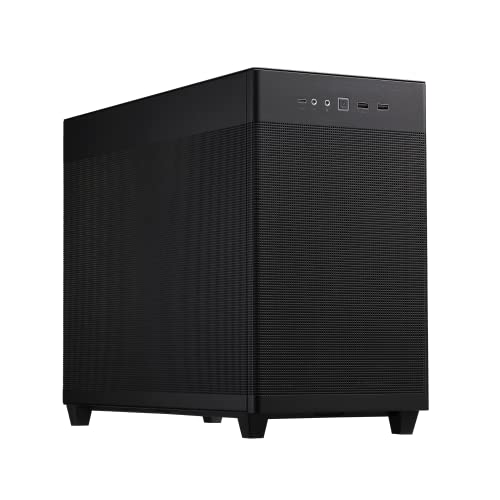
ASUS Prime AP201 (Mesh) — Best Filtered Compact Pick
The AP201’s trick is that the case itself is the filter. Its steel panels are perforated with holes fine enough that ASUS calls the result a quasi-filter mesh: air passes, household dust largely does not, and because the perforation covers the front, sides and top, the case breathes from whichever direction your fan layout prefers. At 33 litres it is not a true small-form-factor case, and this guide will not pretend otherwise — but it accepts mini-ITX boards, swallows graphics cards up to 338mm, mounts a 360mm radiator, and uses a standard ATX power supply, which removes the small-build tax that SFX units and short cables usually impose.
For a filtration-focused builder, the ownership story is the appeal. There is no delicate foam layer to tear and no filter tray to lose; you clean the case by wiping or vacuuming the panels and blowing out the interior on the rare occasions dust does get through, and the fine perforation keeps the through-traffic low. The interior layout is a conventional, friendly one — tool-free side panels, sensible cable room for the size, and none of the sandwich-layout contortions of true SFF design. If your priority order is dust control first, build sanity second and litre-count third, this is the most honest case on the list, and the one we would hand to a builder whose PC lives on a carpeted floor.
One more practical note: because the mesh is the panel, the AP201’s filtration does not depend on fan direction the way filter trays do. Run it as gentle positive pressure and the perforations still guard every seam the air might enter by. Owners in pet households report the panels themselves collect a visible dust film — which is precisely the point. That film is on the outside of the case, where a cloth reaches it, instead of felted onto a graphics card heatsink where only a teardown reaches.
Thermally, the perforation-everywhere approach has a side benefit that suits compact builds in particular: the case does not care much which way up your cooling plan points. A tower cooler exhausting upward, a radiator in the roof, a card dumping heat sideways — every direction finds a breathing panel rather than a sealed wall. Compact cases often force one blessed layout and punish deviation; the AP201’s indifference to layout is a large part of why builders find it so easy to live with, and it costs the filtration nothing, because every one of those breathing panels is itself the filter.
- Volume: around 33 litres (compact micro-ATX)
- Board support: mini-ITX and micro-ATX
- Filtration: quasi-filter perforated mesh panels
- Graphics card clearance: up to 338mm
- Radiator support: up to 360mm
- Power supply: standard ATX
Strengths
- Filtration built into the panels themselves — nothing to remove, tear or lose.
- Standard ATX power supply and long-card support remove the usual small-build compromises.
- Tool-free panels make the monthly wipe-down genuinely quick.
Trade-offs
- At 33 litres it is compact, not small-form-factor; true SFF builders should look below.
- The perforation filters less finely than a dedicated foam filter on the Montech.
- All-mesh panels let internal noise escape freely.
Best for: mini-ITX builders in dusty or pet-friendly homes who want filtration without a maintenance ritual.
Not suited for: anyone counting litres, or chasing the smallest possible desk footprint.
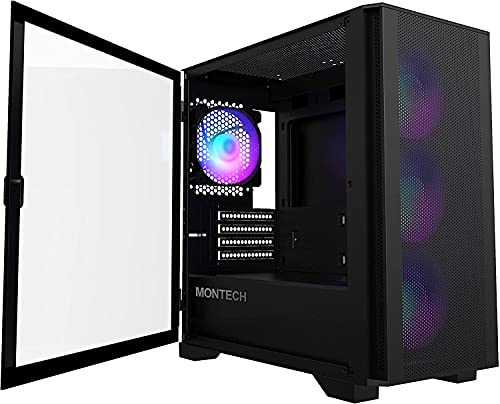
MONTECH AIR 100 ARGB — Best True Dust Filters
Where the AP201 filters by construction, the AIR 100 filters by equipment: proper removable dust filters sit on its intake paths, the kind you slide out, tap clean or rinse, and slide back while the kettle boils. That distinction matters to builders in genuinely dusty environments — a farmhouse office, a workshop-adjacent room, a home with two shedding dogs — because a dedicated filter layer stops finer material than perforated steel can, and can be restored to as-new performance in a minute. The case itself is a compact micro-ATX design that accepts mini-ITX boards, arrives with four fans already fitted behind a mesh front, and closes with a swivelling tempered glass side that opens like a door for cleaning day.
The rest of the package is sensibly judged for the size. Graphics cards up to around 330mm fit, tower coolers have honest clearance, and the included fan set means the filtered intake story works out of the box rather than after a fan purchase. The lighting controller will please builders who want the compact case to look alive on the desk; the filtration will please them more in month nine, when the interior still looks like the photographs from build day. Montech’s steel and finish are a step behind the ASUS, and the case is a touch larger in feel than its specification suggests, but as a filtration appliance for a mini-ITX board it is the most complete linked option in this guide.
It is also the pick that best survives a change of plan. A builder who starts with a mini-ITX board in the AIR 100 can later move to micro-ATX without replacing the case, and the filter arrangement and fan set carry over unchanged. Small-case purchases often become dead ends when a build outgrows them; this one leaves a door open, and leaves it filtered.
A word about the fans, since in a filtered case they are part of the filtration system whether they like it or not. Four fitted fans give the AIR 100 enough intake capacity to hold positive pressure through clean filters without running fast, and that headroom is what keeps the setup honest as the filters load between cleanings. A case with a single intake fan and a fine filter lives permanently on the edge of negative pressure; this one has margin, and margin is what separates a filtration design from a filtration gesture.
- Form factor: compact micro-ATX, accepts mini-ITX
- Filtration: removable dust filters on intake paths
- Included fans: four, behind a mesh front
- Graphics card clearance: around 330mm
- Side panel: swivelling tempered glass
- Notable feature: lighting controller included
Strengths
- Dedicated removable filters catch finer dust than mesh-only designs.
- Four included fans make the filtered airflow work from day one.
- Hinged glass side turns cleaning day into a short job.
Trade-offs
- Filters only work if cleaned; neglected, they become the restriction.
- Finish and steel gauge trail the ASUS pick.
- Still a compact desktop case, not a true sub-20-litre SFF box.
Best for: dusty rooms and pet households that need real, serviceable filters on a mini-ITX build.
Not suited for: builders who know they will never clean a filter — choose the AP201’s panels instead.

ASUS Prime AP201 (Tempered Glass) — Best Filtered Showpiece
This is the same 33-litre AP201 recipe with one side exchanged for tempered glass, and the honest question is what that swap does to filtration. The answer: less than you might fear, provided your fans are arranged sensibly. The mesh front, top and remaining panels still guard the intake paths, and the glass side is a display window rather than a breathing surface, so a build that draws air through the meshed faces keeps its dust defences. What changes is the temptation — a glass side invites lighting and a tidy interior, and the case becomes something you place on the desk rather than under it, which in turn usually means it lives in cleaner air to begin with.
Everything said about the mesh version’s practicality carries over: 338mm of graphics card room, 360mm radiator support, standard ATX power supply, tool-free access. The glass edition simply serves the builder who wants the filtered-compact formula and a view of the build they paid for. We list it separately rather than folding it into its sibling’s section because the filtration story genuinely differs in one respect — with one meshed side replaced by glass, the case breathes from fewer faces, so fan placement matters more. Set the intake fans on the meshed paths, keep the pressure mildly positive, and the difference from the full-mesh version shrinks to the aesthetic one.
There is a small ownership bonus to the glass that rarely gets mentioned: you can see the dust you do get. A glance through the panel tells you whether cleaning day has arrived, which beats the mesh version’s guesswork and the true SFF cases’ total blindness. For builders who maintain by eye rather than by calendar, that visibility is a filtration feature in its own right.
One build note specific to this version: with the glass fitted, plan the fan layout on paper before the parts go in. The mesh version forgives a vague plan because every face breathes; the glass version has a defined set of working faces, and discovering mid-build that your radiator wants the glass side is a special kind of afternoon. Decide which faces intake and which exhaust, keep the intakes on mesh, and the glass edition behaves exactly as its filtration billing promises.
- Boards accepted: mini-ITX and micro-ATX
- Size: around 33 litres, compact micro-ATX class
- Filtration: quasi-filter mesh on front, top and remaining panels
- Side panel: tempered glass
- Graphics card clearance: up to 338mm
- Power supply: standard ATX
Strengths
- Keeps the AP201’s filtered mesh on the faces that actually breathe.
- Glass side makes dust checks and the build itself visible.
- Same generous card, radiator and power supply support as the mesh version.
Trade-offs
- One fewer breathing face than the full-mesh version; fan placement matters.
- Glass adds weight and a fragile panel to a case you will move for cleaning.
- Shares the family size: compact, not genuinely small.
Best for: desk-top builders who want filtration and a display case in the same purchase.
Not suited for: floor placement in a dusty room — take the full-mesh version there.
Cooler Master NR200P — Best True SFF Option (prose-only)
We could not verify a pool listing for the NR200P, so it carries no link here — but no honest guide to filtered mini-ITX cases can omit it. At roughly 18 litres it is the case that taught a generation of builders that small did not have to mean compromised: it accepts serious tower coolers or a 280mm radiator, fits long triple-slot graphics cards, and — the point for this guide — ships with dust filters on its intake panels, in a genuine mini-ITX footprint with an SFX power supply. The steel side panels vent and filter; the layout is a traditional one stood on its head, which keeps building in it comprehensible to anyone who has assembled a tower before.
Its filtration is good rather than perfect. The filters cover the main intakes, but the case’s many panel seams give determined dust a few unguarded paths, so positive pressure discipline matters — set the fans to push slightly more in than out and the seams leak outward instead of inward. Access for cleaning is decent rather than delightful, involving panel removal rather than slide-out trays. None of that dethrones it. If the litres genuinely matter and filtration genuinely matters, the NR200P remains the reference point where those two demands meet, and the linked picks above should be understood as the more convenient, slightly larger answers to the same question.
One caution for buyers: the NR200 family has several variants, including a larger MAX version with bundled power supply and cooler, and listings are not always careful about which is which. Check the exact variant, its included parts and its panel set before ordering — the filtration and size story in this section belongs to the standard NR200P.
There is a community dimension to the NR200P that the newer cases cannot match. Years of production mean years of documented builds: exact cable lengths that work, fan arrangements that suit particular cards, filter-cleaning routines owners have settled on. For a first-time small-case builder, that accumulated knowledge is a genuine feature, because the questions a compact build asks are rarely answered in any manual. Buying the reference design buys the library that comes with it.
- Volume: around 18 litres, true mini-ITX
- Filtration: dust filters on intake panels
- Cooling: large tower coolers or up to 280mm radiator
- Graphics card: long, triple-slot cards supported
- Power supply: SFX (SFX-L in some configurations)
- Availability note: prose-only — no verified pool listing
Strengths
- Genuine SFF size with real filters — the combination this category is short of.
- Cooling headroom that embarrasses cases twice its volume.
- A mature design with years of community build knowledge behind it.
Trade-offs
- Panel seams leave minor unfiltered paths; pressure discipline required.
- Filter access means removing panels, not sliding trays.
- SFX power supply adds cost versus the ATX units the linked picks accept.
Best for: builders who truly need sub-20-litre size and refuse to give up filtration to get it.
Not suited for: anyone who wants tool-free filter trays or an ATX power supply.
Lian Li A4-H2O — Smallest Serious Option (prose-only)
The A4-H2O, designed with DAN Cases, is an 11-litre argument that a mini-ITX build should be organised around a 240mm radiator — and filtration is where that argument spends its budget. Its panels are perforated for the radiator and the graphics card to breathe through, but there is no dedicated fine filter layer, so this pick comes with a condition attached: it belongs in reasonably clean rooms, on desks rather than floors, ideally with the radiator fans arranged to keep pressure friendly. In that setting it is a superb object, dense and precise, with room for long graphics cards that seems to violate its own dimensions.
Why include a lightly filtered case in a filtration guide at all? Because builders searching this category will meet it constantly, and they deserve a straight account of the trade rather than discovering it after a dusty summer. The A4-H2O’s defence is architectural: a liquid-cooled processor moves its heat to the radiator at the case’s edge, and a well-chosen build has fewer internal dust-sensitive fins than an air-cooled one — though the graphics card remains air-cooled and exposed, which is the honest limit of that defence. Treat it as the pick for a clean studio or office, keep a soft brush nearby, and it rewards you with the smallest footprint here. Put it under a desk in a house with a long-haired cat and it will punish the decision.
It also demands build discipline the linked picks forgive: an SFX power supply, carefully measured cables, and a graphics card checked against a strict length and thickness envelope. None of that is a flaw — it is the admission price of 11 litres — but it means this is a case to choose deliberately, with this guide’s filtration caveat written into the decision, rather than a case to drift into.
It deserves one more fairness point. The A4-H2O’s perforations are at least honest ventilation, sized and placed for the components behind them, rather than the decorative slits some small cases hide behind. A builder in a clean room loses little by choosing it, and gains a machine that disappears into a desk setup in a way none of the filtered picks can. The guide’s objection is not to the case; it is to buying the case for a job — dust defence — that it never claimed to do.
- Volume: around 11 litres, true mini-ITX
- Filtration: perforated panels only — no dedicated filter layer
- Cooling: designed around a 240mm radiator
- Graphics card: long cards within a strict thickness envelope
- Power supply: SFX
- Availability note: prose-only — no verified pool listing
Strengths
- The smallest footprint in this guide with genuinely high-end build potential.
- Radiator-first layout keeps processor heat at the case’s boundary.
- Beautifully made; feels like an instrument rather than an enclosure.
Trade-offs
- Filtration is the weakest here alongside the Terra — clean rooms only.
- Tight cable and card tolerances punish improvisation.
- SFX power supply and radiator are effectively mandatory costs.
Best for: clean-room minimalists building a compact liquid-cooled system on a desk.
Not suited for: dusty homes, floor placement, or first-time small-case builders.
Fractal Design Terra — Beautiful but Unfiltered (prose-only)
Let us be direct, because the Terra’s admirers sometimes are not: this case has no dust filters. Its anodised aluminium panels and walnut front are perforated and slatted for ventilation, and air moves through it well, but nothing in the design attempts to stop dust, and in a dusty home the interior will show it within months. We include it in this guide for exactly one reason — it is the small case most likely to be bought by someone who searched for a filtered mini-ITX case and assumed, from the care evident in every photograph, that filtration must surely be part of the package. It is not, and learning that here is cheaper than learning it with a can of compressed air.
Judged on its own terms, the Terra is lovely: around ten litres, an adjustable internal spine that trades space between the graphics card and the processor cooler, and materials that belong in a furniture showroom. Its cooling approach — both main components breathing directly through the case walls — works well in clean air and makes it a fine choice for a tidy studio or a living room with hard floors and no pets. But this guide’s question is filtration, and on that question the Terra is the control group: the beautiful, well-ventilated case that demonstrates what “unfiltered” actually means over a year of ownership. If you buy it, buy it with open eyes and a cleaning schedule.
Owners who do choose it can soften the dust story with habits rather than hardware: keep it on the desk, never the floor; blow it out monthly rather than yearly; and avoid parking it beside a litter tray, a workshop door or any of the other dust sources that a filtered case would forgive. Habits help. They are not a filter, and this guide will not call them one.
Context matters for fairness here, too. Fractal never marketed the Terra as a filtered case; the assumption lives entirely on the buyer’s side, projected onto it by people who wanted the object and reasoned backwards to the specification. That is exactly why this guide spends a full pick on it. Search results for filtered mini-ITX cases are full of beautiful unfiltered cases wearing the searcher’s hopes, and the Terra is simply the most beautiful of them. Admire it accurately, and it can still be the right purchase — for a clean room, with a cleaning habit, at a fair price for what it actually is.
- Volume: around 10 litres, true mini-ITX
- Filtration: none — perforated panels only
- Layout: adjustable spine balancing GPU and cooler space
- Materials: anodised aluminium with walnut front
- Power supply: SFX
- Availability note: prose-only — no verified pool listing
Strengths
- Furniture-grade design and materials unmatched in this list.
- Clever adjustable interior makes the most of its ten litres.
- Direct-breathing layout cools well in clean environments.
Trade-offs
- No dust filtration whatsoever — the central fact of this pick.
- Small volume means zero tolerance for neglected cleaning.
- Premium pricing buys design, not dust protection.
Best for: design-led builders in clean, hard-floored rooms who will clean monthly without resentment.
Not suited for: dusty homes, pet hair, carpeted floors — which is to say, most people who searched for this guide.
Should You Filter the Exhaust Side Too?
No, and the reason is worth understanding because it explains how dust actually enters a PC. Dust arrives on moving air. Air leaves through the exhausts, so an exhaust filter would catch nothing but the case’s own warmth — while adding resistance exactly where the fans are trying to expel heat. The intakes are the only doors dust walks through while the machine runs, which is why every pick in this guide concentrates its filtration there. The exception that proves the rule is the machine at rest: a switched-off PC in a dusty room can settle dust through any opening, top vents included, which is an argument for a dust cover over a small case that sits idle for long stretches, not for exhaust filters.
The subtler point is pressure again. Filter only the intakes and run them slightly ahead of the exhausts, and every unfiltered seam in the case becomes an exit — air leaks out through panel gaps, slot covers and cable holes, and dust cannot swim upstream against that leak. Filter an exhaust and you have spent money to weaken the exhaust side, making negative pressure more likely and the seams into entrances. Filtration strategy in a small case is therefore pleasingly simple: guard the doors in, keep them slightly pressurised, and let everything else leak outward.
Does a Filtered Case Need Different Fans Than an Unfiltered One?
Slightly different priorities, yes. A filter is a resistance the intake fan must push or pull through, so fans with decent static pressure — the ability to keep moving air against an obstruction — serve a filtered case better than fans designed purely for free-air volume. In practice, the fans bundled with the linked picks are chosen by their makers with the filters in mind, which is one more argument for buying a case whose filtration was designed rather than improvised. Where builders go wrong is retrofitting: taking a high-volume, low-pressure fan from an open case, pressing it against a dense filter in a small chassis, and concluding that filtration “kills airflow” when the actual failure was a mismatched fan.
Speed range matters too. A filtered intake rewards a fan that behaves well at low and medium speeds, because the filter’s resistance is proportionally kinder there and the build spends most of its life at partial load. Set the curve so the intakes run a touch ahead of the exhausts, as the cleaning section below advises, and the pressure fans will hold that balance without audible effort. The headline is reassuring: you do not need exotic fans for a filtered mini-ITX build. You need appropriate ones, clean filters, and a curve written by someone who knew both facts.
What Happens Inside an Unfiltered Small Case, Month by Month?
The first month is deceptive: a fine grey film on the graphics card’s backplate, easily wiped, easily dismissed. By the third month the film has found the heatsink fins and begun to weave, because the fibres in household dust interlock under heat and vibration into something closer to felt than powder. Fan blades develop a leading-edge crust that quietly unbalances them. By month six the card’s cooler is wearing an insulating layer exactly where its fins meet the air, and the card responds the only way it can — with fan speed. The build is now measurably louder doing the same work, and the owner starts pricing replacement fans for a problem that lives on the heatsinks.
Nothing in that timeline is dramatic, which is why it wins so often. There is no failure event, no error message, just a slow renegotiation of what the machine sounds like and how hot it runs. Filtration interrupts the timeline at its first step: the felt never forms because the fibres never arrive. When this guide insists that a filter in a small case is a maintenance plan rather than a feature, that six-month slide is the evidence — every stage of it is preventable at the case’s boundary and laborious anywhere else.
How Do Filters Change a Small Case’s Noise?
In two opposite directions, and the net depends on the month you measure. On day one, a filter adds a whisper of resistance noise and asks the intake fans to work marginally harder, so a filtered build can measure a touch louder than its unfiltered twin at the same temperatures. By month six the comparison inverts completely: the unfiltered build’s fans are compensating for felted heatsinks, while the filtered build — its filters rinsed on schedule — still sounds like day one. Small cases amplify both effects because their fans are fewer, faster and closer to your ears than a tower’s.
There is also a tonal point. Dust loading makes fan noise worse in character, not just volume: crusted blades and clogged fins produce the uneven, labouring note that people describe as a PC “sounding old”. A filtered case ages acoustically in a straight line instead of a slope, which for a machine that lives on a desk, in a bedroom, a metre from where you sleep and work, is worth more than a degree or two in either direction. Filtration, judged over the life of the build, is a noise feature as much as a cleanliness one.
How Do the Six Compare Side by Side?
| Case | Approx. volume | Filtration type | Link status | Honest summary |
|---|---|---|---|---|
| ASUS Prime AP201 (Mesh) | 33L | Quasi-filter mesh panels | Linked | Filtration as the structure itself |
| MONTECH AIR 100 ARGB | Compact mATX | Removable dust filters | Linked | Finest filtering, needs cleaning |
| ASUS Prime AP201 (TG) | 33L | Mesh on breathing faces | Linked | Filtered, with a display side |
| Cooler Master NR200P | 18L | Filtered intake panels | Prose-only | True SFF with real filters |
| Lian Li A4-H2O | 11L | Perforation only | Prose-only | Tiny and liquid-focused; clean rooms |
| Fractal Design Terra | 10L | None | Prose-only | Gorgeous, and entirely unfiltered |
What Should You Check Before Choosing a Filtered Mini-ITX Case?
Begin with where the machine will live, and be specific: floor or desk, carpet or boards, pets or none, a room that gets cleaned weekly or a room that gets cleaned eventually. That single answer sorts this list more reliably than any specification. Carpeted floors and pets push you to the linked ASUS and Montech cases and away from the unfiltered pair, whatever their charms. A clean desk in a hard-floored room reopens the whole list. Next, measure your graphics card’s length and thickness and your cooler’s height against the case’s stated limits, remembering that small cases have no “close enough” — a card that misses by four millimetres is a return, not a challenge.
Cooling format interacts with filtration in small cases more than builders expect. An air-cooled build depends on case air for everything, so its filters guard two heatsinks at once; a radiator build moves the processor’s heat to the case wall, where the radiator’s own fans and fins become the dust-sensitive surface — and a radiator clogged with felt is harder to clean in place than any filter. If you are planning liquid in a small case, the filtered intakes stop being a preference and become the radiator’s only protection. Check, too, that fitting the radiator does not require removing the very filter tray that sold you the case; on some compact designs the two compete for the same panel, and the brochure photographs only one of them at a time.
Power supply format deserves an early decision because it shapes the budget. The linked picks accept standard ATX units, which are cheaper, quieter at a given quality and already in many builders’ cupboards. The true SFF picks need SFX units, which cost more for the same quality and come with shorter cables that suit small cases and nothing else. Neither is wrong, but drifting into an SFX purchase by accident is an expensive surprise. Finally, inspect the filter access with your own routine in mind: if the honest version of you cleans filters that slide out and ignores filters behind six screws, shop for the honest version of you.
How Do You Keep a Small Filtered Build Clean Over Time?
Set the pressure first. Arrange the fans so intake slightly exceeds exhaust — one more intake fan, or intakes on a slightly stronger curve — and the case will breathe in through its filters and out through its seams, instead of inhaling dust through every panel gap. In the compact cases here this matters more than in towers, because the seams are never far from a heatsink. Then put the filters on a calendar rather than a conscience: a monthly slide-out and rinse for the Montech, a monthly wipe of the AP201’s panels, and a quarterly interior blow-out for everything on this list, including the filtered picks. Filtration reduces interior cleaning; it does not abolish it.
Technique matters more than frequency. Rinse removable filters from the clean side outward, so the water pushes the trapped dust back the way it came rather than driving it deeper into the mesh, and let them dry completely before refitting — a damp filter in a warm case is a musty smell with a part number. Foam-style layers should be tapped and brushed rather than soaked unless the maker says otherwise. For the AP201’s panels, a vacuum with a brush attachment on the outside faces does the month’s work in a minute; resist the urge to blast the interior with canned air while the filters are off, because that simply relocates the dust from the boundary to the heatsinks you were protecting.
Placement is the other half of the routine. A small case on a desk inhales a fraction of the dust of the same case on a carpet, and a case kept a metre from a pet bed lives an easier life than one parked beside it. If the floor is unavoidable, raise the case on a stand so its intakes clear the carpet’s dust layer, and shorten the filter interval. Watch the build’s idle fan behaviour as your early-warning system: a small PC that idles louder in October than it did in June, in the same room temperature, is telling you its filters or its heatsinks are loaded, and the filters are the cheaper place to look first.
What Are the Most Common Mistakes When Buying a Filtered Small Case?
The first is believing the word “mesh” means “filtered”, which this guide has probably belaboured — but it remains the mistake that fills forums with surprised photographs of dusty Terras. The second is buying filtration and then defeating it with fan direction: an exhaust-heavy small build pulls unfiltered air through every seam, rendering the finest filter tray decorative. The third is choosing a case whose filters you will not clean. A neglected dedicated filter is worse than the AP201’s self-filtering panels, because a clogged filter both blocks air and advertises protection it no longer provides.
Fourth, and specific to this category: assuming a mini-ITX board means any case that mentions mini-ITX is a small case. The linked picks here accept mini-ITX boards in compact bodies of around 33 litres; the prose-only picks are a third of that size with all the cable and power supply discipline the size demands. Know which purchase you are making. And fifth: forgetting that filters cost a little airflow, then compensating with maximum fan speeds forever. The correct compensation is a sensible curve and clean filters — a filtered case run gently will out-cool and out-quiet an unfiltered one screaming through its own dust.
How Fine Should a PC Dust Filter Actually Be?
Fine enough to catch the dust that mats, coarse enough to let the fans breathe. The material that damages builds is not the finest airborne powder — much of that passes through a PC and out again — but the fibrous household dust and pet hair that weave themselves into felt across a heatsink’s fins. A filter that stops the fibres stops the problem, and that is roughly the fineness of the layers and quasi-filter meshes in the linked picks. Going finer still, toward laboratory grades, mostly buys resistance: the fans work harder, move less air, and the build gets louder in exchange for catching powder that was never going to felt.
This is also why cleaning restores a filter rather than merely improving it. A filter’s performance falls off a cliff as its surface loads, because the fibres it has caught become part of the filter medium — finer, denser and far more restrictive than the layer you bought. The monthly rinse is not hygiene theatre; it returns the filter to its designed balance of fineness and flow. Builders who understand that stop asking why their filtered case runs hotter than a review said, because the review measured a clean filter and they are running a six-month one.
Final Recommendation
For most people who searched for this guide, the answer is the ASUS Prime AP201 in its mesh form: its filtration is structural rather than an accessory, it forgives a forgotten cleaning month, it takes ordinary parts at ordinary prices, and it asks only that you accept 33 litres as the price of all that forgiveness. If your room is genuinely dusty and you are genuinely diligent, the Montech AIR 100’s real filter trays stop finer material still. Drop to the NR200P when the litres truly matter, consider the A4-H2O only for clean desks and liquid builds, and admire the Terra the way you would admire a convertible in a rainy climate — as a beautiful thing for somebody else’s weather. In a small build, the filter is not a feature. It is the maintenance plan, and you should buy the one you will actually keep.
One last word for the builder still hesitating between the compact linked picks and a true SFF case: the litre difference looks enormous on a specification sheet and remarkably small on a desk, where both occupy roughly a shoebox’s worth of the same corner. The maintenance difference, compounded monthly over the life of the machine, is the one that grows. Choose the case your future self — the one holding a filter under a tap in month fourteen — would thank you for, and in most homes that is the case whose filtration was designed in, not wished for.
Frequently Asked Questions
Is a mesh case the same as a filtered case?
No. Mesh describes a perforated panel; a filter is a fine layer intended to catch dust before it enters. Some meshes, like the AP201’s quasi-filter perforation, are fine enough to do real filtering work, and this guide credits them for it. Coarse decorative mesh over a fan opening does not, and several famous small cases rely on panels that ventilate without filtering at all.
Do dust filters make a mini-ITX PC run hotter?
Slightly, when everything is clean — a filter is a resistance, and honesty requires admitting it costs a small amount of airflow. The comparison that matters is month six: the filtered build with rinsed filters runs at close to its day-one temperatures, while the unfiltered build’s heatsinks are wearing felt. Over any realistic ownership period, the filtered case is the cooler one. The exception is the neglected filtered case: a filter left for a year becomes a wall, and a walled intake in a small chassis is worse than an open one. Filtration is a subscription paid in monthly minutes — keep the subscription, and the physics stays on your side.
How often do small-case filters need cleaning?
Monthly is the right default for a compact build in a normal home; shorten it for carpeted floors and pets, lengthen it cautiously for a clean desk setup. Small cases load their filters faster than towers because the same household dust is drawn through a smaller filter area by fans that sit closer to the floor’s dust layer.
Can I add filters to an unfiltered case like the Terra?
Aftermarket magnetic filter sheets exist and can be fitted over intake areas, but on a case like the Terra, whose components breathe through the case walls on several faces, you would be wrapping much of the design in filter material and choking the very ventilation that makes it work. It is a compromise some owners accept; it is not equivalent to a case designed around filtration, and this guide does not present it as one.
Does positive pressure really keep dust out of a small case?
It keeps dust entering through the unfiltered paths — seams, slots and gaps — because air leaks outward through them instead. Dust still arrives through the intakes, where the filters are, which is the arrangement you want. It is not a force field; it is a way of making sure the filters are the only door dust uses. In a small case the effect is amplified, because the total seam length is short and the fans are strong relative to the volume — a modest intake advantage genuinely pressurises the whole box.
Are manufacturer “dust-proof” claims trustworthy?
Treat them as a prompt to look closer, not as a conclusion. There is no standard test behind the phrase, so one maker’s dust-proof is a sealed, filtered design and another’s is a mesh panel and optimism. The checks in this guide take a minute on any listing: find the filter layer in the photographs, find how it comes out, and find whether the main intakes are the filtered ones. If a listing cannot answer those three, the claim is decoration.
Which pick should I choose for a PC that lives on carpet?
The mesh AP201, raised on a stand if you can, with the Montech AIR 100 as the alternative if you will clean its filters monthly. Avoid the unfiltered prose-only picks entirely for carpet duty, and avoid any case’s bottom intake sitting directly in the pile — carpet is the single harshest dust environment a PC commonly faces.
Related Guides
If your build is a full-size tower rather than a compact one, our roundup of the best airflow cases for a PC covers the mesh-front options with the strongest stock cooling. Readers weighing a screen-integrated all-in-one style build instead should see our honest guide to AIO-style PC cases and their closest alternatives, and anyone speccing the rest of a small build will find our guide to choosing components for compact PCs a useful companion.



[…] whose interest in this category is really about cooling should continue with our roundup of the best airflow cases for a PC, where radiator support and mesh fronts are compared across the full-size field. If compact is more […]