What's inside
- Key Takeaways
- Quick Picks
- How did we choose these boom mic headsets?
- Why does a boom microphone sound clearer than a built-in one?
- Boom, cable or wireless — which connection suits your working day?
- How does microphone placement change what your callers hear?
- The six boom mic headsets, pick by pick
- Side by side: how the six boom designs differ where it counts
- How do you set up a boom headset for clear calls?
- What should a team buyer check before ordering boom headsets in bulk?
- What mistakes do people make when buying a boom mic headset?
- Final Recommendation
- Frequently Asked Questions
- Related Guides
As an Amazon Associate I earn from qualifying purchases. This post may contain affiliate links at no extra cost to you.
widgetverdict.com is reader-supported. When you buy through links on our site, we may earn an affiliate commission.
Where to buy: each of the six headsets below links to its checked Amazon listing, and the set deliberately spans wired desk headsets, one broadcast model, an open-ear bone-conduction outlier and a wireless UC headset, because a boom microphone means something slightly different in each of those worlds.
The best boom mic headsets share one physical idea: instead of hiding the microphone inside an earcup and hoping software can rescue your voice, they put a capsule on an arm, close to the corner of your mouth, where speech is loudest and room noise is comparatively weak. That geometry is worth more than any noise-cancelling badge. A boom placed two finger-widths from your lips captures your voice at a level a desk fan, a kettle or a colleague three seats away simply cannot match, and every processing trick applied afterwards starts from a far cleaner signal.
What separates the six picks here is everything around that arm. Two are wired USB desk headsets built for back-to-back calls. One is a broadcast headset designed for commentary booths and radio studios, where the microphone is the product and the headphones are almost an accessory. One skips earcups entirely and conducts sound through your cheekbones. One cuts the cable and runs through a USB adapter. And one threads USB-C, USB-A and a 3.5mm jack through a single flexible boom, so it can follow you from laptop to desk phone to a phone in your pocket. Choosing well means deciding which of those jobs is actually yours before you admire any single model.
Comfort runs through every section below because boom headsets are worn for shifts, not songs. Weight, clamp force and earcup material decide whether a headset disappears by the second hour or becomes the thing you keep adjusting between sentences. The microphone matters most, but the head wearing it has a vote too.
Key Takeaways
- A boom near your mouth beats in-earcup microphones and most software suppression, because distance is the strongest noise control there is.
- Wired USB models dominate this list for a reason: zero charging, zero pairing, and call controls that work the moment the plug lands.
- Boom style is a real dividing line — double-sided, flexible, fixed broadcast and detachable designs suit different desks and different habits.
- The SHOKZ OpenComm2 is the exception that proves the fit rule: nothing covers your ears, which some callers love and others cannot tolerate.
- Broadcast and call-centre headsets optimise opposite ends of the same problem, so decide whether listeners or co-workers judge your voice.
- Replaceable earcups and cables quietly decide how many years a hard-used headset survives.
Quick Picks
| Pick | Badge | Why it earns its place |
|---|---|---|
| Lenovo USB-A Wired Stereo Headset | The featherweight desk pick | At 140g with replaceable earcups and a double-sided boom, it is built for full shifts on Teams and Zoom without the end-of-day neck ache. |
| Poly Blackwire 5220 Wired Headset | The three-plug all-rounder | USB-C, USB-A and 3.5mm in one headset, with a flexible boom and over-ear cups — the pick for desks where the device keeps changing. |
| Jabra Evolve2 40 SE | The three-microphone call specialist | A 3-microphone call system in a wired stereo headset with a USB-C/A cable, aimed at people whose voice is their job all day. |
| Audio-Technica BPHS1 Broadcast Stereo Headset with Dynamic Cardioid Bo | The broadcast booth pick | A dynamic cardioid boom built for commentary and studio work, where the microphone must reject a loud venue and flatter a voice for hours. |
| SHOKZ OpenComm2 Open-Ear Bluetooth Headset | The open-ear exception | Bone conduction leaves your ears completely open while a noise-cancelling boom handles calls — for people who must hear the room and the meeting at once. |
| Poly – Voyager 4320 UC Wireless Headset (Plantronics) – | The wireless roamer | A boom headset that reaches the PC through a USB-A adapter and the phone over Bluetooth, certified for Teams — for people whose calls follow them around the building. |
How did we choose these boom mic headsets?
Every pick had to carry its microphone on a genuine boom arm, positioned near the mouth rather than buried in a cup or dangling from a cable. That single filter removed most gaming headsets with stubby detachable wands and every earbud claiming a virtual boom. We then checked each listing title for the connection story, the microphone arrangement and the platforms named, and kept only models whose titles support the claims made in their sections below. Where a title stays silent about a detail, the spec box says so instead of guessing.
Balance mattered as much as any individual winner. A list of six near-identical wired call headsets would be useless, so the final six stretch across the ways people actually use a boom: tethered at one desk all day, moving between laptop and phone, commentating, or keeping ears open to a room. If your work sits close to one of those patterns, one pick should feel obviously yours and the rest should read as useful contrasts. Readers comparing microphone quality across wider categories may also want Best Headsets With Great Mic Quality — Broadcast, Streaming and Meeting Voices Compared, which looks beyond boom designs entirely.
Why does a boom microphone sound clearer than a built-in one?
Sound falls off quickly with distance, and a boom exploits that physics ruthlessly. Your voice reaches a boom capsule from a few centimetres away, while the dishwasher, the traffic outside and the television in the next room all arrive from metres away, hugely reduced in relative level. The microphone therefore hears a favourable ratio before any electronics get involved, and noise-cancelling processing — whether a second capsule, an app or a platform filter — only has to clean an already decent signal rather than perform rescue surgery on a muddy one.
Placement consistency is the second, quieter advantage. A headset microphone fixed in an earcup hears your voice from a position that shifts every time you adjust the fit, turn your head or shrug. A boom, once bent or swung into place, holds its distance and angle through a whole call, so your level stays steady and colleagues stop asking you to repeat the ends of sentences. Presenters and support agents sound professional largely because of this steadiness, not because their voices changed.
There is a trade-off worth naming: a boom sits in your peripheral vision and near your coffee cup. People who gesture while talking occasionally knock a long arm, and anyone eating during a meeting will learn where the capsule lives. Flexible booms forgive most of this by bending rather than snapping, and several picks below mute when the arm swings up, turning the boom itself into the control you reach for most.
Boom, cable or wireless — which connection suits your working day?
A wired USB headset is the default recommendation for a fixed desk, and three of the six picks follow that pattern. The cable carries audio both ways with no battery to manage, no pairing menu to fight and no wireless dropouts when a neighbour runs a microwave. In-line controls put mute and volume under your thumb, which matters more than it sounds: the mute button you can find without looking is the one that saves you when a dog erupts mid-presentation.
Wireless earns its premium when the desk is not really a desk. The Voyager 4320 below connects to a computer through a USB-A Bluetooth adapter and to a phone over Bluetooth directly, so one headset covers the laptop call and the corridor call that follows it. The cost is a charging routine and a battery that will eventually age. Judge honestly how often you leave your chair mid-call; if the answer is rarely, the cable is not a limitation but a simplification.
The 3.5mm jack still deserves respect as the universal fallback. The Poly Blackwire 5220 includes it alongside both USB flavours, which means the same headset can plug into a controller, an older desk phone or a laptop whose USB ports are all occupied. Broadcast work runs on its own connectors again — the Audio-Technica below is a studio tool first — so match the plug to the equipment you truly own, not the equipment you might buy someday. For a wider look at suppression-focused designs, see Best Noise-Canceling Mic Headsets.
How does microphone placement change what your callers hear?
Try a small experiment that broadcasters learn in their first week: record the same sentence with a boom capsule at four positions — close beside the mouth, dropped toward the chin, swung out toward the cheek, and parked near the forehead band. The close position sounds like a person in the room with the listener. Each step away adds hollowness, room echo and consonant loss, until the forehead position sounds like a voice leaking from a corridor. Nothing about the microphone changed; only distance and angle did, which is why this guide treats boom design as the first specification and electronics as the second.
Angle matters almost as much as distance. A capsule aimed across the corner of the mouth catches speech cleanly while breath travels past it, whereas a capsule aimed straight at the lips receives every puff of air as a low thump. Good booms — flexible, double-sided or broadcast — are really positioning instruments: they exist to hold that forgiving angle for hours without drifting when you nod, laugh or reach for a notebook. When you read the pick sections, judge each arm by how confidently it would hold its position through your longest meeting.
There is a social dimension too. People speak more naturally when they trust the channel, and a caller who is not straining to hear you will interrupt less, misunderstand less and rate the conversation better, whether that conversation is a sales call, a support resolution or a podcast interview. The boom is therefore not an accessory to the headset; in every meaningful sense it is the headset, and the earcups are there so you can hear the reply.
The six boom mic headsets, pick by pick
Each pick below is examined on its own terms: what its boom actually does, how it connects, and the working pattern it fits. Spec boxes stick to what the listing titles state, and anything the title leaves unstated is flagged rather than filled in.
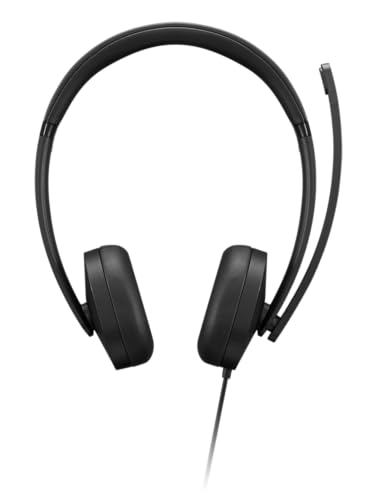
Lenovo USB-A Wired Stereo Headset — The featherweight desk pick
Lenovo pitches this headset squarely at the laptop worker, and the title reads like a checklist written by someone who has survived a winter of video calls. Start with the number that shapes everything else: 140 grams. That is light enough that the headset stops being an object you are aware of wearing, which changes how the sixth call of the day feels compared with the first. Stereo earcups give you both ears in the conversation, and because the cups are replaceable, the part that wears out fastest — the cushion foam and its cover — can be renewed instead of condemning the whole headset to a drawer.
The boom deserves a closer look because its party trick is in the title: double-sided. The arm can be worn on either side, so left-eared and right-eared people both get a natural fit, and a colleague sharing a headset across shifts can flip it to their preference. In-line controls on the cable carry a mute button for calls, the control that gets used dozens of times a day and therefore needs to sit exactly where a thumb falls without a glance down.
Noise cancelling here arrives through an app, according to the title, which is a different arrangement from a second hardware capsule doing the work. Software suppression can be updated and tuned, and it keeps the headset itself simple and light, but it does mean the cleanup depends on the companion app running on your machine. For a managed work laptop where that app is welcome, the trade is sensible. For a locked-down machine where nothing extra may be installed, read the Poly and Jabra sections below with extra care, because their approaches lean on hardware and multi-microphone design instead.
Day-to-day ownership is where this Lenovo quietly scores. A wired USB-A connection means it borrows power from the laptop and asks for nothing overnight, so it is always ready when the first call lands at nine. The stereo presentation keeps a caller’s voice centred and intelligible even at low volume, which helps during the last tired hour of a shift when people unconsciously turn headsets down. Keep a spare set of earcups in a drawer and the headset can be refreshed in seconds mid-week, a small ritual that makes a shared or issued headset feel personal again. For a single-desk worker who values lightness above every other virtue, the argument is honestly difficult to beat.
One more practical note: because the noise cancelling lives in an app, your first setup session should include opening that app, granting it the microphone and testing a call with a television playing nearby. Five minutes of configuration on day one decides whether the feature quietly works for a year or sits unused while you blame the hardware. Workers who make that small investment tend to become the people colleagues describe as suspiciously clear on every call.
- Connection: USB-A wired, for PC and laptop
- Microphone: double-sided boom mic, wearable on either side
- Noise handling: AI noise cancelling via companion app, per the listing title
- Weight: 140g as stated in the title
- Earcups: replaceable cushions
- Controls: in-line, with mute for calls
- Platforms named in title: Microsoft Teams and Zoom
Strengths
- Featherweight 140g build suits genuinely long wearing sessions
- Replaceable earcups extend the useful life of the headset
- Double-sided boom accommodates left- or right-side wearers
Trade-offs
- Noise cancelling depends on the companion app rather than hardware alone
- USB-A only, so USB-C-only laptops need an adapter
- Stereo call tuning prioritises voice clarity over music depth
Best for: remote workers spending most of the day on Teams or Zoom calls from one laptop, valuing low weight over wireless freedom
Not suited for: callers working on locked-down machines where installing a companion app for noise cancelling is not permitted

Poly Blackwire 5220 Wired Headset — The three-plug all-rounder
Poly built its reputation in offices where headsets are issued by the dozen, and the Blackwire 5220 shows that heritage in its connector list. USB-C for the modern laptop, USB-A for the older machine still under the desk, and a 3.5mm plug for everything else: one headset follows you across hardware generations without a bag of adapters. Hot-deskers moving between a new ultrabook and an ageing desktop will understand why that breadth, unglamorous as it sounds, can be the deciding feature.
The boom is flexible, which in daily use means it bends to the exact distance from your mouth that your voice needs, then bends back when a colleague leans in to talk face to face. Flexible arms also survive being stuffed into a laptop bag far better than rigid ones, because they yield instead of cracking. The title describes noise cancelling headphones with a microphone, and the over-ear ergonomic design seals around the ear rather than pressing on it, giving passive isolation that helps in a busy household or an open-plan floor.
Nothing here chases novelty, and that is the point. This is the headset for someone whose employer runs Teams, whose evenings involve Zoom, and whose hardware is a mixture of eras. It works from home, as the title says, but it works equally well in the office the title politely ignores. Choose it when compatibility worries you more than any single headline feature, because its whole design is an argument that the best headset is the one that plugs into whatever is in front of you.
Consider the week this Poly is really built for. Monday at home on a USB-C laptop, Tuesday at a hot desk with an older tower, Wednesday on a 3.5mm-equipped device when the dock misbehaves. Most headsets force a compromise somewhere in that week; the 5220 simply keeps arriving with the right plug attached. The over-ear cushions also spread pressure across a larger area than on-ear pads, which some wearers find kinder across long afternoons, and the flexible boom can be parked upward and out of the way for a coffee without removing the whole headset. It is a design that assumes your environment is imperfect and plans accordingly.
The 3.5mm plug also gives this headset an afterlife. When the next laptop refresh arrives, or when a family member needs a headset for an older machine, the Blackwire simply migrates. Products with a single proprietary connector tend to die with the device they were bought for; a headset fluent in three connection languages keeps finding work. Longevity like that rarely appears in feature lists, yet it is often what separates a sensible purchase from a regrettable one three years later.
- Connection: USB-C, USB-A and 3.5mm wired
- Microphone: flexible boom mic
- Design: ergonomic over-ear
- Noise cancelling: stated in the listing title
- Platforms named in title: Microsoft Teams and Zoom
- Use case named in title: work from home
Strengths
- Three connection types cover new laptops, old desktops and phones
- Flexible boom adjusts precisely and survives bag transport
- Over-ear seal gives useful passive isolation in noisy rooms
Trade-offs
- Wired only, so pacing during calls is impossible
- Over-ear cups run warmer than on-ear designs in summer
- Aimed at calls, so music listening is a secondary talent
Best for: hybrid workers rotating between a USB-C laptop, an older USB-A desktop and a phone, needing one headset that plugs into all three
Not suited for: presenters expecting to stand, move and gesture freely while staying on the call

Jabra Evolve2 40 SE — The three-microphone call specialist
Jabra sells the Evolve2 40 SE on a single engineering claim, printed right in the title: 3-microphone call technology. Multiple capsules let the headset compare what arrives at each microphone, keep the signal they share — your voice, close and consistent — and discount what differs, which is usually the room. In practice this is the difference between colleagues hearing your sentence and hearing your sentence plus your keyboard, your chair and the traffic that happened to pass during it.
The headset is wired stereo with a USB-C/A cable, a small detail that removes a familiar annoyance: whichever USB socket your laptop offers, the same cable answers, with no separate adapter to lose in a drawer. It is described as UC and suitable for all platforms, which matters in organisations where the morning runs on one meeting service and the afternoon on another. Platform-agnostic hardware avoids the trap of a headset that behaves beautifully in one app and strangely in the next.
This 2026 version of the Evolve2 40 SE continues a line that call-heavy workplaces have standardised on for years, and the design language is deliberately sober: black, professional, nothing that glows. It will not be mistaken for a gaming headset, and its stereo drivers are voiced for speech intelligibility rather than spectacle. If your performance review quietly depends on how you sound to clients, this is the conservative, defensible choice in the six — the one bought by people who measure a headset in misunderstandings avoided.
There is also a discipline argument for the Jabra. Because it is wired and platform-agnostic, it behaves identically on the first call of the day and the last, in the office and at the kitchen table, this month and next year. IT departments standardise on that kind of predictability, but individual buyers benefit from the same trait: no firmware roulette, no pairing amnesia, no battery anxiety before a big presentation. The three-microphone system does its work invisibly, which is the highest compliment call technology can earn — nobody on the other end ever comments on your headset, because there is never anything to comment on.
Wearing comfort follows the same professional logic. A stereo headset worn across a full shift lives or dies by how its weight is distributed and how the cups treat the ears at hour five, and the Evolve line has been refined across generations of exactly that feedback. Pair that with the disciplined microphone array and the result is a headset that asks nothing of its owner except to be plugged in — a modest request that busy professionals repay with genuine loyalty to the model.
- Connection: wired, USB-C/A cable
- Microphone: 3-microphone call technology, per the listing title
- Noise cancelling: stated in the title
- Platform fit: UC, all platforms, per the title
- Colour: black
- Edition: 2026 version, per the title
Strengths
- Three-microphone system targets voice isolation directly
- Single USB-C/A cable ends adapter hunting
- Platform-agnostic UC design suits mixed meeting software
Trade-offs
- Wired connection ties you to the desk
- Sober styling and call tuning will not thrill music listeners
- Boom details beyond the microphone system are not elaborated in the listing title — check the manufacturer documentation before ordering for a specific boom length
Best for: client-facing professionals taking calls across several meeting platforms daily, needing their voice isolated from a busy household or office
Not suited for: workers wanting a single headset that doubles as wireless headphones for the commute

Audio-Technica BPHS1 Broadcast Stereo Headset with Dynamic Cardioid Bo — The broadcast booth pick
Every other pick in this list was designed for meetings. The BPHS1 was designed for broadcast, and the difference shows in its microphone: a dynamic cardioid boom capsule. Cardioid describes the pickup pattern — sensitive in front, rejecting to the sides and rear — which is exactly what a commentator needs when a crowd roars behind the booth. Dynamic describes the capsule type, prized in studios for handling loud voices at close range without distortion and for ignoring much of the room by design rather than by processing.
That heritage changes how the whole headset should be judged. This is a tool for podcasters recording in untreated rooms, for esports and sports commentators, for radio guests and streamers whose audience hears every flaw. Listeners comparing it with the call-centre picks should note the intent: those optimise for intelligibility at low bitrates on a meeting platform, while this one optimises for a recording that will be listened to on its own merits. The companion guide Best Headsets With Mic for Podcasting explores that recording-first mindset further.
The trade-offs are equally broadcast-flavoured. A studio headset expects studio connections and a setup that stays put; it is not built around laptop convenience, in-line call controls or platform buttons, and the listing title is correspondingly terse — it names the microphone and the stereo format and leaves the rest to the manufacturer documentation, which you should consult for connector and cable specifics before ordering. Buy it when the microphone is the career, and accept that convenience features were spent on the capsule instead.
Recording engineers will also appreciate what the dynamic capsule forgives. It shrugs off the plosives and level swings that make condenser microphones sound amateur in untreated rooms, and its rejection pattern lets a commentator sit near loudspeakers or a crowd without the recording collapsing into mush. Pair it with a simple interface, learn basic gain staging, and the voice chain is finished — no plug-in chain required to rescue the sound. That is why broadcast headsets like this one remain standard kit long after trendier products cycle through studios: the physics they rely on does not go out of date.
It is worth stating plainly who should walk past this pick. If your day is a sequence of platform meetings and your laptop is the studio, the BPHS1 solves problems you do not have while ignoring conveniences you use hourly. Its presence in this list is a signpost: it shows what a microphone becomes when nothing else matters, and it gives podcasters and commentators a destination inside a list otherwise written for the office. Buy it for a recording chain, and it will earn its keep for years.
- Microphone: dynamic cardioid boom mic, per the listing title
- Format: broadcast stereo headset
- Intended setting: broadcast and commentary work, per the product name
- Further connection and cable details: the listing title does not spell them out — consult the manufacturer documentation
Strengths
- Cardioid pattern rejects crowd and room noise by geometry
- Dynamic capsule handles loud close speech without strain
- Broadcast build assumes hours of continuous professional use
Trade-offs
- Studio-first design lacks laptop call-control conveniences
- Heavier-duty construction than a featherweight office headset
- Connection specifics need confirming in manufacturer documentation
Best for: podcasters, commentators and streamers recording voice in untreated or noisy spaces, needing rejection more than convenience
Not suited for: office callers wanting plug-and-play USB controls and platform mute buttons

SHOKZ OpenComm2 Open-Ear Bluetooth Headset — The open-ear exception
The OpenComm2 breaks the pattern of this list in the most literal way: nothing goes in or over your ears. Bone conduction drivers rest on the cheekbones and send sound through the bone to the inner ear, leaving the ear canal open to doorbells, children, traffic and colleagues. For delivery drivers taking dispatch calls, warehouse staff who must hear forklifts, parents working beside a sleeping baby, or wearers finding sealed ears genuinely uncomfortable over a shift, that openness is not a gimmick but the entire reason to buy.
Crucially for this list, SHOKZ still fits a real boom with a noise-cancelling microphone, rather than relying on the tiny capsules that make most open-ear products hopeless on calls. Your voice gets the close-placement advantage described throughout this guide, and a physical mute button sits where you can silence yourself quickly — the title calls it out specifically for work calls and meetings. PC and Mac compatibility is stated, and the Bluetooth connection means the headset moves with you between desk and kitchen without a cable negotiating every doorway.
Battery life is quoted in the title at sixteen hours with quick charge, figures that comfortably cover a working day and forgive a forgotten overnight charge. Set expectations correctly elsewhere: bone conduction will never deliver the bass weight or the isolation of sealed cups, and in a loud environment your ears remain open to that loudness. This pick is a deliberate trade — awareness and comfort bought with absolute fidelity — and for the right working pattern it is the smartest trade in the six.
Think of the OpenComm2 as safety equipment as much as audio gear. Cyclists taking dispatch calls, carers listening for a child, technicians working near moving machinery — all of them have jobs where sealed ears are a liability, and for them the open design is not a compromise but a requirement. The boom keeps their outgoing voice professional even while the incoming side stays deliberately transparent. It also sidesteps the sweaty, pressurised feeling some people get from sealed cups in warm rooms, because nothing seals at all. If every other headset you have tried came off after twenty minutes, this different physical idea deserves a serious look.
Bone conduction also changes how a headset coexists with glasses, hearing protection policies and hot weather, because nothing competes for the space over or inside the ear. Runners and cyclists who take calls outdoors will recognise the appeal immediately, though the workplace case is just as strong indoors. Keep volume sensible — open ears invite turning things up in noise, which defeats the awareness you bought — and the OpenComm2 becomes the rare headset that makes its owner easier to reach and easier to hear at the same time.
- Connection: Bluetooth, PC and Mac compatible per the title
- Drivers: bone conduction, open-ear
- Microphone: noise-canceling boom mic with mute button
- Battery: 16-hour battery life and quick charge, per the listing title
- Use named in title: work calls and meetings
Strengths
- Ears stay open to surroundings, traffic and family
- Real boom microphone keeps call quality credible
- Sixteen-hour battery covers a full working day
Trade-offs
- Open design cannot isolate you from a noisy room
- Bone conduction bass is modest beside sealed drivers
- Bluetooth pairing is one more thing to manage than a cable
Best for: drivers, warehouse staff and home workers needing to hear their surroundings clearly while staying presentable on calls all day
Not suited for: callers in loud open-plan offices wanting the room shut out during meetings

Poly – Voyager 4320 UC Wireless Headset (Plantronics) – — The wireless roamer
The Voyager 4320 answers the question the wired picks cannot: what happens when the call outlasts your chair? Poly connects it to a PC or Mac through a USB-A Bluetooth adapter, which gives the computer a dedicated, dependable wireless link rather than whatever Bluetooth stack the laptop happens to run, and pairs it with a cell phone over Bluetooth directly. One headset therefore covers the scheduled Teams meeting and the mobile call that arrives while you are making tea between meetings.
Teams certification is named in the title, and it is more than a logo: certified headsets integrate with the platform so that controls on the headset and controls in the app agree with each other, and mute states stay honest. Speakers who have said something unfortunate while believing themselves muted will appreciate why that agreement matters. Zoom and more are named as well, so the certification is a bonus rather than a boundary.
The boom format keeps your voice consistent as you move, which is the subtle gift of this design — a laptop microphone degrades the moment you stand up, while a boom travels with your head. Wireless freedom does bring the usual obligations: charging, an adapter occupying a USB-A port, and Bluetooth behaviour to learn. For a hybrid worker whose day genuinely alternates between desk, corridor and phone, those obligations buy back more than they cost, and this is the pick that treats movement as the normal case rather than the exception.
The adapter deserves a final mention, because it changes the wireless bargain. Many laptops ship with Bluetooth that is adequate for a mouse and erratic for a headset; the Voyager’s dedicated USB-A adapter replaces that lottery with a single-purpose link the headset was designed around. The result is the consistency of a wired headset with the posture of a wireless one — stand for the long planning call, fetch documents during the status update, and let the boom keep your voice exactly where it was when you sat down. Workers whose meetings regularly become walking meetings will feel the benefit within the first day.
Finally, consider the household maths of one headset covering two devices. A separate desk headset and a separate phone headset means two chargers, two mute habits and two sets of controls to remember under pressure. The Voyager collapses that into a single routine: one boom position, one mute gesture, one charging spot. For people whose work and personal calls interleave all day, that simplicity is a feature as real as any microphone specification, and it is the reason this model closes the list rather than opening it.
- Connection: PC/Mac via USB-A Bluetooth adapter; phone via Bluetooth
- Microphone: boom mic
- Certification named in title: Microsoft Teams (Certified)
- Also named in title: Zoom and more
- Lineage: Plantronics, per the listing title
Strengths
- Dedicated USB adapter gives the PC a stable wireless link
- Simultaneous phone pairing covers mobile calls
- Teams certification aligns headset and app controls
Trade-offs
- Battery charging becomes part of the routine
- Adapter occupies a USB-A port permanently
- Wireless link can suffer in very congested radio environments
Best for: hybrid workers moving between desk calls, corridor conversations and mobile calls throughout one working day
Not suited for: desk-bound callers wanting zero charging and zero pairing for a fixed workstation
Side by side: how the six boom designs differ where it counts
Read the table by connection first, because that single row predicts most of your daily experience: the cable you never think about, the adapter you never remove, or the battery you must remember. Then compare boom styles, since double-sided, flexible, broadcast and open-ear designs each encode a different theory of how you work.
| Pick | Connection | Microphone | Fit and form |
|---|---|---|---|
| Lenovo USB-A Wired Stereo Headset | USB-A wired | Double-sided boom, app-assisted cancelling | Stereo on/over-ear, 140g |
| Poly Blackwire 5220 Wired Headset | USB-C / USB-A / 3.5mm wired | Flexible boom, noise cancelling | Over-ear ergonomic |
| Jabra Evolve2 40 SE | USB-C/A wired | 3-microphone call technology | Stereo, UC all-platform |
| Audio-Technica BPHS1 Broadcast Stereo Headset with Dynamic Cardioid Bo | Studio wired (see documentation) | Dynamic cardioid boom | Broadcast stereo headset |
| SHOKZ OpenComm2 Open-Ear Bluetooth Headset | Bluetooth | Noise-canceling boom, mute button | Open-ear bone conduction |
| Poly – Voyager 4320 UC Wireless Headset (Plantronics) – | Bluetooth via USB-A adapter + phone | Boom mic, Teams certified | Wireless stereo headset |
Notice how little the six overlap once their jobs are stated plainly. Only the SHOKZ leaves your ears open; only the Audio-Technica belongs in a recording chain; only the Voyager assumes you will walk away mid-sentence. The three wired office models divide by connector breadth (Poly), microphone count (Jabra) and sheer lightness (Lenovo). A shortlist of two, chosen by working pattern, is usually the honest outcome of this table.
Weight and wear style deserve a final word because they never appear in headline marketing. A headset worn for seven hours is clothing, not gadgetry. If you can, match the wear style to your history: people who hate pressure on the ears should look at the open-ear or lighter over-ear options, while people who share headsets across a team should value the Lenovo’s replaceable cups and either-side boom.
How do you set up a boom headset for clear calls?
Start with the boom itself. Swing or bend the arm so the capsule sits roughly two finger-widths from the corner of your mouth, slightly below lip level and off to the side — never directly in front, where breath blasts the capsule and turns every plosive into a thump. Most call problems blamed on electronics are actually a boom parked beside a cheek or pointing at a chin, so spend the first minute of ownership on geometry, not settings.
Next, choose the default device deliberately. In your operating system sound settings and inside each meeting app, set the headset as both input and output, then make one test call or recording and listen back. Your own ears are the only honest judge here: record thirty seconds of speech with a fan running, play it back, and adjust boom distance until consonants stay crisp without breath noise. Repeat the test in the noisiest room you regularly use, not the quietest.
Learn your mute by touch. Whether it lives on an in-line pod, a boom swing or a button, practise finding it without looking until the motion is automatic. Then set a routine for the wireless and app-assisted picks: charge the Voyager on a schedule rather than at empty, and keep the Lenovo companion app updated if you rely on its noise cancelling. Small habits like these are what separate a headset that sounds professional in month six from one that sounded professional in week one.
What should a team buyer check before ordering boom headsets in bulk?
Anyone equipping a whole team should test one unit in the loudest corner of the real workplace before ordering a box of them, because microphone behaviour that impresses in a quiet demo room can disappoint beside a printer, a coffee machine and six simultaneous conversations. Check that the mute control can be found blind, that the boom survives being swung a few hundred times, and that the connector matches every machine in the fleet rather than most of them. A single afternoon of that kind of testing prevents the classic bulk-buy failure, where thirty headsets arrive and twenty-nine are quietly resented.
Spares deserve a line in the budget from the start. Earcups, cables and boom windscreens are consumables in a busy office, and the models that treat them as replaceable — the Lenovo with its swappable cushions being the clearest example in this list — cost less to own across three years than a cheaper headset replaced whole every spring. Standardising on one or two models also means one mute habit for the whole team, one spare-parts drawer and one support conversation when something misbehaves, which managers consistently undervalue until the week they need it.
One last setup habit separates the professionals from the hopeful: revisit the boom position after the first week. Cushions settle, headbands relax and the arm you set perfectly on Monday can drift a centimetre by Friday, which is enough to thin your voice noticeably. A ten-second check while the first meeting of the week loads keeps the geometry honest, and it costs nothing except the decision to make it a ritual rather than a reaction to complaints.
What mistakes do people make when buying a boom mic headset?
The most common error is buying the microphone and forgetting the wearer. A superb capsule on a headset that clamps painfully will be worn reluctantly, adjusted constantly and eventually abandoned for laptop speakers — the worst microphone of all. Match weight and cup style to the length of your longest call day, not your average one.
Second, shoppers confuse noise cancelling in the headphones with noise cancelling in the microphone. Sealed cups help you hear; they do nothing for the people listening to you. What your callers experience is decided by boom placement and the microphone system, so read pick descriptions for the mic arrangement first and the listening features second.
Third, people ignore the connector reality of their own desks. A USB-A headset bought for a USB-C-only laptop begins life behind an adapter; a studio broadcast headset bought for casual laptop calls begins life as an inconvenience. The Poly 5220 exists precisely because this mistake is so common. Finally, do not assume wireless is automatically the upgrade: for a fixed desk, a cable is not the budget option, it is the reliable one, and several professionals in this list chose it on purpose.
And if you buy for a household rather than an office, run the same test in the room where the calls actually happen, with the washing machine on and the window open, because that recording — not the silent bedroom test — is the voice your manager, your clients and your examiners will judge every single working day of the year ahead, without exception or rehearsal.
Final Recommendation
If one pick must be named first, the Jabra Evolve2 40 SE is the safest pair of hands for pure call work: three microphones, one cable that fits either USB, and no platform loyalties to trip over. The Poly Blackwire 5220 runs it close and beats it for mixed hardware, while the Lenovo is the kind choice for wearers keeping a headset on until evening. The Voyager 4320 owns the moving worker, the SHOKZ owns the open-ear niche outright, and the BPHS1 stands apart as a recording instrument that happens to include headphones.
Whichever you choose, set the boom properly on day one and make one honest test recording before your first important call. A boom headset bought for the right job and positioned with thirty seconds of care will make you sound like the most competent person in the meeting — and in the end, the best boom mic headsets are the ones your colleagues never have to think about at all.
Frequently Asked Questions
Is a boom mic really better than the microphone in a laptop?
Yes, and the gap is mostly geometry. A laptop microphone sits a metre from your mouth and level with your keyboard, so it captures typing, fans and room echo at nearly the same strength as your voice. A boom capsule a few centimetres away captures your voice far louder than everything else, which is why boom users sound present and laptop users sound like they are calling from a corridor.
Can I wear a boom headset on either side?
Some models allow it and some do not, so check the individual pick. The Lenovo in this list uses a double-sided boom designed to be worn on the left or right. Fixed-arm designs commit you to one side, which matters if you share the headset or have a strong preference from years of telephone habits.
Do boom headsets work for podcasting and streaming?
The broadcast pick here, the Audio-Technica BPHS1, was built for exactly that world, with a dynamic cardioid capsule that rejects room noise. Office boom headsets can record acceptably in a quiet room, but their tuning targets meeting-platform intelligibility rather than a polished recorded voice, so dedicated creators should start with the broadcast model.
Wired or wireless for a call-centre shift?
Wired, in most cases. A shift headset should never run out of charge mid-queue, never need re-pairing at a shared desk and never wander off. Wireless earns its place for supervisors and hybrid workers who move, which is why the Voyager is in this list, but the fixed desk remains cable country.
What does Teams certified actually change?
Certification means the headset and the platform have been tested together, so call controls, mute states and audio behaviour agree between the device and the app. The Voyager 4320 carries that certification according to its listing title. Uncertified headsets usually still work, but the buttons and the software occasionally tell different stories about whether you are muted.
How long should a boom headset last?
The honest answer is that the earcups and cable usually age before the electronics. That is why replaceable cups, as on the Lenovo, are worth real attention, and why flexible booms that survive bags outlast rigid ones. Treat the headset as a tool with serviceable wear parts and it can serve for years of daily calls.
Should I choose a stereo or a single-ear boom headset?
All six picks here are stereo or open-ear designs, and stereo suits desk work where you want the conversation in both ears and the room pushed to the background. Single-ear headsets exist for roles where hearing the room is mandatory — reception desks and trading floors, for instance. If your work involves music, video or focus between calls, stereo is the natural default; if your job requires greeting people who walk up to you, weigh the open-ear SHOKZ in this list before anything sealed.
How do I stop my boom headset picking up my keyboard?
Start with distance: the closer the capsule sits to your mouth, the louder your voice is relative to the keys, and the less gain the microphone needs. Then check the boom angle so it is not pointing down the desk toward the keyboard. Noise-cancelling microphone systems, like the three-microphone array in the Jabra or the app-assisted approach in the Lenovo, handle much of the rest. As a last resort, platform-level suppression in your meeting app can clean the remainder, at a small cost to voice naturalness.
Related Guides
- Best Headsets With Great Mic Quality — Broadcast, Streaming and Meeting Voices Compared
- Best Noise-Canceling Mic Headsets
- Best Headsets With Mic for Podcasting


