What's inside
- Where to Buy
- Key Takeaways
- Quick Picks
- How We Chose These Picks
- Comparison Table
- How to Choose a Photo Printer for 11×17 Prints
- Dye or Pigment: Which Chemistry Suits Your Photographs?
- What Paper Should You Feed a Wide Photo Printer?
- How Do You Judge a Test Print Honestly?
- Common Mistakes When Buying an 11×17 Photo Printer
- Final Recommendation
- Frequently Asked Questions
- Related Guides
As an Amazon Associate I earn from qualifying purchases. This post may contain affiliate links at no extra cost to you.
[SITE_DOMAIN] is reader-supported. When you buy through links on our site, we may earn an affiliate commission.
Where to Buy
Six Amazon listings make up this roundup, each linked at the exact configuration its review describes. Epson opens with the Epson Expression Photo HD XP-15000, a six-colour wide-format photo printer reaching thirteen by nineteen inches. The Epson EcoTank Photo ET-8550 follows with refillable tanks, six colours and scanning in the same wide body. Canon’s entry is the Canon PIXMA PRO-200S, a thirteen-inch professional machine running eight-colour dye ink — a chemistry this guide names carefully, because its larger sibling, the Canon imagePROGRAF PRO-1100, represents the seventeen-inch professional tier. Epson returns with the Epson EcoTank ET-15000, a supertank all-in-one included as the versatile household option rather than a dedicated photo instrument, and closes with the Epson Expression Photo XP-980, a six-colour all-in-one with memory card support for creative projects.
A photograph changes character at eleven by seventeen inches. On a phone screen a landscape is a glance; at tabloid size it is a presence — detail you can walk toward, grain that becomes texture, a portrait whose eyes meet yours at something like life scale. Photographers hunting for the best photo printers 11×17 are really hunting for that presence without the lab: no upload queues, no waiting days for a parcel, no discovering the crop was wrong after paying for the big sheet. Printing at home also restores an old darkroom pleasure, the print emerging while the memory of taking it is still warm, ready to be judged, reprinted and judged again in the same evening.
The six machines here reach that size by different roads, and the differences matter more than the shared destination. Four are Epson and two are Canon; five top out at thirteen by nineteen inches — the ceiling that gives tabloid prints their full-bleed freedom — while Canon’s PRO-1100 stretches to seventeen inches outright. Ink systems divide the set into three camps: six-colour dye machines built for vivid photographic output, an eight-colour dye professional model, a pigment flagship, and two tank machines whose bottled ink rewrites the cost of printing big and often. There is no single winner hiding in that spread; there is a right machine for each kind of photographer, and the reviews are organised to find yours.
Speed figures, where the titles give them, are modest across the set — photo printing at this size is a deliberate act, not a race — and they range from the XP-980’s stated 8.5 pages per minute to the ET-15000’s seventeen. Treat those numbers as warm-up trivia rather than decision material. What decides satisfaction at this size is colour behaviour, paper handling and the honesty of the ink bill at the end of a heavy month, and those are the threads each review pulls.
One framing note before the reviews. Two picks — the EcoTank ET-15000 especially — are all-in-one machines whose photography is one talent among several, while the PRO-200S and PRO-1100 are dedicated photo instruments that do nothing else. Neither design is a compromise by default. A household studio that prints photographs between school projects and scanned documents lives a different life from a photographer’s dedicated bench, and this guide scores each machine against the life it was built for.
Key Takeaways
- Five picks print up to thirteen by nineteen inches, giving eleven-by-seventeen photographs full-bleed headroom; Canon’s PRO-1100 goes further, to seventeen inches wide.
- The Canon PIXMA PRO-200S is an eight-colour dye printer — professional in build, dye in chemistry — and should never be confused with a pigment machine.
- Epson’s XP-15000 and XP-980 are six-colour dye photo machines; the XP-980 adds scanning, copying and memory card support.
- The EcoTank Photo ET-8550 pairs pigment black with dye colours in refillable tanks, while the EcoTank ET-15000 is the versatile supertank all-in-one rather than a dedicated photo printer.
- Stated speeds run from 8.5 pages per minute on the XP-980 to 17 on the ET-15000; at this print size, ink cost and paper handling matter more.
- Home printing at tabloid size buys immediacy and iteration — proof, judge and reprint in one evening — that no lab turnaround can match.
Quick Picks
| Pick | Badge | Why it earns a place |
|---|---|---|
| Epson Expression Photo HD XP-15000 | Dedicated six-colour photo printer | Six-colour wide-format photo printing to thirteen by nineteen inches with automatic two-sided printing. |
| Epson EcoTank Photo ET-8550 | Tank-fed photo all-in-one | Six-colour cartridge-free printing to thirteen by nineteen, plus scanning and copying for creators and home studios. |
| Canon PIXMA PRO-200S | Professional dye colourist | Eight-colour dye ink in a thirteen-inch professional body with a 3-inch colour LCD. |
| Canon imagePROGRAF PRO-1100 | Seventeen-inch professional tier | A seventeen-inch professional wireless photo printer for work finished at gallery scale. |
| Epson EcoTank ET-15000 | Versatile supertank all-in-one | Cartridge-free print, scan, copy and fax to thirteen by nineteen inches, with Ethernet for shared rooms. |
| Epson Expression Photo XP-980 | Creative all-in-one with card slot | Six-colour wide-format printing with scan and copy, USB and memory card support for creative projects. |
How We Chose These Picks
Every machine here had to print photographs at eleven by seventeen or beyond, from a listing title that states a wide-format ceiling or a professional photo brief. Within that gate, the set was balanced across the three decisions a photo printer buyer actually faces: dye against pigment chemistry, dedicated machine against all-in-one, and cartridge running costs against tank running costs. A guide containing six near-identical dye inkjets would be easier to write and useless to read.
Chemistry labels were checked pick by pick, because this category’s marketing blurs them enthusiastically. The PRO-200S states eight-colour dye ink in its own title and is described as dye throughout. The ET-8550’s hybrid nature — pigment black, dye colours — is flagged wherever the machine is summarised. The XP-15000 and XP-980 are six-colour dye machines of Epson’s Expression Photo line. Only the PRO-1100 carries the pigment professional brief at seventeen inches, and even there, its title’s silence about ink inventory is recorded rather than papered over.
Figures are quoted only from titles: the XP-15000’s 9.2 pages per minute, the ET-8550’s sixteen, the ET-15000’s seventeen, the XP-980’s 8.5. Where a title gives no number — the Canon pair publish no speeds — the specification lists leave the line marked as unstated. Photo printers are bought for output, and output quality cannot be read off a listing; the reviews therefore concentrate on what the evidence supports — format, chemistry, functions, handling — and leave the final colour judgement where it belongs, on paper, in the buyer’s own test prints.
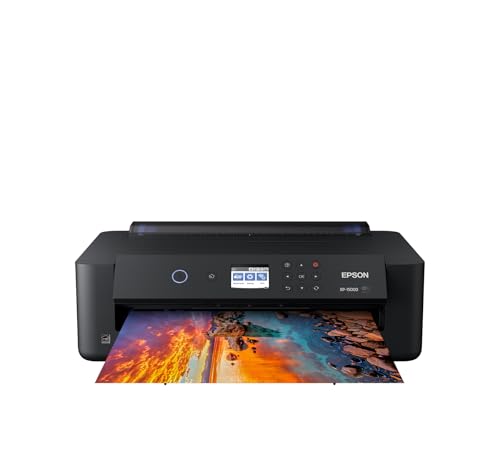
Epson Expression Photo HD XP-15000 — Dedicated six-colour photo printer
The XP-15000 is the purist’s entry in this set: a dedicated photo printer, six colours wide, built for photographers and home studios according to its own title. Six-colour wide-format photo printing to thirteen by nineteen inches is the headline, with a stated speed of up to 9.2 pages per minute and automatic two-sided printing riding along for the document work that even photographers cannot escape. The Expression Photo HD name is Epson’s declaration of intent — this line exists to print photographs, and everything else about the machine is subordinate to that purpose.
Six colours rather than four is the photographic argument in miniature. The extra channels — typically light variants and supporting hues in dye photo sets — exist to smooth the transitions where four-colour printing shows its seams: skies that band, skin that posterises, shadow gradients that step instead of glide. At eleven by seventeen inches, those seams are not subtle. A print that size is viewed across a room and then approached, and the approach is where six-colour printing earns its premium, holding the gradient together at reading distance.
Automatic two-sided printing deserves its footnote, because photo paper is rarely the duplex candidate — the feature serves the photographer’s other paper life: portfolios’ text pages, exhibition labels, the studio’s invoices and price lists. Treat it as a convenience layered under the photo brief, not as a reason to buy. The real ownership question is dye ink economics: cartridges for a six-colour machine deplete unevenly with your subject matter, and a heavy month of tabloid skies will drink the light colours first. Photographers printing weekly will feel that rhythm and should budget for it with eyes open.
- Print width: Up to 13 x 19 in., as its title states
- Ink system: 6-colour wide-format photo printing stated
- Print speed: Up to 9.2 ppm stated
- Duplex: Auto 2-sided printing stated
- Positioning: Photographers and home studios, per the title
Strengths
- A dedicated photo brief with six colours for smooth gradients.
- Thirteen-by-nineteen ceiling gives tabloid prints full-bleed freedom.
- Wireless connection suits a studio bench away from the computer.
Trade-offs
- Dye output lacks pigment’s archival and water resistance.
- No scanning or copying — documents needing digitising go elsewhere.
- Six cartridges make heavy tabloid months a real ink budget.
Best for: a home-studio photographer printing vivid tabloid photographs weekly. Not suited for: archival print sales or office scanning duties.
Before ordering, photographers picturing their own work at that width might open the XP-15000’s Amazon page, where the cartridge family is named alongside the current price.
Paper pairing will decide how this machine is remembered in your studio. Dye ink on glossy stock delivers the saturated, wet-look finish that suits travel and landscape work; the same ink on a matte fine-art sheet turns contemplative, softer, more like a page in a book. The XP-15000’s six colours give both directions enough subtlety to be worth exploring, and a new owner should spend the first paper budget across two contrasting stocks rather than six similar ones. Keep notes on which setting served which paper; at tabloid size, every experiment costs a real sheet, and notes are how experiments compound into knowledge instead of evaporating into anecdotes.
Placement in a home studio follows from the output tray’s geography: tabloid prints emerge needing a landing zone as large as themselves, uncluttered, where a wet-look glossy surface can rest untouched for a few minutes. Studios that clear that landing zone once, permanently, stop losing prints to coffee cups and keyboard edges — a mundane victory that every wide photo printer owner recognises.

Epson EcoTank Photo ET-8550 — Tank-fed photo all-in-one
The ET-8550 returns in this guide wearing its photo hat. Six-colour, cartridge-free, wide-format photo printing to thirteen by nineteen inches, with scan and copy joining in, up to sixteen pages per minute, aimed at creators and home studios — the title is a complete brief. Its ink is a hybrid, pigment black over dye colours, and in a photo guide that label does specific work: the dye colours produce the vivid glossy output this machine is loved for, while the pigment black anchors text pages and monochrome-leaning prints. It is not an all-pigment archival instrument, and photographers selling longevity should keep reading the Canon reviews below.
What the tank changes, for a photographer, is permission. Cartridge photo printing trains a miserly instinct — proof small, print big once, live with the result. Bottled ink untrains it. Proof at full size. Print the variant with the warmer grade beside the cooler one and live with both on the wall for a week. Run the club competition shortlist at final size and edit with a pencil. That iterative freedom is the ET-8550’s true photographic feature, worth more to a developing photographer than a marginal difference in gamut, because seeing your own work large and often is how the work improves.
The all-in-one functions fold the rest of a creator’s paper life into the same box: scan the sketch or the old family print, copy the exhibition entry form, print the photograph. Home studios short on surfaces — which is most home studios — value that consolidation in a way specification tables never capture. Against it, set the standing tank conditions: print regularly so the system stays happy, refill carefully, and remember that dye colours on a sunlit wall will fade on a schedule pigment would have postponed. For the creator printing their own walls and their own education, that schedule is usually acceptable. For the archive, it is not.
- Ink system: 6-colour cartridge-free tank — pigment black, dye colours
- Maximum print size: Up to 13 x 19 in., as its title states
- Print speed: Up to 16 ppm stated
- Functions: Print, scan and copy stated
- Positioning: Creators and home studios, per the title
Strengths
- Bottled ink makes full-size proofing an everyday habit.
- Six colours plus scanning in one wide-format body.
- Pigment black keeps accompanying text work crisp and durable.
Trade-offs
- Dye colours cannot promise archival lifetimes.
- Tank ownership requires regular printing and careful refills.
- Jack-of-all-trades breadth trades against dedicated-machine focus.
Best for: a prolific creator printing wide photographs for home walls and portfolios. Not suited for: prints sold with multi-decade archival promises.
For creators who proof at full size, the ET-8550’s Amazon listing repays a slow read — price, bottle details and that hybrid ink recipe, pigment black beside dye colours, all on one page.
A word about the scanner’s photographic role, since all-in-one scanning is easily underrated by photographers. The flatbed that copies forms all week becomes, on Sunday, the digitiser for the family archive — the box of prints from before phones, the grandparent’s album, the negatives’ contact sheets. Scanning those at home, at your own pace, with the originals never leaving the house, is a photographic project in itself, and the ET-8550’s wide body makes it a comfortable one. Several owners of machines like this report that the archive project, unplanned at purchase, became the printer’s most valued work within a year.
Ink budgeting with tanks runs on a glance rather than a warning light. Build the glance into the Friday tidy: levels visible through the tank windows, one bottle of the hungriest colour in reserve, and the machine never surprises you mid-portfolio. That tiny ritual is the whole of tank discipline, and it is lighter than the cartridge era’s emergency purchases by a wide margin.

Canon PIXMA PRO-200S — Professional dye colourist
Precision about this machine matters, so here it is in its title’s own terms: the PIXMA PRO-200S is a professional thirteen-inch wireless inkjet photo printer with a 3-inch colour LCD and eight-colour dye ink. Dye. Not pigment. Canon builds professional machines in both chemistries — the imagePROGRAF line carries the pigment flag — and the PRO-200S is the dye flagship of the PIXMA family, engineered for the qualities dye does best: a broad, vivid gamut and glossy prints with the deep, wet blacks and seamless saturation that make product shots, travel work and celebration photography glow.
Eight colours is a serious inventory, and on dye it buys smoothness as much as saturation. Skin tones step down through the light inks without banding; saturated reds and blues — the colours that break lesser sets — hold their detail instead of flattening into poster paint. The 3-inch colour LCD supports the stand-alone side of studio life: media confirmation, maintenance, ink checks at the machine. Wireless connection returns the computer to the editing chair. Thirteen inches is the width, and within Canon’s range that positions the PRO-200S as the professional choice for photographers whose finished work lives at portfolio and club sizes rather than gallery walls.
The dye decision should be made with destinations in mind. Prints for your own walls, for clients’ immediate display, for portfolios that are refreshed as work improves — dye serves all of these beautifully, and its glossy brilliance arguably serves them better than pigment. Prints sold as archival objects, or hung in punishing sunlight for decades, belong to the pigment machine reviewed next. Neither verdict diminishes the PRO-200S; a scalpel is not a failed hammer. Readers matching chemistry to destination will find this Canon the most colour-drunk machine in the set, in the best sense.
- Print width: 13 inches, as its title states
- Ink system: 8-colour dye ink stated — dye, not pigment
- Display: 3-inch colour LCD stated
- Connectivity: Wireless stated
- Print speed: Not stated in the listing title — verify with the manufacturer documentation
Strengths
- Eight dye colours deliver vivid gamut and glossy depth.
- Professional PIXMA build with a colour LCD for studio operation.
- Thirteen-inch width matches portfolio and club exhibition sizes.
Trade-offs
- Dye chemistry cannot carry archival sales promises.
- Eight cartridges deplete unevenly across a heavy season.
- Seventeen-inch ambitions need the PRO-1100 instead.
Best for: a photographer printing vivid thirteen-inch colour work for display and portfolio. Not suited for: archival pigment editions.
Colour-first photographers will find the PRO-200S on Amazon with its eight-colour dye set declared in the title and the current price beside it.
Handling glossy dye prints is a small craft of its own. They emerge looking finished and are, nearly — a short rest before stacking lets the surface harden its shine, and cotton-glove handling for client work keeps fingerprints off the deep blacks where they show most. Framers like dye prints for their surface consistency under glass; photographers like them because the print on the wall matches the saturated file on the screen with the least translation. If your photography leans toward celebration — weddings, festivals, travel in hard sunlight — the PRO-200S speaks your language natively.
One more honest note on longevity, to keep the dye story balanced rather than bleak. Modern dye sets on quality papers, framed behind glass away from direct sun, hold their colour for years that satisfy most owners; the fade conversation is about decades and about promises made to buyers. A photographer printing for their own home is not short-changing anyone by choosing dye — they are choosing the chemistry whose strengths match their walls.

Canon imagePROGRAF PRO-1100 — Seventeen-inch professional tier
Every set of photo printers has a ceiling machine, and here it is the PRO-1100: Canon’s seventeen-inch professional wireless inkjet photo printer. Seventeen inches is not a marginal step beyond the tabloid brief of this guide — it is a different category of finished object, the size at which a photograph stops being a page and becomes a furnishing. The imagePROGRAF badge places it in Canon’s professional graphics line, and within this guide’s verified set it carries the pigment professional brief at the widest width, which is why photographers planning to sell large, long-lived work gravitate here first.
The title, as noted in this guide’s pigment roundup, publishes no ink inventory, speed or display figure, and the specification list below records the inventory line as unstated with a pointer to Canon’s documentation. That homework is part of buying at this tier: confirm the full ink set, the media handling for the thick fine-art papers on your shelf, and the borderless widths, from the manufacturer’s own material. A professional machine is bought the way a professional lens is bought — on documentation and test output, not on a marketplace headline — and the PRO-1100 asks nothing unusual in that respect.
What the width buys, practically, is cropping freedom and presence. A photograph composed with room to spare can be cropped for a seventeen-inch frame without the resolution anxiety that haunts smaller ceilings; a landscape can hold a room. Wireless operation lets a machine of this size live at its own printing station while editing happens elsewhere. Studios stepping up from thirteen inches should budget for the ecosystem, not just the printer: wider paper stock, wider storage, a portfolio that swallows the output. The machine is the visible third of the commitment.
- Print width: 17 inches, as its title states
- Class: Professional wireless inkjet photo printer, as titled
- Ink inventory: Not stated in the listing title — verify with the manufacturer documentation
- Print speed: Not stated in the listing title — verify with the manufacturer documentation
- Display: Not stated in the listing title — verify with the manufacturer documentation
Strengths
- Seventeen-inch width reaches genuine gallery and centrepiece sizes.
- imagePROGRAF professional lineage for sold photographic work.
- Wireless link suits a dedicated printing station.
Trade-offs
- The listing omits ink and speed details, so documentation homework is mandatory.
- Wide media and storage expand the true cost beyond the machine.
- Thirteen-inch practices will underuse its ceiling.
Best for: a professional photographer finishing work at seventeen inches for clients and exhibition. Not suited for: a small home studio printing portfolio sizes.
At gallery scale the homework doubles: Amazon carries the PRO-1100’s price, while Canon’s own specification page supplies the ink details its listing omits — read the two together.
Working at seventeen inches changes editing before it changes printing. Files get examined at full magnification as a matter of routine, because flaws that hide at thirteen inches testify at seventeen: the focus that was nearly right, the sensor spot in the sky, the sharpening halo along the ridge line. Photographers who make the step up usually describe the printer as the strictest teacher they own. Embrace that, and your thirteen-inch work improves too — the discipline transfers downward even when the big machine stays idle for a week.
Client conversations change as well. Offering a seventeen-inch finished print moves a photographer’s price list into territory where framing partnerships, delivery packaging and hanging advice become part of the service. None of that is the printer’s doing directly, but the ceiling it provides is what makes the conversation possible, and studios should walk in with their eyes open about the business that follows the capability.

Epson EcoTank ET-15000 — Versatile supertank all-in-one
Let the framing be exact: the ET-15000 is not a dedicated photo printer, and this guide includes it as the versatile pick — the machine for a household or small office whose wide printing includes photographs among many other jobs. Its title tells that broader story: cartridge-free print, scan, copy and fax, up to seventeen pages per minute, printing up to thirteen by nineteen inches, Ethernet wired networking, positioned for home and small offices. Photographs emerging from it benefit from the same tank economics as everything else it prints, which for a family archive or a school art department may matter more than the last degree of photographic refinement.
Judge it, then, as a generalist with a wide reach. The family that prints the holiday photograph at tabloid size for the hallway, the teacher producing classroom displays, the club secretary running posters and programmes — these users need one machine that does everything adequately and some things very well, at an ink cost that never makes them hesitate. The ET-15000’s supertank design is the hesitation-killer: bottled ink at volumes that turn printing into a background utility rather than a budgeted event.
Ethernet is worth its sentence in a photo context too. A shared household machine that holds a stable wired address stops generating the lost-job mysteries that sour families on network printing; photographs sent from three different laptops arrive in order. The four-function set means the same box scans the grandparents’ prints for restoration projects — a photographic use hiding inside an office feature — and copies the exhibition paperwork. Dedicated photo machines do one thing better; this one does the household’s whole paper life, photographs included, without a cartridge bill. Some studios will find that trade exactly right.
- Ink system: Cartridge-free supertank, as its title states
- Maximum print size: Up to 13 x 19 in. stated
- Print speed: Up to 17 ppm stated
- Connectivity: Ethernet stated; wireless in the product name
- Functions: Print, scan, copy and fax stated
Strengths
- One wide machine covers household photography and office paper alike.
- Tank ink removes the cost hesitation from big family prints.
- Ethernet steadies sharing across a busy household network.
Trade-offs
- Photographic refinement trails the dedicated photo machines here.
- A generalist ink set limits subtle gradation work beside six-colour photo sets.
- Tank care — regular use, careful refills — still applies.
Best for: a household or small office printing photographs inside a mixed paper workload. Not suited for: a dedicated photographic studio bench.
Households with mixed workloads should weigh the ET-15000’s four stated functions against their own weekly paper traffic; its Amazon page carries the price for that calculation.
The generalist’s photographic ceiling deserves one fair paragraph rather than a dismissal. For prints that will hang in hallways, classrooms and clubhouses — seen at arm’s length, loved for their subjects — a capable supertank all-in-one produces results that satisfy completely, at a running cost the dedicated machines cannot approach. The gap appears at the extremes: the competition print judged under a lamp, the portrait sold to a client. Knowing which side of that line your own printing lives on is the entire decision, and most households, honestly surveyed, live on the generalist’s side of it.
Volume tells the same story from the other direction. A school art department printing two hundred wide pages a term would spend a cartridge machine’s ink budget several times over; on tanks, that programme is a line item a treasurer approves without a meeting. Versatility plus volume is the ET-15000’s real photographic brief, and within it, the machine is not a compromise at all.

Epson Expression Photo XP-980 — Creative all-in-one with card slot
The XP-980 closes the set as the creative household’s machine: a wireless all-in-one wide-format printer with six-colour printing, scanning and copying, a stated speed of up to 8.5 pages per minute, and — the detail that defines it — USB and memory card support, aimed by Epson at creative projects. Six colours put it in photographic territory rather than office territory; the all-in-one functions and card slot pull it toward the craft table, where photographs are ingredients in projects rather than finished objects.
Memory card support changes who can print. A card straight from the camera into the machine shortens the path from photograph to paper to zero computers, which matters in households where the photographer and the computer’s owner are different people, and in craft rooms where the laptop lives elsewhere. Grandparents printing the weekend’s pictures, teenagers producing photo gifts, a scrapbooker pulling one frame from a card of hundreds — the slot serves all of them without a driver dialogue. USB support covers the wired route for the same jobs.
Scanning and copying complete the creative loop: scan the fabric, the sketch, the child’s drawing; print it at tabloid size; copy the result for the portfolio. Six-colour dye output keeps photographs vivid through that loop, with the standard dye caveat about decades and sunlight applying as it does to the XP-15000. The stated speed is the set’s gentlest, which suits project work — nobody’s craft afternoon was ruined by a print taking a minute longer — and the wide ceiling means the projects themselves can be ambitious: posters, banners’ components, full-size templates and photographic centrepieces for the craft fair table.
- Ink system: 6-colour wide-format printing, as its title states
- Maximum print size: Wide-format — the title gives no inch figure
- Print speed: Up to 8.5 ppm stated
- Connectivity: USB and memory card support stated; wireless in the product name
- Functions: Print, scan and copy stated
Strengths
- Memory card printing frees the machine from the household computer.
- Six colours keep project photographs vivid at wide sizes.
- Scan and copy complete the craft-room creative loop.
Trade-offs
- The gentlest stated speed in the set.
- The title gives no exact inch ceiling — confirm dimensions in Epson’s documentation.
- Dye ink carries the usual longevity limits for sunlit display.
Best for: a craft-driven household printing photo projects from camera cards. Not suited for: high-speed studio production.
Craft households drawn to card-slot printing will want two tabs open — Amazon for the XP-980’s price, Epson’s documentation for the exact paper ceiling its title leaves out.
Project printing has its own economics, and the XP-980 fits them well. Creative work wastes paper cheerfully — the test print, the misjudged crop, the colour that sang on screen and sulked on stock — and a machine serving that process should make its owner brave rather than careful. Six-colour cartridges are not the cheapest ink in this guide, so the bravery has limits, but the card slot’s immediacy keeps experiments short and joyful, which is the rhythm craft rooms actually run on. Pair it with a sampler of papers — glossy for photographs, matte for templates, cardstock for gift work — and the machine becomes the room’s engine.
One household pattern deserves mention: the shared creative machine becomes a family’s informal archive desk. Photographs get printed while they are current, school projects get scanned before they are recycled, and the year’s life accumulates in albums rather than in a phone’s camera roll. Machines are rarely bought for that purpose. They are often, in retrospect, most loved for it.
Comparison Table
| Pick | Ceiling | Ink position | Standout trait |
|---|---|---|---|
| Epson Expression Photo HD XP-15000 | 13 x 19 in. | 6-colour dye | Dedicated photo printer, auto 2-sided |
| Epson EcoTank Photo ET-8550 | 13 x 19 in. | Hybrid tank: pigment black, dye colours | Scan and copy with bottled ink |
| Canon PIXMA PRO-200S | 13 in. | 8-colour dye | Professional build, 3-inch colour LCD |
| Canon imagePROGRAF PRO-1100 | 17 in. | Professional tier — inventory in documentation | Widest ceiling in the set |
| Epson EcoTank ET-15000 | 13 x 19 in. | Supertank, chemistry unstated in title | Four functions with Ethernet |
| Epson Expression Photo XP-980 | Wide-format | 6-colour dye | USB and memory card support |
How to Choose a Photo Printer for 11×17 Prints
Begin with the destination wall. Photographs headed for your own rooms and portfolios ask for vivid colour and honest value, which is dye territory — the XP-15000, the PRO-200S and the XP-980 all live there, at three different levels of seriousness. Photographs headed for buyers, archives or decades ask for pigment, and the PRO-1100 answers at the largest width. Photographs that are one job among fifty in a busy household ask for the tank all-in-ones. Naming the wall first turns a six-machine comparison into a two-machine one, which is where good decisions get made.
Then count your big prints per month. A handful of tabloid photographs monthly makes cartridge economics painless on any pick here. Dozens monthly — the club competitor, the prolific creator, the school art room — bends the decision hard toward bottled ink, where the ET-8550’s photo brief or the ET-15000’s generalist brief takes over. Be honest about the count; photographers systematically underestimate how much they print once printing becomes easy, which is an argument for the tanks all by itself.
Finish with the ecosystem check: the papers you intend to use, the storage for tabloid and super-B stock, the landing zone where wide prints will rest. A photo printer is a paper-playing instrument, and the machine whose media handling matches your favourite stocks will delight you more than a theoretically finer machine fighting your paper drawer. Read the media sections of the manufacturer’s documentation for your final two candidates; that is where this decision is actually documented.
Dye or Pigment: Which Chemistry Suits Your Photographs?
Dye ink soaks colour into the paper’s coating, and its gifts are saturation and gloss: the deep, wet look of a celebration photograph, the seamless red of a festival banner, blacks that shine. This guide’s dye machines — six colours in the two Expression Photo models, eight in the PRO-200S — are built to maximise exactly those gifts. For prints that will be framed behind glass, refreshed as your work improves, or given away with love, dye’s brilliance is not a compromise position; it is the point.
Pigment parks colour particles on the surface, trading a measure of glossy drama for water resistance and multi-decade stability. That is the chemistry of the sold print and the archived print, represented here by the professional Canon at seventeen inches and joined, in hybrid form, by the ET-8550’s pigment black. The hybrid deserves its own clarity: pigment black lends durability to text and monochrome-leaning work, while its dye colours behave as dye — vivid now, mortal over long light exposure.
The practical synthesis most studios reach is destination-based rather than tribal. Print the living-room wall in dye and enjoy it. Print the client’s centrepiece and the archive box in pigment and warrant it. Print the weekly flood of proofs and projects on tanks and learn from them. Chemistry follows purpose; only marketing insists one ink must do everything.
Exhibition habits at home deserve a section of their own, because tabloid printing quietly turns photographers into curators. A wall that can hold an eleven-by-seventeen print can hold a rotating exhibition of one, and many home printers settle into a monthly rhythm: print the month’s best frame large, live with it for four weeks, then replace it and file the retired print in the portfolio. That rhythm disciplines shooting more effectively than any resolution to improve — the wall is waiting, and a weak month shows. It also builds, almost without noticing, a printed archive of your own development that no hard drive scroll can equal for honesty.
Colour-checking against a reference is the companion habit. Print one known image — a portrait with familiar skin, a landscape with a remembered sky — on every new paper and after every ink change, and keep those reference sheets labelled in a folder. When a later print looks wrong, the reference folder tells you whether the machine drifted, the paper changed or your memory did, which is the difference between a five-minute fix and a weekend of profile superstition. Professional labs run exactly this discipline under grander names; a home studio running it on tabloid sheets is practising the same craft at a friendlier scale.
What Paper Should You Feed a Wide Photo Printer?
Glossy photo paper is the vivid default: maximum saturation, sharp detail, the finish most people picture when they picture a photograph. It shows fingerprints and reflections with equal enthusiasm, so it suits frames and albums better than loose handling. Semi-gloss and luster stocks soften the reflections while keeping most of the punch, and they are the working photographer’s compromise for prints that will be passed around a table.
Matte papers trade gloss for depth of a different kind — a soft, painterly surface that flatters landscapes, portraits and monochrome, and that forgives the viewing light in any room. Fine-art matte stocks at tabloid size turn a photograph into an object with weight, literally and otherwise. Whichever direction your taste runs, buy one trusted paper first and learn it completely: its media setting, its drying patience, its behaviour under your room’s light. A printer mastered on one paper outperforms a printer sampled across ten.
Storage is the unglamorous half of paper craft. Wide sheets live flat, in their sleeves, away from humidity and sunlight, and they are handled by their edges. A tabloid sheet with a bent corner or a thumbprint in the sky region is a spoiled sheet, and at this size spoilage is felt in the wallet. Keep the working pack small and the reserve pack sealed, and fan sheets gently before loading to defeat static cling.
How Do You Judge a Test Print Honestly?
Wait. A fresh print — dye especially — settles as it dries, colours deepening and shifting subtly over the first hours. Judging a photograph in the first five minutes is judging a rehearsal. Give test prints a rest, then view them in the light they will live in: the hallway’s daylight, the living room’s lamps, not the studio’s most flattering spot. Photographers who skip this discipline chase corrections for lighting that was never the print’s fault.
Judge at two distances. Across the room, the print should hold together as a composition — the reason it was made large at all. At reading distance, the details you printed it for should resolve cleanly: eyelashes, brickwork, the texture of a wave. A print that passes both distances has earned its wall. One that passes only the first wants a smaller size or a different photograph, and learning to say so is the skill home printing at this size exists to teach.
Keep the failures. A folder of almost-right tabloid prints, annotated with what changed between attempts, is the fastest photographic education available anywhere — each sheet a lesson with the evidence attached. Within a season, that folder explains your printer, your papers and your own taste better than any review, including this one.
Consider, too, the social life of a big print, because it explains why this category keeps growing while small printing shrinks into phones. An eleven-by-seventeen photograph gets carried to the club, unrolled at the family lunch, pinned in the studio for a visitor’s opinion. It gathers fingerprints, arguments and compliments in a way no screen image does, and photographers consistently report that the conversations around the big print — the ones where someone points at a corner and asks how — are where their next shoot gets planned. A printer that enables those conversations is not a peripheral. It is the venue.
Budget honesty closes the practical case. Add the machine, the first full ink set beyond the starter supply, two quality paper packs and a portfolio to hold the output, and that total — not the headline price of the box — is the true cost of starting wide. Photographers who budget the whole kit from the beginning enjoy the first month purely; those who budget the box alone spend the first month discovering the kit. The reviews above were written so that either reader can see the whole commitment before choosing where to stand.
Common Mistakes When Buying an 11×17 Photo Printer
Buying chemistry by assumption leads the list. Shoppers hear professional and think pigment, then discover their vivid dye machine was never the archival instrument they described to a client — the PRO-200S’s own title says dye in plain words, and this guide repeats it because the mistake is so easy. Read the ink line of any listing as carefully as the width line; the two together are the machine’s identity.
Starving a wide printer of paper variety runs second. Owners feed a six or eight-colour machine one bargain glossy stock for a year and conclude the printer is ordinary. These machines are paper instruments; a season spent across glossy, luster and matte stocks reveals three different printers living in the same box. Budget the paper exploration as part of the purchase, not as an indulgence after it.
Ignoring the landing zone finishes the trio. Wide prints need somewhere clean and flat to arrive, rest and be judged, and studios that never arrange that space lose prints to clutter and lose patience with the whole enterprise. Clear the surface before the machine arrives. It is the cheapest upgrade in this entire guide, and the one owners mention most when they describe finally enjoying wide printing.
Gifting is the quiet economy of home photo printing, and tabloid size elevates it. A framed eleven-by-seventeen print of a grandchild, a coastline, a parent’s garden is not a token present; it is the present that takes the wall space other gifts are measured against. Photographers with a wide machine at home find their gift-giving reorganised around it — the calendar of birthdays becomes a printing schedule, and the studio’s paper stock becomes a kind of generosity inventory. That social fact never appears in a specification list, yet it is the reason many owners give when asked, a year on, whether the big printer earned its shelf.
There is a learning curve, and it should be priced in honestly. The first month with any wide photo printer produces a bin of almost-prints: crops misjudged, margins uneven, one memorable incident with the paper loaded backwards. Every owner of every machine in this guide has that bin in their past. The curve flattens fast — by the second paper pack, loading is muscle memory and the proofing discipline described earlier has become habit — but expecting gallery output from the first sheet means misjudging a good machine during its clumsy fortnight. Judge any of these six from your tenth tabloid print onward, not your first.
Final Recommendation
For dedicated photographic printing at tabloid size, the XP-15000’s six-colour focus and the PRO-200S’s eight-colour dye brilliance contest the thirteen-inch ground — Epson’s all-round photo discipline against Canon’s colour-drunk professional. For prolific creators, the ET-8550’s bottled ink turns proofing into a daily habit, while households with mixed paper lives should take the ET-15000’s versatility and the XP-980’s card-slot creativity for project rooms. The PRO-1100 stands at the top for seventeen-inch professional work. Choose by destination wall and monthly count, and eleven-by-seventeen stops being a lab errand and becomes the size your photography was always meant to be seen at.
One practical ritual ties the whole guide together: the first-evening test. On the night any of these machines arrives, print one photograph you know intimately — not a test chart, a picture whose colours live in your memory — at full tabloid size, on the best paper you bought, and pin it where you will see it at breakfast. That single print calibrates your expectations, your room’s light and your paper choice in one act, and it becomes the reference every later print is quietly compared against. Photographers who begin with that ritual start their ownership with knowledge; the rest start with settings.
And when the portfolio fills — as it will, faster than expected — resist upgrading the machine for a season. Live with the prints, notice which ones visitors reach for, and let the wall teach you whether your next step is width, chemistry or simply more paper. The photographers whose work grows are rarely the ones with the newest printer; they are the ones whose printer stopped being a purchase and became a practice. Any of the six machines here can disappear into a practice that way, which is the real test this guide has been applying all along.
Bring a ruler to that decision if you can. Lay your favourite existing prints on the table, measure the ones you wish were bigger, and count how many stop at thirteen inches and how many run past it. That small census, taken from your own portfolio rather than from ambition, settles the width question more honestly than any review — this one included — ever could.
Frequently Asked Questions
Why print 11×17 at home instead of using a lab?
Immediacy and iteration. A home printer lets you proof, judge, adjust and reprint within one evening, learning from each sheet while the shoot is fresh. Labs offer convenience for occasional prints, but the feedback loop of home printing is how photographers improve — and at steady volume, the per-print economics move home as well.
Is the Canon PRO-200S a pigment printer?
No. Its title states eight-colour dye ink, and dye is its chemistry — superb for vivid colour and glossy depth, not the choice for prints sold with archival promises. Canon’s pigment professional in this guide is the seventeen-inch imagePROGRAF PRO-1100 tier.
What does six-colour printing add over four?
Smoother gradients and subtler tones, most visibly in skies, skin and shadow transitions. At eleven by seventeen inches, viewers approach closely enough to see banding that a small print hides, and the extra light inks in a six-colour set exist precisely to erase those steps.
Can these printers handle ordinary documents too?
The all-in-ones — both EcoTanks and the XP-980 — are built for mixed work, and the XP-15000 even states automatic two-sided printing. The dedicated Canon photo machines are specialists; pairing them with any basic document printer covers an office corner completely.
How much ink does an 11×17 photograph use?
Several times a letter page’s worth, depending on coverage — a full-bleed sky consumes far more than a portrait with white margins. That arithmetic is why heavy tabloid printers gravitate to the tank machines here, and why cartridge owners learn to proof thoughtfully at smaller sizes first.
Related Guides
Chemistry questions continue in our guide to workgroup printers for team throughput for readers whose printing is mostly documents. Departments standardising on laser should compare workgroup multifunction laser printers next. For pocket-size instant photographs instead of wall-size ones, see ZINK printers that use no ink at all.


