What's inside
- Key Takeaways
- Quick Picks
- How We Chose These Picks
- Six Budgets, Six Answers: Where the Money Went in Each Design
- What Actually Matters at This Price — and What Is Decoration?
- How Do You Make a Budget Headset Last for Years?
- How Do You Choose Between Wired Value and the One Wireless Pick?
- What Should You Buy for a Younger Player or as a Gift?
- Headset or Headphones Plus a Separate Microphone?
- How Do You Set Up a Budget Headset on PC Without Making It Sound Cheap?
- What Makes a Budget Headset Work in a Dorm or Shared Flat?
- What Are the Most Common Mistakes When Buying an Affordable Gaming Headset?
- How Do You Test a Budget Headset in Its First Week?
- When Should You Upgrade From an Affordable Headset?
- Final Recommendation
- What Does the Second Year of Owning a Budget Headset Look Like?
- Frequently Asked Questions
- Related Guides
As an Amazon Associate I earn from qualifying purchases. This post may contain affiliate links at no extra cost to you.
widgetverdict.com is reader-supported. When you buy through links on our site, we may earn an affiliate commission.
Affordable is the most lied-about word in gaming audio, so this guide to the best affordable gaming headsets starts with a definition: a headset earns the label by delivering the things that actually decide matches and movie nights — clear positional audio, a microphone your team can understand, comfort that survives the third hour — at a price that leaves money for the games themselves. It does not earn the label by glowing. The six headsets below were chosen against that definition: three with verified listings you can order directly, including a wireless model that would have been unthinkable at this level a few years ago, and three covered in prose because our checked pool holds no listing we can attach to them. Every one is a headset we would hand to a younger sibling starting out, which is the strictest test this category has.
Ordering a linked pick is painless: follow the listing, check price on Amazon, and confirm the connection in the title matches your platform — a USB headset and a 3.5mm headset are different purchases wearing similar boxes. The prose-only three are sold by their makers and every major games retailer; buy those by exact model name, because budget lines are where manufacturers reuse names most freely, and the difference between generations at this level can be the difference between a recommendation and a warning.
Expectations, set honestly before the rankings: affordable headsets make their compromises in materials, in feature lists and in the finesse of their tuning — not, in the picks below, in the fundamentals. You will not get flagship noise cancellation, exotic driver materials or a carrying case worth framing. You will get sound that places footsteps correctly, a voice that carries callouts, and a frame that should serve for years if the wear parts are treated as wear parts. In our judgment that is the correct trade, and it is the trade every pick here makes deliberately rather than accidentally.
Key Takeaways
- The HyperX Cloud III is the affordable benchmark: flagship-adjacent comfort and clarity at a mid-budget price, wired for everything.
- The Razer BlackShark V2 X is the lightest serious option — a competitive-leaning wired headset that disappears during long sessions.
- The SteelSeries Arctis Nova 5 proves wireless belongs in this guide, with sixty hours of battery and a strong retractable microphone.
- At this level, spend on drivers, microphone and fit — never on lighting, which buys nothing you can hear.
- A 3.5mm connection is the budget traveller’s friend: one headset for console, PC, handheld and phone with no dongle politics.
- Replacement earpads are the budget headset’s best friend; check they exist before you buy, not after they perish.
Quick Picks
| Pick | Badge | Why it earns its place |
|---|---|---|
| HyperX Cloud III | Best affordable overall | The Cloud formula refined — plush comfort, clear drivers and a proper detachable microphone, wired for every platform. |
| Razer BlackShark V2 X | Best lightweight wired | At about 240 grams it vanishes on the head, with a cardioid mic and a cue-friendly tuning for competitive games. |
| SteelSeries Arctis Nova 5 | Best affordable wireless | Sixty-hour battery, 2.4GHz and Bluetooth, app presets and a retractable mic — the full modern package at a sane price. |
| HyperX Cloud Stinger 2 | Best under-stretch pick | The value end of a famous line: big drivers, a swivel-to-mute mic and comfort that embarrasses its price. |
| Logitech G335 | Best style and lightness | A featherweight wired headset in colors people actually choose, with a suspension strap that suits smaller heads. |
| Razer Kraken X | Best console budget pick | Light, simple and tuned for console controllers, with a bendable cardioid microphone and no setup at all. |
How We Chose These Picks
We started by deleting the category’s usual suspects: headsets whose budget went into lighting strips, headsets with microphones that make their owners sound like they are calling from inside a kettle, and headsets whose frames are famous in review comments for snapping at the yoke. What survived had to clear four bars. Sound first — not audiophile sound, but honest sound: drivers that image well enough to place a footstep, enough bass for an explosion’s weight without drowning a reload’s click, and a tuning that does not fatigue across an evening. Microphone second, because at this level the mic is where corners are usually cut, and a team that cannot understand you will not care how your game sounded.
Comfort third, weighted heavily, because an affordable headset is often a first headset worn for the longest sessions of a player’s life — the school-holiday marathon, the first ranked grind — and a frame that hurts at hour two fails the brief regardless of its drivers. Fourth, the ownership economics: replaceable pads, a cable that is not a single point of failure where avoidable, and a maker whose support exists at this price rather than only above it. Wireless was admitted where it did not break the definition — one pick here proves the category has matured — but wired value remains the guide’s center of gravity, because a cable is still the cheapest high-quality connection ever engineered.
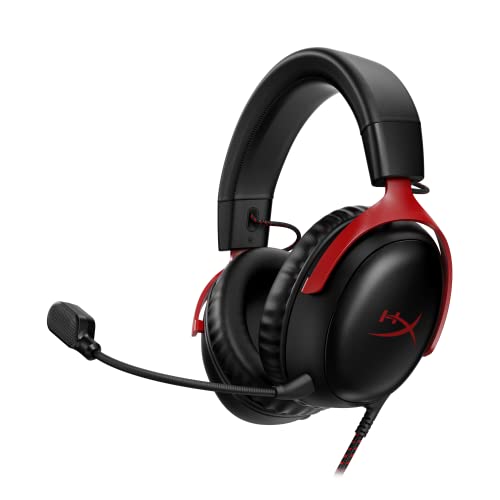
HyperX Cloud III — Best affordable overall
The Cloud III is what the affordable benchmark looks like when a line grows up gracefully. HyperX took the formula that made its name — memory-foam comfort, a durable frame, drivers tuned for games first — and refined the details: earcups angled for a better seal, a detachable 10mm microphone that records with unusual clarity for the class, and a connection story that covers everything, with USB-C, USB-A and 3.5mm all in the box. That last point is quietly decisive at this budget: one headset serves the PC, both console families, the handheld and the phone, with no variant chart and no dongle left behind in a drawer.
The sound is the Cloud character matured — 53mm drivers with a balanced, slightly warm tuning that keeps footsteps and dialogue forward while giving explosions their due. DTS spatial processing is available on PC through the software for players who want the surround layer, and the stereo imaging underneath is good enough that many will never bother, which this guide counts as the correct relationship between a headset and its processing. In competitive titles the imaging is precise in the horizontal plane where it matters; in story games the tuning flatters voices and scores without turning either into syrup.
Comfort is the trait that closes sales in this family, and the III keeps the faith: plush memory foam, a headband that spreads its load, and a clamp firm enough for animation without scheduling a headache. The trade-offs are the visible ones — it is wired, the frame does not fold for travel, and there is no wireless sibling at this price in the line. None of that dents the verdict. If the budget stretches to exactly one serious headset and the platforms are many, this is the one the rest of the guide must argue against, and none of them quite manages it.
- Connections: USB-C, USB-A and 3.5mm all included — every platform covered
- Drivers: 53mm, warm-balanced tuning with clean imaging
- Microphone: detachable 10mm condenser-style capsule, notably clear
- Processing: DTS spatial available on PC; stereo strong on its own
- Fit: memory foam throughout; the long-session benchmark here
Strengths
- Comfort and clarity a class above its price.
- One purchase genuinely serves every platform you own.
- Detachable microphone extends its life as media headphones.
Trade-offs
- Wired only — the wireless convenience costs more in this guide.
- Non-folding frame is a mediocre travel companion.
- No active noise cancellation for noisy households.
Best for: players who want one wired headset done properly for every machine they own. Not suited for: couch players who need wireless freedom, or travelers wanting a folding design.

Razer BlackShark V2 X — Best lightweight wired
Weight is a specification people underrate until hour three, and the BlackShark V2 X is built around winning it: at roughly 240 grams, with plush cushions and a padded band, it is the headset in this guide most likely to be forgotten while worn — and a forgotten headset is a comfortable one by definition. Razer aimed the design at competitive players on a budget, which shows in the tuning: the 50mm TriForce drivers, with titanium-coated diaphragms in this wired model, keep the cue frequencies — footsteps, reloads, the tick of an ability — clean and forward, while the closed earcups and memory foam supply enough passive isolation to keep a household’s television out of your clutch round.
The microphone is the other competitive credential: a fixed HyperClear cardioid boom that rejects sound from the sides and behind, so your callouts arrive without your keyboard’s percussion section. It does not detach, which streamers and travelers should note, but it bends where you want it and mutes via the on-cup controls. The 3.5mm connection makes it the simplest pick here — controller, PC with a splitter where needed, handheld, phone — and the cross-platform honesty is refreshing: what you hear is the drivers, not a platform-specific processing story.
Against the Cloud III it concedes the detachable mic, the USB options and a measure of plushness in the frame’s materials; against everything else at its level it argues lightness, isolation and a tuning that competitive players consistently rate above its price. For the ranked grinder, the student in a shared room, or any player whose current headset announces itself by hour two, the V2 X is the affordable pick with a specialist’s focus — and its focus is exactly where matches are decided.
- Weight: about 240g — the lightest serious headset in this guide
- Drivers: 50mm TriForce with titanium-coated diaphragms
- Microphone: fixed cardioid boom tuned to reject room noise
- Isolation: closed cups with memory foam for shared rooms
- Connection: 3.5mm — the universal budget plug
Strengths
- Featherweight fit that survives marathon sessions.
- Competitive tuning keeps the decisive cues forward.
- Simple, universal wired connection with no software tax.
Trade-offs
- The microphone does not detach for media use.
- No USB processing or surround layer in the box.
- Materials feel functional rather than plush.
Best for: competitive players and shared-room gamers who value lightness above features. Not suited for: streamers needing a detachable broadcast mic, or players wanting wireless.

SteelSeries Arctis Nova 5 — Best affordable wireless
A few years ago a wireless pick in an affordable guide would have been a compromise to apologize for; the Nova 5 is instead the pick that makes wired rivals justify themselves. Its battery runs to sixty hours, which is a week of evenings with margin; its 2.4GHz link keeps latency in the fused, imperceptible range for play, with Bluetooth alongside for the phone; and its retractable ClearCast microphone — the newer generation, with a wider bandwidth — records a voice that embarrasses several wired rivals in this guide. The companion app carries a library of per-game audio presets, which sounds like a gimmick until a preset built for your main title lifts the footsteps out of the mix in a way your own EQ fiddling had not managed.
The drivers are neodymium units with the bright, detailed SteelSeries character, and the fit follows the line’s comfortable pattern with cushions that suit long sessions and a weight the wireless hardware does not spoil. Platform coverage is broad across PC, PlayStation, Switch and mobile in this variant — Xbox households, as ever in this category, must check the variant chart before falling in love, since wireless licensing splits the line. The USB-C dongle is compact enough to live in a handheld, which makes the Nova 5 the rare headset that follows a player from desk to couch to train without a cable ever being missed.
Its compromises are the honest wireless ones: a battery that will age across years, a price above the wired picks here (though below everything in our wireless surround guide), and a retractable mic that, while excellent, will not double as streaming equipment the way a big detachable boom does. Judged as the affordable ceiling — the most a budget buyer should spend before the flagship questions begin — the Nova 5 is complete in a way this category has never been: no asterisk, no apology, just the modern feature set at a price that respects the definition this guide opened with.
- Battery: around sixty hours — a week of play per charge
- Links: 2.4GHz USB-C dongle for play, Bluetooth for the phone
- Drivers: neodymium magnetic units, bright and detailed
- Microphone: retractable ClearCast Gen 2.X with wideband clarity
- Software: companion app with per-game presets worth using
Strengths
- Full wireless freedom without the flagship price.
- Battery and microphone both lead the affordable class.
- Presets make per-game tuning a one-tap affair.
Trade-offs
- Costs more than the wired picks — it is this guide’s ceiling.
- Xbox buyers must verify the correct variant.
- Battery aging is a long-term ownership fact.
Best for: players ready to cut the cord without entering flagship pricing. Not suited for: the strictest budgets, or Xbox households unwilling to check variant charts.
HyperX Cloud Stinger 2 — Best under-stretch pick
The Stinger 2 is the answer when the budget will not stretch to its famous sibling and the choice is between a real headset from a real line and a glowing unknown. It keeps the essentials in the family pattern — large 50mm drivers with a game-friendly tuning, a swivel-to-mute noise-cancelling microphone, and the kind of lightweight comfort that made the original Stinger a dorm-room institution — while trimming the materials and the connection story to a simple wired plug. We cover it in prose because our verified pool holds no listing for it; it is stocked everywhere games are sold, and the model to want is the current generation, since the original Stinger’s long life means older stock circulates beside it.
In play it performs above its station: directional cues are readable, voices are clear, and the mute-by-swivel gesture becomes muscle memory within a day. The compromises are tactile — thinner plastics, simpler padding, a frame that asks to be treated as the budget tool it is. For a first headset, a second-room headset or the spare that rescues a game night when a cable dies, the Stinger 2 is the sensible floor of the whole category: below it, quality falls off a cliff; at it, a player is honestly equipped.
- Drivers: 50mm with the line’s game-first tuning
- Microphone: swivel-to-mute, noise-cancelling
- Fit: lightweight with the family’s comfort geometry
- Connection: wired 3.5mm simplicity
- Buying note: choose current-generation stock deliberately
Strengths
- Real gaming performance at the category’s sensible floor.
- The mute gesture is the fastest in this guide.
- Light enough for younger players and long sessions.
Trade-offs
- Materials and padding are visibly budget-grade.
- No detachable mic, no USB options, no extras.
- Older-generation stock muddies the shopping.
Best for: first headsets, spare headsets and strict budgets that still demand honesty. Not suited for: players who will wear it daily for years and can stretch to the Cloud III.
Logitech G335 — Best style and lightness
The G335 makes a case the spec sheet cannot: that a headset people like the look of gets worn more, cared for better and enjoyed longer. It is a wired design built around a suspension strap — the same fit idea as Logitech’s colorful G733 flagship — which floats the headset on the head at a weight that rivals the BlackShark for the lightest here, in colorways that players choose rather than tolerate. Our pool carries no verified listing for it, so it appears in prose; Logitech’s store and games retailers stock it, and its smaller fit deserves a specific mention — petite heads and younger players who swim inside standard headsets often find the G335 is the first gaming headset that actually fits them.
The audio is competent rather than class-leading: 40mm drivers with a pleasant, undemanding tuning, fine for the breadth of games most people play, and a flip-to-mute microphone that handles team chat clearly. It concedes the Cloud III’s refinement, the BlackShark’s competitive edge and any notion of premium materials. What it returns is wearability and charm at a fair price — a headset that lives on a desk like an accessory instead of hiding like equipment. For the player it fits, that is not a consolation prize; it is the whole purchase.
- Fit: suspension strap, among the lightest wired designs here
- Sizing: suits smaller heads that standard headsets swamp
- Drivers: 40mm, pleasant all-round tuning
- Microphone: flip-to-mute boom for team chat
- Style: multiple colorways, designed to be seen
Strengths
- The fit pick for smaller heads and younger players.
- Featherweight comfort with genuine style.
- Simple wired connection, zero setup.
Trade-offs
- Sound is agreeable rather than exceptional.
- Materials prioritize lightness over luxury.
- No detachable mic or platform extras.
Best for: style-conscious and smaller-headed players wanting wired simplicity. Not suited for: competitive players chasing every positional edge.
Razer Kraken X — Best console budget pick
The Kraken X was designed for a specific, enormous audience: the console player who plugs a headset into a controller and wants the whole transaction finished. It is light, it is simple, its 40mm drivers are tuned to flatter console games, and its bendable cardioid microphone handles party chat with the noise rejection the situation needs. Virtual 7.1 is available on PC through software for owners who later want to experiment, but the headset’s soul is the plug-and-play console session — no dongles, no apps, no settings safari between the box and the first match. We list it in prose because our pool holds no verified listing for it; it is a staple of games retailers, and buyers should confirm they are getting the current X rather than an older Kraken variant at a similar badge.
Its limits are the budget limits in their purest form: a fixed cable, modest materials, a sound signature that favors excitement over analysis. Against those, it sets the virtues of the type — price, lightness, immediacy — executed by a company that has sold this exact recipe in the millions. As the console household’s second headset, the younger sibling’s first headset, or the travel spare that lives in a backpack, the Kraken X is precisely fitted to its job, and this guide respects a tool that knows its job that clearly.
- Audience: console-first, controller-plug simplicity
- Drivers: 40mm tuned for console game mixes
- Microphone: bendable cardioid boom for party chat
- Extras: software surround available later on PC
- Fit: light frame for long couch sessions
Strengths
- Zero-friction console setup — plug in and play.
- Light and comfortable at a genuinely low price.
- Party-chat voice quality punches above its class.
Trade-offs
- Fixed cable and budget materials throughout.
- Tuning favors fun over competitive precision.
- Variant confusion with older Krakens at retail.
Best for: console players and households equipping a second seat cheaply. Not suited for: PC players wanting processing and precision in one package.
Six Budgets, Six Answers: Where the Money Went in Each Design
| Headset | Connection | Where the budget went | What was skipped | First home |
|---|---|---|---|---|
| HyperX Cloud III | USB + 3.5mm wired | Drivers, mic, comfort, every cable included | Wireless, folding | Multi-platform desk |
| Razer BlackShark V2 X | 3.5mm wired | Lightness, isolation, competitive tuning | Detachable mic, USB extras | Ranked sessions, shared rooms |
| SteelSeries Arctis Nova 5 | 2.4GHz + Bluetooth | Battery, radio, app presets, mic | Flagship materials | Desk-to-couch wireless life |
| HyperX Cloud Stinger 2 | 3.5mm wired | Driver size and the mute gesture | Materials, extras | First setup, spare slot |
| Logitech G335 | 3.5mm wired | Fit system and style | Driver finesse | Smaller heads, bright desks |
| Razer Kraken X | 3.5mm wired | Console simplicity and lightness | Analysis-grade tuning | Controller and couch |
The skipped column is the honest heart of the affordable category: every design here is a decision about what not to buy. The headsets that fail at this level are the ones whose skipped column secretly contains the microphone or the frame’s hinge. Read any budget headset — in this guide or outside it — by asking which column its compromises live in, and you will sort the honest tools from the glowing toys faster than any benchmark can.
There is a hearing note that belongs in an affordable guide precisely because its readers play the longest hours: volume discipline is free and priceless. Keep the level at the lowest setting that keeps cues clear, let the headset’s isolation do work your volume knob should not, and take real breaks in long sessions. The picks here isolate well enough that sane levels suffice in most rooms — use that gift. Your ears are the one component in your setup with no replacement part, at any price, in any guide.
What Actually Matters at This Price — and What Is Decoration?
Three things matter, in an order that surprises people who shop by feature lists. The microphone matters first, because it is the only part of your headset your friends experience, and because budget microphones divide sharply into the intelligible and the unusable with very little middle ground. Comfort matters second, because affordable headsets are worn by the players with the longest sessions and the least patience for equipment that hurts — a truth every parent of a teenager already knows. Sound matters third, not because it is unimportant but because at this level the honest headsets cluster closely: the difference between good budget drivers is smaller than the difference between good and bad microphones, or between a frame that fits your head and one that fits the average of other people’s.
Decoration, by contrast, is anything that consumes budget without reaching your ears or your team’s: lighting, elaborate packaging, licensed colorways of the same hardware, and surround badges on headsets whose stereo imaging has not earned them. The picks here are not austere — the G335 is openly stylish, the Nova 5’s app presets are genuinely useful — but each one’s spending can be traced to something audible, wearable or replaceable. That traceability is the definition this guide opened with, applied six times.
Travel deserves a sentence in the care discussion, because affordable headsets are the ones that actually get taken places. The wired picks travel by tolerance — coil the cable, drop the headset in the bag’s softest neighborhood, and accept the scuffs as patina. The Nova 5 travels by intention, dongle in a zipped pocket, case if you bought one. What none of them survives gracefully is being worn around the neck through an airport day of doorframes and seatbelts; the bag is kinder than the neck for anything you want to keep.
How Do You Make a Budget Headset Last for Years?
Treat the wear parts as a schedule rather than a surprise. Earpads are the first consumable: they compress, the seal softens, bass leaks away and comfort goes with it — a fresh set, bought from the maker where offered, restores most of a headset’s youth for a small fraction of its price. Cables are the second: coil them loosely, never wrap them around the earcups under tension, and give the connector a straight pull rather than a yank at an angle. The fixed-cable models here reward that gentleness doubly, since their cable is not a spare part but a lifeline.
Store the headset on a hook or stand rather than in the tangle at the bottom of a bag, keep it out of the sunny side of the desk, and wipe the cushions after summer sessions. For the Nova 5, battery etiquette joins the list — charge before it is empty when you can, and do not leave it flat for a season. None of this is burdensome, and the payoff is the category’s real value proposition: an affordable headset maintained like equipment serves like a mid-range one, while a neglected flagship becomes e-waste with better materials. Longevity is the discount you give yourself.
Sound signatures deserve one plain paragraph for the first-time buyer comparing these picks in a shop. The Cloud III sounds warm and full; the BlackShark sounds lean and alert; the Nova 5 sounds bright and detailed; the Stinger sounds eager; the G335 sounds pleasant; the Kraken sounds fun. None of those adjectives is a ranking — they are matches to taste and genre. A story-game player will live happily inside warmth for years; a ranked player will call the same warmth muddy by the second week. If you can listen before buying, listen for your genre, and trust the match over any stranger’s preference, including the preferences implied by this guide’s ordering.
How Do You Choose Between Wired Value and the One Wireless Pick?
By geography and habit, not by fashion. A player whose gaming happens at one desk, within cable reach of everything, gains nothing from a radio except a charging routine — the wired picks will serve them better per unit of money, forever, and the Cloud III’s included-everything box is the peak of that philosophy. A player whose gaming migrates — desk to couch, console to handheld, room to room — pays the wired tax daily in small frustrations, and for them the Nova 5’s premium is not buying wireless as a feature but removing a recurring friction from their hobby. Shared households add a third case: the headset that lives on a hook by the television and serves whoever sits down earns its wireless keep even at a single location, because the cable was always the thing tangled around somebody else’s controller.
Budget discipline supplies the tiebreaker. If choosing wireless means compromising the microphone or the fit to stay in budget, choose wired and compromise nothing that matters. If the Nova 5 fits the budget whole, its completeness makes it the easiest recommendation in this guide to live with. The wire is not the enemy; the wrong priority is.
Parents buying for a household rather than a player should note the sharing pattern this category settles into: one good headset gets fought over, two honest ones end the war. The arithmetic of this guide favors the second arrangement — a Cloud III for the primary player and a Stinger 2 or Kraken X for the second seat costs less than most single flagships and equips more actual gaming. Shared headsets also argue for the replaceable-pads discipline twice over, since two heads age foam faster than one and hygiene becomes a household policy rather than a personal preference.
What Should You Buy for a Younger Player or as a Gift?
Fit and forgiveness, in that order. Younger players have smaller heads — the G335’s suspension fit exists in this guide largely for them — and harder lives for equipment: headsets get dropped, sat on, carried by one earcup and left inside sofa cushions. The Stinger 2 and Kraken X absorb that life at a price that makes an accident a lesson rather than a tragedy, and their microphones keep a young player’s voice clear in the party chats where their social gaming actually happens. Volume is the safety item adults should manage at the system level: every platform here offers output limiting, and setting it is a two-minute job that protects hearing across the marathon sessions the young specialize in.
As a gift, the Cloud III is the safe pair of hands — it fits nearly everyone, connects to nearly everything, and carries a name the recipient will recognize as a real headset rather than a token. Givers should include the receipt and resist the licensed special editions of lesser models, whose artwork costs exactly the microphone quality the recipient needed. A headset given well becomes part of a thousand hours of a person’s hobby; the difference between the thoughtful pick and the glowing one is measured in years of those hours.
Streaming hopefuls on a budget ask a fair question of this guide: can an affordable headset carry a small channel? The voice half can — the Cloud III’s detachable microphone and the Nova 5’s wideband retractable are both respectable on a recording — and the honest limits are polish and control rather than intelligibility. A beginning streamer is better served by an affordable headset and a quiet room than by a broadcast microphone in a loud one; upgrade the microphone when the audience, rather than the algorithm of hope, asks for it.
Headset or Headphones Plus a Separate Microphone?
The audiophile’s alternative deserves its honest hearing at this budget: a good pair of wired headphones and a clip-on or desk microphone can out-sound any headset here for music, and modular parts fail one at a time. What the combination cannot match is the transaction cost — one purchase, one cable, a boom that is always at the right distance, mute and volume on the cup, and a single object to hang on a hook. For a player whose life is games and calls, the headset’s integration is worth more than the separates’ fidelity edge, especially at prices where the separates’ advantage narrows to a sliver. For the player who listens to music as a primary hobby and games second, the separates deserve consideration — with the warning that the microphone half of the project is where such builds usually skimp, and the team hears the skimping.
There is a middle path several picks here quietly offer: a detachable microphone turns the Cloud III into respectable everyday headphones for the commute and the desk, which is most of the separates’ lifestyle argument captured inside a single purchase. Judge by your hours. If the headset will spend more time in games and calls than in music, buy the headset; the reverse ratio argues the reverse purchase.
Console setup has its own two-minute liturgy worth teaching a first-time buyer: plug in, open the console’s audio settings, confirm the headset is the chat output as well as the game output, and set the chat-to-game balance before the first party rather than during it. Most stories of a headset that only plays game sound are that setting wearing a disguise. The wired picks here reward the liturgy by simply working afterward, every time, which is the deepest convenience the affordable wired category sells.
How Do You Set Up a Budget Headset on PC Without Making It Sound Cheap?
Most budget headsets that sound bad on PC are set up badly, not built badly. Start with the connection: plug into the rear panel or the case’s proper audio jack rather than a hub of convenience, and if your voice sounds thin, check whether the PC has decided your headset is a pair of headphones and disabled the microphone channel — the single most common budget-audio fault call in existence. Set the microphone level so your loudest callout stays shy of distortion, enable the noise suppression your chat application offers, and position the boom at the corner of your mouth rather than in front of it, where breath becomes weather.
Then leave the equalizer alone for a week. Budget tunings are voiced for games by people who test them in games, and the beginner’s EQ — bass up, treble up, middle forgotten — reliably makes a decent headset sound worse while feeling like an upgrade for an evening. If footsteps hide under explosions after that honest week, a small reduction in the low bass is the one move that helps most players. The headsets in this guide arrive closer to correct than their price suggests; the setup’s job is to not talk them out of it.
Handheld players form a quiet constituency for this guide: a Steam Deck or Switch session on a train wants a light wired headset with a short, manageable cable and a microphone that folds or swivels out of the way — the G335 and Kraken X fit the bag best, the Nova 5 fits the life best with its dongle riding the handheld. Affordable headsets earn a second career here even after a desk upgrade, because the handheld bag is where yesterday’s primary goes to keep being useful.
What Makes a Budget Headset Work in a Dorm or Shared Flat?
Isolation in both directions and respect for other people’s sleep. Your game should not reach the room: closed cups, all six picks qualify, keep explosions domestic at sane volumes. The room should not reach your team: a cardioid or noise-cancelling microphone — the BlackShark’s discipline, the Stinger’s cancelling — keeps your flatmates’ film out of your callouts. And your voice should not reach the corridor at 1 a.m.: a microphone that works at a natural speaking level, plus sidetone so you can hear that level, is a social feature disguised as an audio one. The shared-flat player should rank the BlackShark V2 X higher than this guide’s general order does, and should treat the detachable-mic Cloud III as the pick for the household where the headset also serves the daytime desk.
Durability takes a specific dorm shape too: the headset will be borrowed. Lending is survivable when the frame is honest and the pads are replaceable, and unsurvivable when the design is precious. Buy the headset you can lend without a speech, and it will come back to you in working order more often than not.
What Are the Most Common Mistakes When Buying an Affordable Gaming Headset?
The first is shopping by the glow: choosing the headset with the lighting and the aggressive styling over the one with the microphone, then spending a year apologizing for how you sound. The second is ignoring the connection — buying USB for a console that wants 3.5mm, or a console-variant wireless for the wrong console family — and discovering the mismatch at unboxing. The third is sizing by price alone: the cheapest headset in a store is usually cheap in the hinge and the microphone, the two places this guide refuses to economize, and it is replaced within the year at a total cost above the Stinger 2 bought once.
Fourth, buyers forget the household: a fixed-mic headset in a shared room broadcasts the television to your whole team unless its rejection is good, which is why the BlackShark’s cardioid discipline matters. Fifth, they skip the pads question until the pads perish and discover their model has no replacements, converting a small maintenance item into a new purchase. Sixth, they buy for the player they imagine becoming — the streamer, the tournament regular — instead of the sessions they actually play, and overspend on features while underbuying comfort. The affordable category rewards honesty about your own habits more than any other in gaming audio.
One more ownership reality: the affordable headset is the one that gets customized. A hook by the desk, a name written on the case in marker, pads in a color that is yours, a cable routed the way your desk actually works — small appropriations that turn equipment into kit. The picks here tolerate that life gracefully, which is a final, unglamorous argument for buying honest tools at this level: they are built to be used hard and kept long, not to be admired briefly and replaced on schedule.
How Do You Test a Budget Headset in Its First Week?
Test the three things this guide ranked, in the order it ranked them. The microphone first: record a callout in your actual chat software while a loud scene plays, and listen as your team hears you — consonants intact, game bleed low, no distortion when you get excited. Comfort second, at full length: wear it for your longest typical session without adjusting it more than you naturally would, and notice where your attention goes at hour three; a headset that owns your attention then will own it every night. Sound third, in a scene you can repeat: a training range, a busy hub, a favorite track in stereo — and judge imaging by whether you can point at sounds before you see them, not by whether explosions feel enormous, which any bass shelf can fake.
Run the tests inside the return window and believe them over reviews, including this one. Heads differ, rooms differ, and the affordable category’s great virtue is that exchanging a near-miss costs little. The headset that survives your week is the right one even if it is ranked third here; the one that fails your week is wrong even if it is ranked first.
Sales and seasons deserve a practical note to close the buying advice: this category discounts predictably around the big shopping periods, and last generation’s model — bought knowingly, with its pads and parts still stocked — is often the sharpest value in the entire guide’s territory. The discipline is to buy the discount on a headset this guide would recommend at full price, rather than letting a deeper discount promote a headset it would not. A bargain is a good product bought cheaply, not a cheap product bought cheaper.
When Should You Upgrade From an Affordable Headset?
When a specific limitation starts taxing your actual sessions, and not before. The honest triggers are few: your play has moved rooms and the cable now costs you daily; your voice has become a job — streaming, coaching, content — and a broadcast boom is a tool of the trade; your household has grown louder and cancellation has become a need rather than a brochure word; or your affordable headset has genuinely worn out after years of service, in which case it has repaid you and its replacement can be chosen with the calm of experience. Upgrading because a launch video made your current headset look old is the category’s most expensive habit, and the flagship guides will still be there when a real trigger fires.
When the moment does come, the affordable headset does not retire — it becomes the spare, the travel headset, the second seat, exactly as this guide’s picks were chosen to do. That second life is part of their value, and it is why buying an honest affordable headset is rarely money wasted even by players who later climb: the climb starts from a foundation that keeps working underneath it.
Final Recommendation
Buy the Cloud III if one headset must do everything wired: it is the most complete affordable package we know, and its comfort will still be arguing for it in year three. Buy the BlackShark V2 X if your sessions are competitive and long, and your room is shared — its lightness and microphone discipline are worth more than features at that desk. Buy the Nova 5 if your play moves around your home and the budget reaches it whole; it is the first wireless headset at this level that asks for no forgiveness. Below those, the Stinger 2 is the sensible floor for a first or spare headset, the G335 is the fit-and-style answer for smaller heads, and the Kraken X equips a console couch with zero friction.
Whichever you choose, spend the savings the way this guide keeps suggesting: on the games, and on a spare set of earpads in the drawer. An affordable headset chosen by microphone, comfort and drivers — and maintained like it matters — is not a compromise purchase. It is the purchase the flagship marketing hopes you will not make, because it leaves you nothing to upgrade out of dissatisfaction.
Start with the Cloud III if you can, the Stinger 2 if you must — and notice, a month from now, that you have stopped thinking about your headset at all, which is the highest compliment affordable gear can earn.
And a final small thing, because first headsets are often first purchases of any consequence: register the warranty, keep the box until the return window closes, and photograph the receipt. The affordable category’s support is real but it runs on paperwork, and the player who can produce a date of purchase gets the replacement pads, the warranty cable and the courtesy that the player without one negotiates for. Two minutes of administration, filed once on a quiet evening, is the smallest effort with the largest payoff in this roundup.
What Does the Second Year of Owning a Budget Headset Look Like?
Mostly, it looks like nothing — which is the point. The pads get replaced once, the cable develops the gentle memory of its usual coil, the mute gesture and the volume wheel are operated without thought, and the headset becomes part of the room’s furniture in the best sense. The second year is where the affordable picks separate from the bargain-bin ones they outsold: the honest frames are unremarkable because they are intact, while the glowing toys of the same season are in drawers with snapped yokes, awaiting a landfill amnesty. If you are reading this guide while replacing a headset that died young, let the second-year test choose your next one: ask of each candidate not how it demos, but what it will look like, sound like and cost you in month twenty-five.
Frequently Asked Questions
How much should I spend on a first gaming headset?
Enough to clear the floor this guide sets: a reputable line, an intelligible microphone, replaceable pads and a frame with a service record. That floor is the Stinger 2’s territory. Spending more buys comfort, connections and the Nova 5’s wireless completeness; spending less usually buys a replacement purchase within the year. The games themselves should outspend the headset across your first year of play.
Is wireless worth it at this level?
Now, yes — conditionally. The Nova 5 demonstrates that battery, latency and microphone quality no longer require flagship money. The condition is budget wholeness: wireless bought by sacrificing the microphone or the fit is a bad trade, and wired at the same money remains the better headset in absolute audio terms. Buy wireless for movement, not for status.
Can one headset work on my PC and my console?
The Cloud III is built for exactly that, with USB and 3.5mm connections in the box. The 3.5mm wired picks travel anywhere a controller or jack exists, though PC microphone use may need the splitter included with many models. Wireless is where platforms divide — check the Nova 5’s variant against your console before ordering.
Do I need surround sound for competitive games?
You need accurate imaging, which is not the same thing. The wired picks here image well in stereo, and the Cloud III adds optional PC spatial processing for players who like the layer. Many competitive players prefer clean stereo for its precision. Spend on drivers and fit first; add processing only when the foundation earns it.
Why does my team say I sound bad on my current headset?
Usually the microphone: a small capsule placed far from the mouth, in a noisy room, without noise rejection. The fixes in this guide are a boom that gets close, cardioid or noise-cancelling discipline, and correct input levels in your chat software. Every pick here was chosen partly to end that conversation — it is the most common reason affordable headsets get replaced.
Are gaming headsets good for school and work calls?
The wired picks here serve admirably — clear microphones and all-day comfort are the whole requirement — with two courtesies: choose the understated designs for professional settings, and detach the Cloud III’s boom when it is not needed. The Nova 5’s Bluetooth makes it the natural double-duty pick for a student whose laptop and console share a desk. Nobody in a seminar will know your headset was bought for games; they will simply hear you clearly.
What if my headset hurts after an hour?
Adjust before you condemn: loosen the fit, reposition the band so weight rides the crown, and check whether the cups are clamping your jaw rather than sealing your ears. Give it three honest sessions — new headsets and new wearers both settle. If pain persists, the design does not fit your head, and exchanging it within the return window is the correct move; comfort is a specification, and a headset that hurts fails it regardless of its sound.
How long should an affordable headset last?
Years, with pads replaced as they perish and cables treated kindly. The frames and drivers in this guide are not the weak links; neglect is. A headset maintained on the small schedule in this guide will typically outlast the console generation it was bought for, which is the real arithmetic of the affordable category.
Related Guides
From the couch, the natural next step is our guide to headsets for working from home, where call clarity meets all-day comfort. Cutting the cord entirely on a budget is mapped in the affordable wireless headsets roundup, and when the setup grows a screen and a controller, our affordable Xbox headsets guide covers the console-specific picks in the detail they deserve.
Related guide: Best Gaming Headsets Razer
Related guide: Best Gaming Headsets For Bass



[…] radio discipline continues on the ground in our guide to gaming headsets chosen for value, where the same clarity-per-dollar argument runs. Home-based call work gets its own treatment in the affordable headsets for working from home […]