What's inside
- Key Takeaways
- Quick Picks
- How We Chose These Picks
- Native Dial, Flip Mic, or Cable? Laying the Six Across an Xbox Living Room
- Why Does Xbox Wireless Work Differently From Every Other Platform?
- How Do You Set Up Party Chat So Your Squad Hears You Properly?
- Which Xbox Headset Mistakes Fill the Returns Boxes?
- Six Months on the Sofa: How Each Pick Ages in an Xbox Household
- Spatial Sound on Xbox: Sonic, Atmos, and What Your Ears Actually Get
- Setting Up a Two-Headset Xbox Household Without Daily Friction
- Does the Controller Jack Hold Wired Headsets Back?
- Buying for a Younger Player: What Actually Matters?
- A Note on Buying the Previous Generation
- What About Playing on Xbox at a Desk, Beside a PC?
- Final Recommendation
- Frequently Asked Questions
- Related Guides
As an Amazon Associate I earn from qualifying purchases. This post may contain affiliate links at no extra cost to you.
widgetverdict.com is reader-supported. When you buy through links on our site, we may earn an affiliate commission.
Xbox has always done headsets its own way, and that is why the best affordable xbox headsets deserve a guide of their own rather than a footnote in a general roundup. Microsoft’s console uses a licensed wireless system that many otherwise excellent headsets simply cannot join, the controller still offers a 3.5mm jack that keeps wired bargains alive, and features such as game-and-chat balance live in places PC players never look. Six headsets below navigate that landscape honestly — four with verified listings you can order today, two covered in prose — from the first-party wireless answer to a wired workhorse that costs noticeably less than a single new release game.
Read the ordering as a map of decisions rather than a league table, because on this platform the ‘best’ headset changes with the shape of your household, your sofa, your second controller, and the company your console keeps in the entertainment centre. The Xbox Wireless Headset opens because it is the console’s native tongue: it pairs the way a controller pairs, with no dongle at all. The two Turtle Beach Stealth models follow — the 600 as the affordable wireless sweet spot, the 700 clearly labelled as the step-up choice for players who want bigger drivers and a second, higher tier of build — and the Recon 70 proves what a wired connection and honest engineering still deliver. The two prose-only picks cover the premium wireless flagship experience and the ultra-budget wired corner respectively. Check price on Amazon for the linked four; affordability here means Xbox done properly without drifting into flagship money unless you choose to.
Start with the compatibility trap, because it causes more returns than anything else in this category: ‘works with Xbox’ on a box can mean wireless, wired through the controller, or merely that the brand also makes an Xbox model. Every pick below states its connection plainly, and the wired ones are wired proudly — through the controller jack, a cable is not a compromise but a guarantee of zero latency and a battery that can never die. Keep that sentence in mind while reading any Xbox headset listing anywhere: the connection is the product, and a listing that will not state it plainly in its first lines is telling you something about the connection it is selling.
Key Takeaways
- Microsoft’s own Xbox Wireless Headset is the zero-fuss default: controller-style pairing, no dongle, and dials that balance game and chat sound on the ear cup itself.
- The Stealth 600 is the affordable third-party sweet spot, adding Bluetooth for your phone and an eighty-hour battery to the native Xbox wireless link.
- The Stealth 700 is a deliberate step up, not a disguised peer — bigger dual drivers and a plusher build for players who have decided to spend more.
- Wired through the controller remains a genuinely good Xbox answer: the Recon 70 delivers clear chat and zero charging for less than the cost of a game.
- Check the connection wording on any Xbox headset twice before buying; wireless on other platforms does not imply wireless on Xbox.
- Game/chat balance and microphone monitoring are the two Xbox-specific features that change daily play the most.
- A household constitution beats a flagship: one good wireless headset on a hook by the console, one honest wired spare in the drawer, and every seat in the house covered for years.
Quick Picks
| Pick | Badge | Why it earns its place |
|---|---|---|
| Xbox Wireless Headset | The native default | Pairs like a controller with no dongle, rotating ear-cup dials, and spatial audio support built in. |
| Turtle Beach Stealth 600 | Affordable wireless sweet spot | Xbox wireless plus Bluetooth, flip-to-mute microphone, and around eighty hours between charges. |
| Turtle Beach Stealth 700 | The step-up choice | 60mm dual drivers and a plusher build for players deliberately spending beyond the affordable core. |
| Turtle Beach Recon 70 | Wired value anchor | Controller-jack simplicity, flip-to-mute chat clarity, and nothing to charge, ever. |
| SteelSeries Arctis Nova 7X | Multi-console flagship feel | One dongle family spanning Xbox, PlayStation, Switch, and PC for the household with everything. |
| HyperX Cloud Stinger 2 Core (Xbox) | Ultra-budget wired | The Cloud comfort recipe at the lowest rung, with chat balance controls on the cable. |
How We Chose These Picks
Xbox narrows the headset field in ways that reward local knowledge. The console’s wireless audio runs on Microsoft’s proprietary Xbox Wireless protocol, licensed to approved partners, so the first filter was brutally simple: does this headset actually connect to an Xbox the way its marketing implies? Models that are wireless everywhere except here were excluded or honestly labelled wired, because the single most common Xbox headset disappointment is a box opened to discover a cable where freedom was expected.
The second filter examined what a headset does with the Xbox platform once connected. The console exposes game-and-chat mixing, spatial sound formats including Dolby Atmos for Headphones and Windows Sonic, and party chat as a first-class citizen. Headsets that surface those controls physically — a dial, a wheel, a button you can find mid-game — scored ahead of models that bury them in phone apps, because nobody pauses a ranked match to adjust a slider on a second screen.
Microphone quality was weighted for party chat specifically. Xbox parties are social spaces as much as tactical ones: sessions run long, rooms are lively, and a microphone that keeps your voice forward while the household continues around you is the difference between being the party’s anchor and being asked to repeat yourself. Flip-to-mute mechanisms earned particular credit; in a living room, a visible, physical mute prevents more accidents than any software toggle.
Comfort and household fit closed the selection. Xbox play skews toward sofas, shared televisions, and sessions measured in films’ worth of hours, so cushions that breathe, frames that tolerate being tossed onto a cushion, and batteries that survive a week of evenings all counted. The affordability line was drawn generously enough to include one clearly-flagged step-up model — the Stealth 700 — because many readers use an affordable guide to decide whether the step up is worth taking, and an honest guide should answer that question rather than pretend it away. Two further models that many readers will already own — generic Bluetooth headphones and phone earbuds with inline microphones — were tested against the same filters and set aside: the console cannot hear the first at all, and the second’s microphone makes its owner the quietest voice in every party it joins.

Xbox Wireless Headset — The native default
Pairing the Xbox Wireless Headset feels like pairing a controller, because underneath, that is what is happening: press the console’s pairing button, press the headset’s, and the two know each other. No dongle occupies a USB port, no cable crosses the sofa, and the headset can hold a Bluetooth connection to your phone at the same time, so a call can interrupt a session without a settings expedition. For the large population of players who want wireless to simply work, this first-party simplicity remains the benchmark every rival is measured against.
The control design shows a company that understands its own platform. The left ear cup’s outer ring rotates to balance game sound against chat sound; the right ring controls overall volume. Both are findable by touch, adjustable mid-firefight, and more useful in a single evening than most companion apps are in a year. Spatial audio support spans Windows Sonic out of the box and Dolby Atmos for Headphones through its app, and the 40mm drivers deliver a balanced, dialogue-friendly tuning that flatters the story-driven games Xbox’s subscription library is full of.
The microphone auto-mutes when you stop talking — a background-noise gate that keeps your party from hearing your household between sentences — and it can be flipped and adjusted on its flexible arm. Voice isolation processing helps in lively rooms, though a dedicated boom from Turtle Beach below will still outgun it in a genuinely loud lounge. Battery life sits around fifteen hours in the current revision, improved over the launch model, which translates to a week of evenings with a charge somewhere in the middle.
Comfort is good rather than plush: the frame is light, the cushions are modest, and larger heads may feel the clamp by hour three. The build favours function over luxury, with plastics that shrug off sofa life without pretending to be leather and steel. Judged as a complete Xbox answer — connection, controls, platform manners — it is the headset against which the word ‘affordable’ in this guide is calibrated.
- Connection: Xbox Wireless direct to console, plus Bluetooth for phones
- Controls: rotating ear-cup dials for volume and game/chat balance
- Drivers: 40mm, balanced tuning with spatial audio support
- Microphone: adjustable boom with auto-mute voice gating
- Battery: around 15 hours per charge in the current revision
Strengths
- Dongle-free pairing is the simplest on any console.
- Physical game/chat balance dial is used every session.
- Simultaneous phone Bluetooth covers calls mid-game.
Trade-offs
- Battery life trails the Turtle Beach pair by a wide margin.
- Cushions and clamp suit shorter sessions than marathon ones.
- Microphone gating can clip the first word if you speak softly.
Best for: players who want the console’s own answer with zero setup friction. Not suited for: week-long battery expectations or very large heads.
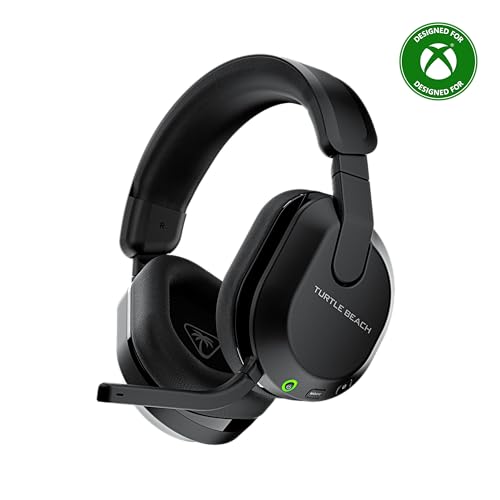
Turtle Beach Stealth 600 — Affordable wireless sweet spot
Where Microsoft’s headset optimises for the console alone, the Stealth 600 optimises for the whole house. Its wireless speaks Xbox natively and also serves PlayStation, PC, and mobile, with Bluetooth alongside and a quick-switch button to hop between the gaming link and the phone. In a household where the Xbox shares a television with other machines — most households, in other words — that breadth converts the Stealth 600 from an Xbox accessory into the living room’s single headset.
The flip-to-mute microphone is the daily delight. Down is live; up is muted, with a confidence no button-hunt can match, and microphone monitoring lets you hear your own voice naturally so party chat stays at conversational volume instead of creeping into a shout as the evening’s excitement builds. Chat clarity is a Turtle Beach home strength: voices arrive forward and intelligible, and the 50mm drivers give game audio a fuller, warmer body than the first-party headset manages, with a low-latency mode for competitive sessions and spatial processing for immersion.
Battery endurance is the headline that changes behaviour: around eighty hours means the charging cable becomes a monthly acquaintance rather than a nightly leash, and the headset is simply always ready — the quality players consistently underrate until they have lived with it. Memory foam cushions with glasses-friendly channels keep the fit kind across long sessions, and the control row along the ear cup — volume wheel, mode, power — becomes touch-memory within a week.
Set against the Xbox Wireless Headset, the trade is clear: you give up the elegant ear-cup balance dial and the dongle-free purity, and you gain battery, breadth, and a fuller sound. Set against its own bigger sibling below, the 600 is where the affordable tier’s value peaks — the 700 adds refinement, not transformation. For most Xbox households reading a guide with ‘affordable’ in its title, this is the recommendation that will still look right in a year’s time.
- Platforms: Xbox wireless, plus PlayStation, PC, and mobile
- Drivers: 50mm with a warm, full-bodied signature
- Battery: around 80 hours between charges
- Microphone: flip-to-mute with natural voice monitoring
- Extras: quick-switch between gaming link and Bluetooth
Strengths
- One headset genuinely covers the whole living room.
- Eighty-hour battery abolishes charging as a routine.
- Flip-to-mute is party-chat-proof and visible to the room.
Trade-offs
- No ear-cup dial for game/chat balance.
- Warm tuning favours spectacle over forensic detail.
- Frame runs large for smaller heads.
Best for: multi-machine living rooms and players who hate charging things. Not suited for: purists wanting the console-native control scheme.

Turtle Beach Stealth 700 — The step-up choice
Let the labelling be plain, because this guide’s honesty depends on it: the Stealth 700 is not an affordable headset wearing a disguise. It is the step up — the model for the reader who came to an affordable guide, found the ceiling of the tier, and wants to know what more money actually buys before deciding. What it buys, in the 700’s case, is a 60mm dual-driver design with separate handling of bass and treble, a plusher build, and the sense that every component was specified a rung higher.
The dual-driver architecture is the substantive difference. Where single drivers must compromise, the 700 assigns low frequencies their own space, and the result is bass with texture rather than mere presence — engine notes with edges, explosions with a beginning and an end — while dialogue and competitive cues stay clean above it. For players whose Xbox time leans cinematic, the improvement is not subtle, and it is the honest core of the price gap between this model and the 600.
Around that sound sits the same household intelligence as its sibling: Xbox wireless with multi-platform reach, Bluetooth for the phone, a flip-to-mute microphone, and a battery around eighty hours. The frame adds gel-infused cushioning and a more premium hand feel, and the control layout will be instantly familiar to anyone upgrading from the 600 — a deliberate kindness to the brand’s own customers.
So who should step up? Players who play single-player epics with the lights down, who notice and care about low-frequency texture, and who keep a headset for many years, amortising the difference across thousands of hours. Players whose week is party chat and competitive shooters will find the 600 spends their money where their ears actually live. Both decisions are respectable; this guide’s job is to make the boundary between them visible, and the 700 sits exactly on the far side of it, labelled.
- Drivers: 60mm dual-driver design, separated bass and treble
- Connection: Xbox wireless plus Bluetooth, multi-platform
- Battery: around 80 hours per charge
- Build: gel-infused cushions, premium-tier materials
- Positioning: a deliberate step above this guide’s core tier
Strengths
- Dual drivers deliver bass texture the tier cannot match.
- Retains the 600’s battery and platform breadth.
- Build quality justifies keeping it for many years.
Trade-offs
- Price leaves the affordable tier behind — by design.
- Heavier frame than its sibling on long sessions.
- Chat-focused players gain little over the 600.
Best for: cinematic single-player devotees planning a long ownership. Not suited for: strict budgets or party-chat-first players.

Turtle Beach Recon 70 — Wired value anchor
Every technology cycle needs a reminder that the simple version, engineered well, is hard to beat. The Recon 70 plugs into the Xbox controller’s 3.5mm jack and delivers the two things a headset exists for — clear game audio and clearer chat — with no battery, no pairing, no firmware, and no failure modes beyond a cable. It has been the default recommendation at its rung for years because the formula is complete: 40mm drivers with an honest, balanced tuning, a flip-to-mute microphone that party chat veterans swear by, and a lightweight frame with cushions that stay comfortable through an evening.
The wired path deserves its defence in an Xbox context specifically. The controller is already wireless, so the ‘cable’ runs from your hands to your head — a short, untroublesome span that never crosses the room. Latency is zero by physics. The headset works with every Xbox controller ever made for the modern consoles, plus PlayStation, Switch, PC, and phones, which makes the Recon 70 the household’s universal spare as well as its budget starter: the headset that rescues any setup, on any machine, in ten seconds.
Sound quality punches at the level its price promises and slightly above it. Bass is present without theatrics, dialogue is clear, and competitive cues are placeable — not to the standard of the wireless picks above, but far beyond the pack-in earbuds and television speakers it usually replaces. The microphone is the genuine standout at this rung: flip it down and your party hears you properly, a transformation for players upgrading from a controller’s built-in compromises or a phone earbud.
Limits are the expected ones. There is no game/chat balance control on the headset itself, so mixing happens in the Xbox guide menus; there is no spatial processing beyond what the console provides; and the cable, however short, is still a cable for players who play standing or hand the controller around. As the value anchor of this guide — the pick that proves how little money a good Xbox voice actually requires — the Recon 70 has no serious rival.
- Connection: 3.5mm through the controller, works everywhere
- Drivers: 40mm, balanced and dialogue-clear
- Microphone: flip-to-mute, the class benchmark at this rung
- Power: none — nothing to charge or pair
- Build: lightweight frame, synthetic leather cushions
Strengths
- Zero latency, zero charging, zero pairing, forever.
- Microphone transforms party chat at a bargain rung.
- Universal spare for every machine in the house.
Trade-offs
- Game/chat mixing lives in console menus, not on the ear cup.
- Cable tethers headset to controller.
- Soundstage is modest next to the wireless picks.
Best for: budget buyers, younger players, and every household’s spare drawer. Not suited for: players who play standing or roam mid-session.
SteelSeries Arctis Nova 7X — Multi-console flagship feel
The Nova 7X exists for a specific and increasingly common household: one with an Xbox, another console or two, and a gaming PC, all wanting the same headset. SteelSeries’ answer is a USB-C dongle ecosystem with a variant tuned for Xbox’s wireless requirements, letting one premium headset roam the entire entertainment centre. The sound is the Nova line’s best affordable-adjacent work — detailed, spacious, with the company’s software EQ on PC — and the retractable ClearCast microphone keeps party chat clean.
Comfort follows the ski-goggle suspension design that made the line famous, floating the frame so long sessions pass without a pressure point, and battery endurance around thirty-eight hours covers a heavy week. Bluetooth rides alongside the dongle link for the phone. The 7X is covered without a link because the pool checked for this batch holds no entry for it; SteelSeries sells it widely, so buy by the exact 7X name — the X matters, since its Nova 7 siblings serve other platforms and will not give an Xbox the wireless connection this one does.
Position it honestly: this is flagship-adjacent money, beyond the affordable core of this guide, justified when the multi-console roaming is a weekly reality rather than a theoretical one. A household that plays only on Xbox buys the Stealth 600 and keeps the change; a household that genuinely rotates machines will find the 7X cheaper than two good headsets and simpler than either. The dongle also demands a small discipline — it must travel with the headset between rooms, and households should agree where it lives before it starts its own adventures.
- Reach: Xbox, PlayStation, Switch, and PC via its dongle
- Battery: around 38 hours, fast charging over USB-C
- Microphone: retractable ClearCast design
- Fit: suspension headband, floating comfort system
- Software: full EQ suite on PC
Strengths
- The one-headset answer for a genuinely multi-console home.
- Detailed, spacious sound above this guide’s core tier.
- Suspension comfort suits the longest sessions here.
Trade-offs
- Price sits beyond the affordable heart of the guide.
- Dongle must be managed between machines and rooms.
- Xbox-specific controls are less native than Microsoft’s own.
Best for: rotating households with several consoles and a PC. Not suited for: Xbox-only homes, where the 600 spends better.
HyperX Cloud Stinger 2 Core (Xbox) — Ultra-budget wired
At the very bottom of the price ladder sits a question: how much of a real headset survives? The Cloud Stinger 2 Core for Xbox answers better than most. It keeps the Cloud family’s essential comfort — proper cushions, a frame that does not creak its way through an evening — adds 40mm drivers with a clear, chat-friendly balance, and puts volume and chat controls on the cable where a budget headset can afford to put them. DTS spatial sound support through the console adds a layer of polish its price has no right to promise.
The Xbox version matters: it is tuned and badged for the platform, with the chat-mix expectations of Xbox players designed in rather than adapted. The microphone is fixed and flips up to mute, capturing a clear, if not luxurious, voice that party chat will have no trouble with. Construction is honest plastic throughout — light, a little hollow-feeling in the hand, and perfectly durable in the ways that matter for a headset that will be borrowed, dropped, and sat on by the household’s younger contingent.
This model sits outside the pool checked for this batch, so it is written up without a link; HyperX distribution is extensive, and the exact Xbox naming matters when ordering, since near-identical siblings serve other platforms. Choose it when the budget is truly the budget — a first headset for a younger player, a spare for the guest controller, a stopgap that turns out to be entirely liveable. It concedes soundstage, materials, and every wireless pleasure to the picks above, and concedes nothing at all on the fundamentals of being heard clearly on Xbox.
- Connection: wired 3.5mm via the controller
- Drivers: 40mm with DTS spatial support on console
- Controls: in-line volume and chat adjustment
- Microphone: fixed boom, flips up to mute
- Build: light plastic, Cloud-family cushioning
Strengths
- Real Cloud comfort at the ladder’s lowest rung.
- Chat controls on the cable suit Xbox party habits.
- Light enough for younger players’ long sessions.
Trade-offs
- Plastic build feels its price in the hand.
- No wireless path of any kind.
- Microphone is clear, not rich — party grade, not streaming grade.
Best for: first headsets, guest controllers, and the tightest budgets. Not suited for: players ready for wireless freedom or premium sound.
Native Dial, Flip Mic, or Cable? Laying the Six Across an Xbox Living Room
| Headset | Xbox connection | Chat control | Battery | Best seat in the house |
|---|---|---|---|---|
| Xbox Wireless Headset | Xbox Wireless, dongle-free | Ear-cup balance dial | ~15 hours | The purist’s armchair |
| Stealth 600 | Xbox Wireless + Bluetooth | Flip-to-mute, monitoring | ~80 hours | The shared family sofa |
| Stealth 700 | Xbox Wireless + Bluetooth | Flip-to-mute, monitoring | ~80 hours | The film-night throne |
| Recon 70 | Wired via controller | Flip-to-mute | None needed | Anywhere, instantly |
| Arctis Nova 7X | Dongle, Xbox variant | Retractable mic, app EQ | ~38 hours | The multi-console den |
| Cloud Stinger 2 Core | Wired via controller | In-line chat controls | None needed | The younger player’s room |
The chat-control column is where Xbox ownership is actually decided. Microsoft’s dial remains the most elegant solution ever fitted to a console headset — a twist of the ear cup rebalances a party that has grown louder than the game, mid-sentence, without a menu. The flip microphones of the Turtle Beach trio answer a different problem: not balance but certainty, the physical guarantee that mute means mute, legible across a room. The in-line controls of the Stinger 2 Core are the budget dialect of the same language. None of these is a consolation prize; they are three philosophies of control, and the one that matches your habits will feel right within a day.
The battery column divides the guide into households that charge and households that forget. Fifteen hours from the first-party headset means a mid-week top-up becomes part of the rhythm, while eighty hours from either Stealth turns charging into a rumour. The wired pair opt out of the question entirely, which is why they anchor so many second-controller and guest setups: a Recon 70 in the drawer is a party-chat seat that is always, unconditionally ready.
Why Does Xbox Wireless Work Differently From Every Other Platform?
Microsoft built its console audio on a proprietary wireless protocol — the same family the controllers use — rather than on standard Bluetooth audio or a generic dongle standard. The benefits are real: pairing behaves like controller pairing, latency is low and consistent, and the console can offer platform-level features such as that ear-cup balance dial knowing exactly what a certified headset can do. The cost is equally real: a headset must be specifically licensed and built for Xbox wireless, which is why ‘wireless’ on a PlayStation or PC headset so often becomes ‘wired’ the moment an Xbox enters the room.
For buyers, the practical rules are three. First, look for explicit Xbox wireless language — the Designed for Xbox badge and named Xbox Wireless support — rather than assuming. Second, remember the controller jack redeems almost everything: nearly any wired headset works on Xbox through the controller, so a beloved wired model from another platform is never wasted here. Third, treat Bluetooth on an Xbox headset as a phone feature, not a console feature; the console itself does not take Bluetooth audio, and the Bluetooth in the Xbox Wireless Headset and the Stealth pair exists to serve your mobile, not your Series X.
None of this makes Xbox the difficult platform — it makes it the legible one. The rules are stable, the controller jack is universal, and the six picks above cover every legitimate path: native wireless, licensed multi-platform wireless, dongle-based roaming, and honest wires.
How Do You Set Up Party Chat So Your Squad Hears You Properly?
Begin in the Xbox audio settings rather than in any game. Set the headset format to your spatial preference — Windows Sonic is free and capable; Dolby Atmos for Headphones adds its own tuning through its app — and then find the microphone monitoring slider, the control that feeds your own voice back into your ears. A touch of monitoring stops the universal party-chat failure mode: shouting because your own voice sounds muffled to you while sounding perfect to everyone else.
Next, position the microphone like you mean it. Boom models want the tip near the corner of your mouth, a couple of centimetres away; the Recon 70 and Stealth booms flip down to roughly the right place, but a small bend toward you pays off in clarity. On the Xbox Wireless Headset, learn the auto-mute’s habits: it gates background sound when you stop speaking, and a deliberate first word after a long silence ensures the gate is open before your actual sentence begins.
Balance the party before the match does it for you. Start with game and chat at an even mix, play one ordinary session, and adjust in small steps toward whichever side you kept straining to hear. On the first-party headset that adjustment lives on the dial; on the others, the Xbox guide’s audio panel holds it. Finally, record a party test: most squads will tell you honestly, if asked once, whether you sound clear — and one honest answer in week one prevents a year of being the quiet one.
Which Xbox Headset Mistakes Fill the Returns Boxes?
Assuming cross-platform wireless tops the list, as it has for a decade. A headset that is gloriously wireless on a friend’s PlayStation arrives, pairs with nothing, and goes back in the box with its owner’s faith in reviews damaged. Every pick in this guide states its Xbox connection in plain words; hold every other headset you consider to the same standard before money moves.
Buying a second headset to fix a settings problem runs second. Party members who sound distant are usually a microphone-position or monitoring issue, and players who cannot hear the game over chat usually have never found the balance control their existing headset already owns. Exhaust the settings — they are genuinely powerful on this platform — before concluding the hardware is at fault.
The third mistake is neglecting the second-controller seat. Xbox households host: friends on the sofa, siblings sharing a console, guests handed a controller. A wired Recon 70 or Stinger 2 Core in the drawer converts those moments from muted spectating into full party participation, for less than the price of the pizza that usually accompanies them. The best Xbox audio setup in a social house is one good headset plus one honest wired spare, and this guide’s six exist to be combined exactly that way.
Six Months on the Sofa: How Each Pick Ages in an Xbox Household
Consoles outlive fashion cycles, and headsets bought for them should be judged on the same clock. Half a year of sofa life — tossed onto cushions, borrowed by siblings, charged in bursts between sessions — separates the durable designs from the delicate ones more honestly than any unboxing.
The Xbox Wireless Headset settles into the household like a second controller: always paired, always where the console is, picked up without thought. Its modest battery builds a small ritual — a cable by the sofa, a top-up during a film — that owners either adopt happily or cite as the reason they eventually wander toward the Stealth line. Its dials, used daily, show no slackening, and the auto-mute becomes invisible infrastructure your party simply benefits from.
The Stealth 600’s six-month story is dominated by the battery’s refusal to be a topic. Owners charge it so rarely that the cable migrates to a drawer and must be hunted on the rare occasions it is needed — a champagne problem, but a real one worth solving with a dedicated hook-and-cable spot. The flip microphone’s hinge, exercised thousands of times, stays decisive, and the cushions keep their shape through the kind of use that flattens lesser foam by spring.
Stealth 700 ownership justifies itself in accumulated evenings: the dual drivers’ low-end texture becomes the household’s reference for what games should sound like, and guests handed the 700 notice. Its extra weight, debated in week one, stops being mentioned by month two as neck and habit adjust. Owners who stepped up from the 600 rarely describe the move as necessary; they describe it as enjoyed, which is the correct standard for a step-up purchase.
The Recon 70 simply accumulates hours. It becomes the headset of the second controller, the visiting cousin, the late-night session where the main headset is charging — and because it asks for nothing, it is never the headset that fails. Its cable is its only ageing part, and treated with minimal respect it lasts for years. Households report a curious pattern: the Recon 70 is bought as a stopgap and kept as infrastructure.
The Nova 7X justifies its prose place in rotation households by erasing a daily friction: one headset, every machine, no re-pairing ceremonies. Its dongle becomes a small household citizen with an agreed home — usually a small dock or dish near the consoles — and the headset’s comfort keeps it first choice even on Xbox-only nights. Owners who bought it for a rotation that never materialised are the ones who feel its price; the rotation is the product.
The Stinger 2 Core ages as budget gear should: uncomplainingly, in the hands of the household’s roughest user. Its plastic shows scuffs without cracking, its cushions are its first wear item, and its voice stays clear long after its price would suggest retirement. It is frequently the headset still working when a pricier sibling is awaiting a replacement part — a fact its owners mention with justified smugness.
Spatial Sound on Xbox: Sonic, Atmos, and What Your Ears Actually Get
Xbox offers spatial audio at the platform level, which changes the buying logic: the headset does not need to generate the effect, only to carry it faithfully. Windows Sonic, built into the console, renders a convincing three-dimensional stage for games that support it, and it costs nothing. Dolby Atmos for Headphones, delivered through its own app under its own licence terms, adds a more theatrical tuning that many film and single-player fans prefer. DTS Headphone:X exists in the same ecosystem — the Stinger 2 Core’s support for it is a small coup at its price.
The honest buyer’s conclusion is liberating: at this tier, do not pay a headset premium for spatial branding. Every pick here can carry the console’s spatial output; what separates them is the quality of the stereo foundation underneath — driver clarity, seal, and tuning — because spatial processing can only place sounds that the drivers render cleanly in the first place. The Stealth 700’s dual drivers give Atmos the most to work with; the Recon 70’s honest stereo gives Sonic a perfectly respectable canvas.
Competitive players should run their own experiment before committing. Play a week of your main shooter in plain stereo, then a week with spatial enabled, and track whether your sense of verticality and distance genuinely sharpens or merely feels grander. Both outcomes are legitimate — spatial audio is partly preference — but the experiment costs nothing and prevents the common error of attributing a good headset’s clarity to a processing badge, or blaming a headset for a processing choice.
Setting Up a Two-Headset Xbox Household Without Daily Friction
Social Xbox houses run best on a small constitution. Article one: the primary wireless headset lives on a hook or stand beside the console, with its charging cable permanently in place, so ‘ready’ is a location rather than a hope. Article two: the wired spare lives in the drawer beneath the television, coiled loosely, known to every member of the household including guests. Article three: dongles, where they exist, are never borrowed for other machines without returning them the same evening.
Profiles help more than hardware. Xbox lets each player sign in with their own settings, and chat preferences — monitoring level, preferred mix — follow the profile when headsets are swapped between players. Ten minutes spent setting up a younger player’s profile with gentler volume limits and a tested microphone level repays itself every time they join a party unsupervised.
Finally, agree the guest protocol before the guests arrive: the visitor gets the wired spare and the second controller, the host keeps the wireless primary, and nobody’s evening depends on a pairing ceremony performed in front of an audience. It sounds trivial until you have watched a games night dissolve into Bluetooth menus; the households that play most are the ones that removed every avoidable menu from the path between the door and the sofa.
Does the Controller Jack Hold Wired Headsets Back?
A persistent myth says wired-through-the-controller means compromised sound, as if the audio were squeezed through a toy. The reality is more flattering: the modern Xbox controller’s jack is fed by the console’s digital audio path, converted competently, and capable of driving any headset in this guide’s wired tier to full, clean volume. What the jack cannot do is power hungry, high-impedance audiophile headphones to their best — a limitation that touches none of these six, all of which were designed with exactly this connection in mind.
The genuine wired compromises live elsewhere. Volume and mix controls move into menus or onto the cable, as the Recon 70 and Stinger 2 Core demonstrate in their different ways. The cable itself is a physical fact: short, light, and forgotten by most seated players within a session, yet a real consideration for players who stand, gesture, or pass controllers around a room. And the jack is a wear point over years of plugging — one more reason the wired picks make such good spares, since their duty cycles are naturally gentler.
Balanced against those compromises is a virtue wireless cannot imitate: the wired headset’s readiness is absolute. No charge state, no pairing state, no firmware state stands between the drawer and the party. In households that measure a headset’s worth in sessions actually played rather than features owned, the wired pair’s simplicity is not the budget option’s apology — it is the budget option’s argument, and it remains undefeated at its price.
Buying for a Younger Player: What Actually Matters?
Gifts of headsets for younger Xbox players fail on predictable lines: a flagship bought for a head it does not fit, a delicate frame bought for a life it cannot survive, a wireless system whose charging discipline a ten-year-old was never going to maintain. The picks that succeed share a profile — light, tough, simple, and cheap enough that a loss is an annoyance rather than a family event. In this guide that profile names the Recon 70 first and the Stinger 2 Core second, and it is not a condescending recommendation; it is the same logic that puts wired headsets in classrooms and call centres.
Fit deserves a moment’s thought. Younger heads are smaller, and an adult frame’s clamp lands differently; both wired picks here are light enough to sit kindly, and their cushions tolerate the constant on-off rhythm of young play. Volume limiting is the other parental feature that matters — set at the console level through the family settings, it protects hearing regardless of which headset is plugged in, which is one more argument for solving safety at the platform layer rather than shopping for it model by model.
Durability, finally, is a household definition before it is a product one. A headset that lives on a hook survives; a headset that lives on the floor meets chair castors. Whatever you buy a younger player, buy the hook too, and make the putting-away part of the gaming ritual from the first day. The Recon 70 has survived more childhoods than any headset in this guide precisely because families treat it as equipment rather than treasure — and equipment, treated as equipment, lasts.
A Note on Buying the Previous Generation
Xbox’s stable platform means headset generations age gracefully, and the previous Stealth and Recon generations still circulate at attractive discounts. The savings can be real, but three checks protect them. Confirm the Xbox wireless licensing belongs to the exact generation you are buying, since line-ups have shifted platform support between revisions. Confirm the battery’s likely state — a heavily used wireless headset’s runtime is its first casualty, which argues for new-old-stock over second-hand at this tier. And confirm cushion availability, because a discounted headset whose foam is already tired is a purchase of somebody else’s wear. Pass those checks and a previous-generation Stealth is one of the smartest buys in this entire category; fail them and the current models in this guide are cheap insurance against other people’s hours.
What About Playing on Xbox at a Desk, Beside a PC?
A growing slice of Xbox play happens at desks — monitor, chair, PC within arm’s reach — and the headset logic shifts subtly there. The sofa’s priorities (roaming range, television distances) fade, and desktop virtues rise: a headset that can serve the console and the PC without re-cabling, microphone quality for the Discord call running beside the Xbox party, and a frame comfortable under the longer, more stationary sessions desk play encourages. The Stealth 600’s breadth and the Nova 7X’s dongle roaming both shine in this habitat, the 7X especially, since its dongle can live in the PC while its Xbox duties are handled in the same sitting.
Desk players should also exploit a freedom sofa players lack: the wired picks become nearly weightless propositions when the controller rests on the desk between rounds, and a Recon 70 at a desk is a zero-latency, zero-maintenance instrument that many desk players end up preferring for competitive sessions even after buying wireless. Habitat, in headsets as in everything else, should have the final vote — and the desk habitat’s vote is that connection variety matters more than connection purity.
Final Recommendation
For the typical Xbox household, the Turtle Beach Stealth 600 is the affordable wireless answer: native Xbox connection, a phone-friendly Bluetooth side, a flip microphone your party will thank you for, and a battery that removes charging from your list of concerns. If your loyalty is to the platform’s own design language — the dial, the dongle-free pairing, the first-party manners — the Xbox Wireless Headset remains a deeply satisfying default, provided its shorter battery fits your rhythm and your sessions are the evening-length sort its cushions were shaped for rather than the all-weekend marathons its rivals shrug off.
Spend upward only with intent: the Stealth 700 earns its step-up label for cinematic players who will hear what the dual drivers do, and the Nova 7X earns its prose place when several consoles genuinely share one headset. Spend downward without a moment’s shame: the Recon 70 and the Stinger 2 Core deliver the fundamentals of Xbox voice — clarity, comfort, reliability — at prices that leave money for games, which is, after all, what the headset is for.
Whatever you choose, spend the first evening with it deliberately: set the monitoring, place the boom, balance the party, and record one honest test with a friend whose opinion you trust. Xbox rewards that small ceremony more than most platforms, because so much of its audio quality lives in settings the console exposes generously and headsets assume you will visit. On Xbox more than anywhere, the right headset is the one whose connection story you understood before you bought it; choose that one, and the platform’s peculiarities turn from traps into advantages within a week.
Frequently Asked Questions
Can I use a PlayStation wireless headset on Xbox?
Wirelessly, almost never — the consoles use different wireless systems, and a PlayStation dongle means nothing to an Xbox. Through the controller’s 3.5mm jack, most wired-capable headsets work fine on Xbox, which is why the wired picks in this guide serve every platform in the house. For true Xbox wireless, look for the Designed for Xbox badge and named Xbox Wireless support.
Does the Xbox Wireless Headset work on PC?
Yes, with caveats. It connects to Windows PCs over Bluetooth or through an Xbox Wireless Adapter, and its dials and spatial support carry over best in that adapter setup. Players who split time evenly between console and PC often prefer the Stealth 600 or Nova 7X, whose dongles treat the PC as a first-class home rather than a second one.
What is microphone monitoring, and should I use it?
Monitoring feeds a little of your own voice back into your ear cups as you speak. Without it, sealed cushions make your voice sound muffled to yourself, and most players unconsciously shout to compensate. A modest amount of monitoring keeps party volume civilised; the Xbox settings and the Turtle Beach models here both offer it, and it is worth two minutes of setup in the first week.
Is Dolby Atmos worth enabling on these headsets?
For single-player and film content, many players enjoy its wider, more theatrical staging, and every wireless pick here can carry it. For competitive play, opinions divide — some players find the processing smears the precise cues they rely on, and prefer plain stereo or Windows Sonic. It costs nothing to test across a week of your real games, and your own ears, in your own genres, are the only authority that matters.
Can two players use wireless headsets on one Xbox at the same time?
Yes — the console supports multiple wireless headsets for local players, each paired like its own controller, though party logistics get interesting when both players sit in one room and hear each other naturally as well as through chat. Many sofa households prefer the simpler constitution used in this guide: one wireless primary for the host, one wired headset through the second controller for the guest, which sidesteps echo and pairing entirely.
Do these headsets work with Xbox cloud gaming on a TV or phone?
The wired picks work wherever a controller with a jack is driving the session, which covers most cloud setups. The wireless models pair to the console rather than to televisions, so for cloud play on a smart TV or tablet, their Bluetooth modes — present on the Xbox Wireless Headset and both Stealth models — are the path, accepting Bluetooth’s latency as the price of the convenience.
Why does my party say I sound quiet?
Work through three causes in order: boom position, which should sit near the corner of your mouth rather than under your chin; the Xbox microphone level and any in-game voice settings layered on top of it; and, on the first-party headset, the auto-mute gate, which can soften the start of sentences spoken gently after long silences. Hardware failure is a distant fourth cause — settings and geometry explain nearly every quiet-voice report.
Related Guides
Keep exploring the neighbouring questions this guide raises: the noise-focused roundup of Bluetooth headsets with active noise cancelling for calls and commutes covers the quiet-seeking side of the category, our durability ranking of gaming headsets built to survive years of daily use stress-tests the frames behind the sound, and the audiophile-leaning guide to headsets with the best outright audio quality shows what the next tier of drivers can do when the budget conversation ends and the listening begins in earnest.


