Our Top Picks


What's inside
- Best Cameras With Eye AF: Sharp Eyes Without the Guesswork
- What Eye AF Actually Does
- Eye AF Versus Face Detection: Why the Difference Matters
- How the Brands Name It, and Why the Names Differ
- When Eye AF Earns Its Keep
- The Honest Limitations of Eye AF
- Canon EOS R100 Double Zoom Lens Kit: Eye Detection in a Two-Lens Starter Kit
- Sony Alpha a6400 With 16-50mm Lens: Real-Time Eye AF in a Compact Travel Body
- Nikon Zfc With NIKKOR Z 28mm f/2.8 SE Lens: Eye AF in a Retro Body
- Sony a7C With 28-60mm Lens and Bag Bundle: The Full-Frame Step
- Sony Alpha a6100 Body Only: Eye AF for Buyers Who Already Own Lenses
- Sony ZV-E10 Bundle: Eye AF Built Around the Creator Workflow
- How to Choose Among These Six
- Settings and Technique Tips for Better Eye AF Results
- Frequently Asked Questions About Eye AF
- Our Verdict
- Check prices on Amazon
- Affiliate Disclosure
As an Amazon Associate I earn from qualifying purchases. This post may contain affiliate links at no extra cost to you.
Best Cameras With Eye AF: Sharp Eyes Without the Guesswork
Focus on the eyes. It is the oldest advice in portrait photography, and it is also the hardest to follow when your subject will not sit still. A child turns toward a window, a partner laughs mid-sentence, a creator walks toward the lens while talking, and in that half second the plane of focus drifts from the eye to an ear, a nose, or the background. Eye autofocus, usually shortened to Eye AF or called eye detection AF, exists to remove that half second of doubt. Instead of asking you to place a small focus point precisely over an eye and keep it there, the camera finds the eye itself, locks onto it, and keeps tracking it as the subject and the camera move.
This guide covers six mirrorless cameras that build that ability into their autofocus systems: the Canon EOS R100 Double Zoom Lens Kit, the Sony Alpha a6400 with its 16-50mm lens, the Nikon Zfc with the NIKKOR Z 28mm f/2.8 SE lens, the Sony a7C with a 28-60mm lens in a bag bundle, the Sony Alpha a6100 sold as a body only, and the Sony ZV-E10 in a bundle aimed at video creators. They span entry-level kits, compact APS-C bodies, a retro-styled model, and one full-frame option, so the right choice depends less on whether a camera has Eye AF and more on how you shoot, what lenses you want to use, and whether stills or video matter more to you.
Our research for this guide started from the product listings themselves and from widely understood principles of how mirrorless autofocus works. Where a listing states a feature, we say so. Where it does not, we stay general rather than filling gaps with invented specifications. That matters with Eye AF in particular, because marketing names differ between brands and even between generations of the same brand, and a confident sounding claim can hide a real limitation, such as eye detection that works for stills but behaves differently in video, or animal eye detection that only some systems offer.
What Eye AF Actually Does
Autofocus has always been a negotiation between the photographer and the scene. Traditional systems asked you to choose a focus point or zone, place it over the most important part of the subject, and trust that contrast or phase detection would find focus there. That works well for a landscape or a still life. It works less well for a portrait at a wide aperture, where depth of field can be so shallow that the difference between an eye in focus and an eyelash in focus is visible when you zoom in. Eye AF changes the starting point of that negotiation. The camera analyses the frame, looks for a face, then looks within that face for eyes, selects one, and drives the lens to focus on it.
The sequence usually runs in stages. First, the camera detects a face within the frame, using patterns it has been trained or programmed to recognise: the arrangement of eyes, nose and mouth, skin tone regions, and the shape of a head. Next, it narrows the search to the eye region and identifies one or both eyes with far more precision than a face box alone allows. Then it hands that small target to the autofocus system, which measures focus distance at that point and adjusts the lens. Finally, while you keep the shutter button half pressed or keep recording video, it keeps updating both the position of the eye in the frame and the focus distance, so a subject who leans in, turns, or walks does not immediately break the lock.
Eye AF Versus Face Detection: Why the Difference Matters
Face detection and Eye AF are related, but they are not the same tool, and confusing them leads to disappointing results. Face detection finds a face and focuses somewhere on it. At moderate apertures and normal portrait distances, that is often good enough, because depth of field covers the whole face. The problem appears when depth of field shrinks: a fast prime lens used wide open, a close-up headshot, or a longer focal length that compresses the scene and thins the zone of sharpness. In those situations, focusing on the face in general can mean the nearest point of the face, often the nose or cheek, is sharp while the eyes sit slightly behind the plane of focus and look soft.
Eye AF narrows the target from the whole face to a single eye, and that precision is exactly what shallow depth of field demands. Viewers are remarkably sensitive to it. We look at eyes first in any portrait, and we forgive softness in hair, clothing and background far more readily than softness in the eye itself. A portrait with a tack-sharp eye and a gently blurred everything else reads as intentional and professional. The same portrait with a sharp nose and soft eyes reads as a near miss, even if almost everything else about it is good.
How the Brands Name It, and Why the Names Differ
Each manufacturer wraps the same basic idea in its own language, and the wording on a listing tells you which family of technology you are getting. Sony uses the term Real-Time Eye AF, which appears in the listings for the a6400, the a7C, the a6100 and the ZV-E10 in this guide. The real-time part of the name reflects Sony’s emphasis on continuous tracking: the camera is not just finding an eye once for a single frame, it is updating its lock as the subject moves, which is why the feature is marketed as heavily for video as for stills.
Canon describes the feature as Eye Detection within its Dual Pixel CMOS AF system, which is the wording used for the EOS R100 in this guide. Dual Pixel refers to how Canon’s sensor gathers focus information, with pixels split so the sensor can measure focus while it captures the image. Eye Detection is the subject-recognition layer on top of that measurement system. When you read a Canon listing, look for both parts of the phrase: the sensor technology tells you how focus is measured, and eye detection tells you what the camera can recognise and prioritise.
Nikon keeps the name shortest. The Zfc listing simply says Eye AF, and across Nikon’s Z system that term covers eye detection autofocus for people, with some models in the wider system extending detection to animals. The lesson from all three naming schemes is the same: do not compare names, compare behaviour. Ask whether eye detection works in the mode you use, whether it tracks continuously or only at the moment of capture, whether you can choose between left and right eye or let the camera decide, and whether animal detection is included if that matters to you.
When Eye AF Earns Its Keep
Portraits are the obvious case, but it helps to be specific about which portraits benefit most. Formal headshots benefit because you can concentrate on expression and timing rather than focus placement, firing at the moment a genuine expression appears instead of the moment your focus point happens to be aligned. Environmental portraits benefit because your subject is smaller in the frame and surrounded by distractions the camera might otherwise prefer. Family photography benefits most of all, because children rarely cooperate with a photographer’s focus point, and Eye AF turns a moving, unpredictable subject into a manageable one.
Video is the second major case, and for many buyers today it is the deciding one. A vlogger or creator recording themselves has no camera operator to pull focus. If they step closer to the lens to show a product, then step back, focus has to follow smoothly and land on the eye, because viewers notice a face drifting soft within seconds. Eye AF in video is what makes solo recording practical without stopping down so far that the look of the footage changes. Several cameras in this guide pair Eye AF with 4K video and flip screens, a combination that is aimed squarely at that solo workflow: frame yourself, let the camera find your eye, and talk.
Animals are the third case, with a caveat. Some autofocus systems extend eye detection to dogs, cats and other animals, and when it works it is transformative for pet portraits, because animals move even less predictably than children and their eyes sit in fur that gives a plain focus point little to grip. However, animal eye detection is not universal, it varies by model and sometimes by firmware, and none of the listings in this guide promises it in so many words. If photographing pets is a priority, treat animal eye detection as a feature to confirm for the specific body you are buying rather than something to assume from the presence of Eye AF for people.
The Honest Limitations of Eye AF
Eye AF is a recognition system, and recognition systems have failure modes. Sunglasses are the classic one: if the camera cannot see an eye, it cannot focus on it, and it will fall back to face detection or to the frame of the glasses themselves. Hair across the face causes similar trouble, particularly a fringe or a windblown strand crossing one eye; the camera may hunt between the two eyes or settle on the clearer one, which may not be the one you wanted. Hats with deep brims, heavy shadows across the face, and subjects in near profile all reduce the information the system has to work with.
Low light is the second limitation, and it applies to autofocus generally, not just eye detection. As light falls, the sensor has less information, detection takes longer, and the camera may step down from eye to face to a general focus area. You can help it: add light where you can, use a wider aperture to let more light reach the sensor, or accept a slightly deeper depth of field so small focus errors matter less. Backlighting creates a related problem, because a face in shadow against a bright background may be underexposed in the camera’s view even when the scene looks fine to your own eyes; exposing for the face, or adding fill light, gives the detection system a face it can actually read.
best 4k mirrorless video cameras
Canon EOS R100 Double Zoom Lens Kit: Eye Detection in a Two-Lens Starter Kit
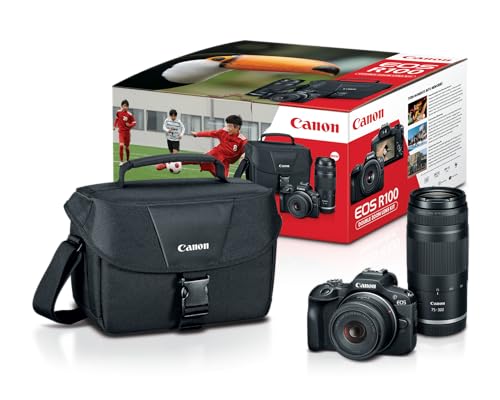
The Canon EOS R100 in this listing arrives as a Double Zoom Lens Kit in black, which immediately sets its role in this group: it is the option for someone starting from nothing who wants coverage for more than one kind of subject on day one. A double zoom kit means two zoom lenses rather than one, so instead of buying a second lens later to reach distant subjects, you begin with a pairing that spans everyday scenes through to longer reach for sports days, school events, wildlife in the garden, and travel details across a square. For a beginner whose interest in Eye AF comes from photographing family, that reach matters, because candid portraits are often taken from further away than posed ones.
The autofocus headline in the listing is Dual Pixel CMOS AF with Eye Detection. As explained earlier, Dual Pixel is Canon’s sensor-based approach to measuring focus, and eye detection is the recognition layer that tells the system where to measure. In practice for a new photographer, that combination removes the two hardest parts of portrait focus at once: you do not have to move a focus point around with a joystick or touchscreen for every frame, and you do not have to focus and recompose, a technique that often shifts the plane of focus just enough to soften an eye when depth of field is shallow. You frame the person, the camera looks for the eye, and you concentrate on timing.
The listing also notes optical image stabilization of up to 4 stops, which helps counter hand movement when you use the longer zoom at a distance. Who should choose the R100 kit? A first-time mirrorless buyer who wants Canon’s approach to eye detection, who values having two lenses from the start, and who mostly photographs people, family events and travel. It is also a sensible route for someone moving up from a phone who finds a single kit zoom limiting within weeks. The questions to ask before buying are about the future rather than the first month: whether Canon’s RF lens range, in the mounts this body uses, contains the fast prime you might want later for even shallower depth of field, and whether you are comfortable with a kit built around zooms rather than a bright fixed-focal-length lens. Within its stated scope, though, the proposition is clear and honest: eye detection autofocus, stabilized zoom coverage, and a body in black that keeps the whole package understated.
Sony Alpha a6400 With 16-50mm Lens: Real-Time Eye AF in a Compact Travel Body
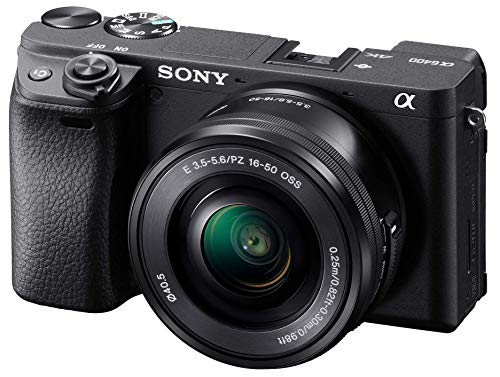
The Sony Alpha a6400 listing describes a mirrorless camera supplied with a 16-50mm lens, and names its autofocus feature as Real-Time Eye Auto Focus. It also lists 4K video, a flip screen, and a compact APS-C interchangeable lens design. Taken together, those points describe one of the most balanced all-rounders in this guide: small enough to travel with, serious enough to grow with, and built around an autofocus system whose eye tracking is designed to keep working while the subject moves and while you record video, not just at the instant you press the shutter.
The 16-50mm kit lens defines the starting experience. That focal range covers wide scenes at its short end through to a short telephoto reach suited to portraits at its long end, and lenses of this type are typically chosen for compactness, collapsing or staying small so the camera remains a take-anywhere tool. For Eye AF, a kit zoom like this is a friendly partner: depth of field is more forgiving than with a very fast prime, so you can learn how the eye detection behaves, when it switches eyes, and how it handles a subject turning away, without every small error being punished. Later, adding a fast prime is when the a6400’s eye tracking really gets to show its precision, because shallow depth of field is where accurate eye placement pays off most.
The flip screen deserves more attention than it usually gets in a stills-focused review. A screen that flips lets you photograph from low or high angles without guessing, and for video it lets a solo creator see framing while standing in front of the lens. Combined with Real-Time Eye AF for video, that makes the a6400 a credible self-recording camera as well as a stills camera, even though it is not marketed as a dedicated vlogging model in the way the ZV-E10 is. The 4K video listing confirms it is not a stills-only purchase; families who shoot both photographs and clips on the same trip will not need a second device.
Choose the a6400 if you want Sony’s Real-Time Eye AF in a compact APS-C body with a versatile starter lens included, and if your shooting mixes portraits, travel and video in roughly equal measure. It suits the photographer who carries a camera daily and wants the eye detection to be a set-and-forget background strength. Consider instead one of the other Sony bodies in this guide if your priority is narrower: the a6100 if you already own lenses, the ZV-E10 if video creation is the main job, or the a7C if you have decided on full-frame.
Nikon Zfc With NIKKOR Z 28mm f/2.8 SE Lens: Eye AF in a Retro Body
The Nikon Zfc listing pairs the camera with a NIKKOR Z 28mm f/2.8 SE lens, and describes a 20.9MP APS-C sensor, 4K video, Eye AF, a retro style, and Wi-Fi. This is the character camera of the group, and it would be a mistake to treat the styling as a distraction from the autofocus story. The Zfc’s appeal is that it wraps a modern eye detection system in a body designed to be handled deliberately, with the kind of dial-led control layout that encourages you to set aperture and shutter speed by touch. For portrait work, that combination is attractive: the handling slows you down in a good way, while Eye AF quietly handles the one task that is hardest to do manually at speed.
The lens choice shapes this kit more than any other in the guide. A 28mm f/2.8 prime on an APS-C body gives a moderately wide field of view, closer to an environmental portrait and street photography tool than a tight headshot lens. That means Eye AF on the Zfc will often be working on faces that are smaller in the frame, within a scene that includes context: a person in their workshop, a traveller in a station, a friend across a cafe table. As discussed in the limitations section, detection is happiest when a face is reasonably large, so Zfc owners should expect eye detection to engage most decisively as subjects come closer, and to step down to face detection at longer distances, which is normal behaviour rather than a fault.
The stated 4K video and Wi-Fi round out a camera that is not a one-note nostalgia product. Wi-Fi matters for the way many people now share portraits, moving images to a phone for quick editing and posting without a cable or card reader. Choose the Zfc if the experience of shooting matters to you as much as the output, if you like a fixed prime lens that encourages you to move your feet and compose with intent, and if your portraits lean environmental rather than tightly cropped. If your main goal is filming yourself or shooting long-lens candids, other cameras in this guide fit better, but for deliberate, enjoyable stills photography with modern eye detection underneath, the Zfc makes a distinctive case.
Sony a7C With 28-60mm Lens and Bag Bundle: The Full-Frame Step
The Sony a7C is the full-frame camera in this guide, and its listing states a 24.2MP full-frame sensor, 5-axis in-body image stabilization, Real-Time Eye AF, a 28-60mm lens, and a bag included in the bundle. Every element of that list points the same way: this is the option for the buyer who has decided that sensor size is their priority and wants eye autofocus and stabilization to match. Full-frame sensors offer their well-known advantages in low light and in depth-of-field control, and both of those interact directly with Eye AF.
Start with depth of field. For the same framing and aperture, a full-frame camera produces shallower depth of field than an APS-C camera, which is precisely why portrait photographers seek it out: backgrounds melt away and the subject stands clear. The cost of that look is that focus errors become more visible, because the zone of acceptable sharpness is thinner. Real-Time Eye AF is therefore not a luxury on a full-frame portrait camera; it is the tool that makes the full-frame look reliably achievable outside a studio, with moving subjects and changing light. The a7C’s proposition is that you can have the shallow depth of field and a system constantly working to put the sharpest point exactly on the eye.
The 5-axis IBIS is the second half of the proposition. In-body stabilization moves the sensor to counter shake, which means it works with the supplied 28-60mm lens and with other compatible lenses you may add later, including lenses without their own stabilization. For portrait work in available light, at a reception, in a home, or on an evening street, stabilization lets you keep shutter speeds sensible without leaning on higher sensitivity settings as early. As with the Canon kit, remember the division of labour: IBIS counters your movement, Eye AF tracks your subject, and you need both handled to get a sharp eye in dim conditions.
The 28-60mm lens is a compact companion chosen to preserve the a7C’s small-body concept, covering wide scenes through to portrait-friendly lengths, and the included bag makes the bundle genuinely ready to carry from the first day. Choose the a7C if you are stepping up to full-frame for portraits and mixed video, if you shoot often in low light, and if you plan to build a lens collection over time around one body. The honest trade-offs are the general ones that come with full-frame systems: lenses tend to be larger and the overall investment grows faster than with APS-C. Buyers who mostly shoot in good light and value the smallest possible kit may find the APS-C Sonys in this guide give them eye autofocus just as capable for their needs in a smaller package.
Sony Alpha a6100 Body Only: Eye AF for Buyers Who Already Own Lenses
The Sony Alpha a6100 listing is explicit that this is a camera body only, model ILCE-6100/B, with no lens included, and it states a 24.2MP APS-C sensor, 4K video, Real-Time Eye AF and fast autofocus. That body-only wording is the most important detail in its listing, and we will repeat it plainly: if you buy this version, you need a compatible lens you already own, or you must budget for one separately, before you can take a single photograph. For the right buyer that is a strength rather than a drawback, because paying for another kit zoom you do not need is its own kind of waste.
For existing Sony APS-C owners, the a6100 is an autofocus upgrade path. Real-Time Eye AF with fast autofocus generally describes a system designed to acquire a subject quickly and then stay with the eye as things move, which suits the way this camera is likely to be used: family life, pets around the home, school and sports days, and portraits with a favourite prime lens already in the bag. Pairing a body like this with a fast prime you already own is arguably the purest Eye AF experience in this guide, because the lens provides the shallow depth of field and the body provides the precise eye placement, with neither half of the partnership being a compromise you settled for in a kit.
Choose the a6100 body only if you already own compatible lenses, or you have a specific first lens chosen and costed separately. It is the value play for people inside the Sony APS-C system who want Real-Time Eye AF without duplicating a kit lens. If you are starting from zero, one of the kit options in this guide, the a6400 with its 16-50mm or the ZV-E10 bundle, will get you shooting sooner and more simply.
Sony ZV-E10 Bundle: Eye AF Built Around the Creator Workflow
The Sony ZV-E10 listing describes a mirrorless camera bundle in black with a 24.2MP APS-C sensor, Real-Time Eye AF, 4K video, a flip screen, and an explicit focus on vlogging and content creation. Where the a6400 is an all-rounder that also films well, the ZV-E10’s identity starts with video and works outward. That distinction shows in how its Eye AF should be judged: for a creator, the question is not only whether the camera finds an eye, but whether it keeps it while the creator moves, gestures, holds products toward the lens, and talks continuously, all without a camera operator.
Solo recording is the scenario this camera is built for, and it is worth walking through what Eye AF does across a typical recording session. You set the camera on a small tripod, flip the screen so you can see yourself, and start talking. You lean in to show detail on something you are reviewing; focus needs to follow your face rather than staying at the distance where you started. You hold an object up; a well-behaved system should not abandon your eye for the object unless you have told it that product focus is what you want in that moment. You step back to show a room or an outfit; the eye gets smaller in the frame and the system should step down gracefully to face tracking rather than hunting. That whole performance, repeated in every video, is why Real-Time Eye AF is the headline feature for creators rather than a footnote.
Choose the ZV-E10 if video is your main output and stills are secondary, if you record alone, and if you want eye tracking that is central to the camera’s design rather than one feature among many. Stills-first photographers who occasionally film will likely prefer the a6400’s all-round balance, and buyers who want full-frame depth of field should look at the a7C. But for the growing number of people whose camera is primarily a video tool that also takes excellent photographs of the life around the channel, this bundle is the most purpose-built option in the guide.
best 5 compact cameras by image quality
How to Choose Among These Six
Start with what you already own. If you have Sony APS-C lenses, the a6100 body only protects that investment and directs your spending toward the autofocus upgrade itself. If you own nothing, cross the body-only option off and compare kits, because a camera without a lens is a plan, not a tool. Next, decide the sensor question honestly. Full-frame, represented here by the a7C, rewards buyers who shoot in low light, want the shallowest depth of field, and accept a larger long-term investment in lenses. APS-C, which covers the other five cameras, rewards buyers who value compact size, lighter bags, and a system that can grow more affordably. Neither answer is wrong; mismatching the answer to your habits is what causes regret.
Then weigh stills against video. Predominantly stills photographers who enjoy the process of shooting may find the Nikon Zfc’s deliberate handling and prime lens the most satisfying route, while family photographers who want two zooms and Canon eye detection from day one should look at the EOS R100 kit. Predominantly video creators should start with the ZV-E10 bundle and work backwards only if its creator focus feels narrower than their ambitions. Buyers who genuinely split their time should give the a6400 a close look, because its listing balances stills, 4K video and a flip screen in a compact body without committing fully to either camp.
Settings and Technique Tips for Better Eye AF Results
- Turn eye detection on and set it to people. On many bodies the feature lives in the autofocus menu and can be assigned to the main subject detection setting. Confirm it is active before a shoot rather than discovering afterwards that the camera was using a plain focus area.
- Use continuous autofocus for anything that moves. Single-shot focus locks distance once; continuous focus keeps updating as your subject sways, walks or talks, which is the entire point of eye tracking. For video, continuous focus is the normal choice.
- Choose which eye when it matters. Where the camera offers left and right eye selection, use it for deliberate portraits: focus the eye nearer the camera, or the eye your composition emphasises, instead of letting the system decide each frame.
- Give the camera a face it can read. Ask subjects to lift sunglasses for key frames, brush hair away from the eyes, and turn slightly toward the light. Small courtesies to the detection system produce visibly better hit rates.
- Watch your depth of field. Eye AF is precise, but it cannot create depth of field that is not there. If both eyes must be sharp in a close portrait, stop down a little or angle the subject so both eyes sit at a similar distance.
- Expose for the face in backlight. A face the camera can see clearly is a face it can find eyes in. Adding exposure for a backlit subject, or using fill light, helps detection as much as it helps the photograph.
- Tap to override. In crowds or group scenes, tap the touchscreen on the person who matters, or use face registration where offered, so the camera prioritises your subject instead of the nearest stranger.
- Keep firmware in mind. Manufacturers sometimes improve subject detection through updates. Checking occasionally whether your body has a newer version available is a low-effort way to keep the system at its best.
Frequently Asked Questions About Eye AF
Does Eye AF work for video as well as stills? On the cameras in this guide, eye autofocus is presented as part of the core autofocus system, and Sony’s Real-Time naming in particular emphasises continuous tracking suited to recording. Behaviour can still vary by recording mode, so if video eye tracking is your main reason for buying, confirm the details for the exact mode you plan to use most.
Will Eye AF focus on my dog or cat? Some systems in the wider market include animal eye detection, but the listings in this guide do not promise it for these specific packages. Treat animal detection as a feature to verify for the individual body rather than assuming it comes with eye detection for people.
What happens when my subject wears sunglasses? The camera cannot focus on an eye it cannot see, so it typically falls back to face detection. The resulting portraits can still be sharp, because face detection at sensible apertures is reliable, but the fine precision of eye placement is unavailable until the eyes are visible again.
Is Eye AF only useful with expensive lenses? No. It is useful with any lens, and kit zooms are a forgiving way to learn it. Its precision becomes more visible, and more valuable, as depth of field gets shallower, which is why fast prime lenses show the biggest difference. The feature and the lens solve different halves of the same problem.
APS-C or full-frame for portraits with Eye AF? Both work well. Full-frame gives shallower depth of field and low-light advantages, making precise eye placement more critical and more rewarding. APS-C gives a smaller, lighter system with more forgiving depth of field, which many family and travel photographers honestly prefer. Choose based on size, light and lens plans rather than on autofocus alone, since all six cameras here offer eye detection.
Why does the focus box sometimes jump from an eye to the whole face? That is the detection hierarchy working as designed. When the eye becomes hard to identify, because the subject turned away, blinked behind hair, or moved further off, the camera steps down to face detection and steps back up when the eye is clear again.
Our Verdict
Eye AF has quietly become the feature that separates a frustrating portrait session from a flowing one, and all six cameras in this guide offer a credible version of it. The Canon EOS R100 Double Zoom Lens Kit suits beginners who want Canon Eye Detection and two-lens coverage from the start. The Sony a6400 is the balanced compact all-rounder. The Nikon Zfc pairs Eye AF with a retro shooting experience and a characterful prime lens. The Sony a7C is the full-frame step, with Real-Time Eye AF and 5-axis stabilization supporting shallower depth of field and dimmer rooms. The Sony a6100 body only is the smart upgrade for existing Sony lens owners. And the Sony ZV-E10 bundle is the creator’s choice, built around solo video. Decide what you own, how you shoot, and which lens comes next, and the right name on this list usually becomes obvious.
Check prices on Amazon
Live listings for the shortlist in this guide are pulled from Amazon below, so prices and availability are always current at the moment you look.

Affiliate Disclosure
This article contains affiliate links to the cameras discussed above. If you choose to buy through one of those links, the retailer may pay this site a commission, and that commission helps fund the research and writing that keep guides like this one available to read without charge. The presence of a link never changes which cameras we include or how we describe them, and our research notes for this guide were drawn from the product listings and from general knowledge of how autofocus systems behave, not from any retailer’s marketing preferences. Prices and availability change over time and are set by retailers, so please check the product page for the current details before you decide. Thank you for supporting independent buying advice in this way.


