What's inside
- Key Takeaways
- Quick Picks
- How Did We Judge Brightness Without Believing Brochures?
- Why Does Ambient Light Hurt Projectors More Than Televisions?
- How Do the Six Fight Light Differently?
- How Bright Is Your Room, Honestly?
- How Do You Set Up a Bright-Room Projector System?
- What Mistakes Do Bright-Room Buyers Keep Making?
- Grey, High-Gain or ALR — Which Screen Surface Fights Your Light?
- What Is the Daytime Sport Playbook?
- How Does Brightness Age — Lamp Fade Versus Laser Steadiness?
- What About Open-Plan Rooms and Kitchen Light?
- Why Do Casual, Everyday Hours Decide Bright-Room Satisfaction?
- What Does a Realistic Bright-Room Budget Look Like?
- How Should You Test a Bright-Room Setup in Its First Week?
- Final Recommendation
- Frequently Asked Questions
- Related Guides
As an Amazon Associate I earn from qualifying purchases. This post may contain affiliate links at no extra cost to you.
widgetverdict.com is reader-supported. When you buy through links on our site, we may earn an affiliate commission.
Where to buy: All six projectors below are current models, sold new through Amazon. For bright-room use, verify the screen you plan to pair with the projector in the same order session — in a lit room the screen is not an accessory but the other half of the brightness equation.
Every projector guide quietly assumes a dark room, and most living rooms refuse to cooperate. The best 4k projectors for bright rooms are built for the reality: windows that cannot be blacked out, kitchens adjoining the viewing wall, children who will not sit in a cave at four in the afternoon, and sport that happens in daylight. This guide approaches brightness the way an engineer rather than a brochure would — because a projector does not fight ambient light with lumens alone. It fights with colour brightness that survives saturation, with contrast that ambient light constantly taxes, with screens that reject light arriving from the wrong angles, and with honest expectations about which rooms can be won and which can only be negotiated with.
That honesty matters more here than in any other projector category, because bright-room marketing is where the industry’s numbers stretch furthest. A lumen figure measured on a white test pattern tells you almost nothing about a football pitch at noon. The six picks below were chosen for verified output, for the colour performance behind the output, and for the ecosystems — ALR screens, high-gain surfaces, laser light sources — that determine what a bright room actually shows you. Two are ultra-short-throw laser TVs, four are conventional-throw machines of unusual brightness, and all six can hold a watchable, genuinely enjoyable 4K image in rooms where an ordinary projector gives up and shows you a grey rectangle.
Key Takeaways
- No projector defeats direct sunlight on the screen — the goal in a bright room is a vivid, watchable image with managed light, not a cave-quality picture at noon.
- Colour brightness is the figure that matters: machines whose colour output matches their white output (the Epson) hold saturation that headline-lumen rivals lose.
- An ambient-light-rejecting screen is the single biggest bright-room upgrade, especially with the two UST picks whose geometry ALR surfaces are designed for.
- Laser light sources suit bright rooms best: instant full brightness, stable output over years, and no lamp dimming to compound the room’s tax.
- Screen size is a brightness decision — a 100-inch image in a lit room beats a washed 150-inch one every time.
Quick Picks
| Pick | Badge | Why it is here |
|---|---|---|
| Epson EpiqVision LS800 | Best Overall for Bright Rooms | 4,000 lumens of colour-equal 3LCD laser light on an ALR screen — the closest thing to a daylight TV at 100 inches. |
| ViewSonic PX749-4K | Brightest Conventional Throw | 4,000 lumens in a standard-throw body, with gaming speed as a bonus for family rooms. |
| Hisense C2 Ultra | Best for Sport and Streaming | Triple-laser colour, Dolby Vision and JBL sound from a portable that can chase the shade around the house. |
| BenQ TK850i | Best Broadcast Colour | 3,000 lumens tuned for Rec.709 accuracy — sport and television look right, not just bright. |
| XGIMI Horizon Ultra | Best for Dim-Not-Dark Rooms | Dolby Vision and dual-light colour for rooms that dim to a glow rather than blackout. |
| Optoma UHZ36 | Best Laser Value in Bright Rooms | A compact laser 4K machine with the output to hold a living-room screen and no lamp to fade. |
How Did We Judge Brightness Without Believing Brochures?
We started from the physics of the problem. Ambient light attacks a projected image at its black floor: the screen reflects the room’s light back at you, so the darkest thing the projector can show is the colour of your lit screen — a grey that no projector can darken, only outshine in the brighter parts of the picture. Contrast in a bright room is therefore a ratio between the projector’s peak output and the room’s wash, and every buying decision in this guide is really a decision about moving one side of that ratio: more lumens, a screen that rejects ambient light, or less ambient light to reject.
Manufacturer figures were treated as claims, not facts, and discounted by technology. Three-chip designs that publish colour brightness equal to white brightness — Epson’s practice — describe the picture you will see on saturated content. Single-chip figures measured on white patterns describe a ceiling that colour scenes approach unevenly. Laser output was weighted for stability: a lamp projector’s bright-room performance slides as the lamp ages, precisely when a bright room can least afford it, which is why four of the six picks are laser machines and why the lamp pick that survives — the BenQ — earns its place on colour quality rather than raw output.
Finally, every candidate was judged with its screen. A bright-room projector on a matte white screen in a lit room is a half-finished system; the same machine on an ALR or higher-gain surface is a different product. The picks below assume you will complete the system, and their assessments say so where it matters.
Why Does Ambient Light Hurt Projectors More Than Televisions?
A television generates its picture at the glass and fights the room with sheer local brightness — its highlights can be many times brighter than a projector’s entire output, concentrated in small areas. A projector paints with reflected light across a huge area, so its peak is modest and its black is borrowed from the room. Sunlight through a window can deposit more light on a screen than the projector does, at which point the image is not dim but inverted in spirit: the room is projecting onto your film.
The practical thresholds are worth knowing. Ordinary evening room light — lamps, a kitchen glowing beyond — is a tax every pick here pays comfortably. Bright overcast daylight through curtains is a negotiation the brighter picks and ALR screens win. Direct sun striking the screen is a surrender no projector survives, and the correct response is architectural: move the screen, shade the window, or schedule the film for evening. Buyers who accept that hierarchy stop chasing impossible lumens and start building systems that win the fights that can be won.
Content matters too, which is why bright-room guides should talk about sport as much as cinema. A football broadcast is a bright, saturated, high-average-luminance image — nearly immune to the black-floor problem, because almost nothing in the frame is meant to be dark. A moody crime drama is the opposite: its information lives in the shadows that ambient light deletes first. The bright-room household that mostly watches sport, news, animation and series will be delighted by every pick here at noon; the household that wants prestige dramas at noon should budget for curtains with the same seriousness as lumens.
There is one more variable the brochures never mention: the colour of the room itself. White ceilings and pale walls are light cannons aimed at your screen, bouncing the projector’s own output back as ambient wash and importing daylight deep into the room. Darker, matte surfaces near the screen wall — even a single painted feature wall behind the screen — reduce that recycled light measurably. Nobody should redecorate for a projector, but anyone already redecorating a bright viewing room should know that the paint chart is a picture-quality document, and that the screen wall is the one place where a deeper tone pays for itself every single day.
Epson EpiqVision LS800 — Best Overall for Bright Rooms
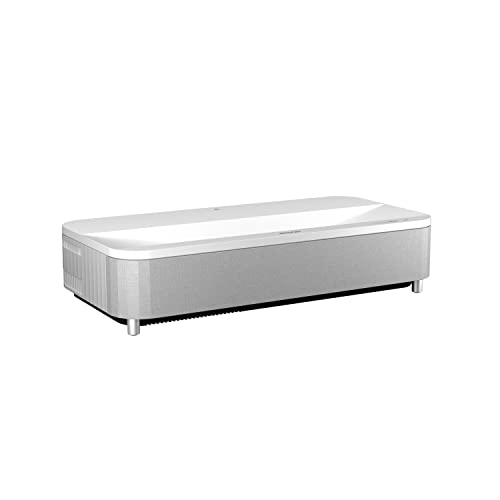
The LS800 is the bright-room argument made hardware. Its 4,000 lumens come from a three-chip 3LCD engine, which means the colour brightness equals the white brightness — the full output is available to a saturated image, not just to a white test card. Placed inches from the wall on a media console and paired with an ultra-short-throw ALR screen, it builds the most convincing daylight big-screen in this guide: the screen rejects the ceiling light, the laser delivers television-like instant-on convenience, and the image at 100 inches holds the kind of punch that makes visitors ask whether it is “one of those new huge TVs”.
The supporting cast completes the television impersonation. The Yamaha-designed 2.1-channel speakers are strong enough that a soundbar is a choice rather than a rescue, Android TV streams natively, and the laser source will hold its output across years of daily use — a property that matters doubly in bright rooms, where a fading lamp’s decline is immediately visible against the room’s constant wash. There are no rainbow artefacts and no laser speckle, so the image is calm for every viewer in the house.
Its boundaries are the familiar UST ones plus a contrast note. The console placement must be exact and the screen flat; there is no lens shift to forgive a careless setup. And in a fully darkened room its black levels, while respectable, belong to the bright-room class rather than the theatre class — the price of an engine tuned for output. In the habitat this guide is about, no pick touches it.
- Technology: 3-chip 3LCD laser, ultra-short-throw lens
- Brightness: 4,000 lumens, colour equal to white
- Sound: Yamaha 2.1-channel built-in system
- Platform: Android TV built in
- Screen pairing: UST ALR screen strongly recommended
Strengths
- The highest honest colour brightness in home projection.
- ALR pairing produces a genuinely TV-like daylight image.
- Laser stability keeps bright-room performance for years.
Trade-offs
- Dark-room contrast is bright-class, not theatre-class.
- Fixed UST geometry demands precise placement.
- Needs the ALR screen to show its best in lit rooms.
Best for: bright living rooms replacing a television with 100 inches or more.
Not suited for: dark theatres or wavy pull-down screens.

ViewSonic PX749-4K — Brightest Conventional Throw
Not every bright room can host an ultra-short-throw console setup — some have their screen wall where the furniture cannot go — and the PX749-4K is the answer for those rooms: a conventional-throw projector with a 4,000-lumen output that can sit on a shelf or mount across the room and still bully ambient light at image sizes up to genuinely large. ViewSonic built it as a gaming projector — 240Hz high-refresh support and a published 4.2ms input lag headline its other life — but its brightness is the feature this guide is buying, because in a family room the same machine that hosts the match in daylight can host the tournament after dark.
Its practical kit suits the multi-use room: optical zoom and keystone correction in both axes for imperfect mounting positions, a USB-C input alongside dual HDMI for modern laptops and sticks, and brightness modes that let you trade a little output for quieter fans during evening films. Colour is honest DLP colour — punchy and sharp, with the single-chip caveat that a minority of viewers see rainbow artefacts in high-contrast scenes, worth an audition if your household has never lived with DLP.
As a lamp-based machine it carries the lamp’s ledger: output will soften as the lamp ages, and a replacement belongs in the long-term budget — the one respect in which the laser picks out-plan it. Its built-in sound is a courtesy. But as a single purchase that gives a bright, big, conventionally installed room both daylight authority and gaming speed, it stands alone in this guide.
- Technology: single-chip DLP, lamp, pixel-shifted 4K
- Brightness: 4,000 lumens
- Gaming: 240Hz support, 4.2ms published input lag
- Inputs: dual HDMI plus USB-C
- Lens: optical zoom with two-axis keystone
Strengths
- Flagship-level brightness in a flexible conventional body.
- Gaming speed doubles its family-room value.
- Placement aids forgive real-world mounting.
Trade-offs
- Lamp output fades over time; budget a replacement.
- Rainbow artefacts possible for sensitive viewers.
- Built-in speaker is for casual use only.
Best for: bright rooms needing a shelf- or ceiling-mounted big screen.
Not suited for: buyers wanting laser permanence or UST convenience.

Hisense C2 Ultra — Best for Sport and Streaming
The C2 Ultra’s bright-room weapon is colour as much as light. Its triple-laser engine produces a gamut far beyond broadcast standards at a 3,000-lumen class output, so a sunlit football pitch does not merely stay visible — it stays green, in the specific saturated way that makes sport feel televised rather than projected. Because it is a portable gimbal design rather than a fixed installation, it also offers the bright-room tactic nobody else here can: it can move. The room’s shade migrates across the day, and the C2 Ultra can follow it from wall to wall, refocusing itself as it goes.
Its credentials for the content bright rooms actually watch are complete. Dolby Vision and IMAX Enhanced handle streamed films with per-scene intelligence; the JBL 2.1-channel sound with its built-in subwoofer gives the match and the movie real body without a soundbar; and an optical zoom — a rarity among lifestyle portables — lets it set image size by lens rather than by pixel-discarding digital shrink, preserving the sharpness that daylight already taxes. Designed-for-Xbox gaming support rides along for the household’s other daylight hobby.
In the brightest rooms it wants a screen’s help like everything else, and its portable nature means it will not match a fixed ALR installation for pure daylight defiance — the LS800 owns that title. Its black levels in darkness are strong for its class without troubling theatre machines. As the bright-room pick for households that stream, sport and move around, it is the most versatile machine in this guide.
- Technology: triple-laser DLP on a gimbal, pixel-shifted 4K
- Brightness: 3,000 lumens class
- HDR: Dolby Vision and IMAX Enhanced
- Sound: JBL 2.1-channel with built-in subwoofer
- Lens: optical zoom, image sizes from TV-scale to 300 inches
Strengths
- Triple-laser colour keeps sport saturated in lit rooms.
- Portable gimbal can chase the shade around the house.
- Sound and streaming need no accessories.
Trade-offs
- A fixed ALR installation still wins pure daylight battles.
- Laser speckle possible on some screen surfaces.
- Portability is wasted in a permanent mount.
Best for: streaming and sport households in bright, multi-use spaces.
Not suited for: fixed theatre installations.

BenQ TK850i — Best Broadcast Colour
The TK850i makes the subtlest argument in this guide: that in a bright room, correct colour at 3,000 lumens beats exaggerated colour at more. BenQ tuned this true-4K DLP machine for Rec.709 accuracy — the standard broadcasts and most streamed content are made to — so skin tones, grass and studio sets look like themselves rather than like a showroom. In a lit room, where ambient wash already distorts the picture, starting from accuracy is not purism; it is how the image survives with its dignity intact.
Its living-room credentials are complete in the traditional format. Android TV is integrated for one-remote streaming, a modest lens shift and useful zoom ease the ceiling or shelf installation, and the brightness is honestly sufficient for dimmed-to-moderate light at sensible screen sizes — this is the pick for the room with curtains and lamps rather than the glass-walled sunroom, and within that large territory it is superb. Sport modes and motion handling flatter the broadcasts that dominate bright-room viewing.
The ledger is the lamp’s and the single-chip’s: output softens as the lamp ages, a replacement belongs in the budget, and rainbow-sensitive viewers should audition before committing. Its contrast in darkness is good rather than theatrical. Judged as what it is — the accurate, friendly, broadcast-first bright-room projector — it has the fewest apologies to make in this guide.
- Technology: single-chip DLP, lamp, true 4K pixel shifting
- Brightness: 3,000 lumens
- Colour: tuned for Rec.709 broadcast accuracy
- Streaming: Android TV integrated
- Lens: zoom with modest vertical shift
Strengths
- Accurate colour that ambient light cannot easily corrupt.
- Complete streaming and friendly installation.
- Excellent for sport and everyday television.
Trade-offs
- Lamp ageing matters in a brightness-critical role.
- Not the pick for sun-flooded rooms.
- Rainbow artefacts possible for a minority.
Best for: curtained living rooms where television and sport dominate.
Not suited for: glass-walled rooms or laser-permanence seekers.

XGIMI Horizon Ultra — Best for Dim-Not-Dark Rooms
There is a class of room this guide must serve honestly: the room that dims to a warm glow in the evening — lamps low, curtains drawn against the street, but never a cave. The Horizon Ultra is its champion. Its rated 2,300 ISO lumens are measured by a standard that understates rather than inflates, and its dual-light engine — laser and LED together — produces wide, calm colour without the speckle conversation. In a dim-not-dark room that output is not a limitation but a match, and what the XGIMI adds on top is the finest streamed-HDR processing in this guide.
Dolby Vision is its headline for a reason. Streamed films arrive with scene-by-scene tone instructions, and a projector working in ambient glow needs those instructions more than most — they preserve the shape of dark scenes that a static tone curve flattens. The Harman Kardon speakers give the evening body, the fully automatic setup squares and focuses the picture while you sit down, and the fabric-wrapped cabinet is the only pick here that improves the room when it is switched off.
Its boundary is brightness headroom: in a genuinely bright midday room it will lose the fight the LS800 and PX749-4K were built for, and its auto-setup prefers a clear wall to work against. Buy it for the room it describes — the evening room, the streaming household, the design-conscious living space — and it is not the compromise pick in this guide but the connoisseur’s one.
- Technology: DLP with dual laser-LED light, pixel-shifted 4K
- Brightness: 2,300 ISO lumens, honestly measured
- HDR: Dolby Vision with HDR10 and HLG
- Sound: twin Harman Kardon speakers
- Setup: fully automatic focus and alignment
Strengths
- Dolby Vision protects dark scenes in ambient glow.
- Wide, speckle-free colour from the dual-light engine.
- Design and sound complete the living-room brief.
Trade-offs
- Brightness headroom is for dim rooms, not daylight.
- No manual lens shift; automation aims it.
- Auto setup wants an unobstructed wall.
Best for: evening streaming rooms that dim rather than darken.
Not suited for: midday-bright or sun-facing screens.
Optoma UHZ36 — Best Laser Value in Bright Rooms
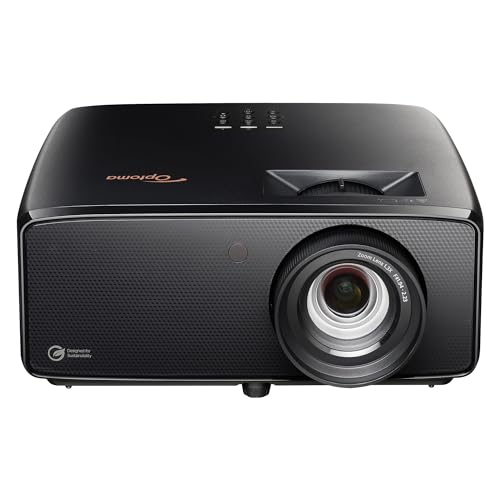
The UHZ36 is the pragmatist’s laser: a compact 4K DLP machine that puts its money into the light source and the brightness a living room needs, and declines the lifestyle ornamentation. Its laser engine delivers the two properties bright rooms value most after raw output — instant full brightness every time you switch on, and output that does not slide away as the years pass — in a body small enough for a shelf or an unobtrusive ceiling mount in rooms where a flagship cabinet would dominate.
That compactness serves real homes. The UHZ36 suits the media wall in an open-plan space, the family room where the projector shares duty with everything, and the buyer who wants laser permanence without paying the lifestyle tax for gimbals and designer fabric. HDR support covers the streamed and broadcast bases, and Optoma’s DLP sharpness keeps text, scores and fine detail legible — an underrated bright-room virtue, since ambient light already softens everything it touches.
The economies show where economies usually do: streaming is a stick’s job rather than a native platform’s, the built-in sound is a starting point rather than a system, and its contrast in darkness is living-room class. None of that argues against it in the rooms this guide addresses. As the straightforward route to a bright, stable, laser-lit big screen, it is the value anchor of the six.
- Technology: single-chip DLP, laser light source, pixel-shifted 4K
- Brightness: high-output class for living-room screens
- Form: compact body for shelf or ceiling
- HDR: HDR support for streamed and broadcast content
- Ownership: no lamp, stable output over laser life
Strengths
- Laser brightness stability at a value position.
- Compact, installation-friendly format.
- Sharp DLP detail survives ambient softening.
Trade-offs
- No meaningful built-in streaming platform.
- Sound needs a soundbar for films.
- Dark-room contrast is living-room class.
Best for: buyers wanting laser permanence and brightness without lifestyle pricing.
Not suited for: all-in-one seekers who refuse a streaming stick.
How Do the Six Fight Light Differently?
| Pick | Output strategy | Throw | Best screen partner | Room it wins |
|---|---|---|---|---|
| Epson LS800 | 4,000 colour-equal lumens | Ultra short | UST ALR | Bright living room |
| ViewSonic PX749-4K | 4,000-lumen lamp punch | Conventional | High-gain or grey | Bright family room |
| Hisense C2 Ultra | Triple-laser colour at 3,000 class | Portable gimbal | Matte or portable ALR | Multi-use bright space |
| BenQ TK850i | Accurate 3,000 lumens | Conventional | Matte white or grey | Curtained living room |
| XGIMI Horizon Ultra | Dolby Vision tone intelligence | Conventional | Matte white | Dim-not-dark evening room |
| Optoma UHZ36 | Stable laser output | Conventional | Grey or high-gain | Open-plan media wall |
Three strategies are visible in the table: overwhelm the room with honest lumens (Epson, ViewSonic), out-colour it (Hisense, BenQ), or out-think it with tone mapping (XGIMI), while the Optoma wins on endurance. The right strategy is the one matched to your light — which is why the next section is a room audit rather than a product ranking.
How Bright Is Your Room, Honestly?
Audit the room at the hours you will actually watch. Stand where the screen will go at midday, at dusk and at nine in the evening, and look at the wall: if you can read a newspaper by the light falling on it at viewing time, you are in the negotiation zone where ALR screens and the brighter picks earn their money. If direct sun patches cross the wall during your viewing hours, no pick in this guide — or any guide — will save the picture; move the screen to another wall or treat the window, because that single architectural act outperforms a thousand extra lumens.
Then audit the content against the light. Daytime sport, news, cartoons and cooking shows are bright-content genres that every pick here shows beautifully even in honest daylight. Evening films in a lamp-lit room are the middle case the whole guide is calibrated for. Dark prestige drama at noon is the extreme case: if that is genuinely your household’s pattern, the answer is blackout treatment for one window, not a brighter projector, and the money saved on lumens will buy excellent curtains.
Finally, audit the screen size against the light. In a bright room, a 100-inch image from these machines will look punchier than a 140-inch image from the same machines, every time, because brightness is divided by area. Choose the smaller, vivid picture; the room will feel more cinematic, not less, because cinema is contrast and saturation before it is acreage.
Write the audit down. A single page — the room’s light at three hours, the windows that strike the screen wall, the content the household actually watches and when — is the most useful document in the entire purchase, because it converts arguments about lumens into decisions about your own home. Buyers who skip it shop for a projector; buyers who write it shop for a system, and the difference shows on the wall every day for years. Bring the page to every decision that follows in this guide: pick, screen, size and placement all read differently once the room has been described honestly on paper.
How Do You Set Up a Bright-Room Projector System?
Start with the screen, because in a bright room it does half the work. UST owners should choose a lenticular ALR screen sized to the console geometry; conventional-throw owners in lit rooms should consider a grey or ALR surface rated for their throw distance, accepting the small brightness cost in exchange for a black floor the room cannot wash out. Position the screen on the wall that receives the least direct light — not the wall that faces the window, but the one beside or behind it — and treat any window that strikes the screen as a problem to be solved with blinds before it is solved with lumens.
Set the projector’s picture mode for the room, not for the brochure. The brighter modes exist for daytime and should be used then without guilt; the cinema modes earn their place after dark, and several of these machines let you store both as presets for the two lives your room leads. Resist the dynamic-contrast and over-sharpening temptations that bright-room anxiety suggests — they manufacture a harshness that reads as cheap within a week. A slightly smaller image, honestly set up, beats a huge one straining at its settings.
Finish with the light you control. Bias lighting behind the screen, lamps placed so they never strike the surface, and a dimmer on the ceiling light transform the perceived contrast of any of these machines more than a model upgrade would. Bright-room projection is a system discipline, and the owners who master it stop talking about lumens entirely.
What Mistakes Do Bright-Room Buyers Keep Making?
The first is believing the biggest lumen number on the box, without asking whether it describes colour or only white, and without discounting a lamp’s decline across its life. The second is buying the projector and postponing the screen, then judging the machine on a white wall in a lit room — the one configuration guaranteed to slander it. The third is size greed: stretching to 150 inches in a bright room and dividing the picture into pallor.
Fourth, buyers aim the screen at the window wall for layout convenience and spend years fighting geometry that a different wall would have forgiven. Fifth, they run every hour in the brightest, loudest mode, wearing lamps and patience alike, when daytime sport and evening film deserve different presets. And sixth — the quietest mistake — they never dim the one light that matters: the ceiling fixture reflecting in the screen’s upper third, whose relocation or dimming is worth a model tier.
Grey, High-Gain or ALR — Which Screen Surface Fights Your Light?
Three screen families serve bright rooms, and they fight light by different mechanisms. A grey screen absorbs a portion of all light — the projector’s and the room’s alike — which deepens the perceived black floor because your eye judges contrast relatively; the projector repays the absorption with brightness, which is why grey screens pair naturally with the high-output picks here. They are inexpensive, forgiving of viewing angle, and the classic bright-room compromise for conventional throw distances.
A high-gain screen reflects more of the projector’s light toward the seating and less toward the walls, effectively multiplying output within its viewing cone. It suits a bright room with a defined sofa position and a conventional projector that needs help, at the cost of hotspotting risk and dimmer extreme seats. An ALR screen goes further: its structured surface is directional by design, accepting the projector’s angle and rejecting others, which is why it is the only surface that truly changes the bright-room equation rather than merely improving its terms — at the highest cost of the three, and with throw-distance variants that must match your machine’s geometry.
The decision tree is short. UST owners buy the UST ALR and stop deliberating. Conventional-throw owners with a fixed sofa and a dimmable room can start with grey and be happy for years. Conventional owners fighting real daylight should save toward the ALR made for their throw distance, because no projector upgrade in this guide returns as much daylight picture as that surface does. Renters who cannot mount a screen should choose the matte wall with the least light falling on it and weight the brightest picks — the Epson and ViewSonic — accordingly.
What Is the Daytime Sport Playbook?
Since sport is the bright room’s flagship content, it deserves a protocol. Set the projector to its bright, accurate mode — the BenQ’s broadcast tuning is the template — and let the screen size sit at the conservative end of your range, because a match is watched socially and the far seats matter. Close the curtains that can be closed without turning the gathering into a séance; the goal is not darkness but the removal of direct strikes on the screen. If your machine has a sport or motion mode that suits broadcast frame rates, use it for the match and retire it for the film, because processing that flatters a fast pan can make cinema look like a soap opera.
Sound carries a daytime crowd differently from a midnight film. Commentary clarity is the whole game, so centre the audio — the LS800’s and C2 Ultra’s built-in systems do this natively — and resist volume wars with the room; a slightly raised dialogue level beats a uniformly loud one. Households that host big matches regularly should consider the projector’s fan noise at full brightness a selection criterion, because a machine shouting over its own fans during a tense final is a machine the room will argue with. The ViewSonic and the lasers at their efficient settings acquit themselves well here; it is the final practical reason the bright-room crown belongs to machines designed for output rather than adapted to it.
How Does Brightness Age — Lamp Fade Versus Laser Steadiness?
A bright room is an unforgiving auditor of light-source ageing, because the room’s wash is constant and the projector’s decline shows against it month by month. A lamp’s output falls measurably across its life — gently at first, then with conviction — so the machine that conquered your living room in January is negotiating with it by the following year, and the owner’s choices narrow to accepting the fade, running the lamp harder and louder, or buying the replacement early. None of this makes lamp projectors bad purchases; the TK850i and PX749-4K earn their places here on merit. It makes their brightness a depreciating asset that the purchase decision should price honestly.
Lasers depreciate so slowly that the room will be redecorated first. Their output curve across a realistic decade of evenings is close to flat, which is why the laser picks dominate a guide about sustained fights with ambient light: the system you calibrate in the first month — projector, screen, curtains, presets — is the system you still own in year five. For households that will use the machine daily in a lit room, that steadiness is not a luxury feature; it is the difference between a bright-room solution and a bright-room honeymoon.
The middle path is behavioural. Lamp owners who reserve full-power mode for genuine daylight and run eco presets for evening viewing stretch both the lamp and its brightness plateau considerably. The menus make it easy; the discipline is remembering that brightness spent on a dim room at night is brightness unavailable to the match next summer.
What About Open-Plan Rooms and Kitchen Light?
The open-plan living space is the bright room’s hardest common variant, because its light is not weather but life: the kitchen’s downlights, the dining pendants, the hallway spill — all burning while the screen is asked to perform. The countermeasures are zoning rather than darkness. Put the screen wall in the plan’s dimmest zone, give that zone its own lighting circuit or smart bulbs so it can drop to a glow while the kitchen stays lit, and choose a screen surface — ALR for the UST, grey or ALR for conventional throw — that treats the remaining spill as the enemy it is. Households that zone their light discover that “bright room” was really two rooms sharing a ceiling, and only one of them needed to win.
Open-plan also changes the sound and size calculus. Sound disperses into the larger volume, which promotes the picks with serious built-in audio or a planned soundbar, and viewing distances stretch, which tempts larger screens that the light then taxes. The discipline from earlier sections applies with interest: the vivid 110 inches in the dimmed zone will be loved; the washed 150 inches spanning the whole plan will be apologised for. Designers of open-plan homes draw the cinema into the plan as a place, and the projector system should be bought the same way.
Why Do Casual, Everyday Hours Decide Bright-Room Satisfaction?
Reviewers test projectors with films; owners live with them through breakfast news, children’s cartoons at teatime, a cookery show while dinner is made and a documentary half-watched from the sofa’s far end. Those hours are all bright-room hours, and they are where satisfaction is actually accumulated. A machine that is magnificent for the Saturday film but washed and weary for the week’s casual hundred hours will be remembered as a disappointment, while a machine that is merely very good at everything — the profile of the LS800, the C2 Ultra and the PX749-4K in their different geometries — becomes part of the house’s furniture of contentment.
This is also where instant-on lasers quietly defeat lamps in the owner’s affections. Casual viewing is spontaneous and short; a light source that is at full brightness in seconds and asks for no cool-down ritual gets used for the twenty-minute show, while a lamp owner rationing hours and warm-ups lets the moment pass to a tablet. Multiply that decision by a year of evenings and the bright-room laser has delivered hundreds of big-screen hours its lamp rival never showed. When this guide weights laser steadiness and television manners so heavily, it is pricing those hours — the unglamorous majority of a projector’s life.
What Does a Realistic Bright-Room Budget Look Like?
Divide the money in the order the room will reward it. The projector takes the largest share, but the screen’s share should be protected with unusual stubbornness — in a lit room the screen contributes a larger fraction of the final picture than it ever does in a theatre, and starving it to afford a brighter projector is the classic false economy of this category. After the screen comes light control: blinds, a dimmer, a relocated lamp, each returning contrast that no specification can. Sound follows, sized to the room’s openness. Cables, mounts and a streaming stick are rounding errors that owners nevertheless manage to get wrong by buying them last and cheap; a full-bandwidth cable belongs in the first order, not in the troubleshooting phase.
The shape of the total matters more than its size. A mid-priced pick here on a proper ALR screen with one window treated will outperform a flagship on a bare wall in the same room, at similar money, by a margin that surprises everyone who has not seen the comparison. Bright-room projection is the one corner of home cinema where the system genuinely outranks the component — which is liberating news for budgets, because systems can be built in stages: projector and screen first, light treatment next, sound when the room asks for it. Each stage visibly pays for itself, and none of them is wasted when the next arrives.
Stage the purchases in that order and resist the showroom’s gravitational pull toward the single expensive box. The room does not care what you spent; it cares what arrives at the screen, and the staged system delivers more of it per unit of money than any solitary flagship.
The staged purchases also protect against the category’s one genuine regret pattern: the owner who bought the brightest projector available, placed it before an untreated window wall on a bare white surface, and concluded that bright-room projection does not work. It works — demonstrably, in thousands of living rooms — when the light is treated as a system. The projector is the engine of that system, never the whole of it, and the six engines above are the ones worth building around.
How Should You Test a Bright-Room Setup in Its First Week?
Test it at the hours of maximum honesty. Run the machine at midday with the room in its normal state — not prepared, not darkened for the occasion — and put on the content the household actually watches at that hour. A projector that delights under demonstration conditions and merely survives real ones has been tested wrongly; the bright-room purchase is justified or condemned at one in the afternoon with the kitchen lit, so that is where the verdict should be gathered while returns are still easy.
Use three scenes as instruments. A football or tennis broadcast tests colour brightness and motion under wash — grass should stay a colour, not a tint. A dialogue scene in a dim interior tests the black floor: faces should model properly, not float in grey. A bright animated film tests saturation headroom, the quality children will judge the machine by daily. Photograph the screen from the main seat during each — the camera exaggerates, but consistently, and the photographs let you compare before and after any adjustment: a curtain added, a screen gain changed, a preset altered. Bright-room tuning is iterative, and the owners who treat the first week as calibration rather than verdict end with systems that look inevitable.
Then make the two presets and label them honestly: Day and Evening, with the fan and brightness behaviours each implies, so the household stops negotiating settings per session. The machine that asks for a menu expedition every time the light changes will be used less; the machine with two buttons’ worth of personality will be used daily. That, in the end, is the bright-room metric no laboratory measures and every owner feels.
Final Recommendation
For most bright living rooms the Epson LS800 on an ALR screen is the complete answer — the brightest honest colour in the category, television manners and laser permanence in one console-width package. Rooms that need conventional throw should take the ViewSonic PX749-4K for daylight authority, or the Optoma UHZ36 for the same fight with laser endurance at a value position. Broadcast-first households will love the BenQ TK850i’s accuracy; households whose rooms dim to a glow should take the XGIMI Horizon Ultra and its Dolby Vision; and anyone whose bright room changes shape across the day should let the Hisense C2 Ultra chase the shade. The bright room is not a projector’s enemy — it is a specification. Meet it with lumens that describe colour, a screen that rejects the room, and expectations set by physics, and a hundred inches of daylight cinema is a perfectly reasonable thing to own.
Do the room audit before the order, protect the screen’s share of the budget while you place it, and judge the result at one in the afternoon rather than at the premiere. A bright-room system chosen that way stops being a compromise people explain to guests and becomes the screen the whole house simply uses.
Frequently Asked Questions
Can any projector work in direct sunlight?
No — direct sun on the screen deposits more light than any home projector produces, and the image loses regardless of budget. Shade the window, move the screen, or shift viewing hours. Every other level of ambient light, from lamps to bright overcast, is negotiable with the picks and screens in this guide.
What is an ALR screen and do I need one?
An ambient-light-rejecting screen uses a structured surface to reflect the projector’s light toward the viewers while rejecting light arriving from other angles — ceilings and windows. In a lit room it is the largest single image-quality upgrade available, and for ultra-short-throw models the lenticular UST variant is effectively part of the product. Buyers on a staged budget can start without one in a dimmable room, but should know the screen is where the system is heading.
Why do some 3,000-lumen projectors look brighter than 4,000-lumen ones?
Because the figures are not always measuring the same thing. Colour brightness — the output available to a saturated image — is what your eyes judge on real content, and a machine whose colour output matches its white figure will out-punch a rival whose headline number describes white only. Measurement standards differ too; treat all lumens as claims to be interpreted by technology, not compared as raw scores.
Is laser really better than lamp for a bright room?
For this habitat, generally yes. A laser holds its brightness across years, reaches full output instantly, and never asks the owner to choose between a dimming lamp and a replacement bill — a real consideration when the room’s light makes every lost lumen visible. Lamp models remain competitive on purchase price and, in the BenQ’s case, on colour quality.
What screen size should I choose for a bright room?
Smaller than your instinct. Brightness divides by screen area, so in a lit room a vivid 100-inch image beats a washed 140-inch one. Let the seating distance suggest the size, then let the room’s light veto any excess — most bright living rooms land happily between 100 and 120 inches.
Will a bright-room projector still look good at night?
Yes — switch to its cinema preset and it becomes a perfectly enjoyable evening machine. The brighter picks will not match a dedicated theatre projector’s black depth in total darkness, but in the lamp-lit conditions most households actually use at night, they are frequently the better-balanced choice.
Are grey walls better than white walls for bright-room projection?
For the room’s other surfaces, yes, modestly: mid-tone walls and ceilings bounce less stray light back onto the screen than brilliant white ones, deepening the picture’s floor without any equipment change. It is the cheapest contrast upgrade in existence where redecoration is already planned — though it ranks behind the screen and the window treatment in impact, and no paint rescues a screen that sunlight strikes directly.
How much fan noise should I expect at full brightness?
Full-output modes are the loudest a projector gets, and in a quiet room at midday that can be noticeable from nearby seats. The laser picks are generally the more civilised at sustained high output, and placing the machine farther from the main seat — a quiet advantage of conventional throw — helps more than any setting. For evening viewing, the eco and cinema presets reduce both output and noise together. If noise is a deciding factor for your household, note where each machine’s vents face in its product photographs and plan the seating so nobody sits in the exhaust path on a summer afternoon.
Should I choose a bigger screen or a brighter projector?
In a bright room, brightness first — then the largest screen that brightness can honestly feed. A vivid image at 100 inches feels cinematic; a pale one at 140 feels like a mistake at any price. If your heart is set on a very large image, the correct purchase is the ALR screen plus the brightest pick, in that order of priority.
Do bright-room projectors work for outdoor evening use?
Several of these machines travel well — the portable Hisense most obviously — and dusk outdoors is effectively a bright-room problem that solves itself as the light falls. Expect the first hour after sunset to be a negotiation and full darkness to be a delight. A portable screen and a battery-aware plan complete the setup; midday outdoor projection remains beyond any machine here.
Related Guides
If your bright room is also a console setup, our guide to 4K laser projectors with short throw covers the UST field in depth. For the general field beyond the brightness brief, see our roundup of the best 4K home projectors, and for rooms where gaming shares the screen, our low-input-lag 4K projector guide picks the responsive specialists.


