Our Top Picks
What's inside
- Readable Dials: Contrast, Numerals, and Hands That Stand Apart
- Talking Watches for Wearers With Low Vision
- Straps and Clasps That Arthritic Hands Can Manage
- Lightweight Cases and All-Day Comfort
- Simple Crowns and Controls That Respect Stiff Fingers
- Analogue Versus Digital: An Honest Comparison for Ageing Eyes
- Vibration Alarms and Reminders That Do Not Shout
- Water Resistance for Real Daily Life
- Strap Materials and Sensitive or Thinning Skin
- Buying a Watch as a Gift for a Parent
- When a Simple Smartwatch Is the Better Answer
- Care, Batteries, and Keeping the Watch in Service
- Check prices on Amazon
- A Closing Checklist for Matching Watch to Wearer
As an Amazon Associate I earn from qualifying purchases. This post may contain affiliate links at no extra cost to you.
Some purchases deserve a calmer introduction than others, and a watch chosen for ageing eyes and hands is one of them. As an Amazon Associate we earn from qualifying purchases. Everything that follows is grounded in manufacturer specifications, published dimensions and materials, and long-standing guidance on low-vision readability and arthritic-friendly design. No single model suits every older adult, because the category spans traditional analogue dials, clear digital displays, talking watches that announce the hour aloud, and simplified smartwatches, each solving a different mixture of problems.
The best watches for older adults share one quality that marketing photographs rarely capture: they reduce effort. Reading the time should take a glance, not a squint. Fastening the strap should take seconds, not a struggle over a kitchen counter. Adjusting the time after a battery change should not require a magnifying glass, a grandchild, and a YouTube tutorial filmed in another language. This guide works through those everyday tests in detail — dials, voices, clasps, weight, crowns, displays, alarms, water, and skin — so a buyer can match a watch to the person who will actually live with it.
Readable Dials: Contrast, Numerals, and Hands That Stand Apart
Legibility begins with contrast. Black numerals on a clean white or cream dial remain the benchmark for most ageing eyes, because the luminance difference between figure and ground is what the visual system detects first. Silver hands on a silver dial may look elegant in a catalogue and vanish completely under kitchen lighting. Gold-tone hands over a champagne face cause the same problem at a softer level. When comparing dials, hold the product photographs to a simple standard: could the hour be told from arm’s length, in dim light, without reading glasses?
Numeral size and completeness matter almost as much. A dial carrying all twelve Arabic numerals gives the reader fixed landmarks, while minimalist markers force estimation that grows harder as vision declines. Partial-numeral designs that show only a few numbers and fill the rest with batons are a common compromise, acceptable for many wearers but weaker for anyone with macular degeneration or cataracts. Bold, unadorned typefaces outperform decorative fonts with thin strokes and curled terminals, which blur at small sizes and low light.
Luminous material on hands and hour markers extends readability into the evening. Older luminous compounds needed light exposure to charge and faded within hours; modern phosphorescent pigments hold a glow far longer after ordinary indoor light. The practical test is a bedside one: after an evening in a normally lit room, can the wearer read the watch during a night-time trip to the bathroom? Hands should also differ clearly in length and width, since confusing the hour and minute hands is a frequent and quietly frustrating error that good dial design prevents entirely.
Domed and highly reflective crystals undermine even excellent dials by throwing glare across the numerals at common reading angles. A flat or gently curved crystal with a matte dial finish is usually kinder. Case diameter interacts with readability too: a larger dial spreads numerals further apart, yet an oversized case can overwhelm a slim wrist and catch on sleeves and door frames. Many older adults settle happily in a middle range that feels substantial without looking or feeling cumbersome, and trying sizes against the wrist, even approximately with a paper template, prevents disappointment.
Day and Date Displays: Helpful or Just Smaller Text?
Calendar complications promise convenience and often deliver the smallest print on the entire dial. A day-date window that the wearer cannot actually read adds cost and visual clutter without benefit. Where calendar information matters, look for the largest apertures available, high-contrast printing on the date wheel, and abbreviations the wearer finds intuitive. Some digital models handle this far better, presenting the weekday in full letters across a wide screen, which is one reason the analogue-versus-digital decision later in this guide deserves genuine thought rather than habit.
Magnification cyclops lenses over date windows divide opinion. They can help one wearer and distort the view for another depending on eye condition and reading angle. If the intended wearer uses progressive lenses, remember that the watch is read through whichever zone of their spectacles aligns at wrist distance, and that interaction is individual. Whenever possible, let the wearer judge photographs or, better, the physical watch, rather than assuming a feature labelled as an aid will function as one for their particular eyes.
Talking Watches for Wearers With Low Vision
A talking watch announces the time at the press of a button, and for someone whose sight no longer resolves any dial, that single function restores a piece of independence that is easy to underestimate. Better models speak in a clear, unhurried voice, state the time in a natural order, and offer volume control or a choice of voice. Some also announce the date, provide spoken alarms, and include an hourly chime that can be switched off at night. The button should be large, distinct by touch, and resistant to accidental presses inside a pocket or bag.
Voice quality varies more than specification sheets admit. A thin, fast, heavily synthesised voice may be unintelligible to a wearer who also has hearing loss, which frequently accompanies vision loss in later life. Where a retailer provides an audio sample, listen to it at realistic volume in a noisy room. Where no sample exists, prioritise models whose makers describe the voice and return policy clearly. A talking watch bought for a parent should be demonstrated patiently, with the wearer practising the button by touch until the action is automatic.
Talking watches also serve people whose vision fluctuates: after eye surgery, during treatment that temporarily blurs sight, or in the early morning before glasses are found. They are equally useful for wearers who simply prefer confirmation, checking a glance against a spoken announcement. Battery changes on talking models deserve attention because the speech module draws more power than a plain movement, and a silent watch that was relied upon for announcements is worse than a plain dial. Spare batteries and a note of the correct cell type, kept with the watch box, solve that problem cheaply.
Privacy is the one honest drawback. A spoken announcement in a quiet waiting room tells everyone the time and, occasionally, the wearer’s alarm messages. Models with adjustable volume and a discreet button placement reduce the embarrassment, and some wearers use the feature mainly at home while relying on a high-contrast dial outdoors. That hybrid pattern is worth considering deliberately: choose a talking model whose dial is also genuinely readable, rather than treating the voice as compensation for a poor display.
Straps and Clasps That Arthritic Hands Can Manage
An expansion band — the stretch design that slips over the hand and settles on the wrist without any clasp at all — remains the kindest fastening for many arthritic hands. There is nothing to align, pinch, thread, or press. The wearer slides the watch on in one motion and removes it the same way. Quality varies in the tension of the links and the smoothness of their edges, and a band that is too tight restricts circulation while one that has lost its spring lets the watch rotate around the wrist, so correct sizing at purchase and periodic checks both matter.
For wearers who prefer a conventional strap, the clasp style decides daily difficulty. A simple buckle demands threading a pin through a small hole with two cooperating hands, a genuinely hard task for stiff or painful fingers. Hook-and-loop fabric straps are far more forgiving: they fasten with a broad press, adjust infinitely rather than in fixed holes, and can be operated with limited grip. Magnetic clasps that find their own alignment are another strong option, provided the magnet is strong enough to survive sleeves and bedding tugging at it.
Deployant and butterfly clasps look refined and keep the strap in a loop, which prevents drops, yet their small release buttons can defeat weak thumbs. Leather straps soften beautifully and suit formal wear, but their holes stretch and their buckles stay fiddly. Silicone straps with large, widely spaced holes and an oversized buckle frame are a pragmatic middle ground for active wearers. Whatever style is chosen, watch a demonstration of the exact fastening with the wearer’s limitations in mind, or better, let the wearer attempt it before the returns window closes.
Strap width and lug design influence comfort more than most buyers expect. A wide strap distributes pressure and stops the case rotating; a narrow one can dig in on a bony wrist. Quick-release spring bars, now common, let family members swap straps without tools when a material irritates skin or a clasp proves troublesome. That small feature extends the useful life of the whole watch, because the usual response to an unwearable strap is not a replacement strap — it is a watch abandoned in a drawer.
Sizing an Expansion Band Without Guesswork
Measure the wrist snugly with a soft tape at the point where the watch will sit, then follow the maker’s sizing chart rather than adding arbitrary slack, because expansion bands are designed to grip gently by design. Between sizes, the larger is usually safer for wearers whose wrists swell during the day, a common pattern with certain medicines and with heat. Links on many metal expansion bands can be removed by a jeweller for a precise fit, a small service worth using instead of accepting a band that slides toward the hand and twists the dial out of its natural reading position.
Lightweight Cases and All-Day Comfort
Weight accumulates quietly. A heavy steel case that feels reassuringly solid in a shop becomes a burden by mid-afternoon on a thin wrist with little muscle padding, and it slides more insistently toward the hand with every movement. Resin, aluminium, titanium, and slim steel cases all reduce that load, with titanium offering an especially useful combination of lightness, strength, and skin friendliness. Published case weights, where makers provide them, are worth comparing directly; where they do not, case diameter and thickness give a rough proxy, since material and dimensions drive most of the total.
Thickness matters alongside weight because a tall case catches on cuffs, cardigan sleeves, and the edges of furniture, and it wobbles on the wrist in a way that thinner designs do not. For a wearer who dresses independently and values neat cuffs, a slim profile is a functional feature rather than an aesthetic one. Case-back design plays a part too: a smooth, slightly domed back sits comfortably, while sharp engraving or a protruding battery hatch can press into the wrist bone during a long day.
Comfort also has a psychological side. A watch that looks like medical equipment will be resisted by many proud, independent older people, however sensible its specifications. Mainstream designs in familiar styles — a classic round dial, a modest bracelet, a leather strap in a normal colour — pass unnoticed as ordinary jewellery or everyday objects. That ordinariness is protective: the watch gets worn to church, to lunch, and to the shops, instead of being saved for occasions or rejected as a symbol of decline.
Simple Crowns and Controls That Respect Stiff Fingers
The crown — the small knob that sets the time — is a notorious test of dexterity. Tiny, smooth crowns demand a precise pinch-and-turn that arthritic fingers, tremor, or neuropathy can make miserable. Larger crowns with deep knurling or fluting give the fingertips purchase, and a crown that pulls out with a definite, easy motion beats one requiring fingernails and force. On a quartz watch the crown is used rarely, mainly after battery changes and clock changes, which is itself an argument for quartz: an automatic or manual-wind watch asks far more of its owner’s hands.
Digital watches replace the crown problem with a button problem. Raised buttons with clear labels and a firm, deliberate press are manageable; flush membrane buttons that need a fingernail are not. Setting an alarm or adjusting for daylight saving should be testable from the manual before purchase, and the number of modes a wearer must cycle through matters. A watch with four modes and large digits is kinder than a feature-packed model whose manual runs to forty pages of combinations nobody in the household will remember by spring.
Clock changes deserve a mention because they embarrass many families twice a year. A radio-controlled or otherwise self-adjusting watch removes that chore entirely, syncing to a time signal overnight, and several talking and digital models include the capability. Where that is unavailable, choose a watch a family member can adjust in seconds during a visit. The deeper principle is consistent across this guide: every recurring interaction with the watch — fastening, reading, setting, charging, cleaning — should be audited against the wearer’s real abilities, not the abilities of the person buying it.
Analogue Versus Digital: An Honest Comparison for Ageing Eyes
Analogue dials offer an instant spatial sense of time — half past, nearly twelve — that many lifelong watch wearers read faster than numbers, and their hands remain visible in a single glance without waking a screen. They ask more interpretation, though, and at small sizes their precision blurs. Digital displays remove interpretation entirely, presenting the exact time in digits that can be made very large, along with seconds, date, and alarms in plain text. For a wearer with cognitive changes who benefits from unambiguous information, that literalness is a genuine advantage.
Digital watches built for older adults differ sharply from sports models crowded with tiny fields. The ones worth shortlisting devote most of the display to the time, use thick digit segments, and keep secondary information sparse. Backlights help at night, provided the button that triggers them is findable by touch. Battery life on plain digital models is often measured in years rather than days, eliminating charging routines altogether, which for some households outweighs every smart feature discussed anywhere in this guide.
Hybrid approaches exist as well: analogue hands over a digital window, or a smartwatch face designed to imitate a clean analogue dial while offering digital clarity on demand. Families shopping across categories may also be equipping the same parent with other technology, and our companion guides to best and easiest smartphones for seniors and similar essentials can help keep the whole set consistent in simplicity. Consistency matters, because a parent who masters one clear interface should not face a completely different logic on every device they own.
The wearer’s own history should break any tie. Someone who has worn analogue watches for sixty years reads hands fluently and may find digits oddly effortful, while a retired engineer who wore digital watches through the nineteen-eighties feels the reverse. Preference is not stubbornness; it is trained fluency, and a gift that honours it will be worn with pleasure instead of politeness. When in doubt, ask, or present two finalists and let the wearer choose, because the choosing itself increases the chance the watch becomes theirs in spirit as well as on paper.
Vibration Alarms and Reminders That Do Not Shout
A vibrating alarm respects both the wearer and everyone around them. It wakes one person without startling a spouse, signals a medication time in a quiet café without broadcasting private business, and reaches wearers whose hearing no longer catches a small watch’s beep reliably. Vibration strength varies considerably between models, and a gentle buzz that a younger reviewer calls subtle may be imperceptible through reduced sensation in an older wrist. Where possible, favour models that let the wearer adjust intensity or that pair vibration with a flashing display for reinforcement.
Multiple daily alarms turn a simple watch into a quiet routine keeper: morning medication, a midday walk, an afternoon appointment, an evening dose. Labelling matters on smartwatches, where an alarm can carry a short text name; on basic digital models, the family can keep a small written card matching alarm numbers to purposes. Either way, set alarms up together, test each one while the wearer is present, and review them after any change in medication schedule, since an obsolete alarm trains the wearer to ignore all alarms.
Medication reminders carry a safety boundary that families should state clearly. A watch alarm prompts; it does not confirm that a dose was taken, and it cannot notice a double dose. Pill organisers, pharmacy blister packaging, and, where a clinician advises, monitored dispensers remain separate layers. The watch’s role is the timely nudge, delivered discreetly on the wrist wherever the wearer happens to be, which is precisely the layer that kitchen clocks and phone alarms left in another room so often fail to provide.
Readers setting up a small ecosystem of senior-friendly devices will find our guide to best android tablets for seniors relevant here, because a tablet with large text makes an excellent home base for reviewing alarms, calendars, and reminders that the watch then delivers during the day. Keeping the planning on a big, comfortable screen and the prompting on the wrist plays to the strengths of both devices, and it gives family helpers a far easier screen to work on during setup visits.
Water Resistance for Real Daily Life
An older adult’s watch meets water constantly: handwashing, washing-up, gardening, rain on the way to the shops, and the occasional forgotten removal before a shower. Basic splash resistance handles the first of those confidently and the rest nervously. A rating suitable for showering removes a daily decision and a daily risk of the watch being left on a bathroom shelf, which is where forgotten watches tend to stay. As with any watch, ratings describe laboratory resistance when new; seals age, and hot water, steam, and soap all accelerate that ageing.
Manufacturers express resistance in metres, atmospheres, or industry codes, and those figures notoriously do not mean the watch can be taken to that actual depth, since the tests are static rather than dynamic. The usable guidance is the maker’s own activity list: which models they approve for showering, bathing, or swimming. Follow that list rather than the headline number. Buttons and crowns should not be operated under water unless the maker explicitly allows it, and a watch that has fogged under its crystal needs prompt attention from a watchmaker before corrosion spreads.
Leather straps complicate the water story even when the case is well sealed. Repeated soaking stiffens and cracks leather and shortens its life dramatically, so a wearer who showers in their watch is better served by silicone, fabric, or metal. Quick-release straps make seasonal swaps simple: leather for occasions, silicone for summer and swimming. That flexibility, arranged in advance by family, spares the wearer any fiddly spring-bar work and keeps the watch continuously usable instead of waiting in a drawer for a strap change nobody can perform.
Strap Materials and Sensitive or Thinning Skin
Ageing skin is thinner, drier, and slower to heal, and the underside of a watch strap is a warm, occasionally damp environment pressed against it for twelve or more hours a day. Nickel in some metal alloys is a well-known contact allergen, and a reaction that begins as itching under a bracelet can end with the watch unworn for weeks. Titanium and certain stainless grades are marketed as hypoallergenic, as are many silicone and fabric straps; a wearer with a known nickel sensitivity should treat that label as a requirement, not a preference.
Fabric straps breathe and flex, suiting skin that dislikes occlusion, but they absorb moisture and need regular washing to stay fresh. Silicone rinses clean in seconds and tolerates sweat and rain, though worn too tightly it traps moisture against the wrist. Leather sits between the two, comfortable and breathable when dry, less happy when wet. The practical answer for many households is two straps in different materials, rotated while one is washed and fully dried, with the watch worn a notch looser than a younger wearer might choose.
Edges and hardware deserve a fingertip test. Stamped metal expansion bands can have sharp inner edges on cheaper examples; keeper loops can chafe; buckle tongues can press into the wrist when a wearer rests their arm on a table. Running a finger along every surface that touches skin, before the returns period ends, catches most of these faults. Any redness that appears in the first week should be taken seriously and discussed rather than endured, because skin breakdown on an older wrist is a medical issue, not a comfort preference.
Households comparing technology gifts across the family technology shelf may also appreciate our roundup of best affordable laptops for seniors, since the same principles — large, clear information, forgiving controls, and honest simplicity — govern good choices in both categories. A watch, a tablet, and a laptop chosen by one consistent philosophy feel like a matched set of tools rather than three separate puzzles, and that coherence quietly raises the wearer’s confidence with each of them.
Buying a Watch as a Gift for a Parent
Most watches for older adults are bought by adult children, and that asymmetry shapes everything. The buyer researches online, values features, and imagines use; the wearer lives with the result daily and may never mention that the clasp defeats them or the dial is unreadable at dusk. Building feedback into the gift solves this: present the watch as a choice to be confirmed together, keep the receipt and packaging, agree openly that swapping it is expected if it is not right, and schedule a check-in after the first week specifically to ask what annoys them about it.
Measure the wrist if at all possible, even casually with a strip of paper during a visit, because strap size is the most common reason an otherwise good gift fails on day one. Note the wearer’s current watch, if they have one: its size, strap style, and condition reveal their real preferences more truthfully than any questionnaire. A beloved but broken watch is also a hint that repair, a new battery, or a like-for-like replacement might delight them more than an unfamiliar upgrade, however well intentioned.
Presentation matters to dignity. A watch handed over with a speech about frailty will be received as a symbol, while the same watch given for a birthday with genuine admiration for its looks will be worn proudly. Set it up before wrapping where possible — correct time, alarms agreed in advance, strap sized — so the first experience is simply putting on a working watch. Include a short handwritten card noting who to call if the strap needs adjusting or the battery runs low, and the gift becomes an arrangement of support rather than a test the parent must pass alone.
When a Simple Smartwatch Is the Better Answer
For some older adults, a simplified smartwatch outperforms every traditional option in this guide. A large, bright screen can show the time in enormous digits or a clean analogue face, announce reminders with text as well as vibration, place calls to family from the wrist, share location with relatives, and detect hard falls on models that offer that feature. For a parent who already uses a smartphone comfortably and charges devices without resentment, those abilities solve several problems in one familiar object, and our guide to best affordable smartwatches is the natural next step for comparing them.
The costs of that choice are equally real. A smartwatch needs charging every day or two, updates that occasionally rearrange familiar screens, a paired phone, and tolerance for notifications that a traditional watch never produces. Touchscreens can frustrate tremor or dry fingertips, though large targets and physical buttons on some models soften that. Cognitive change is the clearest dividing line: a wearer who is beginning to forget routines will usually thrive longer with a watch that does one thing, needs no charging, and looks exactly the same every morning.
A staged approach works well for many families. Start with the simple watch that solves today’s problems — readability, fastening, comfort — and revisit the question if needs change toward communication, location sharing, or fall alerts. Technology adopted at the moment it answers a felt need is welcomed; technology imposed early, in anticipation of decline, is often resisted as a prediction. The wearer’s pace, not the buyer’s anxiety, should set the timetable, with family watching kindly for the moment a different tool would genuinely serve them better.
Care, Batteries, and Keeping the Watch in Service
Quartz watches ask little: a battery every year or few years depending on model and features, a gentle wipe of case and strap, and storage away from extreme heat. Talking and digital models with alarms and backlights consume batteries faster, so note the fitting date and keep the correct spare cell identified in advance. Battery replacement by a jeweller or watchmaker also preserves water resistance, because the case back is resealed properly; home replacement with a case knife risks both the seal and the movement for the sake of a small saving.
Solar and light-powered models remove battery changes almost entirely and suit wearers who spend time outdoors or in bright rooms, provided they are not stored in drawers where they starve. Radio-controlled models remove time setting as well. Combining the two produces a watch that asks essentially nothing of its owner beyond being worn, which for the right person is the highest form of thoughtful design available in this category at any budget.
Plan for loss and damage with the same calm practicality. Note the model and strap size somewhere family can find them, keep the spare strap and links, and photograph the watch on the wearer’s wrist for identification. Watches disappear into hospital laundry, holiday rentals, and the pockets of winter coats with impressive regularity. A household that treats replacement as a known errand rather than a crisis will restore the wearer’s routine quickly, and routine, for an older adult, is not a small thing to protect.
Check prices on Amazon
Live listings for the shortlist in this guide are pulled from Amazon below, so prices and availability are always current at the moment you look.

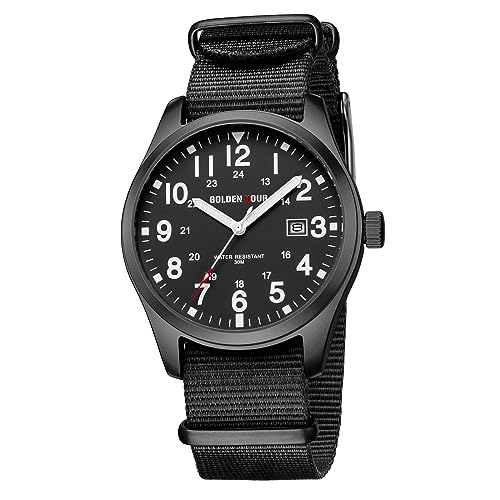
GOLDEN HOUR Men's Nylon Slip-Thru Strap Watch with Military Time Easy Read Dial Glowing Hands in Black
A Closing Checklist for Matching Watch to Wearer
Can the wearer read the time at arm’s length, in dim light, without glasses, and tell the hands or digits apart instantly? Can they fasten and remove the strap unaided, every time, including on a swollen-wrist day? Is the case light and slim enough to forget during a full day of ordinary clothes and ordinary tasks? Are the crown or buttons operable with stiff fingers, and does the watch survive handwashing, rain, and the wearer’s real showering habits without being taken off and forgotten?
Does the strap material suit their skin, does the alarm reach them through vibration or a voice they can actually understand, and — most revealing of all — does the wearer like how it looks enough to choose it each morning? A watch that passes the technical questions and fails that last one will still end up in the drawer. Choose together where you can, verify at home while returns are still possible, and let the wearer’s daily comfort, reported honestly after a week of real use, have the final word over any specification sheet — including every recommendation implied by this guide.
Keep a note of where the watch was bought and when its returns window closes, written on the same card as the strap size, so a swap decided in the first fortnight can actually happen without a search through old emails.
If the wearer attends regular appointments, set one alarm for leaving the house rather than for the appointment itself, since travel time is the part of the routine that quietly expands as mobility changes.
A second inexpensive watch for gardening or messy jobs protects the good one and removes any hesitation about wearing a watch at all during the activities that fill much of a retired week.
When eyesight is changing, review the watch choice at each eye appointment, because a dial that was perfectly readable last year may not survive a new prescription, a cataract decision, or a change in lighting at home.
Families spread across time zones can still help by keeping a shared note of the watch model, battery type, and strap size, so whoever visits next can service or replace it without starting the research again.
Reading glasses complicate watch choice in a way younger buyers rarely anticipate. A wearer who reads a dial through the lower segment of progressive lenses experiences magnification and distortion that differ from their distance vision, and a dial judged perfectly clear in a shop by an adult child may swim for the parent. Testing with the wearer’s actual spectacles, at the distance and angle the wrist naturally presents, is the only honest method. Some wearers conclude that a talking or digital watch removes the spectacles problem entirely, which is a legitimate reason to prefer either over a beautiful analogue dial.
Gift buyers shopping for a milestone birthday should beware the presentation trap: an expensive watch in a handsome box carries an obligation to love it, which silences honest feedback about clasps and comfort. A mid-priced watch presented warmly as a starting point, with an explicit invitation to exchange it, often ends in a better final choice than a grand gesture that cannot be questioned. Retailers’ returns windows are part of the product for this category, and choosing a seller with a generous, simple returns process is a practical kindness disguised as a shopping detail.
Numerals deserve one more test beyond size: their shape at a glance under time pressure. Open numerals such as four and nine can be confused in some typefaces, and a six and a nine are separated only by orientation, which a rotating wrist can obscure. Dials that add a small marker or a distinctively shaped twelve give the eye an anchor that resolves such ambiguity instantly. These are the refinements of mature dial design, invisible in a feature list yet obvious within a week of wear to anyone who depends on them.
A watch worn by someone with tremor should be judged on a moving wrist, not a still one. Light watches dance less than heavy ones; a strap that holds the case firmly against the wrist without tightness reduces the blur that makes reading a dial frustrating; and large digits, whether analogue or digital, remain legible through small oscillations that defeat fine print. Families can simulate the real condition simply by asking the wearer to read the time while walking slowly across a room, a test that takes ten seconds and settles arguments that photographs cannot.
Sleeves and gloves shape winter usability. A slim watch slides under a shirt cuff and a coat sleeve without a fight, while a thick case demands a daily wrestle that arthritic shoulders resent. In cold climates, a wearer who must push a sleeve back with cold-stiffened fingers to read the time will simply stop reading it outdoors. Talking watches earn their keep here, announcing the hour through a coat without any undressing of the wrist, and digital models with a large, proud backlight button can be operated through a thin glove.
Magnets appear in modern clasps and chargers and deserve a mention for wearers with implanted cardiac devices. Guidance from device manufacturers generally advises keeping strong magnets at a modest distance from implants, and watch clasps sit far from the chest in ordinary wear, yet the specific advice for the individual’s implant, obtained from their cardiology team, outranks any general statement in a buying guide. Raising the question costs nothing, and a wearer who has asked it wears the watch without a background worry quietly undermining their confidence in it.
Colour preference is not frivolous in this category. A watch in a colour the wearer associates with hospital equipment will be left behind on social occasions, while one that coordinates with their ordinary wardrobe disappears into daily life. Metal finishes that match existing jewellery — a wedding ring, a favourite bracelet — help a new watch feel like part of the wearer’s established appearance rather than an appliance issued to them. Retail photographs rarely show this, so families should think in terms of the person’s actual drawers of clothes, not the styling of a catalogue shoot.
Two watches can be a better answer than one compromised design. A clear, inexpensive everyday watch for home and garden, and a smarter or more elegant piece for outings, mirrors how most people already treat shoes and coats. The everyday watch absorbs paint, soil, and knocks without anxiety; the better watch preserves the wearer’s pleasure in dressing up. Total cost is often lower than one premium model asked to be everything, and a spare watch also covers the day the main one’s battery dies or its strap finally tears.
Hospital and care-home stays raise practical questions families should settle in advance. Watches are removed for procedures, mislaid in bedding changes, and occasionally taken home by mistake in laundry. An inexpensive, clearly named everyday watch is a better traveller than an heirloom, and a label or engraving with a phone number dramatically improves the odds of return. On discharge, checking that the watch came home too — and that its time, alarms, and strap survived the trip — belongs on the same list as collecting medicines and follow-up letters.
A wearer’s relationship with time itself may be the deepest consideration in this guide. For someone in the early stages of memory change, a watch that also shows the day and date in full can quietly anchor the week, reducing anxious questions and preserving confidence in company. For someone further along, even that information may confuse, and the kindest watch is the simplest analogue dial with nothing else on it. Matching the information load to the person, and revisiting the match as things change, is care expressed through an object.
Watch weight interacts with walking aids in a specific way worth noting. A wearer who grips a frame, cane, or crutch handle all day has a wrist already working hard; a heavy watch on that wrist adds fatigue and can rub where the hand meets the handle. The lighter watch, or wearing the watch on the less burdened wrist, is a small adjustment with daily consequences. Trying the watch together with the aid, over a real walk to the shops rather than a turn around the living room, reveals friction that a fitting at a counter never would.
Sound is a private matter that deserves the wearer’s vote. Hourly chimes that delight one person mortify another in a quiet theatre or place of worship, and alarm beeps carry further than their owners expect. Any audible feature should be demonstrated at full volume before purchase, its off switch located and practised, and its default state agreed. A wearer who has been embarrassed once by their own watch in public may leave it at home for a month, which converts a minor setting into a major loss of the watch’s whole purpose.
Repairability separates watches that serve for a decade from those that serve until the first mishap. Ask whether straps, batteries, and crystals can be replaced locally, whether the maker still supplies parts for the model, and whether an ordinary watchmaker — not only a distant service centre — can open the case. In many towns the independent watchmaker is also a source of excellent advice about what local older customers actually wear and return with, knowledge no online review aggregate can replicate and well worth a conversation before buying.
Photographs in listings flatter dials systematically: studio lighting, enlarged images, and a wrist model decades younger than the intended wearer. Discount all three. Judge size from the stated case diameter against a ruler on the wearer’s wrist, judge legibility from the contrast in the least flattering photograph available, and judge the strap from its described material and fastening rather than its styled drape. Specifications, read sceptically and completely, are the older buyer’s friend precisely because they cannot be lit, angled, or retouched into saying something the object itself will not.
The conversation that accompanies the gift matters as much as the object, and it should include listening for what the wearer has stopped doing because telling the time became difficult: leaving for appointments absurdly early, avoiding evening outings, telephoning family to ask the day. A well-chosen watch quietly returns those activities. Checking a month later which of them has resumed is the truest review the purchase will ever receive, and it is written not in stars or scores but in a diary filling back up with ordinary, chosen life.
When several relatives want to contribute, coordinate rather than compete. One excellent watch chosen together beats three rival watches arriving from different children, each demanding loyalty. Pool the budget if that helps, agree who handles setup and who keeps the paperwork, and let the wearer’s preference arbitrate between finalists. The united approach also models something valuable for the wearer: a family acting as a team around their comfort, which is, in the end, what every recommendation in this guide is really trying to arrange.
Consider the watch from the perspective of a wearer with one functional hand, after a stroke or injury, because that test exposes weak design instantly. Can the strap be fastened one-handed? Expansion and hook-and-loop designs pass; buckles and most clasps fail. Can the time be read without pressing anything? Analogue and always-visible digital displays pass; screens that sleep fail. Can alarms be silenced one-handed without precision? Large buttons pass; small touch targets fail. A watch that survives this audit will serve almost every other wearer in this guide more comfortably as well.
Dementia-friendly design has its own quiet rules beyond simplicity. A familiar-looking watch reduces the distress of a strange object appearing on the wrist each morning; a strap in a colour the wearer has always liked is recognised as theirs; and a dial that never changes its layout avoids the confusion that rotating smartwatch faces can cause. Families sometimes find that a traditional watch identical in style to one the wearer owned for decades is accepted without question, while a technically superior novelty is removed repeatedly and hidden in drawers, pockets, and once, memorably in many households, the refrigerator.
Price discussions within families go better when they are framed around cost per year of daily use rather than the figure on the receipt. A watch worn every day for five years, with one battery change and one replacement strap, is inexpensive companionship by any honest arithmetic, while a bargain watch abandoned in a month is dear at any figure. That framing also justifies spending on the elements that decide daily use — the strap, the clasp, the readable dial — rather than on complications and decorations the wearer will never see, use, or value.
Engraving and personalisation can serve identification as well as sentiment. A case back engraved with a first name and a family telephone number helps care staff, hospital porters, and honest finders return a lost watch quickly, and it does so without any technology at all. Keep the engraving short, legible, and limited to information the family is comfortable sharing, and remember that a deeply personal inscription may affect resale or passing the watch on — a consideration most families in this situation will happily set aside in favour of the practical benefit.
Seasonal strap rotation is worth scheduling rather than leaving to chance. A breathable fabric or perforated strap for the warm months, a smoother material for winter sleeves, and a check of expansion-band tension whenever the clocks change gives the household two natural maintenance moments each year. At the same appointment with the watch, clean the case back, inspect the strap for cracks and worn holes, confirm the time and alarms, and ask the wearer directly whether anything about it has begun to annoy them — annoyances reported early are adjustments; annoyances endured silently become abandonment.
Buyers should read warranty terms for the specific failures older wearers actually encounter: a torn strap hole, a scratched crystal from a fall against a door frame, a crown pulled loose, water ingress after a battery change by an unauthorised shop. Knowing which of these the maker covers, and which local watchmaker can handle the rest affordably, completes the practical picture. A watch is a long-term companion object in this category, and its aftercare arrangements deserve the same attention as its dial, its strap, and its first impression on the wrist.
For wearers who attend religious services, clubs, and classes, a watch also performs a social function that should not be underestimated: it keeps them punctual without dependence on a phone they may dislike carrying, and it does so with a glance that nobody else notices. Independence in small, repeated courtesies — arriving on time, leaving on time, catching the right bus — sustains a person’s standing in their own community. The best watch for an older adult is therefore not only a readable object but a small engine of continued participation in ordinary life.
If the first choice proves wrong, treat the exchange as progress rather than failure. The wearer has learned whether they prefer digits or hands, voice or silence, stretch metal or soft fabric, and that knowledge, bought with one returns process, will make the second choice last for years. Record what was learned where the family keeps the paperwork, so that a future replacement — after loss, damage, or changing eyesight — starts from evidence instead of from the beginning of the search all over again.
Above all, let the wearer remain the author of the final decision wherever their capacity allows it. Present the shortlist, explain the trade-offs in plain language, demonstrate each fastening and each display, and then abide by their choice even when it is not the one the research favoured. A watch chosen by its wearer is checked, charged, fastened, and forgiven its faults; a watch imposed by others is merely tolerated until it is quietly set aside, and no specification in this guide can compensate for that difference.
A final practical suggestion concerns where the watch sleeps. A consistent place — a small dish or stand on the bedside table, beside the glasses and the water glass — means the watch is found in the same moment of the morning routine every day, put on with the other instruments of seeing and facing the world. Habits of place are memory’s oldest technology, and a household that arranges them kindly has done as much for the watch’s daily wearing as any feature the manufacturer built into it.
And when the choice is finally made and the watch is on the wrist, resist the urge to keep optimising. Every household reaches a point where further comparison shopping subtracts more contentment than it adds, and an older adult who has accepted a watch, learned its ways, and begun to trust it has gained something no marginal improvement in specifications can match. Let the purchase settle, let the routine form, and let the small, clear face on the wrist get on with its quiet work of returning time, plainly and kindly, to the person who asked for nothing more.