What's inside
- Key Takeaways
- Quick Picks
- How We Chose These Picks
- How Does a 2.0 System Handle Dialogue Without a Centre Channel?
- What Happens to the Phantom Centre at the Ends of the Sofa?
- How Low Does a 2.0 Pair Really Need to Play?
- How Do Film Scores and Soundtracks Test a 2.0 Pair?
- How Do the Six Pairs Compare for Cinema Duty?
- How Should You Configure a Receiver for a 2.0 System?
- ARC, eARC and the Television: Getting the Signal Right
- What Mistakes Do 2.0 Buyers Make?
- When Should a 2.0 System Grow — and in What Order?
- What About Sport, News and Everyday Television?
- How Should You Demo a 2.0 Pair Before Buying?
- Why Does 2.0 Suit Modern Streaming Films Especially Well?
- Final Recommendation
- Frequently Asked Questions
- Related Guides
As an Amazon Associate I earn from qualifying purchases. This post may contain affiliate links at no extra cost to you.
widgetverdict.com is reader-supported. When you buy through links on our site, we may earn an affiliate commission.
Where to buy: each tower below is linked to the Amazon listing we verified while preparing this guide, and because most floorstanders are priced per cabinet, the listings open on a single speaker unless the name says otherwise. Check the quantity in the basket before checkout — a 2.0 system needs two, and the SVS entry is the exception that arrives as a matched pair.
The best 2 0 home theater speakers solve the most common living-room problem in modern audio: films and television shows mixed for systems nobody in the house actually owns. Dialogue disappears under effects, the television’s own speakers rattle through action scenes, and the soundbar compromise leaves voices thin and scores thinner. A stereo pair of proper towers — a 2.0 system, left and right, no centre channel and no subwoofer yet — is the classic answer, and it remains the most satisfying one per box in the room. Two real cabinets give film sound the scale, dynamics and phantom centre image that a single bar of small drivers cannot simulate.
This guide judges six towers strictly as cinema pairs. The questions are theatrical ones: does dialogue stay intelligible at the volume real households use, does the pair create a stable phantom centre so voices lock to the screen, does the bass reach low enough that explosions convince without a subwoofer, and does the speaker partner an AV receiver gracefully — with a matching centre channel waiting in the same range for the day the system grows to 3.0 and beyond. Musical ability matters here only as it serves scores and soundtracks; our companion guide to two-channel speakers judges a similar field purely as music machines, and the rankings differ because the jobs differ.
Every pick is a passive tower needing an AV receiver or stereo amplifier with an HDMI input from the television. Set the receiver to a two-channel configuration, tell it honestly that no subwoofer exists, and these pairs will carry film nights that make visitors ask where the rest of the system is hidden. There is no rest of the system. That is the point of 2.0 done properly.
Key Takeaways
- A 2.0 tower pair beats a soundbar for films because dialogue rides on a phantom centre image created by two real cabinets, not on processing tricks.
- Tell the receiver there is no subwoofer and no centre: it will route the full soundtrack, including low effects, to the towers where it belongs.
- The ELAC F6.2 is our default cinema pair — balanced, composed at volume, and backed by a matching Debut centre for the 3.0 upgrade.
- The Polk ES60 is the dialogue specialist, voiced and certified to partner modern AV receivers and immersive formats.
- The Klipsch R-800F and RP-8000F II deliver theatre dynamics from modest receivers thanks to horn efficiency — no other picks play this loud this easily.
- The SVS Prime Tower reaches deepest without a subwoofer, which matters most in rooms where a sub is not welcome yet.
Quick Picks
| Pick | Badge | Why it earns its place |
|---|---|---|
| ELAC Debut 2.0 F6.2 | Best overall 2.0 cinema pair | Composed dynamics and a stable phantom centre make films sound complete with nothing else in the room. |
| Polk ES60 | Best for dialogue clarity | Receiver-friendly voicing and Power Port bass keep voices forward and rooms calm. |
| Klipsch R-800F | Best dynamics without a subwoofer | Dual 8-inch woofers and horn efficiency give action scenes physical weight from modest receivers. |
| SVS Prime Tower (Pair) | Best sub-free bass depth | A three-way design with disciplined low end that covers film effects a pair has no right to cover. |
| ELAC Debut 2.0 F5.2 | Best for smaller rooms | The F6.2’s composure in a slimmer cabinet that fits the rooms most 2.0 systems actually serve. |
| Klipsch RP-8000F II | Best for big-room reference levels | The flagship horn tower for viewers who want cinema volume without cinema electronics bills. |
How We Chose These Picks
Cinema duty rewrites the usual tower criteria, so we filtered for theatrical virtues first. Dialogue intelligibility at moderate volume led the list, because that is the complaint that starts every 2.0 purchase: a speaker can have heroic bass and still fail the job if a whispered line vanishes. Phantom imaging came second — in a 2.0 system there is no centre speaker, so the pair must image precisely enough that voices appear to come from the screen itself, which demands matched drivers, sensible dispersion and cabinets that do not colour one side differently from the other.
Bass extension without a subwoofer was the third filter, judged honestly. A 2.0 pair receives the full soundtrack including the low-frequency effects channel folded into the main mix, so towers that reach genuinely low — and stay controlled when an effects peak arrives at the same moment as a music swell — separate themselves quickly. We also required receiver friendliness: impedance and sensitivity that a mainstream AV receiver drives without protection shutdowns during the loudest scene of the loudest film in your library, because a receiver that clips into protection mid-climax fails the whole system.
Finally, we required an exit strategy. Most 2.0 systems are waypoints, not destinations, so every pick here belongs to a range with a matching centre channel voiced for the same front stage. The day its owner adds that centre, the pair should integrate seamlessly rather than becoming the odd components out. All six picks pass that test within their own ecosystems, which is why this guide can recommend starting with two speakers and meaning it as a complete plan rather than a compromise.
How Does a 2.0 System Handle Dialogue Without a Centre Channel?
Through the phantom centre, one of the oldest and most elegant tricks in stereo. When identical information arrives from two matched speakers, your hearing places it midway between them — exactly where the screen sits. Film mixes put dialogue in the centre channel, and a receiver in 2.0 mode folds that channel equally into left and right, so the phantom image rebuilds the voice on the screen. When the pair images well and the listener sits near the centre of the room, the effect is not an approximation of a centre speaker; it is genuinely convincing, and it carries a bonus no centre can match — the voice and the effects share one seamless acoustic space with no tonal seam across the front.
The phantom centre has honest limits, and a guide should state them. Listeners seated far to one side hear the image collapse toward the nearer speaker, so wide sofas with viewers at both ends are where a real centre channel earns its future place in the system. Room asymmetry hurts too: a tower near a side wall and its partner in open space will image unevenly until placement or calibration compensates. These are arguments for the upgrade path, not against starting at 2.0 — for the central seats where the household’s film lovers actually sit, a good pair needs no apology.
Setup decides how well the trick works. The receiver must be told the truth — centre channel set to none, subwoofer set to none — so it folds the missing channels into the pair instead of sending them nowhere. Speaker distances and levels should be measured rather than assumed, because a decibel of imbalance drags the phantom image visibly off the screen. Toe-in sharpens the image for central seats at a small cost to the extremes. Get those four things right and guests will search for the centre speaker that does not exist, which is the defining party trick of the systems in this guide.
What Happens to the Phantom Centre at the Ends of the Sofa?
The honest geometry deserves its own discussion, because it decides many households’ upgrade timing. Stereo imaging depends on sound from both speakers arriving at comparable loudness and time; move toward one end of a long sofa and the nearer tower wins both contests, dragging voices and the whole front stage toward itself. The centre block of seats — usually two, sometimes three — gets the full phantom effect. The end seats get a perfectly enjoyable, slightly lopsided presentation, which most casual viewers never notice and film enthusiasts cannot unhear.
Three mitigations exist short of buying the centre channel. Toe the towers in more firmly, which widens the zone where their outputs balance. Sit the pair slightly further apart and the main seats slightly further back, because distance shrinks the relative difference between the two paths. And use the receiver’s balance and distance settings measured from the household’s real favourite seat rather than the geometric centre — a system is allowed to be optimised for the person who cares most, and in most houses that person has a known chair.
When none of that suffices — wide seating, many viewers, a household of enthusiasts — the centre channel stops being an upgrade and becomes the correct tool, and every range in this guide sells the matching one. The 2.0 pair is not made obsolete by that purchase; it is completed by it. Buyers should therefore think of 2.0 not as the absence of a centre but as the front stage in its first, fully functional form, with the centre as a seating expansion rather than a repair.

ELAC Debut 2.0 F6.2 — Best overall 2.0 cinema pair
The F6.2 earns the top cinema ranking the way it earns most rankings: by having no theatrical weakness. Three 6.5-inch aramid woofers give it the cone area to reproduce a soundtrack’s low swell without a subwoofer’s help, the cloth dome tweeter keeps dialogue natural at the modest volumes of weeknight viewing, and the whole design stays composed when a score, an effects peak and a shouted line arrive in the same second — the moment lesser towers turn to porridge. Films are dense mixes, and composure under density is the F6.2’s defining gift.
Its phantom centre is the most stable of the six for central seats, a consequence of the range’s careful driver matching and even dispersion. Voices sit on the screen with a solidity that regularly convinces visitors a centre speaker is hidden somewhere, and when the upgrade day comes, ELAC’s Debut centre joins without a tonal seam. The receiver appetite is the one caution: the F6.2 appreciates genuine current, so the smallest receivers will find their limit in large rooms at high levels — a fair trade in the medium rooms most 2.0 systems serve.
For the buyer who wants the complete 2.0 experience with the fewest asterisks, this is the pair. It asks for decent amplification, reasonable placement and nothing else, and returns film sound that feels finished rather than provisional.
Streamed television deserves a specific note in the F6.2’s favour: broadcast and streaming mixes vary wildly in quality, and the ELAC’s even balance neither flatters the good ones into harshness nor abandons the poor ones to muddle. A pair that must serve prestige drama, football and a games console in the same evening needs exactly this refusal to specialise.
The ES60 also handles the late-night problem with unusual grace. Its clarity at low volume means the receiver’s dynamic range compression can stay off longer into the evening, preserving the film’s shape while the house sleeps — a benefit insomniac film lovers will use more than any peak specification in this guide.
Gaming is the R-800F’s second career. Modern game soundtracks are mixed like films, with the same dynamic range and the same demand for positional clarity across the front stage, and the Klipsch’s immediacy makes engines, weather and footsteps feel physical in a way that flatters long sessions — provided the room can take the cabinet’s size and the neighbours can take its enthusiasm.
The Prime pair also future-proofs in a direction its rivals cannot match as neatly: when a subwoofer finally does arrive, it will most likely wear the same badge, and SVS voices its subwoofers and towers to integrate with published guidance rather than guesswork. A 2.0 system bought as the first chapter of that story starts with an ending already in mind.
Second-room and den owners add a practical F5.2 virtue: it is the easiest pair here to live around. It fits beside media furniture without dominating it, moves without a second pair of hands, and asks so little of a room that it can be the theatre in a space that also serves as a study, a guest room or a child’s domain by day.
Projector owners should note the RP-8000F II’s particular synergy with big screens: the scale of its sound matches the scale of a projected image in a way smaller towers audibly fail to, restoring the proportion that makes a home cinema feel like a cinema rather than a large television. Sound smaller than the picture is the most common home-theatre disappointment, and this pair is its cure.
- Configuration: three 6.5-inch aramid woofers, cloth dome tweeter
- Cinema strength: composure under dense mixes, stable phantom centre
- Receiver note: appreciates honest current delivery at high levels
- Upgrade path: Debut centre and surrounds share the voicing
Strengths
- Dialogue and effects stay separated in the busiest scenes
- Phantom centre convinces central seats completely
- Bass depth covers most films without subwoofer assistance
Trade-offs
- Modest receivers reach their ceiling in big rooms
- Plain finish beside the furniture-grade Klipsch
- Less sheer volume than the horn-loaded picks
Best for: film-first households in small-to-medium rooms wanting a finished 2.0 system. Not suited for: very large rooms driven by entry-level receivers.

Polk ES60 — Best for dialogue clarity
If the complaint that starts your shopping is “we can’t hear what anyone is saying,” the ES60 is the pick aimed at you. Polk voices the Signature Elite range for the television age: dialogue presence is lifted just where intelligibility lives, the tweeter is certified for high-resolution audio and tuned to stay clear at low evening volumes, and the whole speaker is designed to integrate with the immersive-format receivers most buyers now own. In 2.0 duty that voicing produces the most immediately intelligible speech of any pair here — the newsreader test, the whispered-scene test and the mumbled prestige-drama test all pass on the first evening.
The Power Port bass system matters theatrically too. By venting downward with a shaped port, the ES60 produces low end that stays controlled near the walls and television stands where living-room towers actually live, so effects weight arrives without the boom that muddies the dialogue you bought it for. Its matching centre channel is among the most highly regarded in its class, which makes the ES60 pair the natural foundation of a Signature Elite theatre assembled over time.
The trade is a degree of cinematic warmth over forensic neutrality — scores sound lush rather than dissected — and the cabinet is tall. For the dialogue-led buyer, neither matters beside the central fact: this pair fixes the problem the purchase was about.
- Configuration: three 6.5-inch woofers, 1-inch tweeter, downward Power Port
- Cinema strength: dialogue intelligibility at real-world volumes
- Placement: port design tolerates living-room wall distances
- Upgrade path: Signature Elite centre is a standout in its class
Strengths
- Clearest dialogue of the six at modest volumes
- Bass stays controlled near walls and TV stands
- Built to partner modern immersive-format receivers
Trade-offs
- Warm presentation favours comfort over analysis
- Tall cabinet needs the usual placement care
- Maximum dynamics sit behind the Klipsch pair
Best for: dialogue-frustrated viewers and living-room theatres placed near walls. Not suited for: listeners who want the most analytical presentation of film scores.

Klipsch R-800F — Best dynamics without a subwoofer
A 2.0 system asks its towers to be the subwoofer as well, and the R-800F is built like it heard the request. Dual 8-inch woofers move the air that effects tracks demand, the horn-loaded tweeter delivers them with Klipsch’s characteristic immediacy, and the efficiency of the whole design means a mainstream receiver — not a flagship — produces genuine cinema dynamics. The jump from a quiet scene to an explosion is the most theatrical quantity in home audio, and no other pick in this guide renders it with this much physical conviction at this level of electronics.
Dialogue through the horn is vivid and forward, which large rooms appreciate and small rooms should audition carefully — the same presence that carries a voice across a big space can feel insistent at two metres. The phantom centre is strong for central seats, and the Reference range’s centre channel waits for the upgrade with the same character, so the front stage will never change accent as it grows.
Placement is the price of admission: the rear port wants air behind it, and corners will exaggerate the bass into boom. Give it the space and the R-800F is the 2.0 pair that makes guests check whether a subwoofer is hidden behind the sofa. There is not. There is just cone area, honestly deployed.
- Configuration: dual 8-inch woofers, horn-loaded tweeter
- Cinema strength: dynamics and effects weight from modest receivers
- Placement: rear port needs distance from walls and corners
- Upgrade path: Reference centre and surrounds match the character
Strengths
- Effects carry genuine physical impact without a subwoofer
- Efficiency makes mainstream receivers sound like flagships
- Dialogue projects clearly across large rooms
Trade-offs
- Forward voicing can overwhelm small rooms and close seats
- Rear port punishes corner placement with boom
- Big cabinet dominates compact living spaces
Best for: action-film lovers in medium-to-large rooms with ordinary receivers. Not suited for: small rooms, near-wall placement or quiet-presentation tastes.
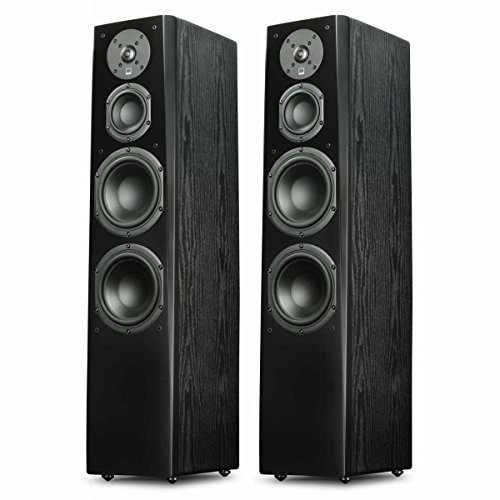
SVS Prime Tower (Pair) — Best sub-free bass depth
SVS makes subwoofers for a living, and the Prime Tower is what happens when that obsession designs a tower that must survive without one. The three-way layout — twin woofers, a dedicated midrange, an aluminium dome tweeter — reaches lower with more control than any other pair here, so the low-frequency effects folded into a 2.0 mix arrive with their pitch and shape intact rather than as an undifferentiated rumble. Orchestral scores in films gain the same benefit: the bottom octave of a cinema orchestra is present, disciplined and clearly separated from the dialogue riding above it.
That dedicated midrange driver is the theatrical detail. In dense scenes the woofers can be working hard on effects while the midrange presents voices untouched, a division of labour two-way designs approximate and this one simply has. The phantom centre is precise, the presentation is accurate rather than flattering, and the pair pricing — sold as a pair, in one listing — removes the arithmetic trap that catches so many tower buyers.
The Prime asks more of the receiver than the Klipsch picks and wears a plainer finish than any of them. In exchange it offers the most complete sub-free film sound in this guide and the support culture of a company that treats a speaker purchase as the start of a relationship. For rooms where a subwoofer is politically impossible, this pair is the answer that concedes least.
- Configuration: three-way, twin woofers, dedicated midrange driver
- Cinema strength: deepest controlled bass of the six without a sub
- Pricing: sold as a matched pair in a single listing
- Upgrade path: Prime centre and the maker’s subwoofers integrate cleanly
Strengths
- Effects depth and control reflect the maker’s subwoofer pedigree
- Dedicated midrange keeps dialogue clean under bass load
- Pair pricing and strong support simplify the purchase
Trade-offs
- Asks more amplifier than the efficient Klipsch designs
- Plain finish beside prettier cabinets
- Accuracy can feel less forgiving of poor broadcasts
Best for: subwoofer-free film systems in medium rooms, and score lovers. Not suited for: buyers wanting maximum volume from minimal receivers.
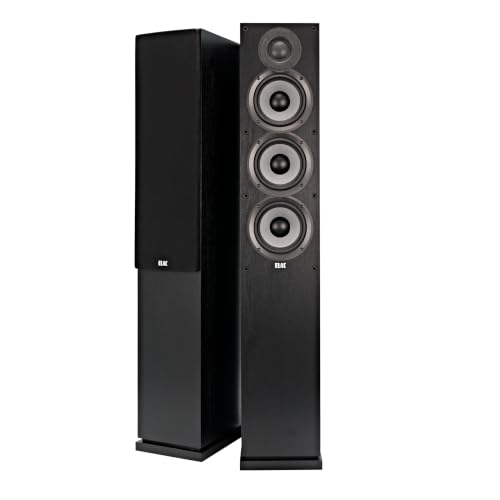
ELAC Debut 2.0 F5.2 — Best for smaller rooms
Most 2.0 systems live in rooms too small for the biggest towers, and the F5.2 is the pick scaled to that reality. It carries the Debut family’s composure — three 5.25-inch aramid woofers, a waveguide-loaded cloth dome tweeter, a crossover that keeps dense scenes untangled — in a slimmer cabinet that fits beside real television furniture without annexing the room. In a small space its phantom centre is arguably the most convincing here, because the distances are short, the dispersion is even, and the whole picture hangs together at the volumes small rooms allow.
Bass is the honest compromise: firm and articulate, sufficient for drama and most action, but without the low swell its bigger sibling or the SVS provide when an effects track digs deep. Small rooms forgive this — they amplify bass themselves, often to excess — and the F5.2’s restraint frequently sounds more correct in situ than a deeper speaker fighting the room’s own reinforcement. Dialogue, the small-room priority, is natural and unforced at the low levels of evening viewing.
As a foundation it shares the Debut centre and surrounds, so the small system can grow without changing its front-stage accent. For flats, dens and second rooms, the F5.2 is not the budget version of this guide’s idea — it is the correctly sized version of it.
- Configuration: three 5.25-inch aramid woofers, cloth dome tweeter
- Cinema strength: imaging and composure at small-room distances
- Form: the slimmest linked tower in this guide
- Upgrade path: full Debut centre and surround range behind it
Strengths
- Phantom centre is superb at short listening distances
- Restrained bass suits rooms that reinforce low end themselves
- Composure survives dense scenes and low volumes alike
Trade-offs
- Effects depth is the most modest of the six
- Large rooms will find its output ceiling
- Modest sensitivity, like its larger sibling
Best for: flats, dens and small living rooms building a first theatre. Not suited for: large rooms or effects-led viewing at high levels.

Klipsch RP-8000F II — Best for big-room reference levels
The RP-8000F II is the ceiling of this guide: the pair for the viewer with a big room, a projector screen and the ambition to play films at the levels they were mixed at. The second-generation Reference Premiere design — dual 8-inch cerametallic woofers, a larger and better-behaved Tractrix horn — produces reference dynamics from receivers that would leave lesser towers breathless, and it does so while keeping dialogue anchored and intelligible inside the spectacle. Scale is its native language: scores swell like weather, effects land like events, and the room’s far seats hear what the near seats hear.
In 2.0 specifically, its imaging discipline surprises people who expect horns to be blunt instruments. The revised horn controls dispersion well enough that the phantom centre holds for the central block of seats, and the matching Reference Premiere centre — one of the finest in class — waits for the day the room graduates to 3.0 and beyond. This is the pick whose upgrade path leads to a genuinely serious theatre.
The requirements are space, budget headroom within the system’s total, and a room that can absorb its energy. In return it offers the only 2.0 experience here that big-room viewers will not outgrow. If your screen is measured in metres and your films are events, this is your pair.
- Configuration: dual 8-inch cerametallic woofers, second-generation Tractrix horn
- Cinema strength: reference-level dynamics from mainstream receivers
- Imaging: controlled dispersion holds the phantom centre for central seats
- Upgrade path: Reference Premiere centre leads to a serious theatre
Strengths
- Cinema scale and volume no other pick here approaches
- Dialogue stays intelligible inside the largest effects
- Upgrade path tops out higher than any rival’s
Trade-offs
- Needs a genuinely large room to justify and contain it
- Rear port demands placement space behind the pair
- Most expensive direction in this guide once its centre joins
Best for: projector rooms and big-space film events. Not suited for: small rooms, close seating or restrained budgets.
How Low Does a 2.0 Pair Really Need to Play?
Film soundtracks concentrate their energy higher than their reputations suggest. Dialogue, score and most effects live comfortably within the reach of every tower here; the dedicated low-effects channel adds the deepest layer — the rumble under an explosion, the weight under a starship — and in a 2.0 system the receiver folds that layer into the towers at a managed level. A pair that reaches into the low forties of hertz with control will render the great majority of that content convincingly. Below that, output falls away, and what is lost is sensation more than information: you stop feeling the last octave in your ribs.
Control matters more than depth in this folding arrangement, because the towers receive bass they did not choose at moments the mix chooses for them. A speaker whose low end stays disciplined — the SVS is the exemplar, the ELACs close behind — keeps dialogue clear while the effects peak passes through the same cabinet. A speaker whose bass turns loose under load muddies the very voices the system was bought to clarify. This is why our ranking weights bass quality over bass depth for cinema, reversing the instinct of most specification comparisons.
Room gain quietly assists. Walls and corners reinforce low frequencies, sometimes generously, so a pair that measures modestly in a laboratory can sound full in a living room — and a deep pair in a small room can sound excessive. The practical test is a familiar action scene at your real listening level: if the room feels energised and the dialogue remains untouched, the pair reaches low enough for your life, whatever the brochure arithmetic says.
How Do Film Scores and Soundtracks Test a 2.0 Pair?
A soundtrack is the most complex signal most systems ever play: an orchestra, electronic bass, dialogue, effects and room ambience layered into two channels in a 2.0 fold-down. The pairs here separate themselves by how they handle that layering at the moments of maximum density — the battle scene under a full score, the storm under a whispered conversation. Composure, again, is the quality that matters, and it is a product of crossover design and driver headroom rather than of any feature a badge can advertise. The ELACs and the SVS hold their layers apart longest; the Klipsch pair renders the same moments with more physical force and slightly less separation; the Polk keeps the dialogue layer foremost, which many households will judge the correct priority.
Quieter films test the opposite virtue. A chamber drama is ninety minutes of voices in rooms, and a 2.0 pair earns its keep by making those rooms audible — the size of the space in a voice’s reflections, the hush under a pause — without ever drawing attention to the equipment. This is where the smaller ELAC and the Polk justify themselves against their bigger rivals, and why our ranking resists the simple equation of size with merit. Cinema is mostly people talking; the explosions are the punctuation, and a system chosen only for punctuation will misread the book.
How Do the Six Pairs Compare for Cinema Duty?
| Pick | Dialogue | Sub-free bass | Strongest theatre use |
|---|---|---|---|
| ELAC Debut 2.0 F6.2 | Natural, composed | Deep and firm | All-round 2.0 cinema |
| Polk ES60 | Clearest of the six | Controlled near walls | Dialogue-led living rooms |
| Klipsch R-800F | Vivid, projecting | Big and physical | Action dynamics, modest receivers |
| SVS Prime Tower (Pair) | Clean under bass load | Deepest and most disciplined | Sub-free film systems |
| ELAC Debut 2.0 F5.2 | Natural at low volume | Firm, modest depth | Small-room theatres |
| Klipsch RP-8000F II | Anchored in spectacle | Large-scale and deep | Big-room reference levels |
How Should You Configure a Receiver for a 2.0 System?
Configuration is where 2.0 systems are won and lost, and it costs nothing. In the receiver’s speaker setup, declare exactly what exists: front speakers present and set to large or full-range, centre set to none, subwoofer set to none, surrounds set to none. Those declarations tell the receiver to fold the centre channel into the phantom image and the low-frequency effects into the towers, rather than discarding them into channels with no speakers attached — the single most common reason a new 2.0 system sounds thin and confused.
Then measure. Enter the real distance to each tower, balance the pair with the receiver’s test tones or its calibration system, and check the result with a scene you know: a voice should sit on the screen, not lean toward the nearer cabinet. Disable dynamic range compression and night modes for film viewing unless the hour demands them, because the dynamics they tame are the ones these towers were bought to reproduce. Finally, feed the television’s audio through HDMI ARC or eARC where available so the receiver wakes, switches and controls volume with the television remote — a 2.0 system the whole household can operate is a 2.0 system that gets used for everything, which is when it earns its place.
ARC, eARC and the Television: Getting the Signal Right
The finest 2.0 pair in this guide will underperform if the television feeds it badly, so the signal path deserves the same care as the speakers. HDMI eARC is the route to choose where the television and receiver both offer it: it carries the full-quality soundtrack formats, synchronises audio with the picture, and lets the television remote run the system’s volume, which is the feature that decides whether the household actually uses the system for everyday viewing. Optical connections remain a perfectly good fallback for stereo duty, carrying the folded two-channel mix without drama.
Television settings are the trap. Many sets default to processing their audio output — downmixing oddly, applying their own effects, or passing through a format the receiver then handles inconsistently. Set the television to pass its audio through unprocessed, disable its internal speakers entirely rather than merely muting them, and let the receiver own every decision downstream. Lip-sync, the other classic complaint, is adjustable in the receiver in fine increments; fix it once with a dialogue-heavy scene and the setting holds for every source that shares the path.
Streaming devices and consoles should connect to the receiver rather than the television where the receiver’s inputs allow, because that gives the receiver first sight of the soundtrack in its best format. None of this requires expertise — it requires one careful evening with the menus, after which the system disappears into daily life. A 2.0 theatre that wakes with the television and needs no remote of its own is the one that justifies its floor space every single day.
What Mistakes Do 2.0 Buyers Make?
The first is leaving the receiver configured for speakers that do not exist, silently discarding the centre channel and the effects track — an hour of setup menus matters more than any cable. The second is placing the towers asymmetrically, one in a corner and one in free space, then blaming the phantom centre for wandering. The third is judging the system with the television’s own processing still mangling the signal on its way to the receiver. The fourth is buying towers so large for the room that dialogue drowns in bass boom, when the F5.2-sized pick would have sounded clearer. And the fifth is treating 2.0 as a failed 5.1 rather than a complete system in its own right: judged as itself, a good pair with honest configuration outperforms the sprawling budget surround bundles it is so often unfavourably compared with.
When Should a 2.0 System Grow — and in What Order?
Growth should be driven by the room’s complaints, not by the calendar. If viewers at the sofa’s ends report wandering dialogue, the centre channel is the answer and it should come first, chosen from the same range as the towers so the front stage keeps one accent. If films feel weightless in a large room despite the towers working honestly, the subwoofer is the answer, and it will relieve the pair of the deepest duties so their midrange clears further. If the household starts hosting film nights where viewers sit behind the sofa, surrounds enter the conversation — and not before, because surround speakers serving empty air are the classic wasted stage of a growing system.
Each addition re-opens the configuration ritual: declare the new speaker, re-run calibration, re-check the phantom questions that no longer apply. Owners who treat setup as part of every upgrade keep systems that sound designed; owners who bolt on channels and hope keep systems that sound accumulated. The pairs in this guide were chosen so that either future — staying at 2.0 forever, or growing to a full theatre — is a respectable destination, and that dual citizenship is rarer in this market than it should be.
What About Sport, News and Everyday Television?
A 2.0 theatre spends most of its hours on ordinary broadcasts, and its behaviour there decides whether it is loved or bypassed. Commentary through these pairs gains the same intelligibility as film dialogue, crowd noise gains a sense of place that television speakers flatten into hiss, and the newsreader test — the daily referendum on any system — passes so completely that households stop reaching for subtitles they never needed for hearing, only for clarity. That everyday transformation, repeated across hundreds of ordinary hours, is the true return on a 2.0 purchase; film nights are merely its celebration.
Everyday use also argues for the receiver features that theatre purists dismiss: quick-select memories for the household’s sources, a volume limiter for households with children and remotes, and Bluetooth or streaming inputs for the radio and podcasts that fill kitchens and mornings. The towers do not care what they play. A system that serves the breakfast news as faithfully as the blockbuster is a system earning its floor space around the clock, and every pair in this guide is capable of that double life the moment its owner configures it once and stops thinking about it.
How Should You Demo a 2.0 Pair Before Buying?
Bring scenes, not songs. The ideal demonstration reel is unglamorous: a dialogue-heavy scene with background music, because that is the mix that defeats systems; an action sequence you know well enough to notice what is missing; and a quiet scene with room tone, because that is where composure shows. Play each at the volume you actually use at home — demonstration levels flatter every speaker and mislead every buyer — and sit where you will sit, including the sofa’s end if that is your seat, so the phantom centre is judged from your life rather than from the sweet spot.
Ask the dealer to configure the receiver as a true 2.0 system, with no subwoofer quietly assisting from a corner, because a pair demonstrated with hidden help will disappoint at home in exact proportion to the help it received. If a home trial is offered, take it: rooms are the other half of every speaker, and the pairs in this guide come from makers whose support cultures generally understand that. The right pair will make the decision feel less like a victory of research and more like a recognition — the film simply sounds the way it was supposed to, and the search is over.
Why Does 2.0 Suit Modern Streaming Films Especially Well?
Streaming has quietly changed what a home theatre must do. Films now arrive with mixes that vary enormously between services and even between titles on the same service, and the systems that cope best are the ones with composure rather than processing gimmicks. A 2.0 pair of honest towers presents a lean mix and a dense mix with the same steadiness, asking nothing of the viewer between titles. Soundbars chase these variations with modes; surround systems chase them with calibration; a good stereo pair simply plays them, because two well-matched channels have fewer places for inconsistency to hide.
There is also the matter of the television itself. Modern sets are bought for their pictures and endured for their speakers, and the gap widens every year as panels grow and cabinets shrink. A 2.0 pair closes that gap in proportion — the sound finally matches the image’s scale — without committing the household to a room full of speakers before it knows whether it wants one. In an era when the screen upgrades every few years and the content arrives by subscription, the stable, transferable part of the system is the pair of towers. They will serve the next television exactly as they serve this one, which is the deepest sense in which 2.0 is the rational cinema purchase.
Final Recommendation
Build the default 2.0 theatre on the ELAC F6.2: it is the pair with no theatrical weakness and a centre channel waiting patiently in its range. If dialogue frustration is the wound that brought you here, take the Polk ES60 and let its voicing heal it. Choose the SVS Prime Tower when a subwoofer is not coming and the bass must be real anyway, the F5.2 when the room is small and the imaging must be close-range perfect, and either Klipsch when dynamics are the religion — the R-800F for value and scale, the RP-8000F II for the big room’s full ceremony. Configure the receiver honestly, sit in the middle, and a pair of towers will remind you why cinema sound was a stereo invention before it was anything else.
One last piece of housekeeping belongs in every 2.0 plan: photograph the receiver’s configuration screens once the system sounds right. Firmware updates, curious relatives and inquisitive children all have opinions about menus, and a photograph restores your settings in minutes where memory would take an evening. The same applies to the towers’ final positions — a strip of tape on the floorboards, invisible in daily life, preserves the geometry you worked to find. Systems stay good when their goodness is documented, and documentation is the cheapest component in this entire guide.
And settle the remote question on day one, while enthusiasm is high. Whether the household controls the system through the television remote over eARC, a receiver remote kept in one known place, or a single universal control, the decision should be made deliberately and taught to everyone who uses the room. A theatre that only one person can operate is a theatre that sits silent whenever that person is out — and the pairs in this guide were bought to be heard, by everyone, every day.
Keep the cartons until the pair has survived its first month of films, and keep the grilles on if the room includes small children or large dogs — a tower’s drivers are its value, and the phantom centre cannot image through a dented woofer. After that first month, revisit the toe-in once with a dialogue scene and a fresh ear; systems settle, rooms settle, and the small correction made with a month’s knowledge is worth more than the dozen made on the first evening.
Register the warranty for both the towers and the receiver in the same sitting, and store the serial numbers together. A 2.0 system is a partnership of components, and its paperwork should reflect that: when support is ever needed, the household that can state both halves of the system, their ages and their settings is the household whose problem gets solved in one conversation rather than three.
Then dim the lights and stop evaluating. The measure of a 2.0 system is not how it performs under audition but how completely it vanishes under a film — the evening when nobody mentions the sound at all, because the story simply happened in the room at full size. Every pair in this guide can deliver that evening; the configuration is yours to finish, and the first film is closer than the shopping makes it feel.
One more small discipline pays for itself within the year: keep a single notebook page — physical or digital — with the system’s sources, inputs and settings written in plain language. Guests, partners and future you will all operate the theatre from that page, and a system that anyone can run is a system that gets run. It is the least technical item in this guide and, in many houses, the most used.
Finally, resist the urge to re-open the comparison the week after the purchase. Rooms teach slowly, ears adjust honestly, and the pair that sounded merely good on the first night often sounds inevitable by the tenth, once placement has been revisited and the receiver’s settings have settled around your real viewing. Judged on that tenth night — the correct night — every system in this guide earns its floor space.
That tenth-night standard is also the fairest way to read this guide’s ranking: not as a verdict on which pair is best in the abstract, but as a map of which pair reaches inevitability fastest in which kind of room, with which kind of films, for which kind of household.
Choose by that map, configure with care, and the two speakers beside your screen will carry more cinema than systems with three times their channel count and half their quality.
The rest — the films themselves, watched at the size they deserve — is the part no guide can write for you, and the part every pair here was built to serve.
Start tonight, with whatever is already waiting in your watchlist, and let the pair speak for itself.
Frequently Asked Questions
Is 2.0 really enough for films, or do I need 5.1?
For dialogue, scores and front-stage scale, a good 2.0 pair is not merely enough — it outperforms cheap 5.1 bundles whose budget is spread across too many small speakers. What it cannot do is place effects behind you. Most households find that trade easy to live with, and the upgrade path remains open.
Where does the centre channel go in a 2.0 system?
Nowhere — and everywhere. The receiver folds centre-channel content equally into both towers, and your hearing reconstructs it as a phantom image at the screen. Correct configuration is what makes this work, which is why the setup section of this guide matters as much as the speakers.
Can I add a centre channel and subwoofer later?
Yes, and every pick here is chosen partly for that path. Add the matching centre from the same range first for dialogue solidity across wide seating, then a subwoofer for the lowest effects octave. The towers remain the front stage throughout.
Do I need an AV receiver, or will a stereo amplifier do?
A stereo amplifier with an HDMI or optical input from the television works beautifully for pure 2.0 and often sounds better for the money. An AV receiver adds calibration, channel management and the upgrade path to centre and surrounds. Choose by whether the system will grow.
How loud can a 2.0 pair play films?
Louder than most households ever ask. The Klipsch pairs reach genuine cinema levels from mainstream receivers; the others reach every level a living room tolerates. The limiting factor in most homes is the room and the neighbours, not the towers.
Related Guides
When the system grows, start with our best 1000 floor standing speakers, continue with our best 15 inch powered speakers, and compare the music-first view in our guide to two-channel speakers for stereo listening.


