What's inside
- Key Takeaways
- Quick Picks
- How We Chose These Picks
- How Does the Kicker Ladder Actually Work?
- What Does the Money Buy as You Climb?
- What Is the Kicker House Sound, and Who Is It For?
- How Do the Generations Within a Tier Differ?
- Where Does a Subwoofer Fit in a Kicker System?
- Which Kicker 6.5 Speakers Deserve Your Doors?
- How Do the Six Kicker Entries Compare Side by Side?
- How Do You Choose Your Rung Without Overbuying?
- How Do You Install the KS Components Without Wasting Them?
- What Should Happen to the Rest of the System as You Climb?
- What Mistakes Do Kicker Buyers Keep Making?
- How Does Kicker Compare With the Rival Ladders?
- What Does Living With Each Tier Actually Feel Like?
- Final Recommendation
- Frequently Asked Questions
- Related Guides
As an Amazon Associate I earn from qualifying purchases. This post may contain affiliate links at no extra cost to you.
widgetverdict.com is reader-supported. When you buy through links on our site, we may earn an affiliate commission.
Where to buy: Five of the six entries below link to checked Amazon listings. The sixth, Kicker’s flagship QS line, is covered as prose only, because clean new listings for it have become genuinely hard to find — and a brand guide that pretended otherwise would be failing at its one job, which is telling you what the badges on the boxes actually mean.
Kicker’s catalogue confuses buyers in a way that looks accidental and is not. The company sells four families of 6.5-inch speakers under letter pairs — DS, CS, KS and QS — and the letters carry the entire pricing ladder, while the model numbers recycle the same digits across families until a DSC650, a CSC65, a KSC6504 and a KSS6504 blur into one alphabetical soup. Owners end up comparing speakers across tiers as if they were rivals, or paying KS money for a job the DS line was built to do. This guide to the best 6.5 Kicker speakers exists to untangle that ladder: what each family is for, where the money goes as you climb, which tier suits which car, and where the ladder honestly stops being worth climbing. Five of the six entries are current, linked products spanning DS to KS; the sixth addresses the QS flagship and the awkward truth about its availability.
A word about Kicker itself, because the brand’s character shapes every tier. The company built its name in the loud end of car audio — subwoofers, competition systems, a house sound that values impact and presence — and its door speakers carry that DNA at every level: even the calmest Kicker is a fraction more forward than the calmest rival, and the family’s midbass punch is a signature rather than an accident. Buyers who want that character will find this guide a ladder of refinements of it. Buyers who want neutrality above all should know now that no tier of this brand is aimed at them, and the honest service a brand guide can do is to say so in the introduction rather than the conclusion.
Key Takeaways
- Kicker’s letters are the ladder: DS is the factory-replacement line, CS the mainstream upgrade, KS the refined performance tier, QS the flagship above them.
- The DSC650 (DS) is the correct Kicker for repairs and value upgrades; paying more buys refinement it was never designed to need.
- The CSC65 (CS) is the range’s centre of gravity — the balanced coaxial most Kicker buyers should start, and many should finish, with.
- The KSC6504 (KS coaxial) adds silk-dome smoothness and a more composed cone to the same coaxial convenience.
- The KSS6504 (KS component) is the imaging step: separate tweeters with Kicker’s flexible mounting kit, for cars ready to use them.
- The KSS365 is a three-way KS component system with a dedicated midrange, and the QS flagship is covered honestly as prose only because clean new listings are scarce.
Quick Picks
| Pick | Badge | Why it earns its place |
|---|---|---|
| Kicker DSC650 | DS tier — the replacement specialist | The factory-substitute coaxial the DS line was created to be. |
| Kicker CSC65 | CS tier — the mainstream centre | The balanced upgrade coaxial at the ladder’s most sensible rung. |
| Kicker KSC6504 | KS tier — the refined coaxial | Silk-dome composure added to coaxial simplicity. |
| Kicker KSS6504 | KS tier — the component step | Separate tweeters and a mounting kit that fits difficult cars. |
| Kicker KSS365 | KS tier — the three-way system | A dedicated midrange driver for the fullest KS front stage. |
| Kicker QS/Q-Class components | Flagship tier — prose only | The top of the ladder, covered honestly while clean listings are scarce. |
How We Chose These Picks
A brand guide has a different duty from a market roundup: it must represent the brand’s own structure truthfully, which here meant one entry per meaningful tier and format rather than six near-identical coaxials. The DS and CS coaxials anchor the ladder’s working rungs; the KS family takes three entries because it is where Kicker’s range genuinely branches — coaxial, two-way component and three-way component are different products for different cars, not trims of one. The QS flagship is included as the sixth entry in prose, without a link, because a ladder described without its top rung misleads, while a link invented to complete the table would mislead worse.
Within each tier we favoured the current series designations — the 51-prefixed KS models are the line’s present generation — and checked each product against the job its family exists to do. Kicker’s own positioning is unusually legible once the letters are decoded, and this guide’s judgements mostly ratify it: the tiers are honestly differentiated, the money between them buys identifiable things, and the mistakes buyers make are almost always tier mistakes — the right speaker from the wrong rung — rather than product failures. That is the lens every analysis below uses.
How Does the Kicker Ladder Actually Work?
Read the families as answers to four different questions. DS asks: what does a factory speaker replacement need to be? The answers are fitment, durability, easy power and a price that suits a repair, and the line is engineered down to exactly that brief with no waste. CS asks: what should the mainstream upgrade be, for the owner improving a healthy car? The answers add refinement — better tweeters, more composed cones, a balanced voicing — at a price still inside the mainstream. KS asks: what can Kicker do when the buyer cares about sound quality as a subject in itself? The answers are silk tweeters, better motors and crossovers, component architectures and the materials budget to execute them. QS, the Q-Class, asks what the company can build when the price ceiling lifts, and answers with its flagship component designs.
Two consequences follow for buyers. The first is that climbing the ladder buys refinement, not volume or bass in proportion: a KS speaker is not twice the speaker a DS is, it is a more polished one, and owners whose complaint is loudness should spend on other things. The second is that the tiers overlap in capability at their edges — a CS coaxial and a KS coaxial differ less than their badges suggest, while the jump from any coaxial to the KS components is a change of kind, not degree, because the tweeter leaves the door. The most consequential decision in this entire guide is therefore not DS versus CS versus KS. It is coaxial versus component, taken once, with the tier chosen afterwards to set the polish.
What Does the Money Buy as You Climb?
Itemised honestly, the steps purchase four things. Tweeter quality comes first: the climb from the DS and CS dome arrangements to the KS silk tweeters is audible in the first minute, a smoothing of the top end that removes the faint glare all cheaper domes carry. Cone and motor refinement come second, heard as control — bass that stops when it should, midrange that stays separate under load. Crossovers come third, invisible but consequential, dividing the signal with less waste and better manners as the tiers rise. And fourth, in the component tiers, architecture itself: separate drivers, aiming, placement, the soundstage that no coaxial at any price in this guide can produce.
What the money does not buy is equally worth listing, because brand ladders thrive on the assumption that it does. It does not buy deeper bass in any meaningful degree; every speaker here is a 6.5 working in a door, and the family’s low end is a story of punch and control rather than extension. It does not buy immunity from installation: a KS set fitted carelessly loses to a DS pair fitted well, every time, in every car. And it does not buy a different brand character — the Kicker forwardness and midbass emphasis persist up the ladder, refined but recognisable, so an owner who dislikes the CS voicing will not be converted by the KS. Ladders reward buyers who like the ground floor’s accent and want it spoken more fluently.
What Is the Kicker House Sound, and Who Is It For?
Every brand voices its range around a centre, and Kicker’s centre is easy to identify once named: energy in the presence region, so voices and guitars sit forward of the mix rather than inside it, and a midbass with genuine thump, tuned to make a door sound like it means it. The character descends from the company’s subwoofer heritage, where impact is the product, and it survives refinement remarkably intact — the KS silk tweeter smooths the top end without retreating from it, and the three-way set’s separation organises the energy rather than dissipating it. In a moving car, against road noise, that forwardness is a functional virtue: it is the voicing least likely to be masked, which is why Kicker systems so often satisfy owners whose listening is loud, social and mainstream in repertoire.
The same character defines who should shop elsewhere, and a brand guide serves its readers by naming them. Listeners whose reference is a neutral studio monitor, who prize a flat midrange and a treble that never announces itself, will find every rung of this ladder a degree too eager, and no amount of climbing changes a voicing philosophy. Jazz and classical listeners divide: the KS tiers’ composure wins many of them, while the DS and CS eagerness can tire over long, quiet listening. The practical test is repertoire and volume. If your car plays rock, pop, hip-hop, electronic music and talk at real road levels, Kicker’s house sound was designed in your image. If it plays acoustic recordings quietly in a refined cabin, sample the KS tiers before committing, and keep the rival brands’ calmer sets in the comparison without guilt.
How Do the Generations Within a Tier Differ?
Brand ladders have a time axis as well as a price axis, and Kicker’s KS line illustrates it: the current models carry a 51 prefix in their full designations — 51KSC6504, 51KSS6504, 51KSS365 — marking the present generation of the series, while earlier KS stock circulates with the older 47-prefixed designations and similar names. The generations differ in detail — tweeter and crossover revisions, cosmetic and mounting updates — rather than in philosophy, and an older-generation KS at a fair price is not a mistake. The trap is comparison: listings mix generations freely, prices overlap, and a buyer pricing a new 51-series set against a discounted older one is comparing two related but distinct products.
The discipline is to compare within a generation when judging value, and to treat a previous generation’s discount as exactly what it is — a fair exchange of the latest revisions for money — rather than as either a bargain or a warning. The same applies, with less documentation, to the CS and DS lines, whose long production runs mean the speaker bought today may differ in small ways from the one reviewed years ago, almost always in the direction of quiet improvement. Kicker’s ranges evolve by iteration rather than reinvention, which suits a ladder guide’s purposes: the rungs described here have been stable in character across those iterations, and it is character, not model-year minutiae, that should drive the choice.
Where Does a Subwoofer Fit in a Kicker System?
Sooner or later every Kicker conversation reaches the subwoofer, because the brand’s audience reliably contains the owners most likely to add one, and the door speakers’ role changes the day it arrives. With a subwoofer carrying the lowest octaves, the doors are relieved of the frequencies that cost them the most excursion and distortion, and the whole front stage gains clarity at volume — which reframes the ladder choice. A system planned around a subwoofer can favour the tiers with the cleanest midrange and top end, the KS sets especially, because their relative lack of low-end heroics stops mattering once the subwoofer is doing that work. Conversely, a system that will never have one should weight midbass punch more heavily, which is the CS and KS woofers’ home ground.
The sequencing advice follows. Owners certain about a subwoofer should buy the front stage for the finished system, not for the interim, and let the doors sound a fraction lean until the sub arrives. Owners uncertain about it should buy the rung that satisfies alone — CS for most, KS coaxial for the polish-minded — because a speaker chosen for a hypothetical system serves neither the present car nor, often, the eventual one. And owners at the DS tier, repairing a car, should hear the guide say plainly that no subwoofer is required to complete them: the ladder’s foot was designed to stand alone, and a repair that grows a subwoofer has changed its brief, not fulfilled it.
Which Kicker 6.5 Speakers Deserve Your Doors?

Kicker DSC650 — DS tier, the replacement specialist
Within the brand’s own logic, the DSC650 is the most honestly positioned product in this guide: the DS line exists to replace factory speakers, and the DSC650 does that job with a completeness that makes its higher siblings irrelevant for the purpose. Its polypropylene cone and ribbed surround are chosen for survival in doors, its tweeter restores the octave factory speakers omit, and its efficiency suits the head units it will overwhelmingly be paired with. Judged against its own family’s ladder, the point to grasp is that the DS is not a diminished CS — it is a different brief, executed without apology, and in a repair context its lower price is not a compromise but the correct allocation of a budget that has other claims on it.
The ladder perspective also defines when to leave it behind. An owner upgrading a healthy, young car they intend to keep is not the DS’s audience, however well it would serve; that owner is buying years of listening, and the CS’s refinement amortises. An owner repairing an older car, preparing one for sale, or fixing the family runabout is exactly its audience, and for them the DSC650’s position at the ladder’s foot is a virtue: Kicker’s build discipline and dealer-bred fitment knowledge, bought at the tier where nothing was spent on polish the job did not need.
- Tier: DS — factory replacement line
- Design: coaxial pair, polypropylene cone, ribbed surround
- Impedance: 4 ohms
- Brief: fitment, durability and easy power above refinement
Strengths
- Purpose-built for the replacement job
- Efficient and cheerful on any head unit
- The ladder’s value floor is genuinely low
Trade-offs
- Refinement ceiling is the lowest here
- Tweeter can glare slightly in bright cabins
- Not the tier for a car being kept and upgraded
Best for: repairs, older cars and value upgrades. Not suited for: long-term keepers who will hear its limits daily for years.

Kicker CSC65 — CS tier, the mainstream centre
The CSC65 is where the ladder’s centre of gravity sits, and a brand guide should say plainly that the centre is usually the answer. The CS tier takes the DS brief and spends its increment on the things a healthy car’s owner actually hears: a balanced dome tweeter with a smoother account of the top end, a cone that keeps its composure further into the volume range, and a voicing tuned for the broad middle of taste. Against its own sibling it is the refinement step; against the KS coaxial above it, it is the value argument — most of the sound for noticeably less of the money, in the same four-screw coaxial convenience.
Its position also makes it the guide’s recommendation for the undecided, which in brand-ladder terms is a real category: the buyer who knows they want Kicker’s character, does not know whether components are in their future, and wants a purchase that is complete in itself. The CSC65 is complete in itself. It asks nothing of the car’s wiring, nothing of the owner’s weekends beyond the swap, and it leaves every future path open — rears matched later, an amplifier welcomed, components eventually in the front with the CS pair retiring gracefully to the back doors. Ladders are climbed from a secure rung, and this is the secure rung.
- Tier: CS — mainstream upgrade line
- Design: coaxial pair, balanced dome tweeter
- Impedance: 4 ohms
- Brief: balanced refinement for healthy cars
Strengths
- The range’s best balance of sound and money
- Smoother and more composed than the DS
- Leaves every future upgrade path open
Trade-offs
- KS silk tweeter is audibly smoother still
- Coaxial imaging limits apply as at every tier
- Character is safe rather than distinctive
Best for: the mainstream upgrade and the undecided Kicker buyer. Not suited for: listeners ready for components, who should skip to the KS sets.

Kicker KSC6504 — KS tier, the refined coaxial
The KSC6504 answers a question the ladder’s lower rungs cannot: how far can a coaxial go? Its KS brief spends the tier’s budget inside the coaxial format — a silk dome tweeter of three-quarter-inch size where the lower tiers use simpler domes, a more refined cone and motor, and crossover manners to match — and the result is the smoothest, most composed single-point speaker Kicker makes in this size. The silk tweeter is the headline in the listening: the faint hardness that survives even in the CSC65 at volume is gone, replaced by a top end that can be listened to closely, and the whole presentation gains the calm that distinguishes the KS badge.
Who should pay for a flagship coaxial when the same money approaches component territory? The buyer whose car defeats components — no tweeter location worth using, a lease that forbids trim work, a door architecture that punishes ambition — and who refuses to accept the lower tiers’ polish as the ceiling. For that buyer the KSC6504 is not a compromise but the correct maximum. The buyer with a usable tweeter location, by contrast, should read the next two entries first, because at KS money the component step buys a kind of improvement — imaging — that no refinement of the coaxial format can match. The ladder’s most interesting decision lives exactly here, and it is decided by the car, not the catalogue.
- Tier: KS — performance line, coaxial format
- Tweeter: silk dome, three-quarter inch
- Impedance: 4 ohms
- Brief: maximum coaxial refinement
Strengths
- Silk tweeter smoothness the lower tiers cannot match
- Composed at volumes where CS begins to harden
- Full KS polish with coaxial simplicity
Trade-offs
- Price approaches component money
- Imaging remains in the door, as all coaxials
- Overkill for repairs and rough service
Best for: cars that cannot take components but deserve the brand’s best coaxial. Not suited for: cars with good tweeter locations, where components spend better.
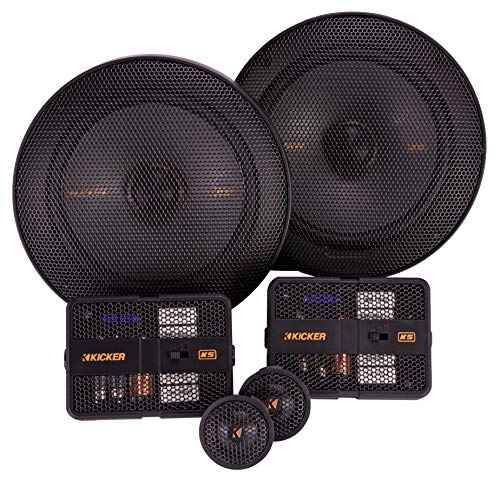
Kicker KSS6504 — KS tier, the component step
Read as a rung on the ladder, the KSS6504 is where Kicker’s 6.5 range changes kind. The woofer stays in the door, the one-inch silk tweeter leaves it — for the sail panel, the pillar, the dash corner — and the soundstage that every coaxial in this guide leaves in the footwell rises to the windscreen. That transformation, not any specification, is what the KS component money buys, and Kicker supports it with the most practical hardware in the family: tweeter housings for flush, surface and angled mounting, and a convertible arrangement that lets the tweeter sit in the woofer while a permanent home is prepared. In ladder terms, this is the rung where installation effort enters the price, and the kit is Kicker’s way of discounting it.
Sonically the set refines the family accent rather than replacing it: the midbass punch is present and disciplined, the silk tweeter smooth at the top, the whole presentation a clear tier above the KS coaxial in separation and air. Against the three-way sibling below it trades the dedicated midrange for simplicity and a lower install burden, which most cars and most owners should prefer. The KSS6504 is the guide’s answer for the buyer who has decided on components and on Kicker: the mainstream flagship of the practical range, with the QS above it belonging to a different conversation about availability as much as sound.
- Tier: KS — performance line, component format
- Tweeter: 1-inch silk, multiple mounting housings
- Woofer: 6.5-inch, polypropylene cone
- Brief: imaging and refinement together
Strengths
- Raised soundstage transforms the front seats
- Mounting kit suits cars with awkward tweeter provision
- Silk tweeter refinement matches the coaxial KS
Trade-offs
- Install effort is real — trim, routing, crossover placement
- Convertible tweeter mode wastes the format if left permanent
- Midrange has less dedicated support than the three-way set
Best for: component buyers who want Kicker’s character with an image. Not suited for: four-screw install expectations.

Kicker KSS365 — KS tier, the three-way system
The KSS365 is the ladder’s connoisseur rung: a three-way KS component system that adds a dedicated 2.75-inch midrange driver between the 6.5-inch woofer and the 1-inch tweeter. The engineering argument is division of labour. In a two-way set the woofer must climb into the lower treble to meet the tweeter, working at the top of its range where cones are least happy; a dedicated midrange takes the vocal and instrumental heartland onto a small, fast driver built for it, leaving the woofer to be a woofer. The audible return is in the region where music lives — voices gain body and separation together, and dense arrangements unthread into their parts in a way two-way sets, however refined, approximate rather than achieve.
The costs are equally concrete. A third driver per side needs a home: dash corners, pods, or custom work in cars that never imagined a midrange, and the crossover network grows accordingly. This is the one entry in the guide whose installation can exceed a careful afternoon, and owners should budget the midrange’s placement as a design problem, not an afterthought, because a badly placed midrange squanders the entire premise. For the right car — factory three-way locations exist in more vehicles than owners realise, particularly in premium trims — the KSS365 is the fullest expression of what Kicker’s practical range can do, and the natural ceiling of a system that still intends to run without exotic electronics.
- Tier: KS — performance line, three-way component
- Drivers: 6.5-inch woofer, 2.75-inch midrange, 1-inch tweeter
- Brief: dedicated midrange for vocal and instrumental separation
- Install: midrange placement is the project’s centre
Strengths
- Midrange clarity and separation lead the range
- Woofer relieved of upper-range duties
- The fullest KS front stage available
Trade-offs
- Midrange drivers need locations many cars lack
- Most complex install in the guide
- Benefits shrink in cars used mainly for speech
Best for: cars with factory three-way locations and music-first listeners. Not suited for: simple door swaps or speech-led use.
Kicker QS/Q-Class Components — Flagship tier, prose only
The ladder has a top rung, and honesty requires describing it without selling it. Kicker’s QS series — the Q-Class — is the company’s flagship component line, built with the brand’s best materials and crossovers as a statement of what its engineers can do when the mainstream price ceiling lifts. In sound, owners and reviewers consistently place it a clear refinement beyond the KS components: quieter backgrounds, finer tweeter detail, the sense of a product finished without a costing meeting in the room. As the summit of the range this guide covers, it deserves its place in the story.
It is covered without a link for a practical reason that buyers deserve to hear plainly: clean, current, new-in-box listings for the QS 6.5 components have become genuinely difficult to find through the usual channels, with availability drifting toward remaining stock, specialist dealers and the used market, where condition and completeness — crossovers and tweeter hardware especially — vary in ways a listing cannot guarantee. A guide that attached a confident buy link here would be decorating, not advising. The practical guidance is threefold: if you find verified new QS stock from a reputable seller, it is the brand’s best and priced accordingly; if you are buying used, inspect for the complete crossover pair and tweeter mounts, without which the set is a project; and if neither is available, the KS components above are not a consolation — they are where the range’s value and availability currently live, and most owners should let them be the top of their ladder.
- Tier: QS (Q-Class) — flagship component line
- Status: covered as prose only; clean new listings are scarce
- Character: the brand’s finest refinement and detail
- Buying note: verify completeness carefully on the used market
Strengths
- The finest sound Kicker offers in this size
- Flagship materials and crossover execution
- A genuine step beyond the KS components
Trade-offs
- New availability is scarce and inconsistent
- Used examples risk incomplete hardware
- Flagship pricing for a refinement, not a transformation
Best for: committed Kicker listeners who find verified stock. Not suited for: buyers who need a pair this weekend from a mainstream listing.
How Do the Six Kicker Entries Compare Side by Side?
| Pick | Tier | Format | The rung in one line |
|---|---|---|---|
| Kicker DSC650 | DS | Coaxial | The repair, done properly |
| Kicker CSC65 | CS | Coaxial | The mainstream answer |
| Kicker KSC6504 | KS | Coaxial | The refined ceiling of the format |
| Kicker KSS6504 | KS | Component | The imaging step |
| Kicker KSS365 | KS | 3-way component | The midrange specialist |
| Kicker QS components | QS | Component | The flagship, when findable |
The table’s lesson is that the ladder has two kinds of step, and confusing them is the source of nearly every disappointed Kicker purchase on record. DS to CS to KS-coaxial is a staircase of polish within one format; KS coaxial to KS component is a doorway into a different kind of listening; and QS is a landing above, reached when stock and budget align. Buyers who locate their step correctly rarely regret a Kicker purchase, because the tiers are honest and the differences between them, while real, are differences of polish that a well-matched buyer feels as satisfaction rather than as a debt still owed. Buyers who buy a badge instead of a step — the flagship for a repair, the replacement tier for a flagship’s job — are the ones writing the disappointed reviews, and their reviews, read closely, almost always describe a ladder climbed to the wrong height rather than a speaker that failed.
How Do You Choose Your Rung Without Overbuying?
Three questions, answered honestly and in order, place almost every buyer on the correct rung without further deliberation. First: is the car being repaired, improved or built? Repaired points to DS, improved to CS or KS-coaxial, built to the components. Second: does the car offer a tweeter location you are willing to use? If not, the component rungs are theoretical and the KS coaxial is your ceiling; if yes, the KSS6504 is usually the correct summit. Third: how long will you keep the car, and how do you listen? Years of music-first listening justify climbing; a year of mixed use argues for the centre rung and money kept. Answer those, in writing if the decision feels slippery, and the ladder stops being a marketing device and becomes what it should have been all along — a shortlist of one, arrived at by the car’s needs rather than by the catalogue’s arrangement of badges and ascending numbers.
One more discipline protects the purchase, and it is the one most often skipped in the excitement of choosing: buy the rung that matches the rest of the system as it exists today. KS components behind a tired, distorting head unit will faithfully reproduce the tiredness; a CS pair behind a good source will sound like the better system. Kicker’s own range is balanced enough that the speaker is rarely the weakest link by the time the KS badge is reached, and owners climbing that far should expect to spend something on the door’s sealing and the source’s settings as part of the same project, or hear, with the flagship’s own clarity, precisely and unforgettably what they failed to fix.
How Do You Install the KS Components Without Wasting Them?
The component entries in this guide carry the range’s highest install stakes, because their advantage is positional and position must be earned. The tweeters’ home decides the result: sail panels or dash corners, at matched heights, aimed symmetrically, with the Kicker housings chosen to suit the surface rather than the installer’s convenience. The crossovers need a dry, secured home inside the door or behind the kick panel, clear of the window’s travel, with their connections protected from the door cavity’s damp. And the woofers deserve the sealing discipline every guide in this batch repeats — foam tape at the mount, a check of window clearance, polarity verified on both sides before the cards return — because a KS woofer leaking air is a CS result at KS money.
The three-way KSS365 adds its midrange problem, which rewards planning over improvisation. Cars with factory midrange locations — in the dash corners, upper doors or pillars — should use them, since the manufacturer already solved the aiming. Cars without them ask for pods, and pods ask for the tweeters’ same discipline: matched, aimed, secure, and tested in position with temporary fixings before anything is drilled. The owners who get the three-way right describe the vocal clarity as the system’s defining trait; the owners who mount the midrange wherever it fits describe an expensive two-way with extra wiring. The difference is an hour of placement experiments, and at this rung of the ladder that hour is the purchase.
What Should Happen to the Rest of the System as You Climb?
A ladder climbed in isolation produces a lopsided car, so each rung carries an implied companion spend, and naming it is part of honest guidance. At the DS rung, the companion spend is nothing — the tier was designed to complete a repair unaided, and money beyond clips and seals is better kept. At CS, the natural companion is door treatment in miniature: the sealing and a sheet of deadening per front door, which the CS’s extra composure makes audible. At the KS coaxial, add the settings discipline — flat tone controls, processing off — because refinement is the first casualty of a loudness contour. At the KS components, the companions are the tweeter placement work and, in time, the amplifier the sets so clearly welcome, bought when the head unit’s ceiling becomes the system’s story rather than the speakers’.
None of this obliges anyone to spend beyond the speakers; it sequences the spending for those who will. The failure mode it prevents is the familiar one — flagship speakers, factory everything else, and a disappointed owner concluding the brand was overrated when the system around the speakers was simply never finished. Kicker’s ladder is honest enough that each rung performs as advertised in a system finished to that rung’s standard. Finish to the standard, and the badge on the box turns out to have been a description rather than a promise.
What Mistakes Do Kicker Buyers Keep Making?
The brand-specific mistakes begin with the model numbers: confusing the DSC650 with the CSC65, or the KSC coaxial with the KSS component of nearly identical digits, and ordering the wrong tier or format in good faith. Read the letters, not the numbers — the letters are the product, the numbers are merely its size and series wearing a disguise of significance, and a buyer who orders by the letters will never receive a component set when a coaxial was intended, or a replacement-tier speaker when the flagship’s little brother was the plan. Second is climbing for volume: no rung of this ladder is a loudness upgrade in itself, the tiers differing in polish rather than in acoustic output, and buyers chasing output should be shopping amplifiers and subwoofers, where loudness is actually sold. Third is leaving the KS component’s tweeters in their convertible coaxial position permanently, paying for an image and never collecting it, which is the single most expensive act of tidiness available in this entire range of speakers. Fourth is mixing tiers across the car without a plan — KS fronts with failing factory rears on one head unit, the flagship faithfully reproducing the rears’ decay at fill level — and fifth is hunting the QS badge on the used market without verifying the crossovers and hardware are complete, the one purchase in this guide that can genuinely go wrong in ways no warranty will rescue.
How Does Kicker Compare With the Rival Ladders?
A brand guide that never looks sideways leaves its readers to do the comparison badly elsewhere, so here is the honest positioning. Against JBL’s ranges, Kicker trades a little top-end sparkle for a little more midbass body, and the choice between them is mostly repertoire. Against Rockford Fosgate’s Prime and Punch ladders — the closest structural rival, with the same replacement-to-performance staircase — Kicker’s voicing runs a shade more forward and Rockford’s a shade warmer, while Rockford’s integrated-crossover component designs are easier installs and Kicker’s tweeter kits are more flexible ones. Against the European-leaning brands, Focal above all, Kicker concedes neutrality and wins on presence, durability of character at volume, and the sheer breadth of its fitment support.
None of those comparisons produces a winner, because ladders are climbed by people with cars, not by specifications. What they produce is a confirmation test: if the description of Kicker’s house sound in this guide sounded like a description of your taste, the brand’s ladder will serve you at whichever rung your car selects, and cross-shopping further mostly spends time. If it sounded like a warning, believe it early and cheaply, at the research stage, rather than at the DS rung with the door cards off. Brand loyalty in car audio is usually just voicing loyalty that has found its match, and the most useful sentence in this entire guide may be the one that tells a minority of its readers to go and be loyal to somebody else.
What Does Living With Each Tier Actually Feel Like?
Specifications describe the first week; ownership is the following years, and the tiers age differently in the mind. The DS pair disappears — the highest compliment a repair can earn — becoming simply the car’s sound, unremarked by anyone, which is why it is the wrong purchase for an enthusiast and the right one for everyone else. The CS pair keeps a small daily presence: a clarity on the morning radio, a fullness on the familiar road, that reminds the owner the job was done well without ever demanding attention. The KS coaxial adds the quality listeners describe as ease, a sense that the system is not working hard even when it is, which compounds over long drives into measurably less fatigue.
The components change the relationship most. A raised soundstage is not a refinement of the old experience but a new one, and owners of the KSS6504 and KSS365 tend to become the kind of listeners who notice recordings again — who hear the backing vocal placed left, the guitar right, the room around the drums — in a car they previously used for background. That transformation is the ladder’s real top, higher in lived terms than the QS landing above it, because the QS refines an experience the components create. Buyers choosing their rung should therefore weigh the doorway more than the staircase: cross into components when the car and the calendar allow, and let the tiers on either side of that door be chosen by budget and taste, in the knowledge that the door itself was the decision.
Final Recommendation
Pick your rung and stand on it confidently, because the most common failure in this entire range is not choosing the wrong tier but choosing the right tier and then apologising for it with bad installation, factory loudness settings left engaged, and a fader that hands half the system to the rear doors. Repairing: the DSC650. Improving a keeper the mainstream way: the CSC65. Wanting the brand’s polish without component work: the KSC6504. Ready for the soundstage: the KSS6504, or the KSS365 if your car offers midrange homes and your listening justifies them. The QS remains the summit — admire it honestly, buy it only when verified stock appears from a seller you trust, and lose no sleep meanwhile, because the rungs below it are not a waiting room but a destination fully worth the journey and the listening in their own right. A ladder understood is a ladder climbed correctly, and somewhere on these six rungs is the Kicker your car has been waiting for, wearing its letters where you can finally read them. Buy the rung your car and your listening actually describe, fit it with the care its tier deserves, and the letters will stop being a code and become what they were always meant to be: a shorthand you can trust the next time a door comes off and a decision has to be made.
Frequently Asked Questions
What is the difference between Kicker DS, CS and KS?
They are ascending tiers of one range. DS is the factory-replacement line, built for fitment and value. CS is the mainstream upgrade, adding refinement and balance. KS is the performance tier, with silk tweeters, better crossovers and the component architectures. The letters matter more than the model numbers, which repeat across the families. In listening terms the steps are felt as polish rather than power: each tier plays the same music with a little less effort audible in it, and the component KS sets add the raised soundstage that no coaxial tier offers.
Is the KS coaxial worth it over the CS?
If the car cannot take components, yes — its silk tweeter and composure are the coaxial format’s ceiling in this range. If the car can take components, the same money is usually better spent on the KSS6504, because the raised soundstage is a larger improvement than any refinement within the door. The listeners who benefit most from the KS coaxial are those who play music at sustained volume in a car that must stay coaxial: the composure gap over the CS widens exactly there, at the top of the range, where the cheaper dome begins to harden and the silk unit has not yet started to try.
Why is the QS model not linked?
Because clean new listings for the QS 6.5 components are currently scarce, and this guide links only to listings it can stand behind. The QS is covered in prose so the ladder is described truthfully; buyers who find verified new stock from a reputable seller are getting the brand’s flagship, and used buyers should verify the crossovers and mounting hardware are complete. Treat any listing that seems too easy or too cheap for a flagship with corresponding suspicion, and remember that the KS components remain in full production as the range’s practical summit.
Do Kicker speakers need an amplifier?
The DS and CS coaxials are designed for head-unit power and thrive on it. The KS coaxials also run happily from a head unit, and the KS components work without one while gaining from an amplifier later. Nothing in this guide requires amplification to justify itself. Owners who do amplify will find the KS tiers scale the furthest, since their crossovers and motors were designed with real power in mind, but that headroom is a bonus held in reserve rather than a debt the purchase owes.
Can I mix Kicker tiers between front and rear doors?
Yes, with the better tier in front, where the listeners and the image are. A KS front stage with CS rears is a coherent and commonly chosen allocation; the reverse wastes the flagship on fill duty while the seats that matter most make do with the lesser speaker. Keep the family the same so the tonal character matches across the cabin. One caution belongs to head-unit systems specifically: the rear pair shares the source’s small output, so a heavy rear tier can tax a system whose front stage was the point of the exercise — keep the rears a rung below the fronts and the hierarchy stays healthy.
I have factory Kicker audio in my car — are these the same speakers?
Not exactly. Several manufacturers offer factory Kicker-branded systems, and those speakers are built to the car maker’s specification, size and tuning for that vehicle — related in voicing philosophy to the aftermarket range, but not identical products to the ones in this guide, and not always standard 6.5 fitments. Owners replacing a factory Kicker driver should measure and check impedance as with any premium factory system before assuming an aftermarket Kicker is a like-for-like substitute. The good news is that the aftermarket range’s character will feel familiar if you liked the factory system’s voice, so an owner replacing a complete factory set, rather than a single driver, can climb this ladder with reasonable confidence about the accent awaiting them.
Which Kicker tier is best for a truck or SUV?
The larger, noisier cabins of trucks and SUVs reward presence and midbass, which is the brand’s home ground at every tier. The CS coaxial is the usual answer for a working truck, the KS components for a truck that doubles as the family’s long-distance vehicle, where the raised soundstage earns its install effort over hours at the wheel. The DS remains the repair answer when a door speaker has simply failed. Trucks also forgive the brand’s forward voicing more than most vehicles, because their cabins are loud and their listening is rarely hushed, so owners of pickups can climb this ladder by budget and format alone, without the taste reservations that quieter cars impose.
What does the 51 prefix on the KS models mean?
It marks the current generation of the KS line — the 51KSC6504 and 51KSS6504 are the present series designations for the KS coaxial and component sets. When comparing listings, the 51-prefixed models are the ones to price against each other, rather than older KS stock of similar name. Older-generation KS sets remain good speakers and can be fair value when discounted honestly, but they should be bought knowingly, as the previous iteration of the rung, and never at the current generation’s price by a listing that blurred the distinction.
Related Guides
For the bass side of the door-speaker story, read Best 6.5 Door Speakers for Bass Without a Subwoofer; for the vocal specialists, see Best 6.5 Inch Midrange Speakers for Loud, Clear Vocals; and for punch in the doors, continue to Best 6.5 Midbass Speakers for Punch in the Doors.


