What's inside
- Key Takeaways
- Quick Picks
- How We Chose These Picks
- What Does “Bass From a Door” Actually Mean?
- Which Specs Matter When There Is No Subwoofer to Hide Behind?
- How Much Power Does Door Bass Really Need?
- Will These Speakers Fit Your Doors?
- What Should You Listen For on the First Drive?
- How Do the Six Compare Side by Side?
- How Should You Prepare a Door to Act Like an Enclosure?
- Does Speaker Break-In Change the Bass?
- What Are the Most Common Mistakes in a Sub-Free Door Build?
- What Does Each Pick Ask of Your Doors?
- Should the Rear Doors Get the Same Treatment?
- How Long Will a Door Install Like This Last?
- Does Wiring Deserve Any of the Budget?
- Final Recommendation
- Frequently Asked Questions
- Related Guides
As an Amazon Associate I earn from qualifying purchases. This post may contain affiliate links at no extra cost to you.
widgetverdict.com is reader-supported. When you buy through links on our site, we may earn an affiliate commission.
Where to buy: Every pick in this guide links to a checked Amazon listing, and each name in the Quick Picks table goes straight to its product page. Two are Rockford Fosgate models from different tiers, two come from Skar Audio, and the Kicker and Infinity entries round out the set — so check the exact model code before ordering, because several of these brands sell near-identical-looking 6.5-inch speakers at very different quality levels.
Shopping for the best 6.5 door speakers for bass without a subwoofer means accepting one physical truth up front and then engineering around it: a 6.5-inch cone in a car door will never reproduce the bottom octave the way a boxed subwoofer does, but it can absolutely deliver the kick, warmth and low-mid weight that make music feel full at normal listening levels. The difference between a door install that thumps satisfyingly and one that sounds thin and rattly is rarely the badge on the grille. It is cone area used honestly, a surround that can travel, sensitivity that matches the power you actually have, and — more than most buyers expect — how well the door itself has been prepared to act like an enclosure instead of a vibrating tin can.
This guide is written for the driver who has decided, for budget, space or stealth reasons, that there will be no subwoofer in this build. That decision changes what “good” means. You are not shopping for the speaker with the prettiest treble or the most impressive peak wattage printed on the box. You are shopping for usable excursion, honest low-frequency extension in the 50–80 Hz region where kick drums and bass guitar fundamentals live, and midbass punch that stays composed when the volume goes up on the motorway. Every pick below was chosen against that brief, and the buying sections explain how to read a spec sheet with sub-free ears.
Key Takeaways
- Bass from a door is a system result: speaker excursion, amplifier headroom and door sealing matter as much as the driver itself. No 6.5-inch speaker overcomes a rattling, unsealed door.
- Sensitivity decides how much of your bass goal is reachable on head-unit power. Efficient speakers like the Kicker DSC650 make real low-end weight at low wattage; hungrier designs need an amplifier to show their advantage.
- The Rockford Fosgate P1650 is the balanced default for most doors — strong midbass, forgiving installation, and a tweeter that does not punish long drives.
- Component systems such as the Rockford P3V2-65 extract more from the same door because the tweeter mounts where ears can hear it, but they demand more install time and usually an amplifier.
- Seal the door’s service holes and add sound deadening behind the speaker before blaming any of these drivers for weak bass. That single afternoon of work changes the result more than stepping up one price tier.
Quick Picks
| Pick | Badge | Why it earns its place |
|---|---|---|
| Rockford Fosgate P1650 | Best overall for bass doors | Punch-series midbass weight with a silk-dome tweeter that stays easy to live with. |
| Skar Audio TX65 | Best value punch | Elite-series coaxial with a bass-forward tune and a price that leaves budget for door deadening. |
| Skar Audio RPX65 | Best budget door filler | The affordable Skar for factory replacements where any real midbass is an upgrade. |
| Infinity Kappa 63XF | Best clarity with low end | Glass-fibre cone and edge-driven tweeter for listeners who want detail riding on top of the punch. |
| Kicker DSC650 | Best on head-unit power | High sensitivity and shallow manners make it the easiest bass improvement with no amplifier. |
| Rockford Fosgate P3V2-65 | Best component upgrade | A three-way component system that moves the tweeter up to ear level and lets the woofer work. |
How We Chose These Picks
We started by throwing out every 6.5-inch speaker whose design brief was clearly treble sparkle at the expense of the low end. A sub-free door build lives or dies between roughly 50 and 250 Hz, so cone material, surround design and motor strength in that band carried more weight than tweeter exoticism. Polypropylene and treated-fibre cones with rubber surrounds scored well because they can move air repeatedly without the fatigue and weather sensitivity of paper in a door that sees rain runoff and temperature swings. Foam surrounds and featherweight cones, common on the cheapest factory replacements, were marked down: they sound fine at conversation volume and give up exactly when a bass line asks them to work.
Power honesty was the second filter. Manufacturers print peak wattage in large type because it sells, but a door speaker fed by a factory head unit may see only a modest continuous output, while the same speaker on a proper amplifier can be fed several times that. We favoured models whose real-world reputation matches modest power as well as models that clearly reward an amplifier, and we say plainly in each review which camp a pick belongs to. Sensitivity — how much sound a speaker makes from a given input — was treated as a first-class specification, because in a no-subwoofer build the last thing you can afford is a driver that wastes your limited watts.
Finally, we weighted install reality. Doors differ in mounting depth, in how much plastic trim crowds the grille, and in whether the factory wiring even reaches a component crossover. Picks that fit the broadest range of doors without spacers or surgery scored higher for most readers, while the one component system on the list earned its place by being honest about the extra work it asks for. Every model named here is a current, verifiable listing; where a brand sells several similar variants, the exact model code in the link is the one this guide is describing.
What Does “Bass From a Door” Actually Mean?
A subwoofer in a sealed or ported box controls the air behind its cone, and that controlled air is what lets it play deep notes cleanly at volume. A door speaker gets no such help. Behind the cone sits the whole door cavity — a large, leaky, oddly shaped volume full of window mechanisms, wiring looms and drain holes, walled by thin sheet metal that flexes and sings along. The back wave from the cone escapes through every unsealed service hole and partially cancels the front wave at low frequencies, which is why two identical speakers can sound muscular in one car and anaemic in another. When this guide talks about bass from a door, it means strong, tuneful output in the region a door can realistically support — the thump of a kick drum, the body of a bass guitar, the warmth under male vocals — rather than the sub-bass pressure of film effects and the lowest electronic notes.
That framing should set your expectations in a healthy place. If your favourite tracks lean on synthesised lows that live below what a door can reach, no pick here will conjure them, and the honest upgrade path is a small powered subwoofer later. But most rock, country, hip-hop fundamentals, jazz and pop carry their rhythmic weight exactly where a good 6.5-inch door speaker plays. Listeners who seal their doors and choose an efficient, long-throw driver routinely describe the result as “finally full” rather than “almost a sub” — and full is what daily driving actually needs.
Which Specs Matter When There Is No Subwoofer to Hide Behind?
Frequency response figures are the first thing buyers read and the least standardised thing on the box. One brand measures in a lab baffle, another in a door, a third simply prints an optimistic range. Treat the low number as a rough character sketch rather than a promise: a speaker rated down into the 50s will usually sound weightier than one that gives up in the 70s, but the printed figure alone does not guarantee punch. What you can trust more is the combination of cone size (all six here are true 6.5-inch class drivers), surround material, and sensitivity. A rubber surround on a stiff cone, driven by a decent motor, is the recurring recipe in every pick that made this list.
Sensitivity deserves a paragraph of its own because it interacts with bass in a way buyers miss. Doubling amplifier power buys only a modest step in loudness, so a speaker that is a few decibels more efficient effectively sounds like it is on a bigger amplifier everywhere — including in the bass, where headroom disappears first. If you are staying on head-unit power, sensitivity is arguably your most important number, and it is why the Kicker DSC650 appears here despite being one of the simpler designs on the list. If you already own or plan an amplifier, you can trade some efficiency for excursion and control, which is the trade the Rockford component system makes.
Impedance is simpler: nearly every pick here is a standard 4-ohm design that factory wiring and aftermarket amplifiers both expect. Some Infinity designs run lower impedance to draw more from compatible amplifiers; if you choose such a route in other ranges, confirm your amplifier is stable into the load. For the six below, standard wiring applies, and the install sections flag the one system whose crossover adds a step to the job.
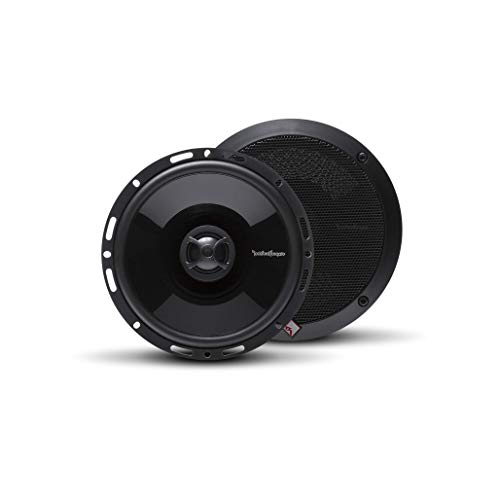
Rockford Fosgate P1650 — Best overall for bass doors
The P1650 sits in Rockford’s Punch line, and the name is a fair description of its priorities. Its mineral-filled polypropylene cone is injection-moulded rather than pressed, which keeps the cone stiff and consistent, and the butyl rubber surround lets it use its excursion without the edging fatigue that foam shows after a few summers in a hot door. In practice this is the speaker on the list that most often makes owners say the kick drum arrived. Bass guitar lines stay distinct instead of smearing into one warm blur, and the low end holds together at volumes where factory speakers have long since started to flap.
What lifts the P1650 above a pure bass hammer is its restraint up top. The silk-dome tweeter is not chasing sparkle; it is voiced to sit under the midbass rather than on top of it, so long drives do not fatigue. Rockford’s FlexFit basket design, with its slotted mounting holes, also quietly solves a real-world problem: many factory doors have slightly non-standard hole spacing, and the P1650 forgives that instead of demanding a drill. The integrated concealed crossover keeps wiring simple for a coaxial — there is no separate box to mount, just a cleaner signal path than the single capacitor on bargain speakers.
- Design: two-way coaxial in the 6.5-inch class
- Cone: injection-moulded mineral-filled polypropylene
- Surround: butyl rubber
- Tweeter: silk dome, integrated concealed crossover
- Impedance: 4 ohm
Strengths
- Midbass with genuine weight and control — the low end punches rather than booms, and stays composed as volume climbs.
- Forgiving installation thanks to the slotted FlexFit basket and a mounting depth that suits most modern doors.
- Balanced voicing that works across genres; nothing in the presentation shouts for attention on a long drive.
Trade-offs
- On pure head-unit power it sounds good rather than great — an amplifier unlocks the bottom octave it is capable of.
- The grille design is plain, which matters if your door leaves the speaker visible and you care about the look.
- It is priced above the budget Skar and Kicker entries, so a four-door set costs noticeably more.
Best for: the majority of sub-free builds — a daily driver who wants one purchase that gets door bass right with no drama. Not suited for: listeners determined to run the cheapest possible four-speaker swap, or anyone chasing maximum treble detail above all else.

Skar Audio TX65 — Best value punch
Skar built its name on subwoofers, and the TX65 from its Elite series carries that house sound into a door coaxial: a deliberate emphasis on the low and midrange that makes small systems sound bigger than they are. The cone uses a pressed paper pulp treated for stiffness — paper remains a fine cone material when it is protected, and Skar pairs it with a foam surround tuned for easy movement. The result is a speaker that sounds generous at the volumes factory systems actually reach, with a low-end tilt that flatters hip-hop, electronic and modern pop production.
The honest caveat sits in that foam surround and in the power story. Foam moves easily, which helps sensitivity, but it ages faster than rubber in doors that bake in summer sun, and the TX65’s bass-forward tune can turn slightly thick if your head unit already boosts the lows. The piezo-style high-frequency arrangement on this class of Skar coaxial is serviceable rather than refined — cymbals are present and clear enough, but this is not the pick for listeners who analyse treble. What you are buying, at a price that undercuts the Rockford and Infinity, is the most low-end enthusiasm per pound in this guide, plus budget headroom to deaden the doors — which, as the how-to section argues, is where the smart money goes anyway.
- Format: 6.5-inch two-way coaxial from the Elite series
- Cone: treated pressed paper pulp
- Surround: foam
- Tweeter: dome tweeter with ferrite magnet structure
- Impedance: 4 ohm
Strengths
- Bass-forward tuning delivers an immediately satisfying sense of scale on factory power.
- Price leaves room in the budget for the sound deadening that makes door bass real.
- Standard mounting pattern and modest depth fit a wide range of factory locations.
Trade-offs
- Foam surround will not outlast the rubber surrounds elsewhere on this list in hot climates.
- Treble is the weakest here — adequate, never a reason to buy the speaker.
- The low-end emphasis can sound thick on head units with aggressive factory bass boost; you may need to trim the bass control.
Best for: budget builds that want maximum perceived bass now and accept a shorter surround lifespan. Not suited for: detail-first listeners, or cars that live outdoors in extreme heat year-round.

Skar Audio RPX65 — Best budget door filler
The RPX65 is Skar’s entry-level coaxial, and its role in this guide is specific: it is the speaker for the car whose factory drivers have torn, buzzed or simply given up, where the owner wants a real improvement in fullness without starting an audio project. It shares the family’s bass-leaning voicing in a simpler construction — a paper cone, foam surround and a basic mylar-style tweeter arrangement — and while it gives away refinement to everything else here, it gives away far less low-end presence than its price suggests. Against a dead factory speaker, the transformation is not subtle: vocals gain body, drums gain a floor, and the system stops sounding like a telephone.
Set expectations by tier and the RPX65 pleases; set them by the P1650 and it will not. Its treble can turn grainy when pushed, and its bass, while willing, loses definition sooner as volume rises — the cone and motor simply have less control in reserve. The sensible way to buy it is as part of a cheap system refresh: four doors done at once, a roll of deadening on the front pair, and the factory head unit’s EQ set flat rather than boosted. Bought that way it is one of the most cost-effective fullness upgrades in car audio. Bought as a would-be audiophile speaker, it will be replaced within a year, and the money would have been better spent once on the TX65 or P1650.
- Format: entry-level RPX-series 6.5-inch two-way coaxial
- Cone: paper pulp
- Surround: foam
- Power character: designed for factory and low-power systems
- Impedance: 4 ohm
Strengths
- The cheapest route on this list to genuine fullness across all four doors.
- Easy-going on power — sounds alive on tired factory head units.
- Light, shallow and undemanding to install in place of failed originals.
Trade-offs
- Treble grain and bass looseness arrive earlier than on any other pick here.
- Foam surround and basic materials set a shorter service life.
- No headroom to grow into an amplifier later; it is a finished answer, not a first step.
Best for: reviving a tired factory system on a strict budget, especially across four doors. Not suited for: anyone planning staged upgrades, or listeners who regularly play at high volume.

Infinity Kappa 63XF — Best clarity with low end
The Kappa 63XF answers a different question from the Skars: what if you refuse to choose between bass weight and the ability to hear the room around a recording? Its glass-fibre cone is stiffer and lighter than the polypropylene norm, which buys two things at once — cleaner pistonic movement in the midbass, so kick and bass stay separate voices, and a midrange that does not collapse into the cone’s breakup modes. Infinity’s edge-driven textile dome tweeter sits in a UniPivot mount that can be aimed, and the tweeter level adjustment lets you tame a bright door location without touching the head unit.
The Kappa’s bass character is definition over sheer thump. It will not out-punch the P1650 in a blind loudness test, and it asks for more power to reach its stride — this is a speaker that thanks you for an amplifier and merely tolerates a weak factory unit. Installation also deserves respect: the Kappa’s basket and magnet are substantial, and shallow doors may need the included mounting hardware arranged carefully. But for the listener whose complaint about door speakers is muddiness rather than thinness, the 63XF is the grown-up answer on this list — the one that keeps a double bass woody and a kick drum skin-tight at the same time.
- Design: Kappa-series 6.5-inch two-way coaxial
- Cone: glass fibre
- Tweeter: edge-driven textile dome, UniPivot aimable mount
- Extras: tweeter level adjustment, Plus One cone-area design
- Impedance: check listing for the 63XF’s low-impedance design before pairing with a marginal amplifier
Strengths
- Best separation and detail here — bass notes have pitch and texture, not just weight.
- Aimable, adjustable tweeter solves bright or awkward factory locations elegantly.
- Plus One cone area squeezes more effective radiating surface from the 6.5-inch format.
Trade-offs
- Needs real power to justify itself; on a weak factory unit its advantages shrink.
- Substantial basket and magnet can challenge shallow doors.
- Premium pricing, and its definition-first bass will feel restrained to thump seekers.
Best for: detail listeners adding or already running an amplifier, who want door bass with articulation. Not suited for: head-unit-only builds on a budget, or shallow doors with no room to work.

Kicker DSC650 — Best on head-unit power
Every guide like this needs the speaker that respects the most common real-world constraint: no amplifier, no plans for one, and a factory head unit that will never be accused of generosity. That speaker is the DSC650 from Kicker’s DS series. Its design brief is efficiency — a rigid polypropylene cone, a ribbed surround that keeps the cone centred through its travel, and a sensitivity figure that lets modest wattage produce genuinely full sound. Where the Kappa asks for power, the Kicker makes do, and “makes do” undersells it: on factory power this is frequently the loudest and fullest-sounding pick in the entire list.
Kicker voices the DS series with a friendly midbass lift and a balanced dome tweeter that avoids the tizz cheap coaxials are known for. The shallow mounting depth is a practical gift in modern doors crowded with window regulators and side-impact hardware. Limits appear when you add power and volume together: the DSC650 will play loud on an amplifier, but its composure at the top of its range is a step behind the P1650, and its bass, while eager, is more midbass fullness than true low reach. As a head-unit build, though, the equation is simple — nothing else here returns so much bass per watt, and that is the only currency a factory system spends.
- Format: DS-series 6.5-inch two-way coaxial
- Cone: polypropylene with ribbed surround
- Tweeter: balanced dome
- Character: high sensitivity, shallow mounting depth
- Impedance: 4 ohm
Strengths
- Fullest sound on factory power of any pick here — efficiency does the work an amplifier would.
- Shallow depth fits doors that reject deeper baskets.
- Polite, fatigue-free tweeter suits talk radio and podcasts as well as music.
Trade-offs
- Composure runs out sooner than the P1650 when an amplifier pushes it hard.
- Bass is fullness more than depth; the lowest notes remain suggested rather than stated.
- Basic crossover limits ultimate clarity next to the Kappa.
Best for: head-unit-only upgrades that still want to feel like a system, not a repair. Not suited for: high-power builds, or listeners who will definitely add an amplifier within the year.

Rockford Fosgate P3V2-65 — Best component upgrade
The P3V2-65 is the one pick here that changes the architecture rather than the driver. As a three-way component system it separates the jobs: a 6.5-inch woofer low in the door devoted to midbass, and separate high-frequency drivers mounted up where your ears actually are — in the A-pillar, sail panel or high door position your car provides. That separation is worth more to perceived quality than any single spec on this page. Door-mounted coaxial tweeters fire at your ankles; a component tweeter fires at your head, and the stereo image, vocal clarity and sense of space all step up a class while the woofer, relieved of treble duty, works its own band with less strain.
Be clear-eyed about the invoice, which is paid in time as much as money. You will run wire to the tweeter locations, mount an external crossover where it stays dry, and spend an afternoon rather than an hour. The system also assumes reasonable power; Rockford’s Punch P3 tier is built to be driven, and on a feeble factory output the simpler DSC650 will sound bigger. But for the reader ready to do the install properly, this is the ceiling of the list: the strongest midbass foundation here, a front stage that finally images, and components that will still make sense when an amplifier joins later. In a sub-free build, where the front doors carry the entire low end, giving them a dedicated woofer and a raised tweeter is the most complete answer available in the 6.5-inch format.
- Type: 6.5-inch three-way component system, Punch P3 series
- Woofer: 6.5-inch door woofer dedicated to midbass and midrange
- Tweeters: separate, surface/flush mountable at ear level
- Crossover: external, mount in a dry location
- Impedance: 4 ohm
Strengths
- Raised tweeters transform imaging and vocal presence in a way no coaxial can match.
- Dedicated woofer delivers the most authoritative midbass foundation on this list.
- Grows with the system — fully at home when an amplifier is added later.
Trade-offs
- Installation is a project: tweeter mounting, crossover placement and extra wiring runs.
- Underwhelming on weak factory power relative to the efficient coaxials here.
- Highest total cost once mounting hardware and time are honestly counted.
Best for: committed front-stage builds where the doors are the whole system. Not suited for: quick factory replacements, leased cars, or anyone unwilling to mount tweeters.
How Much Power Does Door Bass Really Need?
Power requirements in a sub-free build are misunderstood in both directions. One camp insists nothing works without a large amplifier; the other expects miracles from a factory radio. The truth is governed by sensitivity and by how loud you honestly listen. Most daily driving happens at moderate volume, where even a factory head unit delivers enough clean power to make an efficient 6.5-inch speaker sound full — provided the door is sealed. Bass notes demand the most cone movement, so they are the first casualty when an amplifier runs out of clean output: the sound does not get quieter so much as harder, thinner and more distorted, because the clipped waveform stops describing the note. That is why owners often report that an amplifier “added bass” to speakers they already owned — it did not change the speaker’s low-frequency extension at all; it simply let the existing extension play at volume without distortion eating it.
So the practical rule is to match the speaker’s appetite to the power you truly have today, not the power you daydream about. If an amplifier is a definite purchase within months, buy the P1650 or Kappa and accept a few restrained months. If it is a vague someday, buy the DSC650 or TX65 and enjoy the system now; an efficient speaker on an amplifier later still sounds good, merely less ultimate than a hungrier design. What you should not do is buy the least efficient speaker on the list for the weakest head unit in the name of future-proofing — future-proofing that sounds worse every single day until the future arrives is a poor trade.
Will These Speakers Fit Your Doors?
The label “6.5 inch” conceals a small family of related sizes. True 6.5-inch drivers, oversized 6.75-inch variants, and metric 165 mm speakers all compete for the same factory holes, and manufacturers are not perfectly consistent about which label they print. Before ordering, measure the factory driver’s diameter and mounting depth, or consult a fitment guide for your exact vehicle and year. Most picks here use standard 6.5-inch mounting patterns and moderate depths that suit the majority of doors; the Kappa’s larger magnet structure and the component system’s separate parts are the two cases where a tape measure earns its keep.
Depth matters as much as diameter because the window glass travels down behind the speaker in most doors. A driver that is too deep either blocks the glass or gets struck by it — a failure you discover the first time you lower the window after the install. If your chosen speaker is marginal, shallow spacer rings can buy clearance at the cost of pushing the cone closer to the door card, which must then clear the surround at full excursion. Check both ends of the travel before the panel goes back on: window fully down, speaker playing a bass-heavy track at your maximum sane volume, panel test-fitted. Ten patient minutes here prevent the classic rattle-and-regret cycle.
Also confirm what your factory system expects electrically. A small but real minority of vehicles use 2-ohm factory speakers or actively crossed-over premium systems where the door driver receives only a low-passed signal. In an actively crossed system, a coaxial’s tweeter may receive nothing to reproduce, and a component set with its own crossover can behave oddly. If your car has a branded premium audio option, research its architecture before choosing; the picks themselves are all conventional passive speakers designed for a full-range signal.
What Should You Listen For on the First Drive?
Judge a sub-free door build with music that stresses the right things. A well-recorded kick drum should arrive as a felt thump with a defined leading edge, not a woolly bloom that lingers into the next beat. A bass guitar line should let you follow individual notes up and down the neck; if every note sounds like the same warm hum, the system has midbass quantity without control, and a small cut in the 100–200 Hz region of your EQ — or better door sealing — is the cure rather than more volume. Male vocals are a useful lie detector: they should sound chesty and present without booming, because their fundamentals sit exactly where door speakers are tempted to exaggerate.
Then listen for what should not be there. Buzz on specific notes points to a loose panel, loom or regulator, not a speaker defect. Distortion that arrives suddenly at a certain volume, across all material, is amplifier clipping. A left-right imbalance in the low end usually means one door sealed better than the other, or one driver wired out of polarity — reversed polarity on one side cancels bass in the middle of the car while leaving each speaker sounding plausible on its own. That last fault is worth checking first on any install that disappoints, because it costs nothing to fix and masquerades as weak speakers.
How Do the Six Compare Side by Side?
| Model | Type | Bass character | Power appetite | Install effort |
|---|---|---|---|---|
| Rockford P1650 | Coaxial | Punchy, controlled | Moderate — rewards an amp | Low |
| Skar TX65 | Coaxial | Bass-forward, generous | Low | Low |
| Skar RPX65 | Coaxial | Willing, loosens early | Very low | Very low |
| Infinity Kappa 63XF | Coaxial | Defined, articulate | High | Moderate |
| Kicker DSC650 | Coaxial | Full midbass per watt | Very low | Very low |
| Rockford P3V2-65 | Component, 3-way | Deepest foundation | Moderate to high | High |
Read the table by your constraint, not by the badge order. Power first: if no amplifier exists or is planned, the honest shortlist is the DSC650, TX65 and RPX65, in descending order of refinement. If an amplifier is present, the P1650 and Kappa contest the top, split by taste — punch versus articulation — and the P3V2-65 sits above both for anyone willing to install it. Budget second: the two Skars let you fund door treatment, which the next sections argue is not an accessory but half the product.
How Should You Prepare a Door to Act Like an Enclosure?
Start with the panel off and the factory speaker out, and look at what the manufacturer left you: typically a speaker hole, several large service openings in the inner door skin, and a thin plastic vapour barrier. Those service openings are the enemy of bass, because the cone’s back wave escapes through them and cancels the front wave. Covering them with sound-deadening mat — the butyl-and-foil sheets sold for exactly this — seals the cavity, adds mass to the thin metal so it stops resonating, and routinely transforms the same speaker’s low end. Apply mat around the speaker mounting surface too, and use a foam gasket or fast ring behind the driver so its output is coupled into the cabin rather than leaked into the door.
While the panel is off, deal with the rattles you will otherwise chase for months: clip every loose wiring loom, add foam tape where the panel meets metal, and check the window regulator bolts. Then set expectations with the head unit. Turn loudness and factory bass boost off, set EQ flat, and only then judge the speakers — most factory systems ship with a low-end boost tuned for anaemic paper cones, and feeding that boost into capable speakers produces boom and distortion that owners wrongly blame on the new drivers. Add boost back a notch at a time only if the result still sounds thin at your normal volume, and prefer a small cut elsewhere to a large boost anywhere.
Finally, protect your work. Doors are wet environments by design — water enters past the window seal and drains from holes in the bottom. Keep deadening and crossover placements out of the drain path, use speaker baffles or foam shields where the factory design exposes the driver’s back to direct runoff, and never block the drain holes themselves. A sealed-for-sound door that traps water trades a bass improvement for a rust problem, and no speaker on this list is worth that bargain.
Does Speaker Break-In Change the Bass?
New speakers do change slightly over their first hours of use: the surround and spider soften from their factory stiffness, and the low end typically gains a small amount of ease and extension as the suspension settles. The change is real but modest — a seasoning, not a transformation. Judge a new install’s character after a week of normal driving rather than in the first ten minutes, but do not use break-in as an explanation for a fundamentally thin result. If the doors are unsealed or a driver is wired out of polarity, no amount of playing time repairs it; the mechanical settling of a suspension cannot fix an acoustic leak. Conversely, if the install sounds right on day one, break-in will only nudge it in the direction it is already going, which is why the test-listen checklist earlier in this guide focuses on faults — buzzes, clipping, imbalance — that time will never cure on its own.
What Are the Most Common Mistakes in a Sub-Free Door Build?
The most expensive mistake is shopping by peak wattage. The large number on a speaker box describes a momentary laboratory figure, not the continuous power the driver wants, and buyers who match peak numbers to a head unit end up with hungry speakers on a starvation diet. Shop by sensitivity and realistic continuous ratings instead. The second mistake is skipping door treatment to afford a higher speaker tier; in controlled comparisons the treated door with the mid-tier speaker wins, because the enclosure problem dominates the driver problem at these sizes.
Third comes EQ panic: hearing less boom than the old factory tune and immediately boosting the bass control, which pushes small amplifiers into clipping and sends distorted power to brand-new cones. Fourth is mixing intentions — fitting a component system but mounting its tweeters low in the door because it is easier, which surrenders the system’s main advantage while keeping all of its cost. And fifth is forgetting the rear doors exist in the budget conversation at all: a front-only upgrade is a legitimate strategy, but fading a strong front stage against dreadful rear speakers still colours the result, so at minimum plan the rear pair’s tier before the front pair is chosen.
What Does Each Pick Ask of Your Doors?
P1650: the least fussy of the amplifier-friendly picks. Its slotted basket forgives imperfect factory hole spacing, and its integrated crossover means the wiring job ends at the speaker terminals. Give it a sealed mounting surface and it returns the favour immediately; it is the pick least likely to generate a second weekend of troubleshooting.
TX65: plan the install around its foam surround’s environment. In doors that channel a lot of water past the driver, a foam speaker baffle behind it is sensible protection. Its easy movement also means it reveals panel rattles sooner — it will find the loose clip you skipped, usually during the first bass-heavy chorus.
RPX65: the fastest install here, deliberately. It drops into factory holes on factory wiring and asks nothing else, which is precisely its brief. Resist upgrading its wiring or adding hardware; the money belongs in the front doors’ deadening or saved toward the eventual tier above.
Kappa 63XF: measure depth before ordering and decide the tweeter angle during a test fit, not after the panel is clipped back. The UniPivot mount rewards a few minutes of aiming — a small tilt toward the opposite headrest usually beats pointing both tweeters straight at the nearest ear.
DSC650: its shallow depth makes it the problem-solver for crowded modern doors, including many where the window track leaves little room. Because it is efficient, it also exposes a noisy factory source more honestly; if your head unit hisses, you will hear it — that is the source talking, not the speaker.
P3V2-65: budget the install as two jobs — woofer and crossover in the door, tweeters up high — and mount the crossovers inside the cabin side of the door or under the dash rather than inside the wet door cavity where possible. Label left and right crossover outputs before running wire; component installs generate more “which wire was that” moments than any other job in this guide.
Should the Rear Doors Get the Same Treatment?
Rear doors in a sub-free build play a supporting role with one important exception: passengers. From the front seats, rear speakers contribute fill and a sense of envelopment, and their bass contribution is real but secondary — your ears localise the front stage, and the system’s punch is judged there. That is why the staged plan of strong front doors first, rears later, works. When the rear upgrade happens, matching the front model keeps tonal balance coherent as sound pans; dropping one tier at the rear is the acceptable economy, dropping to a completely different voicing is not.
The exception is the vehicle that regularly carries rear passengers who care — family cars, crew-cab trucks used as family transport, anything where the back seat is a listening seat rather than cargo space. There, rear doors deserve the same sealing treatment and a speaker of genuine quality, because an untreated rear door at family volume sounds exactly as thin to them as your original front doors sounded to you. The RPX65 and DSC650 both make honest rear-fill choices behind a stronger front pair, with the Kicker the pick where rear passengers get head-unit power only.
How Long Will a Door Install Like This Last?
Materials decide lifespan more than brand tier. Rubber surrounds — on the P1650 and DSC650 class of design — routinely survive a decade of door duty, while foam surrounds trade some of that longevity for easy movement, which is a fair trade at the Skars’ prices provided you know you are making it. Heat is the accelerant: a car parked outdoors in a hot climate ages every soft part faster, and no speaker is immune. The electronics, by contrast, almost never wear out — crossovers and tweeters removed from twenty-year-old cars usually still work; it is surrounds, glues and cone treatments that time collects.
You can extend any pick’s life with habits that cost nothing. Keep drain holes clear so drivers are not sitting above standing water. Do not use maximum volume as a daily setting — distortion is clipped amplifier output, and clipped output is what cooks voice coils. And if a speaker starts buzzing on bass notes after years of service, check the surround and the mounting screws before assuming the driver has died; a perished surround or a worked-loose screw imitates terminal failure convincingly and is far cheaper to put right.
Does Wiring Deserve Any of the Budget?
For a head-unit build, factory speaker wire is adequate: the runs are short, the power is modest, and replacing it buys nothing audible. Spend the money on deadening instead. Wiring earns attention in two specific situations. The first is age — in older vehicles, corroded terminals and chafed insulation in the door jamb, where the loom flexes every time the door opens, quietly eat output and can imitate a failing speaker with crackles that come and go over bumps. Inspect the jamb boot and terminals while the panel is off; cleaning or repairing a connection there is unglamorous and genuinely effective. The second situation is a future amplifier: if the doors are open today and an amplifier is genuinely planned, running quality wire now, while access is free, saves repeating the labour later. Label both ends of every run you add. Future you, fault-finding in February, will be grateful.
One wiring fault deserves a second mention because it is the single most common cause of a “no bass” verdict on good speakers: polarity. If one door driver is wired backwards relative to the other, the pair cancel each other’s low frequencies in the centre of the cabin. The test takes a minute — play a mono recording, sit centrally, and listen for whether the bass and the vocal image sit solidly in the middle. If the low end feels hollow and the image wanders, swap the connections on one speaker and listen again. This check costs nothing, requires no tools beyond panel access you already have, and has rescued more sub-free builds than any product upgrade in this guide.
Final Recommendation
For most readers the Rockford Fosgate P1650 is the purchase: it delivers the punch this keyword promises, installs without drama, and has headroom to spare if an amplifier arrives later. If there will never be an amplifier, buy the Kicker DSC650 and spend the savings on deadening. If money is the binding constraint, the Skar TX65 — or the RPX65 across four doors — buys real fullness honestly. The Kappa 63XF is the connoisseur’s coaxial, and the P3V2-65 is the full-commitment answer. Choose by your power and your patience, treat the doors as enclosures, and a 6.5-inch pair will carry your music’s weight with nothing in the boot but luggage.
Frequently Asked Questions
Can 6.5-inch door speakers really replace a subwoofer?
They can replace the need for one in most daily listening, covering kick, bass guitar and warmth convincingly. They cannot reproduce the deepest sub-bass of electronic music or film effects. If your library lives down there, plan a small subwoofer later and choose an amplifier-friendly pick such as the P1650 now.
Do I need an amplifier for door bass?
No, provided you choose an efficient speaker and treat the doors. The DSC650 and TX65 are built for that job. An amplifier still improves control and headroom for every pick here, and it is close to mandatory to hear the Kappa 63XF or P3V2-65 at their best.
Why did my new speakers have less bass than expected?
Almost always the door, not the driver: unsealed service holes cancel low frequencies, and factory bass boost tuned for the old speakers distorts the new ones. Seal the openings with deadening mat, set EQ flat, and reassess before returning anything.
Should I upgrade front or rear doors first?
Front. You sit facing the front stage, and in a sub-free build the front doors carry the system. Do the front pair properly — speakers plus treatment — then match the rears later at the same or one tier below.
Will a high-pass filter help my door speakers play cleaner?
Yes, if your head unit or amplifier offers one. Asking a 6.5-inch door driver to attempt the very lowest frequencies wastes excursion it could spend on the bass it can actually reproduce, and it muddies everything above. A gentle high-pass somewhere in the region below the kick drum’s weight — set by ear, starting conservatively — lets the cone stop chasing notes it cannot play and devote its travel to the ones it can. The improvement is clarity and headroom rather than more bass, and in a sub-free build that trade is usually worth making once the doors are sealed.
How long does a four-door upgrade take?
Speakers alone, in a car you know, can be an hour a door. Speakers plus proper door treatment is a full day for four doors the first time — most of it panel removal, sealing and rattle-hunting rather than the drivers themselves. Do the front pair completely on day one rather than all four doors halfway; a finished front stage tells you whether the approach is working before the second day is committed.
Coaxial or component for a bass-focused build?
Coaxial for simplicity and value; component when imaging matters and you will mount the tweeters high. The woofer’s bass contribution is similar in both formats at this size — the component advantage is where the treble comes from, not how much low end exists.
Related Guides
Best 6.5 Inch Midrange Speakers for Loud, Clear Vocals · Best 6.5 Midbass Speakers for Punch in the Doors · Best 6.5 Marine Speakers That Run Without an Amp



[…] the bass side of the door-speaker story, read Best 6.5 Door Speakers for Bass Without a Subwoofer; for the vocal specialists, see Best 6.5 Inch Midrange Speakers for Loud, Clear Vocals; and for […]