What's inside
- Key Takeaways
- Quick Picks
- How the Marine Shortlist Was Chosen
- Comparison
- How Does Bluetooth Actually Reach a Boat’s Speakers?
- What Should You Measure Before Cutting a Single Hole?
- How Do You Keep Installed Marine Audio Alive Season After Season?
- Where Do Speakers Belong on a Small Boat, a Cruiser and a Wake Boat?
- Which Installation Shortcuts Come Back as Next Season’s Repairs?
- How Much Amplifier Does a Cockpit Pair Actually Need?
- What Changes on a Sailboat Compared With a Powerboat?
- How Do You Plan Zones Without Turning the Boat Into a Nightclub?
- What Should a Buyer Listen for in the First Hour After Installation?
- How Does a Marine System Hold Its Value at Resale Time?
- What Does a Sensible Phased Refit Look Like Across Two Seasons?
- Final Recommendation
- Frequently Asked Questions
- Related Guides
As an Amazon Associate I earn from qualifying purchases. This post may contain affiliate links at no extra cost to you.
widgetverdict.com is reader-supported. When you buy through links on our site, we may earn an affiliate commission.
Anyone searching for the best bluetooth boat speakers deserves a straight answer before a shopping list, so here it is: there is no such thing as a portable Bluetooth speaker category for boats in the way there is for beaches, and the six products below are not carry-on gadgets. They are marine audio — speakers designed to be cut into a boat’s panels, wired into its 12-volt system and driven by a stereo head unit or an amplifier, with Bluetooth arriving through that electronics chain rather than through a battery in the speaker. That is not a disappointment or a bait-and-switch. It is why boat audio sounds better, lasts longer and survives weather that would end a portable speaker’s career in a single season. But it changes what buying means: you are fitting a system, not purchasing an accessory.
The line-up reflects that reality honestly. Three picks come from Garmin’s Fusion range — the XS 6.5 Classic rated at 200 watts in its listing, the Signature Series 3i 7.7 coaxial pair at 280 watts, and the XS 7.7 Sports at 240 watts with RGB lighting — and they are passive speakers, expecting a Fusion or compatible stereo to feed them. Herdio’s 6.5-inch pair puts Bluetooth in its own title and aims at boats plus ATVs, UTVs and golf carts. BOSS sells the shortcut: a marine stereo kit bundling a head unit with a pair of 6.5-inch speakers. And DS18’s tower speakers arrive with their own amplifier and remote, built for wakeboard towers rather than cabin panels. Six products, three different architectures, one shared requirement: tools, wire, a tape measure, a tube of marine sealant and an afternoon you are willing to spend once so that a decade of afternoons can spend themselves differently.
It is also worth naming what this category is not competing with. A boat’s installed system does not replace the portable speaker in the dinghy, at the beach picnic or in the dockside shower block; it replaces the silence — or the tinny compromise — at the centre of the boat’s own life, the cockpit hours that accumulate into the majority of all the music a boating family ever hears. Judged on those hours, installed audio is not the expensive option. It is the option whose cost is divided by a decade.
Claims in this guide are held to the listings exactly. Wattages are quoted as printed — noting that Herdio’s 120W is a peak figure, as its title states — and no IP ratings are asserted for any pick, because none of the six listings prints one. Marine speakers live in a world of salt, spray and ultraviolet light, and their makers’ reputations for surviving it are discussed as reputation. Where a listing is silent, the review says what the product is and lets the silence stand.
Key Takeaways
- Boat speakers are installed equipment: every pick here mounts permanently and draws power from the boat, with Bluetooth supplied by a head unit, an amplifier or the speaker’s own built-in receiver where its listing says so.
- The Garmin Fusion XS 6.5 Classic is the sensible default panel speaker — a 6.5-inch, 200-watt design in Garmin’s marine Fusion range, supplied with white and black grille options per its listing.
- The Fusion Signature 3i 7.7 is the upgrade path: a 280-watt coaxial pair in classic white for owners building a serious Fusion system.
- The Fusion XS 7.7 Sports adds RGB lighting to a 240-watt, 7.7-inch format for boats whose evenings matter as much as their days.
- Herdio’s 6.5-inch pair is the budget route and the flexible one, naming Bluetooth in its title and suiting boats, ATVs, UTVs and golf carts alike.
- BOSS’s MCKGB450B.6 kit bundles a marine stereo with a pair of 6.5-inch speakers — the fastest route from silence to a working Bluetooth system — while DS18’s amplified tower pair serves wake boats that need sound thrown aft.
- No listing in this set prints an IP rating, and this guide asserts none; marine survival is argued from each maker’s specialisation and from installation quality, and buyers who require a certified grade should request the maker’s current documentation for the exact model.
Quick Picks
| Pick | Badge | Why it earns its place |
|---|---|---|
| Garmin Fusion XS 6.5 Classic | The default panel speaker | A 6.5-inch, 200-watt marine speaker from the Fusion range, in classic styling with white and black finishes named in its listing. |
| Garmin Fusion Signature 3i 7.7 | The serious-system upgrade | A 7.7-inch, 280-watt coaxial pair in classic white, from Fusion’s Signature Series 3i line. |
| Garmin Fusion XS 7.7 RGB | The evening boat’s speaker | A 7.7-inch, 240-watt sports-format speaker with RGB lighting built into the design. |
| Herdio 6.5 Marine Bluetooth Speakers | The budget all-rounder | A two-way 6.5-inch pair with Bluetooth in its title and a 120W peak rating, aimed at boats, ATVs, UTVs and golf carts. |
| BOSS MCKGB450B.6 Marine Stereo Kit | The one-box system | A marine boat stereo bundled with a pair of 6.5-inch speakers — head unit and speakers in a single purchase. |
| DS18 MP4TP.4A Marine Tower Speakers | The wake-tower specialist | 4-inch tower speakers rated at 600W in their listing, with Bluetooth, an amplifier and a remote in the package. |
How the Marine Shortlist Was Chosen
Architecture came first. A boat audio guide that mixed passive panel speakers, self-amplified towers and complete kits without distinguishing them would mislead every reader it served, so the shortlist was built to represent each architecture at its most sensible: Fusion for the panel-speaker system builders, in three grades; Herdio for the simple powered-by-your-existing-setup pair with Bluetooth named outright; BOSS for the owner who needs the whole chain in one box; DS18 for the tower application that panel speakers physically cannot serve. Every pick was then read against its listing word by word, and only the facts printed there — sizes, wattages, formats, bundled components — are asserted in the reviews.
Marine credibility formed the second filter, applied as judgement rather than as a spec. The Fusion name carries the weight of Garmin’s marine electronics business behind it; BOSS has supplied budget marine and vehicle audio for years; DS18 is a known quantity in the tower and powersports world; Herdio serves the value end where boats share driveways with ATVs and golf carts. None of that substitutes for a printed IP grade, and the absence of printed grades across all six listings is itself reported in this guide rather than papered over — buyers for whom a certified rating is a condition of purchase should confirm the current product documentation with the maker before ordering.
A word about the word Bluetooth in this keyword, because it misleads more boat owners than any other in the category. On a product page for a portable speaker, Bluetooth describes the whole product. On a boat, Bluetooth describes one link in a chain — the hop between the phone and the electronics — and the rest of the chain is wire, amplification and installed speakers doing work no radio can do. Owners who understand that distinction shop calmly: they choose the chain first and the link second. Owners who miss it buy speakers expecting radios inside them and spend a confused weekend discovering otherwise. This guide’s structure — architecture before adjectives, in every review — is built to put its readers permanently in the first group.
Finally, the shortlist was tested against the question every boat owner actually asks: what will this sound like underway, at anchor, and in three seasons’ time? Panel speakers in a cockpit, towers throwing aft, a kit refreshing an older boat’s dead stereo — the six picks divide those lives between them, and the reviews grade each pick inside its own life rather than against an abstract ideal no installed speaker could meet.

Garmin Fusion XS 6.5 Classic — The default panel speaker
Most boat audio journeys begin with a pair of round holes in a cockpit panel and a stereo that has given up, and the XS 6.5 Classic is the speaker those journeys most sensibly start with. Garmin’s listing describes a Fusion XS Series marine speaker, 6.5 inches, rated at 200 watts, in classic styling, with white and black named — the two grille colours that between them match nearly every cockpit ever moulded. As a passive speaker it brings no Bluetooth of its own and no battery; it expects a head unit or amplifier to feed it, and in return it offers the installed virtues no portable can match: it is always aboard, always powered by the boat, and impossible to leave in the car.
The Fusion context matters. Garmin bought Fusion to anchor its marine entertainment line, and the XS series sits inside an ecosystem of stereos, amplifiers and remotes designed to be specified together — which means a boat fitted with these speakers has a coherent upgrade path: a Fusion stereo today, an amplifier when the budget allows, additional zones when the refit bug bites. The classic grille styling is deliberately anonymous, suiting family cruisers and fishing boats that want sound without a nightclub accent. Rated at 200 watts in the listing, the XS 6.5 has the headroom to be driven properly by a real marine amplifier rather than merely by a head unit’s modest output, and that headroom is what clear sound at cruising speed is made of.
Buyers should understand the transaction precisely. The box contains speakers; the system requires a source. If your boat already runs a working marine stereo with Bluetooth, these are the clean, credible replacement or first-fit speakers to hang from it. If your boat has no stereo at all, read the BOSS kit review below before ordering, because speakers alone will give you beautifully mounted silence. Judged inside its architecture, the XS 6.5 Classic is the guide’s default recommendation for the typical cockpit refit.
- Size and rating: 6.5-inch marine speaker, 200 watts per the listing
- Series: Garmin Fusion XS, classic styling
- Finishes named in the listing: white and black
- Architecture: passive panel speaker — needs a stereo or amplifier source
Strengths
- The Fusion ecosystem gives the installation a coherent future: stereos, amplifiers and zones from one marine specialist.
- Classic styling and two grille colours disappear into almost any cockpit design.
- A 200-watt rating leaves genuine headroom for amplifier-driven clarity underway.
Trade-offs
- No source is included; a boat without a working stereo needs one before these make a sound.
- Panel mounting means cutting holes — a permanent decision portable speakers never ask for.
- The listing prints no IP grade, so certification-minded buyers should consult Garmin’s documentation.
Best for: cockpit refits and first fits on boats with a working or planned Fusion-style stereo.
Not suited for: anyone hoping to unbox music this afternoon with no wiring involved.

Garmin Fusion Signature 3i 7.7 — The serious-system upgrade
The Signature Series is where Fusion stops being merely sensible and starts being aspirational, and the 3i 7.7 is its statement in this guide: a pair of 7.7-inch marine coaxial speakers rated at 280 watts, in classic white. Coaxial describes the architecture — the tweeter mounted within the woofer’s axis, so high and low frequencies arrive from the same point — and in a boat cockpit, where listeners sit at wild angles to the speakers and stereo imaging is a pleasant fiction, a well-executed coaxial is the honest engineering answer. The larger 7.7-inch format moves more air than the 6.5-inch XS, and the 280-watt rating tells the amplifier shopper exactly what class of power the design is ready to use.
Who is this for? The owner building a system rather than replacing a component: a Signature-level stereo or a substantial amplifier, a boat whose cockpit is a social space at anchor, and ears that can hear the difference between adequate and composed when the engines are off and the evening is quiet. Underway, wind and engine noise will tax any speaker; at anchor, in the still of a marina at dusk, the Signature pair’s extra refinement is the whole point of the evening. Classic white suits the bright, gel-coated cockpits of the cruisers and centre consoles where such systems live.
The cautions are the honest companions of ambition. A 7.7-inch cutout is a bigger commitment than a 6.5, and older panels may not offer the depth or the flat area the format wants. The pair deserves real amplification; feeding Signature speakers from a tired head unit’s internal chip is the marine equivalent of putting budget tyres on a sports car. And the listing, again, prints no IP grade — Garmin’s marine reputation carries the environmental argument, and buyers should read the maker’s current documentation for the certified details before a salt-water installation.
- Format: 7.7-inch coaxial marine speakers, sold as a pair
- Rating: 280 watts per the listing
- Series: Garmin Fusion Signature Series 3i
- Finish named in the listing: classic white
- Architecture: passive — designed for a quality stereo or amplifier
Strengths
- Coaxial design keeps the sound coherent for listeners scattered around a cockpit.
- The larger format and 280-watt rating support genuinely powerful, composed playback at anchor.
- Signature-tier positioning brings the ecosystem’s best engineering to the speaker position.
Trade-offs
- Bigger cutouts and a real amplifier budget are part of the true purchase price.
- Classic white only, per this listing — dark cockpits should look at the XS range instead.
- Its refinement is wasted on boats whose listening happens only over engine noise.
Best for: system builders fitting out a cruiser or console boat for serious at-anchor listening.
Not suited for: quick replacements on small boats with modest head units.

Garmin Fusion XS 7.7 RGB — The evening boat’s speaker
Some boats work the day shift and some work the evening, and the XS 7.7 Sports with RGB is built for the second kind. The listing describes a 7.7-inch Fusion XS Series marine speaker rated at 240 watts, in sports styling, with RGB lighting integrated. The lighting is not decoration pasted onto an audio product; on the water after dark, cockpit lighting is atmosphere, safety and identity at once — the glow that makes a boat findable, boardable and photogenic — and speakers are a natural place to put it, since they already occupy the cockpit’s corners with wiring behind them.
The 7.7-inch format and 240-watt rating place this pick between the XS 6.5 and the Signature pair in raw capability: a substantial speaker with real headroom, voiced and styled for the sports-boat world of towers, swim platforms and evening raft-ups. RGB control typically runs through the Fusion ecosystem’s lighting controllers and app environment, so owners already inside that ecosystem will find the integration natural; owners arriving fresh should budget the controller question into the project plan, because light that cannot be controlled is merely light that happens to you. Sports styling — bolder grilles than the classic line — suits boats whose design language is already extroverted.
As with its Fusion siblings, this is a passive speaker: the music still arrives from a stereo or amplifier, and Bluetooth arrives with that source. The RGB’s power and control wiring adds an installer hour to the job, which is worth stating plainly in a guide that respects its readers’ weekends. For the boat that hosts sunset cruises and evening gatherings — the boat whose cockpit is a room that happens to float — the XS 7.7 RGB is the pick that treats that room properly.
- Size and rating: 7.7-inch marine speaker, 240 watts per the listing
- Lighting: RGB integrated, per the listing
- Series: Garmin Fusion XS, sports styling
- Architecture: passive panel speaker within the Fusion ecosystem
Strengths
- Integrated RGB turns the speaker positions into the cockpit’s evening lighting scheme.
- The 7.7-inch format delivers real output for open cockpits and swim-platform listening.
- Fusion ecosystem membership keeps stereo, amplifier and lighting control in one family.
Trade-offs
- Lighting control hardware and wiring add cost and installation time beyond a plain speaker swap.
- Sports styling will look loud in a traditional, teak-and-white cockpit.
- No IP grade is printed in the listing; check Garmin’s documentation for certified ratings.
Best for: sports boats and evening cruisers whose cockpits host gatherings after dark.
Not suited for: traditional boats, or a speaker swap with no extra wiring involved.

Herdio 6.5 Marine Bluetooth Speakers — The budget all-rounder
Herdio’s listing says the quiet part out loud: these are marine Bluetooth speakers, a two-way 6.5-inch pair rated at 120W peak, in black, aimed at boats and equally at cars, ATVs, UTVs and golf carts. That breadth of ambition tells you the product’s philosophy — a simple, affordable speaker pair for vehicles that live outdoors, with Bluetooth named in the speakers’ own description rather than delegated entirely to a head unit. For the small boat, the jon boat, the pontoon on a budget, or the golf cart that shares the driveway, that simplicity is a genuine architecture, not a compromise: fewer components, less money, music sooner.
The 120W figure carries its own honesty label — peak, as the listing states — and peak figures describe momentary capability rather than sustained output, so expectations should be set for cheerful, clear sound at the volumes small craft need, not for harbour-filling power. Two-way construction means separate drivers for low and high frequencies, the basic recipe for intelligible music and speech over wind and a small outboard. Black grilles suit workboat and utility aesthetics, and the multi-vehicle brief means mounting patterns and expectations are forgiving: this is equipment for machines that earn their keep.
Where does the Herdio pair lose to the Fusion range? In ecosystem, in refinement, and in the depth of marine specialisation behind the name. Where does it win? In the driveway arithmetic of real life, where the boat shares a budget with a trailer, a truck and a family. Owners of modest craft who want Bluetooth music aboard without a head-unit project will find this pair the most direct route in the guide — provided they read “peak” honestly and keep their volume ambitions sized to their boat.
- Format: 6.5-inch two-way marine speakers, sold as a pair
- Rating: 120W peak, as stated in the listing
- Bluetooth: named in the product’s own title
- Intended vehicles, per the listing: boats, cars, ATVs, UTVs, golf carts
- Finish in this listing: black
Strengths
- The most direct route to Bluetooth music on a small boat, without a separate head-unit project.
- Multi-vehicle versatility lets one purchase serve the boat and the yard machines alike.
- Two-way design keeps voices and music intelligible over small-engine noise.
Trade-offs
- The 120W figure is a peak rating; sustained output expectations should be modest.
- No marine ecosystem stands behind it — no matched stereos, amplifiers or lighting control.
- The listing prints no IP grade, so heavy-weather installations deserve extra caution.
Best for: small boats, pontoons and utility vehicles needing simple Bluetooth sound on a budget.
Not suited for: large cockpits or owners building a multi-zone Fusion-style system.

BOSS MCKGB450B.6 Marine Stereo Kit — The one-box system
The Fusion trio and the DS18 pods each presume that part of a system already exists aboard. The BOSS kit presumes nothing: its listing describes a marine boat stereo bundled with a pair of 6.5-inch speakers, which is to say the whole chain — source, controls and sound — in one purchase. For the enormous fleet of older boats running a dead cassette deck or an empty dashboard hole, that completeness is the product. A stereo head unit brings the radio, the inputs and the Bluetooth connection; the speakers bring the noise; the owner’s Saturday brings the wiring. By Saturday evening, a silent boat has a system.
BOSS occupies the value tier of vehicle and marine audio with a clear-eyed brief: everything works, nothing is precious, and the price of entry stays low enough that a fishing boat can justify music. Kit thinking also solves the compatibility question that haunts component shopping — the head unit and speakers in one box were specified to work together, so the first-fit owner is spared the impedance-and-output homework that the Fusion path, for all its rewards, eventually assigns. The 6.5-inch speaker size matches the commonest cutouts in the industry, which matters when the kit is refreshing holes a previous decade already drilled.
The honest limits are refinement and ceiling. A kit at this tier will not out-resolve a Signature-level component system, and owners who catch the audio bug will eventually upgrade through it — which the kit’s defenders would call a feature, since it teaches the boat’s owner what they actually want before serious money moves. As the fastest, simplest route from silence to Bluetooth aboard, nothing else in this guide competes with it.
- Package: marine stereo head unit plus a pair of 6.5-inch speakers
- Architecture: complete kit — source and speakers in one purchase
- Maker: BOSS Audio Systems, marine line
- Best-fit job: refreshing boats with dead or missing stereos
Strengths
- One purchase delivers the entire Bluetooth audio chain, with compatibility settled in advance.
- The common 6.5-inch speaker size suits the cutouts most older boats already have.
- Value-tier pricing makes music a rational upgrade even for working boats.
Trade-offs
- Component-system refinement is beyond a kit at this level; keen ears will hear the ceiling.
- The listing’s title states no wattage, so output comparisons rest on the kit’s format and tier.
- Owners bitten by the upgrade bug will treat it as a first step rather than a destination.
Best for: older boats with dead or missing stereos, and music this weekend, complete.
Not suited for: audiophile refits or multi-zone systems planned from a blank sheet.
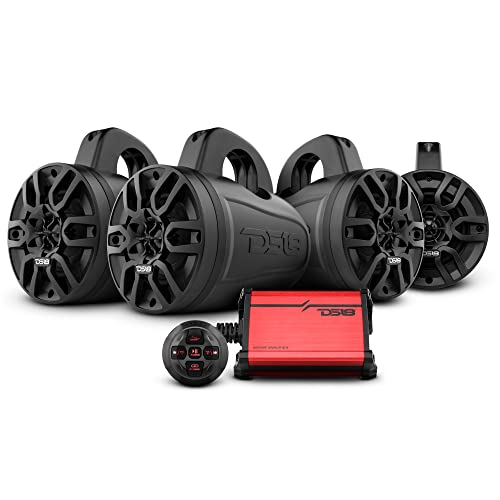
DS18 MP4TP.4A Marine Tower Speakers — The wake-tower specialist
Tower speakers exist to solve a geometry problem: the listener is behind the boat, on a board or a rope, and the music must travel aft across engine noise and water. DS18’s listing describes 4-inch marine tower speakers rated at 600W, with Bluetooth, an amplifier and a remote included — a self-contained pod system that clamps to a wakeboard tower and brings its own power and control. The included amplifier matters enormously in this architecture: tower pods sit far from the head unit, and a system that arrives with matched amplification sidesteps the output calculations that strand many DIY tower projects.
The 600W figure should be read as the listing’s headline for the package — a peak-oriented number in the style of the powersports audio world — and the practical translation is simpler: this is a loudness-first design for listeners at rope’s length, where clarity at distance is bought with power and with drivers aimed like spotlights. The remote completes the working picture, because the person who needs the volume changed is rarely the person at the helm; control that lives with the action, rather than at the dashboard, is a safety feature wearing a convenience costume. Bluetooth in the package keeps the phone — and therefore the playlist — wherever the crew wants it.
Tower pods are specialists, and their trade-offs are the specialist’s own. They serve the water behind the boat superbly and the cockpit indifferently; they add windage, weight aloft and a visual statement that traditional boats will not want; and clamp compatibility with your tower’s diameter is a measurement to make before ordering, not after. For wake boats whose entire purpose is the rider astern, no panel speaker in this guide can do this job at all — which is precisely why the DS18 earns the sixth seat.
- Format: 4-inch marine tower speakers for wakeboard towers
- Rating: 600W as printed in the listing
- Package includes, per the listing: amplifier and remote
- Bluetooth: named in the product’s title
- Architecture: self-amplified pods, clamped to the tower
Strengths
- Purpose-built to throw sound aft to riders, a job panel speakers cannot do.
- Included amplification removes the hardest calculation in a tower installation.
- A remote puts control with the crew aft rather than only at the helm.
Trade-offs
- Cockpit listening is a by-product, not the design’s aim.
- Tower clamp sizing must be verified against your boat before ordering.
- The headline wattage is a package figure in the powersports style; judge it as loudness intent, not laboratory output.
Best for: wake and ski boats whose soundtrack belongs to the rider behind them.
Not suited for: cruisers, sailboats or any boat without a tower to clamp to.
Comparison
| Pick | Architecture | Size | Rating from its listing | Bluetooth arrives via |
|---|---|---|---|---|
| Garmin Fusion XS 6.5 Classic | Passive panel speaker | 6.5-inch | 200 watts | The stereo or amplifier feeding it |
| Garmin Fusion Signature 3i 7.7 | Passive coaxial pair | 7.7-inch | 280 watts | The stereo or amplifier feeding it |
| Garmin Fusion XS 7.7 RGB | Passive panel speaker with RGB | 7.7-inch | 240 watts | The stereo or amplifier feeding it |
| Herdio 6.5 Marine Bluetooth Speakers | Two-way pair, Bluetooth named in title | 6.5-inch | 120W peak | The speakers’ own described Bluetooth |
| BOSS MCKGB450B.6 Marine Stereo Kit | Kit: head unit plus speaker pair | 6.5-inch speakers | Not printed in the listing title | The bundled marine stereo |
| DS18 MP4TP.4A Marine Tower Speakers | Self-amplified tower pods | 4-inch | 600W | The package’s own Bluetooth |
How Does Bluetooth Actually Reach a Boat’s Speakers?
Three routes, all represented in this guide. The classic route runs through the head unit: a marine stereo with Bluetooth receives the phone’s stream and amplifies it — or passes it to a separate amplifier — which drives passive speakers like the Fusion trio. This is the architecture of serious systems, because each component can be chosen and upgraded on its own merits, and because the stereo also brings radio, wired inputs and zone control to the helm. The kit route, BOSS’s, is the same idea pre-assembled: the stereo in the box is the Bluetooth door, and the speakers in the box are matched to it.
The second route puts the receiver in the speaker package itself, as Herdio’s title describes and as DS18’s amplified pods implement: the phone pairs toward the speaker end of the system, and the included or integral electronics handle the rest. This suits boats with no dashboard stereo culture at all — small fishing boats, utility craft, towers — at the price of the head unit’s other gifts. The third route, worth knowing even though no pick here depends on it, is the add-on Bluetooth receiver wired into an existing stereo’s auxiliary input, which refreshes an older system for the cost of a cable-end box. Whichever route a boat takes, the phone’s side of the bargain is identical; what changes is where the wire begins.
What Should You Measure Before Cutting a Single Hole?
Everything, twice, because fibreglass forgives nothing. Start with the cutout diameter and the mounting depth behind the panel: a 7.7-inch speaker needs both the hole and the void behind it, and panels conceal wiring looms, hoses and structural foam in exactly the places speakers want to live. Check what the hole will open into — a speaker backed by a sealed locker sounds different from one backed by an open hull void, and both differ from a speaker mounted in a thin panel that will drum along with the bass. Trace the wire run before drilling it: cable should travel protected, away from bilge water’s standing level, with drip loops where it descends to connections, and with enough slack that a future replacement does not begin with a splice.
Electrical homework follows. The boat’s battery bank feeds everything; an amplifier’s appetite must be added to the budget honestly, fusing belongs near the battery, and wire gauge is chosen for the run’s length, not for the wire that happens to be in the shed. None of this is advanced — it is the standard discipline of marine electrics, where corrosion taxes every shortcut — but it is the difference between an installation that serves for a decade and one that becomes next winter’s fault-finding expedition. Measure the tower’s tube diameter too, if DS18 pods are the plan; clamps are honest about their sizes even when owners are optimistic about theirs.
How Do You Keep Installed Marine Audio Alive Season After Season?
Salt is patient and electricity is its accomplice, so marine audio care is mostly corrosion management. Connections should be tinned, sealed and inspectable; a spring ritual of opening panels, checking terminals for the green bloom of corrosion and re-seating anything doubtful will out-perform any product upgrade ever sold. Rinse salt spray off grilles with fresh water when the boat is washed, and let cockpits dry rather than sealing damp air in with the cover — trapped humidity is the silent partner in most marine electronics failures, speakers included.
Ultraviolet light takes its own tax on cones and surrounds, so boats stored outdoors benefit from covers or at least from the knowledge that speaker positions in full sun age fastest. In winter, batteries disconnected or maintained, the audio system sleeps with the rest of the boat’s electrics; a system left connected to a dying battery inherits the battery’s problems. None of this is glamorous, and all of it is cheaper than replacement — the installed speaker’s great advantage, that it is always aboard, is only an advantage while it works, and working is a habit the owner maintains.
Where Do Speakers Belong on a Small Boat, a Cruiser and a Wake Boat?
Small boats reward modesty and symmetry: one pair, mounted where they face the crew rather than the sky, at roughly seated head height where the panel allows, clear of the spray’s main highway. On a small centre console that usually means the console’s sides or the forward bulkhead, wired short and simple — the Herdio pair’s natural home, or a single XS 6.5 pair where a stereo already lives. Keep speakers away from compasses, whose needles dislike magnets, and from the helm’s ear at full volume, whose owner will dislike everything by noon.
Cruisers can think in zones: cockpit speakers for sailing and socialising, perhaps a second pair for the cabin, each zone controllable so that a sleeping cabin and a celebrating cockpit coexist. The Fusion ecosystem’s strength is exactly this growth, and the Signature pair belongs in the zone where people sit still and listen. Wake boats answer a different geometry entirely — the tower, with pods aimed aft, as the DS18 implements — supplemented at most by a cockpit pair for the anchored hours. In every case, mount for the listener’s position underway and at anchor, not for the symmetry of the brochure photograph, and walk the boat at rest with music playing before the final screws are driven home.
Which Installation Shortcuts Come Back as Next Season’s Repairs?
Automotive wire in a marine bilge environment heads the list: untinned copper corrodes from the inside, invisibly, until resistance and heat announce the failure mid-season. Household connectors follow it, then unsealed splices, then the amplifier fused at the wrong end of its cable or not at all. Each shortcut saves an hour in spring and spends a weekend in August, usually the best weekend. The second family of errors is mechanical: holes cut a size optimistic, screws into cored decks left unsealed so water migrates into the core, speakers mounted where a knee or a cooler will find them weekly.
The third family is acoustic, and it is the saddest because the equipment is blameless: speakers facing each other across a narrow cockpit cancelling their bass, a pair wired out of phase so the middle of the music vanishes, tower pods aimed at the sky. All three are prevented by the same unglamorous ritual — wire one side, listen, wire the other, listen again — performed before the panels close. Marine audio rewards the methodical with a decade of music; it bills the hurried in a currency of weekends.
How Much Amplifier Does a Cockpit Pair Actually Need?
Less than the wattage race suggests, and better than the cheapest option offers. A cockpit pair’s real enemy is not insufficient power but insufficient control: wind, water and engine noise push owners to raise volume, and an amplifier working comfortably inside its limits keeps the music clean at those levels, while a strained head unit turns ragged at exactly the moment the crew asks for more. The ratings printed in this guide — 200 watts for the XS 6.5, 280 for the Signature pair, 240 for the RGB — describe what the speakers can accept, which is the shopper’s cue to provide amplification with headroom rather than amplification at its limit. Headroom is not loudness; it is the absence of strain, and ears can hear the difference across a whole harbour.
Practical sizing follows the boat’s life. A daysailer playing music at anchor and at cruising volume under sail needs modest, clean power. A centre console that must be heard over a planing hull and an open exhaust needs more, delivered by a proper marine amplifier with the battery bank to feed it. The DS18’s included amplifier and the BOSS kit’s matched components exist precisely to spare their owners this calculation; the Fusion path rewards owners who enjoy making it. Either way, the calculation should be made once, on paper, before the wire is bought — the sea charges interest on electrical optimism.
What Changes on a Sailboat Compared With a Powerboat?
Power discipline, above all. A powerboat’s alternator refills the bank whenever the engine runs, so its audio can be generous; a sailboat under sail is a closed electrical economy where every amp-hour is budgeted against lights, instruments and the bilge pump’s reserve. Sailors therefore favour efficient systems at moderate volumes, speakers positioned close to listeners so less power buys the same clarity, and head units whose draw is known rather than hoped. The cockpit pair at head height in a small sailing cockpit — the XS 6.5’s natural posting — can be intimate at volumes a powerboat would consider a whisper.
Heeling and spray redraw the map too. A sailing cockpit takes water from angles a powerboat’s never does, and speaker positions that are dry at the dock are awash on a beat; mount with the boat’s working angles in mind, and favour positions the crew’s bodies and the dodger shelter. Rigging adds a final caution: keep speaker magnets and their fields away from the compass and from the crew’s stored electronics, and route cables clear of lines that move. The reward for this discipline is considerable — music under sail, at sailing volumes, is one of the great pleasures the technology exists to serve.
How Do You Plan Zones Without Turning the Boat Into a Nightclub?
A zone is simply a group of speakers with its own volume, and its purpose is peace: the cockpit can celebrate while the cabin sleeps, the foredeck can sunbathe in quiet while the stern swims to music. Planning zones begins with honesty about how the boat is actually used at anchor, because that — not the underway picture — is when zones earn their wiring. One zone serves most boats under thirty feet entirely; two zones transform larger cruisers; beyond that, complexity starts billing the owner in head-unit menus and fault-finding.
The Fusion ecosystem’s appeal is that zones are its native language, growing from a stereo’s built-in zones to amplified expansion as the refit budget allows, with the XS and Signature speakers slotting into whichever zone their position serves. Owners planning a phased refit should wire for the zones they foresee even if the speakers come later — cable pulled during one panel-opening is cheap, while panels reopened are expensive in every currency a boat owner holds. Restraint, though, remains the design principle: a boat is a small world, and the best zone system is the one whose controls a tired skipper can operate in the dark without a manual.
What Should a Buyer Listen for in the First Hour After Installation?
The first hour is a diagnostic, and it should be run at the dock with the engine off, then repeated underway. At the dock, play speech first — a podcast or a newsreader — because voices expose wiring errors that music forgives: a pair wired out of phase hollows out the centre of a voice unmistakably, and a channel imbalance announces itself the moment a single speaker should be carrying a sentence. Walk the boat. The sound should remain coherent in the cockpit, present at the swim platform if that was the plan, and absent — politely — from the cabin if zones promised it would be. Test Bluetooth from the helm, from the stern and from below deck, because fibreglass, tanks and bodies all vote on range.
Underway, listen for the system’s manners against the boat’s own noise. The correct cruising volume is the one where music sits under conversation without either fighting; a system that only sounds right when it is dominating the boat is a system positioned or powered wrongly. Note rattles and panel resonances at the volumes you will actually use — a buzzing locker door cured by a felt pad this week is a season of irritation if ignored. Write down the settings that work. Boats accumulate skippers, guests and charter crews, and the note taped inside the electrical panel is the difference between a system everyone enjoys and a system one person understands.
How Does a Marine System Hold Its Value at Resale Time?
Boats are sold as stories, and a coherent, working audio system tells a good one: a boat whose Fusion stereo lights up, whose cockpit speakers play cleanly and whose installation looks factory-tidy reads as a boat that was maintained by someone who cared about systems generally. Surveyors and buyers both reason that way, fairly or not. The reverse also holds — a spaghetti installation with automotive wire and mystery splices discounts the whole boat’s electrical reputation, which is one more return on the methodical installation this guide keeps recommending.
Documentation compounds the effect. Keep the manuals, the wiring notes and the receipts with the boat’s papers; note which zones exist and where the amplifier hides. A buyer who inherits understanding inherits confidence, and confidence is priced. None of this argues for gold-plating a fishing boat with Signature speakers it does not need — proportionality is the soul of boat ownership — but a sensibly chosen, tidily installed system, whether that is the BOSS kit in a runabout or a Signature pair in a cruiser, returns its cost in enjoyment first and in reputation later, which is the correct order for any boat money.
What Does a Sensible Phased Refit Look Like Across Two Seasons?
Few owners fund a whole system at once, and marine audio rewards phasing gracefully when the phases are planned. Season one is the foundation: the head unit or kit that establishes Bluetooth and control, plus the primary cockpit pair — the BOSS kit as a single step, or a Fusion stereo with the XS 6.5 pair where the ecosystem path is chosen. Live with it for a season. The boat will teach you where the sound is missing, which is information no showroom can sell: perhaps the swim platform is the social centre, perhaps the cabin wants its own quiet pair, perhaps the cockpit at cruising speed is hungrier than expected.
Season two spends where the lesson pointed — an amplifier if headroom was the lack, a second zone if geography was, the RGB XS pair if evenings became the boat’s signature, tower pods if a wake boat joined the family or the old one finally got its tower. Wiring foreseen in season one makes season two a fitting job rather than a demolition. The phased owner also spreads the learning: each step is tested across real weekends before the next is designed. It is slower than the single grand refit and, for most boats, it lands closer to the system the owners would have specified if they had known their own habits from the start.
Final Recommendation
Start from the boat you have, the stereo it already runs, and the way its crew actually spends time aboard — in that order, because each answer narrows the next, and because the most expensive marine audio mistake is a beautiful system designed for a boat that exists only in the brochure photographs of somebody else’s summer. A working stereo and tired speakers call for the Fusion XS 6.5 Classic, or the Signature 3i pair if the system and the ears justify the climb. An evening boat with social ambitions should take the XS 7.7 RGB and enjoy its own glow. No stereo at all means the BOSS kit, complete and honest. A small utility boat or a shared driveway of machines means the Herdio pair. A wake boat means the DS18 pods, full stop. If one image summarises why installed audio wins, it is this: the October morning when the portable-speaker owners are ashore charging their gadgets, and the Fusion-fitted boat leaves the marina with its music already aboard, wired, sealed and singing — because it never left.
Frequently Asked Questions
Can I just use a portable waterproof speaker on my boat instead?
Many people do, and for a borrowed boat or a first season it is a reasonable trial. The installed system’s advantages compound over time: it is always aboard and charged by the boat, it cannot be forgotten or stolen from a tote bag, its sound is positioned for the cockpit, and it survives weather as part of the boat rather than as a guest. This guide exists for owners ready to make that step.
Do passive marine speakers work with any stereo?
Broadly, yes — passive speakers accept amplified output from marine stereos and amplifiers generally, provided the amplifier’s power and the speakers’ ratings are sensibly matched and impedances are respected. The Fusion ecosystem simply guarantees the match and adds unified control. Check the specific ratings in each product’s documentation before pairing components across brands.
Why do none of these listings print an IP rating?
Because marine speakers are traditionally specified through their makers’ own documentation and standards rather than through the consumer IP shorthand used for portable gadgets. This guide reports the absence honestly instead of inventing grades. Buyers who need certified figures should request the current documentation for the exact model before an exposed installation.
What does “peak” wattage mean on the Herdio and DS18 listings?
Peak describes momentary maximum capability, not sustained output. It signals the class of loudness a design aims at, but it should not be compared directly with continuous ratings or treated as a promise about all-day volume. Size expectations to the boat: small craft need clarity at modest distances, which is what these designs are built to deliver.
Is a tower speaker system useful at anchor?
Yes, with adjusted expectations. Tower pods aim aft, so at anchor they serve swimmers and the swim platform behind the boat better than the cockpit. Many wake-boat owners pair them with a modest cockpit set for anchored hours. The DS18’s remote makes those transitions painless, since control travels with the crew rather than living only at the helm.
How long does a first installation realistically take?
For a like-for-like speaker swap into existing cutouts with sound wiring, a couple of hours is honest. A fresh installation — head unit, wire runs, new cutouts — is a full day for a methodical owner, and a phased system’s first stage should be planned as a weekend so that testing, sealing and tidying are not rushed. Tower pods sit between the two: clamping and aiming are quick, while power and signal runs to the tower decide the real schedule. Every estimate assumes the measuring described in this guide happened before the tools came out.
Can I install marine speakers in an RV or a golf cart instead?
The Herdio pair’s listing explicitly blesses that breadth, naming cars, ATVs, UTVs and golf carts alongside boats, and the logic travels: outdoor vehicles share weather, vibration and 12-volt power. Panel depth, mounting surface and the vehicle’s own charging system still need checking, and a golf cart’s modest electrical budget argues for the efficient end of the range. Where a listing names your vehicle, you are inside the maker’s intent; where it does not, you are improvising with your eyes open.
Related Guides
For the days when the water is a swimming pool rather than a harbour, our battery-powered speaker guide comparing stated playtime across portable picks covers the carry-aboard alternative in full. When the boat comes out of the water and the projects move to the workshop, a beginner 3D printer guide written with the same measure-twice discipline is the natural next read. And for the home harbour — the house itself — our home 3D printer roundup weighing noise, space and enclosure choices continues the theme of fitting equipment to the place it will live.


