What's inside
- Key Takeaways
- Quick Picks
- How We Chose These Picks
- Comparison Table
- Dye or Pigment: Which Ink Chemistry Belongs on Your Paper?
- How Large Should You Actually Print?
- How Do You Proof a Print Without Wasting the Expensive Sheets?
- What Does a Home Studio Need Around the Printer?
- How Do You Care for a Professional Photo Printer Between Bodies of Work?
- What Separates a Portfolio Print From a Saleable One?
- How Should You Read a Photo Printer’s Listing Before Believing It?
- Common Mistakes
- Final Recommendation
- Frequently Asked Questions
- Related Guides
As an Amazon Associate I earn from qualifying purchases. This post may contain affiliate links at no extra cost to you.
widgetverdict.com is reader-supported. When you buy through links on our site, we may earn an affiliate commission.
The best art and photo printers are bought by people who have stopped asking a document printer to be a darkroom. The difference is not resolution on a spec sheet; it is intent. These machines are built around wider colour systems, larger sheets and the patience to lay ink down carefully, so that a print can be framed, exhibited or sold rather than merely looked at. The six picks below divide along the axes that genuinely separate this class: dye ink against pigment ink, 13-inch output against 17-inch, dedicated print engines against all-in-ones that also scan, and cartridge systems against one refillable tank interloper that changes the running-cost conversation entirely.
Where to buy: each linked name leads to its Amazon listing, where you can check price on Amazon before committing studio space and a paper budget to any of these machines; no static prices are assigned here, because in this class the machine is the smaller commitment — ink and fine-art paper over years of serious, deliberate printing are the larger one, and they deserve the attention a headline price would steal from the decision that actually shapes a studio’s next five years of work. Every specification credited to a pick comes from its listing title, verified through this site’s Creators API pool: colour counts where titles state colour counts, sheet sizes where titles state sheet sizes, and nothing beyond.
A word about honesty in this category: listing titles in the professional photo class are unusually informative — Canon states “8-Color Dye Ink” and “9 Color Pigment Ink” outright, Epson states its six-colour wide-format systems and its 13 x 19 inch ceiling — so this guide can be specific without inventing. Where a title stays silent, notably on the PRO-1100’s ink architecture, the guide notes the silence and lets the listing page speak, rather than borrowing a sibling model’s specification to fill the paragraph. That restraint is not a stylistic quirk; in a class where the ink set costs real money and the paper costs more, a borrowed specification could steer a studio’s whole budget wrong.
Key Takeaways
- Canon’s PIXMA PRO-200S is the vivid-colour 13-inch pick: a professional wireless photo printer with a 3-inch colour LCD and an 8-color dye ink system, dye being the chemistry of saturated, glossy-friendly colour.
- Canon’s imagePROGRAF PRO-310 answers with 9-color pigment ink at the same 13-inch size and with the same 3-inch LCD — pigment being the chemistry of matte papers, fine-art media and prints meant to keep.
- Canon’s imagePROGRAF PRO-1100 steps the sheet up to 17 inches for exhibition-scale work; its listing title keeps its ink details brief, so confirm them on the listing itself.
- Epson’s Expression Photo HD XP-15000 is the wide-format all-rounder: 6-color printing up to 13 x 19 inches, a stated up to 9.2 ppm and automatic 2-sided printing, aimed at photographers and home studios.
- Epson’s Expression Photo XP-980 adds scanning and copying to a 6-color wide-format brief, with USB and memory card support and a stated up to 8.5 ppm — the studio machine that also digitises.
- Canon’s PIXMA G620 is the class’s running-cost rebel: a MegaTank refillable photo all-in-one with print, copy and scan, for photographers who print constantly and count bottles instead of cartridges.
Quick Picks
| Pick | Badge | Why it earns its place |
|---|---|---|
| Epson Expression Photo HD XP-15000 | The wide-format all-rounder | 6-color wide-format printing up to 13 x 19 inches with auto 2-sided printing, for photographers and home studios. |
| Canon PIXMA PRO-200S | The vivid dye specialist | A professional 13-inch wireless printer with a 3-inch colour LCD and an 8-color dye ink system. |
| Canon imagePROGRAF PRO-310 | The pigment printmaker | A professional 13-inch wireless printer with a 3-inch colour LCD and 9-color pigment ink. |
| Canon imagePROGRAF PRO-1100 | The 17-inch exhibition step | A 17-inch professional wireless inkjet photo printer for prints that need gallery scale. |
| Canon PIXMA G620 | The tank-fed photo printer | A MegaTank photo all-in-one — print, copy, scan — with refillable ink economics and Alexa support. |
| Epson Expression Photo XP-980 | The scanning wide-format | 6-color wide-format print, scan and copy with USB and memory card support, at a stated up to 8.5 ppm. |
How We Chose These Picks
The first filter was seriousness of intent, judged from listing titles rather than marketing tiers. A pick had to declare a photo or professional brief in its own title: a multi-colour ink system counted in the title — six, eight or nine colours — or a professional designation with a stated sheet size, or a photo all-in-one identity backed by a tank system. Ordinary home all-in-ones that print pleasant snapshots were left to the basic inkjet guide, where they belong; this guide is for prints that get framed.
The second filter was axis coverage. Photo printers divide by ink chemistry, and a guide that listed only dye machines would mislead matte-paper artists; one that listed only pigment would mislead glossy colourists. So the shortlist carries both chemistries at 13 inches, adds the 17-inch step for exhibition scale, includes two six-colour Epson wide-formats that also serve studio utility — one with automatic two-sided printing, one with scanning — and admits the G620 as the deliberate outlier: a tank-fed photo all-in-one testing whether running cost can be a photo printer’s headline virtue.
The third filter was documentary restraint. Colour counts, sheet sizes and speeds appear in this guide exactly as titles state them, and the PRO-1100’s section openly notes what its title does not state. In a category where buyers pay premiums for ink architecture, borrowing a specification from a neighbouring model would be a serious offence against the reader; this guide would rather show a gap than paper over it. Readers comparing listings elsewhere should hold those writers to the same standard, because a photo printer bought on a borrowed specification is a studio argument waiting to happen.
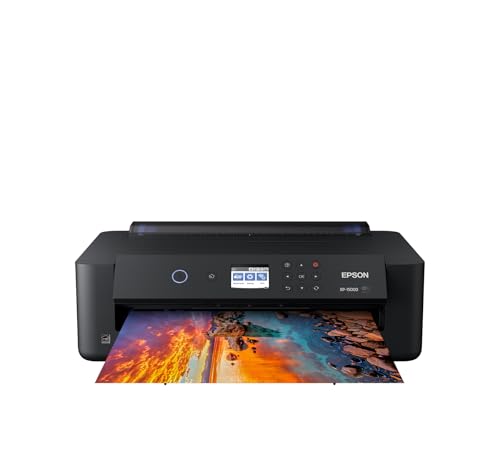
Epson Expression Photo HD XP-15000 — The wide-format all-rounder
The XP-15000 opens this guide because it asks the most useful question in the class: how much photo printer does a serious home studio actually need? Epson’s listing describes a wireless wide-format inkjet with 6-color wide-format photo printing, a stated up to 9.2 ppm, output up to 13 x 19 inches and automatic 2-sided printing, aimed at photographers and home studios. Thirteen by nineteen is the size where prints stop being enlargements and start being wall pieces — large enough for a framed landscape to hold a room, small enough for a desk-side studio to feed and store.
Six colours is the XP-15000’s tonal argument. Beyond the standard four, the extra colours exist to smooth the transitions where photo prints usually confess their machinery: skies banding between blues, skin tones stepping between shades, shadow gradients breaking into visible stairs. A home studio printing portraits, landscapes and still life for walls, gifts and local exhibition will feel that smoothness on every large sheet. The photographer printing mostly documents with the occasional snapshot will not, and should be reading the basic inkjet guide instead — this machine’s virtues are priced for people who print pictures on purpose.
Automatic 2-sided printing is the surprise guest in the specification, and a welcome one. Studios produce paper besides photographs: price lists, exhibition labels’ drafts, portfolio companions, invoices. A wide-format that duplexes its document work means the studio need not keep a second, lesser printer for paperwork, and the XP-15000’s wireless brief keeps it reachable from every machine in the house. The stated up to 9.2 ppm is a photo printer’s pace — unhurried, quality-first — and on 13 x 19 sheets, each of which is a small event, pace matters less than the absence of a ruined sheet.
What the title does not claim is scanning or copying; this is a print-focused machine, and studios that digitise film, artwork or documents should note the XP-980 below, which adds exactly that. For the print-only studio, the XP-15000’s documented combination — six colours, 13 x 19 inches, duplexing documents, wireless — is the most balanced brief in this guide. Check price on Amazon, and budget alongside it for the large-format paper it exists to consume.
- Ink system: 6-color, per listing title
- Maximum sheet stated: 13 x 19 inches
- Stated speed: up to 9.2 ppm
- Automatic 2-sided printing: yes, per listing title
- Scan / copy: not stated in listing title
- Positioning in title: photographers and home studios
Strengths
- 13 x 19 inch output reaches genuine wall-piece scale for home studio work.
- The 6-color system smooths skies, skin and shadow gradients beyond four-colour work.
- Automatic 2-sided printing lets the studio’s paperwork share the same machine.
Trade-offs
- No scanning or copying is stated, so digitising artwork needs another device or the XP-980.
- Its stated pace is a quality-first crawl beside document printers — large sheets are events, not throughput.
- It stops at 13 inches wide; exhibition ambitions beyond that belong to the PRO-1100.
Best for: a home studio photographer printing wall-worthy work up to 13 x 19 inches, who wants one wireless machine to also carry the studio’s documents.
Not suited for: an artist who must scan originals as part of the workflow, since nothing in this listing gives it a scanner.

Canon PIXMA PRO-200S — The vivid dye specialist
The PRO-200S is Canon’s colourist at 13 inches. Its listing states the essentials with professional economy: a professional 13-inch wireless inkjet photo printer, a 3-inch colour LCD, and an 8-color dye ink system, in black. Dye ink is the chemistry of saturation — the inks dissolve into the paper’s coating rather than sitting upon it, which is why dye prints carry that luminous, glossy depth that makes travel photography, product shots and vibrant illustration glow. Eight colours widen the palette the machine can reach without mixing compromises, and the results are prints that look wet with colour even when bone dry.
The 3-inch colour LCD is more than furniture on a machine of this class. Photo printers live by their paper handling — different stocks, thicknesses and sizes, each wanting its own settings — and a real screen at the machine makes loading a fine-art sheet, confirming its profile and checking ink levels a stand-up task rather than a crouch at a computer. Wireless connectivity keeps the printer placeable where a studio has room for a 13-inch machine, which is a genuine consideration: these are not small boxes, and the freedom to site one across the room from the desk is worth having.
Choose dye knowingly. Dye’s strengths are gloss, vibrancy and smooth colour; its traditional cautions concern matte papers, where pigment generally holds deeper blacks, and the longest archival horizons, where pigment generally claims the advantage. A photographer whose work lives on glossy and lustre papers — landscapes, travel, commercial colour — plays directly to dye’s strengths with the PRO-200S. A photographer whose work lives on matte fine-art stock should read the PRO-310’s section next, because the two Canons at this size are a deliberate fork in the road, and Canon built both tines.
The listing states no speed, and this guide invents none; professional photo printing is measured in minutes per treasured sheet, not pages per minute. What the title documents — professional class, 13-inch ceiling, eight dye colours, colour screen, wireless — describes the most colour-drunk machine in this guide. Check price on Amazon, and price the ink set alongside it, because in this class the cartridges are the subscription and the machine is the pen.
- Class: professional 13-inch wireless inkjet photo printer
- Ink system: 8-color dye ink, per listing title
- Display: 3-inch colour LCD
- Stated speed: not stated in listing title
- Scan / copy: not stated in listing title
- Colour: black
Strengths
- An 8-color dye system delivers the saturated, glossy-friendly colour this class prizes.
- The 3-inch colour LCD makes paper profiles, loading and ink checks manageable at the machine.
- A professional 13-inch format covers serious portfolio and wall sizes.
Trade-offs
- Dye is not the matte-paper specialist; pigment holds the advantage on fine-art matte stocks.
- No scanning or copying is stated — it is a dedicated print engine.
- The listing publishes no speed, reflecting a class where sheets are events rather than volume.
Best for: a photographer printing vibrant colour work on glossy and lustre papers at up to 13 inches, who wants dye chemistry’s saturation with a professional machine’s manners.
Not suited for: a matte fine-art printmaker, whose papers and permanence priorities point at the pigment PRO-310 instead.

Canon imagePROGRAF PRO-310 — The pigment printmaker
If the PRO-200S is the colourist, the PRO-310 is the printmaker. Canon’s listing mirrors its sibling’s frame — professional 13-inch wireless inkjet photo printer, 3-inch colour LCD, black — and changes the heart: 9-color pigment ink. Pigment particles sit on the paper’s surface rather than dissolving into it, which is the chemistry behind matte papers’ deep, chalk-free blacks and behind the archival reputation that makes pigment the default choice for prints that will be sold, exhibited and kept for decades.
Nine colours, one more than the dye machine, serves pigment’s particular challenge: coaxing smooth gradients and subtle tonal separation from inks that rest on a surface. For black-and-white photography the advantage compounds — monochrome prints from a multi-pigment system can hold neutral greys and deep shadows without the colour casts that haunt lesser engines, and matte black-and-white work is where this class of machine builds its legend. Portraitists working in matte, landscape artists printing on cotton-rag papers, and photographers producing editions for sale all live on the PRO-310’s side of the fork.
The shared furniture with the PRO-200S is a virtue rather than a redundancy. The same 3-inch colour LCD philosophy applies — paper handling at this level is a physical craft of loading sheets, choosing profiles and confirming levels, and the screen serves it. Wireless siting matters equally for a 13-inch machine. The decision between the two Canons is therefore refreshingly pure: not size, not screen, not connectivity, but ink chemistry against paper choice. Glossy and lustre, choose dye; matte and fine-art, choose pigment; both, choose by the work you print more, and accept the compromise on the other side like every studio before you.
As with its sibling, the title states no speed, and none is claimed here. The PRO-310’s documented brief — professional, 13-inch, nine pigment colours, colour LCD, wireless — is the fine-art specification in this guide, and its natural reader is a photographer whose prints leave the house with prices or exhibition labels attached. Check price on Amazon and weigh the pigment ink set’s cost into the decision, because permanence is a running expense as well as a virtue.
- Class: professional 13-inch wireless inkjet photo printer
- Ink system: 9-color pigment ink, per listing title
- Display: 3-inch colour LCD
- Stated speed: not stated in listing title
- Scan / copy: not stated in listing title
- Colour: black
Strengths
- 9-color pigment ink serves matte and fine-art papers with deep blacks and archival intent.
- Monochrome work benefits from a multi-pigment system’s neutral greys and shadow control.
- The 3-inch colour LCD keeps fine-art paper handling deliberate and machine-side.
Trade-offs
- On high-gloss papers, dye’s dissolved-in luminosity can out-glow pigment’s surface sit.
- It is a dedicated printer — no scan or copy functions are stated.
- Pigment ink sets are a serious running cost that edition printers must price into their work.
Best for: a fine-art photographer printing on matte and cotton papers at up to 13 inches — portraits, monochrome, editions for exhibition or sale.
Not suited for: a glossy travel-and-colour photographer, whose papers play to the PRO-200S dye system’s strengths instead.

Canon imagePROGRAF PRO-1100 — The 17-inch exhibition step
Seventeen inches changes the conversation. The PRO-1100’s listing title is the briefest in this guide — a 17-inch professional wireless inkjet photo printer — and the size alone carries the argument: at 17 inches wide, prints reach exhibition and client-deliverable scale, the dimensions at which photography stops decorating a room and starts commanding it. Every other pick here tops out at 13 inches; the PRO-1100 exists for the photographer whose work has outgrown that ceiling — gallery submissions, large client portraits, landscape work whose detail demands acreage.
Scale brings practical consequences a buyer should price in honestly. A 17-inch machine is furniture: it needs a sturdy, dedicated surface, storage for large and expensive paper stock, and a room where a sheet that size can be handled, dried and flattened without drama. Ink consumption per print climbs with area, so the running-cost discipline of proofing small before printing large stops being advice and becomes economics. None of this argues against the machine; it argues for buying it when the work genuinely requires the size, rather than as a speculative upgrade whose capacity sits idle.
Documentary restraint matters most exactly here. Canon’s title for the PRO-1100 does not state its ink colour count, its display, or any speed, and this guide will not borrow figures from the PRO-310 or any other relative to fill the silence. What is documented — professional class, 17-inch format, wireless inkjet photo printing, imagePROGRAF lineage shared with the pigment PRO-310 — is enough to place the machine correctly in a shortlist. The rest belongs to the listing page, which a buyer at this level should read in full, including its ink system description, before committing studio space and budget.
Wireless, the one connectivity word the title does offer, is worth more at this size than at any other: a 17-inch printer goes where the studio can fit it, not where the computer happens to be, and wireless siting is what makes that freedom real. If your prints have been pressing against a 13-inch ceiling — cropped ambitions, outsourced enlargements, exhibition calls specifying larger work — the PRO-1100 is the documented step up in this guide. Check price on Amazon, read its complete specification there, and measure your table before you measure your excitement.
- Class: professional 17-inch wireless inkjet photo printer
- Ink system: not stated in listing title — confirm on the listing
- Display: not stated in listing title
- Stated speed: not stated in listing title
- Scan / copy: not stated in listing title
- Lineage: Canon imagePROGRAF professional series
Strengths
- 17-inch output reaches exhibition and large-client scale no other pick here can serve.
- Professional imagePROGRAF lineage places it in Canon’s serious printmaker line.
- Wireless connectivity frees a very large machine to live where the studio has room.
Trade-offs
- The listing title omits ink and display details, so specification homework on the listing is essential.
- Its footprint and paper sizes demand dedicated studio space and storage.
- Per-print ink and paper costs at this scale punish careless proofing habits.
Best for: a photographer whose exhibitions, clients or large-format landscapes have genuinely outgrown 13 inches and who has the studio space to house the step up.
Not suited for: a home printer of occasional enlargements, where the 13-inch picks deliver the same walls at a fraction of the commitment.

Canon PIXMA G620 — The tank-fed photo printer
The G620 walks into a professional conversation carrying a consumer idea, and the idea deserves a hearing. Canon’s listing describes a wireless MegaTank photo all-in-one printer — print, copy, scan — in black, that works with Alexa. MegaTank is Canon’s refillable tank system, the same bottle-fed economics this site’s EcoTank guide explains across brands, transplanted into a machine with a photo brief. Every other pick in this guide drinks from cartridges, where photo ink is a premium consumable; the G620 drinks from bottles, and that single fact rewrites who can afford to print photographs constantly.
Consider the high-volume photo lives this serves. A photography club’s printer, a school art department, a family historian digitising and reprinting an archive, a crafter whose work is printed imagery, a small seller printing photo products in batches — all of them live under cartridge economics like a weather system, rationing test prints and dreading large runs. Tank economics removes the dread. Test prints become a normal stage of the work rather than a cost centre, and the all-in-one scanner aboard the G620 closes the digitise-print loop in one machine: scan the archive print, restore it on screen, reprint it from bottles.
Honesty requires the counterweight, stated plainly: the G620’s title claims no colour count, no professional designation and no wide format, and this guide credits it with none. The dedicated machines above — eight dye colours, nine pigment colours, six-colour wide formats — exist because tonal refinement is their entire engineering brief. The G620’s brief is different: good photo output at a running cost that permits volume, inside an all-in-one that also scans and copies. Photographers should choose between those briefs with open eyes, because they are both honourable and they are not the same.
Alexa support, stated in the title, is a small modern grace — voice-triggered printing has its uses in a busy craft room — and wireless keeps the machine placeable. For the right buyer, the G620 is the most liberating pick in this guide: not the finest print engine here, but the one that lets its owner print photographs the way tank owners print documents, freely and often. Check price on Amazon and compare its bottle economics against your last year of cartridge spending; the arithmetic will make the argument better than adjectives can.
- Functions stated in listing: print, copy, scan (photo all-in-one)
- Ink system: Canon MegaTank refillable tanks
- Voice support: works with Alexa, per listing title
- Colour count: not stated in listing title
- Wide format: not stated in listing title
- Colour: black
Strengths
- MegaTank bottle economics make constant photo printing affordable in a way cartridges never do.
- A built-in scanner closes the digitise-and-reprint loop for archive and craft work.
- Print, copy and scan in one wireless machine serves a whole studio corner alone.
Trade-offs
- No colour count or professional designation is stated, unlike the dedicated engines above.
- Nothing in the title claims wide format, so output stays at home photo sizes.
- Tonal refinement for exhibition work belongs to the PRO and six-colour Epson picks.
Best for: a high-volume photo printer — clubs, schools, crafters, family archivists — who needs good photographs constantly and a scanner in the same machine, at bottle prices.
Not suited for: an exhibition printmaker chasing maximum tonal depth, who should spend on ink architecture instead of ink economy.

Epson Expression Photo XP-980 — The scanning wide-format
The XP-980 completes the Epson side of this guide by adding the one capability its XP-15000 sibling omits: a scanner. Epson’s listing describes a wireless all-in-one wide-format printer with 6-color wide-format print, scan and copy, a stated up to 8.5 ppm, and USB and memory card support, aimed at creative projects. For the artist whose workflow runs in both directions — originals in, prints out — that combination is not a convenience but the whole point: paintings, collages, film-era photographs and mixed-media pieces can be digitised on the same machine that later prints their enlargements up to wide-format scale.
The six-colour system carries the same tonal argument as the XP-15000’s: smoother skies, skin and shadows than four-colour engines manage, now applied to a workflow where the source is often a physical original whose subtleties deserve preserving. Memory card and USB support speak to an older, still-living photography habit — cards straight from cameras, files on sticks — and let the machine print without a computer intermediary, which suits shared studios, classrooms and craft rooms where the computer is the bottleneck or simply elsewhere.
The stated up to 8.5 ppm sits a breath below the XP-15000’s 9.2, a difference no studio will ever measure, and the meaningful comparison between the Epsons lies elsewhere: the 15000 offers automatic 2-sided printing for document work, the 980 offers scanning and copying for original-based work. Studios are one or the other. A photographer printing from files, with paperwork on the side, belongs to the 15000; an artist printing from things — scanned paintings, archived prints, classroom originals — belongs to the 980. Epson built both because studios genuinely divide that way.
Positioned for creative projects rather than named professional, the XP-980 is this guide’s bridge machine: wide-format, six-colour output with a digitiser aboard, at a brief a serious hobbyist or a school art room can justify more easily than a professional engine. Check price on Amazon, and if your workflow’s first step is placing something on a scanner lid, let that fact outrank every other line in this comparison.
- Functions stated in listing: print, scan, copy (all-in-one)
- Ink system: 6-color wide-format, per listing title
- Stated speed: up to 8.5 ppm
- Direct inputs: USB and memory card support, per listing title
- Automatic 2-sided printing: not stated in listing title
- Positioning in title: creative projects
Strengths
- A scanner aboard a 6-color wide-format printer serves originals-in, prints-out art workflows.
- Memory card and USB support allow printing without a computer in the loop.
- Six colours keep scanned originals’ gradients faithful at wide-format sizes.
Trade-offs
- No automatic two-sided claim appears in the title, where the XP-15000 makes one.
- Its brief is creative rather than professional, unlike the Canon PRO engines.
- Wide-format paper costs apply here as everywhere in this class — budget for stock.
Best for: an artist, teacher or creative studio whose work begins with physical originals — paintings, collages, archive prints — and ends with wide-format enlargements.
Not suited for: a files-only photographer with heavy document duties, who is better matched by the duplexing XP-15000.
Comparison Table
| Pick | Format ceiling | Ink system as titled | Scan / copy | Stated speed |
|---|---|---|---|---|
| Epson Expression Photo HD XP-15000 | 13 x 19 in | 6-color | Not stated | Up to 9.2 ppm |
| Canon PIXMA PRO-200S | 13-inch class | 8-color dye | Not stated | Not stated in listing title |
| Canon imagePROGRAF PRO-310 | 13-inch class | 9-color pigment | Not stated | Not stated in listing title |
| Canon imagePROGRAF PRO-1100 | 17-inch class | Not stated in listing title | Not stated | Not stated in listing title |
| Canon PIXMA G620 | Not stated in listing title | MegaTank refillable | Print, copy, scan stated | Not stated in listing title |
| Epson Expression Photo XP-980 | Wide-format (size not stated) | 6-color | Print, scan, copy stated | Up to 8.5 ppm |
Dye or Pigment: Which Ink Chemistry Belongs on Your Paper?
This is the class’s defining decision, and it is made of paper, not preference. Dye inks dissolve into a paper’s coating, producing the luminous saturation that glossy and lustre stocks show off; the PRO-200S’s 8-color dye system is built for that world. Pigment inks rest on the surface as particles, which matte and fine-art papers are engineered to receive — deep blacks without gloss glare, textures preserved, and an archival reputation that print sellers rely on; the PRO-310’s 9-color pigment system is built for that world. Choose the paper you love first, and the chemistry chooses itself.
Black-and-white work sharpens the question. On matte papers, a multi-colour pigment system can lay down neutral greys and profound shadows with a control that makes monochrome a specialism rather than a filter; on glossy papers, dye’s depth gives monochrome a wet-darkroom richness. Neither is the “better black” in the abstract — each is better somewhere, and the somewhere is a paper surface. Photographers who print both ways must pick a primary, which is why studios so often end up owning one of each, in that order of acquisition: the chemistry of their main body of work first, the other when the second body of work demands it.
The six-colour Epson machines and the tank-fed G620 sit alongside this fork rather than on it — their titles state colour counts and systems without entering the professional dye-versus-pigment debate in those terms. For home studio work across mixed papers, that middle ground is genuinely serviceable. The fork matters most at the committed ends: glossy colourists and matte printmakers, whose papers are chosen and whose chemistry should follow.
One practical test settles most fence-sitters: print the same demanding image — a portrait with shadow detail and a saturated garment in it — on your favourite glossy stock and your favourite matte stock, at a print service or a friend’s studio, before buying either machine. The sheet you cannot stop looking at names your chemistry more reliably than any specification table, including the honest ones in this guide. Photographers are visual people; let the decision be a visual one, made once, on paper, before money follows it.
How Large Should You Actually Print?
Let the destination decide, because size is a cost multiplier disguised as a dimension. A 13-inch print suits portfolio pages, club exhibitions, most client portraiture and the walls of ordinary rooms viewed from ordinary distances. It is the size this guide’s four 13-inch-class picks serve, and for most serious photographers it is not a compromise but a match. Printing larger than the destination rewards is a tax paid in paper, ink, storage and handling difficulty on every single sheet.
Seventeen inches earns its place for specific callings: gallery walls where viewers stand back, large landscapes whose detail is the subject, client work specified at that scale, and prints sold by the square foot of presence. The PRO-1100 is in this guide for photographers who can name their 17-inch destination — an exhibition, a client, a wall measured and waiting. Photographers who cannot name one yet should buy the 13-inch machine their work fits today and let a future body of work argue for the larger engine when it exists; printers are not investments that appreciate while idle.
Paper logistics deserve a sentence of their own, and then a paragraph. Large stock arrives in packs that need flat, dry storage; large prints need drying space, flattening patience and frames that cost accordingly. A studio that has solved those problems is ready for width. A studio that has not will find 13 x 19 — the XP-15000’s stated ceiling — already generous enough to expose every one of them.
How Do You Proof a Print Without Wasting the Expensive Sheets?
Proof small, in stages, and on the paper you will finish on. A small test print on the actual fine-art stock reveals colour and contrast truths that a screen’s glow conceals and that a different, cheaper paper would lie about — coatings change everything, so proofing on office paper for a matte cotton final is a fiction that wastes more than it saves. Print a strip test of the image’s hardest region — the shadow gradient, the skin tone, the sky — at full size on a cut piece of the real stock before committing a whole sheet; studios have done this since the darkroom, because paper has always been the expensive part.
Let prints dry before judging them. Inkjet output changes as it dries and outgases — colours settle, blacks deepen or lift — and a verdict delivered on a wet print is a verdict on a print that will not exist tomorrow. Give glossy dye work its drying time flat and uncovered-but-undisturbed, and judge under the light the print will live in: a photograph balanced for a bright studio may hang in a warm hallway, and the paper’s white will take the room’s colour with it. Proofing is not pedantry; at this class’s paper prices, it is the difference between a hobby and a bonfire.
Keep a proof log, even a pencil one. Note the file, the paper, the settings and the verdict for each test, because the session where you finally nail a difficult image’s print will otherwise evaporate, and the reprint order three months later will begin from fog. Studios that sell prints treat this notebook as part of the edition’s value; studios that print for love will find it saves the expensive paper that guesswork eats. Either way, the log is the cheapest accessory in this entire guide and the one most likely to be skipped.
What Does a Home Studio Need Around the Printer?
Flat surfaces and patience, mostly. A printer of 13 or 17 inches wants a sturdy stand that does not wobble when the carriage travels, clearance behind and above for large sheets to feed and exit, and a nearby flat area where prints can rest while drying, safe from sleeves, cats and coffee rings. Paper storage wants to be flat, dry and dark — a drawer or a portfolio case near the machine — because a curled fine-art sheet feeds badly and prints its curl as banding.
Light deserves thought. You will judge prints where you make them, so a consistent, reasonably neutral light over the proofing area prevents the heartbreak of prints that looked right at the desk and wrong everywhere else. A cutting mat, a straight edge and clean cotton gloves for handling finished sheets complete a kit that costs little and dignifies the output. None of this is glamorous, and all of it separates studios whose prints arrive from studios whose prints happen.
Finally, plan the digital side of the desk: a calibrated-enough screen, a filing habit for master files, and a backup that exists. A printer this capable turns files into objects worth money; losing the masters to a dead drive is the one studio accident no ink system can repair. The machine is the visible investment — the habits around it are the actual studio.
Visitors complete the studio’s education. Hang your own prints where guests see them, and watch which ones hold attention from across the room and which only reward a close approach; that cruel, useful data tells you what your next body of work should print larger, richer or not at all. A home studio is a feedback loop with a printer in it, and the photographers who improve fastest are the ones who close the loop — print, hang, look, adjust — rather than printing into a drawer.
How Do You Care for a Professional Photo Printer Between Bodies of Work?
Professional photo printers live an unfair life: weeks of silence while their owners shoot, then a deadline that demands perfection from the first sheet. The bridge between those states is a rhythm of small prints. Every fortnight, run one image that exercises every colour — a test photograph with sky, skin, foliage and shadow — on ordinary photo paper. It costs little, it proves the machine’s health while repairs are still cheap, and it turns the deadline-week discovery of a clogged channel into a quiet mid-month maintenance note instead.
Storage of consumables is the second discipline. Fine-art papers absorb the room they live in: humidity curls them, light ages them, dust lands on the coating and prints as flaws. Keep stock flat in its packaging, in the driest, darkest drawer you have, and handle sheets by their edges — cotton gloves are not theatre when a fingerprint on a matte cotton sheet prints as a permanent shiny ghost. Ink, likewise, wants a cool, stable shelf rather than a windowsill’s daily temperature swing.
Cleaning cycles on professional machines consume professional ink, so dose them like medicine: a nozzle check first, one cycle if the pattern shows gaps, a re-check, and patience before any repeat. Machines left standing after a failed cycle often recover overnight as ink wicks back through the head. The expensive habit is panic — cycle after cycle in an afternoon, draining the very colours the exhibition needs. A studio calendar with a fortnightly print already in it makes most of this section unnecessary, which is precisely its point.
What Separates a Portfolio Print From a Saleable One?
Consistency, mostly. A portfolio print must please one viewer who already loves the work; a saleable print must match the buyer’s expectation every time it is produced — the edition’s third print indistinguishable from its first, the colours true to the proof the client approved, the paper the paper that was promised. That is why the professional machines in this guide pair their ink systems with real screens and deliberate paper handling: repeatability is a workflow, and the printer is only its most visible instrument.
Paper discipline is the commercial half of the craft. Sell a print on a named stock and keep printing it on that stock; a client’s second purchase must match the first on their wall. Keep a printed reference of each edition — a master proof, stored dark — against which later prints are judged, and record the settings that produced it. These habits sound like bureaucracy until the day a gallery reorders; then they are the business.
Finally, permanence is part of the product. A buyer paying for a photographic print is buying an object expected to outlast trends, which is why pigment systems carry their archival reputation into sales conversations and why matte fine-art papers dominate editioned work. Dye prints sell happily too — for glossy, vivid work where their saturation is the point — but the seller should know which promise each chemistry makes. The print that leaves the studio carries the studio’s name; everything in this section is how that name stays good.
How Should You Read a Photo Printer’s Listing Before Believing It?
Read for the countable things. A trustworthy professional listing names its ink system in colours and chemistry — “8-Color Dye Ink,” “9 Color Pigment Ink,” “6-color wide-format” — and its sheet ceiling in inches, because those are the specifications its maker can be held to. This guide has quoted exactly those elements and flagged their absence where a title omits them, as with the PRO-1100’s ink details and the G620’s colour count. A listing that substitutes adjectives for those numbers is asking you to buy a mood.
Read the function list with the same cold eye. “Photo printer” in this class usually means a dedicated print engine; scanning and copying appear only where a title states them, as the G620’s and XP-980’s do. Studios have bought wide-format machines before now and discovered the digitising half of their workflow missing on delivery day. The title is a contract summary — brief, but binding — and five minutes spent parsing its verbs is the cheapest diligence in the whole purchase.
Finally, read what the listing makes easy to check next: the ink set’s identity and the paper sizes in the full specification. In this class the machine is the beginning of an expense relationship, and the listing page that shows ink and media plainly is telling you the maker expects an informed buyer. Bring your paper choice and your destination size to that page, and the decision usually makes itself.
Common Mistakes
Buying by colour count alone is the first mistake. Eight and nine colours are meaningful inside their chemistries and formats, but a colour count is not a quality score that travels across brands and systems; paper choice, the photographer’s proofing discipline and the file’s quality move the result more than the arithmetic of ink channels. Shoppers who choose the largest number and the wrong chemistry for their papers have bought a specification, not a print.
Printing exhibition ambitions on office paper is the second. Every machine in this guide is engineered around coated photo and fine-art media; plain paper starves them of everything they were built to do and then gets cited as evidence the printer disappoints. Budget paper as part of the machine’s cost from the first day — a smaller stack of the right stock teaches more than a mountain of the wrong one.
A third, quieter mistake is leaving the machine idle between bodies of work. Photo printers sit idle while photographers shoot, and idle inkjets of any class risk dried nozzles and a cleaning bill paid in expensive ink. A small print every fortnight — a test image that exercises every colour — keeps a professional engine ready for the week the exhibition deadline arrives. The photographers who curse their printers in deadline week are usually meeting the consequences of a silent month.
Final Recommendation
Decide by paper and destination, and this shortlist resolves itself. Matte and fine-art photographers should take the imagePROGRAF PRO-310, whose 9-color pigment system is the fine-art specification at 13 inches; glossy colourists should take the PIXMA PRO-200S, whose 8-color dye system is built for saturation. Home studios wanting width with utility divide between the XP-15000’s duplexing 13 x 19 brief and the XP-980’s scanning wide-format for original-based work. Photographers whose work has truly outgrown 13 inches should step to the PRO-1100 and read its full listing with care. And high-volume photo printers should not overlook the G620: bottle-fed economics will not win a tonal contest against the PRO machines, but it will let you print every day without negotiating with a cartridge. The best art printer is the one whose ink lands on your favourite paper at the size your walls demand — everything else is commentary, and your walls, in the end, will deliver the only review that matters, every morning, in the light you actually live in.
Frequently Asked Questions
What is the real difference between dye and pigment ink?
Dye ink dissolves into the paper’s coating and excels at saturated, glossy colour — the PRO-200S carries an 8-color dye system. Pigment ink sits on the surface as particles and excels on matte and fine-art papers, with deep blacks and an archival reputation — the PRO-310 carries a 9-color pigment system. Match the chemistry to the paper you print on most; that single decision outweighs most specification comparisons in this class.
Is 13 inches wide enough, or should I go straight to 17?
For portfolios, club exhibitions, most client work and ordinary walls, 13 inches is a match rather than a compromise, and four of these six picks serve it. Choose the 17-inch PRO-1100 when you can name the destination that needs it — a gallery, a client specification, a measured wall. Buying width speculatively taxes every print in paper, ink and handling for a benefit that may never be cashed.
Can these printers handle everyday documents too?
Some can, happily. The XP-15000 states automatic 2-sided printing, and the G620 and XP-980 are all-in-ones with scan and copy. The Canon PRO machines are dedicated print engines whose titles claim no office functions; they will print a document, but using a professional photo engine as the household’s form-printer wastes its ink economics. Many studios keep a basic all-in-one for paperwork and reserve the photo machine for photographs.
Why is a tank-fed photo printer in a professional guide?
Because running cost is a creative variable. The G620’s MegaTank system lets clubs, schools, crafters and archivists print photographs constantly — test prints, batches, iterations — at bottle prices, with a scanner aboard for digitising originals. It does not claim the colour counts or professional designations of the PRO machines, and this guide credits it with none; it earns its place on a different, legitimate axis.
How much should I budget for paper and ink beyond the machine?
Treat the machine as roughly the first instalment. Fine-art and photo papers at 13 and 17 inches are premium stock, and multi-colour ink sets are consumed sheet by treasured sheet. Proofing on the real stock, printing strip tests of hard regions, and letting prints dry before judging them are the habits that keep the consumables bill honest. Check price on Amazon for both the printer and its ink set before deciding a machine “fits the budget.”
Should a beginner buy a professional photo printer or grow into one?
Grow into one, but not timidly. A photographer still learning to see prints — how paper changes a file, how proofing disciplines the eye — gets full value from the six-colour Epson machines or the G620’s forgiving running costs, because the education is in the printing, and cheaper printing means more of it. The PRO-class engines reward photographers who already know their paper and their market. Buying the professional machine one body of work before you need it is ambition; buying it three bodies early is storage.
Do I need a scanner on my photo printer?
Only if your workflow starts with physical originals. Artists enlarging paintings, teachers digitising classwork and archivists reprinting old photographs will use the XP-980’s or G620’s scanner constantly. Photographers working purely from digital files gain nothing from a scanner lid and may prefer the XP-15000’s duplexing or the PRO machines’ dedicated design. Buy the workflow you have, not the one a feature list imagines for you.
Related Guides
Photo printing sits between two neighbouring needs, and the guides below cover both. If the parcels matter as much as the prints, our 4×6 thermal shipping label printer roundup handles the seller’s side of the studio. For photographs on the move, the compact portable printer guide separates true document portables from pocket photo printers like Canon’s SELPHY line. And if running costs are the worry that brought you here, the cheap inkjet guide, framed honestly around cost per page shows how the tank class changes the arithmetic for everyday printing too.


