What's inside
As an Amazon Associate I earn from qualifying purchases. This post may contain affiliate links at no extra cost to you.
A Denon receiver is the heart of most home theatre systems, and in-ceiling speakers are the way it delivers the height and surround channels that make a film sound three-dimensional, so the choice of ceiling speaker matters as much as the choice of receiver. The right in-ceiling speakers make a helicopter sound like it is flying overhead and rain sound like it is falling on the roof, while the wrong ones make the height channels sound like an afterthought, and the difference is audible the first time a film plays. This guide compares six in-ceiling speakers that work with Denon receivers, from the value-packed Micca M-8C to the superb Bowers & Wilkins CCM664, and it explains how many you need and where to put them.
Every speaker here is a real, widely sold model, chosen because it sounds good as a height or surround channel and because it works with the way a Denon AVR drives a system, whether that is a 7.1.2 Atmos setup with two height speakers or a 7.1.4 setup with four. None of them is a hi-fi speaker pretending to be a theatre speaker, and none of them requires a separate amplifier for a standard Denon system, although a receiver with more channels than its built-in amplifiers can drive will need one. What they do is deliver the height and surround channels that make a home theatre feel like a cinema, and that is the whole point of a Denon system.
Quick picks: best ceiling speakers for denon receivers
| # | Product | Where to buy |
|---|---|---|
| 1 | Klipsch CDT-5800-C II | Check on Amazon |
| 2 | Polk Audio RC80i | Check on Amazon |
| 3 | Yamaha NS-IC800 | Check on Amazon |
| 4 | Micca M-8C | Check on Amazon |
| 5 | KEF Ci160QR | Check on Amazon |
Quick Comparison
The table below gives a fast overview of the models in this guide, so you can shortlist two or three before reading the detail. Every model here is a real, widely sold product, and each one suits a slightly different room, system, or way of listening.
| Speaker | Size | Best For |
|---|---|---|
| Klipsch CDT-5800-C II | 8-inch in-ceiling, Dolby Atmos | Best Atmos height speaker |
| Polk Audio RC80i | 8-inch in-ceiling, surround use | Best value Denon surround speaker |
| Yamaha NS-IC800 | 8-inch in-ceiling, sealed back | Best for sound quality |
| Bowers & Wilkins CCM664 | 6-inch in-ceiling, Nautilus tweeter | Best premium Denon speaker |
| Micca M-8C | 8-inch in-ceiling, budget pair | Best budget Denon speaker |
| KEF Ci160QR | 6.5-inch in-ceiling, Uni-Q driver | Best for even coverage |
The Products in Detail
Klipsch CDT-5800-C II
The Klipsch CDT-5800-C II is an 8-inch two-way in-ceiling speaker from Klipsch’s Custom Designer series, and it is the pick here for a Denon receiver running a Dolby Atmos system. It pairs an 8-inch Cerametallic woofer with a 1-inch titanium tweeter in a horn, with a pivoting tweeter and a controlled dispersion design that directs the sound toward the listening position. A Denon AVR with Atmos support uses in-ceiling speakers as height channels, and the CDT-5800-C II is designed for exactly that role, with the efficiency and the dispersion to make height effects convincing.
The CDT-5800-C II sounds dynamic and clear, with a midrange that keeps dialogue and effects intelligible and a treble that is detailed without turning harsh. The horn tweeter is the key feature for a Denon Atmos system: it controls the dispersion of the sound, so the height effects reach the listener cleanly instead of bouncing around the ceiling, which is what makes a helicopter or a rainstorm sound like it is above you rather than somewhere in the room. The speaker is efficient, so it plays loud on the power a Denon AVR provides to its height channels, and it is built to Klipsch’s usual standard, with a paintable grille that blends into the ceiling.
Strengths: Excellent dynamics and clarity, with a horn tweeter that makes Atmos height effects convincing. The controlled dispersion directs the sound toward the listener, and the high efficiency means loud, clean sound on the power a Denon AVR provides. Build quality is strong, and the speaker is easy to install in a ceiling.
Trade-offs: The horn sound is forward and lively, which suits film soundtracks but may not suit a room that wants a soft, background atmosphere. Bass depth is good for the size but not deep, and the speaker costs more than the budget models in this guide, which adds up across four height channels.
Who it fits: Home theatre owners running a Denon AVR with Dolby Atmos, who want in-ceiling height speakers that make the effects convincing. It suits dedicated theatre rooms and living-room systems alike, and anyone who wants the height channels to sound as good as the main speakers.
Play a film scene with height effects, such as rain or a helicopter, and notice how clearly the sound comes from above rather than from the front speakers. Then listen to a dialogue scene and notice how clear the voices stay, because the height channels should add atmosphere without distracting from the story.

Polk Audio RC80i
The Polk Audio RC80i is an 8-inch two-way in-ceiling speaker that is the natural starting point for a Denon surround system on a budget, and the reason is simple: it sounds good, it is easy to install, and it works with the way a Denon AVR drives a surround system. A Denon receiver can use in-ceiling speakers as surround channels or as height channels, and the RC80i’s warm, full sound and its aimable tweeter make it a good choice for either role, with a large 8-inch woofer that gives the surround channels a weight that smaller speakers lack.
The RC80i sounds warm and full, with a bass response that is deeper than most in-ceiling speakers thanks to the large 8-inch woofer, and a midrange that keeps dialogue and effects clear and intelligible. The aimable tweeter is a genuine advantage in a surround system, because it lets the installer direct the treble toward the listening position rather than letting it fire straight down at an empty patch of floor. Polk designs the RC series for easy installation, with a rotating cam system that clamps the speaker to the ceiling from below, so no access from above is needed, and the speaker is sold in pairs, which keeps the cost of a multi-channel Denon system manageable.
Strengths: Deep, full sound for an in-ceiling speaker, with a large 8-inch woofer that gives real bass weight. The aimable tweeter directs the sound where it is needed, and the moisture-resistant build suits any room in the house. Installation is straightforward, and the price is accessible for a multi-channel system.
Trade-offs: The sound is warm rather than detailed, so it suits surround effects rather than critical listening. The speaker needs a ceiling void of sufficient depth, and it needs a Denon AVR with enough channels to drive it, because it is a passive speaker with no built-in power.
Who it fits: Home theatre owners building a Denon surround system on a budget, who want warm, full surround and height channels without spending a fortune. It suits living-room systems and dedicated theatre rooms alike, and anyone who wants a reliable, affordable in-ceiling speaker for a Denon receiver.
Play a film scene with surround effects and notice how evenly the sound spreads around the room, with no obvious hot spot under one speaker and no dead zone between them. Then listen to a dialogue scene and notice how clear the voices stay, because the surround channels should support the story, not distract from it.
Check price on Amazon: Klipsch CDT-5800-C II
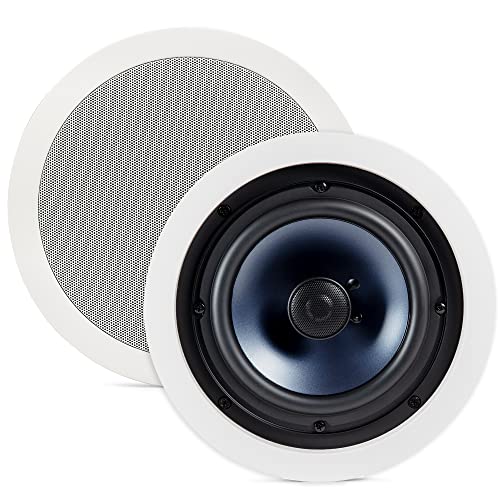
Yamaha NS-IC800
The Yamaha NS-IC800 is an 8-inch two-way in-ceiling speaker that brings Yamaha’s long experience in both hi-fi and professional audio to a Denon surround system, and it is the pick here for owners who care about sound quality as well as effects. It pairs an 8-inch polypropylene mica woofer with a 1-inch balanced-dome tweeter, with a sealed-back design that keeps the sound consistent regardless of what is above the ceiling, which matters in a home theatre where the void above may be full of ducts, pipes, and insulation.
The NS-IC800 sounds clean and detailed, with a midrange that is more refined than most in-ceiling speakers and a treble that stays smooth and airy at the volumes a home theatre uses. The sealed-back design is the key feature: it isolates the speaker from the ceiling void, so the bass stays tight and controlled instead of changing with the size and the contents of the space above, and it keeps sound from leaking into the room upstairs, which matters when a film is playing late at night. Yamaha builds the NS-IC800 to a high standard, with a paintable grille and a mounting system that clamps securely from below.
Strengths: Clean, detailed sound with a refined midrange and a smooth treble, which suits a home theatre where the sound matters. The sealed-back design keeps the sound consistent regardless of the ceiling void, and it reduces sound leakage to the floor above. Build quality is excellent, and the speaker is easy to install.
Trade-offs: It costs more than the budget speakers in this guide, which adds up across a multi-channel installation. Bass depth is good but not as deep as the largest in-ceiling speakers, and it needs a Denon AVR with enough channels to drive it.
Who it fits: Home theatre owners who value sound quality and want the surround and height channels to sound good, not just present, especially in a house where the ceiling void is unpredictable. It suits dedicated theatre rooms and living-room systems alike, and anyone who watches films late at night.
Play a well-recorded film scene and notice the clarity of the midrange and the air around the effects, which is where the NS-IC800 earns its keep. Then check the room above, if there is one, and notice how little sound leaks through, which is the benefit of the sealed-back design.
Check price on Amazon: Polk Audio RC80i

Bowers & Wilkins CCM664
The Bowers & Wilkins CCM664 is a 6-inch two-way in-ceiling speaker from a company that builds some of the finest loudspeakers in the world, and it is the pick here for a Denon system where the budget allows a premium choice. It pairs a 6-inch Kevlar woofer with a 1-inch Nautilus tube-loaded tweeter, a design borrowed from Bowers & Wilkins’ flagship speakers, which gives it a clarity and a refinement that few in-ceiling speakers can match. A Denon AVR driving a set of CCM664 speakers as height or surround channels delivers a home theatre experience that is closer to a cinema than to a living room.
The CCM664 sounds refined and musical, with a midrange that is natural and detailed and a treble that is smooth and extended, thanks to the Nautilus tube that absorbs the sound from the back of the tweeter and prevents it from colouring the sound. The Kevlar woofer is stiff and light, so the bass stays tight and controlled, and the speaker is designed to disappear into the ceiling, with a paintable grille that blends into any decor. It is a speaker built for a serious home theatre, and it rewards a Denon AVR that is set up properly, with the levels and the distances calibrated for the room.
Strengths: Superb sound quality, with a refined midrange and a smooth, extended treble from the Nautilus tweeter. The Kevlar woofer gives tight, controlled bass, and the build quality is excellent. The speaker disappears into the ceiling, with a paintable grille that blends into any decor.
Trade-offs: It is the most expensive speaker in this guide, which adds up across four height channels or a full surround system. The 6-inch woofer gives less bass than an 8-inch model, so a subwoofer is more important, and the speaker needs a Denon AVR with enough channels and enough power to do it justice.
Who it fits: Home theatre owners building a premium Denon system, who want the surround and height channels to match the quality of the main speakers. It suits dedicated theatre rooms and anyone who values refinement and is willing to pay for it.
Play a film scene with subtle height effects, such as rain or wind, and notice how naturally the sound comes from above, with no sense of a speaker in the ceiling. Then listen to a dialogue scene and notice the naturalness of the voices, which should sound like people in a room rather than voices from a speaker.
Check price on Amazon: Yamaha NS-IC800
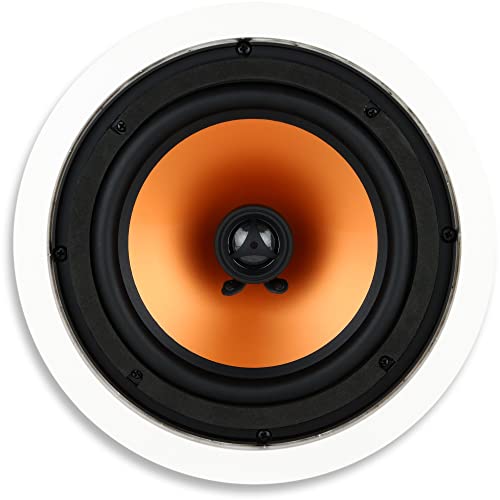
Micca M-8C
The Micca M-8C is an 8-inch two-way in-ceiling speaker that earns its place in this guide through value, and it is the pick for a home theatre owner who needs several channels on a tight budget. It pairs an 8-inch polypropylene woofer with a 1-inch silk-dome tweeter in a simple, well-engineered design, and it works with a Denon AVR as a surround or a height channel, with a large woofer that gives the surround channels a weight that smaller budget speakers lack. For a system that needs four height channels, the difference between the Micca and a premium brand adds up to a substantial saving.
The M-8C sounds clear and balanced for its size, with a midrange that keeps dialogue and effects intelligible and a bass response that is full enough for surround use in a home theatre. The large woofer moves plenty of air, which gives the sound a weight that smaller in-ceiling speakers lack, and the tweeter stays smooth at the volumes a home theatre actually uses. Micca designs the M-8C for easy installation, with a template and a clamp system that a competent installer can fit quickly, and the speaker is sold in pairs, which keeps the cost of a multi-channel Denon system under control.
Strengths: Very affordable, which makes it possible to build a full Denon surround system with four height channels on a small budget. The sound is clear and balanced, with good intelligibility for dialogue and effects. Installation is straightforward, and the large 8-inch woofer gives more bass than most budget in-ceiling speakers.
Trade-offs: Detail and refinement are a step behind the premium speakers in this guide, and the sound is pleasant rather than detailed. The build is functional rather than premium, and the speaker needs a ceiling void of sufficient depth. It is a passive speaker, so it needs a Denon AVR with enough channels.
Who it fits: Home theatre owners on a tight budget who need several in-ceiling channels for a Denon surround or Atmos system, and anyone building a first home theatre where the channel count matters more than the last few percent of sound quality. It suits living-room systems and dedicated theatre rooms alike.
Play a film scene with surround effects and notice how evenly the sound fills the room, with no obvious gap in coverage. Then listen to a dialogue scene and notice how natural the voices sound, which is the mark of a well-engineered budget speaker.
KEF Ci160QR
The KEF Ci160QR is a 6.5-inch in-ceiling speaker that uses KEF’s Uni-Q driver, which places the tweeter in the centre of the woofer so the sound comes from a single point, and that design gives it the most even coverage of any speaker in this guide. A Denon AVR driving a set of Ci160QR speakers as height or surround channels delivers a sound that is consistent from every seat in the room, because the Uni-Q driver disperses the sound evenly in all directions, with no hot spot directly underneath the speaker and no dead zone between them.
The Ci160QR sounds clean and balanced, with a midrange that is natural and detailed and a treble that is smooth and extended, thanks to the Uni-Q driver that keeps the tweeter and the woofer working as one. The even dispersion is the key feature for a Denon system: in a home theatre, the listeners sit in different places, and a speaker that sounds good from only one seat is a poor choice for a room full of people. The Ci160QR sounds good from every seat, which is exactly what a home theatre needs, and it is built to KEF’s usual standard, with a paintable grille that blends into the ceiling.
Strengths: Even coverage from every seat, thanks to the Uni-Q driver that disperses the sound uniformly. The sound is clean and balanced, with a natural midrange and a smooth treble. Build quality is excellent, and the speaker is easy to install, with a paintable grille that blends into any ceiling.
Trade-offs: The 6.5-inch woofer gives less bass than an 8-inch model, so a subwoofer is more important in a system using the Ci160QR. It costs more than the budget speakers in this guide, and it needs a Denon AVR with enough channels to drive it, because it is a passive speaker.
Who it fits: Home theatre owners who want even sound from every seat in the room, especially in a theatre with several rows or a wide seating area. It suits dedicated theatre rooms and living-room systems alike, and anyone who values consistent coverage over maximum bass.
Sit in different seats in the room and notice how little the sound changes with position, which is the benefit of the Uni-Q driver. Then play a film scene with height effects and notice how naturally the sound comes from above, with no sense of a speaker in the ceiling.
Check price on Amazon: Micca M-8C

Denon Receivers and In-Ceiling Speakers: How They Work Together
A Denon AVR is the heart of most home theatre systems, and in-ceiling speakers are the way it delivers the height and surround channels that make a film sound three-dimensional. A Denon receiver with Dolby Atmos support assigns specific channels to the ceiling speakers, usually two or four of them, and it sends the height effects to those channels while the main speakers handle the dialogue and the front effects. The result is a sound field that extends above the listener, so a helicopter sounds like it is flying overhead and rain sounds like it is falling on the roof, rather than coming from a speaker in front of you.
The key to making it work is the Denon receiver’s calibration system, which measures the distance and the level of each speaker and adjusts them so the sound arrives at the listening position at the right time and the right volume. Run the calibration with the microphone supplied with the receiver, place the microphone at the listening position, and let the receiver do the work: it will set the levels, the distances, and the crossover frequencies for each channel, including the ceiling speakers, and the result is a system that sounds coherent and convincing, even in a room that is far from ideal.
Check price on Amazon: KEF Ci160QR
Height Channels or Surround Channels?
A Denon receiver can use in-ceiling speakers in two roles, and the choice depends on the layout of the room and the system you are building. As height channels in a Dolby Atmos system, the ceiling speakers deliver the sounds that come from above, such as rain, helicopters, and aircraft, and they are placed above and slightly in front of the listening position, so the effects sound like they are coming from the sky. As surround channels, the ceiling speakers deliver the sounds that come from the sides and the rear, such as footsteps, voices, and ambient effects, and they are placed above and to the sides of the listening position.
Most Denon systems use the ceiling speakers as height channels, because that is the role that adds the most to a film, and the surround channels are usually floor-standing or bookshelf speakers at ear level. A system with both, using in-ceiling speakers for the height channels and ear-level speakers for the surrounds, is the most convincing arrangement, but it needs a Denon receiver with enough channels to drive them all, so check the channel count before you buy. A 7.1.2 system needs nine channels, and a 7.1.4 system needs eleven, which is more than an entry-level receiver provides.
Setting Up a Denon System: The First Evening
The first evening with a new Denon ceiling system is the best time to set it up properly, because the room is quiet, the furniture is in place, and there is time to listen carefully. Start by running the Denon calibration with the supplied microphone, placed at the listening position at ear height, and let the receiver measure each speaker, including the ceiling speakers, and set the levels, the distances, and the crossover frequencies. Then play a film you know well, with a scene that has height effects, and listen for whether the sound comes from above or from the front speakers, because that tells you whether the height channels are working as they should.
The second job is the volume balance between the channels, because a system that is too loud in the height channels sounds distracting, while one that is too quiet sounds like the ceiling speakers are not there at all. Play a dialogue scene and check that the voices are clear and centred, then play an action scene and check that the effects are present without overwhelming the dialogue. A small adjustment to the height channel level, up or down by a decibel or two, often makes the difference between a system that sounds impressive and one that sounds natural, and the right setting is the one you forget about while you watch the film.
Buying Guide
Start by counting the channels your Denon receiver can drive. A receiver rated at 7.1.2 has nine channels, which is enough for seven ear-level speakers and two height speakers, while a receiver rated at 7.1.4 has eleven channels, which is enough for four height speakers. Check the receiver’s specification sheet before you buy any ceiling speakers, because a speaker with no channel to drive it is no use to anyone.
Measure the ceiling before you order. The height, the void depth, and the construction all decide which speaker fits, so check the specification sheet for the mounting depth and the cutout diameter, and confirm that the ceiling can take it. A speaker that needs a deeper void than the ceiling provides is no bargain at any price, and a speaker that does not fit the cutout is a problem that is expensive to fix after the ceiling is finished.
Place the height speakers correctly, because placement matters more than brand for an Atmos system. The height speakers go above and slightly in front of the listening position, in line with the front left and right speakers, so the effects sound like they are coming from above and in front of you. A speaker placed directly overhead sounds like it is on top of you, which is distracting, while one placed too far forward sounds like it is part of the front soundstage.
Run the Denon calibration properly. Place the microphone at the listening position, at ear height, and let the receiver measure the distance and the level of each speaker, including the ceiling speakers, and set the levels, the distances, and the crossover frequencies for each channel. The calibration is the difference between a system that sounds coherent and one that sounds like a collection of speakers, so take the time to do it properly and repeat it if you move the furniture.
Match the ceiling speakers to the main speakers as closely as you can. The height and surround channels should sound like they belong to the same system as the front speakers, with a similar tonal character, so the sound moves smoothly around the room instead of changing character as it passes from one speaker to another. A Klipsch ceiling speaker pairs naturally with Klipsch main speakers, and a Polk ceiling speaker pairs naturally with Polk mains, so stay within a brand family where you can.
Finally, do not forget the subwoofer. In-ceiling speakers are small, and even the best of them cannot reproduce the deepest bass notes, so a subwoofer is essential in a Denon home theatre system. Set the crossover so the subwoofer takes over below the point where the ceiling speakers naturally roll off, and the bass will be deep and controlled, with the ceiling speakers free to handle the midrange and the treble where they perform best.
Frequently Asked Questions
Can I use ceiling speakers with my Denon receiver?
Yes, and it is one of the most common uses for in-ceiling speakers. A Denon AVR drives in-ceiling speakers as height channels in a Dolby Atmos system, or as surround channels in a conventional surround system, and the receiver’s calibration system measures each speaker and adjusts its level and distance so the sound arrives correctly. Check that your receiver has enough channels for the ceiling speakers you want, because a 7.1.2 system needs nine channels and a 7.1.4 system needs eleven.
How many ceiling speakers do I need for Dolby Atmos?
Two height speakers is the minimum for Dolby Atmos, and four is the recommended number for a convincing effect. Two speakers give a sense of height, but four give a much more precise sense of where the sound is coming from, because the receiver can place effects between the front and the rear height speakers. A Denon receiver rated at 7.1.2 drives two height speakers, while one rated at 7.1.4 drives four, so check the channel count before you buy.
Where should I place ceiling speakers for a Denon Atmos system?
The height speakers go above and slightly in front of the listening position, in line with the front left and right speakers, so the effects sound like they are coming from above and in front of you. For a four-speaker system, the second pair goes above and slightly behind the listening position, in line with the rear speakers. A speaker placed directly overhead sounds like it is on top of you, which is distracting, so the slight forward placement matters.
Do I need a separate amplifier for ceiling speakers with a Denon receiver?
No, not if the receiver has enough channels. A Denon AVR has a built-in amplifier for each channel, including the height channels, so it drives the ceiling speakers directly, with no separate amplifier needed. The exception is a receiver that has more channels than its built-in amplifiers can drive, in which case it needs an external amplifier for the extra channels, so check the receiver’s specification sheet to see how many channels it amplifies internally.
Can ceiling speakers replace my surround speakers?
They can, but it is not the ideal arrangement. Surround speakers work best at ear level, because the sounds they carry are meant to come from beside and behind you, while ceiling speakers work best as height channels, because the sounds they carry are meant to come from above. A system that uses in-ceiling speakers for the height channels and ear-level speakers for the surrounds is the most convincing arrangement, but if the room does not allow ear-level surrounds, ceiling speakers are a good compromise.
Will my Denon receiver calibrate ceiling speakers automatically?
Yes, through the calibration system supplied with the receiver, which uses a microphone placed at the listening position to measure the distance, the level, and the frequency response of each speaker, including the ceiling speakers. Run the calibration after the speakers are installed, place the microphone at ear height at the listening position, and let the receiver do the work. Repeat the calibration if you move the furniture or change the speakers, because the room affects the sound more than the speakers do.
What is the best crossover setting for ceiling speakers?
The Denon calibration system sets the crossover automatically, and it is usually right, but a good starting point is 80 hertz for most in-ceiling speakers, which sends the bass below that point to the subwoofer and lets the ceiling speakers handle the midrange and the treble. A smaller speaker may need a higher crossover, such as 100 or 120 hertz, because it cannot reproduce lower notes cleanly, while a larger speaker may work well at 80 hertz. Trust the calibration, and adjust by ear only if the bass sounds thin or boomy.
Can I mix ceiling speaker brands with my Denon system?
You can, but it is better to match them where possible, because the height and surround channels should sound like they belong to the same system as the front speakers, with a similar tonal character. A Klipsch ceiling speaker pairs naturally with Klipsch main speakers, and a Polk ceiling speaker pairs naturally with Polk mains, so stay within a brand family where you can. If you must mix brands, run the Denon calibration carefully, because it will adjust the levels to compensate for the differences.
Do I need a 4K television to use Dolby Atmos with a Denon receiver?
No, Dolby Atmos is an audio format, and it works with any television, including an older high-definition model, provided the receiver and the source support it. A 4K television improves the picture, but it has no effect on the sound, and the height effects from the ceiling speakers work exactly the same way on a standard television. What matters is the source: a streaming service or a disc that carries a Dolby Atmos soundtrack, and a Denon receiver that can decode it, which is the combination that makes the ceiling speakers come alive.
Conclusion
A Denon home theatre is only as good as its weakest channel, and the ceiling speakers are too often the afterthought that holds the system back. Start with the Klipsch CDT-5800-C II if you want the most convincing Atmos height effects, or the Polk RC80i if you want the best value across a full system. Count the channels, place the speakers correctly, run the calibration, and enjoy a home theatre that sounds like a cinema every time a film plays.


