What's inside
- Key Takeaways
- Quick Picks
- How Did We Choose These 5.1 Systems?
- What Does “5.1” Actually Mean, Channel by Channel?
- Which of These Systems Fits Your Room and Your Existing Gear?
- How Do the Six Systems Compare Side by Side?
- Where Should Each Speaker and the Subwoofer Actually Go?
- What Mistakes Do First-Time 5.1 Buyers Keep Making?
- How Much Receiver Power Do Small Satellites Really Need?
- How Do You Set Crossovers and Levels Without Test Equipment?
- What Should You Check Before Buying a Used 5.1 Bundle?
- Which Room Sizes Suit Satellite Systems, and When Should You Buy Bigger Speakers?
- What Do the Surround Formats on the Box Actually Change?
- How Do You Wire and Commission a 5.1 System in One Evening?
- Why Does the Centre Channel Deserve Its Own Placement Rules?
- Should You Choose a Soundbar Instead of Five Separate Speakers?
- Do Stands and Mounts Change How These Speakers Sound?
- Final Recommendation
- Frequently Asked Questions
- Related Guides
As an Amazon Associate I earn from qualifying purchases. This post may contain affiliate links at no extra cost to you.
widgetverdict.com is reader-supported. When you buy through links on our site, we may earn an affiliate commission.
Where these systems actually come from: three of the six picks below — the Klipsch Reference Theater Pack, Yamaha’s YHT-5960U bundle and Logitech’s Z906 — carry live, checked Amazon listings, so their names link straight to the product page. The Onkyo HT-S3910 and the Polk TL1600 are covered in prose only, for a reason we state plainly rather than hide: at the time of checking, the Onkyo’s Amazon presence had shrunk to a replacement remote, and the Polk set had no clean listing we could stand behind. The sixth pick, Monoprice’s long-running budget system, is sold through its maker’s own store rather than a listing we verified, so it also appears without a link. Everything else in this guide — the placement math, the receiver settings, the wiring order — applies whichever box you bring home.
Shopping for the best 5 1 channel speakers usually starts with a photograph: five small speakers arranged around a television, a subwoofer tucked beside the sofa, and the promise that film night will stop sounding like it comes from inside the TV cabinet. That promise is real, but the category hides a fork that the photographs never show. Down one path sit complete home-theater-in-a-box bundles, where a receiver, five matched satellite speakers and a subwoofer arrive in a single carton with the cables already cut roughly to length. Down the other path sit speaker-only packages, which assume you already own — or are about to buy — a receiver with five amplified channels and a subwoofer output. Buy from the wrong side of that fork and you own either a receiver you did not need or five silent speakers waiting for one.
This guide keeps both paths in view. The Yamaha bundle below is the full one-carton answer, receiver included. The Klipsch pack is the speaker-only answer for a household that already has amplification. The Logitech Z906 belongs to a third, smaller tribe: a self-powered system built for a desk, a console corner or a bedroom, with its amplification inside the subwoofer and its inputs aimed at game consoles and PCs as much as at televisions. The two prose-only veterans, Onkyo’s HT-S3910 and Polk’s TL1600, remain worth understanding because they turn up constantly in searches and secondhand listings, and because each teaches something about what a 5.1 budget can and cannot do. Read the fork first, then the picks, then the placement notes that make either path sound its best.
Key Takeaways
- The first decision is not brand but bundle type: a receiver-included package like the Yamaha YHT-5960U, or a speaker-only pack like the Klipsch Reference Theater Pack that needs an AV receiver you supply.
- Five identical or closely matched satellites matter more than raw wattage claims, because pans across the front three speakers only sound seamless when their voicing agrees.
- The subwoofer does the heavy lifting in every system here; its placement in your room changes the result more than any setting on the receiver.
- The Logitech Z906 is the desk-and-console outlier: self-powered, no receiver required, and happiest near a PC or games setup rather than under a big television.
- Two respected older systems, the Onkyo HT-S3910 and Polk TL1600, are prose-only in this guide because their current Amazon listings are a replacement remote and an unclear listing respectively — check the notes before hunting them elsewhere.
- Budget for speaker wire, a subwoofer cable and an evening of calibration; no 5.1 system sounds right in the first ten minutes after unboxing.
Quick Picks
| Pick | Badge | Why it earns its place |
|---|---|---|
| Klipsch Reference Theater Pack 5.1 | Best speaker-only pack | Five horn-loaded satellites and a wireless subwoofer that turn an existing receiver into a lively, efficient cinema system. |
| Yamaha YHT-5960U | Best complete bundle | Receiver, speakers and subwoofer in one carton, with YPAO room calibration and modern 8K-capable HDMI switching. |
| Logitech Z906 | Best for desk and console | A self-powered THX-certified system with optical and coaxial inputs that needs no receiver at all. |
| Onkyo HT-S3910 | Prose-only veteran | A once-ubiquitous budget bundle whose Amazon presence is now a replacement remote; understand it before buying used. |
| Polk TL1600 | Prose-only compact set | A tidy satellite-and-sub package with no clean current listing; worth knowing, not worth chasing blind. |
| Monoprice Premium 5.1 | Prose-only budget route | The long-running direct-sold system that undercuts nearly everything, bought from its maker rather than a verified listing here. |
How Did We Choose These 5.1 Systems?
We started from the two questions readers actually ask. The first is whether the receiver lives inside the purchase or outside it, so the shortlist deliberately spans receiver bundles, speaker-only packs and one self-powered system, rather than pretending those are interchangeable. The second question is what the five small speakers are made of, because at this size the engineering is a negotiation with physics: a satellite with a three- or four-inch woofer cannot produce deep bass, so every honest design hands everything below roughly a hundred hertz to the subwoofer and asks the satellites to be clear, efficient and consistent instead. Picks that accept that bargain gracefully ranked above picks that advertise impossible bass from tiny enclosures.
We also weighed the unglamorous evidence of ownership: whether the subwoofer connects by wire or wirelessly, whether the receiver offers automatic room calibration, whether the satellites can sit on a shelf and also mount on a wall, and whether replacement parts and documentation remain easy to find. Two famous names failed the final test not on sound but on shopping reality — their listings had decayed — and rather than quietly dropping them or, worse, linking you to a remote control, we kept them as clearly labelled prose-only entries. A guide that hides that kind of decay is not protecting you; it is protecting its own links.
What Does “5.1” Actually Mean, Channel by Channel?
The numbers describe speakers, not magic. The five counts five full-range channels: front left, front right, a centre channel that carries nearly all dialogue, and two surround channels placed to the sides or slightly behind the seats. The point-one is a single low-frequency channel feeding the subwoofer, band-limited to the region the small satellites cannot reach. When a film mix sends a door slam to the front left, a voice to the centre and rain to both surrounds while the subwoofer handles the thunder underneath, each speaker does one job it is sized for. That division of labour is the entire idea, and it explains both the format’s longevity and its setup demands: five speakers in roughly the right places will outperform seven speakers shoved wherever the furniture allowed.
It also explains the centre channel’s outsized importance. Viewers who complain that they ride the volume control — turning up for dialogue, down for explosions — usually have a centre speaker that is too small, badly placed, or set too quietly relative to its neighbours. Every system in this guide ships a dedicated centre, and the calibration sections below treat its level as the first thing to verify, because intelligible dialogue at a civilised volume is the upgrade most households actually feel every single night.
Which of These Systems Fits Your Room and Your Existing Gear?
Work through three filters. First, inventory what you already own. A working AV receiver less than a decade old points you at a speaker-only pack; nothing at all points you at a bundle; a desk with a PC and a console points you at the self-powered Logitech. Second, measure the room honestly. Satellite systems are built for small and medium rooms — in a large open-plan space their little woofers run out of headroom before film volume gets exciting, and a future upgrade to bigger front speakers should be part of your thinking from the start. Third, look at your walls and shelves. Every satellite here can sit on furniture, but surround speakers in particular often end up mounted; check bracket compatibility and cable routes before the boxes arrive, not after.

Klipsch Reference Theater Pack 5.1 — Best speaker-only pack
Klipsch built its name on horn-loaded tweeters, and this pack shrinks that signature into five satellites small enough to hold in one hand. The horn is not decoration: it makes the tweeter unusually efficient, so the satellites play clearly at modest receiver power and keep dialogue crisp without the amplifier working hard. Each satellite pairs that horn with a small copper-spun woofer in an injection-moulded graphite design, and the four identical satellites plus a slightly larger centre share the same voicing, which is exactly what front-to-side pans need. In a real room the effect is a system that sounds alert and forward — film scores have bite, whispered lines stay intelligible, and action scenes feel faster than the modest hardware suggests.
The subwoofer deserves its own paragraph because Klipsch made a quietly practical choice: it connects wirelessly to its transmitter at the receiver, so the sub can live where the bass measures best rather than where a cable happens to reach. It is a compact ported unit with a down-firing design in most placements, and its job in this system is larger than in most, since the tiny satellites hand over everything below a fairly high crossover. Set that crossover where the manual suggests, resist the urge to run the subwoofer hot, and the blend is convincing. What the pack does not include is any amplification — a receiver with five channels and a subwoofer pre-out is assumed, and buyers without one should look at the Yamaha below instead of pricing this pack alone.
- Channels: 5.1 speaker package; receiver required and not included
- Satellites: four matching surround/front speakers plus dedicated centre
- Tweeter: horn-loaded design across all five speakers
- Subwoofer: wireless connection to its transmitter; compact ported enclosure
- Placement: shelf or wall-mount friendly satellites
Strengths
- High efficiency means clean, loud-enough playback from entry-level receivers.
- Matched voicing across all five satellites keeps pans and dialogue consistent.
- Wireless subwoofer frees placement, which is where bass quality is decided.
Trade-offs
- No receiver in the box, so the true system cost is higher than the pack’s price alone.
- The bright, forward Klipsch character can sound lean with poorly recorded television.
- Satellites depend heavily on the subwoofer; switch it off and the system thins out immediately.
Best for: households that already own a decent AV receiver and want the liveliest small-speaker cinema sound in this guide. Not suited for: anyone starting from zero equipment, who should buy a bundle instead.

Yamaha YHT-5960U — Best complete bundle
The YHT-5960U is the answer to the simplest version of the question: one carton, everything inside, film night by the weekend. Yamaha builds the bundle around a proper AV receiver rather than a cut-down hub, and that decision ripples through the ownership experience. The receiver handles modern HDMI switching including 8K-capable passthrough for games consoles, decodes the standard Dolby and DTS surround formats, and — most valuable of all — runs YPAO, Yamaha’s automatic calibration, which measures the room with a supplied microphone and sets distances, levels and basic equalisation for you. For first-time surround owners, that microphone is worth more than any single specification on the box.
The speaker side is deliberately modest: five compact speakers and a ported subwoofer with a larger driver than most bundle subs manage, voiced conservatively in the Yamaha house style. Nothing about them is exotic, and that is the point — they are balanced, forgiving of placement, and matched to the receiver’s power so the system reaches satisfying volume in small and medium rooms without strain. MusicCast support adds multi-room streaming possibilities later, and the receiver’s extra features mean the bundle can grow: a better pair of front speakers or a second zone can join in time, which cannot be said of sealed all-in-one kits. As a first surround system that does not need replacing the moment enthusiasm grows, it is the most complete argument in this guide.
- Channels: 5.1 bundle with AV receiver included
- Calibration: YPAO automatic room measurement with supplied microphone
- Video: modern HDMI switching with 8K-capable passthrough
- Streaming: MusicCast multi-room platform built in
- Subwoofer: ported, larger-driver unit matched to the receiver
Strengths
- Truly complete: receiver, speakers, subwoofer and calibration in one purchase.
- Automatic setup removes the steepest learning curve for new owners.
- The receiver outlives the speakers, giving the system a genuine upgrade path.
Trade-offs
- The bundled speakers are the ceiling of the system’s sound until you upgrade them.
- A full receiver adds a large component that needs ventilation space in the cabinet.
- Medium and large rooms will find the small speakers’ limits on loud action films.
Best for: first-time surround buyers who want one purchase, automatic setup and room to grow. Not suited for: enthusiasts who already own a receiver and want to spend the whole budget on speakers.
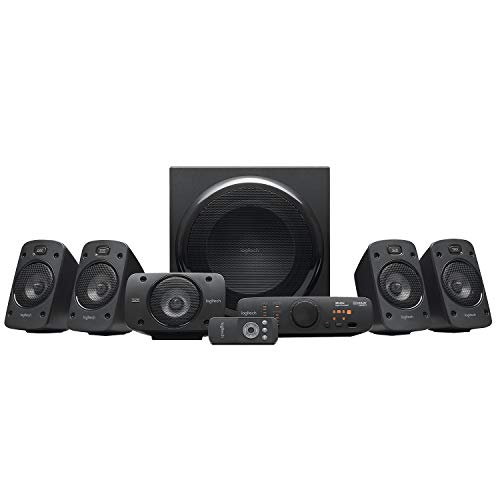
Logitech Z906 — Best for desk and console
The Z906 has been on sale, in essentially this form, for well over a decade, and its survival tells you something: nothing else at its level does quite its job. It is a self-powered 5.1 system — amplification lives in the subwoofer enclosure — aimed at desks, console corners and bedrooms rather than at a main television. Five satellites connect by speaker wire to the sub, a small control console handles volume and input selection, and the input panel is the reason the system endures: multiple optical and coaxial digital inputs alongside analogue connections mean a PC, a console and a streaming box can all live here without a receiver anywhere in the chain. It decodes Dolby Digital and DTS directly, so a console’s surround output arrives intact.
Set expectations by habitat. At a desk, nearfield, the Z906 sounds big, clean and genuinely cinematic for games; the satellites sit a metre from your ears and never strain. Moved to a living room sofa three metres away, the same system works harder, the subwoofer’s ported thump becomes more obvious, and the experience is good rather than great. The control console’s tethered cable also fixes where the volume knob can live, a small ergonomic tax desk users barely notice. Within its intended territory, though, it remains the reference: no receiver purchase, no HDMI switching questions, just surround sound for the screen you actually game on.
- Channels: 5.1 self-powered system; no receiver required
- Decoding: Dolby Digital and DTS built in
- Inputs: multiple optical and coaxial digital, plus analogue
- Certification: THX-certified design
- Control: wired control console plus remote
Strengths
- Connects to PCs and consoles directly, with several digital inputs.
- Nearfield performance at a desk is the best in this guide.
- A decade of production means parts, cables and advice are everywhere.
Trade-offs
- No HDMI inputs, so it cannot sit at the centre of a modern TV setup.
- Satellite cables are fixed lengths, which constrains larger rooms.
- The subwoofer’s one-note tendency shows on music at higher volumes.
Best for: gamers and PC users who want real surround at the desk without buying a receiver. Not suited for: a main living-room television, where HDMI switching and longer cable runs matter.
Onkyo HT-S3910 — Prose-only veteran
For years the HT-S3910 was the default answer to “surround sound, small budget”: a Dolby Atmos-capable receiver bundled with five compact speakers and a passive subwoofer, sold at a price that made separates look extravagant. It earned that position honestly. The receiver was the star — genuine format support including height-channel decoding in a 5.2.2-style configuration if you repurposed channels, Bluetooth for casual music, and enough HDMI inputs for a normal household. Owners who bought it new generally got years of service, and the model still circulates heavily in the used market, which is precisely why it appears in this guide at all.
The reason it carries no link is stated in our sources and repeated here so nobody clicks in false hope: when we checked, the Amazon presence under this model name had decayed to a replacement remote control rather than the system itself. That happens to older bundles, and it changes the buying advice completely. New, at a fair price from a retailer with returns, an HT-S3910-class bundle remains a sensible buy. Used, the calculus shifts to the receiver’s HDMI board health and whether the passive subwoofer — powered by the receiver, remember — still works, because replacing that sub is not as simple as swapping in any powered unit. Treat this entry as a field guide to a common secondhand encounter, not as a product we can send you to.
- Channels: 5.1 bundle with receiver; height-channel options in some configurations
- Subwoofer: passive design powered by the receiver
- Status: prose-only — listing decayed to a replacement remote at checking time
- Buying route: used market or remaining retail stock, inspected carefully
Strengths
- The receiver’s format support punched well above the bundle’s class.
- Huge ownership base means manuals, settings advice and spares knowledge are easy to find.
- Used examples can deliver full surround for very little money when healthy.
Trade-offs
- No trustworthy new listing to link, so purchase protection varies by seller.
- The passive subwoofer limits replacement and upgrade options.
- Bundled speakers were always the weak link, voiced thin at high volume.
Best for: bargain hunters who can test a used unit before paying. Not suited for: anyone who wants a warranty and a returns window.
Polk TL1600 — Prose-only compact set
Polk’s TL1600 belongs to the Blackstone TL family, a line built around a single idea: make the satellite so small and so cleverly shaped that people who hate the look of speakers will tolerate five of them. The satellites use an aerated polypropylene cone and a small silk-dome tweeter in a curved, time-aligned enclosure, and they sit on shelves or hang on walls without visually shouting. The matching powered subwoofer is a compact down-firing unit. As a design exercise in domestic diplomacy, the TL1600 succeeded for years, and its sound — smooth, polite, a little warm — suits television, sport and casual film far better than its size suggests.
Why prose-only, then? Because at checking time we could not find a clean Amazon listing for the complete TL1600 system that we were willing to attach this guide’s name to — the name resolves to fragments, accessories and third-party offers of uncertain content. Linking a reader to a box that might contain one satellite instead of a system is the kind of error that destroys trust in a buying guide, so the Polk stands here as knowledge rather than as a checkout. If you find the complete set through a reputable audio retailer, the advice is simple: it is a good small-room system whose speakers you will want to cross over fairly high, and whose subwoofer works best near a wall rather than in a corner.
- Format: five satellites plus subwoofer; amplification supplied by your own receiver
- Satellites: curved enclosures with silk-dome tweeters, wall-mountable
- Subwoofer: compact powered down-firing unit
- Status: prose-only — no clean complete-system listing at checking time
Strengths
- Among the least visually intrusive speaker sets in this guide.
- Smooth, forgiving voicing flatters ordinary television audio.
- Flexible mounting makes awkward rooms easier to serve.
Trade-offs
- Very small drivers demand a high crossover and lean on the subwoofer hard.
- Buying the genuine complete set currently takes retailer hunting.
- Dynamics run out early in bigger rooms or with demanding film mixes.
Best for: living rooms where speaker appearance is negotiated territory. Not suited for: buyers who want a one-click purchase today.
Monoprice Premium 5.1 — Prose-only budget route
Monoprice’s Premium 5.1 system is the budget benchmark that refuses to die: five two-way satellites with real tweeters and four-inch woofers, an eight-inch powered subwoofer, and a price through its maker’s own store that has historically undercut almost every branded rival. The satellites are larger than the Klipsch and Polk entries here, which cuts both ways — they look more like speakers, because they are, and they produce a fuller midrange that relies less desperately on the subwoofer. Build quality is honest rather than luxurious: vinyl-wrapped cabinets, spring-clip terminals, and a general sense that the money went to the drivers.
It appears without a link because it is a direct-sold product and not one of the Amazon listings verified for this guide; our pool rules are strict on that point, and we would rather explain an absence than smuggle in an unchecked link. Judged purely as hardware, it remains the clearest demonstration that the floor of the 5.1 market is better than its reputation. Pair it with any entry-level receiver, spend the savings on a calibration microphone session and decent wire, and the result embarrasses bundles costing noticeably more. The caveats are the retailer’s own shipping and returns terms, and satellites that will not disappear into a styled room the way the Polk set does.
- Format: five two-way satellites plus powered sub; receiver bought separately
- Satellites: two-way design with four-inch woofers
- Subwoofer: eight-inch powered unit
- Status: prose-only — sold direct by its maker, not a verified listing for this guide
Strengths
- Larger satellites deliver the fullest midrange of the speaker-only packs here.
- Historically the lowest entry cost into separates-based 5.1.
- Standard connections make receiver pairing and later upgrades simple.
Trade-offs
- Bigger cabinets are harder to hide and need real shelf space.
- Spring-clip terminals are less pleasant than binding posts.
- Purchase runs through one retailer, so compare its terms before ordering.
Best for: budget-first buyers building a separates system around an affordable receiver. Not suited for: rooms where speakers must be nearly invisible.
How Do the Six Systems Compare Side by Side?
| System | Receiver included? | Subwoofer | Best habitat |
|---|---|---|---|
| Klipsch Reference Theater Pack 5.1 | No | Wireless, compact ported | Existing-receiver living rooms |
| Yamaha YHT-5960U | Yes, with YPAO calibration | Wired, ported | First complete home cinema |
| Logitech Z906 | Not needed — self-powered | Powered hub of the system | Desks, consoles, bedrooms |
| Onkyo HT-S3910 | Yes (bundle, used market now) | Passive | Tested secondhand bargains |
| Polk TL1600 | No | Compact powered, down-firing | Appearance-sensitive small rooms |
| Monoprice Premium 5.1 | No | Eight-inch powered | Budget separates builds |
Read the table as a decision tree rather than a league ladder. The Yamaha is the only pick that is a whole answer in one box. The Klipsch and Monoprice compete for the same receiver-owning reader and split on character: efficiency and sparkle against size and midrange weight. The Z906 is not really competing with either, because it replaces the receiver entirely for a different room. The two prose-only veterans frame the market’s history — one a receiver-led bundle now found used, the other a design-led set whose retail trail has gone quiet.
Where Should Each Speaker and the Subwoofer Actually Go?
Placement is the free upgrade. Put the centre channel directly above or below the screen, angled toward ear height at the main seat, and pull it to the front edge of its shelf so reflections off the furniture do not smear dialogue. Front left and right belong at roughly ear height, forming a triangle with the listener, toed in slightly. Surrounds go to the sides of the seating, a little above ear level, aimed across rather than directly at the nearest ear. The subwoofer obeys different rules: corners multiply its output and its boom alike, so start with it along the front wall, try the famous crawl test — sub at the listening seat, you crawling the wall line listening for the smoothest bass — and then run the receiver’s calibration again after any move. Small changes of thirty centimetres matter more at low frequencies than any cable ever will.
What Mistakes Do First-Time 5.1 Buyers Keep Making?
The most expensive mistake is buying across the fork described in the introduction: a speaker-only pack with no receiver, or a second receiver bundled into a system bought for a room that already had one. The second is placing all five speakers along the front wall because the room looks tidier that way, which collapses surround into a wide stereo bar and wastes the format. Third comes the subwoofer turned up until it announces itself; bass should be felt as foundation, and a sub you can locate with your ears is usually a sub set too hot or crossed too high. Fourth, skipping calibration — even the basic microphone routine in the Yamaha bundle corrects level errors that most owners never fix by ear. Finally, there is wire: the thinnest included cable runs are fine for surrounds, but long runs deserve a heavier gauge, and every connection deserves a check for stray strands before the receiver is powered.
How Much Receiver Power Do Small Satellites Really Need?
Less than the marketing suggests, and the reason is the crossover. In a 5.1 system the subwoofer’s own amplifier handles the deepest, most power-hungry frequencies, so the receiver’s channels feed satellites that are only asked to reproduce the range above roughly eighty to a hundred hertz. That is light work. A modest receiver rated conservatively will drive the Klipsch pack — whose horn tweeters are notably efficient — to more volume than a small room tolerates, and even the less efficient Polk and Monoprice satellites reach comfortable film levels without exotic amplification. Where power genuinely matters is headroom during peaks: the few seconds when an explosion, a score swell and dialogue land together. Receivers handle those moments from their power reserves, and a system that sounds strained or harsh only at the loudest moments is usually telling you about headroom, not about average wattage. The practical advice is to buy the receiver for its calibration quality, its HDMI handling and its format support, in that order, and let power take care of itself at this speaker size.
Impedance is the one electrical figure worth a glance. Most satellites in this guide are rated at eight ohms or are comfortably driven as such, which suits every mainstream receiver. If you later upgrade to more demanding front speakers, check the receiver’s rating again — but nothing in this guide’s six picks will trouble a standard AV receiver from any major brand.
How Do You Set Crossovers and Levels Without Test Equipment?
Start by telling the receiver the truth about your speakers: set all five satellites to “small” in the speaker configuration menu, whatever their physical size suggests to your pride, because “small” is the setting that routes deep bass to the subwoofer where it belongs. Set the crossover at the figure the speaker maker recommends, or at eighty hertz when no guidance exists, and nudge upward toward a hundred or a hundred and twenty for the tiniest satellites such as the Polk set. Distances matter more than most owners expect: measure from each speaker to the main seat and enter those numbers, since the receiver uses them to time-align arrivals so a pan crosses the room as one event rather than five echoes.
Then run whatever automatic calibration the receiver offers — YPAO on the Yamaha bundle is the worked example in this guide — with the microphone at ear height on the main seat, the room quiet, and yourself out of the room or at least out of the sound path. Afterwards, verify rather than worship the result. Play a dialogue-heavy scene at your normal evening volume: speech should sit naturally in front of the score, not buried under it. Play a scene with a vehicle crossing the screen and listen for the sound to travel rather than jump. If dialogue needs help, raise the centre channel by a decibel or two and leave everything else alone. Resist the temptation to keep adjusting for a week; small systems settle, ears adapt, and most “problems” after honest calibration are the mix itself, which varies from film to film no matter what you buy.
What Should You Check Before Buying a Used 5.1 Bundle?
Because two entries in this guide now live mainly in the secondhand market, a short inspection ritual is worth more than another specification. Power the receiver and run every HDMI input with a real source; ageing boards often fail one input at a time. Play something with deep bass at moderate volume and listen at each satellite in turn for rattles, buzzes or silence — a blown tweeter announces itself as dullness rather than drama, so compare left against right with the same passage. Check the subwoofer by hand as much as by ear: the cone should move freely without scraping when pressed gently, and the surround foam on older units should not crumble at a touch. Confirm the remote is present and working, since universal replacements handle volume but often cannot open the setup menus you will need. Finally, ask for the calibration microphone if the bundle originally shipped with one; receivers of the Yamaha type lose half their setup value without it, and replacements cost more than sellers expect.
Which Room Sizes Suit Satellite Systems, and When Should You Buy Bigger Speakers?
Satellite systems earn their keep in rooms up to roughly twenty square metres with ordinary ceiling heights, where the listening distance stays under about three and a half metres. Inside that envelope, the six systems here differ in character but not in fundamental capability: all of them fill the space, all of them beat television speakers by an embarrassing margin, and all of them keep dialogue where it belongs. The limits appear at the edges. Stretch the seating distance, open the room into a kitchen or a stairwell, or develop a taste for action films at enthusiastic volume, and the small woofers begin to work visibly hard — the sound stays clear but loses body, and the subwoofer, asked to cover more of the midrange than it should, starts to reveal its location.
The graceful response is not to abandon the format but to upgrade asymmetrically. Because the front three speakers carry nearly everything you hear, replacing just the front pair and centre with larger bookshelf models later — keeping the small satellites as surrounds — transforms a system more cheaply than replacing all of it. That path is open to owners of the speaker-pack picks and of the Yamaha bundle, whose receiver will happily drive better fronts. It is closed to the Logitech, which is a sealed ecosystem, and that is the honest trade at the heart of this guide: sealed convenience now, or modular growth later. Neither answer is wrong; they are answers for different households, and choosing consciously is the whole job.
What Do the Surround Formats on the Box Actually Change?
Dolby Digital and DTS are the baseline languages of 5.1, carried by broadcast television, streaming services and every disc format, and every system in this guide handles them. The newer names — Dolby TrueHD, DTS-HD, and above all Dolby Atmos — describe mixes with either lossless compression or height information. A strict 5.1 layout cannot reproduce height channels, so an Atmos badge on a five-speaker bundle means the receiver can decode the stream and fold it down intelligently, not that sounds will arrive from above your head. That fold-down is still worthwhile: Atmos mixes are often mastered with extra care, and the core 5.1 experience benefits. But do not pay a large premium for height decoding unless you genuinely plan to add the speakers, and do not let a salesman present a 5.1 system as an Atmos system without that sentence attached.
For gaming, the practical format question is different: consoles output surround as either bitstreamed Dolby or DTS, which the Logitech decodes directly, or as multichannel PCM over HDMI, which needs a receiver in the chain. PC players should note that most games send PCM too, so a receiver-based system or a soundcard with encoding is the reliable route at a desk. These plumbing details decide more evenings than any tweeter material, and they are worth ten minutes of checking against your own devices before money moves.
How Do You Wire and Commission a 5.1 System in One Evening?
Work in an order that keeps you out of trouble. First, place every speaker and the subwoofer before connecting anything, because cable lengths follow placement and not the other way round. Second, cut and run the speaker wire with everything unplugged, labelling both ends of every run with tape — front left at the receiver must be front left at the speaker, and the five minutes labelling saves an hour of confused test tones later. Mind polarity religiously: the marked or ribbed conductor goes to the red terminal at both ends, on every channel, because one reversed speaker quietly hollows out the bass and smears the image in a way no calibration can fully repair. Keep wire runs away from tight parallel bundles with mains cables where you can, and leave a service loop of slack behind the receiver so the unit can slide out for cleaning without tearing connections loose.
Third, connect the subwoofer — by cable from the receiver’s subwoofer pre-out, or by pairing the Klipsch pack’s wireless transmitter and confirming its link light before you bury the sub in its chosen corner. Fourth, connect sources to the receiver and the receiver to the television’s ARC or eARC socket, then power everything up and open the setup menu. Run the automatic calibration if your receiver offers it, with the room arranged as it will be during films — curtains as usual, doors as usual, the dog wherever the dog insists on being. Fifth, verify with content you know: a dialogue scene, a concert recording, a game you have played for a hundred hours. Check that sound labelled left arrives on the left, that the surrounds contribute atmosphere rather than announcements, and that the subwoofer is a foundation you feel in the floor during a explosion scene yet cannot point to during a conversation. Only then hide the cables. Owners who commission in this order finish in an evening; owners who connect first and place later are still adjusting in a month.
Why Does the Centre Channel Deserve Its Own Placement Rules?
Because it carries the plot. In a typical film mix the centre speaker reproduces the large majority of dialogue plus a share of music and effects anchored to the screen, which makes it the hardest-working box in the system and the one whose mistreatment is most audible. Three errors recur. The first is burying it inside a cabinet, where the enclosure adds its own resonances and the shelf above blocks dispersion; if a cabinet is unavoidable, pull the speaker to the cabinet’s front edge and leave air around it. The second is height mismatch: a centre sitting on the floor or on a high shelf while the front pair flank the screen at ear level forces voices to detach from faces, so angle the centre up or down toward the listeners with a wedge or its own adjustable foot. The third is level neglect, already covered in the calibration section, but worth repeating because it masquerades as a faulty product: most “this system sounds muddy” complaints are a centre channel running several decibels shy of its neighbours, and the fix lives in a menu, not in a returns box.
Should You Choose a Soundbar Instead of Five Separate Speakers?
It is the question every reader of this guide has open in another tab, so it deserves a straight answer. A good soundbar wins on installation, on appearance, and on not requiring a receiver, and for casual television in a rented flat that may settle the matter. What it cannot do — whatever the virtual-surround badge claims — is put sound physically behind or beside you, because all of its drivers sit in front of the sofa and its surround effects are psychoacoustic suggestions rather than arrivals from real positions. The difference is not subtle in a dark room during a thriller: rain in a true 5.1 system occupies the space around the seats, while a soundbar’s rain stays politely near the screen. Soundbars also strand your investment when you outgrow them, since the bar, its amplification and its processing are one indivisible unit, whereas every speaker pack in this guide can migrate to a better receiver and every receiver can adopt better speakers.
The middle path some households take — a soundbar now, separates later — usually costs more than choosing once, because the bar’s money does not transfer. Our counsel: if the room allows five speakers and an evening of setup, buy the real arrangement and enjoy the format as it was designed. If the room, the landlord or the other people in the house forbid it, buy the bar without guilt and without believing its surround claims. What you should not do is buy a bar while telling yourself it is equivalent; it is a different, legitimate product wearing borrowed clothes.
Do Stands and Mounts Change How These Speakers Sound?
Only through height and stability, but both matter. A satellite’s tweeter should sit near the ear height of a seated listener; a speaker marooned on a low cabinet fires into knees and coffee tables, while one perched on a tall bookcase beams over heads. Inexpensive stands exist for every satellite in this guide, and their second virtue is decoupling — a speaker on a rigid stand wobbles less, and therefore blurs less, than one balanced on a stack of magazines. Wall mounts trade a little of that precision for freedom from floor space, and they earn their keep for surrounds, where the ideal position is often a wall rather than any piece of furniture. Whichever support you choose, avoid placing satellites deep inside shelving units: the cavity walls around a small speaker act like a megaphone with opinions, boosting some frequencies and swallowing others in ways calibration can only partly undo. An inch of air on every side is the cheapest acoustic treatment in this entire guide.
Final Recommendation
Choose by what you already own. With a receiver on the shelf, the Klipsch Reference Theater Pack brings the most energy per speaker in this guide, and the Monoprice set is the value alternative if its direct-sale route suits you. Starting from nothing, the Yamaha YHT-5960U is the single purchase we would hand a friend, because its calibration microphone quietly fixes the mistakes every beginner makes. At a desk, stop comparing home-cinema bundles entirely and take the Z906. And if a used Onkyo or a retailer-found Polk crosses your path at the right price, you now know exactly what each is and what to test. Five small speakers, honestly placed and honestly bought, will change film night more than any television upgrade at the same money — start with the centre channel at ear height and the subwoofer where the crawl test tells you, and the rest of the system will fall into place around them.
Frequently Asked Questions
Can I use a 5.1 speaker pack with a stereo receiver?
No — a stereo receiver has only two amplified channels and no surround decoding or centre and surround outputs. Speaker packs like the Klipsch and Polk need a multichannel AV receiver; bundles like the Yamaha include one, and the Logitech Z906 sidesteps the question by powering itself.
Is wireless subwoofer connection worse than a cable?
For the frequencies a subwoofer plays, a well-implemented wireless link like the Klipsch pack’s is audibly indistinguishable from a cable in normal use, and the placement freedom it buys usually improves bass more than any theoretical loss costs. Keep the transmitter in the same room and away from obvious interference sources.
Why is dialogue still quiet after I set everything up?
Check three things in order: that the centre speaker is actually connected and selected, that its level in the receiver menu is not several decibels below the front pair, and that any night or dynamic-range compression mode is not fighting the mix. Raising the centre channel level a little is a legitimate, common adjustment.
Can I add height speakers later for Atmos?
Only if the receiver supports it. A bundle receiver with height-channel capability can grow; a basic five-channel receiver cannot be upgraded by speakers alone. The speaker satellites themselves can be repurposed as surrounds in a later, larger system.
Can the surround speakers go on the ceiling or high on the wall?
They can, and in rooms where stands or shelves beside the sofa are impossible, high wall mounting angled down toward the seats is a workable compromise that many owners live with happily. Keep expectations calibrated: surrounds mounted far above ear level pull the soundstage upward and can blur the boundary with height effects, so mount as low as the room allows and angle the speakers rather than leaving them firing flat across the ceiling. Whatever you choose, choose it before running wire, because surround cable routes are the hardest to change afterwards.
Do these systems work for music, or only for films?
They work for music with a caveat about how you listen. Most receivers offer a stereo mode that uses the front pair plus the subwoofer, which suits satellite systems well because the sub fills the small speakers’ missing bottom end; the Klipsch pack in particular makes lively, detailed stereo. Multichannel music modes that spread a stereo recording across all five speakers divide opinion and default to off in our house. For a household whose listening is mostly music with occasional films, larger front speakers deserve priority in the budget; for film-first rooms, the systems here are honestly musical enough.
How much speaker wire should I buy?
Measure each run along its real route — down, across, up — then add slack. Surround runs are the long ones and are commonly underestimated. A single spool sized generously is cheaper than a second spool bought in a hurry.
What gauge of speaker wire do the surround runs need?
For the short front runs in most rooms, the wire included with bundles or any standard spool is adequate. Surround runs that travel around a room can stretch to ten metres or more, and at those lengths a heavier gauge preserves level and damping that thin wire quietly loses; when in doubt, buy the thicker spool, since the cost difference is small and the wire will outlive several systems. Keep connections bare-wire tight or use banana plugs at the receiver end, where five pairs of terminals crowd together and stray strands are most likely to meet.
Related Guides
Continue with our companion reading: the dual-subwoofer surround build explained, floor-standing speakers for larger rooms, and best 5 1 ceiling speakers. You may also find our desktop speaker picks for nearfield listening useful if the second screen in the house needs attention too, since a house with one good-sounding room tends to develop opinions about all the others, and the desk is usually the next place those opinions land.


