What's inside
As an Amazon Associate I earn from qualifying purchases. This post may contain affiliate links at no extra cost to you.
Clear sounding computer speakers are the ones that let you hear what is actually there, and this guide is about finding them without spending a fortune. A clear speaker has low distortion, a balanced response, and a treble that is detailed without being harsh, so that voices are easy to understand and instruments stay separate. The speakers here range from a tiny USB pair to a bookshelf pair with a remote, and they share a single quality: they make daily listening easy, whether the day is music, calls, or films.
Every pair here is a real, widely sold product, chosen because it sounds clear at its price and because it is simple to live with at a desk, and the guide is organised from the most detailed to the most versatile, so you can stop at the point where the sound meets your use. None of them needs a separate amplifier, and none of them asks you to learn a new system. What they share is a simple promise: press play, and hear everything.
Quick picks: best clear sounding computer speakers
| # | Product | Where to buy |
|---|---|---|
| 1 | Audioengine A2+ | Check on Amazon |
| 2 | Kanto YU2 | Check on Amazon |
| 3 | Edifier R1280DB | Check on Amazon |
| 4 | Logitech Z407 | Check on Amazon |
| 5 | Bose Companion 2 Series III | Check on Amazon |
Quick Comparison
The table below gives a fast overview of the models in this guide, so you can shortlist two or three before reading the detail. Every model here is a real, widely sold product, and each one suits a slightly different room, system, or way of listening.
| Speaker | Type | Best For |
|---|---|---|
| Audioengine A2+ | Powered desktop, 2.75-inch woofer | Best clear desktop speakers |
| Kanto YU2 | Powered desktop, 3-inch woofer | Best compact clear speakers |
| Edifier R1280DB | Powered bookshelf, Bluetooth, optical | Best clear speakers with Bluetooth |
| Creative Pebble V3 | USB desktop speakers, 2.25-inch | Best clear speakers on a tiny budget |
| Logitech Z407 | 2.1 system, Bluetooth, subwoofer | Best clear 2.1 computer speakers |
| Bose Companion 2 Series III | Multimedia speakers, 2.0 | Best clear speakers for voice and calls |
The Products in Detail
Audioengine A2+
The Audioengine A2+ is a small powered desktop speaker with a reputation for clarity, and it is the natural starting point for this guide. It has a 2.75-inch Kevlar woofer and a silk dome tweeter in each compact cabinet, with a built-in amplifier, a USB digital input, analogue inputs, and a subwoofer output, so it plays from a computer cleanly and can grow with a subwoofer later. The sound is open and detailed, with a treble that is crisp without harshness and a midrange that keeps voices clear, and the small size means the pair fits on a crowded desk without dominating it.
What makes the A2+ sound so clear is the combination of a good tweeter and a well-designed cabinet, because the small enclosure is braced and damped to avoid the boxy colouration that affects many desktop speakers. The USB input is a genuine advantage, because it takes a digital signal straight from the computer, bypassing the noisy analogue output that many desktops have, and the result is a cleaner, quieter sound. The speakers are quiet when idle, with no audible hiss, and they image well, placing instruments and voices in a stable stereo picture that makes long listening sessions easy.
Strengths: A clear, detailed sound with a crisp treble and an open midrange, in a compact pair that fits any desk. The USB digital input gives a clean signal from a computer, the subwoofer output allows a later upgrade, and the build is excellent, with a finish that looks good. It is the clearest small speaker in this guide.
Trade-offs: The small woofer limits the bass, so the sound is light without a subwoofer, and the pair is best heard at close range. It costs more than the budget desk speakers, and there is no Bluetooth, so a phone needs a cable. The volume control is on the back, which is awkward on a desk.
Who it fits: Desk workers, writers and listeners who value clarity above bass, especially anyone who listens at close range and wants to hear detail in music and dialogue. It suits a small desk, a home office, and anyone who will add a subwoofer later.
Play a track with a quiet vocal and a detailed accompaniment and notice how clearly each part is separated, because that separation is what a clear speaker does. Then play the same track on a larger, warmer speaker and listen for what is gained and what is lost, because clarity and warmth are a trade-off.

Kanto YU2
The Kanto YU2 is a tiny powered desktop speaker, and it is the pick here for buyers whose desk has almost no space but who still want a clear sound. It has a 3-inch woofer and a silk dome tweeter in a cabinet barely larger than a coffee mug, with a built-in amplifier, USB and analogue inputs, and a subwoofer output, so it plays from a computer and can grow with a subwoofer. The sound is surprisingly full for the size, with a clear midrange and a smooth treble, and the speakers come in a range of colours that suit a modern workspace.
The YU2 sounds bigger than it looks, because Kanto tuned the small cabinet carefully, with a port that adds a little weight to the low end and a tweeter that stays smooth at volume. The USB input gives a clean digital signal from a computer, and the speakers are quiet when idle, with no hiss to distract from work. They image well for their size, and they suit a desk where the listener sits close, because the sound is designed for near-field listening rather than for filling a room.
Strengths: A genuinely tiny footprint with a clear, balanced sound that is far bigger than the cabinets suggest. The USB input gives a clean signal, the subwoofer output allows a later upgrade, and the range of colours suits a modern desk. It is the best choice here for a crowded workspace.
Trade-offs: The 3-inch woofer limits the bass and the maximum volume, so the sound is thin in a large room and a subwoofer helps for music. There is no Bluetooth, and the small size means the speakers need to be close to the listener to sound their best. The volume control is on the back.
Who it fits: Anyone with a small or crowded desk who still wants a clear, musical speaker, especially students and home workers. It suits a laptop setup, a small office, and anyone who values footprint over bass.
Play a spoken-word recording and notice how clear and natural the voices sound, because voice clarity is where a small speaker proves itself. Then play music and listen for where the bass runs out, because the limit is real and a subwoofer is the answer if it matters.
Check price on Amazon: Audioengine A2+

Edifier R1280DB
The Edifier R1280DB is a powered bookshelf pair with a warm, clear sound, and it earns its place here as the most versatile clear-sounding computer speaker in the guide. It has a 4-inch woofer and a silk dome tweeter in each cabinet, with Bluetooth, optical, coaxial and dual RCA inputs, and a wireless remote, so a computer, a phone and a television can all stay connected at once. The sound is clear and balanced, with a midrange that keeps dialogue intelligible and a bass response that is solid for a bookshelf pair, and the larger cabinet gives the sound a fullness that the tiny desk speakers here cannot match.
The R1280DB sounds clear without being clinical, because Edifier tuned it for enjoyment rather than for measurement, and the result is a speaker that makes music sound musical and dialogue sound natural. The optical input takes a clean digital signal from a computer or a television, the Bluetooth connection is stable, and the remote makes daily use easy. The speakers are quiet when idle, the controls are simple, and the wood-effect cabinets look good on a desk or a shelf, which is where a bookshelf pair belongs.
Strengths: A clear, balanced sound with a solid bass, plus Bluetooth, optical and coaxial inputs and a remote, which together make it the most connected speaker in this guide. The larger cabinet gives a fuller sound than the tiny desk pairs, and the price is low for what it offers.
Trade-offs: The sound is warm rather than detailed, so a critical listener may prefer the Audioengine A2+ for absolute clarity. The cabinets are larger than a desk pair, so they need a shelf or a spacious desk. The Bluetooth connection is standard quality rather than high-resolution.
Who it fits: Buyers who want a clear-sounding pair that plays from a computer, a phone and a television, especially anyone whose desk doubles as a media corner. It suits a home office, a bedroom, and anyone who values connections and a remote as much as sound.
Play a film scene with quiet dialogue and notice how clearly every word comes through, because dialogue clarity is the test of a clear speaker. Then switch from Bluetooth to the optical input and listen for whether the digital connection sounds cleaner, because the comparison shows what the inputs buy.
Check price on Amazon: Kanto YU2

Creative Pebble V3
The Creative Pebble V3 is a small USB-powered desktop speaker pair, and it is the pick here for buyers who want a clear sound for almost no money. It has a 2.25-inch driver in each spherical cabinet, angled upward toward the listener, with a USB-C connection that carries both power and audio from the computer, plus a Bluetooth mode for a phone. The sound is clear and balanced for the size, with a midrange that keeps voices natural and a treble that is smooth, and the angled design means the sound reaches the ears rather than the desk, which is a simple trick that works.
The Pebble V3 sounds better than its size and price suggest, because the upward angle and the small, well-damped cabinet give the sound a clarity that a flat desktop speaker struggles to match. The USB-C connection is convenient, because a single cable powers the speakers and carries the audio, and the Bluetooth mode is stable for a phone. The speakers are quiet when idle, the volume control is on the front, and the whole pair takes up almost no desk space, which is why it is popular in offices and dorm rooms.
Strengths: A clear, balanced sound at a very low price, with a USB-C connection that powers the speakers and carries audio in one cable. The upward angle directs the sound at the listener, the Bluetooth mode covers a phone, and the footprint is tiny. It is the cheapest clear-sounding speaker in this guide.
Trade-offs: The 2.25-inch driver limits the bass and the maximum volume, so the sound is thin for music and films, and a subwoofer is not an option. There is no separate amplifier and no digital optical input, so the sound quality depends on the computer’s USB audio. The speakers are best heard at close range.
Who it fits: Students, office workers and anyone who needs a clear speaker for video calls and casual listening on a tiny budget. It suits a laptop, a small desk, and anyone who values clarity and footprint over bass and volume.
Join a video call and notice how clear the voices sound, because that is the job this speaker is built for. Then play music and listen for where the bass runs out, because the limit is real, and the price is the reason.
Check price on Amazon: Edifier R1280DB
Logitech Z407
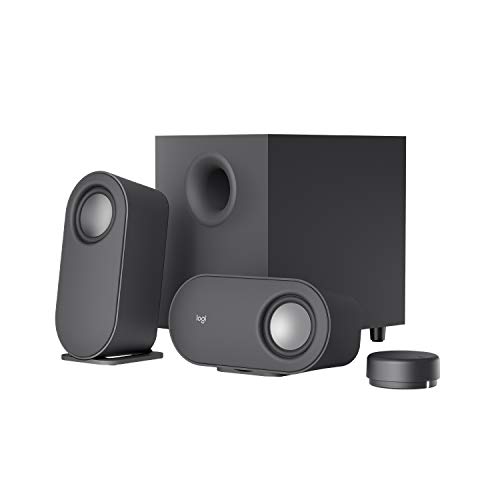
The Logitech Z407 is a 2.1 computer speaker system with a subwoofer, and it is the pick here for buyers who want a clear sound with a proper low end. It has two small satellite speakers with a clear, balanced sound, a down-firing subwoofer that adds weight to films and games, and a wireless control dial that adjusts volume, bass and mute from the desk. It connects by USB, Bluetooth or a 3.5 mm cable, so a computer, a phone and a tablet can all play through it, and the whole system is designed to sit neatly on a desk without dominating it.
The Z407 sounds clear and full, with a midrange that keeps dialogue intelligible and a subwoofer that is controlled rather than boomy, and the wireless dial is the best control in this guide for daily use, because it sits on the desk and adjusts everything without reaching behind a speaker. Bluetooth pairing is quick, the USB connection gives a clean digital signal, and the satellites are small enough to sit beside a monitor. The system is quiet when idle, and the bass can be tuned with the dial, so the balance can be adjusted to the room.
Strengths: A clear sound with a proper subwoofer, a wireless control dial that makes daily use easy, and USB, Bluetooth and analogue inputs that cover every source. The bass is controlled rather than boomy, the satellites are small, and the system is easy to set up.
Trade-offs: The satellites are small, so the midrange is thinner than a bookshelf pair, and the sound is best heard at close range. The subwoofer is down-firing, so it needs a hard floor to sound its best, and the system will not fill a large room. There is no optical input.
Who it fits: Desk owners who want a clear sound with bass, especially gamers and film watchers who need a subwoofer without a large system. It suits a home office, a bedroom, and anyone who values a wireless dial over a remote.
Play a film scene and notice how the subwoofer underpins the dialogue without drowning it, because that balance is the point of a 2.1 system. Then turn the bass down on the dial and listen for how much of the sound disappears, which shows how much the subwoofer contributes.
Bose Companion 2 Series III
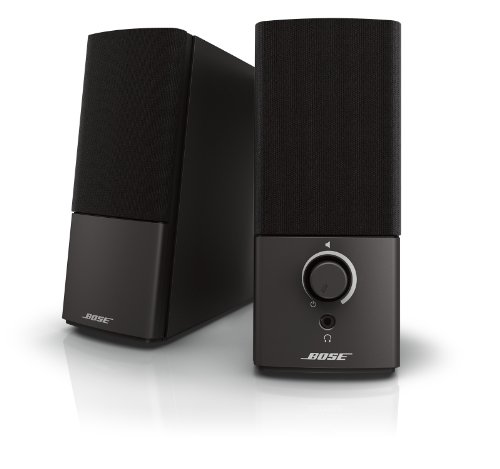
The Bose Companion 2 Series III is a multimedia speaker pair with a reputation for clear, natural sound, and it is the pick here for buyers who spend their days on calls and video. It has a small woofer and a tweeter in each compact cabinet, with a built-in amplifier, a 3.5 mm input, a headphone output and a volume control on the front, so it plays from a computer with a single cable and nothing else to learn. The sound is clear and balanced, with a midrange that makes voices sound like people in the room, and a treble that is smooth over long sessions.
The Companion 2 sounds clear because Bose tuned it for the human voice, and the result is a speaker that makes calls, podcasts and dialogue sound natural and easy to follow. The bass is modest but tight, the treble is smooth rather than sparkling, and the speakers are quiet when idle, with no hiss to distract from work. The front headphone output is convenient for private calls, and the volume control is within reach, so the speakers are easy to live with day after day, which is the real test of a desk speaker.
Strengths: A clear, natural sound that is tuned for voices, with a smooth treble that suits long sessions. The front headphone output and volume control are convenient, the setup is a single cable, and the build is solid. It is the best choice here for calls and spoken word.
Trade-offs: The bass is modest, so music and films sound thinner than on a system with a subwoofer. There is no Bluetooth, no digital input and no remote, so a phone needs a cable and every adjustment is manual. The sound is pleasant rather than detailed, so critical listeners may prefer the Audioengine A2+.
Who it fits: Home workers, students and anyone who spends their days on video calls, podcasts and spoken word, and wants a speaker that makes voices clear. It suits a desk, a home office, and anyone who values simplicity and voice clarity over bass and features.
Join a video call and notice how natural the voices sound, because that is the job this speaker is built for. Then play music and listen for whether the bass feels thin, because the trade-off is real and the price is the reason the speaker is tuned this way.
Check price on Amazon: Logitech Z407
What Clear Sounding Actually Means
Clear sounding is a phrase that gets used loosely, and it is worth pinning down, because it means different things to different listeners. In the strict sense, a clear speaker is one with low distortion, a balanced frequency response, and a treble that is detailed without being harsh, so that each part of a recording can be heard separately. In the everyday sense, a clear speaker is one that makes voices easy to understand, which depends mostly on the midrange, where the human voice lives, and on a cabinet that does not colour the sound with its own resonances.
The practical point is to listen for the midrange first, because a speaker with a muddy midrange will never sound clear, however good its treble is. Play a spoken-word recording and listen for whether every word is distinct, then play a track with a vocal and an accompaniment and listen for whether the voice sits in front of the instruments or gets buried in them. A clear speaker keeps the voice forward and the instruments separate, and that separation is the quality this guide is about.
Check price on Amazon: Bose Companion 2 Series III
Near-Field Listening and Why It Matters
Computer speakers are near-field speakers, which means they are designed to be heard from a short distance, usually an arm’s length, and that changes how they should be judged. A speaker that sounds thin from across a room can sound full and clear at a desk, because the direct sound reaches the ears before the room has a chance to colour it, and the bass that seems missing at distance is present up close. Judging a desk speaker from the far side of a room is like judging a book by reading it from across the street.
The practical consequence is placement: put the speakers at ear height, angle them slightly inward, and sit at the distance they were designed for, which is usually the distance from your eyes to the monitor. Give them a little space from the wall, use foam pads to decouple them from the desk, and listen from your normal chair, not from the doorway. A well-placed small speaker will sound clearer than a badly placed large one, and the difference costs nothing.
The Desk Is Part of the Speaker
A computer speaker does not sound the same on every desk, because the desk is part of the acoustic system, and a hollow desk will colour the sound more than any difference between two speakers. A speaker cabinet vibrates as it plays, and a thin desktop or a hollow shelf will vibrate with it, adding a boxy resonance that muddies the midrange and booms the bass. The cure is decoupling: a pair of foam isolation pads, a set of small rubber feet, or a proper desktop stand that lifts the speaker off the surface and lets it sound as it was designed to.
The second desk factor is reflection, because a hard desktop reflects sound upward toward the listener a fraction of a second after the direct sound, and that reflection smears the treble and blurs the stereo image. Angling the speakers slightly upward, or raising them on stands so the tweeters point at the ears, reduces the reflection and sharpens the sound noticeably. It is a small change that costs nothing, and it is worth doing before judging any speaker, because a speaker heard through a desk reflection is not the speaker at all.
The third factor is clutter, because a desk crowded with books, boxes and a second monitor creates reflections and shadows that a clear sound cannot survive. Give the speakers a little space on each side, keep the area in front of them clear, and move anything that sits directly between the speaker and your ears. A tidy desk is not vanity: it is the cheapest acoustic treatment there is, and it makes every speaker in this guide sound better.
Buying Guide
Start by deciding what clear means to you, because a speaker that is clear for music is not always the same as a speaker that is clear for calls. Music clarity needs a detailed treble and a balanced response, while call clarity needs a natural midrange and a smooth top end that does not fatigue over hours. Think about what you listen to most, and choose the speaker tuned for it.
Check the connection, because a clear speaker fed by a noisy signal will sound noisy. A USB digital input bypasses a computer’s analogue output, which is often the weakest link in a desk setup, and it is worth choosing a speaker that has one if your computer’s headphone output hisses. Bluetooth is convenient but compressed, so it is fine for casual listening and less ideal for critical work.
Think about the bass honestly, because a clear speaker with no bass sounds thin, and a speaker with too much bass sounds muddy. The small speakers in this guide trade bass for clarity, and that is a fair trade at a desk, where the listener sits close. If music matters, a subwoofer output is worth having, because it lets you add the low end later without replacing the speakers.
Consider the size of your desk, because a clear speaker that does not fit is a speaker you will not use. The Kanto YU2 and the Pebble V3 fit anywhere, the Audioengine A2+ needs a little more room, and the Edifier R1280DB needs a shelf or a spacious desk. Measure the space before you buy, and leave room for the speakers to breathe, because a speaker pushed against a wall will sound boomy.
Listen for hiss, because a powered speaker with a noisy amplifier will hiss when idle, and that hiss is maddening in a quiet office. The speakers in this guide are all quiet, but a cheap speaker from an unknown brand often is not, so it is worth checking reviews for the word hiss before you buy. A silent speaker is a sign of a well-designed amplifier, and it matters more than any specification.
Finally, remember that clarity is a matter of taste as well as measurement, and the only reliable test is your own ears. If you can, listen to a speaker before you buy, or buy from a seller with a good returns policy, because a speaker that measures well and sounds wrong to you is the wrong speaker. Trust your ears over a specification sheet, and choose the speaker that makes your daily listening easy.
Frequently Asked Questions
What are the clearest sounding computer speakers?
The Audioengine A2+ is the clearest small desktop speaker in this guide, with a detailed treble and an open midrange, and the Kanto YU2 is the clearest tiny speaker. The Edifier R1280DB is the clearest versatile pair, with a balanced sound and the most connections. The right answer depends on your desk, your budget, and whether you value absolute detail or everyday versatility more.
Why do my computer speakers sound muddy?
Usually because of placement, not because of the speakers. A speaker pushed against a wall gets a bass boost that muddies the midrange, a speaker on a hollow desk picks up vibrations, and a speaker heard from across the room loses its clarity to the room itself. Pull the speakers away from the wall, put them on foam pads, angle them toward your ears, and listen from your normal chair, and the muddiness often disappears.
Does a USB connection sound better than a 3.5 mm cable?
Often, yes, because a USB connection carries a digital signal and bypasses the computer’s analogue output, which is frequently noisy. A 3.5 mm cable carries an analogue signal that has already been through the computer’s sound hardware, and a cheap sound chip will add hiss and distortion. If your computer’s headphone output hisses, a speaker with a USB input, such as the A2+ or the YU2, will sound noticeably cleaner.
Do I need a subwoofer for clear computer speakers?
Not for clarity, because the midrange and treble are where clarity lives, and a small speaker does those well. A subwoofer adds bass, which makes music and films fuller, but it does not make voices clearer, and a badly set subwoofer can muddy the sound. Choose a speaker with a subwoofer output if you think you will want one later, but do not buy a subwoofer to fix a clarity problem, because it will not.
Are small speakers clearer than large ones?
Not necessarily, but small speakers have an advantage at a desk, because they are designed for near-field listening and their cabinets are less prone to resonance. A large speaker heard from a metre away can sound superb, but it needs space to breathe, and a desk rarely gives it. At close range, a well-designed small speaker is often clearer than a large one, because the direct sound dominates and the room matters less.
Why do some speakers hiss when idle?
Because the amplifier has a high noise floor, which is a sign of a cheap or poorly designed circuit. A good powered speaker is silent when idle, and the speakers in this guide all are. If a speaker hisses, it will hiss during quiet passages as well, and it will be maddening in a quiet room. Check reviews for the word hiss before you buy, and return a speaker that hisses, because it is a fault, not a feature.
Can a cheap speaker sound clear?
Yes, as the Creative Pebble V3 proves, because clarity depends on a good tweeter, a well-damped cabinet and a clean amplifier, none of which is inherently expensive. A cheap speaker will lack bass and volume, and it will not fill a room, but at a desk, at close range, it can sound remarkably clear. Spend on the speaker that suits your distance and your use, not on the one with the highest price.
Should I buy a DAC for my computer speakers?
Not before you have chosen the speakers, because the speakers make a far bigger difference than the DAC, and a good speaker fed by a mediocre source still sounds good, while a mediocre speaker fed by a perfect source still sounds mediocre. A separate DAC helps if your computer’s headphone output hisses or sounds dull, and a speaker with a USB input already has a DAC built in, which is the simplest answer. Spend on the speakers first, and consider a DAC later, if the sound still bothers you.
How do I know if a speaker is too bright?
Listen for fatigue: a bright speaker sounds exciting for a few minutes and tiring after an hour, because the treble is emphasised and the ears grow sensitive to it. Play a track with cymbals and sibilant vocals at your normal volume, and notice whether you want to turn it down after ten minutes. If you do, the speaker is too bright for you, whatever the reviews say, and a warmer speaker such as the Edifier R1280DB will suit you better.
Is it worth buying speaker stands for a desk?
Yes, if the speakers sit too low, because a tweeter that points at the desk instead of at your ears will sound dull and distant, and a small stand that raises the speakers to ear height makes a real difference. Stands also decouple the cabinets from the desk, which cleans up the bass, and they free up space underneath for a keyboard or a notebook. A pair of foam pads is a cheaper alternative that does most of the same job, and either is worth buying on day one rather than after months of wondering why the speakers sound muffled.
Do I need to break in new speakers?
Not really, because modern drivers are consistent from the first hour, and any change over the first few days is small and mostly in the bass, as the suspension loosens slightly. What changes more is your ears, as you learn the speaker’s character and adjust to it. Play the speakers normally for a week before judging them, and if they still sound wrong after that, the problem is the speaker or the placement, not the break-in, and a return or a repositioning is the answer.
Conclusion
The clearest sounding computer speaker is the one that matches your desk and your ears, and for most buyers that is the Audioengine A2+, because its detail and its USB input make it the cleanest listen here. Check your connection, place the speakers at ear height, and trust your ears over a specification sheet. A clear speaker makes every day of listening easier, and the right one is the one you stop thinking about, because the sound simply gets out of the way and lets the music, the call, or the film through.


