What's inside
As an Amazon Associate I earn from qualifying purchases. This post may contain affiliate links at no extra cost to you.
Column array speakers have become the standard for churches, and this guide explains why, because a sanctuary is one of the hardest rooms to fill with sound. A church is usually tall, hard-surfaced and reverberant, and a conventional speaker sprays sound at the ceiling, where it echoes and blurs the words. A column array controls where the sound goes, spreading it across the congregation and keeping it away from the ceiling, so the sermon stays clear from the front row to the back, and the music stays musical.
Every system here is a real, widely sold column array, chosen because it suits a church’s particular needs, from a small chapel to a large sanctuary with a worship band, and the guide is organised from the most versatile to the most specialised, so you can stop at the point where the system meets your room. None of them needs a separate amplifier, and most include a mixer, so a service can run from a single column. What they share is a simple promise: every word heard, everywhere in the room.
Quick picks: best column array speakers for church
| # | Product | Where to buy |
|---|---|---|
| 1 | Bose L1 Pro16 | Check on Amazon |
| 2 | Bose L1 Pro8 | Check on Amazon |
| 3 | JBL PRX One | Check on Amazon |
| 4 | Electro-Voice Evolve 50 | Check on Amazon |
| 5 | RCF EVOX J8 | Check on Amazon |
| 6 | Yamaha Stagepas 1K MkII | Check on Amazon |
Quick Comparison
The table below gives a fast overview of the models in this guide, so you can shortlist two or three before reading the detail. Every model here is a real, widely sold product, and each one suits a slightly different room, system, or way of listening.
| Speaker | Type | Best For |
|---|---|---|
| Bose L1 Pro16 | Column array, 16 drivers, subwoofer | Best column array for a church |
| Bose L1 Pro8 | Column array, 8 drivers, compact | Best column array for a small church |
| JBL PRX One | Column array, 7-channel mixer | Best column array with a full mixer |
| Electro-Voice Evolve 50 | Column array, 8 drivers, 1000W | Best column array for clarity |
| RCF EVOX J8 | Column array, 8 drivers, compact | Best compact column for a church hall |
| Yamaha Stagepas 1K MkII | Column array, 5-channel mixer | Best column array for a church band |
The Products in Detail
Bose L1 Pro16
The Bose L1 Pro16 is a column array system built for rooms where people need to hear every word, and it is the natural starting point for a church guide. It combines a tall, slim column of sixteen small drivers with a powerful subwoofer, and the column spreads sound evenly from the front row to the back, with far less drop-off over distance than a conventional speaker. The system is portable, sets up in minutes without tools, and includes a built-in mixer with Bluetooth, so a service can run from a single column, or a pair can cover a larger sanctuary, with a sound that is clear, warm and easy to listen to for an hour or more.
What makes the L1 Pro16 work so well in a church is the way a column array controls dispersion: the tall line of drivers produces a wide horizontal spread and a narrow vertical one, so the sound reaches the congregation instead of the ceiling, and the reflections that make a stone or plaster room echo are reduced. The sixteen drivers give the system a smooth, even response, the subwoofer adds weight to music without booming, and the built-in mixer handles a microphone, an instrument and a phone at once. The system is loud enough for a medium sanctuary, and it stays clear at volume, which is the first requirement of any church speaker.
Strengths: An even, clear sound that reaches the back row without overwhelming the front, with a slim column that blends into a sanctuary rather than dominating it. The built-in mixer and Bluetooth simplify the setup, the system is portable and quick to assemble, and the sound stays intelligible in a reverberant room, which is the hardest test for a church speaker.
Trade-offs: It is a single-column system, so a very large or wide sanctuary needs a pair, which doubles the cost. The subwoofer is heavy, the system has no flying hardware for a permanent install, and the price is higher than a pair of conventional speakers. The built-in mixer is basic, so a large service with many microphones needs an external desk.
Who it fits: Medium churches, chapels and fellowship halls where speech clarity matters most, especially sanctuaries with hard surfaces and long reverberation. It suits a congregation that meets in a room that echoes, and a team that values a quick setup and a discreet appearance.
Stand at the back of the room during a spoken passage and notice whether every word is clear, because that is the test of a church speaker. Then walk to the front and listen for whether the sound is painfully loud, because a column array should be even from front to back, and that evenness is its point.

Bose L1 Pro8
The Bose L1 Pro8 is the smaller brother of the Pro16, and it is the pick here for small churches, chapels and meeting rooms where a full-size column would be too much. It has a column of eight drivers on a compact subwoofer base, with the same wide horizontal dispersion and the same even coverage as its larger sibling, and a built-in mixer with Bluetooth, so a small service can run from a single unit. The whole system weighs little, fits in a car, and sets up in minutes, which makes it as useful for a midweek meeting in a hall as for a Sunday service in a chapel.
The Pro8 sounds clear and warm, with a midrange that makes speech intelligible and a bass response that supports music without overwhelming a small room. The eight drivers give the system a smooth, even sound, and the column’s dispersion means the front row is not blasted while the back row strains to hear, which is the common fault of a conventional speaker in a small room. The built-in mixer handles a microphone and an instrument, the Bluetooth input plays music from a phone, and the system is quiet when idle, with no hiss to distract from a quiet moment.
Strengths: A compact, portable column that sounds clear and even in a small room, with a built-in mixer and Bluetooth that simplify a small service. It is light, quick to set up, and discreet, and it solves the front-to-back volume problem that plagues small churches.
Trade-offs: It is not loud enough for a large sanctuary, so a bigger room needs the Pro16 or a pair of Pro8s. The bass is modest, the built-in mixer is basic, and the system has no flying hardware for a permanent install. The subwoofer base, while compact, is still a box to carry.
Who it fits: Small churches, chapels, house groups and meeting rooms where a full-size system would overwhelm the space. It suits a congregation of a few dozen, a team that moves between rooms, and anyone who needs a speaker that sets up in minutes and disappears into the background.
Sit in the back row during a reading and notice whether every word is distinct, because a small room with hard walls is where speech gets lost. Then sit in the front row and listen for whether the sound is comfortable, because a good column should be as gentle up close as it is clear at distance.
Check price on Amazon: Bose L1 Pro16

JBL PRX One
The JBL PRX One is a column array system with a seven-channel digital mixer built in, and it is the pick here for churches that need more inputs than a basic column provides. It combines a column of twelve drivers with a subwoofer, and the mixer handles microphones, instruments, Bluetooth and a media player, with effects, EQ and a simple app for control. The system is designed for a working church, where a service may involve a preacher, a worship leader, a keyboard and a backing track, and it keeps all of them in one box, with a sound that is clear, powerful and easy to manage.
The PRX One sounds clean and authoritative, with a midrange that keeps speech intelligible and a bass response that gives music weight, and the column’s dispersion keeps the sound even across the room. The seven-channel mixer is the real advantage: it has enough inputs for a small worship team, it includes reverb and delay for vocals, and the app lets the operator adjust the mix from the pews, which is far more useful than walking back to the speaker. The system is portable, with a column that breaks down for transport, and it is loud enough for a medium to large sanctuary.
Strengths: A seven-channel digital mixer with effects and app control, built into a powerful column array, which together handle a full worship team without an external desk. The sound is clear and even, the system is portable, and the app control means the mix can be adjusted from anywhere in the room.
Trade-offs: It is heavier and more expensive than a basic column, and the digital mixer has a learning curve, so a volunteer team needs a little training. The app control depends on a phone or tablet, and the system has no flying hardware for a permanent install. The column is tall, so it needs a little space behind it.
Who it fits: Churches with a worship team, a keyboard, and several microphones, where a basic column’s mixer is not enough. It suits a medium to large sanctuary, a team that values app control, and anyone who wants a single box that handles a whole service.
Run a full service through it and notice whether the mix stays balanced as microphones come and go, because a seven-channel mixer is only useful if it is easy to manage live. Then stand at the back and listen for whether the speech is clear, because that is the test every church speaker must pass.
Check price on Amazon: Bose L1 Pro8

Electro-Voice Evolve 50
The Electro-Voice Evolve 50 is a column array system with a reputation for clarity, and it is the pick here for churches where the spoken word is the priority. It has a column of eight drivers on a 12-inch subwoofer, with a built-in mixer, Bluetooth, and a level of detail that makes speech unusually easy to follow, even in a reverberant room. The system is powerful, with a clean, controlled sound that stays intelligible at volume, and it is built to the standard of a professional touring product, with a cabinet and a finish that suit a permanent or a portable role.
The Evolve 50 sounds precise, with a treble that is detailed without harshness and a midrange that keeps every syllable distinct, and the column’s dispersion means the sound is even from the front to the back of the room. The subwoofer is tight and controlled, adding weight to music without muddying speech, and the built-in mixer handles a microphone, an instrument and a phone. The system is easy to set up, with a column that assembles in seconds, and it is loud enough for a large sanctuary, with headroom to spare.
Strengths: Exceptional speech clarity, with a detailed treble and a precise midrange that make every word easy to follow. The column dispersion is even, the subwoofer is tight, and the build is professional. It is the clearest-sounding column in this guide.
Trade-offs: It costs more than the Bose columns, and the built-in mixer is simpler than the JBL’s seven-channel desk. The system is heavy, the subwoofer is large, and there is no flying hardware for a permanent install. The precise sound can feel clinical to listeners who prefer a warmer tone.
Who it fits: Churches where preaching and reading dominate, and where every word must be heard clearly at the back. It suits a large sanctuary, a congregation that values intelligibility above warmth, and a team that wants a professional, reliable system.
Listen to a sermon from the back row and notice whether the consonants are crisp, because that is where a clear speaker earns its keep. Then listen to music and notice whether the sound feels precise or cold, because the Evolve’s clarity is a character, and it suits some rooms better than others.
Check price on Amazon: JBL PRX One
RCF EVOX J8
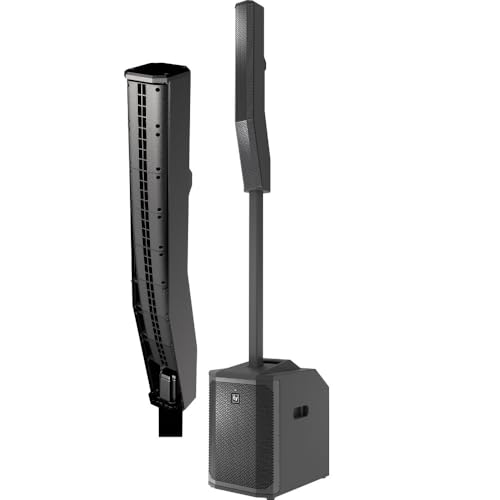
The RCF EVOX J8 is a compact column array system from an Italian professional audio maker, and it is the pick here for church halls and fellowship rooms where a full-size column is too much. It has a column of eight 2-inch drivers on an 8-inch subwoofer, with a built-in mixer, Bluetooth, and a sound that is clear, warm and musical, in a package that is small enough to carry with one hand. The system is designed for rooms where people gather to talk, sing and listen, and it does that job with a minimum of fuss and a maximum of clarity.
The EVOX J8 sounds warm and clear, with a midrange that suits speech and singing alike, and a bass response that is solid for the size, thanks to a well-designed subwoofer. The column’s dispersion keeps the sound even across a hall, and the system is loud enough for a hundred people without straining. The built-in mixer handles a microphone and a phone, the Bluetooth connection is stable, and the whole system packs down into a small footprint, which matters in a hall that serves many purposes.
Strengths: A compact, light column with a warm, clear sound that suits speech and singing, and a built-in mixer and Bluetooth that simplify a hall event. It is easy to carry, quick to set up, and loud enough for a medium hall, with a professional build that will last.
Trade-offs: It is not loud enough for a large sanctuary, and the built-in mixer is basic, so a service with many microphones needs an external desk. The bass is modest, the system has no flying hardware, and the brand is less familiar than Bose or JBL, which can matter for a volunteer team buying on reputation.
Who it fits: Church halls, fellowship rooms and small sanctuaries where a compact, portable column is enough. It suits a hall that hosts many different events, a team that carries the system between rooms, and anyone who values warmth and portability over raw power.
Play a hymn and notice whether the voices blend naturally, because a hall speaker has to serve singing as well as speech. Then listen to a spoken passage from the back and check that every word is clear, because a column that sings well but speaks poorly is only half a church speaker.
Check price on Amazon: Electro-Voice Evolve 50

Yamaha Stagepas 1K MkII
The Yamaha Stagepas 1K MkII is a column array system with a five-channel mixer, and it is the pick here for churches with a band, because it is built for live music as much as for speech. It has a column of ten drivers on a 12-inch subwoofer, with a mixer that handles microphones, guitars, keyboards and a phone, and a sound that is clear, full and musical. The system is a development of Yamaha’s long-running Stagepas line, which has served small venues and churches for years, and it brings that experience to a column format that suits a sanctuary.
The Stagepas 1K MkII sounds warm and musical, with a midrange that keeps vocals clear and a bass response that gives a band a solid foundation, and the column’s dispersion keeps the sound even across the room. The five-channel mixer is genuinely useful, with EQ, reverb and a one-knob compressor on the microphone channels, so a volunteer operator can get a good mix without deep knowledge. The system is portable, with a column that breaks down and a cover included, and it is loud enough for a medium to large sanctuary, with a sound that suits worship music as well as preaching.
Strengths: A five-channel mixer with EQ, reverb and compression, built into a musical column array that suits a worship band. The sound is warm and full, the system is portable and well protected, and the Yamaha name carries a long record in churches and small venues.
Trade-offs: It is heavier than the Bose columns, and the mixer, while good, has fewer channels than the JBL’s seven. The column is tall, the subwoofer is large, and the system costs more than a basic column. There is no flying hardware for a permanent install.
Who it fits: Churches with a worship band, a keyboard, guitars and several vocalists, where the system must serve music as well as speech. It suits a medium to large sanctuary, a team that values a good mixer, and anyone who wants a single system for the whole service.
Listen to the band and notice whether the vocals sit clearly above the instruments, because that balance is the test of a mixer as much as of a speaker. Then listen to a sermon from the back and check that the speech is as clear as the music, because a church system must do both.
Check price on Amazon: RCF EVOX J8

Why Column Arrays Suit Churches
A church is one of the hardest rooms to fill with sound, because it is usually tall, hard-surfaced and reverberant, and a conventional speaker makes the problem worse by spraying sound at the ceiling and the walls, where it echoes. A column array solves the problem by controlling where the sound goes: the tall line of small drivers produces a wide horizontal spread and a narrow vertical one, so the sound reaches the congregation and stays away from the ceiling, and the reflections that blur speech are reduced. The result is a room that sounds clearer, even though nothing about the room has changed.
The second advantage is evenness, because a conventional speaker is loud up close and quiet at distance, so the front row suffers while the back row strains. A column array’s sound falls off far more slowly with distance, so the back row hears almost as well as the front, and the volume can be set for the whole room rather than for the nearest listener. That evenness is the reason column arrays have become the standard for churches, and it is worth hearing in person before choosing anything else.
Check price on Amazon: Yamaha Stagepas 1K MkII
Portable Versus Installed Church Sound
A church faces a choice between a portable column system and a permanently installed one, and the right answer depends on how the building is used. A portable column suits a church that meets in a shared hall, a school, or a building used for many purposes, because it sets up in minutes, packs away cleanly, and leaves no trace. An installed system suits a dedicated sanctuary, because it can be flown from the ceiling, wired neatly, and tuned to the room once, with no setup each week.
The practical point is to be honest about who sets the system up, because a portable column is only portable if someone is willing to carry it, assemble it and pack it away every week, and a volunteer team that is short-handed will soon resent the job. An installed system costs more up front, but it costs nothing each Sunday, and it is always ready. Count the volunteers before you count the money, and choose the system that fits the team as well as the room.
Setting Up a Column in a Sanctuary
Setting up a column array in a sanctuary is simpler than setting up a traditional PA, but it still rewards care, because the column’s position decides how well it covers the room. The usual place is at the front, to one side of the pulpit or the altar, or a pair flanking it, with the column vertical and the subwoofer on the floor beneath it. The column should be at the front of the room, not in the middle, because a column array is designed to throw sound forward, and placing it halfway back leaves the front row too close and the back row too far, which defeats the evenness that is its main advantage.
The second setup rule is height, because a column that sits on the floor throws its sound at the front rows’ knees, while one raised on its subwoofer or on a short stand reaches the congregation’s ears. Most columns are designed to sit on their subwoofer, which puts the drivers at the right height for a seated congregation, and that is the height to use unless the room has a raised platform. A column on a stage needs to be at the front edge of the stage, not set back, because a set-back column fires into the stage floor and loses its clarity before the sound reaches the room.
The third rule is to test with the room full, because an empty sanctuary sounds very different from a full one: people absorb sound, especially in the midrange where speech lives, so a system that sounds bright and echoing when empty will sound warmer and clearer when the pews are full. Set the level for a full room, not an empty one, and resist the temptation to turn it up during the soundcheck, because the congregation will do the rest. A column that sounds right empty will sound too loud full, and a column that sounds right full is the one to keep.
Buying Guide
Start by listening to the room, because a church’s acoustics decide what kind of speaker it needs. A stone or plaster room with a long reverberation needs a column array that controls dispersion, while a carpeted hall with soft furnishings can use almost anything. Clap once in the empty sanctuary and listen for how long the sound lingers: a long, ringing decay means the room is reverberant, and a column is the right answer.
Think about speech first, because a church service is mostly words, and a speaker that makes music sound beautiful but speech hard to follow has failed. Test any system with a spoken passage from the back row before you judge its music, and choose the speaker that keeps every syllable clear. Music matters, but it is secondary to the sermon.
Consider the size of the congregation, because a column that fills a chapel will not fill a cathedral, and a system that is too small will be driven into distortion, which sounds harsh and tires the ears. Count the seats, measure the room, and choose a system with headroom to spare, because a speaker working comfortably always sounds better than one working at its limit.
Check the inputs, because a church service involves more sources than a living room: a pulpit microphone, a lectern microphone, a worship leader, a keyboard, and a phone for backing tracks. Count them, then count the mixer’s channels, and make sure the second number is at least as large as the first, with one spare for the unexpected.
Think about who operates the system, because a church sound desk is usually run by a volunteer, and a complicated mixer will be misused. A simple system with a few clearly labelled controls will sound better in practice than a powerful one that nobody understands. Choose the system the team can actually run, and train them on it, because a trained volunteer with a simple system beats an untrained one with a complex one.
Finally, remember that a column array is a tool, not a decoration, and its appearance matters less than its sound. A slim column blends into a sanctuary, which is a virtue, but do not choose a speaker for its looks over its coverage. Place it where the sound needs to go, aim it at the congregation, and let the architecture take care of itself.
Frequently Asked Questions
What is the best column array speaker for a church?
The Bose L1 Pro16 is the best all-round choice for a medium church, with an even, clear sound and a slim column that suits a sanctuary. The Bose L1 Pro8 suits a small church, the JBL PRX One suits a church with a worship team, and the Electro-Voice Evolve 50 suits a church where speech clarity is the priority. The right answer depends on the size of the room and the number of inputs, not on the brand alone.
Why do churches use column array speakers?
Because a column array controls where the sound goes, spreading it widely across the congregation and narrowly up and down, so less sound hits the ceiling and the walls, and the reverberation that blurs speech is reduced. A column also loses volume slowly with distance, so the back row hears almost as well as the front. In a tall, hard-surfaced room, those two qualities matter more than raw power.
How many column speakers does a church need?
One column is enough for a small to medium sanctuary, especially if it is placed centrally. A large or wide sanctuary needs a pair, one on each side, and a very large one may need more, or a permanently installed system. The test is the back row: if every word is clear there without the front row being overwhelmed, one column is enough.
Can a column array replace a traditional PA system?
Yes, for most churches, because a column array is a complete PA: speakers, subwoofer, mixer and often Bluetooth in one portable package. A very large church, or one with a complex installed system, may still need a traditional setup with flown speakers and a separate desk, but for a small to medium sanctuary, a column is simpler, quicker and often clearer.
Do column speakers work in a reverberant stone church?
Better than a conventional speaker, because their narrow vertical dispersion keeps sound away from the ceiling and the upper walls, which are the main sources of echo in a stone building. They do not cure reverberation entirely, and a very live room will still need treatment, but they are the best portable answer, and many stone churches use them successfully.
What is the difference between the Bose L1 Pro8 and Pro16?
Size and power: the Pro16 has sixteen drivers and a larger subwoofer, so it is louder and suits a medium sanctuary, while the Pro8 has eight drivers and a compact base, so it suits a small church or a hall. Both have the same dispersion character and the same built-in mixer, so the choice is about the size of the room, not about the sound quality.
Should a church buy a portable or an installed system?
It depends on the building and the team. A portable column suits a shared hall or a church that moves between rooms, because it sets up quickly and leaves no trace. An installed system suits a dedicated sanctuary, because it is always ready and can be flown and tuned to the room. Count the volunteers who will set it up each week before deciding, because a portable system is only portable if someone carries it.
Can a column array handle a choir and an organ?
Yes, within limits, because a column array is a full-range system with a subwoofer, and it reproduces a choir and an organ clearly. The limit is volume: a large choir with a pipe organ is very loud, and a single column may not keep up without distortion, in which case a pair, or a permanently installed system with more headroom, is the better answer. For a small choir and a digital organ, a single column is usually enough, and the clarity it brings to the voices is a genuine advantage.
Do I need a separate mixer with a column array?
Not for a simple service, because most columns have a built-in mixer with enough channels for a pulpit microphone, a lectern microphone and a phone. A service with a worship band, several vocalists and a keyboard needs more channels, and in that case a system with a larger built-in mixer, such as the JBL PRX One, or a small external desk, is the answer. Count the sources before you buy, and make sure the mixer has one spare channel, because a service always gains a microphone nobody mentioned.
How do I stop feedback with a column array?
Keep the microphones in front of the column, not behind it, because feedback happens when a microphone hears the speaker and the loop builds. A column array helps, because its narrow vertical dispersion keeps sound away from a pulpit microphone above it, but a handheld microphone waved behind the column will still feed back. Place the column forward of the microphones, keep the level sensible, and use the mixer’s feedback controls if it has them, and the problem largely disappears.
Conclusion
The best column array for a church is the one that makes every word clear at the back without overwhelming the front, and for most medium churches that is the Bose L1 Pro16. Listen to the room, test with speech from the back row, and choose the system your volunteers can actually run. A column that is set up properly will serve the congregation for years, and the best compliment it can earn is that nobody notices it, because every word is simply heard.


