What's inside
- Key Takeaways
- Quick Picks
- How did we separate real craft tables from desks in costume?
- What does a craft table have to survive that a desk never meets?
- How much surface does your craft actually use?
- How do you organise materials so the table stays usable?
- What should you check about a frame and top before trusting them?
- Which table fits the way you actually make things?
- How do different crafts bend the choice?
- How do the six compare on form, storage, and mobility?
- How should a craft table be set up for cutting day?
- How do you keep a craft table’s surface honest over the years?
- What mistakes do craft table buyers keep making?
- Final Recommendation
- Frequently Asked Questions
- Related Guides
As an Amazon Associate I earn from qualifying purchases. This post may contain affiliate links at no extra cost to you.
widgetverdict.com is reader-supported. When you buy through links on our site, we may earn an affiliate commission.
Where to buy: the six tables below are all sold through their checked Amazon listings; before ordering, lay your largest cutting mat and your sewing machine side by side on the floor and measure the pair, because that footprint — not the room’s total size — is what a craft table must swallow.
The search for the best craft desks is polluted by impostors. Type the words into any marketplace and half the results are ordinary L-shaped computer desks wearing a craft costume: a desktop, a keyboard tray, and a marketing photograph with two skeins of yarn placed on top like a disguise. A real craft table is built around different work. Fabric gets spread, measured, pinned, and cut with a rotary blade. Paper gets trimmed in stacks. A machine gets carried to the surface and vibrates there for hours. The table that serves that work needs a wide, flat, honest surface, storage shaped for materials rather than for files, and a height that suits standing work with a cutter in hand.
Every pick in this guide passes that test on its own listing title. These are sewing tables, cutting tables, and craft workstations: one with a printed cutting grid across its top, two that fold away on casters when the room must become a bedroom again, one solid-wood farmhouse workstation over five feet long, and two with charging stations built in for the lamps, tablets, and machines that modern craft rooms run. None of them is a computer desk with yarn on it.
Height is the quiet divider in this category. Counter-height tables — the Tribesigns and the TRIBEWOOD here — put the surface where a standing crafter’s hands naturally work, which is why cutting, pressing, and layout work feel easier on them and why long rotary-cutting sessions tire the back less. Adjustable and folding tables trade some of that fixed sturdiness for the ability to sit, stand, or vanish into a cupboard. Neither philosophy is wrong; they answer different rooms. What matters is choosing the philosophy before choosing the finish, because a beautiful table at the wrong working height becomes an expensive shelf within a month.
Storage is the second divider, and it is where craft tables most clearly part company with desks. Craft materials are awkward: bolts of fabric, interfacing rolls, paper pads, bead organisers, a cutting mat that must live flat. Open shelves suit the bolts and bins; drawers suit the small sharp things that must not migrate. The six picks below split along that line, and each is judged on whether its storage matches the materials its surface invites.
Key Takeaways
- All six picks are genuine sewing, cutting, or craft tables per their listing titles — no L-shaped computer desks in costume.
- Counter height is the cutting advantage: the Tribesigns and TRIBEWOOD workstations stand tall for rotary cutting and layout.
- The Sew Ready grid table prints its measuring grid across a 58.75 x 36.5 inch top, turning the surface itself into the ruler.
- Three picks fold away on casters — both Sew Ready folders and the Furnaza — for rooms that cannot surrender permanent floor space.
- PAKASEPT and Furnaza add charging stations, acknowledging that craft rooms now run lamps, tablets, and machines from the table.
- Storage splits by type: open tiered shelves for fabric and bins, drawers for the small tools that wander.
Quick Picks
| Pick | Badge | Why it earns its place |
|---|---|---|
| Tribesigns 55 in Sewing/Craft Table with Storage Shelf | The counter-height workhorse | A 55-inch counter-height workstation with a three-tier storage shelf and the leg room quilters actually need. |
| TRIBEWOOD 63 in Craft Table with Storage | The solid-wood centrepiece | Solid wood, an X-shaped frame, and 63 inches of counter-height surface for a dedicated craft room. |
| Sew Ready Folding Craft Table with Drawers | The fold-away with drawers | Adjustable height, storage drawers, and wheels, folding flat when the craft room must be a bedroom again. |
| Sew Ready Foldable Hobby and Cutting Grid Table | The gridded cutting surface | A printed grid top at 58.75 x 36.5 inches, six casters, drawers and a shelf, built around fabric cutting. |
| PAKASEPT Height Adjustable Sewing Cutting Table | The charging-station cutter | Height adjustment, movable shelves for large fabric, and a charging station in a folding white frame. |
| Furnaza 56.7 in Foldable Wheeled Craft Table | The lockable-caster folder | A 56.7-inch folding table that doubles as a sewing machine cabinet, with four lockable casters and charging built in. |
How did we separate real craft tables from desks in costume?
We applied a single test to every candidate: does the listing title describe craft work, or merely permit it? A craft table’s title talks about cutting, quilting, sewing, fabric, or hobby work, and its design follows — grid tops, counter heights, folding leaves for yardage, shelves sized for material. A computer desk’s title talks about monitors and keyboards, and no quantity of staged yarn changes what it is. Everything that failed the test was excluded, however handsome, which is why this guide contains no corner desks and no gaming surfaces.
Surfaces were then judged as work surfaces. Width and depth were read against the two objects every craft room owns: a large cutting mat and a sewing machine. A table that cannot hold both at once forces a rotation ritual — machine away to cut, mat away to sew — that quietly taxes every project. Storage was judged by shape rather than volume: open tiers for fabric bolts and project bins, drawers for scissors, rotary cutters, needles, and the other small sharps that need a home with a lid on their wandering.
Mobility was scored as a genuine feature rather than a compromise, because for many households it is the whole ballgame. A folding table on casters that gets used weekly beats a magnificent fixed workstation that cannot exist in the room at all. Where a title states caster counts or locking wheels, we recorded them; where it states charging stations, we treated them as the practical modern addition they are. Finish and farmhouse styling were considered last, and only as tiebreakers — a craft table is bought for the work it hosts.
What does a craft table have to survive that a desk never meets?
Blades, first of all. A rotary cutter that jumps its mat edge, a craft knife scoring card stock, scissors dropped point-down a hundred times a year — the craft surface lives a harder life than any office desktop, and it should be chosen with that in mind. A printed grid top, like the larger Sew Ready’s, accepts that reality and builds the measuring into the surface itself. Other tables ask you to protect them with a self-healing mat, which is a perfectly good system provided the mat lies flat and the table beneath it is flat too.
Weight in motion comes second. A sewing machine does not merely sit on a table; it vibrates, walks microscopically, and transmits its rhythm into the frame at speed. Flimsy frames sing along. The counter-height workstations here answer with mass and bracing — the TRIBEWOOD’s X-shaped frame is exactly the geometry that resists racking — while the folding tables answer with casters that lock, because a table that rolls away from its own sewing machine is a farce in the making. When you test any craft table, run the machine at full speed before you fall in love with the finish.
Spread comes third. Craft projects expand to fill the surface available and then ask for more: a quilt top is wider than any table in this guide, which is why the workflow sections below talk about supporting overhang rather than pretending it away. The honest craft table is the one whose edges, height, and surrounding floor let a large project drape without dragging — and whose owner has a plan, even if the plan is two dining chairs and a broom handle, for the day the quilt arrives.
How much surface does your craft actually use?
Measure your largest regular project, not your largest imaginable one. A dressmaker cutting pattern pieces needs length more than depth; a quilter squaring blocks needs a mat’s worth of flat, true surface and room to rotate work; a paper crafter needs less area but more drawers, because paper crafts multiply small tools the way sewing multiplies fabric. The 63-inch TRIBEWOOD and the 58.75-inch grid table serve the spread-out crafts. The folders serve everyone whose craft must share a room, provided their folded footprint — a figure worth confirming in each maker’s documentation, since these titles do not publish it — fits the cupboard or wall gap intended for it.
Do not forget the floor’s vote in all this. A craft table on carpet behaves differently from one on boards: casters sink and resist, folding legs settle unevenly, and fabric draped off the edge picks up whatever the carpet keeps. If the craft room is carpeted, the fixed workstations gain a point and the wheeled folders should be tested on the actual pile before the return window closes. A large low-pile rug under the table is the compromise many crafters land on, defining the work zone while giving casters a fair surface.
Height interacts with surface in a way buyers underestimate. Cutting is standing work for most people, and a surface at counter height lets the rotary cutter be driven by body weight through the shoulder rather than by wrist force alone, which is both safer and less tiring across a long cutting session. Sewing is sitting work, and the same table at counter height demands a taller chair or a dropped machine platform. Adjustable-height folders exist precisely for households that do both at one table. Decide which activity owns the table, and let the minority activity adapt.
How do you organise materials so the table stays usable?
A craft table fails organisationally in a predictable way: the surface becomes the storage. The project in progress, the next project’s fabric, the machine’s accessories, the post, a mug — each layer arrives innocently, and within a fortnight the expensive flat surface you bought is a shelf with a small clearing in the middle where work happens at an angle. The storage built into these six tables exists to interrupt that slide, and each design interrupts it differently.
Open tiers, like the Tribesigns’ three levels and the TRIBEWOOD’s two shelves, work on visibility. Materials stored in the open get used, rotated, and finished; materials stored in boxes get forgotten and rebought. The discipline open shelving asks for is containment within the openness — project boxes, baskets, and bolt boards that give each material a boundary. Crafters who work one project at a time thrive with open tiers. Crafters running five projects in parallel usually need the boxes to be opaque and labelled, or the tiers become a colourful landslide.
Drawers work on the opposite principle: concealment with categories. The Sew Ready folders’ drawers suit the tools that are dangerous loose and annoying lost — rotary cutters and their spare blades, needle cases, seam rippers, marking tools, machine feet sorted by function. A drawer system succeeds when each drawer has a single job and fails when one drawer becomes the miscellaneous drawer, because miscellaneous is where small tools go to be lost in company. The cabinet form of the Furnaza splits the difference: enclosed like drawers, roomy like shelves, and best suited to a machine plus its dedicated kit living together.
There is also the question of the machine’s household: presser feet, bobbins wound and empty, the manual, the lint brush, the oil if the maker calls for it. These belong within arm’s reach of the seated position, which argues for storage at the table’s ends rather than only along its back. When you arrange whichever storage your pick provides, set it up from the chair, not from the doorway — the geometry of reaching is the geometry that decides whether the system survives contact with a real project.
Whichever system your table offers, reserve the surface itself for the current session only. The rule that keeps craft tables working for years is brutally simple: at the end of a session, everything on the top either belongs to tomorrow’s first task or goes back into the storage the table provides. The folders enforce the rule by folding; the fixed tables rely on the habit. Build the habit and any of these six will serve. Skip it and the largest table here will be full by March.
What should you check about a frame and top before trusting them?
Run a palm across the top first. A craft surface must be flat in fact, not in photograph: dips swallow ruler edges, humps tilt cutting mats, and a warped panel makes accurate cutting a negotiation. On arrival, lay a long ruler or a trusted straightedge across the surface in several directions and look for daylight beneath it. Folding tables deserve the same check at their hinges and leaves, since a leaf that sits a fraction low catches fabric at exactly the point where a cut is travelling.
Then test the frame the way the work will. Stand at the long side and push sideways — a craft table should answer with solidity, not with a sway that takes a moment to settle. Run a machine, if the table is for sewing, at its fastest stitch for thirty seconds and watch a glass of water on the surface: ripples are information. Check the casters’ locks with your foot rather than your hand, because that is how you will use them mid-project, and confirm the folded table — for the folders — leans or stands in its storage spot without wanting to topple.
Finally, read the maker’s documentation for the two numbers these titles mostly leave out: the surface’s weight capacity and the folded dimensions. A table that will host a machine, an iron, and a stack of quilting cotton is carrying more than buyers estimate, and the capacity figure is the maker’s own statement of where the design’s confidence ends. Treat it as you would any stated limit in this guide — as a ceiling to stay comfortably beneath, not a target to test on delivery day.
Which table fits the way you actually make things?

Tribesigns 55 in Sewing/Craft Table with Storage Shelf — The counter-height workhorse
The Tribesigns makes its pitch in its proportions: 55 inches of wooden work surface standing at counter height, a three-tier storage shelf built into the design, and — a detail its title is right to boast about — ample leg room. That last point separates it from craft tables whose storage is stacked exactly where a seated sewer’s knees need to be. Here the tiers take the materials and the worker keeps the void, so the same table serves standing cutting in the morning and seated machine work after lunch without a furniture rearrangement between.
Counter height deserves a moment of respect for what it does to cutting. Standing at a surface that meets your hands at the right level, a rotary cutter tracks straighter and a ruler stays put under a palm that can lean. Quilters laying out yardage and dressmakers pinning pattern tissue will feel the benefit in the first session. The farmhouse styling is honest wood-toned furniture rather than workshop equipment, which matters in the many homes where the craft table lives in a dining room and must not apologise for itself at dinner.
The open tiers are the storage philosophy to examine before buying. Fabric bolts, project boxes, and a pressing ham live happily in the open; a household with a curious toddler or a cat that collects notions may prefer drawers between the world and the pins. Tribesigns sells this table through its Amazon listing, where the current price and the shelf dimensions are set out for anyone measuring bins against tiers.
- Surface: 55 inches, wooden craft table top
- Height: counter height, per the listing title
- Storage: 3-tier storage shelf
- Design: farmhouse style with ample leg room
- Stated uses: quilting and fabric cutting workstations
Strengths
- Counter height turns cutting and layout into standing work your back will thank you for.
- Three open tiers keep the current project’s materials visible and within arm’s reach.
- Leg room survives the storage — seated machine work does not fight the shelving.
Trade-offs
- Open shelves offer no barrier between small sharps and small household explorers.
- It is a fixed piece of furniture; there is no folding it away when guests arrive.
- Counter height wants a taller stool for long seated sessions than a standard chair provides.
One more consideration for garment makers: pattern tissue and interfacing rolls store gracefully on the open tiers, and the counter height doubles as a fitting-room worktop when a dress form stands beside it. The Tribesigns is at its best in that mixed sewing-room life, where the table is less a station than the room’s working centre.
Best for: a quilter or dressmaker with a permanent corner to claim, who cuts standing and sews seated at the same surface.
Not suited for: a room that must return to guest duty weekly — this table does not fold, roll, or pretend to be anything else.

TRIBEWOOD 63 in Craft Table with Storage — The solid-wood centrepiece
Sixty-three inches of solid wood is a statement of intent. The TRIBEWOOD is the largest fixed table in this guide and the only one whose title leads with its material: a solid wood sewing worktable on an X-shaped frame, finished in brown and white, standing at counter height with two open storage shelves. In a dedicated craft room, this is the piece the room gets arranged around — the island where fabric is cut, projects are pinned, and the machine lives permanently rather than visiting.
The X-frame is more than a farmhouse gesture. Crossed legs brace against the side-to-side racking that sewing machines provoke and that long cutting strokes exploit, and solid wood carries the mass that damps vibration. Two open shelves rather than three keeps the under-table volume simpler and the leg room generous, at the cost of some tiered sorting. Owners who work in project boxes will not miss the third tier; owners who sort by material might.
Buy this table the way you would buy a dining table: for a room measured to receive it and a decade of use. Its Amazon listing carries the current price, and the dimensions deserve a doorway check before ordering, because a 63-inch solid top does not negotiate narrow hall turns gracefully.
- Surface: 63 inches, solid wood
- Frame: X-shaped frame
- Height: counter height workstation, per the listing title
- Storage: 2 open storage shelves
- Finish: brown and white farmhouse
Strengths
- The longest fixed surface here — full pattern layouts stop being a juggling act.
- Solid wood mass and cross-bracing shrug off machine vibration.
- It reads as furniture, anchoring a craft room that doubles as a pleasant place to be.
Trade-offs
- Two shelves sort less finely than the Tribesigns’ three tiers.
- Solid wood at this size is a two-person move, every time.
- A dedicated room is effectively required; this is not spare-corner furniture.
Owners of long-arm ambitions should note that a table this size also serves as the pressing and basting station of a serious quilting practice, not merely the cutting one. The solid top tolerates a wool pressing mat and sustained iron heat at one end while cutting continues at the other — a two-station workflow the smaller tables here cannot host.
Best for: a committed sewist with a real craft room, cutting large pieces and running the machine daily.
Not suited for: a first-apartment setup or any room where the table must occasionally be moved by one person.

Sew Ready Folding Craft Table with Drawers — The fold-away with drawers
Sew Ready builds for the crafter without a craft room, and this folding table is the clearest expression of the idea: an adjustable-height sewing and craft surface with storage drawers, mounted on wheels, that folds flat when the project ends. The drawers are the distinguishing feature among the folders here. Most folding tables offer a bare surface and wish you luck with the notions; this one gives the scissors, cutters, marking tools, and machine feet a closed home that travels with the table into its cupboard.
Adjustable height changes the folding table’s character. Set low, it is a seated sewing station; raised, it becomes a cutting surface a standing worker can lean into. That range is what lets one table serve a mixed practice — garments one month, quilts the next — in a flat that can only spare one. White finish keeps it visually light in a bedroom corner, and the rolling base means the folded table’s journey to storage is a push rather than a carry.
The compromises are the honest ones of its class. A folding frame will never feel as planted as the TRIBEWOOD’s crossed legs under a machine at full speed, and the folded-flat promise depends on your storage gap matching its folded depth, a figure to confirm in the maker’s documentation. Its listing on Amazon shows the drawer arrangement in detail, which is the view that will decide most buyers.
- Form: folding craft table, folds flat per the listing title
- Height: adjustable
- Storage: storage drawers
- Mobility: wheels fitted
- Finish: white
- Stated uses: quilting, fabric cutting, crafts, hobby room
Strengths
- Drawers on a folding table are rare, and they keep sharps stored with the surface they serve.
- Height adjustment lets one table cover seated sewing and standing cutting.
- Folds flat and rolls, so a bedroom reclaims itself in minutes.
Trade-offs
- Folding frames flex more under a fast machine than fixed workstations do.
- The folded depth must match your actual storage gap — verify before relying on it.
- Drawer volume suits notions and tools, not fabric bolts.
Renters in particular will appreciate that the whole workstation arrives and departs without wall fixings, deposits be praised. When the tenancy ends, the table folds, rolls to the van, and takes its drawers of notions with it — a craft room in one rolling object rather than a room’s worth of separate furniture to move.
Best for: a flat-dwelling sewist whose craft station must vanish into a cupboard or against a wall between projects.
Not suited for: a heavy machine run at full speed for hours daily — the fixed workstations above will feel calmer.

Sew Ready Foldable Hobby and Cutting Grid Table — The gridded cutting surface
The grid is the idea. Sew Ready prints a measuring grid across this table’s 58.75 x 36.5 inch top, so the surface itself becomes the ruler: fabric is squared against the printed lines, strips are checked without fetching a mat, and the whole table functions as one large cutting station. For quilters who cut constantly, removing the mat-fetching step from every cut is a workflow improvement that compounds across a project.
Around the grid sits a complete workstation: storage drawers and a shelf for the materials, adjustable height for sitting or standing work, and six casters underneath — a count its title states, and a meaningful one, because six wheels distribute a loaded table’s weight and make a 58-inch surface genuinely movable by one person. It folds flat when the season ends. The white finish and the grid give it an unmistakably purposeful, workshop look; this is equipment that does not pretend to be a dining table.
Two cautions belong with the praise. A printed grid is a reference, not a calibration instrument — check it against a trusted ruler when a pattern demands precision, as you would any printed scale. And the grid top should still be protected by a mat for heavy rotary work, or the surface that measures your cuts will slowly be scored by them. The Amazon listing sets out the current price and the drawer configuration for quilters weighing it against the plain-topped folders.
- Surface: 58.75 x 36.5 inches with printed grid top
- Storage: storage drawers and shelf
- Height: adjustable
- Mobility: rolls on 6 casters, per the listing title
- Form: folds flat
- Finish: white
Strengths
- The grid top squares and checks fabric without a separate mat for every task.
- Six casters make a genuinely large table a one-person move.
- Drawers plus shelf cover both the sharps and the yardage.
Trade-offs
- Printed grids are references; precision work still wants a trusted ruler’s confirmation.
- The workshop aesthetic will not blend into a formal dining room.
- Heavy rotary cutting still needs a mat, or the grid surface takes the scars.
Teachers and workshop hosts form a quiet fan base for tables like this one: the grid reads clearly to a class gathered around it, and the six-caster base lets the demonstration surface travel to the light. If your quilting involves showing others where the line goes, a printed top teaches while it measures.
Best for: a quilter who cuts yardage weekly and wants the measuring built into the furniture.
Not suited for: a household wanting the craft table to double as invisible spare-room furniture — the grid announces its purpose.

PAKASEPT Height Adjustable Sewing Cutting Table — The charging-station cutter
PAKASEPT’s table starts from a modern observation: the craft table is now also a power hub. Its listing leads with a charging station, and around that it assembles a height-adjustable, folding sewing and cutting table with movable shelves sized for large fabric. The charging point serves the task lamp, the tablet holding the pattern, the phone timing the pressing breaks, and the machine itself — one deliberate power location instead of a cable expedition behind the furniture.
Movable shelves are the second thoughtful touch. Fabric storage is not one shape: bolts want length, folded yardage wants a stack, and a shelf system that rearranges lets the table’s storage follow the current project’s materials rather than forcing the materials to follow the furniture. Height adjustment covers the sit-stand range of a mixed practice, and the folding frame keeps the whole proposition available to rooms that cannot host a permanent workstation.
As with every folder here, the frame’s feel under a vibrating machine will not match a fixed solid-wood table, and the charging station’s exact socket and port layout is a detail to confirm on the listing before assuming your devices’ plugs all fit the party. The Amazon page carries that layout and the current price.
- Form: folding sewing cutting table
- Height: height adjustable, per the listing title
- Power: charging station built in
- Storage: movable shelves for large fabric
- Finish: white
- Stated setting: home sewing and craft rooms
Strengths
- A charging station ends the cable hunt for lamps, tablets, and the machine.
- Movable shelves adapt as projects change from bolts to folded yardage.
- Folding plus height adjustment covers the widest range of rooms in this guide.
Trade-offs
- Confirm the charging layout suits your plugs before ordering; layouts vary.
- Folding construction trades the planted feel of fixed tables for its flexibility.
- No drawers are named in the title, so small sharps need a box of your own on the shelves.
The PAKASEPT also suits the crafter whose work blends fabric and electronics — vinyl cutting, machine embroidery with a laptop driving designs, resin work with a tablet of tutorials open. The charging station stops being a convenience in that company and becomes the point of the design.
Best for: a pattern-tablet, task-lamp, machine-running modern sewist working in a room shared with the rest of life.
Not suited for: a drawer-dependent organiser whose notions must live behind closed fronts.
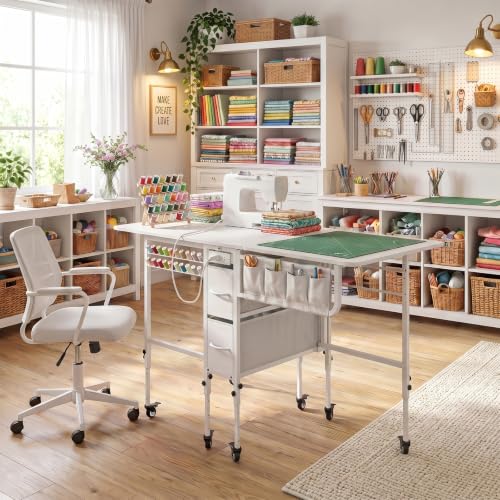
Furnaza 56.7 in Foldable Wheeled Craft Table — The lockable-caster folder
The Furnaza’s title describes a hybrid: a 56.7-inch foldable wheeled craft table that also works as a folding sewing machine cabinet desk, with height adjustment, a charging station, and four lockable casters. The cabinet word matters. Where a plain folding table offers a surface, a cabinet-style folder offers an enclosure the machine and materials can live in, so the folded result reads as a piece of furniture rather than as stored equipment.
Lockable casters are the detail that decides whether a wheeled sewing table is usable, and Furnaza states four of them. A machine at speed on unlocked wheels walks; on locked ones, the table stays where the workflow put it, and the fold-away convenience survives contact with real sewing. The charging station repeats the PAKASEPT’s modern logic in a different body plan, and the white finish keeps the cabinet unobtrusive in a living room corner.
Choose between this and the Sew Ready drawer folder by storage philosophy: cabinet enclosure versus drawers. Choose it over the PAKASEPT if the machine-cabinet form suits your room better than open movable shelving. Its Amazon listing shows the cabinet interior and carries the current price, and that interior view is the one to study — cabinet sewing stations live or die by whether your machine’s shape and your fabric stash fit their compartments.
- Surface: 56.7 inches
- Form: foldable, doubles as a sewing machine cabinet desk
- Mobility: 4 lockable casters, per the listing title
- Height: height adjustable
- Power: charging station built in
- Finish: white
Strengths
- Four lockable casters make the wheeled format genuinely sewable, not just movable.
- The cabinet form hides the machine and materials behind a furniture face.
- Charging built in keeps lamp and tablet power at the table.
Trade-offs
- Cabinet compartments fit some machines and stashes better than others — check the interior dimensions.
- Enclosed storage is less instantly visible than open shelves when hunting a notion mid-project.
- Like all folders, it concedes some rigidity to the fixed workstations.
Households with toddlers will see the cabinet’s other virtue immediately: when the session ends, the machine and its sharp companions go behind a closed face, and the room returns to being safe for small explorers. That daily open-and-close rhythm is the Furnaza’s real product.
Best for: a living-room sewist who wants the machine to disappear into a cabinet between sessions.
Not suited for: an open-shelf worker who keeps every material in sight and reaches without opening anything.
How do different crafts bend the choice?
Quilting is the most demanding tenant a craft table can host. It arrives with yardage, leaves with a top wider than the table, and in between it wants cutting accuracy, pressing space, and somewhere for the finished bulk to rest without dragging the work in progress off the edge. Quilters should weight surface truth and size above everything: the grid table for its measuring top, the TRIBEWOOD for its span, and the Tribesigns for standing cutting comfort. A quilt draped over the table’s end needs support — a chair, an ironing board at matched height, anything that keeps the weight from pulling — and planning that support is part of choosing the table, not an afterthought.
Garment sewing asks for length and for a machine that lives set up. Pattern pieces are long, fabric is slippery, and the workflow alternates between cutting table and machine often enough that moving the machine becomes the tax on every seam. Fixed tables with clear leg room serve garment makers best, because the machine can stay resident and the chair can stay parked. Dressmakers working in shared rooms are the exception — for them the Furnaza’s cabinet, which keeps the machine installed yet hidden, resolves the contradiction between a resident machine and a presentable room.
Paper and mixed-media crafts invert the priorities. Their surfaces can be smaller, but their tool counts are enormous and their materials are flat, heavy, and numerous: card stock, boards, dies, stamps, inks. Drawer storage climbs the ranking for these makers, and surface protection changes its meaning — paper craft scores, glues, and inks rather than cutting, so a sacrificial craft mat and a wipeable top matter more than a printed grid. Scrapbookers in spare rooms are the drawer folder’s natural constituency, with the PAKASEPT’s shelves carrying the paper stacks that drawers cannot.
And then there is the crafter who does everything, in rotation, in one room. That reader should choose by the craft performed most often and forgive the table its compromises in the others — or choose adjustability itself as the feature, since the height-adjustable folders are the only picks here that change their answer as the project changes.
How do the six compare on form, storage, and mobility?
| Table | Size | Storage form | Mobility | Defining feature |
|---|---|---|---|---|
| Tribesigns workstation | 55 in | 3-tier open shelf | Fixed | Counter height with leg room kept clear |
| TRIBEWOOD workstation | 63 in | 2 open shelves | Fixed | Solid wood on an X-shaped frame |
| Sew Ready drawer folder | Not stated in title | Drawers | Wheels, folds flat | Drawers on a folding frame |
| Sew Ready grid table | 58.75 x 36.5 in | Drawers and shelf | 6 casters, folds flat | Printed cutting grid top |
| PAKASEPT cutting table | Not stated in title | Movable shelves | Folding | Charging station, shelves for large fabric |
| Furnaza cabinet table | 56.7 in | Cabinet enclosure | 4 lockable casters | Sewing machine cabinet form |
Two of the six titles do not publish a surface size, and we have left those cells honest rather than borrowing numbers from elsewhere. A folding table’s working size is best confirmed on its listing and in the maker’s documentation before you plan a room around it — the folded dimensions matter just as much, and they too belong to the documentation rather than to guesswork.
How should a craft table be set up for cutting day?
Light first. Position the table so daylight or your task lamp falls across the surface without your own body shadowing the cut line; raking light reveals fabric grain and pencil marks that overhead light washes out. On a grid top, align the fabric’s straight edge to a printed line before the ruler comes down. On a plain top, the mat does that work — so anchor the mat with the table’s own weight distribution, keeping it fully supported rather than overhanging an edge where a leaning palm will tip it.
Pressing deserves its station in the plan. An iron should never share the cutting surface itself — heat, steam, and blades are poor neighbours — so decide where the pressing mat or board lives before the first project: at the table’s end for the fixed workstations, or on a side surface for the folders. Keeping the iron’s cord routed away from the cutting zone is a small decision that prevents the classic craft-room accident of a cord dragging a ruler mid-cut.
Then stage the workflow in the order the work happens. Fabric and pattern at the wide end, cutting in the middle where the surface is best lit, and the machine — if it shares the table — at the far end, unplugged while blades are out. Small sharps live in their drawer or box between cuts, never loose on the surface where a sliding layer of fabric can hide them. At the end of the session, the folders in this guide earn their keep: lock the casters only after the table is parked, fold only after the machine is unplugged and the drawers checked for the rotary cutter. A craft room’s tidiness is mostly a sequence, and the table is where the sequence either holds or dissolves.
How do you keep a craft table’s surface honest over the years?
A craft top ages by insult: blade nicks at the mat’s edge, iron shine where the pressing happened off the mat, glue freckles, ink ghosts, and the slow polish of a thousand fabric slides. None of it is fatal, and some of it is the honourable patina of a table that gets used — but the surface’s flatness and legibility are worth defending, because cutting accuracy lives there. The defence is mostly sacrificial layers: a mat that takes the blades, a pressing cloth that takes the heat, a sheet of card that takes the glue. Rotate the mat’s position monthly so its wear spreads, and flip it if the maker allows, so one corner does not become a valley.
Grid tops ask for one extra habit: clean the printed surface with a damp cloth rather than solvents, since the grid’s lines are the feature and harsh cleaners are how printed references fade. Wooden tops like the TRIBEWOOD’s want the opposite respect — coasters under the iron’s water cup, a wipe for steam spills — because solid wood records moisture faithfully. White folding tables show every pencil line and ink kiss; a magic eraser handles most of them, and accepting a few permanent marks as the table’s diary handles the rest.
Frames age more quietly. Folding mechanisms want their pivots kept free of the thread and paper dust that craft rooms generate in industrial quantities; a vacuum nozzle along the hinges each month keeps a folder folding. Casters collect thread like spools — turn the wheeled tables over twice a year and pick the axles clean, or the smooth roll you bought becomes a drag. Fixed frames want their bolts revisited after the first month and then yearly. None of this is onerous; all of it is the difference between a table that serves a decade of projects and one that wobbles into retirement by the third quilt.
What mistakes do craft table buyers keep making?
The classic error is buying a computer desk for craft work because it was cheaper and prettier, then discovering that keyboard trays, monitor shelves, and shallow tops fight every stage of making. The second is ignoring height: a standard desk-height surface makes standing cutting a stooping exercise, and the table gets blamed for a sore back that its dimensions predicted. Third comes storage mismatch — drawers bought for fabric bolts, open shelves bought for a household with a pin-collecting toddler.
Folding-table buyers add two mistakes of their own: never checking the folded dimensions against the intended cupboard, and leaving casters unlocked under a running machine. Fixed-table buyers make the opposite pair: skipping the doorway measurement for a 63-inch solid top, and placing a counter-height workstation where a standard chair must serve it, then wondering why seated sewing feels like perching. Every one of these mistakes is a measurement or a question asked a week too late.
Final Recommendation
Start from the room you have rather than the room in the photographs, and the six sort themselves quickly. Give a dedicated room the TRIBEWOOD and never think about craft furniture again; its solid wood span is the closest thing here to a permanent answer. Quilters who cut constantly should look hard at the Sew Ready grid table, whose printed surface removes a step from every single cut. Households without a craft room are the folders’ natural owners — drawers with Sew Ready’s first folder, a cabinet with the Furnaza, movable shelves and charging with the PAKASEPT — and the Tribesigns stands as the middle path for a corner that can stay claimed. The right craft table is the one your largest regular project fits and your room can honestly keep; measure both, and the choice makes itself.
One last word of encouragement for the undecided, offered from long acquaintance with craft rooms that work and craft rooms that merely photograph well: crafters rarely regret the table they can set up in five minutes and clear in ten. Whatever you choose from this list, the first project will teach you its habits — where the mat wants to live, which drawer adopts the cutters, how the light falls at your working hour. Let it teach you, arrange it once with that knowledge, and then spend your attention where it belongs — on the making itself, rather than on the furniture that hosts it.
Frequently Asked Questions
Why does counter height matter for a craft table?
Cutting and layout are standing tasks, and a counter-height surface lets you drive a rotary cutter with shoulder weight behind it while keeping your back upright. The Tribesigns and TRIBEWOOD are built at that height deliberately; the adjustable folders can be raised toward it when cutting day comes.
Can a folding craft table really hold a sewing machine?
Yes, with the casters locked and the machine placed over the frame’s supported area rather than cantilevered at a folding leaf’s edge. The Furnaza’s four lockable casters and the Sew Ready folders are designed for exactly this, though no folder will feel as planted as a fixed solid-wood workstation under a machine at full speed.
Do I still need a cutting mat on a grid table?
For heavy rotary cutting, yes. The Sew Ready grid top is a measuring reference and a squaring aid; a self-healing mat on top of it takes the blade wear so the printed grid survives to keep measuring. Use the grid to align, and the mat to absorb.
What storage suits fabric best?
Bolts and folded yardage suit open shelves and tiers, like the Tribesigns’ three levels or the PAKASEPT’s movable shelves, where lengths can lie flat and stay visible. Drawers suit the small tools — cutters, scissors, needles, marking pens — that need containment. Most serious craft rooms end up wanting both, which is why the grid table’s drawers-plus-shelf layout is so practical.
How do I choose between the two Sew Ready folders?
By what you do most. If cutting dominates, the grid table’s printed surface and six casters serve it directly. If your practice is mixed sewing and general craft in a room that must reset often, the drawer folder’s adjustable height and flat fold are the simpler answer.
What size cutting mat should I pair with these tables?
The largest mat your chosen surface holds fully flat, with no overhang at any edge. A mat that cantilevers off the table’s side will flex under the cutter and wander mid-strip. On the 58.75-inch grid table a mat in the mid-forty-inch class sits comfortably; on the folders, measure the opened surface first and let the mat follow the table rather than the other way round.
Should a craft table live against a wall or in the middle of the room?
Against a wall suits folders and smaller fixed tables, keeping the room’s centre free. Island placement suits the big fixed workstations, because quilts and garment pieces want access from both long sides and the overhang support that only open floor gives. If your room allows the TRIBEWOOD or the Tribesigns to stand as an island, cutting large work becomes noticeably calmer — you walk around the project instead of dragging the project around you.
Is a charging station on a craft table a gimmick?
No — it is an admission of how craft happens now. Patterns live on tablets, task lamps are essential, and machines need power; a deliberate charging point at the table, as on the PAKASEPT and the Furnaza, beats a trailing extension lead across a floor where fabric drapes.
Related Guides
From the making table, the natural next stops in this series are the vanity, the sewing cabinet’s close cousins, and the front-of-house counter: Best Makeup Desks With Storage, Best Sewing Desks, and Best Reception Desks.


