What's inside
- Key Takeaways
- Quick Picks
- Why do folding cabinets dominate this category so completely?
- What does a flush machine bed actually change at the needle?
- How much room does a sewing session actually need around the cabinet?
- What separates a well-built folding cabinet from a wobbly one?
- Which of the six belongs in your sewing corner?
- How do the six compare on what their titles actually state?
- How should you set up a folding sewing cabinet in its first week?
- How do you stop a rolling cabinet creeping while you sew?
- What mistakes do sewing desk buyers keep making?
- How do you organise notions so they stay organised past the first month?
- Will your machine actually fit the cabinet you are eyeing?
- Final Recommendation
- Frequently Asked Questions
- Related Guides
As an Amazon Associate I earn from qualifying purchases. This post may contain affiliate links at no extra cost to you.
widgetverdict.com is reader-supported. When you buy through links on our site, we may earn an affiliate commission.
Where to buy: all six sewing desks below are sold through their checked Amazon listings; before ordering, measure the doorway the flat-pack has to pass through and the corner it will fold into, because the whole point of this category is furniture that shrinks when the sewing stops.
Finding the best sewing desks starts with admitting what the category actually is in 2026: it is mostly cabinets that fold. Five of the six picks below hide the machine away behind doors or under leaves, roll on casters, and collapse into something that looks like a sideboard or a side table when guests arrive. Only the Sauder is a true rolling cart rather than a cabinet. That shape dominates for a sound reason. A sewing machine is heavy, threaded, mid-project, and usually attached to a half-finished quilt; a desk that lets you close the doors on all of that, without unthreading anything, solves the real problem, which is not sewing space but sewing sprawl.
The second thing to understand is the platform. Several of these cabinets lower the machine so the needle plate sits flush with the surrounding surface, and that flush bed is what stops fabric dragging, bunching, and pulling against a raised machine base while you feed long seams through. One pick here states an adjustable platform outright, one states an adjustable tier, and the rest leave the mechanism undescribed in their titles, so the spec boxes below are blunt about which is which. A flush bed matters most to quilters and garment sewers moving bulky work; a dressmaker sewing short seams on a raised machine may never miss it.
Storage is the third dividing line, and it is more specific than drawers-versus-no-drawers. Sewing generates a particular clutter: thread spools that roll, bobbins that vanish, fabric trays, patterns, a pressing ham, scissors that must never sit loose near fabric. The picks below answer that clutter differently — shelves, trays, pegs, hooks, hidden compartments, magnetic doors — and the right answer depends on whether your supplies live in the cabinet full-time or migrate in from elsewhere in the house.
Finally, wheels. Almost everything here rolls, and rolling is a double-edged gift: it lets one person reposition a loaded cabinet, and it lets a cabinet creep across a hard floor under the vibration of a fast machine unless the casters lock. Locking wheels or lockable casters appear in most of these titles, and that small word, locking, deserves more weight in your decision than any finish name.
Key Takeaways
- This category is dominated by folding cabinets: five of six picks fold, roll, or drop a leaf to reclaim floor space between projects.
- Only one title here states an adjustable machine platform outright; one more states an adjustable tier, and the rest require a documentation check before you count on a flush sewing bed.
- Locking casters matter as much as storage, because a cabinet that creeps under machine vibration ruins seam accuracy.
- The Best Choice Products cabinet is covered here in its White finish only, as a single pick, with shelves, trays, and pegs behind magnetic doors.
- The Sauder is the outlier: a drop-leaf cart rather than a cabinet, suited to sewers whose machine travels between rooms.
- Built-in charging appears once in this group, on the first pick; every other cabinet expects the room to supply power, so plan the socket geography before the cabinet arrives.
Quick Picks
| Pick | Badge | Why it earns its place |
|---|---|---|
| Foldable Sewing Craft Table with Storage Cabinet | The powered cabinet | A folding storage cabinet that adds power outlets, USB and AC charging, an adjustable tier, and six hooks for tools. |
| Best Choice Products Folding Sewing Machine Table (White) | The full organiser | Shelves, trays, and pegs behind magnetic doors, on locking wheels, folding down into an innocent side table. |
| Sauder Sewing Cart Drop-Leaf Craft Table | The rolling cart | A drop-leaf cart in a soft white finish for sewers who sew at a shared table and park the machine elsewhere. |
| PAKASEPT Folding Sewing Table with Storage | The hidden storage pick | A multipurpose cabinet with hidden storage, magnetic doors, and lockable wheels for rooms that must hide the hobby completely. |
| Folding Sewing Table on Wheels with Adjustable Platform | The flush-bed pick | An adjustable platform, spacious drawers, and expandable leaves on lockable casters — the quilter’s configuration. |
| VIVOHOME Folding Sewing Table with Storage | The walnut finish | A folding cabinet with shelves and trays in walnut, for rooms where white craft furniture clashes with everything else. |
Why do folding cabinets dominate this category so completely?
Because the alternative is a dedicated sewing room, and most sewers do not have one. The cabinet format answers a specific domestic negotiation: the machine gets a proper home with its supplies around it, the room gets its floor back on demand, and an unfinished project can stay threaded and positioned instead of being packed away and re-set-up at every session. Setup friction is the silent killer of sewing habits; a cabinet you open in a minute gets used on a Tuesday evening, while a machine that lives in a cupboard under the stairs gets used at Christmas.
The fold also protects the work. Doors and leaves keep dust off fabric, keep household pets off half-pinned garments, and keep the sharp, small, swallowable parts of sewing — pins, needles, seam rippers — behind a closed front in a house with children. None of that appears in a dimensions table, yet for many households it is the entire purchase.
What the cabinet format costs you is a fixed sewing position. The machine sits where the cabinet’s platform or tier puts it, the leaves open in one configuration, and the whole arrangement is less flexible than a big open table you can approach from any side. Quilters working on very large pieces sometimes find a cabinet’s enclosed knee space restrictive. That trade — flexibility surrendered, tidiness and protection gained — is the honest frame for every pick below.
What does a flush machine bed actually change at the needle?
When a machine sits on top of a desk, its needle plate stands a few inches above the surface, and fabric has to climb that step before it reaches the presser foot and drop back down the other side. Light fabrics cope; heavy or bulky assemblies do not. A quilt sandwich approaching the needle rides up, drags against the machine’s base, and pulls the seam line sideways, and the sewer compensates with one hand lifting and guiding, which is exactly the hand that should be free.
A platform that lowers the machine until the bed is level with the cabinet top removes the step. Work slides across a continuous plane, gravity stops fighting the feed dogs, and long seams feed straighter with less wrestling. The gain is largest on quilts, curtains, upholstery-weight projects, and anything layered; it is smallest on short garment seams, hems, and repairs, where the step barely registers. Judge the feature by your project mix, not by its prominence in listing photographs.
There is a mechanical footnote: a platform or tier that moves must also stay put. Before trusting any adjustable arrangement with a heavy machine, confirm in the manufacturer’s documentation how the platform locks at sewing height and what weight it is intended to carry. Titles in this group state the adjustability; they do not state the load figures, and this guide will not invent them.
How much room does a sewing session actually need around the cabinet?
More than the cabinet’s footprint, and in specific directions. To the left of the needle, fabric pools and waits; behind the machine, finished seam length accumulates; in front, the sewer’s chair and knees claim a territory that no leaf or door may invade. A cabinet opened against a wall on its left side forces all the fabric to the right, across the sewer’s lap, and a long session becomes a wrestling match conducted at elbow height. When you tape the open footprint on the floor, tape the chair’s footprint too, and a generous crescent in front of the machine where work can spread without sliding off an edge.
Vertical room counts as well. Leaves that open upward or doors that swing wide need clearance from shelves, radiators, and the backs of dining chairs, and a cabinet that can only open three-quarters because a bookcase blocks a door will irritate you every single session. Walk the full opening sequence in the taped outline, miming the doors and leaves, before the box arrives. Five minutes of mime saves a return.
Light is the third dimension buyers forget. Sewing is close visual work, and a cabinet parked in the room’s dimmest corner because that is where it fits will strain eyes and hide stitch faults until pressing reveals them. If the corner is dim, budget the lamp into the plan — which is one more argument for the powered cabinet in this group, since a lamp plugged into the cabinet itself can be positioned once and left alone, instead of migrating on and off the surface at every session.
What separates a well-built folding cabinet from a wobbly one?
Start at the hinges and the leaf supports, because a folding cabinet is a machine for changing shape, and its moving joints decide its lifespan. Leaves that droop under a quilt’s weight or doors that sag out of alignment after a season of opening are the classic failures of the format. You cannot test hinges from a listing, but you can read the design: leaves supported along a length rather than at a point, doors hung on more than the minimum hardware, and casters sized for a loaded cabinet rather than a featherweight frame all point the right way.
Next, the top surface itself. It should be smooth enough that fabric glides without snagging on grain, seams between panels, or screw heads, and honest enough in its finish to survive pin scratches and the occasional iron rested a moment too long. A surface that demands coasters and apologies will slowly train you not to sew on it.
Finally, judge the closed cabinet as furniture, because that is the state it spends most of its life in. Doors that meet evenly, a finish without obvious thin patches at the edges, and a silhouette that suits the room all determine whether the cabinet earns permanent residence or gets exiled to a spare room, taking your sewing habit with it. The folding format’s promise is presence without visual cost; a cabinet that looks cheap closed breaks that promise daily.
Which of the six belongs in your sewing corner?

Foldable Sewing Craft Table with Storage Cabinet — The powered cabinet
This white cabinet is the only pick whose title promises electricity, and for a modern sewing corner that is a genuinely practical difference. The listing states power outlets plus a USB and AC charging station built into the table, which means the machine, a task lamp, an iron on standby, and a phone running a tutorial video can all draw from the cabinet instead of from a trailing extension lead crossing the room. Anyone who has caught a trailing cable with a chair caster mid-seam will understand why that matters.
The rest of the title reads like a checklist of small frictions removed: an adjustable tier for positioning the machine, six hooks that give scissors, tape measures, and rotary cutters a home off the work surface, and a folding, space-saving format for craft rooms and offices that double as something else. The hooks are the detail we keep returning to — vertical tool storage at the side of a cabinet keeps sharp tools visible and reachable without occupying the flat surface fabric needs. If the powered layout appeals, the listing page carries the current price and the exact outlet arrangement, which is worth a look because outlet placement decides whether your iron cord reaches comfortably.
- Format: foldable sewing table with storage cabinet, white
- Power: outlets with USB and AC charging station, as stated in the listing title
- Machine position: adjustable tier
- Tool storage: 6 hooks
- Intended rooms: craft room or office, per the title
- Platform load figure: the listing headline gives no weight figure, so check the maker’s documentation before seating a heavy machine
Strengths
- Built-in power ends the extension-lead tangle that most sewing corners accumulate within a month.
- Six hooks keep cutting tools off the fabric surface while staying in arm’s reach.
- The adjustable tier gives some control over machine height without a separate insert or riser.
Trade-offs
- A powered cabinet must live within reach of a wall socket, which narrows where the fold-away corner can be.
- Hooks suit tools with hanging holes or loops; boxed notions still need shelf or drawer space elsewhere.
- The title does not describe drawers, so notions storage leans on the cabinet shelves and your own trays.
One ownership note: a charging station inside a sewing cabinet quietly becomes the household’s spare charging point, and other people’s phones will migrate to it. Decide early whether the cabinet is sewing-only territory, because a surface colonised by family charging cables is a surface your fabric no longer owns. The white finish, meanwhile, shows thread snippets and fabric dust honestly — a virtue for cleaning, if not for hiding a busy week.
Thread management deserves a word here, because the hooks change it: cones and spools hung by their loops stay visible, and visible thread gets used instead of duplicated. Owners of powered cabinets also report an unplanned benefit — the charging point becomes the place where the small rechargeable seam ripper light and the cordless mini iron live, so the whole electrical side of the kit charges in one spot overnight.
Best for: a dual-purpose craft room or office where the machine, lamp, and iron all need power at one folding station.
Not suited for: a corner with no reachable wall socket, or a sewer whose notions collection demands deep drawers this design does not claim.

Best Choice Products Folding Sewing Machine Table (White) — The full organiser
Best Choice Products sells this cabinet in more than one colour; this guide covers the White version as a single pick, because the organisation system — not the finish — is the story. Behind magnetic doors the title lists storage shelves, trays, and pegs, which is three different storage logics in one cabinet: shelves for fabric and patterns, trays for the small loose things, pegs for hanging tools and hoops. Most cabinets offer one of those; the layering here suits a sewer whose supplies are varied rather than bulky.
The party trick is the fold: the title states it folds to a side table, so the closed cabinet passes as ordinary furniture in a living room rather than announcing itself as hobby equipment. Locking wheels handle the move between sewing position and parking position, and the magnetic door catches keep the front shut while it rolls — a small mechanism doing real work, since a door swinging open mid-move spills trays. Current pricing and the other finish options sit on the Amazon listing; order the white one deliberately if this pick is yours, because the colour variants share the page.
- Format: rolling sewing cabinet and craft desk, folding to a side table
- Finish covered here: White
- Storage: shelves, trays, and pegs behind magnetic doors
- Mobility: locking wheels
- Machine platform: the title does not describe a lowering platform, so consult the manufacturer’s documentation if a flush bed is essential
- Door hardware: magnetic catches, as stated in the title
Strengths
- Three storage types in one cabinet match the mixed shapes of a real notions collection.
- Folding into a side table is the most complete disguise in this group for living-room sewing.
- Magnetic doors stay shut while the cabinet rolls, protecting trays of small parts in transit.
Trade-offs
- Pegs and trays favour many small items over a few large ones; bulk fabric bolts will live elsewhere.
- The side-table fold means unfolding and setting up is a small ritual before every session.
- No platform is described in the title, so assume a raised machine position until documentation says otherwise.
Consider how this cabinet ages in a busy house: the side-table disguise works only if the household respects it. The first time someone parks a coffee mug and a stack of post on the folded cabinet, reopening it becomes a negotiation. Families who keep that boundary get the full benefit; families who cannot may be happier with the Sauder cart below, which never pretends to be furniture and so never gets used as any.
The tray system rewards a particular habit: one tray per project, lifted out whole and returned whole, so a half-finished shirt never sheds its buttons and interfacing across the cabinet. Sewers who run two projects in parallel — most of us, whatever we claim — will find that two trays impose a tidier discipline than any drawer, because a project that has no tray does not get started until another one finishes.
Best for: a living-room sewer with a varied notions collection who needs the hobby to disappear completely between sessions.
Not suited for: quilters who require a confirmed flush platform, or anyone storing long fabric bolts inside the cabinet itself.
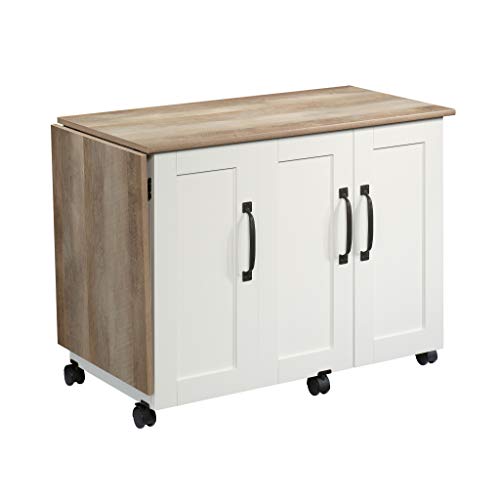
Sauder Sewing Cart Drop-Leaf Craft Table — The rolling cart
Sauder’s entry breaks the cabinet pattern, and its title says so plainly: this is a sewing cart with a drop-leaf, in a soft white finish, from the brand’s miscellaneous storage line. A cart does not hide the machine inside itself; it carries the machine and its kit to wherever the sewing will happen — the kitchen table, a cleared desk, a sunny corner — and the drop leaf extends the working surface once it arrives. For renters, shared houses, and anyone whose sewing spot changes with the season, that mobility is the feature the cabinets cannot match.
The trade is equally plain. A cart offers storage, per the title, but not the enclosed, close-the-doors protection of a cabinet; the machine rides exposed, and an in-progress project does not travel with the same security. The drop-leaf format also means your sewing surface is partly leaf, and leaves are happiest with loads spread sensibly rather than a heavy machine parked at the leaf’s outer edge. Treat the leaf as workspace for fabric and tools, and the cart’s fixed section as the machine’s seat. The listing page is the place to confirm the current price and the cart’s folded footprint against your storage cupboard.
- Format: sewing cart with drop-leaf top — not a folding cabinet
- Finish: Soft White, as named in the listing title
- Storage: included, per the title; the compartment layout is a detail to confirm in Sauder’s own documentation
- Surface: drop leaf extends the working area when raised
- Maker: Sauder, miscellaneous storage range
- Machine platform: no lowering mechanism is mentioned in the title — the manufacturer’s literature is where to verify machine positioning
Strengths
- The machine travels to the best-lit, roomiest surface in the house instead of owning one fixed corner.
- A drop leaf adds working area only when raised, keeping the parked footprint small.
- Sauder’s flat-pack experience shows in a product aimed at ordinary homes rather than studios.
Trade-offs
- No enclosing doors, so dust and household curiosity reach the machine between sessions.
- The leaf should carry fabric and tools, not the machine’s full weight at its outer edge.
- Storage volume is cart-scale; a large fabric stash needs a separate home.
The cart suits a particular rhythm: sew in bursts, at a table that returns to dining duty afterwards, with the machine parked in a hallway or cupboard between times. If that is your rhythm, the cabinets in this guide ask you to dedicate floor space you may not have. If instead you sew most days, the repeated fetch-and-set-up will eventually annoy you into a cabinet — the honest dividing line between this pick and the rest.
Think about the route the cart travels, not just the rooms at either end. Hallway widths, a step between kitchen and sitting room, a rug with a thick edge — each decides whether the cart’s mobility is a daily pleasure or a weekly obstacle course. The drop leaf also earns a second job on tour: raised in a hallway or landing, it turns the parked cart into a pressing and pinning station for small work when the main table is occupied.
Best for: a mobile sewer in a shared or rented home who sews at a multi-purpose table and parks the machine away afterwards.
Not suited for: leaving a threaded, mid-project machine untouched for weeks — an open cart offers no closed-door protection.

PAKASEPT Folding Sewing Table with Storage — The hidden storage pick
PAKASEPT’s cabinet leans into concealment: the title pairs a craft storage cabinet with hidden storage, magnetic doors, and lockable wheels, and describes the whole as a multipurpose sewing machine table. Hidden storage is a specific pleasure — a compartment that does not announce itself keeps the closed cabinet visually calm and keeps one class of supplies, whether that is the good fabric scissors or the expensive specialty feet, out of casual circulation.
The multipurpose framing matters too. A cabinet that can serve as general craft storage when the machine is elsewhere earns its floor space in months when sewing pauses, which for many households is most of the year. Magnetic doors and lockable wheels repeat the Best Choice Products formula of shut-while-rolling security, though the internal mix differs: where that cabinet layers trays and pegs, this one emphasises concealed capacity. Which suits you depends on whether your clutter is small-and-many or private-and-precious. Check the listing for the current price and for photographs of the hidden compartment, since its size decides what the concealment is actually worth.
- Format: folding sewing table and craft storage cabinet
- Storage: hidden storage compartment, as stated in the listing title
- Doors: magnetic catches
- Mobility: lockable wheels
- Use framing: multipurpose, per the title
- Machine platform: the headline names no adjustable platform, so the maker’s documentation is the authority if bed height matters to you
Strengths
- Hidden storage keeps precious tools and feet out of sight and out of general household rotation.
- The multipurpose cabinet role justifies the footprint during long non-sewing stretches.
- Lockable wheels plus magnetic doors make the closed cabinet safe to move when loaded.
Trade-offs
- A hidden compartment is, by design, one compartment; the rest of your storage needs ride on the main cabinet space.
- No adjustable platform is claimed in the title, so flush-bed sewing is not a promise here.
- Concealment cuts both ways: supplies in the hidden section are the ones owners forget they own.
There is a household-politics angle worth naming: hidden storage works best as a personal boundary in a shared home, a place where the serger’s specialty feet and the one good pair of shears simply are not available for opening parcels. If your sewing supplies keep being borrowed into general duty, this cabinet defends them more effectively than any amount of labelling on open shelves.
There is also a gifting angle to concealment that owners mention with feeling: fabric bought for a surprise quilt, or the good interfacing reserved for a wedding garment, stays genuinely hidden in a compartment visitors cannot see. A cabinet whose secrets are structural rather than social — no reliance on nobody opening that drawer — protects projects whose whole point is not being discovered early.
Best for: a sewer in a shared home who wants one concealed compartment for valuable tools, inside a cabinet that doubles as craft storage.
Not suited for: flush-bed sewing as the top priority — this title makes no platform claim at all, so the bed height stays an open question.

Folding Sewing Table on Wheels with Adjustable Platform — The flush-bed pick
Here is the one title in the group that says the words quilters scan for: adjustable platform. This folding table lowers the machine on a platform the title explicitly calls adjustable, pairs it with spacious drawers and expandable leaves, and rolls the whole assembly on lockable casters. Read together, that is a coherent quilting specification — a flush bed for feeding layered work, leaves that open to support the quilt’s bulk on both sides, and drawers sized, in the maker’s own word, spaciously, for the fat quarters and batting offcuts that defeat shallow trays.
The leaves deserve emphasis, because they solve the second quilting problem: weight. A large quilt hanging off a desk’s edge drags against every stitch; expanded leaves give the work somewhere to rest at surface level, and the sewer guides rather than lifts. When the project ends, the table folds and rolls away like the rest of this category. The platform’s travel range and load rating are not stated in the title, so confirm both in the manufacturer’s documentation against your machine’s weight before ordering — and check the current price on the listing while you are there, since this is the configuration specialists will compare hardest.
- Format: folding sewing table on wheels, cabinet style
- Machine position: adjustable platform, as stated in the listing title
- Storage: spacious drawers
- Surface: expandable leaves for supporting large work
- Mobility: lockable casters
- Platform travel and load: no figures appear in the title — verify both in the manufacturer’s documentation for your machine
Strengths
- The stated adjustable platform is the clearest flush-bed promise in this group of six.
- Expandable leaves support a quilt’s weight at surface level instead of letting it drag off an edge.
- Spacious drawers suit bulky quilting supplies that frustrate tray-based cabinets.
Trade-offs
- Drawers and leaves make this a fuller cabinet to fold and park than the slimmest designs here.
- Platform mechanics add a moving part that needs occasional checking and sensible loading.
- Garment sewers doing short seams gain least from the flush bed this pick is built around.
Positioning advice specific to this design: set the platform once, carefully, with your most-used machine, and mark the setting if the mechanism allows it. Owners who readjust the platform for every small task end up sewing on a raised machine out of laziness and blaming the table. Set it for the big work, leave it there, and let the leaves handle the day-to-day variation in project size instead.
Pressing discipline pairs with this table in a way worth copying: keep the iron at a separate station and treat the expanded leaves purely as support, never as a pressing surface, however tempting the flat expanse looks mid-project. The leaves’ job is to hold the quilt level with the needle; heat and steam belong elsewhere, and a quilter who keeps that boundary gets straighter seams and a table that stays flat for years.
Best for: a quilter feeding large, layered work who wants a flush bed, leaf support on both sides, and drawers for bulky supplies.
Not suited for: a heavy machine whose weight you have not checked against the platform documentation, or a very tight parking corner.

VIVOHOME Folding Sewing Table with Storage — The walnut finish
VIVOHOME’s cabinet covers familiar ground — folding format, storage shelves, trays, wheels, a cabinet that suits small spaces — and then changes one variable the rest of this group does not: the finish is walnut. Five white or soft-white designs dominate this category because craft furniture defaults to white, but a walnut cabinet sits comfortably in a living room of wood tones, a traditional dining room, or a study where a white box would glare. If your sewing corner is really a corner of a furnished room, finish is not vanity; it is the difference between furniture and appliance.
Functionally the title promises the organiser’s mix of shelves and trays in a rolling, foldable cabinet aimed at small spaces, without claiming a platform, charging, or hidden compartments. That honesty makes the pick easy to place: it is the straightforward folding organiser, chosen when its colour and its shelves-and-trays layout fit, rather than for any single headline mechanism. Small-space buyers should still pace out the open footprint with tape before ordering — folding cabinets need swing room for doors and leaves that their parked dimensions conceal. The Amazon listing carries the current price and the open and closed measurements side by side.
- Format: folding sewing table and cabinet for small spaces
- Finish: Walnut, as named in the listing title
- Storage: shelves and trays
- Mobility: wheels, per the title; whether they lock is a point the title leaves open, so the manufacturer’s documentation is the place to confirm it
- Machine platform: no platform is described in the headline — check the maker’s literature if a flush bed is on your list
- Intended use: sewing machine desk and rolling craft table
Strengths
- The walnut finish blends with wood-toned rooms where the white cabinets in this guide would stand out.
- Shelves plus trays cover the standard organiser’s mix without gimmicks to learn.
- The folding cabinet format keeps a small room’s floor recoverable between projects.
Trade-offs
- Wheel locking is not stated in the title, so stability while sewing needs a documentation check.
- No charging, platform, or hidden storage is claimed; specialists in those features should look at the earlier picks.
- A darker finish shows pale thread and lint more readily than the white designs do.
One practical thought on colour: walnut also hides the scuffs and caster marks of a working cabinet better than white does, and in a room that hosts guests, a closed walnut cabinet reads as a sideboard without needing the side-table fold trick. Owners who sew in dining rooms — a common arrangement, given the table is already there — tend to value that camouflage more with every year of ownership.
Walnut also changes the second-hand story, should the cabinet ever move on: wood-toned furniture sells to a broader room than white craft furniture, which buyers read as hobby-specific. That is a minor consideration beside daily use, but a folding cabinet bought for a small flat may well be sold from that flat one day, and a finish that reads as sideboard rather than sewing equipment widens the audience considerably.
Best for: a small-space sewer in a wood-toned room who wants the standard folding organiser in a finish that matches the furniture.
Not suited for: anyone who needs locking casters or a lowering platform confirmed by the title itself rather than by further reading.
How do the six compare on what their titles actually state?
| Pick | Format | Machine positioning stated | Storage stated | Mobility stated |
|---|---|---|---|---|
| Foldable Sewing Craft Table with Storage Cabinet | Folding cabinet | Adjustable tier | Cabinet storage, 6 hooks | Folding, space-saving |
| Best Choice Products Folding Sewing Machine Table (White) | Rolling cabinet, folds to side table | None stated | Shelves, trays, pegs | Locking wheels |
| Sauder Sewing Cart Drop-Leaf Craft Table | Cart with drop leaf | None stated | Storage, layout unstated | Cart format |
| PAKASEPT Folding Sewing Table with Storage | Folding cabinet | None stated | Hidden storage | Lockable wheels |
| Folding Sewing Table on Wheels with Adjustable Platform | Folding table, cabinet style | Adjustable platform | Spacious drawers | Lockable casters |
| VIVOHOME Folding Sewing Table with Storage | Folding cabinet | None stated | Shelves, trays | Wheels |
How should you set up a folding sewing cabinet in its first week?
Assemble it where it will live, not where the box lands. Cabinets are easiest to build flat on the floor of the sewing room, and a loaded cabinet that has to be carried through a doorway afterwards is a two-person lift you can simply avoid. During assembly, work on the floor protection you plan to keep: casters that roll sweetly on the rug during the build may behave differently on the bare boards where the cabinet will actually park.
Set the machine position before you organise a single drawer. Sit at the cabinet in your sewing chair, run a practice seam on scrap, and adjust the tier or platform until your forearms rest roughly level and the needle area is visible without hunching. Only then assign storage: machine feet and needles nearest the machine, cutting tools on hooks or pegs away from fabric, and the heaviest supplies low, where they steady the cabinet instead of making it top-heavy on its casters.
Finish the week with the fold test. Close the cabinet completely with a realistic project inside — machine threaded, fabric stored, tools in their places — and reopen it the next day. If anything has to be removed before the doors close, that item needs a different home, because a cabinet that cannot close over a real project will spend its life standing open, defeating the entire format.
How do you stop a rolling cabinet creeping while you sew?
Start with the locks. Engage every locking caster before a session, not just the front pair; a cabinet locked at the front can still pivot around those wheels when the machine’s vibration works on the free pair. If your pick’s title does not promise locking wheels — the VIVOHOME and the Sauder cart are the open questions here — a pair of caster cups or a low-pile mat under the cabinet achieves much the same stillness.
Floor pairing matters next. Hard, smooth floors let casters wander; a thin mat adds grip and also catches the pins that will inevitably escape, keeping them out of bare feet and vacuum cleaners. Keep the mat thin enough that the cabinet still rolls onto it willingly when moving day comes, or the parking routine becomes a wrestling match.
Finally, load low and sew honestly. Heavy fabric stored in the bottom of the cabinet lowers the centre of gravity and damps movement, while a top-heavy cabinet on casters is a sail. And if a particular high-speed stitch setting sets the whole cabinet humming, that is the machine telling you the surface is too mobile for that speed — slow down for dense work rather than fighting the furniture.
What mistakes do sewing desk buyers keep making?
The commonest is measuring the parked cabinet and not the open one. Doors swing, leaves rise, and a chair plus a seated sewer need their own territory; a cabinet that fits its corner closed may block a doorway or a drawer bank the moment it opens for work. Tape both footprints on the floor before ordering.
Second, assuming a platform exists because the photographs look flush. Several titles here describe no platform at all, and a machine perched on a cabinet top is a perfectly workable arrangement that is nonetheless not the flush bed the photographs of a different model suggested. Read the title, then the documentation, and only then the pictures.
Third, buying storage by count rather than by shape. Six hooks are wonderful for tools that hang and useless for a box of zips; spacious drawers swallow fat quarters and swallow bobbins into invisibility. Match the storage logic to the clutter you actually generate, which you can audit in ten minutes by emptying your current sewing bag onto the table.
Fourth, forgetting the chair. Cabinet knee space, leaf height, and platform position all interact with the chair you already own. A chair that cannot roll close because its arms meet the cabinet front will undo careful platform adjustment, so check the pairing during the first week while returns are still simple.
How do you organise notions so they stay organised past the first month?
Give every category of clutter a single home and make that home the easiest place to return the item to, not merely a logical one. Thread that must be wound, boxed, and shelved will migrate to the table’s edge; thread that drops onto a peg or into an open tray will go home. This is why the storage logic of the cabinet you choose shapes your habits more than its volume does: hooks and pegs forgive laziness, deep drawers punish it, and trays sit happily in between.
Work in project kits. The current project’s feet, needles, thread, and notions should live together — in one tray, one drawer section, one shelf run — so starting a session means opening the cabinet, not conducting a search. When the project finishes, the kit dissolves back into general storage in one pass. Sewers who organise by object type across the whole cabinet spend their first ten minutes of every session gathering; sewers who organise by project spend those minutes sewing.
Keep a small exile box. Every cabinet accumulates homeless objects — a stray bobbin of unknown origin, a foot for a machine you no longer own, buttons awaiting a decision. Without an exile box, those objects colonise the work surface one by one. With one, the surface stays clear and the box gets sorted on a rainy afternoon twice a year, which is the correct frequency for such decisions.
Will your machine actually fit the cabinet you are eyeing?
Measure the machine, not the marketing. The three dimensions that matter are the machine’s width across its widest point including the handwheel, its height with the spool pin up, and the depth of its base — and they must be compared against the cabinet’s machine well or tier space with the doors closed, because a machine that fits only while the cabinet stands open has not really been stored at all. Add the foot pedal and power lead to the picture; they need a route into the storage space that does not pinch them in a door seam every time the cabinet closes.
Serger owners should do this exercise twice. An overlocker is taller, fussier about its thread stand, and often lives beside the main machine rather than alternating with it. Several cabinets in this group can host one machine inside and a second on the opened surface, but that arrangement only works if the internal machine’s doors still close — check the pairing in the taped floor plan and the documentation dimensions before assuming a two-machine household fits a one-machine cabinet.
Weight closes the question. A machine that the platform or tier must raise, lower, or simply bear for years should be weighed honestly — bathroom scales will do — and set against the manufacturer’s documented figure for that moving part, not against a general impression of sturdiness. Cabinets fail at their moving parts first, and they fail there because a heavy machine was trusted to a mechanism rated for a lighter one. Ten minutes with the scales is the cheapest insurance in this entire guide.
Final Recommendation
Match the cabinet to the sewing you actually do. Quilters and anyone feeding large layered work should start with the adjustable-platform table, whose leaves and drawers support that work directly. Sewers whose corner must also power a lamp, an iron, and a phone should take the powered cabinet with its charging station and hooks. Living-room sewers who need the hobby to vanish should choose between the Best Choice Products side-table fold in white and the PAKASEPT’s hidden storage, depending on whether their clutter is small-and-many or precious-and-private. The mobile should take the Sauder cart without apology, and the wood-toned room should take the VIVOHOME.
Whichever you choose, do the unglamorous checks first: both footprints taped on the floor, platform claims verified in documentation, caster locks confirmed. A sewing cabinet is bought once and opened hundreds of times, and the opening is the experience you are really purchasing.
One last consideration belongs to households that sew in company. A cabinet station invites a second chair — a child learning to thread a needle, a partner hemming trousers under supervision, a friend finishing a costume the night before it is needed. Leaves and open doors create the shared surface those sessions need, and a cabinet that welcomes a second sewer tends to be used more, taught from more, and regretted less than a solitary workstation ever is. If your sewing is social, favour the designs whose opened shape gives two people somewhere to sit.
When the doors of the right cabinet close over a threaded machine and a half-finished quilt, in a room that looks like a room again, the category stops sounding like a compromise and starts feeling like the reason you sew more often.
Frequently Asked Questions
Do I really need a platform that lowers the machine?
Only if your work is bulky. Quilts, curtains, and layered assemblies feed noticeably straighter across a flush bed, while short garment seams and repairs barely register the step up to a raised machine. Buy the platform for the projects that fight you, not for the ones that already behave.
Can these cabinets hold a heavy modern machine?
The titles in this guide do not publish load figures, so the honest answer is to check the manufacturer’s documentation for the specific cabinet and platform against your machine’s weight. A cabinet’s general sturdiness and a moving platform’s rating are different questions, and the platform figure is the one that governs.
Where does the fabric stash go if the cabinet is full of tools?
Usually elsewhere, and that is normal. These cabinets organise the working kit — machine, feet, tools, current project — while bulk fabric lives in bins or shelves nearby. Expecting one folding cabinet to swallow an entire stash is how buyers end up disappointed with storage that was designed for a different job.
Are locking wheels genuinely important?
Yes, out of proportion to their size in the listing. A cabinet that creeps a few millimetres per seam still creeps, and you will unconsciously steer fabric to compensate. If a design’s locking is unstated, plan on caster cups or a thin mat as part of the purchase.
How long does setting up a folding cabinet take each session?
Once the machine lives in the cabinet, setup is opening doors or leaves and engaging caster locks — a minute or two. The cart is the exception: fetching it, raising the leaf, and placing the machine takes longer, which is the accepted price of not dedicating floor space.
Is a sewing cabinet worth it if I only sew a few times a year?
It can be, provided the cabinet earns its floor space between sessions — as a side table, a sideboard, or general craft storage, which is precisely the double life the folding designs in this guide are built for. The infrequent sewer gains the most from the format’s core trick: the machine stays threaded and the project stays assembled, so a rare free afternoon starts at the needle instead of at the back of a cupboard. What the infrequent sewer should not buy is the specialist end of the group; a flush platform earns its keep across hundreds of seams, not across six. Choose the cabinet that flatters the room first and the hobby second, and the purchase stays honest even in a quiet sewing year.
What should I verify on the listing before I order?
Open and closed dimensions, platform or tier details, whether the wheels lock, and what the doors actually contain — shelves, trays, pegs, drawers, or a hidden compartment. Those four checks separate cabinets that look similar in photographs but live very differently.
Related Guides
Once the sewing corner folds away neatly, the neighbouring workstations in this series deserve the same scrutiny: Best Reception Desks, Best Ladder Desks, and Best Electric Desks.


