What's inside
- Key Takeaways
- Quick Picks
- Why does leaning storage beat a bookcase beside a desk?
- How do you load a leaning frame without making it nervous?
- Which of the six belongs against your wall?
- Side by side: which frames state drawers, power, and dimensions?
- How should you install a ladder desk in its first afternoon?
- How do you keep a small desk corner from feeling like a corridor?
- How much work surface do you honestly need at a ladder desk?
- What should you check on the wall before any of these desks arrives?
- What mistakes do ladder desk buyers keep making?
- How do you style open ladder shelves so the desk looks intentional?
- Final Recommendation
- Frequently Asked Questions
- Related Guides
As an Amazon Associate I earn from qualifying purchases. This post may contain affiliate links at no extra cost to you.
widgetverdict.com is reader-supported. When you buy through links on our site, we may earn an affiliate commission.
Where to buy: each ladder desk below is sold through its checked Amazon listing; before ordering, measure the wall it will lean against or mount to — including skirting boards, radiators, and sockets — because this entire category lives or dies by one wall’s real dimensions.
The best ladder desks solve a problem that ordinary desks make worse: the small room. A ladder desk leans its storage upward instead of outward, stacking shelves above a modest worktop in a frame that narrows as it rises, borrowing the wall’s height to pay for floor space it never takes. In a box-room study, a bedroom corner, a studio flat, or the end of a hallway, that trade can be the difference between a real workstation and a laptop balanced on a bed. But the format has physics, and the physics are not optional: a leaning structure, shelves loaded above head height, and — in one pick here — a desk that does not lean at all but hangs from the wall itself.
Five of the six picks are freestanding ladder frames; the sixth, the ZIOTHUM, is wall-mounted, and this guide treats that as a different species rather than a variation, because a mounted desk’s strength is the wall’s strength, its installation is a drilling job, and its position is permanent in a way a leaning frame’s never is. Renters, in particular, should read that pick with their tenancy agreement in mind.
Within the freestanding five, the differences are honest ones. Two picks come from Haotian and look like cousins, but they are different models: the FRG60-W is a shelves-only secretary desk in white, while the later Haotian adds a power outlet and a drawer — a distinction this guide keeps sharp, because a buyer choosing between them is really choosing whether their desk needs to charge things and hide things. Two more come from Tangkula, one a 71-inch three-tier design in brown and one a space-saving model in a natural finish. Between them sits the American Trails, the only other pick with a stated drawer.
What none of these titles state is a load figure — not for the worktop, not for the shelves — and ladder desks are the category where that silence matters most, because the temptation is to load the top shelf with the heaviest books. The spec boxes below therefore refuse to invent capacities, and the buying sections explain how to load a leaning frame so that physics stays on your side.
Key Takeaways
- A ladder desk trades floor space for wall height: shelves rise above a modest worktop in a frame that narrows as it climbs.
- Five picks lean as freestanding frames; the ZIOTHUM is wall-mounted, a different commitment involving fixings, wall strength, and permanence.
- The two Haotian picks are different models — the FRG60-W has shelves only, while the other Haotian adds a power outlet and a drawer.
- No title in this group states a load capacity, so shelf loading must be governed by judgement: heavy items low, light items high.
- Drawers appear on two picks only; the rest store everything in the open, which shapes how tidy the desk can look.
- The Tangkula 71-inch is the tall statement of the group; the other Tangkula is the compact space-saver in a natural finish.
Quick Picks
| Pick | Badge | Why it earns its place |
|---|---|---|
| Haotian Ladder Desk with Shelves | The clean original | A white freestanding ladder desk and bookshelf in one, model FRG60-W, with no drawer or outlet to complicate it. |
| Tangkula 3-Tier Ladder Computer Desk 71 in | The tall brown frame | A 71-inch, three-tier ladder desk and bookcase with a metal frame in brown, for a study wall with height to spare. |
| American Trails Freestanding Ladder Desk with Drawer | The natural drawer pick | A freestanding ladder desk in a natural finish with a drawer for the clutter open shelves cannot hide. |
| ZIOTHUM Wall Mounted Ladder Desk with Shelves | The mounted outlier | A wall-mounted floating desk in a rustic pipe style, 36 x 20 x 81 inches, for a permanent small-space installation. |
| Haotian Ladder Desk with Power Outlet and Drawer | The connected Haotian | A narrow Haotian with shelves, a drawer, and a built-in power outlet for a bedroom or office corner that must charge as it works. |
| Tangkula Space Saving Computer Desk with Shelves | The compact natural | A space-saving Tangkula with a three-tier ladder bookshelf and metal frame in a natural finish, for the tightest corners. |
Why does leaning storage beat a bookcase beside a desk?
Because the two pieces of furniture a small room cannot afford are a desk and a bookcase standing separately, each with its own footprint, its own dead space behind it, and a gap between them that collects cables and dust. The ladder format merges them into one footprint and tilts the storage back over the desk, where the wall was doing nothing. The shelves sit within arm’s reach of the chair, the floor keeps a single rectangle of occupation, and the room’s other walls stay free for the bed, the door swing, and the radiator.
The narrowing profile matters more than it photographs. A frame that steps back as it rises leaves the worktop visually open — you are not sitting inside a cupboard — and it keeps the heaviest visual mass low, where rooms tolerate it. Sit at a full-height bookcase-desk and the shelves loom; sit at a ladder desk and they recede. In a bedroom, where the desk shares the room with rest, that recession is worth real money.
The format’s limit is depth, and it should be stated plainly: ladder shelves are shallower than bookcase shelves, especially near the top, and the worktop is a writing-and-laptop surface, not a spreading-out surface. Anyone whose work involves large monitors on arms, paper plans, or two machines side by side is outside this category’s promise, and no pick below will change that.
How do you load a leaning frame without making it nervous?
Think like the frame. A ladder desk’s stability comes from its lean and its base; load it so the centre of gravity stays low and toward the wall. Books, files, and anything dense belong on the worktop level and the lowest shelf; the upper shelves are for the light and the rarely reached — baskets, a plant, display objects, the printer paper rather than the printer. A top shelf loaded with encyclopedias is not a storage decision, it is a slow argument with gravity that gravity eventually wins.
Anchor the question of anchoring. Many leaning frames are designed to rest against the wall, and some owners add a discreet strap or bracket at the top for insurance, particularly in homes with children who pull themselves up on furniture or in regions where the ground occasionally moves. Whether a given model includes or expects any fixing is a detail for its documentation; the principle is universal, and it costs little to honour it.
Floor pairing completes the picture. A leaning frame on thick carpet settles and can shift its angle as the pile compresses; on hard floors it can skate a few millimetres when knocked. Either way, set the desk, load the low shelves first, and then push gently at shoulder height: the frame should feel planted, not perched. If it does not, the load distribution — not the desk — is usually the thing to change first.
Revisit the loading after a month, because shelves drift the way cupboards do: a heavy reference book migrates upward one helpful reshelving at a time, a printer insinuates itself onto a middle shelf, and the careful gradient of the first week quietly inverts. A two-minute monthly audit — heaviest things down, lightest things up, nothing dense above head height — keeps the frame’s physics exactly where you left them, and it is the sort of small, regular attention that leaning furniture rewards out of all proportion to its cost.
Which of the six belongs against your wall?

Haotian Ladder Desk with Shelves — The clean original
Haotian’s FRG60-W is the straightforward expression of the idea: a ladder desk with shelves that doubles as a freestanding bookshelf, dressed as a secretary desk and workstation, finished in white. There is no drawer and no power outlet in this title, and the absence is a position, not an oversight — this is the model for a corner where storage means shelves, charging happens at a wall socket nearby, and the desk’s job is to hold books, a laptop, and a lamp with the least possible visual fuss. White helps that mission in small rooms, bouncing light and receding against pale walls.
The secretary-desk framing deserves a moment, because it hints at the intended scale of work: correspondence, a laptop, a notebook, study — sustained, seated, single-screen work rather than a multi-monitor command post. Buyers whose day matches that description will find the open shelves honest and sufficient; buyers whose cables multiply should look at the other Haotian in this guide, which was clearly designed after listening to owners of this one. The listing page carries the current price and the shelf dimensions, which decide whether your tallest books stand upright or must lie in a stack.
- Format: freestanding ladder desk with shelves; also a bookshelf and secretary desk, per the listing title
- Model: FRG60-W, as printed in the title
- Finish: white
- Drawer and power: neither is mentioned in the headline — this model is shelves-only, unlike the other Haotian below
- Shelf and worktop load figures: the title publishes none, so the manufacturer’s documentation is the place to check before loading the top shelf
- Intended setting: small spaces, per the title
Strengths
- The simplest brief in the group — shelves, worktop, white finish — and the easiest to live with visually.
- Freestanding format moves rooms or homes without leaving a single fixing hole.
- The bookshelf-desk merger removes a whole second footprint from a small room.
Trade-offs
- No drawer means nothing hides; the desk’s tidiness depends entirely on what you shelve.
- No built-in power, so charging cables arrive from the wall and must be managed by you.
- Open shelves near the top reward light objects only, whatever their size suggests.
Styling is this desk’s quiet skill: because everything is visible, the shelves become part of the room’s decoration whether you plan it or not. Owners who arrange them with the same care as a bookcase — books low, a basket or two, one object with breathing room at the top — get a piece of furniture visitors compliment. Owners who treat them as overflow storage get a visible confession. The desk does not decide which; it merely displays the decision.
Chair pairing deserves a thought with this desk: because the shelves are open and the profile leans back, a chair with a low back keeps the corner’s sightlines clean, while a tall gaming chair parked against it swallows the frame’s shape entirely. In a bedroom especially, the desk and chair together are the furniture statement, and the slimmer chair lets the white ladder frame remain the taller, calmer object in the corner.
Best for: a bright bedroom or studio corner needing a laptop desk and bookshelf in one white, freestanding footprint.
Not suited for: a setup that needs a drawer for clutter or built-in charging at the desk — that is the other Haotian’s brief.

Tangkula 3-Tier Ladder Computer Desk 71 in — The tall brown frame
Tangkula’s larger entry stands 71 inches tall and organises itself as three tiers of ladder shelving over a computer desk, with a metal frame and a brown finish, doubling as a bookcase stand for a home office. Height is the argument: 71 inches claims the wall properly, giving the shelves enough rise to hold a real working library above the desk rather than a token row. In a study or a spare room with a full-height wall going spare, that ambition suits the room better than a squat desk apologising in the corner.
The metal frame matters at this height, because a tall leaning structure lives or dies by its rigidity; the title’s explicit mention of the frame is the closest any of these listings comes to talking about structure, and it is welcome. Brown, meanwhile, is the warmest finish in the group, pairing with wood floors and traditional study furniture where the white Haotians would look like appliances. Three tiers also imposes a discipline worth naming: the top tier is a step-stool tier for most adults, so it belongs to the seldom-needed and the purely decorative. Check the listing for the current price and the tier depths, since a tall desk with shallow top shelves is a display piece wearing a library’s clothes.
- Height: 71 inches, as stated in the listing title
- Structure: metal frame, per the title
- Shelving: 3-tier ladder shelves; doubles as a bookcase stand
- Finish: brown
- Drawer and power outlet: the headline claims neither — the manufacturer’s documentation is where to confirm the full specification
- Load figures: no capacity appears in the title, so check the maker’s published documentation before shelving heavy reference sets up high
Strengths
- Full-height shelving holds a working library, not a decorative gesture.
- The stated metal frame suits a tall structure that must not flex.
- Brown warmth fits studies and wood-toned rooms the white picks cannot.
Trade-offs
- The top tier is out of comfortable reach for daily items — plan it as display or archive.
- Seventy-one inches needs ceiling and wall that can take the visual height in a small room.
- No drawer or outlet is claimed, so clutter and charging are your own arrangements.
Placement advice for a desk this tall: give it the room’s most uninterrupted wall, because a tall ladder frame straddling a window edge or a picture rail looks accidental and leans its top shelf into competition with whatever it overlaps. Centred on a clean wall run, the same desk looks intentional — a study wall in a single gesture. Measure the skirting board’s depth as well; a frame designed to lean flush will stand off a deep skirting, changing its angle by a small but visible amount.
Use the height deliberately in a study’s routine: the middle tier at seated reach becomes the working reference shelf — the dictionary, the style guide, the current project’s binder — while the top tier holds the archive you consult monthly. That division, reach for the weekly and height for the monthly, is what makes a tall ladder desk feel organised rather than merely tall, and it is worth setting on the first day rather than discovering by accident in the third month.
Best for: a home office or study with a tall, uninterrupted wall and a real collection of books to shelve above the desk.
Not suited for: low-ceilinged rooms, daily access to top-shelf items, or anyone needing a drawer in the desk itself.

American Trails Freestanding Ladder Desk with Drawer — The natural drawer pick
American Trails contributes the group’s quiet essential: a freestanding ladder desk, in a natural finish, with a drawer. The drawer sounds like a small thing until you picture the alternative, which every other shelves-only pick in this guide lives with — the pens, cables, spectacles, notebooks, and small daily debris of a working desk displayed permanently on open shelves or colonising the worktop. One drawer swallows that entire category of clutter and closes on it, and the desk’s whole appearance changes from storage-with-a-laptop to a calm workstation.
The natural finish splits the difference between the white Haotians and the brown Tangkula, suiting rooms that mix painted and wooden furniture, which is most real rooms. The title is otherwise spare — no tier count, no dimensions, no outlet — so this pick asks for a documentation check on shelf layout and size before it is matched to a specific corner or a specific book collection. That homework is worth doing carefully, because a drawer desk is bought for years. The Amazon listing carries the current price and the measurements that settle whether the natural finish is coming home to the right wall.
- Format: freestanding ladder desk, per the listing title
- Storage: a drawer, as stated in the title, alongside the ladder shelving
- Finish: natural
- Dimensions and tier count: the headline gives neither figure — the manufacturer’s documentation and listing diagram are the authorities to consult
- Power: no outlet is claimed in the title, so do not plan charging around one
- Load figures: none appear in the title; verify with the maker’s documentation if heavy shelving is planned
Strengths
- The drawer hides the daily debris that open-shelf desks display forever.
- A natural finish blends with mixed painted-and-wood interiors more easily than stark white or deep brown.
- Freestanding format keeps the rental deposit and the wall intact.
Trade-offs
- One drawer is a clutter solution, not a filing system; paperwork beyond the daily sort lives elsewhere.
- The spare title leaves shelf count and sizes to be confirmed before buying for a specific collection.
- No stated outlet means the cable run from the wall is yours to tame.
Think of this desk as the group’s grown-up compromise: it concedes that a workstation generates unsightly small things and provides exactly one place for them to vanish into, without pretending to be a filing cabinet. Paired with disciplined shelving — books low, one basket high — it produces the calmest sub-inventory in this guide relative to its simplicity, and in a bedroom that calm is the entire point of choosing a ladder desk over a conventional one.
The drawer also changes the desk’s relationship with its own chair: a workstation that can be cleared in ten seconds — debris into the drawer, laptop closed — releases the chair and the corner back to the bedroom every evening. Owners in one-room living arrangements rate that reset ritual highly, because the alternative is sleeping inside your office. A single drawer is a small mechanism performing that entire psychological service.
Best for: a bedroom or mixed-use room where one drawer of hidden clutter makes the difference between a workstation and a storage display.
Not suited for: paperwork-heavy work needing real filing depth, or a buyer who wants dimensions and tier counts confirmed by the title alone.

ZIOTHUM Wall Mounted Ladder Desk with Shelves — The mounted outlier
ZIOTHUM’s design must be described accurately before it can be judged: this is a wall-mounted desk, an industrial ladder-style floating desk for small spaces, built around a rustic pipe frame, at 36 by 20 by 81 inches. It does not lean. It hangs, fixed to the wall, and that single fact reorganises everything about owning it — the installation is a fixing job into a wall whose construction you must know, the position is chosen once, and the floor beneath the desk is entirely, gloriously empty, which is why mounted desks feel like more room than even the slimmest leaning frame can give.
The pipe construction brings an industrial character none of the wooden frames attempt: this is a desk for lofts, teenage rooms, workshops-adjacent studies, and interiors where exposed structure is the aesthetic rather than an apology. Eighty-one inches of height makes it the tallest pick here, with shelving to match, while the 36-inch width keeps the worktop honestly small — a laptop, a notebook, a lamp, and no illusions. Because the wall carries everything, the manufacturer’s fixing guidance is not fine print; it is the product. Read it before ordering, confirm your wall type against it, and check the listing for the current price while you absorb what a permanent installation involves.
- Format: wall-mounted floating desk — not freestanding, and not a leaning frame
- Dimensions: 36 x 20 x 81 inches, as stated in the listing title
- Construction: rustic pipe style, per the title
- Shelving: storage shelves above the worktop
- Fixings and wall requirements: the headline does not detail them — the manufacturer’s documentation is the essential read before purchase
- Load figures: no capacity is stated in the title, and with a mounted desk the wall and fixings govern; verify in the maker’s literature
Strengths
- A completely clear floor beneath the desk — the strongest small-room illusion in this group, and easy cleaning.
- Fixed mounting removes every question of lean, creep, or caster behaviour.
- The pipe aesthetic gives small rooms a deliberate industrial feature rather than a compromise.
Trade-offs
- Installation is permanent and wall-dependent; rented walls and unsure DIYers should pause here.
- Repositioning means new holes — this desk does not follow you around the room, let alone the house, easily.
- The 36-inch worktop is a one-laptop surface, firmly.
The decision this pick demands is really about commitment. A leaning desk is a furnishing choice; a mounted desk is a small building project, with a wall’s studs or masonry as silent partners in every shelf you load. Owners who know their wall, like the look, and expect to stay put get the most dramatic space-saving in the category. Everyone else is better served by the frames that lean — which is not a criticism of this desk, but the honest border of its territory.
Plan the cable route as part of the installation, not after it: a mounted desk has no rear legs to hide a drop, so the lead from the worktop to the socket will be visible unless it is run along the pipework or the wall’s edge deliberately. Done well, that visible routing becomes part of the industrial look — conduit as decoration. Done by accident, it is a cable hanging in the room’s most photographed corner.
Best for: a homeowner with a known, solid wall and a permanent small-space workstation in mind, in a room that suits industrial pipe styling.
Not suited for: rented rooms where fixings are forbidden, walls of unknown construction, or anyone who rearranges furniture seasonally.

Haotian Ladder Desk with Power Outlet and Drawer — The connected Haotian
Now the other Haotian, and the distinction matters enough to state in its first lines: this is a different model from the FRG60-W above. Where that desk is shelves-only, this narrow bookshelf desk adds a drawer and a built-in power outlet to the ladder format, and describes itself as a compact secretary desk for small spaces across bedroom, home, and office. Those two additions answer the two commonest complaints about the simpler model — nowhere to hide clutter, and a charging cable trailing from a distant wall socket across the worktop.
The outlet changes the desk’s daily geography. A laptop and phone charge at the desk, the lamp plugs in at the desk, and the only cable leaving the furniture is the desk’s own lead to the wall, which can be routed once, down a rear leg, out of sight and out of the chair’s caster path. In a bedroom corner far from sockets, that single lead is the difference between a tidy installation and a trip hazard with a laptop attached. The drawer, meanwhile, takes the pens-and-cables layer off the shelves. The listing carries the current price and the outlet’s exact configuration, which is worth a close look — how many sockets and what else the unit offers decides which chargers you can retire.
- Format: narrow ladder bookshelf desk with shelves, freestanding secretary style
- Power: built-in power outlet, as stated in the listing title — the only powered pick in this group
- Storage: a drawer, per the title, in addition to the shelves
- Intended settings: small spaces, bedroom, home, office, per the title
- Finish and dimensions: the headline does not name them — the manufacturer’s documentation and listing details are where to confirm both
- Load figures: none are published in the title, so the maker’s documentation governs any heavy shelving plans
Strengths
- Built-in power collapses the corner’s cabling into one routed lead to the wall.
- The drawer gives this Haotian the clutter hiding place its sibling model lacks.
- A narrow footprint suits the bedroom corners and landings that defeat standard desks.
Trade-offs
- Narrow means narrow: the worktop is a laptop-and-notebook surface, not a spreading one.
- The desk must live within its own lead’s reach of a wall socket, which fixes the corner it can serve.
- With power and a drawer in the brief, the clean all-shelf simplicity of the FRG60-W is traded away.
Choosing between the two Haotians is the cleanest decision in this guide, because the models divide by lifestyle rather than quality. If your desk corner sits beside a socket, your clutter is minimal, and you prize the bookshelf look, the white FRG60-W serves you. If your corner is socket-poor, your cables multiply, and your drawers in every other room are full, this is your desk. Buyers who blur the two listings — they share a brand and half a name — risk ordering the wrong feature set, so check the title of the listing in your basket twice.
One habit multiplies this desk’s value: charge everything overnight at the desk and let the drawer hold the cables’ daytime tangle, so the corner wakes up as a charged, clear workstation rather than a nest with a laptop in it. In a bedroom, that overnight-charging role also moves phones off the pillow-side table for many owners — an unplanned benefit that the outlet’s position, at the desk rather than the bed, quietly delivers.
Best for: a narrow bedroom or office corner with one distant socket, where the desk must charge a laptop and phone and hide its own clutter.
Not suited for: a wide dual-screen setup, or a corner with no reachable socket for the desk’s own lead.
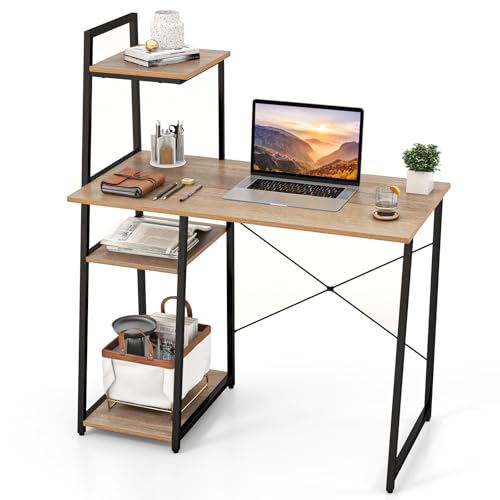
Tangkula Space Saving Computer Desk with Shelves — The compact natural
Tangkula’s second entry inverts the first: where the 71-inch model reaches upward in brown, this one is explicitly a space-saving computer desk with a three-tier ladder-shaped bookshelf, a metal frame, and a natural finish, built as a compact workstation for the home office. The natural finish and the compact brief make it the diplomat of the group — a desk that fits the spare-room corner, the studio flat, or the landing niche without imposing a colour scheme on the room around it.
Three tiers at compact scale is a considered ratio: enough shelving to lift the printer paper, the reference books, and the storage basket off the worktop, without the top tier retreating into step-stool territory as the tall model’s does. The stated metal frame again speaks to rigidity, which matters in a compact frame that will be nudged by chairs and hips in a tight space more often than a desk in a spacious study ever is. What the title does not give is a height or width, so the tape measure and the listing’s dimension diagram must do that work together before this desk is assigned a corner. The current price sits on the listing page with those measurements.
- Format: space-saving computer desk with ladder-shaped bookshelf, per the listing title
- Shelving: 3-tier ladder storage
- Structure: metal frame, as stated in the title
- Finish: natural
- Dimensions: the headline publishes no figures — consult the manufacturer’s documentation and the listing diagram against your corner
- Drawer and outlet: neither is claimed in the title, so plan clutter and charging as your own arrangements
Strengths
- Compact proportions with three usable tiers — shelving that stays within reach instead of becoming display-only.
- The natural finish coexists with almost any room’s existing furniture.
- A stated metal frame suits a desk that will take knocks in a tight traffic path.
Trade-offs
- No drawer, so the daily debris needs a basket discipline on the shelves.
- Dimensions must be confirmed from the listing rather than the title before a tight corner is promised to it.
- Compact worktop space assumes a laptop or a single modest screen.
This is the pick for the room that was never meant to be an office: the corner of a studio, the wide landing, the spare room that still hosts guests. In those spaces a desk must justify itself daily against the room’s first purpose, and a compact natural frame with honest shelving does so by disappearing when the work ends — laptop closed, chair tucked, shelves reading as a small bookcase. If that disappearing act is the requirement, this Tangkula performs it with the least argument in the group.
Guests are this desk’s secret test, and it passes in a specific way: with the laptop closed and the chair tucked, a natural-finish ladder frame reads to a visitor as a bookcase with ideas, not as an office that failed to leave. In a spare room that earns its keep as a guest room six weekends a year, that reading is worth more than an extra tier of shelving would be.
Best for: a studio flat, landing, or spare-room corner needing a compact, neutral workstation that reads as a bookcase when closed down.
Not suited for: a dedicated study wanting full-height storage — that is the taller Tangkula — or work needing a drawer in the desk.
Side by side: which frames state drawers, power, and dimensions?
| Pick | Format | Drawer stated | Power stated | Size or frame stated |
|---|---|---|---|---|
| Haotian Ladder Desk with Shelves | Freestanding, white, FRG60-W | No | No | Small-space framing |
| Tangkula 3-Tier Ladder Computer Desk 71 in | Freestanding, brown | No | No | 71 in tall, metal frame |
| American Trails Freestanding Ladder Desk with Drawer | Freestanding, natural | Yes | No | Not stated |
| ZIOTHUM Wall Mounted Ladder Desk with Shelves | Wall-mounted, pipe style | No | No | 36 x 20 x 81 in |
| Haotian Ladder Desk with Power Outlet and Drawer | Freestanding, narrow | Yes | Power outlet | Narrow framing |
| Tangkula Space Saving Computer Desk with Shelves | Freestanding, natural | No | No | Metal frame, 3-tier |
How should you install a ladder desk in its first afternoon?
Build it in the room it will serve, flat on the floor, and stand it against its wall before loading a single shelf. Check the lean: the frame should meet the wall the way its design intends, accounting for your skirting board, and it should stand without rocking on your floor’s real surface. This is the moment to decide on any wall strap or bracket the documentation suggests, while the shelves are empty and the frame is light enough to move with one hand.
Load it from the bottom, over the following week rather than the following hour. Books and heavy items first, low down; worktop kit next; the upper shelves last and lightest, edited after a few days of actually sitting at the desk, because reach from the chair — not reach while standing — is the measure that matters. A shelf you cannot reach from your seat is a display shelf, and it should be stocked like one.
Route the cables before the books go in. Whether the desk has its own outlet or borrows the wall’s, the cable path down the rear of the frame, once hidden behind the lowest shelf’s books, tends to stay solved for years; cables arranged after the shelves are loaded tend to stay visible for just as long. Do the unglamorous routing while the frame is empty and grateful for it.
How do you keep a small desk corner from feeling like a corridor?
Light it as a destination. A ladder desk in a dim corner reads as storage; the same desk with a lamp on its worktop or a warm light at its shelves reads as a room within the room, and you will sit at it more willingly for longer. The desk’s own verticality helps here — a small lamp on the second shelf washes the wall above the worktop and gives the corner a ceiling it did not have.
Defend the floor in front of it. The chair’s footprint and a body’s worth of approach space are part of the workstation, and the moment a laundry basket or a storage box colonises that space, the desk becomes a shelf you occasionally lean across. Small corners fail by encroachment, not by size; a modest desk with defended territory outperforms a larger one besieged by the room’s overflow.
Finally, let the top shelf be beautiful on purpose. It is the part of the desk at eye level when you stand, the part visitors see, and the part you see last when you leave the corner. One plant, one object, and empty air will do more for the room than a third row of paperbacks, and the paperbacks will not miss the promotion.
How much work surface do you honestly need at a ladder desk?
Be literal about your kit. A laptop, a notebook, a mug, and a phone describe most ladder-desk work, and every pick here swallows that list whole. Add a separate keyboard and the surface still copes; add a second screen, a drawing tablet, or a spread of paper documents and the format’s edges appear quickly — not because the desks are badly made, but because the narrowing frame that buys the shelves spends the depth a sprawling setup needs. Lay your actual kit on a table and measure the rectangle it occupies before you fall for a photograph; that rectangle, compared honestly against the listing’s worktop dimensions, settles the question better than any review.
Vertical thinking rescues some sprawl. A document stand lifts paper into the shelf zone, a laptop riser reclaims the surface beneath the machine, and the shelves themselves hold the reference material that a conventional desk spreads sideways. Owners who think in three dimensions get surprising mileage from these worktops; owners who insist on a flat, single-layer layout will feel constrained by Friday. Neither reaction says anything about the desk — both say something about the match between the desk and a working style, which is precisely what this category asks you to examine before buying.
What should you check on the wall before any of these desks arrives?
Flatness, first: a wall that bows or a corner that is not square will show itself the moment a leaning frame meets it at two points and hovers at a third. Run a long straight edge — or the frame itself, on arrival — along the intended stretch and note the gaps, because a ladder desk against an uneven wall leans at the wall’s angle, not its own. Minor unevenness is a felt-pad problem; dramatic unevenness is a choose-another-wall problem, and it is better discovered with the frame still in its box.
Obstructions, second: skirting boards set the frame’s feet away from the wall by their depth, radiators forbid whole stretches, and sockets are precious — a ladder desk parked over the corner’s only socket, without a built-in outlet of its own, creates a daily annoyance out of a planning oversight. Map the wall on paper with every fixture drawn in, then place the desk on the drawing before you place it in the room.
For the mounted pick, add construction: what the wall is made of, where its studs or solid material run, and whether the manufacturer’s fixing guidance matches that reality. This is the one pick in the guide where a wrong answer is not an inconvenience but a failure, so the checking is not pedantry — it is the installation, done early, on paper, where mistakes are free.
What mistakes do ladder desk buyers keep making?
Loading the top shelf like a bookcase is the classic, because the shelves look like a bookcase and invite it. They are the upper reaches of a leaning frame, and they should carry weight like it. Books low, baskets high, and nothing above your head that you would not want arriving there unexpectedly.
Second, measuring the wall’s width and forgetting its obstacles. Radiators, sockets, skirting, a door’s swing, a window’s opening arc — a ladder desk’s wall is a working surface, and every fixture on it is a negotiation. The mounted ZIOTHUM raises the stakes further: know the wall’s construction before the drill comes out, not after.
Third, buying the wrong Haotian. The brand sells a shelves-only white model and a powered, drawered model in this very guide, under similar names. Decide which feature set your corner needs, then verify the listing title in the basket character by character.
Fourth, expecting a worktop to be a desk in the full sense. These are laptop-and-notebook surfaces for focused, seated work. A buyer who needs dual monitors, a drawing tablet, and elbow room for paper is not badly served by these desks; they are shopping in the wrong category, and a compact conventional desk will make them happier.
How do you style open ladder shelves so the desk looks intentional?
Work in a rhythm of filled and empty. A shelf packed edge to edge reads as storage under pressure; the same shelf with a deliberate gap — a hand’s width of air beside a basket, a single object standing alone — reads as chosen. Ladder shelves narrow as they rise, so let the composition narrow with them: the fullest shelf at the bottom, the lightest touch at the top, and the eye travelling upward finds the frame getting calmer rather than more desperate.
Contain the small things. Open shelving displays whatever sits on it at its actual level of tidiness, and loose small objects — cables, chargers, stationery — are untidy at any quantity. One basket or box per shelf converts that scattered layer into a single calm shape, and it is the cheapest transformation available to any pick in this guide, including the two with drawers, whose owners still need somewhere for the oversized items a drawer refuses.
Repeat one material or colour. A run of shelves holding the same basket weave, the same book cloth tones, or the same white boxes acquires a designed coherence that mixed containers never quite reach, whatever their individual merits. In a small room the desk is always in view, so its shelves are effectively a wall treatment — and wall treatments reward exactly this kind of simple, repeated decision.
Final Recommendation
Divide the group by commitment first. If the wall can be drilled and the position is permanent, the ZIOTHUM’s floating installation gives back the most floor and the boldest look. Everyone else is choosing among leaning frames, and the choice runs on features: the powered, drawered Haotian for the socket-poor corner with clutter to hide; the American Trails for a drawer in a natural finish; the white FRG60-W for the clean bookshelf-desk in a bright room; the tall brown Tangkula for a study wall with a library to house; and the compact natural Tangkula for the corner that must disappear into a room with another purpose.
Whichever frame you choose, load it low, light it warmly, and defend the floor in front of it. A ladder desk succeeds as a small room’s treaty between work and everything else, and treaties hold when both sides keep their terms.
Do the paper work before the cardboard work: the wall mapped with its skirting, sockets, and radiators drawn in; your kit measured as a rectangle on a table; the two same-brand pairs in this guide — Haotian against Haotian, Tangkula against Tangkula — decided by feature and scale rather than by a hurried glance at near-identical names. Those three checks, none of which costs anything, prevent nearly every return this category generates, and they leave the delivery day as the simple pleasure it should be: a frame leaning against a wall that was measured for it, in a corner that has been waiting.
Choose the frame that fits your wall honestly, and the corner you wrote off as dead space becomes the seat you reach for first — laptop open, shelves above, and the whole small room suddenly working at full size.
And if the corner later grows — a bigger room, a dedicated study, a desk with drawers and depth — the ladder frame rarely becomes waste. It migrates to a hallway as a bookcase, to a child’s room as a first desk, to a landing as the household’s charging and correspondence station, because a structure that is mostly shelves with a worktop is useful in every room it has ever stood in. Few desks can promise a second and third life that plausible; in a small home, that afterlife is part of the value you are buying.
Frequently Asked Questions
Are ladder desks stable enough for daily work?
A freestanding ladder frame, loaded heavy-low and light-high and standing against its wall as designed, is a stable everyday workstation for laptop-scale work. Stability is a loading discipline as much as a product property: the same frame loaded top-heavy becomes nervous. Where a model’s documentation suggests a wall strap, fitting it is cheap insurance.
Can I put a desktop monitor on a ladder desk?
A single modest monitor on the worktop is within the format’s intent for most of these designs; monitor arms, dual screens, and large displays are not what a narrowing ladder frame is built around. No load figures are stated in these titles, so check the manufacturer’s documentation for the specific model against your screen’s weight before committing.
What is the real difference between the two Haotian models?
Features, entirely. The FRG60-W is a white, shelves-only secretary desk and bookshelf. The other Haotian is a narrower design that adds a drawer and a built-in power outlet. They share a brand and a format, not a specification, and choosing between them is choosing whether your corner needs hiding space and charging at the desk.
Is the wall-mounted desk stronger than the leaning ones?
It is differently strong: its capacity is governed by the wall and the fixings rather than by a frame’s geometry, which is why its documentation matters more than any other pick’s here. On a suitable wall, correctly fixed, it is a rigid and permanent installation; on an unsuitable wall it should not be installed at all.
How much weight can the shelves hold?
These titles do not state shelf capacities, and this guide will not guess at figures that govern objects above a seated person’s head. Consult the manufacturer’s documentation for the model you choose, and until you have, load by the conservative rule: dense and heavy at the bottom, light at the top.
Can a ladder desk serve two people at different times?
Yes, if the household treats the shelves as shared territory with zones: one person’s working shelf, the other’s, and the worktop cleared between shifts. The format’s openness actually helps here, because nothing hides and each user can see at a glance whether the corner is free. What it cannot do is seat two people at once — the worktop is a one-person surface in every pick here — so households needing simultaneous desks need a second station, not a bigger ladder.
Will a ladder desk work in a rented room?
The five freestanding picks will, since they lean without fixings — though a protective strap, if used, may need a fixing point, so check your agreement. The wall-mounted ZIOTHUM is the exception: it is a drilled installation and belongs in homes where the wall is yours to drill.
Related Guides
The small corner is one problem; the powered, the commercial, and the making workstations are others, covered in Best Electric Desks, Best Craft Desks, and Best Makeup Desks With Storage.
Related guides
- Best 3D Mechanical Engineering Laptops: Certified Workstations for CAD and Simulation
- Best Tattoo Printers: Thermal Stencil Machines for Clean, Lasting Transfers
- Best 15 Laptops Under $1000: Six 15-Inch Machines That Spend the Budget Honestly
- Best Battery NiMH Chargers: Six Units That Understand the Chemistry


