What's inside
- Key Takeaways
- Quick Picks
- How Did We Sort Boom Microphones From Button Microphones?
- Why Does the Microphone’s Address Matter More Than Its Brand?
- What Should You Check About Fit When the Whole Headset Weighs Almost Nothing?
- How Does Each Model Handle the Voice Job It Claims?
- The Fork, the Plugs, and the Fit: All Six in One View
- How Do You Get the Best From a Wired Earbud Headset Day to Day?
- Which Mistakes Do Earbud Headset Buyers Keep Making?
- Final Recommendation
- How Do Earbud Headsets Fit Into a Working Kit Alongside Full-Size Headsets?
- What Happens to Your Voice on the Other End of These Six Designs?
- Why Do Gamers and Agents, Who Agree on Nothing Else, Agree on the Boom?
- What Should You Expect From the Cable, the Component That Decides the Lifespan?
- Frequently Asked Questions
- Related Guides
As an Amazon Associate I earn from qualifying purchases. This post may contain affiliate links at no extra cost to you.
widgetverdict.com is reader-supported. When you buy through links on our site, we may earn an affiliate commission.
Where to buy: Amazon stocks the full shortlist, and the links in the Quick Picks table and in each full review lead to the matching listing, so you can confirm the plug and variant before ordering. The best earbud headsets solve a problem the over-ear world cannot: how to carry a real conversation on almost no hardware. But the category hides a fork that decides everything, and this guide is built around it. On one side stand earbuds with boom microphones — a small arm that places the microphone near your mouth, the way a full headset does — built for calls, call centers, and game chat where your voice is the product. On the other side stand ordinary wired earbuds with a tiny microphone built into the cable, designed for music first and calls second, which are cousins of the true wireless music earbuds flooding the market and share their priorities. Both kinds appear below, labelled honestly: the SteelSeries Tusq, the ALTEAM mono, and the hook-and-boom 3.5 mm model carry real boom microphones; the AIAUXAI puts its microphone on a USB earbud body for computer work; and the Panasonic and Sony are inline-microphone earbuds whose titles promise music-era convenience rather than boom-grade voice. Buy across that fork knowingly and you will be satisfied; buy across it accidentally and you will blame the product for your own category error.
Connection is the second map. Three of these six speak 3.5 mm — the universal analogue language of phones, controllers, laptops, and tablets — with the ALTEAM specifying a TRRS plug, the four-contact variant that carries microphone and stereo audio down one cable. One pick, the AIAUXAI, speaks USB directly to a computer, trading universality for a laptop-native identity. Wearing style is the third map: mono single-ear designs for people who must hear the room, stereo in-ear designs for people who want both ears in the call or the game, and ear hooks wherever movement is part of the job. Nothing here is a true wireless earbud, and that is deliberate — the wired earbud headset is a distinct tool with its own virtues: no battery, no pairing, no connection dropped mid-sentence, and a microphone whose position physics, not software, can guarantee.
Key Takeaways
- Boom versus inline is the category’s great divide: three picks carry genuine boom microphones, two carry cable-inline microphones, and one is a USB computer earbud.
- Nothing in this guide is a true wireless music earbud — every pick is wired, by design and by job description.
- The SteelSeries Tusq runs a dual-microphone system with a detachable boom, the most complete voice arrangement in the guide.
- The ALTEAM is the mono specialist: a single earbud, a bendable boom, and a 3.5 mm TRRS plug for phones, tablets, and PCs.
- The AIAUXAI is the only USB model, built for computer calls and named laptop brands in its title.
- The Panasonic ErgoFit ships with three earpad sizes (S/M/L) — the only fit kit quantified in any title here.
Quick Picks
| Pick | Badge | Why it made the list |
|---|---|---|
| SteelSeries Tusq | Boom-mic flagship | Dual microphones with a detachable boom, in an in-ear mobile gaming design. |
| ALTEAM Mono Earbud Headset with Boom Mic | Mono boom specialist | A single wired earbud with a bendable boom arm and an adjustable earhook. |
| 3.5mm Earbuds with Ear Hooks & Detachable Boom Mic | Secure-fit boom pick | Ear hooks plus a detachable boom, aimed at gaming, call centers, and workouts. |
| AIAUXAI USB Earbuds for PC | USB computer pick | Wired USB earbuds with microphone and audio control for laptop office work. |
| Panasonic ErgoFit Earbuds with Mic | Everyday inline classic | An in-ear classic with microphone and call controller, and three sizes of earpads. |
| Sony MDR-EX15AP Earbuds with Mic | Simple inline staple | Sony’s in-ear earbuds with a built-in microphone — the uncomplicated spare-pair pick. |
How Did We Sort Boom Microphones From Button Microphones?
By reading each title for the microphone’s physical address. A boom microphone lives on an arm near the mouth; an inline microphone lives on the cable near the chest, and the physics of those two addresses decide call quality more than any brand name in this category. The boom picks were therefore evaluated as voice tools — for agents, gamers, and callers — while the inline picks were evaluated as everyday earbuds that also take calls, which is the job their titles actually describe. The guide’s wider family makes the same distinction at larger scales: the aviation guides in Best General Aviation Headsets and Best David Clark General Aviation Headsets are built entirely around boom microphones, because in a cockpit nothing else survives, while the office world of Best Business USB Headsets splits the difference with full-size booms on over-ear frames. The earbud category is where the fork matters most, because the products look identical in a thumbnail and behave like different species on a call.
Specifications, as ever in this cluster, come only from the titles. Driver size appears once (the ALTEAM’s 15 mm), plug types are used only where stated, and no battery, Bluetooth, or noise-cancelling claim is made for any pick whose title does not make it. Where a title is silent — most notably the Sony’s, which is nearly silent about everything — the spec box records the silence rather than dressing the product in borrowed facts.
Why Does the Microphone’s Address Matter More Than Its Brand?
Sound obeys an unforgiving arithmetic: every doubling of distance between your mouth and a microphone costs the microphone a large share of your voice’s level, while the room’s noise — the keyboard, the colleague, the traffic — stays where it was. A boom microphone a few centimetres from your lips therefore starts the contest with an enormous advantage that no processing can fully repay, which is why call centers, pilots, and dispatchers converged on booms decades before the earbud existed. An inline microphone at chest height hears your voice from perhaps ten times the distance, competing with shirt rustle, cable bumps, and every sound your torso makes. Modern phones apply processing that rescues inline microphones for casual calls, and for casual calls that rescue is enough. For a working call — an agent’s shift, a ranked match’s coordination, a client who must not ask you to repeat the numbers — the boom’s physics is the professional answer, and this guide’s first three picks exist to deliver it at earbud scale.
The detachable booms on the Tusq and the hook-and-boom model add a graceful compromise: boom on for the call, boom off for the train, the same earbuds serving both lives without a second purchase. That convertibility is the earbud category’s distinctive trick, impossible for a full-size headset to copy and pointless for a pure music earbud to attempt. Judge the category by how honestly each product declares its side of the fork, and the six below sort themselves with unusual clarity.
What Should You Check About Fit When the Whole Headset Weighs Almost Nothing?
In-ear fit is a seal problem, and the seal is the product. An earbud that sits loosely loses bass, leaks your call to the room, and migrates during movement until it falls out at the worst moment; an earbud sealed correctly stays, sounds complete, and isolates passively. This is why the Panasonic’s three earpad sizes, stated in its title, are a more meaningful specification than most of the adjectives in this category — fit is personal, and a maker who ships sizes is admitting it. Ear hooks, carried by the ALTEAM and the hook-and-boom model, answer the movement half of the problem: a hook over the ear carries the earbud’s tiny weight and the cable’s tugs, so the seal is never asked to do a hook’s job. Mono wearers should think about which ear works — the ALTEAM’s adjustable fit geometry, again from its title, exists because a single-ear device must fit its one ear perfectly, having no partner to share the work.
Cable discipline completes the fit picture. A wired earbud’s cable is its leash and its lifeline: routed under a jacket or clipped at the chest, it disappears; left swinging, it snags, tugs the seals loose, and drums its handling noise into inline microphones. The wired category’s entire reliability advantage is preserved or squandered by this thirty-second habit, and it is the closest thing earbud headsets have to a setup ritual.
How Does Each Model Handle the Voice Job It Claims?

SteelSeries Tusq — Boom-mic flagship
The Tusq is what happens when a gaming peripherals maker takes the earbud headset seriously as a voice instrument. Its title describes an in-ear mobile gaming headset with a dual microphone arrangement built around a detachable boom mic, in an ergonomic suspension design, for mobile use. Dual microphone is the architecture to understand: the boom carries the primary voice microphone at mouth distance, while a second microphone on the earbud body covers the moments when the boom is detached — calls taken casually, without the full apparatus. That two-tier system mirrors how mobile gaming life actually alternates between serious sessions, where callouts must be perfect, and casual ones, where convenience wins. Detach the boom and the Tusq becomes an ordinary pair of mobile earbuds; attach it and your voice moves to the front of the mix with a proximity no inline microphone can imitate.
The ergonomic suspension design named in the title addresses the in-ear category’s chronic problem — earbuds that ache or wander after an hour — with a fit system meant to distribute the earbud’s presence rather than concentrate it. For mobile gamers, whose sessions are long and whose heads move, that fit system is not a luxury. The title does not state a plug type or driver size, so connection homework belongs on the listing; the mobile framing implies the phone-and-controller world, but this guide confirms nothing the title leaves open. As the guide’s boom flagship, the Tusq is the pick against which the other voice-first models are measured: examine the Tusq listing on Amazon if your earbud headset exists primarily so that other people can hear you properly.
Its honest boundary is specialisation. The Tusq’s design energy is spent on mobile gaming voice; a call-center agent needing a shift-proof mono tool, or a laptop worker needing USB, will find their picks below, built for those rooms instead. Specialisation is not a flaw in a six-pick guide — it is the sorting mechanism working as intended.
- Microphone system: Dual microphone with detachable boom mic, per the title
- Design: In-ear with ergonomic suspension design, per the title
- Stated world: Mobile gaming, per the title
- Plug type: Not stated in the title — confirm on the listing
- Driver size: Not stated in the title — consult the listing if it decides your purchase
Strengths
- A real boom for serious voice, a body microphone for casual moments — two tiers in one product.
- Detachability converts it to plain mobile earbuds when the session ends.
- Fit system designed for long mobile sessions rather than short calls.
Trade-offs
- Gaming-mobile specialisation leaves call-center and USB-computer needs to other picks.
- Connection details are unstated in the title and require a listing check.
- The boom is one more small component to keep track of between sessions.
Best for: mobile gamers who want boom-grade voice without a full-size headset.
Not suited for: agents and office workers whose calls run through a computer’s USB port.
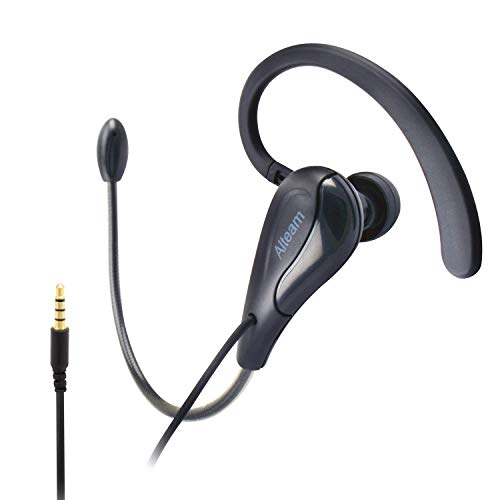
ALTEAM Mono Earbud Headset with Boom Mic — Mono boom specialist
The ALTEAM is the most specialised object in this guide, and its title is a pleasure to read for exactly that reason: a wired mono single headset with a one-hook earphone-earbud design, a bendable boom arm mic, adjustable ear angle and earhook length, a 15 mm driver, and a 3.5 mm TRRS plug for smartphones, tablets, and PCs. Every clause describes the mono professional’s reality. One ear carries the call; the other ear carries the world — the supervisor’s voice, the doorbell, the traffic, the child. The boom bends, because a microphone’s position is personal and a fixed arm fits the average face that nobody actually has. The ear angle and hook length adjust, because a single earbud must achieve alone what a stereo pair achieves together: a seal and a hold that survive a working day.
The TRRS plug is the compatibility sentence: the four-contact 3.5 mm standard that carries microphone and audio together into phones, tablets, and the headset jacks of PCs and controllers. Mono plus TRRS plus boom is the exact specification of the drive-through window, the dispatch desk, the warehouse picker on voice instructions, and the home agent who must hear the house. The 15 mm driver, the only driver size stated in this guide, serves the single ear generously. Nothing about this product pretends to be for music, and that honesty is its charm — it is a tool in a category full of toys wearing tool costumes. Look at the ALTEAM listing on Amazon if your working day is one ear in the call and one ear in the room, and you are tired of stereo headsets pretending that is a compromise.
Buyers should simply be certain that mono is their life before choosing it. Stereo content — games with directional audio, music, video — collapses into one ear here, by design and without apology. The ALTEAM is the guide’s clearest example of a product whose limitation and whose virtue are the same fact, and it rewards buyers who know which side of that fact they live on.
- Wearing: Mono single earbud with one-hook design, per the title
- Microphone: Bendable boom arm mic, per the title
- Fit adjustments: Ear angle and earhook length both adjust, per the title
- Driver: 15 mm driver, per the title
- Plug: 3.5 mm TRRS for smartphone, tablet, and PC, per the title
Strengths
- The fullest fit-adjustment story in the guide, built for one-ear all-day wear.
- A bendable boom puts the microphone where your face actually is.
- TRRS universality across phones, tablets, and PC headset jacks.
Trade-offs
- Mono audio is a hard boundary: no stereo games, music, or video immersion.
- Wired 3.5 mm only — devices without a jack need an adapter in the chain.
- Its tool-like specialisation offers nothing to the casual listener.
Best for: agents, dispatchers, and drivers who work with one ear on the room.
Not suited for: listeners wanting stereo sound for games, films, or music.

3.5mm Earbuds with Ear Hooks & Detachable Boom Mic — Secure-fit boom pick
This unbranded-in-spirit entry makes its argument entirely from mechanics: 3.5 mm earbuds with over-ear hooks and a secure in-ear fit, a detachable boom mic described as crystal-clear, aimed at gaming, call centers, sports, and intense workouts. The hooks-plus-boom combination is the interesting engineering. Hooks solve retention under movement; the boom solves voice under noise; together they describe the earbud headset for people whose calls and games happen in motion — the agent who paces, the gamer who leans into the screen, the trainer taking calls between sets. The detachable boom repeats the Tusq’s convertibility at a different tier: boom fitted for the call queue or the match, boom removed for the run.
The breadth of its stated worlds — gaming, call centers, sports, workouts — should be read as a claim about the fit system rather than about four different tunings. A secure fit is the common requirement of all four activities, and it is the one this product’s title actually substantiates with hardware: hooks, in-ear seal, detachable voice arm. What the title does not provide is equally clear: no brand story, no driver figure, no plug detail beyond the 3.5 mm in its name. Buyers are purchasing a mechanism, and should judge it as one — test the hook’s hold and the boom’s clarity inside the return window, on a real call, in real motion. Check the hook-and-boom earbuds listing on Amazon if your headset has to stay fitted and intelligible while everything else in your day is moving.
Its slot in this guide is the value expression of the boom idea. The Tusq above it is the designed object from a gaming house; this is the same physics in a plainer wrapper, and for buyers whose priority is the mechanism over the marque, that may be exactly the right trade — provided the return-window test is actually performed, because unbranded mechanisms live or die by the individual unit’s execution.
- Fit system: Over-ear hooks with secure in-ear fit, per the title
- Microphone: Detachable boom mic, per the title
- Connection: 3.5 mm, per the product name in the title
- Stated worlds: Gaming, call centers, sports, and intense workouts, per the title
- Driver and brand details: Not stated in the title — judge the unit on its return-window test
Strengths
- Hooks plus boom: retention and voice, the two moving-body problems, answered together.
- Detachable boom converts between call duty and plain earbud life.
- A mechanism-first purchase for buyers unmoved by brand stories.
Trade-offs
- No brand, driver, or specification depth in the title to research before buying.
- Four stated worlds is breadth; the fit system, not tuning, is what unites them.
- Execution varies at this tier, making the return-window call test essential.
Best for: active callers and gamers who need a boom that stays put while they move.
Not suited for: a buyer requiring published specifications and brand support channels before purchasing.

AIAUXAI USB Earbuds for PC — USB computer pick
The AIAUXAI occupies the guide’s only USB seat: wired USB earbuds for PC with a microphone for the computer, audio control, noise-isolating stereo laptop earphones, named for Dell, HP, and Surface machines and for office and Zoom working. Understand what USB changes at earbud scale. A 3.5 mm earbud borrows the computer’s analogue audio path, with its variable quality and its single-jack-versus-split-jack confusions; a USB earbud arrives as its own audio device, identified by name in the operating system and in the meeting app’s device list, behaving identically on every laptop it meets. For a worker whose calls are their job and whose laptop changes — hot desks, loaners, upgrades — that device identity is a genuine professional feature wearing a very small costume.
Noise isolating, in the title, describes the passive seal of the in-ear fit rather than any electronic cancelling, and this guide uses the phrase in that sense only. The named laptop brands are compatibility reassurance rather than limitation — USB audio is a standard, and the names signal the office terrain the product was tested against in its maker’s mind. Audio control on the cable covers the call-handling essentials. What the title does not state — a boom, notably — tells you the microphone lives on the earbud or cable rather than on an arm, so set voice expectations at the inline level: entirely adequate for meetings, a tier below the boom picks for hostile noise. View the AIAUXAI listing on Amazon if your earbud headset’s natural habitat is a laptop’s USB port and a calendar of video calls.
Within the guide’s economy, this is the earbud for the worker who looked at the full-size USB headsets in the companion guide and wanted the same plug-and-work discipline at a tenth of the desk footprint. It is also the natural spare for such a worker: a complete, computer-native call kit that lives in a laptop bag’s smallest pocket.
- Connection: Wired USB for PC, per the title
- Microphone: Microphone with audio control, per the title — no boom is claimed
- Isolation: Noise isolating (passive in-ear seal), per the title
- Wearing: Stereo laptop earphones, per the title
- Named terrain: Dell, HP, Surface PCs; office and Zoom working, per the title
Strengths
- USB device identity: the meeting app sees a named device, not an anonymous jack.
- Computer-native design for the laptop-and-Zoom working pattern.
- Stereo in-ear fit with passive isolation for focus in shared spaces.
Trade-offs
- USB-only: phones and controllers without adapters are outside its world.
- No boom, so voice-in-noise performance sits at the inline tier.
- Named-brand reassurance is not a specification; verify against your exact laptop.
Best for: laptop-based workers wanting USB reliability in an earbud form.
Not suited for: callers in loud environments who need a boom microphone’s physics.

Panasonic ErgoFit Earbuds with Mic — Everyday inline classic
Crossing to the inline side of the fork, the ErgoFit is the category’s long-running everyday answer: Panasonic in-ear earbuds with a microphone and call controller, compatible — per its title — with iPhone, Android, and Blackberry, in black, with earpads in small, medium, and large. That compatibility list is a small museum of the wired era, and it makes the ErgoFit’s point better than any modern phrasing could: a 3.5 mm earbud with an inline mic and controller was the universal communication accessory of the smartphone’s first decade, and the design persists because the job persists. Answer the call, talk, hang up, return to the music — one button, no menu, no battery, no thought.
The three sizes of earpads are this pick’s quiet distinction, as the fit section argued: in-ear comfort and seal are size problems, and Panasonic ships the solution in the box. The ErgoFit name itself is a fit claim — an earbud shaped to sit in the ear’s anatomy rather than merely in its canal — and its longevity in the market is the evidence that the claim largely holds for many ears. Set the voice expectation correctly: the inline microphone serves phone calls in ordinary environments perfectly well and was never designed to defeat a call-center floor. Buyers who need that defeat should return to the boom picks above without resentment; the ErgoFit is not a failed boom headset, it is a successful everyday earbud. See the ErgoFit listing on Amazon if your requirement is a dependable wired earbud that takes calls gracefully and disappears into a pocket afterwards.
It also earns a place as the household spare — the pair in the drawer that rescues a day when the primary headset fails, the travel pair whose loss would be an annoyance rather than a claim on the insurance. Categories need their honest staples, and in this guide the ErgoFit is the staple with the best fit kit.
- Microphone: Inline microphone with call controller, per the title — no boom
- Design: ErgoFit in-ear earbuds, per the title
- Fit kit: Earpads in S, M, and L, per the title
- Compatibility named: iPhone, Android, and Blackberry, per the title
- Colour: Black, per the title
Strengths
- Three earpad sizes in the box — fit treated as a specification, not a hope.
- The universal wired pattern: plug in, answer, talk, pocket it.
- A long market life that testifies to the fit design’s broad success.
Trade-offs
- Inline microphone physics: fine for ordinary calls, outmatched by noisy floors.
- Its compatibility language belongs to the wired era; jack-less phones need adapters.
- No hooks or retention system for active, moving use.
Best for: everyday phone calls, commuting, and as the household’s dependable spare pair.
Not suited for: professional call work where your voice must defeat a loud room.

Sony MDR-EX15AP Earbuds with Mic — Simple inline staple
The Sony’s title is the shortest in this guide — in-ear earbud headphones with mic, black, model MDR-EX15AP/B — and the review will honour its spirit: this is the simple object, from a maker whose audio lineage needs no introduction, for buyers whose requirement is a wired earbud with a microphone that works when picked up. The “AP” in Sony’s model language denotes the smartphone-oriented variant with the inline microphone and control, and the title’s claim extends exactly that far and no further. No boom is promised, no isolation figure is quoted, no gaming or call-center world is invoked. In a guide full of specialisation, the Sony represents the baseline against which specialisation must justify itself: if your calls are ordinary, your rooms are ordinary, and your priority is a known maker’s uncomplicated earbud, the baseline may be the whole answer.
That baseline role has practical weight. A Sony earbud is the pair bought at an airport of the mind — the replacement that requires no research because the category’s floor, from this maker, is trustworthy. It will take the call, play the music, survive the pocket, and ask nothing. What it will not do is rescue your voice from a loud kitchen or stay hooked during a workout, and buyers must not ask it to: the guide’s boom and hook picks exist precisely where the Sony’s simplicity ends. The title states no driver size, no fit kit, and no plug detail, so any of those, if decisive, must be read on the listing rather than assumed from the logo. Open the MDR-EX15AP listing on Amazon if your brief is a mic’d earbud from a household name, bought in one decision and used without a second thought.
There is a discipline in ending the guide here. Six picks that began with a dual-microphone gaming instrument close with the plainest object in the category, and the distance between them is the guide’s real content: know which side of the boom fork your life is on, know your connector, know your fit — and the plainest object, chosen knowingly, will serve you better than the fanciest one chosen by accident.
- Microphone: Built-in mic (inline type), per the title — no boom is claimed
- Design: In-ear earbud headphones, per the title
- Colour: Black, per the title
- Model: MDR-EX15AP/B, per the title
- Driver, fit kit, plug: None is stated in the title — the listing holds those answers
Strengths
- The trusted baseline: a major maker’s simple mic’d earbud with no learning curve.
- One-decision purchase for ordinary calls and everyday listening.
- The natural spare pair for a bag, a drawer, or a second phone.
Trade-offs
- Inline microphone only — loud rooms and professional call work exceed its brief.
- The title is nearly bare of specifications for buyers who research first.
- No retention system, so active use will test its seal unfairly.
Best for: everyday callers wanting a simple, known-name wired earbud with a mic.
Not suited for: boom-grade voice work, call centers, or sport and movement.
The Fork, the Plugs, and the Fit: All Six in One View
| Model | Microphone type | Connection | Wearing | Signature detail |
|---|---|---|---|---|
| SteelSeries Tusq | Detachable boom + body mic | Not stated | In-ear stereo | Dual microphone system |
| ALTEAM Mono | Bendable boom | 3.5 mm TRRS | Mono, earhook | 15 mm driver, adjustable hook |
| Hook-and-Boom 3.5mm | Detachable boom | 3.5 mm | In-ear with hooks | Secure fit for movement |
| AIAUXAI USB | Inline/body mic with control | USB | Stereo in-ear | Computer-native device identity |
| Panasonic ErgoFit | Inline with call controller | 3.5 mm era standard | In-ear | Earpads in three sizes |
| Sony MDR-EX15AP | Inline mic | Not stated | In-ear | The simple baseline |
How Do You Get the Best From a Wired Earbud Headset Day to Day?
Start with the seal: try every earpad size you are given, on both ears separately if your anatomy is asymmetric, and judge by a phone call rather than by music — the seal that keeps your voice’s low end intact for the listener is the right one. Position any boom as the aviation world teaches: at the corner of the mouth, close, consistent. Route the cable once, deliberately — inside a jacket in winter, clipped at the chest in summer — and store the earbuds wound loosely in a pouch rather than crushed in a pocket, because the cable is the product’s lifespan and pockets are where cables go to be injured. Clean the earpads and the mesh over the drivers on a rhythm; in-ear devices live in ears, and both hygiene and sound depend on it. Finally, keep the category’s spare-pair logic: a wired earbud headset costs little enough that a backup in the bag converts its one true vulnerability — a severed cable at the wrong hour — from a crisis into a shrug.
Which Mistakes Do Earbud Headset Buyers Keep Making?
The category error leads: buying inline-microphone music earbuds for professional voice work, then reviewing them as failed headsets when they were only ever failed expectations. The second mistake is the mirror — buying a mono boom tool like the ALTEAM and resenting its single ear during a film. The third is ignoring the plug audit: TRRS versus separate jacks on a PC, USB versus 3.5 mm, the adapter a jack-less phone quietly requires. The fourth is judging fit by the first minute; in-ear comfort is an hour-three property, and the return window exists to test exactly that. The fifth is chasing wireless envy — replacing a wired tool that works with a battery-dependent one whose microphone sits even further from the mouth — without naming a single problem the change solves. Every one of these mistakes is a failure of the fork, the plug, or the fit: the three questions this guide has asked from its first paragraph.
Final Recommendation
Decide your side of the fork first. If your voice works for a living — calls, coordination, clients — stay with the booms: the Tusq for mobile gaming’s two-tier microphone system, the ALTEAM for the one-ear professional life, the hook-and-boom model for voice in motion. If your calls live on a laptop, the AIAUXAI brings USB discipline to earbud scale. And if your requirement is simply a wired earbud that takes ordinary calls gracefully, the Panasonic’s fit kit and the Sony’s plain reliability close the guide as honestly as it opened. The earbud headset is the smallest complete communication tool a person can own — a microphone, a seal, a cable, a decision — and chosen with its fork in mind, it will be the purchase you stop thinking about fastest and use the longest.
One last test, to be performed before the return window closes on whichever pick you choose: make the hardest call in your life — not the longest, the hardest acoustically. The kitchen at dinner time, the platform at rush hour, the gaming room at full voice. Talk at your normal level, and afterwards ask the other person a single question: how did I sound? Their answer, unprompted and unpolished, is the only review of an earbud headset that has ever mattered, and if the answer is that you sounded like yourself, close to the phone and clear of the room, then the smallest tool in your kit has done the whole job it was bought for.
How Do Earbud Headsets Fit Into a Working Kit Alongside Full-Size Headsets?
Few professionals own only one voice tool, and the earbud headset’s real role in a working life is usually as the second instrument — the one that travels. The full-size headset owns the desk: the boom, the cushions, the eight-hour comfort. The earbud headset owns the bag, the pocket, the train, the client site, and the day the desk is a kitchen table in another city. That division explains the category’s otherwise puzzling tolerance for compromise. An earbud headset does not need to win an eight-hour comfort contest against your desk headset; it needs to be present, instantly working, and good enough for the call that cannot wait for you to be somewhere better equipped. Judged as a primary tool, several picks here look modest. Judged as the tool that is actually there — in the jacket, at the moment the important call arrives early — they are the most valuable audio hardware many workers own.
The kit logic also runs in reverse: the earbud headset is the backup that makes the primary headset’s failures survivable. Cables fray, cushions tear, a colleague borrows the desk set for a call that becomes a day. A wired earbud in the drawer — the Panasonic or the Sony are this guide’s natural spares — restores your voice channel in thirty seconds with no pairing ritual and no software’s opinion. Operations that equip teams have institutionalised the same logic at scale, holding earbud headsets as the hot spare for fleet headsets, because a spare that fits in an envelope and works on every machine is a spare that actually gets used. When you assemble your own kit, buy the earbud for the role it will truly play — traveller, backup, specialist mono tool — and it will be the rare purchase that never has to justify itself twice.
There is finally a hygiene and sharing dimension where the earbud’s smallness wins outright. In-ear devices are personal in a way over-ear fleets pretend not to be; a worker’s own earbud headset, fitted with their own earpads, travelling in their own pouch, ends the communal-equipment compromises that hot-desking imposes on shared headsets. For the growing number of workers whose office is wherever their laptop opens, that personal, portable, always-yours quality is not a convenience feature. It is the entire proposition, and the six picks above are six different ways of cashing it.
What Happens to Your Voice on the Other End of These Six Designs?
It is worth walking the category from the listener’s chair, because that is where these products are ultimately judged. On the boom picks — the Tusq in a gaming lobby, the ALTEAM on a dispatch channel, the hook-and-boom model on a support call — your voice arrives with the close, dry, forward character of a headset microphone: consonants intact, room suppressed, your sentences easy to follow at low listening volumes. Listeners relax without knowing why. On the AIAUXAI, your voice arrives as a competent meeting voice, cleaner than a laptop’s built-in microphone by a distance that colleagues will notice in the first call, because the microphone is at least on your person and pointed at your life rather than across the room on a desk. On the inline Panasonic and Sony, your voice arrives as a good phone voice — perfectly serviceable in a quiet room, increasingly negotiated-with in a loud one, as you instinctively raise your level and the person on the other end begins asking the room behind you to repeat itself.
None of those outcomes is a surprise, and that is the point of this guide’s structure: the listener’s experience is predictable from the microphone’s address, which is printed in every title here for a buyer willing to read titles as engineering documents. The most expensive mistake in the category is paying boom money for inline physics or expecting inline convenience to perform boom work. The cheapest satisfaction is the matched purchase — the product whose microphone address equals your room’s difficulty — and it is available at every tier in this guide, from the ALTEAM’s uncompromising mono boom to the Sony’s uncompromising simplicity. Choose the address first. The brand, the colour, and the cable will take care of themselves.
Why Do Gamers and Agents, Who Agree on Nothing Else, Agree on the Boom?
Competitive gaming and call-center work look like opposite worlds until you listen to them. Both are voice-critical, time-critical, and conducted in rooms full of competing sound — a team’s other callouts, a floor’s other agents — and in both, a misunderstood sentence costs something real: a round, a customer, a sale, a save. That is why the two cultures independently arrived at the same hardware conclusion decades apart: the microphone goes near the mouth, on an arm, or the voice loses. The earbud versions in this guide are that conclusion miniaturised. The Tusq exists because mobile gamers reached the competitive level where inline microphones started losing matches; the ALTEAM exists because the one-ear professions — dispatch, drive-through, warehouse voice-picking — needed the boom in a form that leaves an ear free for the physical world the game players are happy to shut out.
The difference between the two cultures is what the free ear is for. The gamer seals both ears to hear the game world — footsteps, cues, spatial information — and the boom serves a sealed listener. The agent keeps an ear open to hear the real world — the supervisor, the customer standing at the counter, the forklift — and the boom serves an aware one. Same microphone physics, opposite wearing philosophies, and the guide’s stereo-boom and mono-boom picks map exactly onto that split. A buyer who knows which world’s citizen they are will find the category suddenly simple; a buyer who tries to live in both with one product should choose the convertible designs — the detachable booms — and accept the small ceremony of fitting the arm when the serious session starts.
What Should You Expect From the Cable, the Component That Decides the Lifespan?
Every wired earbud in this guide will most likely end its life at the cable — at the plug’s strain relief, at the split, at the point where a pocket’s daily crushing finally breaks a conductor — and buyers who understand that can double a product’s service with habits that cost nothing. Wind the cable in loose loops rather than tight coils, because tight coiling work-hardens the conductors at the same points every day. Never wrap it around a phone as a carrying method. Use the pouch or case if one is provided, and if none is, a small pouch of your own is the least expensive protection in this entire category. Where the cable meets the earbud and the plug are the two addresses of mortality; treat bends there gently, pull plugs by their bodies rather than their cords, and route the working cable so that chairs, drawers, and doors never get a vote on its future.
The detachable-boom models add one more small discipline: the boom’s connector is a precision joint asked to survive daily attachment cycles, so fit and remove it by its body, aligned, rather than levering it out at an angle. None of this is preciousness. It is the maintenance regime of a tool whose entire design bargain — no battery, no electronics, nothing to charge or pair — concentrates its mortality into two metres of cable and one small joint. Care for those, and the wired earbud headset is effectively immortal by consumer-electronics standards; neglect them, and even the best boom in this guide becomes a photograph of itself within the year.
Frequently Asked Questions
Are earbud headsets the same as true wireless earbuds?
No. True wireless earbuds are music-first products with microphones built into the earbud body, far from the mouth, dependent on batteries and Bluetooth. Every pick here is wired, and the guide’s first three carry boom microphones that sit near your lips — a different tool for the job of being heard, with no charging and no pairing as its working advantages. The distinction survives every product cycle because it is not a styling difference but a physical one: wire carries the signal without a radio, a battery, or a negotiation, and in the middle of the most important call of your week, boring physics is the most luxurious feature a headset can offer.
Why does a boom microphone sound so much better on calls?
Distance. A boom holds the microphone a few centimetres from your mouth, so your voice arrives loud relative to the room. An inline microphone hears you from chest distance, where your voice is weaker and clothing and cable noise compete with it. Processing narrows the gap for casual calls; physics keeps the boom ahead for professional ones. Your listeners will never use the word physics, of course — they will simply say you sound clear, and mean it as a compliment to you rather than to a small arm of plastic and wire.
What does TRRS mean on the ALTEAM’s plug?
It describes the four-contact 3.5 mm plug — tip, two rings, sleeve — that carries stereo audio and a microphone channel down a single connector, the standard for phone and controller headset jacks. The practical check is whether your device has a single combined headset jack; older PCs with separate microphone and headphone sockets may need a splitter. The mono ALTEAM uses that same plug family to carry its one channel of audio plus its boom microphone, which is why it moves so freely between a phone in a driver’s cab, a tablet on a warehouse station, and a PC at a dispatch desk — the plug is the passport, and TRRS is the stamp almost every modern border recognises.
Can I use a mono earbud headset for music?
You can hear music through it, in one ear, which is a faithful description of the experience and a sufficient review of it. Mono headsets like the ALTEAM are professional tools for voice and room-awareness. If music matters in your day, choose from the stereo picks and let the mono tool serve the workers it was designed for.
Do any of these have noise cancelling?
None of the six titles claims electronic noise cancelling, and this guide claims none for them. The AIAUXAI’s “noise isolating” wording describes the passive effect of a sealed in-ear fit. If active cancelling is your requirement, you are shopping in the over-ear categories, not among wired earbuds. It is worth adding that for the listener’s side of the call — the person hearing you — a boom microphone at your lips does more practical noise rejection than any cancelling circuit in a music earbud, because it wins the contest at the source, before the noise and your voice ever have to be separated by software.
How do I stop earbuds falling out during calls?
Work the fit system your product actually has: the correct earpad size (the Panasonic ships three), the earhook adjusted to your ear (the ALTEAM and the hook model), and a cable route that never asks the seal to carry the cable’s weight. If all three are right and the earbud still wanders, the shape is wrong for your ear — return it inside the window and choose a different fit architecture rather than a louder complaint.
Wired earbuds feel old-fashioned — is there a practical case left for them?
The practical case is the whole guide. A wired earbud headset cannot run out of battery in the fourth hour of a shift, cannot unpair itself during an operating-system update, cannot introduce wireless latency into a competitive callout, and places its microphone — in the boom models — closer to your mouth than any wireless earbud’s design allows. Fashion cycles through audio every few years; the physics of microphones and the arithmetic of batteries do not cycle at all, which is why the professions in this guide — agents, dispatchers, competitive players — keep a wired tool in the kit long after their personal listening went wireless.
Can one earbud headset serve both my phone and my laptop?
Only if the connectors agree, which is why the plug audit matters more than any feature in this category. A 3.5 mm TRRS model like the ALTEAM serves a phone and any laptop with a combined headset jack; the AIAUXAI serves computers by USB and leaves phones out; the Tusq’s connection must be confirmed on its listing before you plan a two-device life for it. Buyers whose week genuinely splits between phone and computer should either choose the connector their primary device speaks, or accept the category’s own answer — two inexpensive wired tools, one for each world, still costing less in total than a single premium compromise.
Related Guides
Continue with Best General Aviation Headsets, Best David Clark General Aviation Headsets, and Best Business USB Headsets.


