Our Top Picks



What's inside
- Why Loose 18650 Batteries Need More Than a Drawer
- How to Choose a Fireproof Box for 18650 Storage
- Zeee Fireproof Explosionproof Lipo Bag, Compact Size
- Zeee Lipo Battery Bag Fireproof, Large Size
- VLITEX Lithium Battery Storage Box XL
- Battery Organizer Storage Box With BT-168 Checker
- ZOOPIP Lithium Battery Storage Organizer
- JHSafer E-Bike Battery Safe Bag
- A Quick Comparison of the Six Options
- Safety Rules That Matter More Than the Box
- Frequently Asked Questions
- Disclosure
- Check prices on Amazon
- The Bottom Line
As an Amazon Associate I earn from qualifying purchases. This post may contain affiliate links at no extra cost to you.
Why Loose 18650 Batteries Need More Than a Drawer
An 18650 is a rechargeable lithium-ion cell, slightly larger than a familiar AA, and it shows up everywhere in modern gear. Flashlights, headlamps, vaping devices, power tool packs, laptop packs, and countless DIY electronics projects all rely on this one cell format. Because the cells are powerful for their size and because many people keep spares, a typical home can quietly accumulate a dozen or more loose cells in drawers, backpacks, toolboxes, and charging corners.
That loose storage is where the trouble starts. A healthy cell, stored sensibly, is a stable piece of hardware. A damaged cell, a cell with a torn wrapper, or a cell whose positive terminal touches loose metal can behave very differently. Keys, coins, screws, paper clips, and the exposed terminal of another cell can all bridge the contacts of an unprotected 18650. A short circuit can heat a cell quickly, and in the worst case a compromised lithium-ion cell can enter thermal runaway, venting hot gas and flame and potentially igniting nearby cells stored against it.
A fireproof box or bag for storing 18650 batteries does not make a bad cell good, and it does not replace careful handling. What it does is add a layer of containment and organization between your cells and the rest of the room. Instead of loose cells rolling around with metal objects, the cells sit inside a closed, non-conductive, flame-resistant container, separated from clutter, easier to count, easier to inspect, and easier to move. If one cell does fail, a flame-resistant enclosure can help contain the event for a short time and reduce the chance that it spreads immediately to furniture, paper, or neighboring gear.
It is worth being precise about the word fireproof here. In product names across this category, fireproof generally means the materials resist flame and are intended to contain a battery fire briefly, not that the container is an absolute, rated safe that makes any fire impossible to escape. Most soft bags in this class are made from fiberglass fabric, often coated with silicone, chosen because it tolerates high heat without readily burning. Hard cases use a rigid shell with a flame-resistant exterior. Either way, the container is one part of a safer system that also includes terminal protection, sensible charge levels, and keeping damaged cells out of the collection entirely.
This guide compares six storage options that suit 18650 owners in different ways. Two are different sizes of the same Zeee bag line, and we say so plainly rather than pretending they are unrelated products. One is a large certified storage box from VLITEX. One is a hard organizer case built mainly for household batteries that also suits lithium cells. One is a large-capacity organizer box from ZOOPIP with dual handles and sortable placement. And one is a long e-bike battery bag from JHSafer, included for readers whose lithium storage problem includes a large pack alongside loose cells. Our research for this guide drew on manufacturer information and current listings, and we compared listings side by side on size, format, and stated purpose rather than on any single headline claim.
If you also need a safer way to replenish the cells you store, pairing this kind of container with a charger covered in our guide to best 18650 battery chargers gives you a complete charge-and-store routine instead of two unrelated habits.
How to Choose a Fireproof Box for 18650 Storage
Start With Material, Not Marketing
The first thing to check is what the container is actually made from and what job that material is doing. Fiberglass fabric is the workhorse of this category because it resists burning and holds its shape under heat better than ordinary nylon or polyester. A silicone coating, mentioned in several listings in this guide, adds surface protection and helps the fabric shed water and resist abrasion. Some products describe an E-fiberglass and silicone fabric construction, which is the same general family of materials presented in a more engineered form.
Material alone is not the whole story. Seams, zippers, and closures matter because a bag that opens easily under stress offers less containment than its fabric suggests. Look for a closure that stays shut, a flap or zipper arrangement that covers the opening fully, and stitching that looks even in listing photos. For hard cases, look at the latch and hinge as carefully as the shell. None of this turns a storage bag into a certified safe, and listings that use words such as explosionproof should be read as describing a design intent to contain pressure and flame briefly, not as a promise that nothing can ever escape.
Size the Container to the Collection You Actually Have
Capacity claims in this category can be hard to compare because one maker measures a bag for large lithium polymer packs while another counts individual household cells. A more reliable approach is to work from internal dimensions and your own cell count. An 18650 is about 65 millimeters long, so any compartment, slot, or bag that comfortably clears that length without forcing the cell will work. Then consider growth. A collection that holds eight cells today may hold twenty after the next flashlight purchase, and a container bought with no spare room becomes a second loose-storage problem in a different drawer.
At the same time, bigger is not automatically better. An oversized bag with a handful of cells inside lets those cells roll and knock together unless you add individual cell holders or wrap protection inside it. A right-sized container keeps cells settled. That is why this guide includes a compact bag and its larger sibling from the same line: the honest choice between them is simply how much lithium you need to contain, not which one is better in the abstract.
Soft Bag or Hard Box
Soft fireproof bags are light, inexpensive to ship, easy to fold away when empty, and well suited to charging areas because many are designed as guard pouches for both charging and storage. They conform to odd spaces, such as the corner of a workbench or the side pocket of a gear cabinet. Their weakness is crush protection. A soft bag will not stop a heavy tool dropped on top of it from denting a cell, and it offers less structure for keeping many small cells neatly separated.
Hard boxes and organizer cases answer those weaknesses. A rigid case protects cells from impact, stacks neatly, and often provides individual slots so each cell sits in its own place. That slot-based layout makes visual inspection fast: an empty slot means a cell is in a device, and a cell with a swollen or damaged wrapper stands out instead of hiding in a pile. The trade-offs are bulk and weight. A large hard organizer earns its shelf space in a home with many battery types, but it is more than a flashlight hobbyist with six spare cells usually needs.
Storage Only, or Charging Inside the Container Too
Several products in this category are described for both storage and charging, and the distinction matters for how you set up your space. Storing cells in a closed container on a shelf is the simpler use. Charging inside a bag or box adds heat from the charger itself and adds cables passing through or under a closure, so it demands more attention to layout. If you charge inside a container, the charger should sit flat, cables should not be pinched, and the container should sit on a non-flammable surface away from paper, fabric, and solvents.
Many owners settle on a hybrid routine. Cells rest in a storage container day to day, move to the charger when needed, and return to the container once charging finishes and the cells have cooled. Readers who also keep rechargeable household cells for remotes and toys may find the approach in our roundup of best battery nimh chargers useful for the non-lithium side of the same charging shelf, since keeping chemistries and their chargers organized together reduces mix-ups.
Terminal Protection Is Not Optional
No container choice removes the need to protect cell terminals. The positive end of an 18650 is small, and the cell wrapper is the only insulation along the body. A nick in that wrapper can expose the metal can underneath, which changes the safety picture of the whole cell. Inside any box or bag, cells should not be free to grind against loose metal, and individual plastic cell cases or silicone sleeves are a sensible extra layer for cells that travel.
Before a cell goes into storage, look at its wrapper, check for dents, and set aside anything swollen, leaking, unusually warm, or damaged. A suspect cell should never be stored mixed in with good cells, because the container that protects the room also groups the cells together. Quarantine the questionable cell on its own, in a non-conductive container, and follow your local guidance for recycling damaged lithium batteries rather than keeping it just in case.
Charge Level and Storage Conditions
General industry guidance for lithium-ion storage favors a partial state of charge rather than storing cells completely full or completely empty for long periods, along with a cool, dry location away from direct heat sources. A fireproof container kept beside a radiator or in a hot vehicle works against that guidance no matter how good its fabric is. Choose a shelf or cabinet that stays at ordinary room conditions, keep the container closed, and keep it out of reach of small children, who should never treat loose lithium cells as toys.
Finally, think about access. The best container is the one you will actually open and close every time, so place it where cells are used and charged, not in a distant closet that encourages a temporary pile on the desk.
Zeee Fireproof Explosionproof Lipo Bag, Compact Size
The compact Zeee bag, listed at 8.46 by 6.5 by 5.71 inches, is the smaller of two sizes from the same Zeee line covered in this guide. We checked the listings for both sizes carefully, and the honest description is that this is one product family offered in two footprints, not two separate inventions. That is actually good news for buyers, because it means the choice between them is a straightforward size decision made within a consistent design, rather than a gamble between unrelated brands.
Zeee describes this bag as a guard pouch for lithium polymer battery charging and storage, built to be fireproof and explosionproof in the containment sense discussed earlier. For an 18650 owner, the format translates well even though the listing speaks the language of the radio-control hobby. Loose cells, a small charger, and charging leads all live in the same world of lithium storage risk, and a pouch sized for small packs also suits a modest collection of individual cells kept in their own holders inside the bag.
The compact footprint is the point. At this size the bag fits on a charging shelf, inside a cabinet, or in the corner of a workbench without dominating the space, which makes it realistic as an everyday home for six to a dozen or so cells in individual cases, depending on how you arrange them. Because the bag is soft, it will not add crush protection, so it belongs on a shelf rather than at the bottom of a heavy toolbox. Kept in the right place, it does the core job well: cells grouped, closed away from loose metal, and contained by flame-resistant material if a cell fails.
Choose the compact Zeee if your collection is small, your space is limited, and you want one closed, flame-resistant pouch for both storage and supervised charging sessions. Skip it if your collection is growing quickly or includes large packs, because the larger sibling below exists precisely for that situation, and buying the small bag twice helps no one.
Zeee Lipo Battery Bag Fireproof, Large Size
The large Zeee bag, listed at 14.17 by 7.87 by 9.84 inches, is the second size option in the same Zeee line as the compact bag above. We want to be direct about that relationship: same maker, same general design language, larger internal volume. Readers comparing the two should treat this as a sizing decision, the way you would choose between two storage bins from one range, and our research found the listings consistent with that reading.
Zeee presents this larger bag as an explosionproof safe bag for lithium polymer storage and charging, and the extra volume changes what it can hold in practical terms. Where the compact bag suits a small set of cells, the large bag can hold a bigger collection of 18650 cells in individual holders, several larger lithium packs, or a combination of cells and the charger that serves them, all inside one closed container. For households where flashlights, tools, and hobby gear have multiplied the spare-cell count, that single larger home can end the scatter of cells across multiple drawers.
The larger footprint also makes this size a reasonable charging station base for owners who charge inside a bag. There is more room for a charger to sit flat without cables being forced against the closure, and more air space around warm equipment. The same cautions still apply: charge on a non-flammable surface, keep the area clear, and stay nearby rather than treating any bag as permission to charge unattended in another part of the home.
Because it is still a soft bag, it folds away when empty and weighs little, but it will not shield cells from a heavy impact, and cells stored loose inside a large volume can roll. Fill the space sensibly with individual cell cases so cells do not knock together.
Choose the large Zeee if you have outgrown a compact pouch, keep larger lithium packs alongside your 18650 cells, or want one roomy container for a combined storage and charging setup. If your collection is genuinely small, the compact size above will serve you just as well and take up less shelf, which is the whole reason the line offers both.
VLITEX Lithium Battery Storage Box XL
The VLITEX Lithium Battery Storage Box XL steps up from soft pouches to a purpose-built storage box. The listing describes it as fire-resistant, made with E-fiberglass and silicone fabric, and as a certified lithium polymer safe container engineered in Germany. Those details place it at the more engineered end of this category, aimed at owners who want a defined container product rather than a general-purpose bag.
The XL designation signals the intended audience: people storing a meaningful quantity of lithium batteries in one place. Home workshops, serious flashlight collections, e-bike households with spare packs, and small workspaces that keep lithium cells on site all fit that picture. A single, clearly designated box for lithium storage also helps households set a simple rule that everyone can follow: lithium cells live in the box, nowhere else. Rules like that do more for real-world safety than any single product feature, because most storage accidents begin with a cell left somewhere it should never have been.
The E-fiberglass and silicone fabric construction follows the same material logic as the rest of this category, combining a heat-tolerant glass fiber base with a protective silicone surface. In a box format, that material story is paired with more structure than a pouch provides, so the container keeps its shape on a shelf and presents a consistent, closed home for cells rather than slumping around them.
Choose the VLITEX XL if you store lithium batteries in quantity, want a certified container product with an engineered materials story, and have a permanent place to keep it. Readers with only a few spare cells may find a compact pouch simpler, but for a growing collection that has become a fixed feature of the home, this box matches the scale of the problem.
Battery Organizer Storage Box With BT-168 Checker
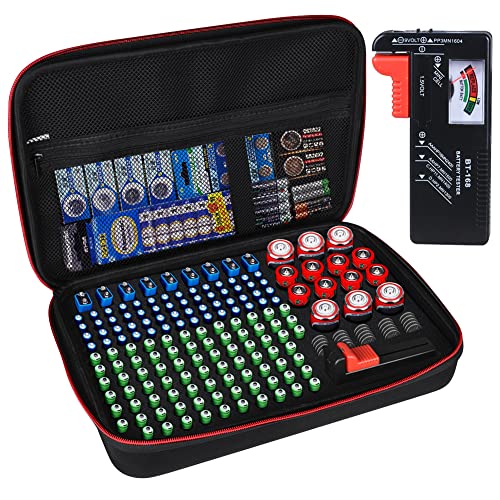
This hard organizer case takes a different approach from the lithium-specific bags above. It is a battery organizer storage box with a BT-168 battery checker included, described as a fireproof, waterproof, and explosionproof battery vault case, and it holds more than 200 batteries across common household sizes including AA, AAA, C, D, and 9V. Its slots also accommodate lithium cells such as 18650s as part of that broad organizer layout, which is how it earns a place in this guide: not as a specialist lithium pouch, but as the household-wide organizer whose flame-resistant shell also gives loose 18650 cells a defined, separated home.
That distinction matters, and we present it plainly. If your only problem is a set of lithium cells, a lithium-specific bag or box is the more focused tool. If your home has the usual sprawling mix of household batteries in kitchen drawers, remotes, toys, and flashlights, one rigid organizer that gathers everything into labeled, separated slots solves a wider problem at once. Every battery in its own slot means no loose cells touching, no mystery batteries rolling in a drawer, and a fast visual count of what the household actually holds.
The included BT-168 checker adds a practical habit to that organization. Before a cell goes back into storage or into a device, a quick check with the included checker helps you sort healthy cells from depleted ones, so the case does not slowly fill with dead batteries nobody can identify. For rechargeable cells, that sorting habit supports the partial-charge storage routine described earlier, because you can see which cells need attention before they are put away for a long stretch.
The rigid case format brings the usual hard-box advantages: crush protection that soft bags cannot offer, a latching lid, and a shape that stacks or slides onto a shelf neatly. The waterproof and flame-resistant exterior descriptions suit storage in utility rooms and garages where conditions are less gentle than a living room shelf, though lithium cells should still be kept away from heat and damp as a matter of basic care.
Choose this organizer if your battery problem is household-wide and you want one hard case, with a checker in the lid, to bring order to all of it, 18650 cells included. Choose one of the lithium-specific options instead if you want a container devoted solely to lithium storage near a charger.
ZOOPIP Lithium Battery Storage Organizer
The ZOOPIP Lithium Battery Storage Organizer is a large-capacity, fireproof lithium safe box listed at 13.5 by 9.8 by 10.4 inches, with dual handles and sortable placement, described as fireproof and explosion-proof and as safe for charging and storing. In this lineup it occupies the roomy middle ground between a soft pouch and a fully household-focused organizer: a lithium-dedicated container with enough internal volume and organization to manage a substantial collection in one place.
Sortable placement is the feature that will matter most day to day for 18650 owners. A large empty box invites the same rolling and mixing problems as a large empty bag, but internal organization lets you group cells by device, by charge state, or by age, and to keep a separate corner for cells awaiting recycling. That kind of sorting is how a collection stays inspectable. When every cell has a place, a damaged wrapper or a swollen case gets noticed during normal use instead of during an emergency.
The dual handles suit a container of this size. Two handles make moving a loaded box between a storage shelf and a charging area steadier and more deliberate, which matters for households that store cells in one room and charge in another.
ZOOPIP describes the box for both charging and storing, so owners who charge inside a container gain the internal room to lay a charger flat and route cables without crowding cells against it. The standard cautions from earlier in this guide still govern that use: non-flammable surface, clear surroundings, and an adult nearby while charging runs.
Choose the ZOOPIP organizer if you keep a large lithium collection, want internal sorting rather than a single open space, and expect to move the container between storage and charging spots. Its capacity is more than a handful of spare cells requires, but for the reader whose 18650 count keeps climbing with every new light or tool, it is sized for where the collection is heading, not just where it started.
JHSafer E-Bike Battery Safe Bag
The JHSafer bag is the specialist in this guide, and we present it in its correct role. It is an e-bike battery safe bag, listed at 19.3 by 5.1 by 7 inches, described as explosionproof and fireproof, made as a silicone coated fireproof storage bag, and supplied with two mesh bags and a reflective strip. That long, narrow shape is built around an e-bike pack, not around individual 18650 cells, and pretending otherwise would mislead readers.
So why does it belong in a guide about storing 18650 batteries? Because many 18650 owners arrived at loose cells through larger lithium gear, and an e-bike household often has both problems at once: individual cells for lights and accessories, and one large, expensive, high-capacity pack that needs its own containment. The JHSafer bag answers the second problem within the same fireproof storage approach, so a household can cover the big pack with a purpose-shaped bag while a pouch or box from this guide covers the loose cells.
The silicone coated construction follows the category pattern of a heat-resistant fabric with a protective surface, and the included mesh bags help organize smaller items inside the larger bag. The reflective strip adds visibility if the bag is stored near where bikes are kept and moved.
For a reader whose lithium storage is only loose 18650 cells, this bag is the wrong shape, and one of the five options above will fit better. For a reader with an e-bike pack stored in a hallway, garage, or apartment corner, a dedicated bag shaped for that pack is a more honest fit than forcing the pack into a general container, and it keeps the largest single lithium item in the home inside flame-resistant material rather than leaning against a wall.
Choose the JHSafer if a large e-bike or similar long pack is part of your lithium storage picture. Pair it with a right-sized cell container for your 18650s, and the whole collection, large and small, sits inside containment instead of only the convenient half of it.
A Quick Comparison of the Six Options
Stepping back, the six products divide neatly by format and by the size of the problem they solve. The two Zeee bags are one line in two sizes: the compact bag at 8.46 by 6.5 by 5.71 inches for small collections, and the large bag at 14.17 by 7.87 by 9.84 inches for bigger collections and larger packs. Choosing between them is purely a question of volume, and there is no wrong answer beyond buying a size that does not match your shelf.
The VLITEX XL and the ZOOPIP organizer are the two lithium-dedicated boxes. The VLITEX leans into its certified container positioning and engineered materials, suited to a fixed storage point for a substantial collection. The ZOOPIP, at 13.5 by 9.8 by 10.4 inches, leans into internal sorting and dual-handle portability, suited to a collection that moves between storage and charging areas. Both serve the owner whose lithium count has outgrown a pouch.
The hard organizer case with the BT-168 checker is the household generalist, holding more than 200 batteries across AA, AAA, C, D, and 9V sizes while also accommodating lithium cells in its layout, and adding the sorting help of an included checker. The JHSafer bag is the large-pack specialist, shaped at 19.3 by 5.1 by 7 inches for an e-bike battery, with two mesh bags and a reflective strip rounding out a cycling-focused design.
Readers who keep their charging gear organized alongside storage may also want a dependable bench charger for other battery types, and our comparison of best automatic battery chargers covers that side of the shelf. Likewise, if your charging corner is crowded with cables for phones and laptops, the picks in best 65 watt usb c chargers can help consolidate the non-lithium charging that shares the same surface.
The simplest way to decide is to name your actual problem in one sentence. A few loose cells point to the compact Zeee. A growing collection points to the large Zeee, the VLITEX, or the ZOOPIP. Every battery type in the house points to the hard organizer case. A large e-bike pack points to the JHSafer, usually alongside a cell-sized option.
Safety Rules That Matter More Than the Box
Inspect Every Cell Before It Goes In
Make inspection a reflex. Look at the wrapper for tears, nicks, and peeling, check the ends for dents or corrosion, and notice whether a cell feels warm when it should be at room temperature. Any cell that is swollen, damaged, leaking, or behaving strangely leaves the collection. Do not store it with healthy cells while you decide what to do, and do not charge it to see whether it recovers. Set it aside in its own non-conductive container and arrange proper recycling through a local battery collection point.
Keep Terminals Covered and Metal Away
Most loose-cell incidents begin with a terminal touching something conductive. Store cells in individual cases or slots where possible, keep the storage container free of coins, tools, and loose hardware, and never carry a bare 18650 in a pocket or bag compartment with keys. When you move cells, move them in the container or in individual cases, every time, without exceptions for short trips across the room.
Store Partly Charged, Cool, and Dry
For long-term storage, general lithium-ion guidance favors a partial charge over a full or empty cell, a location at ordinary room temperature, and protection from damp. Keep the container away from heaters, sunny windows, and vehicles that heat up in the sun. If cells will sit for months, check them occasionally, confirm none has swollen or leaked, and refresh the routine for any cell that has been forgotten in a device.
Charge With Attention
Charging deserves the same discipline whether it happens inside a fireproof bag or beside one. Use a charger appropriate for 18650 cells, place it on a non-flammable surface, keep the area around it clear, and remain nearby while charging runs. Remove cells when charging completes rather than leaving them sitting on a charger for days, let warm cells cool before they return to storage, and retire any charger that behaves erratically. A container contains problems; it does not supervise a charger for you.
Have a Simple Plan for a Cell That Fails
If a cell vents, smokes, or becomes suddenly hot, do not pick it up with bare hands and do not carry a burning container through the home. Move people away, and if a fire has started and it is safe to do so, follow the emergency guidance for your area, which for lithium fires generally means calling emergency services rather than improvising. The realistic role of a fireproof container is to slow an event down and limit its spread, buying time for people to act sensibly. Keeping the container closed, on a clear surface, and away from exits you may need is part of that plan.
Frequently Asked Questions
Does a fireproof bag make 18650 storage completely safe?
No, and any product or guide claiming otherwise should be distrusted. A fireproof bag or box adds containment and organization, which are meaningful improvements over loose storage in a drawer. It does not repair damaged cells, prevent every failure, or guarantee that a serious thermal runaway event stays inside forever. Treat the container as one layer alongside inspection, terminal protection, sensible charge levels, and proper disposal of suspect cells.
Can I store 18650 cells loose inside a large bag?
You can, but it is not the best use of the container. Cells left free inside a large space can roll, knock together, and mix with anything else placed in the bag. Individual plastic cell cases or an organizer layout keeps terminals protected and cells separated, and it makes the collection easier to inspect. The bag provides containment for the group; the individual cases provide order and terminal protection within it.
Should I charge cells inside the storage container?
Several products here are described for both charging and storing, so charging inside is a supported use for those models when it is done carefully. The charger should sit flat, cables should not be pinched by the closure, the container should rest on a non-flammable surface, and someone should stay nearby. Many owners prefer to charge on an open, clear surface and use the container for storage only. Either routine is reasonable; an unattended charger in a closed bag in an empty home is not.
How many 18650 cells fit in these containers?
Listings in this category are usually framed around lithium polymer packs or, for the hard organizer, around total household battery counts, so a single universal cell count would be misleading. Work from the internal dimensions given for each product and the length of an 18650 cell, and remember that cells in individual cases take more room than bare cells. When in doubt, size up within the same product line, as with the two Zeee bags, rather than forcing a small container to hold more than it comfortably can.
What should I do with a swollen or damaged 18650?
Stop using it, do not charge it, and do not store it with your good cells. Place it in its own non-conductive container, keep it away from heat and flammable material, and take it to a local battery recycling or hazardous waste collection point that accepts damaged lithium batteries. Never throw a damaged lithium cell into ordinary household trash, and never keep it in the main storage box while you postpone the trip.
Is a hard case better than a soft bag?
A hard case adds crush protection and individual slots, which suits large mixed collections and shelf storage. A soft bag is lighter, folds away, and often suits charging areas better. The better choice matches your collection, your space, and the routine you will actually follow.
Disclosure
This page may earn a commission through the Amazon Associates program when readers buy through links on the page, at no additional cost to the reader. That relationship does not decide which products appear here. The six products in this guide were selected through our research into manufacturer information and product listings, comparing stated size, format, materials, and intended use against the needs of people storing 18650 cells. No manufacturer provided sample products for this article, and no brand paid for placement or for a particular position in the order above. Where a listing makes a claim such as fireproof or explosionproof, this guide explains what that language generally means in this category rather than treating it as a guarantee, and readers should always follow the safety guidance supplied with their own batteries and chargers.
Check prices on Amazon
Live listings for the shortlist in this guide are pulled from Amazon below, so prices and availability are always current at the moment you look.

The Bottom Line
Storing 18650 batteries safely is mostly a matter of replacing a loose habit with a contained one. Pick the container that matches your real collection: the compact Zeee bag for a small set of cells, its larger Zeee sibling when volume grows, the VLITEX XL for a fixed and certified storage point, the hard organizer case when the whole household battery drawer needs order, the ZOOPIP organizer for a large sortable lithium collection, or the JHSafer bag when an e-bike pack is the biggest item to contain. Then do the unglamorous parts consistently: inspect cells, protect terminals, store them partly charged in a cool place, charge with attention, and remove damaged cells without delay. A good fireproof box makes that easier to sustain, and a sustained routine is what keeps a home safer.