Our Top Picks
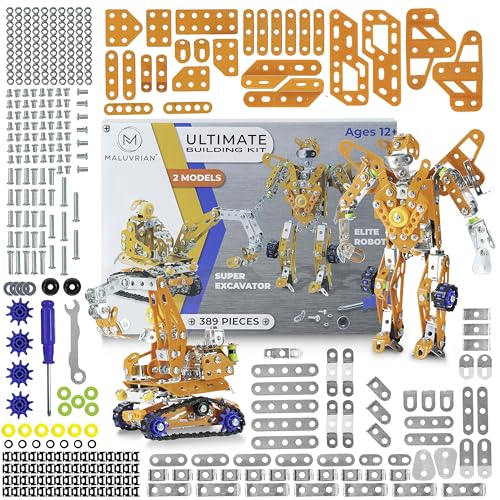
 Meccano Pro 11-in-1 Super Construction Metal Erector SetLarge4 x 16 x 13.88 inches7.17 poundsCheck on Amazon



What's inside
- Perforated strips and bolts versus plastic snap-together kits
- Realistic ages and the adult’s role in the first sessions
- Why the included tools decide whether a child continues
- Hole spacing, the standard underneath everything
- From static models to gears, cranks and motors
- Safety with metal edges, small parts and motor batteries
- Sorting and storing hundreds of small pieces
- Skills gained at each stage of building
- Start small, or buy the large set straight away?
- Choosing a set that fits your household
- Troubleshooting: the faults every builder meets
- Free building: leaving the plan book closed
- Keeping plans, instructions and spare paperwork
- Models that grow with a builder: a practical sequence
- When interest dips, and how to respond
- Check prices on Amazon
- A bench routine that makes every session easier
As an Amazon Associate I earn from qualifying purchases. This post may contain affiliate links at no extra cost to you.
As an Amazon Associate we earn from qualifying purchases. Metal engineering sets ask more of a child than almost any other construction toy, and they repay that effort differently too: a finished model has weight, its joints can be loosened and remade, and a wheel that wobbles points to a specific bolt, bracket, or alignment that a young builder can actually fix. For families tired of models that click together once and then live as ornaments, a box of perforated strips, plates, wheels, and fasteners offers a slower, more mechanical kind of satisfaction.
The classic form of this toy has changed remarkably little in over a century, because the underlying idea is strong. Flat metal strips and plates pierced with evenly spaced holes are joined with small bolts and nuts, angle brackets shape corners, axles pass through holes to carry wheels and gears, and a screwdriver and spanner do the work that moulded clips do in plastic systems. A child who learns this grammar can build a crane one month, a tractor the next, and something entirely unlisted by spring, using the same pieces in new arrangements.
That freedom comes with honest friction. Hundreds of small parts need sorting, plans need reading rather than glancing at, small fingers must learn to start a nut on a bolt without cross-threading it, and the first sessions go better with an adult building alongside rather than supervising from a distance. This guide explains how metal sets differ from plastic snap-together kits, what ages they genuinely suit, why the included tools matter so much, how hole spacing decides compatibility, and how a builder progresses from a static model to gears, cranks, and eventually a motor.
Perforated strips and bolts versus plastic snap-together kits
The deepest difference between the two families is reversibility with consequence. A plastic brick or snap kit connects in seconds and separates with a tug; a bolted joint takes longer to make, holds under real load, and can be adjusted by degrees. A young engineer can tighten a joint fully, discover that a wheel no longer turns because its axle is pinched, back the nut off a quarter turn, and feel the wheel free up. That small causal loop, tight, too tight, just right, teaches mechanical judgement that a fixed clip cannot, because the clip has only two states and the bolt has a whole range.
Metal pieces also behave differently under stress. A long perforated strip can flex slightly, a plate can serve as a genuine structural skin, and a triangulated frame built from strips feels rigid in the hands in a way that makes the principle of bracing tangible. Models can be heavier, which is part of their appeal and part of their demand: a crane that can actually lift a small load with a string and hook is a working machine, however modest, and children understand the distinction immediately.
Plastic systems keep real advantages, and naming them helps a family choose rather than drift. Snap kits are faster, kinder to younger children, quieter on hard floors, and often better at sculptural shapes, characters, and colour. A child whose pleasure is rapid invention, building five creatures in an afternoon, may find bolting slow. A child who lingers, who wants the lorry’s wheels to steer and the drawbridge to rise, is the natural metal builder. Many households end up with both, used on different days for different moods, and there is no contradiction in that.
Cost of entry and cost of mistakes differ as well. A lost plastic brick is an annoyance; a lost handful of nuts can stall a metal project entirely, which is why these sets teach workshop habits whether a family plans that lesson or not. Conversely, a bent metal strip can often be straightened carefully on a flat surface, while a cracked plastic connector is finished. Longevity favours metal in a particular way: the material tolerates being rebuilt for a decade, handed down, and rebuilt again, with fasteners replaced as consumables rather than the whole system retired.
Realistic ages and the adult’s role in the first sessions
Boxes in this category carry a wide spread of age guidance, and the realistic range depends less on intelligence than on three physical skills: the pinch strength to hold a small nut steady, the patience to repeat a fastening twenty times for one chassis, and the planning to keep parts for later steps from being consumed early. Many children around six or seven can complete the simplest models with an adult partner. From about eight, independent building of small and medium models becomes realistic for a child who enjoys the process. Larger sets with gears, many plates, and dense plans suit nine, ten, and beyond, and continue to challenge teenagers and adults who build alongside.
The adult’s job in the first two or three sessions is specific and temporary. Hold the strip steady while the child starts the nut. Demonstrate, once, how a spanner prevents the bolt from spinning while the screwdriver turns. Read the plan aloud as a sequence of decisions rather than commands, asking which piece must be found next. Then withdraw in stages: first to sorting parts for the next step, then to building a separate small part of the same model, and finally to being merely nearby. A child who is rescued from every fiddly joint learns to wait for rescue; a child left entirely alone with a frustrating first model may conclude, wrongly, that the whole hobby is beyond them.
Session length matters more than session frequency at the start. Forty focused minutes that end with a rolling chassis beat two hours that end in tears over a gearbox. Leaving a model mid-build is normal in this hobby, and a tray or shallow box that holds the work in progress, with its remaining parts corralled, makes stopping easy and resuming inviting. Adults who model that calm attitude to unfinished work give the child permission to treat a big project as a journey across several days, which is precisely how real engineering behaves.
Siblings of different ages can share the bench with a little structure. A younger child can sort fasteners by size, spin finished wheels, and build free-form towers from spare strips while the main project proceeds, provided small parts are managed with the safety rules covered later. An older child can be given the genuinely responsible job of checking a sub-assembly against the plan. Shared sessions work when everyone has real work; they unravel when a sibling is only allowed to watch.
Families often compare several big-ticket gifts in the same season, and the questions rhyme more than expected; a parent reading about best affordable laptops for children for schoolwork is weighing durability, repairability, and how long a purchase will stay useful, which are exactly the axes on which a good metal set scores well. The difference is that the engineering set’s usefulness grows with the child’s skill rather than shrinking as software moves on, so an honest judgement about current patience matters more than a guess about future needs.
Why the included tools decide whether a child continues
Ask adults who loved these sets as children what they remember, and the tools surface quickly: a small spanner that fit the hand, a screwdriver that did not cam out of every screw head, the particular patience of a nut held just so. Tools are not accessories in this hobby; they are the interface. A poorly made spanner with jaws slightly too wide rounds nuts, slips, and pinches fingers, and a child experiences that failure as personal clumsiness rather than bad equipment. Within a few sessions, a set with miserable tools becomes a set that is quietly avoided.
Judge the spanner first. It should grip the standard nut of the system firmly with minimal play, have smooth edges where small fingers press, and be long enough for leverage without being so long it twists small bolts apart. Some sets include a combined tool or a small wrench for each hand, which suits the classic technique of holding one side while turning the other. A screwdriver should match the bolt heads closely, with a handle a child can grip with the whole hand rather than fingertips; magnetic tips are a convenience, not a requirement, and a tip that fits deeply matters more.
Hex keys, small pliers, and nut drivers appear in larger or more modern sets, and each earns its place only if sized for the system’s own fasteners. A magnifying look at the plan, a parts tray, and a magnet dish for dropped nuts are not usually included, yet they transform a bench. Families can add them cheaply from household items: a shallow tray with a rim, a small ramekin for fasteners, and a sheet of plain paper under the work area so dropped pieces show up instead of vanishing into a carpet’s pattern.
Tool care is a first workshop lesson hiding in plain sight. Tools returned to the same corner of the box, wiped if they get sticky, and never used as levers for jobs they were not shaped for will serve for years. A child who learns to put the spanner down in its place rather than in the general pile has learned the habit that separates a workable bench from a frustrating one. When a tool is genuinely outgrown, a better spanner or a comfortable screwdriver makes an excellent small gift that upgrades every future model, which is more than can be said for most toy accessories.
Left-handed children deserve a specific check. Most bolting tasks are ambidextrous in principle, but a screwdriver handle shaped for one grip, a spanner that must approach from one side, or plans that assume a particular hand for a tight corner can add friction. Building at a clear table with room to approach the model from either side solves most of it. Rotating the model freely, rather than reaching around it, is good practice for every builder and should be taught early as a normal move rather than a concession.
Hole spacing, the standard underneath everything
Every traditional metal system is built on a grid: holes punched at regular intervals along strips and across plates, with that interval governing which pieces can join, how axles align, and whether gears mesh. In the long-established pattern, holes sit half an inch apart, a spacing inherited from the earliest sets and kept by many successors, which is why pieces separated by decades can still meet on the same model. When a family understands that the grid is the system, buying decisions clarify: extra pieces are valuable in proportion to how faithfully they honour the grid.
Compatibility between brands and generations is real but not automatic. Two sets may share hole spacing while using bolts of different thread, nuts of different size across the flats, or axle diameters that pass through the holes with different amounts of play. A wheel borrowed from one system may wobble on another’s axle; a gear may share spacing yet mesh poorly because its tooth profile differs. None of this prevents mixing, but it argues for mixing experimentally, with one borrowed component at a time, rather than merging two collections into a single unsorted box on the first day.
Plates deserve attention beyond their size. A flexible plate that bends gently around a curve serves a different purpose from a rigid flat plate that forms a lorry bed or a building’s wall, and both differ from triangular plates that brace corners. Holes near a plate’s edge take more stress and tear out first if a joint is overtightened, so plans usually keep fasteners a hole or two in from an edge. Teaching a child to notice that pattern builds an instinct for where structures are strong and where they are merely present.
Axles, collars, and bushings are the quiet heroes of the grid. An axle must be long enough to carry its wheels and gears with a collar or nut retaining each side, and straight enough that a wheel runs true. A slightly bent axle, rolled on a tabletop to check, will announce itself by making its wheel describe a small, maddening wobble. Straightening is an adult job; replacing is cheap if the system is current. Keeping axles sorted by length, like strips, prevents the common mid-build discovery that the only remaining axle is the one already holding the crane together.
When relatives ask what to add to a collection, the grid gives them a safe answer: strips in lengths the builder lacks, plates, angle brackets, wheels of a new diameter, and fasteners, all in the same system. A headset for a gaming sibling, found through guides such as best gaming headsets for children, is a finished object bought once; metal pieces are closer to ingredients, and the right gift is usually the staple ingredient the kitchen keeps running out of, not an exotic one-off part with a single use in a single model.
From static models to gears, cranks and motors
A sensible first project does almost nothing, and that is its virtue. A simple trolley, a small crane with a fixed jib, or a bridge between two stacks of books introduces strips, brackets, wheels, and a dozen fasteners without any mechanism to debug. The builder finishes, rolls the trolley, and owns the complete experience of plan, parts, assembly, and result in one sitting. Sets whose smallest model is already a complex vehicle with steering ask a beginner to learn every skill at once, and the failure that follows teaches nothing except avoidance.
The second stage adds one moving idea at a time. A crank that winds a string and lifts a load teaches that rotary motion can do work, and that the handle’s circle becomes the load’s straight climb. A pair of pulleys with a belt, often a simple band, shows speed changing between shafts. A windmill or a roundabout isolates rotation around a fixed axle. Each mechanism should be built, played with, and understood before it is buried inside a larger model, because a mechanism that misbehaves inside a finished tractor is far harder to diagnose than the same mechanism standing alone on the table.
Gears are the milestone most children anticipate, and they reward the wait. Two meshing gears trade speed for turning force in a ratio a child can count in teeth and verify by marking one tooth with a removable dot and counting turns. Getting a mesh right requires the grid to be respected: axles must sit at the distance the teeth demand, neither grinding nor slipping, and the frame holding them must be rigid enough not to flex apart under load. A builder who solves that has done real mechanical work, and the whirring result, driving a fan, a mixer, or a Ferris wheel, feels earned in a way a pre-assembled gearbox never does.
Steering, linkages, and cams belong to the next layer. A steering model teaches that turning the front wheels together requires a linkage that keeps them roughly parallel, and that a loose joint anywhere in the chain shows up as wander. A cam turning rotation into a nodding or hammering motion delights children who like automata, and it can be combined with strips and figures to make a small mechanical theatre. These projects justify larger sets, because they consume brackets, short strips, and patience in quantity.
A motor changes the builder’s role once more, from operator to designer. A small battery motor with a pulley or gear output can drive a previously hand-cranked model, and the conversion is an education: the frame must resist vibration, the gearing must suit the motor’s speed rather than a hand’s, and a switch must be placed where it can be reached when the model misbehaves. Motors should arrive after cranks in a child’s career, not instead of them, because a hand on a crank feels load, resistance, and jamming directly, and that feel is the intuition a motorised model is later tuned by.
Safety with metal edges, small parts and motor batteries
Metal edges are the first safety item to inspect, in the literal sense of running a careful adult thumb along strips and plates when a set is new and whenever a piece is bent or cut in an accident. Well-made pieces are deburred and smooth; a piece with a raised burr or a sharp corner from damage should be smoothed by an adult away from the child or retired. Builders should be taught to carry long strips vertically rather than waving them, and to keep faces back when a springy strip is being flexed into place, because a released strip can flick.
Small parts define who else can be in the room. Nuts, bolts, washers, and collars are exactly the size that toddlers explore with their mouths, so a metal set and a child under three are a combination that requires separation in space or time: building at a table the toddler cannot reach, storing the set in a latched box on a high shelf, and sweeping the floor area after each session for escapees. A magnetic pickup tool or a careful hand under good light helps, and the count-in, count-out habit for fasteners doubles as both safety practice and stock control.
Eye and finger sense develop with experience. A screwdriver that slips from a screw head travels somewhere, and the rule that the other hand never holds a piece directly in line with the blade prevents most small injuries. Pinches from spanners and from closing joints are the common minor harms of the hobby; they teach respect quickly, but an adult should still check that a frustrated child is not using force as a substitute for alignment. If a joint needs force, something is wrong: a crossed thread, a wrong hole, a bracket reversed. Stopping to find the error is the safe and the skilled response.
Motor power brings battery rules into the workshop. Battery boxes should be opened by an adult or by an older child following the household’s general rules, cells should never be mixed old with new or type with type, and a motor stalled under load should be switched off rather than left straining, since heat builds in small motors and battery packs alike. Any mains adapter belongs entirely to adults. Wires pinched in a frame or run across a gear will wear; routing them visibly along the structure, with slack at moving joints, is both safer and easier to inspect.
Storage safety overlaps with household safety. A heavy box of metal parts belongs low, where a child pulling it down is not bringing weight onto themselves from height, and never on top of a wardrobe or a wobbling shelf. Loose strips stored flat do not become spears in a tipped box. These are unglamorous arrangements, and they are the difference between a hobby that runs for years without incident and one remembered for a single bad afternoon.
Sorting and storing hundreds of small pieces
Every metal set eventually becomes a logistics problem. Two hundred fasteners, forty strips in six lengths, plates in several shapes, wheels, gears, brackets, axles, and a handful of odd pieces will, if stored as one heap, consume the first fifteen minutes of every session in searching. The solution is not an elaborate cabinet; it is a small number of consistent categories that match how building actually proceeds. Fasteners together, strips by length, plates together, wheels and gears together, axles with collars, and a miscellaneous corner for the genuinely singular.
Compartment boxes with adjustable dividers suit fasteners and small hardware well, provided the lid closes snugly enough that a tipped box does not remix everything. Strips and plates store happily in a shallow tray, a wide box, or even a set of labelled envelopes or zip pouches inside the main container, sorted by length so a builder can fan through them like files. Keeping one model’s worth of parts on a work tray during a build, separate from the main stock, prevents the common accident of the stock box being upended beside an almost-finished chassis.
Inventories sound joyless and save hobbies. A simple list on the box lid, updated when pieces are added or retired, tells a builder whether a planned model is possible before the bench is covered. Counting fasteners in and out for big projects reveals losses while they are still findable in sofa cushions and carpet edges. When a set is shared between siblings or moves between two homes, a photograph of the sorted trays at a moment when everything is present becomes the reference everyone can restore to without argument.
Cleaning is occasional and simple. Metal parts that have grown sticky from years of hands can be wiped, and fasteners can be dried thoroughly if they are ever washed, since trapped moisture invites rust on unprotected steel. A drop of household care on threads is an adult decision and rarely needed; more important is storing the set dry, away from bathroom humidity and garden sheds. Rust on one neglected strip spreads a general air of decay over a box, and children are less drawn to equipment that looks uncared for, a small psychology worth respecting.
Labelling serves the youngest builders most. A strip’s length can be identified by counting holes, and turning that count into the label on its compartment, for example by hole count rather than by an adult’s measurement, lets a child put things away correctly without help. Putting away is part of the hobby’s discipline, and a system a child can operate alone will actually be used, while a perfect system that needs an adult’s interpretation will be quietly abandoned by both parties within a month.
Skills gained at each stage of building
Reading a plan is the first and most transferable skill. A metal set’s instructions show an assembly from one or two angles, expect the builder to infer hidden fasteners, and often require counting holes to place a bracket exactly. A child who learns to orient a drawing, to check a sub-assembly against its picture from the same viewpoint, and to notice a discrepancy of one hole before twenty bolts depend on it, has learned a form of literacy that serves in furniture assembly, science diagrams, maps, and every technical subject that follows.
Symmetry arrives next, usually through error. A chassis with a bracket one hole out on the left will lean, bind, or refuse its wheels, and the diagnosis, comparing sides hole by hole, teaches a builder to use symmetry as a checking tool rather than an aesthetic preference. Many plans exploit symmetry deliberately, instructing the builder to make two identical sides, and the quiet satisfaction of two frames matching exactly is a genuine engineering pleasure that children recognise and seek again.
Transmission and ratio follow when gears and pulleys enter. Counting teeth, predicting which shaft will turn faster, and then verifying by hand gives number a physical meaning that pencil exercises rarely achieve. Friction becomes a concept with evidence: the axle that needs a washer to stop a wheel rubbing its frame, the belt that slips under load, the gear pair that runs sweetly only when the frame stops flexing. Vocabulary grows naturally around these events, because a child who has felt backlash, tension, and torque wants words for them.
Planning and decomposition are the mature skills, and they appear when a child stops following plans exclusively and starts designing. A self-designed model forces questions in a productive order: what must the frame hold, where will the axles sit, which parts of the stock does that consume, and what should be built first so later stages remain reachable with a screwdriver. Keeping a simple notebook of designs, even rough sketches with hole counts, turns one-off builds into a developing practice. It also gives a child something to show that survives the necessary dismantling of a model to recover its pieces.
Households that support several making hobbies at once find the skills cross-pollinate; a child who prints labels and diagrams for a parts inventory after a parent consults best printers for kids is applying the same organisational thinking the workshop taught, and a sibling projecting a plan at large scale, a scenario explored in guides like best projectors for kids, is solving the same problem of reading an image and transferring it to real parts. The metal set is often the source of the discipline, because its materials punish vagueness immediately and reward precision within the same minute.
Start small, or buy the large set straight away?
The case for starting small is about information. A modest set with a handful of achievable models reveals, within a few weeks, whether a particular child enjoys bolting for its own sake, tolerates plans, and returns to the bench voluntarily. If the answer is yes, every piece of the small set remains useful inside a larger system, so little is wasted. If the answer is no, the family has learned cheaply, and the small set can be passed on complete rather than lingering as a large, reproachful box.
The case for buying large immediately rests on a different frustration: running out. A keen builder in a small set hits ceilings quickly, unable to make two sides of a frame at once, lacking the second gear a design needs, or dismantling a loved model to free its strips for the next idea. For a child who already builds persistently with other materials, who has asked specifically for gears and mechanisms, or who will share the set with an older sibling, a mid-sized or large set can be the honest purchase, because the constraint it removes is the one that would actually bite.
A useful middle path is a medium foundation set plus a deliberate promise: one expansion, chosen by the builder after completing several models, targeted at whatever the stock lacks most. That promise teaches the builder to notice their own constraints, which is itself an engineering skill, and it gives relatives a clear future gift. Expansions should favour staples, strips, plates, brackets, wheels, gears in the system’s standard sizes, and fasteners, over a single elaborate accessory that only one model uses.
Second-hand sets complicate the choice in a mostly happy way. Vintage and used collections can offer large quantities of genuine pieces at modest cost, with two cautions: count the fasteners, because a set can look complete while lacking the nuts and bolts that make it buildable, and check for rust, bent strips, and non-standard pieces mixed in from other systems. A used set with a plan book missing can still serve a confident builder, while a beginner needs those plans, so match the purchase to the builder rather than to the bargain.
Whichever size is chosen, protect the first month. Keep sessions short and successful, store the set where the builder can reach it without an expedition, resist buying a motor or a complex accessory until hand-built models are rolling, and let at least one finished model stay assembled on a shelf for a while as evidence. Children return to hobbies that show them proof of their own competence, and a small metal tractor that they fastened together, wheel by wheel, is more persuasive than any encouragement an adult can phrase.
Choosing a set that fits your household
Look first at the plans, because the builder will live in them. Clear step drawings, parts shown at findable scale, and a progression from simple to ambitious models indicate a maker who understands children. Look next at the tools, for the reasons already given, and then at the piece mix: a healthy set is heavy on strips, brackets, plates, and fasteners, and lighter on single-purpose mouldings. A box whose contents are mostly one model’s body panels is a model kit wearing an engineering set’s clothing, and it will not support free building once that model is made.
Consider noise, space, and flooring with clear eyes. Metal building is a table hobby with a pleasant clink, unsuited to a bedroom floor shared with a sleeping baby and well suited to a kitchen table that is cleared before meals, which imposes a useful rhythm of tray, build, and pause. A builder needs elbow room, good light, and a surface where dropped nuts can be heard and found. Providing those conditions consistently does more for success than any upgrade in set size.
Finally, think about who the set is really for in the best sense. The strongest reason to choose metal over easier alternatives is that an adult in the house finds it genuinely appealing too, because shared enthusiasm carries a child through the fiddly early sessions and turns building into family time rather than solitary homework. A set that gathers a parent, a child, and eventually a sibling around one tray of strips and bolts, each with real work in hand, justifies its shelf, its sorting boxes, and its small demands many times over, and the models that roll off that table will carry the memory of those evenings in every tightened nut long after the builders have moved on to larger machines.
Troubleshooting: the faults every builder meets
A wheel that will not turn freely is the most common fault in a young builder’s workshop, and it has a short list of usual causes. The axle may be pinched between two nuts tightened against the frame, the wheel may rub a bracket because a washer is missing, the axle itself may be slightly bent, or the frame holes on either side may not be the matching pair, so the axle runs at a slant and binds. Working through that list in order, loosening before forcing, teaches a diagnostic habit that transfers to bicycles, furniture, and every machine the child will meet later.
A structure that twists or racks under its own weight is telling its builder about bracing. Four strips bolted into a rectangle will happily deform into a parallelogram; add one diagonal, or a plate across a corner, and the same rectangle becomes stubborn. Children grasp triangulation fastest when they can push a frame both ways with their own hands, first without the diagonal and then with it, and many will then start adding diagonals to everything for a week, which is a fine phase to indulge before judgement about elegance catches up.
Gears that grind, slip, or separate in use point to alignment and rigidity rather than to the gears themselves. Axles must be parallel, their spacing must suit the teeth, and the plates carrying the bearings must not flex apart when the crank is turned hard. A builder can test a gear pair alone, mounted on a single rigid plate, before installing it in a model, and that isolation step, testing a mechanism before trusting it inside a larger assembly, is professional practice learned at a kitchen table.
Threads cause their own quiet troubles. A nut that will not start is usually being offered at an angle, or the bolt’s first thread is damaged, or the two parts come from different systems with threads close enough to deceive and different enough to jam. The rule is absolute and worth stating to every beginner: a fastener that needs force to start is a fastener to stop, inspect, and restart. Cross-threaded joints feel wrong in a specific gritty way, and learning that feel early protects both the parts and the builder’s temper.
Keeping a short fault log in the design notebook sounds formal and proves surprisingly popular. A line or two about what wobbled, what caused it, and what fixed it turns frustration into evidence of progress, and rereading old entries before a new build prevents the same diagonal from being forgotten twice. Adults can contribute their own entries when a joint defeats them too, which keeps the log honest and the hierarchy flat.
Free building: leaving the plan book closed
Plans teach the grammar; free building is where a child starts speaking. The transition deserves encouragement and a little protection, because a first original design is usually wobblier, slower, and less handsome than the models built from instructions, and a careless comparison can send a builder back to the book for good. Praise the specific decision, the braced tower, the steering that almost works, rather than the finish, and let the model stand for a day before it is dismantled for parts.
Constraints help free building more than blank freedom does. Build something that carries a cup across the table, a bridge that spans the storage box and bears the heaviest toy vehicle, a machine that lifts a soft toy using a crank: each brief gives a test the builder can apply without asking an adult whether the result is good. Challenges shared between siblings or friends, with the same stock of parts and an agreed test, generate inventive differences that no plan book contains, and the judging is done by the bridge, the load, and the stopwatch of a counting chant rather than by taste.
Combining the metal system with household materials extends it further. Cardboard bodywork on a metal chassis, a paper sail on a wheeled land yacht, string, elastic bands, and wooden offcuts as loads or ramps all teach a builder to see the set as a framework for ideas rather than a closed world. The discipline is to keep additions removable, so the stock returns intact to its trays, and to keep anything wet, sticky, or rust-prone away from the metal.
Photographing free builds before dismantling them preserves the record that the parts cannot. A builder who can scroll back through a year of towers, cranes, and improbable vehicles sees their own development more clearly than any adult summary could show it, and a photograph often reveals, to the builder’s own eye, the wobble or asymmetry they will fix next time without a word from anyone else.
Keeping plans, instructions and spare paperwork
The plan book is part of the equipment and should be stored like it. A book that lives loose in the parts box will be torn by strips and stained by workshop life within a year; a book kept in a sleeve or a separate folder, brought to the bench only when needed, lasts the life of the set. Where a maker provides plans digitally, a printed copy of a favourite model, slipped into the same folder, saves a session when a screen is unavailable or unwelcome at the table.
Annotating plans is allowed and useful. A pencil tick at each completed step, a note that a particular joint was easier with a longer bolt, or a warning beside the step everyone in the family fumbled turns a generic book into this household’s workshop manual. When a set is eventually handed on, those notes are a gift to the next builder, evidence that the difficulties are normal and survivable.
Spare fasteners and the occasional replacement strip should be bought before they are urgently needed, because a build halted for a fortnight waiting for ten nuts loses momentum that a small envelope of spares in the box would have preserved. Keep that envelope labelled and in the fasteners tray, and replenish it when it is opened rather than when it is empty. Workshop continuity is mostly this: small preparations made calmly so that enthusiasm, when it arrives on a Saturday morning, is not spent on searching, waiting, or making do.
Models that grow with a builder: a practical sequence
A family unsure what the progression feels like in practice can picture a first year in broad strokes. The opening models are wheeled and simple: a trolley, a cart, a small lorry with a fixed bed. Then come models that lift: a crane with a hand-wound string, a well sweep, a drawbridge raised by a cord over a pulley. After lifting comes turning together: a roundabout, a windmill driving nothing but its own sails, a hand mixer whose beaters are really small plates spinning in a bowl. Each stage uses the previous stage’s confidence and adds exactly one new demand.
The second phase, whenever the builder is ready for it, is where vehicles gain behaviour. A tractor acquires steering, a car acquires a differential-like arrangement or at least rear wheels on a shared axle that can be compared with independent wheels, and a crane acquires a slewing base so its jib can swing without the whole machine being carried around the table. These are the builds that consume weekends in the best way, stall on a Friday evening, and are solved after breakfast on Saturday by a builder who slept on the problem, literally and mechanically.
Automata and fairground machines form a natural third phase for children drawn to movement for its own sake. A Ferris wheel with geared drive, a carousel with a crank hidden in its base, a nodding figure worked by a cam, or a marble run element driven by a wheel all combine structure, transmission, and presentation. They also invite decoration, paint-free and reversible: coloured plates chosen deliberately, paper flags, and figures borrowed from other toys riding a machine that actually turns.
Working models of real machines mark a fourth phase, and they benefit from reference material. A builder who studies how a beam engine, a tower crane, or a combine harvester is arranged, even in simplified pictures, learns to select the essential mechanisms and omit the rest, which is the core judgement of all model engineering. At this stage the plan book has become a parts catalogue and an idea bank rather than a teacher, and the notebook of original designs is the document the builder reaches for first.
When interest dips, and how to respond
Even keen builders cool on a set occasionally, and the pattern usually has a mechanical cause. A project left stalled for weeks because one joint will not align can poison the whole box by association. The remedy is decisive and kind: dismantle the stalled build together, sort its parts back into their trays, and start something small that will certainly roll by bedtime. Momentum in a workshop is a real quantity, and a small success restores it more reliably than encouragement alone.
A second common dip arrives when plans feel exhausted but free building has not yet caught fire. This is the moment for a challenge brief, a visit to see real machinery in action, or a themed build tied to something the child already loves: a vehicle for a favourite figure, a machine from a story, a bridge for an existing toy railway. Connecting the set to a living interest reopens it, while buying a larger set to solve a motivational dip usually only enlarges the box that sits unused.
A third dip is social. Building alone at a table while friends pursue faster games can make even a devoted builder drift, until a friend is invited to build in parallel, each with a tray and a brief, comparing results at the end. Two builders of similar level spur each other; a much stronger builder should be cast as a consultant with their own project, not as a rescuer, so the pleasure of solving stays with the person whose model it is.
If a genuine, settled indifference persists across a season, store the set complete and sorted rather than dispersing it. Metal systems keep indefinitely, younger siblings arrive at the right age on their own schedule, and the original builder sometimes returns at eleven or twelve with the patience for the motorised projects that were beyond them at eight. A set that was chosen for its grid, its tools, and its honest materials will be waiting, unchanged and entirely buildable, whenever that return happens, and the first model of the second era is often the crane that defeated everyone years before, finally standing steady with its load held high above the tray.
Check prices on Amazon
Live listings for the shortlist in this guide are pulled from Amazon below, so prices and availability are always current at the moment you look.
A bench routine that makes every session easier
Experienced young builders develop a ritual, and teaching its outline early saves a great deal of low-level frustration. Clear the table fully before opening the box. Lay a plain sheet or tray cloth so small parts stay visible. Choose the model and read its whole plan once before touching a piece, noting any step that looks tight or unfamiliar. Gather the parts for the first stage only, in a tray, and keep the main stock to one side. Build in stages, pausing after each to compare the work with the plan from the same angle the drawing uses.
During the build, keep the tools in one place and return them there after every use, lay fasteners in a shallow dish rather than on the table where elbows scatter them, and stop at the first sign that force is replacing thought. When a stage is finished, spin every wheel, turn every crank, and flex the frame gently before adding more, because a fault found at the stage where it was made takes a minute to fix and an hour to find later. Photograph unusual successes, note unusual failures, and dismantle in reverse order when the time comes, sorting as you go rather than sweeping everything into a single pile for a future self to resent.
End each session by leaving the bench ready for the next one: work in progress on its tray, tools in their corner, trays lidded, floor checked for escapees in good light. That closing discipline sounds adult, yet children adopt it readily when they feel its benefit at the start of the following session, when the model is exactly where memory left it and the first bolt of the day goes in within a minute of sitting down.
Given that routine, a good set, and time to grow, a child builder’s progress tends to look after itself, moving from borrowed plans to original machines at a pace no schedule could improve, until one ordinary afternoon the adult at the table realises they have become the assistant, holding a strip steady while the engineer in the family starts a nut, checks the drawing once, and turns the screwdriver with complete and justified confidence.
Years later, what remains is rarely a single model, since every model was built to be unbuilt. What remains is the habit of looking at a wobbling thing and asking which joint, which hole, and which quarter turn would steady it, and that habit, carried from a tray of strips into workshops, kitchens, bicycles, and machines not yet imagined, is the quiet inheritance a humble box of perforated metal hands to the child who once opened it.
So choose the box whose tools feel honest in the hand, whose grid has served builders for generations, and whose smallest model a young engineer can finish with pride before supper, then let the trays, the plans, and the patient rhythm of bolt, check, and turn do the teaching across the seasons that follow at your table.