Our Top Picks
 US Chess Quiver Tournament Chess Set Combination Triple20 x 20 inches20 x 20 x 0 inches3 poundsCheck on Amazon


What's inside
- What portable really means for a chess set
- The four main designs and how they behave
- Board size, square size, and king height
- Piece stability when the surface will not sit still
- Staunton shape and why it matters more when small
- Materials: wood, plastic, silicone, and metal
- Hinges, clasps, and magnets over time
- Taking a chess set on a plane
- Playing outdoors and in imperfect places
- Cleaning, storage, and small repairs
- Travel sets, tournament sets, and decorative sets are different tools
- Common buying mistakes and how to avoid them
- Choosing by the way you actually travel
- Reading a product page like an editor
- How long a good travel set should last
- Check prices on Amazon
- A short decision path before you buy
As an Amazon Associate I earn from qualifying purchases. This post may contain affiliate links at no extra cost to you.
This site is reader-supported, and purchases made through links on this page may bring us a commission on qualifying purchases, without adding anything to what you pay.
A portable chess set succeeds or fails on a train table, not on a product photograph. On a still desk almost any board looks tidy, with ranks aligned and pieces standing in neat rows. Add braking, vibration, a tilted tray, a gust across a park bench, or a hurried hand reaching for coffee, and the weaknesses appear quickly: a knight slides into an adjacent file, a pawn tips and rolls under a seat, a folding board pinches shut, or a lid opens inside a bag and scatters thirty-two pieces among cables and books. Choosing well therefore means looking past the folded dimensions printed on a box and asking how the set behaves while it is actually being carried, opened, played on, knocked, cleaned, and packed away again under time pressure.
The category also contains very different objects that happen to share a name. A pocket magnetic board for studying tactics in a waiting room, a roll-up vinyl mat for a club night, a peg-in travel set for a long coach journey, and a handsome folding wooden box for a holiday cottage all travel, yet they solve different problems. Treating them as interchangeable leads to the familiar disappointment of a set that is technically portable but unpleasant to use: squares too small to read at a glance, pieces so light they skate, or a board so bulky that it stays at home. This guide separates those designs, explains the measurements that matter, and shows how materials, hinges, magnets, and storage change the experience over months of regular use.
What portable really means for a chess set
Portability has three parts that are often confused. The first is carried size: the length, width, and thickness of the closed board or rolled mat, plus the weight of pieces and any case. The second is deployed size: the playing surface once opened, because a set can fold impressively small yet unfold into a board too cramped for comfortable play. The third is security in transit: whether every piece stays accounted for and undamaged between games. A set that wins on the first measure and loses on the other two is not genuinely portable; it is merely small.
Weight deserves a more careful look than a single number on a listing. A solid wooden folding board feels reassuring in the hand and resists sliding on a table, but that same mass becomes noticeable at the bottom of a daypack after a long walk between stations. A thin plastic or silicone board weighs little and shrugs off rain, yet it may need a book underneath to sit flat. Neither answer is universally better. The right balance depends on whether the set travels daily in a commuter bag, occasionally in checked luggage, or mainly from a car boot to a picnic table a few metres away.
Think, too, about how quickly the set can be brought into play. Some players want a board that opens, empties from an internal compartment, and is ready before an opponent has settled. Others are happy to unroll a mat, flatten its corners, and arrange loose pieces from a drawstring pouch. Setup time matters in short windows: a twenty-minute break, a delayed flight, or a lunchtime game that must end promptly. Sets with captured storage inside the board usually win on speed, while roll-up designs often win on board size for a given carried weight.
The four main designs and how they behave
Magnetic folding boards
The magnetic set is the design most people picture first. Pieces carry a small magnet in the base, the board contains a ferrous layer beneath the squares, and the whole board folds in half, often with the pieces stored inside the closed box. The attraction is obvious: a nudge that would topple an ordinary pawn merely shifts a magnetic one, and a tilted board does not immediately become a landslide. On trains and in cars, where the playing surface rarely stays level and still, that grip changes the character of a game, allowing players to relax instead of guarding every piece between moves.
Magnetic strength, however, is a spectrum rather than a yes-or-no feature. Weak magnets provide little more than a suggestion of hold; pieces still drift when the board is lifted by one corner. Very strong magnets create a different annoyance, because pieces resist being slid and instead need to be lifted and placed, and neighbouring pieces can snap together when a hand moves quickly. The most usable sets sit between those extremes, holding a piece firmly enough to survive vibration while still allowing a deliberate slide across one or two squares. Listings rarely quantify pull force, so descriptions that promise extreme strength should be read as a warning as much as a benefit.
The internal layout matters as much as the attraction itself. Better folding boards give each piece a shaped recess, a foam insert, or at least a divided compartment, so pieces do not rattle, chip, or wedge against the hinge. Loose storage inside a shallow box can be worse than a separate pouch, because hard pieces strike each other on every journey. Felt or flocked interiors quiet that movement and protect finishes, though they also collect dust and are harder to clean after a spillage.
Peg-in travel sets
Peg sets take a mechanical approach: each piece ends in a small peg, and each square has a corresponding hole. A piece stays where it is put because it is physically socketed, not because of friction or magnetism. For genuinely rough travel — a bus on an unmade road, a boat, a shared table that gets knocked repeatedly — this is the most secure arrangement of all. Games can be paused, the board tilted into a bag with care, and the position preserved in a way no magnetic board can reliably match.
The trade-offs are tactile and visual. Inserting and removing pegs slows every move slightly, and captures involve pulling one piece free while seating another, which interrupts the flowing slide many players enjoy. Holes interrupt the surface of the squares and can make a position marginally harder to read, especially on the smallest boards where each hole occupies a noticeable share of its square. Pegs also wear: a loose peg wobbles and eventually loses its advantage, while an overly tight one strains the hole and can split thin plastic or lift the printed surface around the rim. Peg sets reward patient players and puzzle solvers who set up a position and study it, and they suit correspondence-style play over several sittings better than fast blitz between friends.
Roll-up silicone and vinyl boards
Roll-up boards separate the surface from the pieces entirely. The mat, printed with a full-size grid, rolls or folds into a tube, and the pieces travel in a pouch, a small box, or a compartment in a bag. Because the board itself has almost no structure, it can offer the largest playing area for the least carried bulk, which is why roll-up mats dominate club and school chess. A teacher can carry several mats and a bag of plastic pieces into a classroom more easily than the same number of wooden boards.
Material decides how pleasant that simplicity feels. Vinyl mats are inexpensive in construction, wipe clean, and lie reasonably flat after a short rest, though older vinyl can retain a curl at the edges and develop a persistent sheen under bright light that makes dark squares harder to distinguish. Silicone mats are heavier and more flexible, grip the table, resist curling, and tolerate being folded rather than rolled, but they attract dust and hair and can feel slightly tacky under sliding pieces. Both materials forgive rain, spilled drinks, and muddy ground in a way wood never will, and both can be used on uneven surfaces if a firm layer sits underneath.
The weakness of any roll-up set is the pieces, which gain no stability from the mat. Light hollow plastic pieces topple at a touch and slide on a sloped table, so roll-up boards pair best with weighted or broad-based pieces and with calm, level playing conditions. Outdoors, a gust that leaves a magnetic board untouched can clear a roll-up board in a second. Players who love the format often accept that bargain because the board size is generous and replacement pieces are easy to find in matching Staunton shapes.
Folding wooden boxes and wallet boards
A folding wooden box is the traditional travel set: two halves joined by hinges, inlaid or printed squares on the upper surface, and a lined cavity below that holds the pieces when closed. At its best it is an object people enjoy owning, with the weight, grain, and click of a brass clasp giving the start of a game a small ceremony. At its worst it is a decorative box with a chessboard attached, where the squares are uneven, the contrast between light and dark is poor, and the pieces are turned to shapes that look elegant in a photograph and confuse in a real game.
At the opposite extreme of size, wallet and pocket boards flatten the game almost to a card. Thin magnetic sheets, press-stud pieces, or flat tokens representing each piece allow a position to be carried in a coat pocket or notebook. These are analysis tools more than playing sets: they excel at recording a position from a book, working through a puzzle on a flight, or holding a correspondence position between sessions. Expecting a satisfying two-player game from tokens the size of coins asks too much of the format, and most owners use them alongside, rather than instead of, a fuller set.
Board size, square size, and king height
Three measurements explain most of the difference between a set that feels generous and one that feels like a toy. The first is the side length of the board in play. The second is the width of a single square, which follows from the first once borders are subtracted. The third is the height of the king, traditionally the tallest piece and the reference point for the proportions of the whole set. Quoted board dimensions in listings frequently describe the closed box rather than the open playing surface, or include a wide decorative border, so the playing area can be considerably smaller than the headline figure suggests. Dividing the true playing width by eight gives the square size, and that single number predicts comfort more reliably than any marketing label.
A useful rule from established chess equipment practice is that the base of the king should occupy roughly three quarters to four fifths of a square. Much wider, and pieces crowd each other, collide during captures, and hide the squares beneath them; much narrower, and pieces look lost, tip more readily, and become fiddly to grasp. When a listing gives king height but not base diameter, height alone can mislead, because a tall, slender king and a shorter, broader one play very differently. Staunton proportions keep those relationships predictable, which is one reason the pattern has endured.
For analysis and slow games, larger squares repay their bulk. Players can rest a finger beside a piece, slide variations across the board, and read a crowded middlegame without leaning in. Boards in the middle of the portable range, with squares around the width of two adult fingers, handle most casual games comfortably and still fold into a bag. Below that, every reduction is felt first in the centre of the board, where knights, bishops, and pawns cluster and where a misread square changes a result. Very small sets remain valuable for solo study, where only one person is reaching in and the position changes slowly, but they punish fast two-player games.
There is also a difference between a board that is large enough and a board that is large enough for the way a particular player sees. Strong contrast between light and dark squares, a matte finish that does not reflect ceiling lights, and coordinates printed along the edges all reduce the effort of reading a position. Coordinates are especially helpful for learners recording moves, for players returning to a paused game, and for anyone reconstructing a position from notation after a piece has been knocked. A plain border looks cleaner; a labelled border works harder.
Piece stability when the surface will not sit still
Stability comes from four sources that combine differently in each design: base width, centre of gravity, friction or magnetic hold, and the flatness of the surface underneath. A broad base with weight low down resists tipping. A tall piece on a narrow foot, however handsome, acts like a lever waiting for a nudge. Felt on the base softens contact and protects the board, but on a glossy surface felt can also reduce friction and let a piece glide further once it starts moving. Rubberised or bare textured bases grip better on smooth tables and mark delicate wood less than might be expected, provided they are kept clean.
Vehicle vibration is a distinct test from a single knock. A sharp jolt topples; a constant tremor migrates. Under steady vibration, light pieces creep a fraction at a time, usually toward the edge or toward each other, until a pawn that began on its own square is touching a neighbour and the position becomes ambiguous. Magnets counter migration better than weight alone because the hold acts continuously. Pegs eliminate it entirely. For unmagnetised sets, a shallow lip around the board, a silicone mat underneath, and a level surface matter more than any property of the pieces themselves.
Players who expect to play in cars or on trains should also consider how a game is paused. A magnetic folding board can often be closed slowly with the position intact if the pieces are short enough not to foul the opposite half, though closing a board mid-game is a skill that improves with practice and should never be assumed from a listing photograph. Peg boards preserve positions most faithfully. Roll-up sets preserve nothing once rolled, so a phone photograph of the position before packing away is the practical safeguard, and taking one should become part of the routine rather than an afterthought.
Anyone who regularly carries a laptop alongside a chess set will recognise the same packing logic that shapes choices among best backpacks for travel anti theft laptop university — a rigid object with hard corners needs a sleeve, a divider, or a dedicated pocket if it is not to wear through linings and press against screens during a crowded commute.
Staunton shape and why it matters more when small
The Staunton pattern, registered in the nineteenth century and now the universal language of chess pieces, is not a matter of nostalgia. Its silhouettes are engineered for recognition at a glance: the king’s crown and cross, the queen’s coronet, the bishop’s mitre cut, the knight carved as a horse’s head, the rook as a crenellated tower, and the pawn as a simple ball on a collar. In a fast game, players identify pieces by outline from above and from across the board, often in poor light. Decorative sets that replace those outlines with soldiers, animals, historical figures, or abstract sculptures force players to relearn the cast, and mistakes follow — a bishop mistaken for a pawn in a cramped corner is not a charming quirk but a lost game.
Shrinking a set tests the pattern further. Fine detail disappears first: the knight’s muzzle, the cut in the bishop, and the points of the queen’s coronet become blunt at small scales, and cheap moulding can leave two pieces nearly indistinguishable. Well-made small sets simplify boldly rather than miniaturising every detail, keeping the knight’s head unmistakable and the bishop’s cut deep. When comparing photographs on a product page, look at the knight and bishop at actual size rather than enlarged; those two pieces reveal the quality of the whole mould or carving.
Colour contrast between the two armies deserves the same scrutiny. Natural boxwood against stained dark wood is classic and usually clear, but some travel sets pair pale pieces with mid-brown pieces whose tones converge under warm evening light. Black and white plastic reads clearly in almost any light, at the cost of a less tactile feel. For outdoor play in bright sun, very glossy pale pieces can glare, while matte finishes stay readable. Players with reduced vision often benefit more from strong piece contrast and large squares than from any other single feature.
Materials: wood, plastic, silicone, and metal
Wood remains the material players describe with the most affection, and the reasons are practical as well as aesthetic. A wooden piece has a density that settles satisfyingly onto a square, a surface that warms in the hand, and a repairability that plastic lacks: a small chip can be sanded, a felt base replaced, a finish renewed. Sheesham, boxwood, acacia, and maple appear frequently in travel sets, in combinations of a pale wood against a stained partner. The vulnerabilities are moisture and impact. A wooden board left against a damp tent wall can warp, a hinge-side veneer can lift, and a dropped king can lose the tip of its cross. Travel in wet climates argues for a sealed finish and a case rather than bare wood in a bag.
Plastic covers the widest quality range of any material in the category. At the bottom are hollow, feather-light pieces with visible mould lines, bases that are not quite flat, and magnets glued unevenly so that a piece rocks. At the top are solid, weighted, matte-finished pieces with clean moulding, recessed magnets, and felted bases that would not embarrass a club board. The word plastic on a listing therefore says almost nothing by itself; weight per set, base diameter, and finish say much more. Plastic’s advantages are real: it tolerates drops, ignores rain, cleans with soap, and can be replaced piece by piece when a pawn inevitably disappears under a railway seat.
Silicone appears mainly in boards rather than pieces, and in a few novelty piece sets. As a board it is nearly indestructible in a bag, immune to water, and quiet on hard tables. As pieces it is divisive, because the soft grip that prevents sliding also prevents the crisp placement many players like, and dust clings to it. Metal travel sets, usually small and magnetic, trade playing comfort for durability and a jewel-like feel; they suit a desk drawer or a gift more than a daily game, since cold, heavy, tiny pieces tire the fingers during long sessions. Whichever material is chosen, consistency helps: pieces from one production run share weight and finish, while mixing spare pieces from different sets often produces a board where one knight feels noticeably different from the other, a small irritation that grows with familiarity.
Hinges, clasps, and magnets over time
A folding board is opened and closed far more often than it is admired, so its moving parts decide its lifespan. Small brass hinges screwed into end grain can loosen as the wood around them compresses, leaving the two halves slightly out of plane; the board then rocks, and the centre squares form a shallow ridge that catches sliding pieces. Piano-style continuous hinges spread the load and keep halves aligned longer, though they add weight and can pinch if poorly fitted. Some modern boards replace metal hinges with a flexible spine of leather, fabric, or moulded polymer, which removes the ridge entirely and lets the board lie flatter, at the cost of a less rigid open surface that needs support underneath.
The alignment of the two halves deserves a close look on any folding set. When closed halves are misaligned, edges knock and finishes wear; when open halves sit unevenly, a visible step runs down the centre files. A step of even a fraction can stop a sliding queen and tilt a tall king. Listings seldom mention this, but photographs taken straight down the centre line of an open board can reveal it, as can reviews that mention rocking. A board that rocks on a flat table at home will only behave worse on the uneven surfaces travel provides.
Clasps and closures fail in quieter ways. A weak clasp opens in a bag; a magnetic closure can be pulled apart by the weight of the pieces themselves if the board is carried vertically; an elastic strap stretches and loses its hold within a season. The most reliable closures combine a positive mechanical catch with an outer sleeve or case, so that even if the catch releases, the pieces remain contained. Losing a full set of pieces inside luggage is rarely catastrophic, but reassembling them from among clothes and chargers, and discovering one pawn missing, is the kind of small disaster that makes owners stop carrying the set at all.
Magnets age differently from hinges. The magnets themselves, usually ferrite or neodymium sealed in the base, lose strength very slowly under normal conditions, but the assembly around them can fail sooner: glue softens in a hot car, a base cap cracks after a drop, and a magnet shifts or falls out entirely, leaving one piece that behaves differently from its fellows. Heat is the main enemy, since prolonged high temperatures can weaken common magnet grades and degrade adhesives at the same time. A set left on a dashboard or in a sun-baked boot through a summer will show it first in the pieces that start to wander. Checking each piece’s hold occasionally, and re-gluing a loose base early, prevents the slow decline that players otherwise blame on the board.
Storage hardware ages alongside the board itself, much as the drives people pack for a trip are judged less by headline capacity than by whether connectors and cases survive repeated packing, a parallel familiar to anyone who has compared best hard drives for travel before trusting one with the only copy of a journey’s photographs.
Taking a chess set on a plane
Chess sets are, in general, uncomplicated air travellers. Pieces of wood or plastic, a folding board, and small embedded magnets pass through cabin baggage screening without special treatment in most jurisdictions, and magnets of the size used in travel sets are far below anything that troubles navigation equipment. The practical issues are mundane rather than regulatory. A set carried in hand luggage should be packed where it can be reached without unpacking the whole bag, because the point of carrying it is to use it during the wait and the flight. A set in checked luggage should be padded, since baggage handling drops are harder than anything a commuter bag delivers, and wooden corners chip accordingly.
Playing in the air imposes its own constraints. Tray tables are narrow, slightly sloped, and shared with drinks that the crew will deliver whether a game is in progress or not. A board that fits the tray with margin to spare, pieces with magnetic hold, and a playing style that keeps captured pieces in a case rather than loose on the tray all reduce risk. Turbulence rarely ruins a magnetic game outright, but it does end unmagnetised ones, and a piece that falls in an aircraft cabin tends to roll several rows away. Window light also changes through a flight, so a board with strong square contrast stays readable when the cabin dims.
Long-haul routines reward a set that supports solo play as well as a shared game. Many travellers spend more time with puzzles, endgame studies, and recorded games than with an opponent, because a seatmate may not play. A board with coordinates, pieces that stay put when the tray is bumped by a passing trolley, and a size that allows a book or tablet to sit alongside all suit that solitary use. In that setting a peg or magnetic analysis set can be more valuable than a larger social board, even for a player who would choose the larger board at home.
Playing outdoors and in imperfect places
Outdoor chess introduces wind, uneven ground, glare, and grit, each of which attacks a different part of a set. Wind threatens light pieces and loose captured pieces; a magnetic board or a sheltered table solves most of it, while a roll-up mat on a breezy terrace is an exercise in vigilance. Uneven ground — a warped picnic table, grass, sand — undermines rigid boards, which rock on three contact points, and favours silicone mats that conform, provided the pieces have bases broad enough to stand on a surface that is not perfectly level. A folded towel or a jacket under a board is an old and effective levelling device, and experienced outdoor players carry one without thinking of it as equipment.
Glare is the quietest problem. Glossy boards and pale pieces under midday sun can wash out the difference between squares until players are squinting at the position rather than thinking about it. Matte finishes, mid-tone boards, and a seat chosen with the sun behind the players rather than behind the board all help. Grit is the most damaging: sand on a board acts as an abrasive under every sliding piece, scratching finishes and wearing printed squares, so outdoor sets should be brushed down before pieces are moved and shaken out before they are packed. A plastic or silicone set shrugs off a beach afternoon; a polished wooden set records it permanently.
Rain deserves a plain rule. If there is a real chance of getting wet, take the set that water cannot harm. Silicone and plastic boards can be rinsed and dried; wooden boards should be dried slowly, away from direct heat, and never closed while damp, because trapped moisture lifts veneers and encourages mould on felt linings. Pieces stored damp in a closed box will smell of it for months. A few minutes of drying at the end of a game is the cheapest maintenance a wooden set will ever receive.
Cleaning, storage, and small repairs
Chess sets accumulate the evidence of their travels: coffee rings on a border, sunscreen on pale pieces, dust in the carving of a knight, and a faint stickiness on a vinyl mat that has lived in a warm bag. Cleaning methods follow the material. Wooden pieces want a dry or barely damp cloth and nothing stronger; soaking swells joints and dulls finishes, and household sprays can soften the glue holding felt bases. Plastic pieces tolerate warm soapy water and benefit from it, since skin oils build up on frequently handled pawns and make them slippery. Silicone mats can be washed and air-dried, though they emerge from any bag having collected lint that needs a rinse rather than a wipe.
Boards need gentler handling than pieces because their surfaces carry the printed or inlaid grid. A printed board that is scrubbed will eventually lose its squares at the centre, where traffic is heaviest. A soft brush for dust, a cloth for spills while they are still wet, and prompt attention to anything sugary will keep most boards serviceable for years. Felt bases that have peeled can be replaced with self-adhesive felt cut to size, a five-minute repair that also restores a piece’s quiet landing. Loose magnets can be re-seated with a drop of suitable adhesive, taking care to orient the pole consistently with the rest of the set, because a single reversed magnet will repel the board’s attraction pattern and behave oddly among its neighbours.
Storage at home matters more than storage in transit for wooden sets. A board kept in a dry room at a steady temperature, out of direct sun, will hold its shape and colour; the same board stored in a loft through seasonal extremes may warp or crack along the hinge line. Keeping the pieces inside the board is convenient and protects them, but a crowded cavity where pieces press against each other can rub finishes at the contact points, so shaped inserts or a soft cloth between layers earns its place. For plastic and silicone sets, the main storage rule is separation from heat and from heavy objects that can take a set into a mat or bend a thin board permanently.
Travel sets, tournament sets, and decorative sets are different tools
Confusion between categories causes many disappointing purchases, because a set can be excellent in one role and wrong in another. A tournament set follows the conventions of organised play: a full-size board with generous squares, Staunton pieces of regulation proportions with the king notably taller than any travel king, weighted bases for decisive placement, and usually a clock and notation alongside. It is portable only in the sense that players carry it in a dedicated bag to a venue where it will sit on a proper table. Judging a travel set against tournament dimensions will always make the travel set look inadequate, and judging a tournament set by travel standards makes it look absurdly bulky; they answer different questions.
A decorative set answers a third question: how the game looks when nobody is playing it. Themed pieces, glass boards, marble squares, and sculptural designs serve a room first and a game second. Some are perfectly playable and give their owners real pleasure, but many sacrifice silhouette clarity, square contrast, and piece stability to appearance. The honest test is whether a player who did not set up the position can identify every piece from across the board in ordinary light. If not, the set is furniture that references chess, and it should be bought with that understanding rather than with expectations of regular play.
Between those poles sits the serious travel set: Staunton in outline, moderate in size, secure in transit, and durable enough for daily use. Players who travel to tournaments often own one of these as a companion to their full-size equipment, using it for analysis in hotels and games in transit while reserving the large set for the playing hall. Players who only ever play casually may find that a good travel set is simply their set, full stop, because a board that is always within reach gets used more than a grander board that lives in a cupboard. Frequency of play is a quality of its own, and portability is what produces it.
The same habit of matching equipment to the journey rather than to a catalogue photograph guides photographers choosing among best 4k cameras travel, where the camera that survives the trip in a jacket pocket often returns with more pictures than a larger body left behind in a hotel room.
Common buying mistakes and how to avoid them
The most frequent mistake is buying by closed dimensions alone. A board advertised by its folded size sounds conveniently compact until it opens to reveal squares better suited to counters than to chess pieces, or until the pieces stored inside turn out to be so small that adult fingers knock two at a time. Whenever a listing gives only one dimension, treat the missing ones as a deliberate omission and look for the square size or king height elsewhere on the product page before deciding.
A second mistake is trusting the word magnetic without asking how the pieces are stored. Magnets solve stability on the board and do nothing for security off it. A magnetic set whose pieces rattle loose in a smooth box will arrive at each destination as a jumble, with finishes wearing at every journey. Internal divisions, foam, or a separate pouch are not accessories; they are half of what makes the set work. Similarly, a set with a beautiful exterior and a plain hollow interior has spent its budget where it shows rather than where it functions.
Overvaluing piece count novelties is a third trap. Extra queens for pawn promotion are genuinely useful and worth having, since promotions to a second queen do occur and improvising with an inverted rook confuses everyone. Beyond that, bundled extras — a draughts side, dice, cards, a second game printed on the reverse — often signal a general-purpose games box rather than a considered chess set, and the chess components usually bear the compromise. A plain set that does one game well will outlast a compendium that does several games indifferently.
Finally, many buyers ignore their own hands. Hand size, dexterity, eyesight, and patience are specifications too. A player with large hands or reduced grip strength will struggle with pieces designed for a pocket board, and no amount of clever magnet engineering changes the geometry of picking up a pawn between two neighbours. Players buying for children face the reverse problem: pieces sized for adults on a board a child cannot reach across. The most reliable pre-purchase check is unglamorous — compare the square size and king height with a set already known to feel right, and let that comparison overrule attractive photography.
Choosing by the way you actually travel
Daily commuters need containment above all: a slim folding magnetic board with captured storage, a positive clasp, and a case that tolerates being dropped into a bag among keys and bottles. Weight matters, but thickness matters more, because a thin board rides against books and laptops without distorting the bag. Commuters also benefit from pieces that can be set up and cleared in under a minute, since the playing window is usually a platform wait or a lunch break rather than an afternoon.
Frequent flyers should weigh durability and tray fit. A mid-size magnetic set with strong square contrast, coordinates for solo study, and pieces short enough to fold away mid-position covers most airborne needs. Those who check luggage and play at the destination can afford a larger wooden box, protected in the centre of a suitcase, and will enjoy the better board every evening of the trip. Photographers in the same packing position make a comparable call when weighing best 1 inch sensor travel zoom cameras against smaller compacts, trading a little carried convenience for a noticeably better result once they arrive.
Families travelling together need robustness and replaceability. Plastic pieces, a wipeable board, spare pawns, and a size that lets small hands participate without constant adult rescue will produce more games than a treasured wooden set that adults protect from the children it was bought to entertain. A roll-up mat with a bag of sturdy pieces is often the family optimum: it spreads across a holiday table, survives juice, and packs into a corner of a car. Couples who play a long game across a whole trip, a few moves each evening, should look instead at peg or magnetic sets that hold a position safely between sessions.
Students and club players moving between venues value board size and speed. A roll-up board with proper squares and a set of weighted plastic Staunton pieces remains the working standard for good reason: it is the largest, clearest game that can be carried under one arm. Adding a slim magnetic analysis board for the bus ride completes a kit that covers both the destination and the journey, and the two together still weigh less than a single large wooden board.
Reading a product page like an editor
Retail listings for travel chess sets use a vocabulary that rewards translation. Solid wood may describe only the frame, with the playing surface a printed veneer over composite board; that construction can be perfectly serviceable, but it should be priced and judged as what it is. Handmade may mean hand-finished, hand-assembled, or merely handled. Weighted may mean a metal slug in the base of the king alone or in every piece. Felted may describe a full base pad or a thin ring. None of these phrases is necessarily deceptive, yet each leaves room that photographs and specifications should fill. Where a listing provides the weight of the complete set, the height and base of the king, the size of a square, and a photograph of the interior storage, a buyer can judge the set on evidence; where it offers only lifestyle images and adjectives, caution is the rational response.
Photographs deserve the same scepticism as text. Images taken from directly above hide piece height and base width; images with a hand in frame give scale, and a hand that dwarfs the king tells a buyer more than a paragraph. Pictures of the closed board show thickness and clasp design. If every photograph shows the set empty and open on a pristine table, the storage, the hinge, and the closed profile — the three things travel actually tests — have been kept out of view, and that absence is itself information.
Reviews from other buyers are most useful when read for recurring physical details rather than for enthusiasm. Repeated mentions of pieces arriving chipped point to loose internal storage. Several notes that a board does not lie flat point to hinge alignment. A pattern of praise for appearance alongside silence about playability suggests a set bought as a gift and seldom used. Individual complaints can reflect individual mishandling, but the same observation from many owners, phrased in different words, is the closest thing a buyer has to a long-term durability report before committing.
How long a good travel set should last
Durability in this category is rarely about a single dramatic breakage. Sets decline by accumulation: a hinge gains play, a clasp loses its snap, two pieces lose their felt, a printed square fades where thumbs land, a magnet works loose, a corner is crushed in luggage. Each fault is minor and each makes the set slightly less pleasant, until one day the owner reaches for a phone application instead. Buying with that slow decline in mind shifts attention from first impressions to replaceable and repairable details. Felt can be renewed, clasps can sometimes be tightened, and a board with standard Staunton pieces can accept a replacement pawn that matches closely enough; a board built around a unique themed cast cannot, and the loss of one irreplaceable piece retires the whole set.
Construction clues predict that trajectory reasonably well. Screws that enter solid material hold longer than screws in thin composite edges. A playing surface inlaid or printed under a protective finish outlasts a surface printed on top of one. Piece bases that are capped or sealed keep magnets and weights in place through knocks that would open a hollow base. Storage that separates pieces prevents the slow chipping that loose transport guarantees. None of these features photographs dramatically, which is precisely why they separate sets built for years of travel from sets built for the moment of unboxing.
Owners can extend any set’s life with habits that cost nothing. Closing a folding board empty rather than forcing it over tall pieces protects hinges. Carrying the board flat, or against a rigid object, prevents the flexing that loosens joints. Keeping a set out of hot vehicles preserves magnets, glues, and finishes together. Shaking grit from a board before sliding pieces prevents scratches that no later care can remove. Wiping spills immediately, drying thoroughly before closing, and storing the set dry are the whole of wooden board maintenance, and they are enough.
Check prices on Amazon
Live listings for the shortlist in this guide are pulled from Amazon below, so prices and availability are always current at the moment you look.

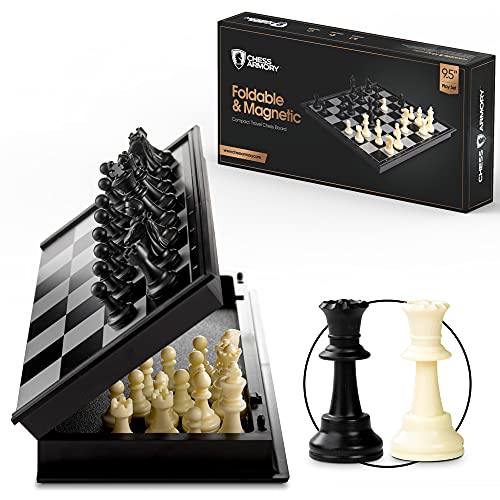
Travel Chess Set, 10 inch Magnetic Chess Board with 2 Extra Queen Portable Folding Board Chess Games for Kids, Adults



A short decision path before you buy
Start with the surface the set will meet most often. If that surface moves, tilts, or vibrates, narrow the field to magnetic and peg designs and let other virtues compete within that boundary. If the surface is a stable table and the journey is the only challenge, roll-up boards and folding boxes re-enter the picture with their larger squares and simpler construction. Next, fix a minimum square size based on who will play: children, players with larger hands, and anyone who enjoys fast games should hold out for the generous end of the portable range, while solo analysts can accept smaller boards without regret.
Then examine storage as if it were the product itself, because in transit it is. Pieces should be captured, separated, or at least contained in a way that survives the bag being dropped. After storage, look at the knight and the bishop in photographs for silhouette clarity, check the contrast between the two armies and between the squares, and confirm the king’s height and base against the square size. Finally, decide which material matches the climate and the company the set will keep: wood for care and pleasure, plastic for punishment and sharing, silicone for water and grit.
Resist the urge to solve every scenario with one purchase. A traveller who plays daily on a train and monthly at a cottage may genuinely be better served by a slim magnetic board for the commute and a larger folding box that lives at the destination than by a compromise that is slightly wrong in both places. Sets are small, relatively simple objects, and owning two modest ones matched to their settings often produces more and better games than owning one elaborate one matched to neither.
Above all, judge a portable set by the games it will actually host: the delayed-train puzzle, the holiday-table rematch, the lunchtime game finished with seconds to spare. A board that is present for those moments, that opens flat, holds its pieces, reads clearly, and packs away without a search for a missing pawn has done everything the category promises. Choose the set you will still be slipping into your bag, without a second thought, on the grey Tuesday morning of the fiftieth trip rather than the bright first one.
One last consideration belongs to the opponent rather than the owner. A travel set is usually shared, and its quality is partly measured by how a stranger or a grandparent or a child experiences it across the board: whether they can tell the pieces apart from the far side, whether the board sits steady when they reach, whether captured pieces have somewhere sensible to wait. Sets bought only from the owner’s side of the table sometimes fail that courtesy test, with glare on the far files or pieces whose fronts and backs differ confusingly. Turning the board around, literally or in imagination, before buying is a small discipline that prevents it. When both players forget the equipment entirely and argue only about the position, the set has quietly succeeded, and that forgetfulness — two people leaning over thirty-two pieces in a draughty station café, wholly absorbed — is the real destination every portable board is travelling toward.
A note on buying for someone else closes the practical advice. Gift buyers should favour clarity over cleverness: a Staunton travel set of honest size, with storage that keeps its pieces together and a board whose squares read clearly in lamplight, will be used by almost any player, while an ingenious novelty set depends entirely on the recipient sharing the giver’s taste. Including a small notebook for recording games costs almost nothing and quietly raises the set’s value, turning casual encounters into a running match with a history. Wrapped well and chosen plainly, a good travel board is among the few gifts that invite the giver to sit down opposite it immediately — and the first game, played on the floor among the wrapping paper while the kettle boils, tends to be remembered long after the occasion itself has blurred.