Our Top Picks


What's inside
- Why a matched set solves problems that separate rings create
- Reading the geometry: contour, shank, and stack height
- Gold alloys explained: karat, colour, and what changes in daily wear
- Platinum, palladium, and the weight question
- Centre stones compared on physics, not folklore
- Certification, paperwork, and how to read a grading report
- Setting styles and what each one asks of you
- Sizing honestly: knuckles, seasons, and the resizing limits nobody advertises
- Buying online without guessing: listings, returns, and warranty language
- Matching the set to a life, not just a hand
- Care, cleaning, and inspection rhythms that keep stones secure
- Common mistakes, read as a checklist before you commit
- Where the money actually goes inside a set
- Check prices on Amazon
- Putting the decision together
As an Amazon Associate I earn from qualifying purchases. This post may contain affiliate links at no extra cost to you.
Full disclosure before the details: this guide is supported by its readers, and when a purchase follows one of the links here, a small commission may come back to the site while the price paid stays exactly the same.
Why a matched set solves problems that separate rings create
A bridal set pairs an engagement ring with a wedding band designed from the same drawing board, so the two pieces share a profile, a shank width, and a plan for how they meet on the finger. That coordination sounds cosmetic until you wear two unrelated rings together for a week. A solitaire with a low basket can collide with a straight band, leaving a visible wedge of skin between them. Prongs catch on the neighbouring edge, stones rub against metal, and the pair twists independently until the centre stone sits off axis. A matched set removes most of that friction at the design stage rather than asking a jeweller to fix it afterwards.
Contour is the first advantage worth understanding. Many engagement rings place the centre stone in a raised head that widens near the top of the shank. A straight wedding band cannot sit flush against that widening, so designers curve the companion band around it, notch it, or mirror its silhouette in reverse. When the curve is cut for that exact head shape, the two rings nest together with no gap, which also keeps them from rocking against each other during ordinary hand movement. Less rocking means less abrasion on prongs and less wear where the metals touch.
Profile height matters just as much as outline. If the engagement ring lifts its stone high above the finger while the band carries small stones in a low channel, the taller piece dominates and snags more easily, while the shorter piece can disappear visually beside it. Sets coordinate those heights deliberately. Designers decide how far the centre stone should rise, how thick the band should feel, and how the shoulders taper, so the finished stack reads as one considered object instead of two purchases that happen to share a finger.
Buying together also settles metal matching early. Two rings described with the same colour name can still differ noticeably when alloys, plating, and finishing methods come from different workshops. A set produced as a pair uses the same alloy batch logic and the same polishing approach, so the tone stays consistent as both pieces age. That consistency becomes harder to achieve when a band is ordered months later from a different seller, especially with white gold, where the rhodium finish strongly influences what the eye sees.
There is a practical budgeting benefit, though it has nothing to do with chasing a discount. Planning both rings at once forces honest decisions about where money matters most: centre stone size, metal durability, band stone coverage, or warranty protection. Couples who buy the engagement ring in isolation sometimes discover later that the band they imagined requires custom work to fit, turning a straightforward second purchase into a fabrication project. A set makes the total commitment visible from the start, including resizing, maintenance, and insurance considerations.
None of this means separate purchases are a mistake. A plain band chosen later can suit someone who wants contrast, plans to wear the band alone at work, or inherits a family ring that deserves its own companion. The point is narrower: when a flush fit, aligned styling, and predictable daily comfort are priorities, a set designed as a unit answers questions that two independent rings leave open. Understanding that distinction helps you judge product pages by geometry rather than by photography alone.
Reading the geometry: contour, shank, and stack height
Start with the shank, the part of the ring that circles the finger. Shanks vary in width, thickness, and cross-section, and those small differences change both comfort and durability. A very thin shank can feel elegant and make a centre stone look larger by contrast, yet it also carries less metal to resist bending and may need more frequent inspection at the sizing area. A wider shank distributes pressure, resists distortion, and gives engravers or stone setters more material to work with, although it can feel substantial on a smaller hand.
Cross-section shapes carry their own trade-offs. A flat interior presents a crisp modern edge and can feel secure, while a rounded interior, often called comfort fit, slides over the knuckle more gently and reduces the pinched feeling some people notice by late afternoon when fingers swell slightly. Neither shape is universally better. Hands that swell in heat, during exercise, or across a long workday often appreciate the rounded interior, whereas someone who prefers a ring that stays put may like the firmer contact of a flatter profile.
Look next at how the shoulders rise toward the stone. Cathedral shoulders sweep upward in an arc that supports the head and creates a graceful side view, but that architecture adds height and can complicate band matching unless the companion band follows the same sweep. Tapered shoulders narrow as they approach the centre, drawing attention inward and lightening the feel on the finger. Split shanks divide into two strands before reaching the head, opening negative space that looks airy yet introduces more junctions to inspect for looseness over time.
The gallery, the open structure beneath the centre stone, deserves attention on any listing photograph that shows a side view. A generous gallery admits light beneath the stone and makes cleaning easier, because a soft brush can reach areas where lotion and soap residue collect. A closed or very low gallery can sit closer to the finger and feel sturdier, though trapped moisture and debris may dull the stone faster between cleanings. Product images taken only from above hide this entirely, so side and angled views are more informative than a single glamorous top shot.
Stack height is the combined measurement that decides how the pair behaves under gloves, inside pockets, and against door handles. Add the engagement ring height to the band thickness and consider the total against your daily routine. Someone who wears fitted work gloves, lifts equipment, or works with their hands in tight spaces will notice every extra fraction of height. A lower combined profile slides under gloves more cleanly and catches less often, even if it gives up some of the dramatic lift that makes a centre stone appear to float.
Finally, examine how the two rings meet along their full circumference, not just near the stones. Some sets align beautifully at the top but leave the lower halves mismatched in width, so the stack feels uneven when you grip a steering wheel or a rail. Photographs rarely show the bottom of the shank, which is also where resizing work and the greatest wear usually occur. Listings that include a full rotation view or clear specifications for width and thickness give you more to judge than those relying on a single styled image.
Gold alloys explained: karat, colour, and what changes in daily wear
Pure gold is too soft for a ring expected to survive decades of contact with hard surfaces, so jewellers alloy it with other metals that add strength and adjust colour. Karat numbers describe the proportion of pure gold in that mixture. An 18-karat alloy contains more pure gold and tends to feel richer in colour and slightly heavier, while a 14-karat alloy contains a larger share of strengthening metals and generally resists scratching and bending better in active use. That difference is one of degree rather than quality, and the right choice depends on routine, sensitivity, and how the colour reads against your skin.
Yellow gold remains the most forgiving colour for long-term appearance because its tone runs through the metal itself. Surface scratches blend into the warm colour, and polishing restores the finish without any plating step. Its alloys typically combine gold with copper and silver in varying proportions, which is why two yellow rings of the same karat can still lean slightly warmer or paler depending on the maker. When a set is produced together, that subtle variation stops being a concern because both pieces share the same recipe.
White gold achieves its pale colour through alloying with white metals and, in most commercial jewellery, a thin rhodium plating that gives a bright, almost mirror-like finish. Underneath that plating the metal itself is a softer off-white, so as the plating wears at the bottom of the shank and around prong tips, a faint warmth can show through. Replating restores the original brightness and is a routine maintenance item rather than a defect, but buyers should expect it periodically and ask how the seller handles that service after purchase.
Nickel sensitivity is the other white gold consideration that listings sometimes bury. Many white gold alloys use nickel as a whitening and hardening agent, and a portion of wearers react to prolonged nickel contact with itching or redness. Rhodium plating acts as a barrier while it lasts, yet worn plating can expose sensitive skin again. Palladium-based white gold alloys avoid nickel and keep a naturally greyer white tone, usually at higher material cost. If you have reacted to costume jewellery or watch backs before, raise the alloy question before ordering rather than after the rings arrive.
Rose gold takes its blush from copper in the alloy, and that copper content also makes it comparatively hard and resistant to everyday scuffs. Its colour deepens or softens with the karat and the exact copper share, so a 14-karat rose piece can look noticeably pinker than an 18-karat version from another maker. Rose gold needs no plating, ages to a slightly deeper patina that many wearers like, and pairs convincingly with both warm and neutral wardrobes, though matching a later addition from a different source can again prove tricky.
Mixed-metal sets complicate and enrich these choices at the same time. A white gold head on a yellow gold shank keeps the centre stone in a pale setting that minimises colour reflection into the stone, while the band retains the warmth the wearer prefers. Two-tone bands can echo that contrast so the stack feels intentional. The maintenance picture follows the most demanding element, which usually means white gold plating care even when most of the set is yellow or rose. Ask which parts are plated and which are solid colour before assuming upkeep will be simple.
Platinum, palladium, and the weight question
Platinum earns its reputation through density and behaviour under wear rather than through marketing language. It is noticeably heavier on the finger than a gold ring of the same dimensions, which some wearers experience as reassuring substance and others as fatigue by the end of a long day. When platinum scratches, the metal tends to displace rather than flake away, developing a soft patina that can be polished back to brightness. Prongs in platinum are prized because the metal holds stones securely and resists thinning at the tips, a meaningful advantage for a centre stone carried high.
That security comes with practical costs beyond the purchase itself. Platinum work requires higher temperatures and specialised skill, so resizing, retipping, and repairs can take longer and may need a bench jeweller equipped for the metal. Not every local shop works in platinum confidently, which matters if you expect to rely on nearby servicing rather than shipping the rings away. Before choosing platinum, confirm who will maintain it and how warranty work is routed, because a generous policy is less useful when every adjustment becomes a long postal journey.
Palladium sits in the same family of metals and shares the naturally white colour that needs no plating, while weighing considerably less than platinum. That lighter feel suits wearers who like the white-metal look without the heft, and its hypoallergenic character helps those avoiding nickel alloys. Palladium is less common in bridal lines, so style selection narrows, and fewer jewellers stock experience with it. Availability of matching bands, future resizing, and repair expertise should all be checked in advance rather than assumed from the metal’s technical merits.
Weight also interacts with balance. A top-heavy engagement ring with a substantial stone and a light shank tends to spin on the finger, especially when hands are cold and the fit loosens slightly. A denser metal or a slightly wider shank can counter that rotation by adding grip and lowering the centre of gravity of the piece. Sets help here because the companion band adds stabilising contact beside the engagement ring, reducing the slow drift that leaves the centre stone resting against the neighbouring finger by midday.
Consider climate and occupation alongside metal romance. Hands exposed to frequent washing, sanitiser, gym equipment, or workshop tools will test any alloy, but softer high-karat gold will show that life sooner than platinum or a lower-karat gold. Cooks, clinicians, climbers, and tradespeople often remove rings for safety or hygiene, and a set that comes off daily needs a considered storage habit as much as a hard metal. A small ring dish in a consistent place, or a silicone substitute for work hours, protects the fine set more reliably than any alloy choice alone.
Longevity claims deserve a calm reading. Every metal used in bridal jewellery can last for decades with sensible care, and every one of them can be damaged by a hard knock at the wrong angle, a prong caught on a car door, or years without inspection. The meaningful differences are maintenance rhythm, repair access, weight on the hand, colour stability, and allergy profile. Choosing by those concrete factors, rather than by prestige ranking, leads to a set you will still be comfortable wearing when the novelty of the purchase has long faded.
Centre stones compared on physics, not folklore
Natural diamond, lab-grown diamond, and moissanite are often discussed as if they were interchangeable versions of the same material at different prices. Physically, they are not. Diamond, whether mined or grown in a laboratory, is crystallised carbon with a hardness of ten on the Mohs scale, strong resistance to scratching, and a particular way of splitting white light into spectral flashes as it moves. Lab-grown stones share that crystal structure and those optical properties because they are diamond in composition, produced through high-pressure or chemical vapour deposition methods rather than geological formation.
Moissanite is silicon carbide, a different material entirely, with hardness just below diamond and noticeably higher dispersion. That higher dispersion produces broader, rainbow-like flashes that some wearers love for their liveliness and others find too colourful under strong indoor lighting. Moissanite also shows double refraction when viewed at certain angles through the crown, a property trained eyes use to distinguish it, though at normal viewing distance most observers simply register a bright white stone with generous fire. Neither impression is wrong; they are different optical personalities.
Durability differences show up at edges and points more than on flat surfaces. All three stones resist everyday scratching well, but a sharp blow can chip any gem at a girdle edge or a pointed corner, particularly in marquise, pear, and princess silhouettes where geometry concentrates stress. Settings that protect vulnerable points with V-shaped prongs or partial bezels reduce that risk. Hardness also says nothing about toughness, a distinction product pages rarely explain. A stone can be extremely hard and still fracture from impact, which is why protective setting design matters as much as material choice.
Colour and clarity grading apply most consistently to diamonds. Natural and lab-grown diamonds are graded for colour on a scale from colourless toward visibly warm, and for clarity according to inclusions visible under magnification. Those grades influence appearance in specific ways: colour shows most readily in larger stones and in white metal settings that provide no warm contrast, while many inclusions graded in the middle ranges remain invisible to the unaided eye once the stone is mounted. Paying for grades beyond what the eye can register is a personal decision, but it should be a decision rather than a default driven by a listing headline.
Moissanite follows its own grading conventions, usually described in colour ranges rather than the diamond scale, and reputable sellers state those ranges plainly. Because moissanite is manufactured, inclusions tend to differ in character from diamond inclusions, and large stones can show a slight warmth or grey cast under some lighting depending on production quality. If you are considering a larger moissanite centre, pay attention to how the seller describes colour behaviour and returns, because the stone that looks brilliant in a studio video may read differently beside a window on an overcast day.
Environmental and origin claims deserve the same scepticism applied to any product category. Lab-grown production uses significant energy, mining operations vary widely in practice, and moissanite manufacturing has its own footprint. Sellers who make sweeping ethical claims without documentation are offering marketing, not information. If origin matters to you, look for specific, verifiable disclosures about production location, energy sources, and supply chain auditing, and accept that no option is impact-free. The honest comparison weighs documented practices rather than slogans printed beside a stone option dropdown.
Certification, paperwork, and how to read a grading report
A grading report from an established laboratory gives you an independent description of a diamond’s proportions, colour, clarity, and carat weight. Reports associated with organisations such as the GIA and IGI are widely used, and the useful habit is reading what the document actually records instead of treating its presence as a badge. Check that the report number corresponds to the stone offered, that the measurements match the listing, and that the report date and laboratory are stated clearly enough to verify through the laboratory’s own lookup service where one is offered.
Cut quality deserves more attention than it often receives, because proportions govern how efficiently a round brilliant returns light to the eye. A stone with excellent symmetry and well-judged angles can look lively at a modest size, while a poorly proportioned stone of greater weight can appear dull or show dark areas under the table. Fancy shapes are graded differently and rely more on visual assessment, since elongated outlines introduce effects such as the dark bow-tie area that can appear across the middle of oval, marquise, and pear cuts. Photographs and rotating video under neutral lighting reveal more about fancy shapes than any single grade label.
Fluorescence, polish, and symmetry lines on a report are worth a slow read rather than a glance. Strong fluorescence occasionally gives a diamond a hazy appearance in daylight, though many stones with fluorescence show no visible effect at all. Polish and symmetry influence sparkle at the margins and indicate the care taken in finishing. None of these entries should be judged in isolation; they combine with proportions and the setting’s openness to produce the stone you actually see. When a listing highlights only carat weight and a colour letter, it is selecting the numbers that sell rather than the ones that describe.
For lab-grown diamonds, reports also identify the growth method and state plainly that the stone was created in a laboratory. That disclosure should appear in the listing itself, not only in paperwork delivered after purchase. Moissanite typically arrives with a warranty document from its manufacturer rather than a full grading report, covering the stone against clouding or colour change under normal wear. Read what that warranty excludes, how a claim is made, and whether it transfers if the ring is given as a gift, because the recipient is the person who will actually need it.
Appraisals and insurance paperwork serve a different purpose from grading reports. An appraisal assigns a replacement value for insurance scheduling, and it should list the metal, stone characteristics, and identifying details clearly enough that a replacement could match the original closely. Many insurers require an appraisal above certain value thresholds and updated values periodically. Keep digital copies of the grading report, appraisal, and purchase receipt together, stored separately from the rings themselves, so a loss does not also erase the documentation needed to make a claim.
Beware of in-house certificates that borrow the visual language of independent laboratories. A seller-issued document can still be useful as a specification sheet, but it is not an independent assessment, and its grades may run generous compared with stricter laboratories. When comparing two similar sets from different sellers, align the comparison on independently graded stones where possible, or accept that house grades introduce uncertainty and weigh return policies more heavily. A clear returns process is the buyer’s protection when paperwork cannot fully settle a question in advance.
Setting styles and what each one asks of you
The solitaire remains the reference design: a single centre stone held by prongs, with nothing competing for attention. Four prongs leave more of the stone visible and create a squarer impression around a round stone, while six prongs add security and a rounder outline at the cost of more metal over the girdle. Prong shape matters too. Pointed claw prongs look refined and catch less fabric, rounded prongs feel sturdier and more traditional, and flat tab prongs suit certain geometric cuts. Every prong style needs periodic inspection, because a single lifted prong is the most common route to a lost stone.
Halo settings surround the centre with a ring of small stones, increasing the apparent size of the centrepiece and adding sparkle from every angle. That visual generosity brings maintenance obligations: many small stones mean many small seats, each capable of loosening, and the halo’s edge can trap lotion and debris beneath its rim. Hidden halos place the circle of stones under the centre instead, visible mainly from the side, offering detail without widening the top view. Either version pairs best with a companion band designed for its outline, since the halo often extends beyond the shank width that a straight band expects.
Pavé bands set small stones closely along the shank in tiny beads of metal, producing a continuous line of light that makes the whole ring shimmer. The trade-off is structural. Stone seats remove metal from the shank, and extensive pavé can limit resizing options because loosening or tightening the ring disturbs the seats along the bottom. Many jewellers leave a plain sizing bar at the back of a pavé shank for exactly this reason. If a listing shows stones running fully around the band, ask how resizing is handled before assuming a simple size exchange covers every scenario.
Three-stone settings place a centre stone between two side stones, traditionally symbolising a timeline but practically offering a wider spread of sparkle across the finger. Side stones can match the centre material or introduce contrast, and their angle determines whether the trio sits as a smooth arc or as three distinct peaks. Proportion is the design skill here: side stones that are too large compete with the centre, while undersized companions can look like an afterthought. Because three-stone heads are wide, the matching band question returns again, and sets designed together usually handle the junction more gracefully.
Bezel and partial bezel settings wrap the stone in a rim of metal instead of prongs. A full bezel offers the smoothest profile, excellent security, and a modern outline that slides under gloves and resists snagging better than any prong arrangement. The rim covers the girdle edge and slightly reduces the visible diameter, and a closed bezel back can limit light entry and complicate cleaning. Partial bezels and tension-style designs open the sides for light and drama, though tension settings rely on precise engineering and should only come from makers who explain their servicing requirements clearly.
Channel and flush settings suit the band side of the set. Channel-set stones sit between two metal walls with no prongs to catch, giving a clean line that tolerates daily contact well, while flush-set stones sit level with the band surface for the lowest possible profile. Both styles protect stones effectively and appeal to wearers who want sparkle without height. Their limitation appears at repair time: replacing a stone in a channel requires skilled work, and resizing a channel band is more involved than resizing a plain one. Those are acceptable costs when understood in advance and unwelcome surprises when discovered later.
Sizing honestly: knuckles, seasons, and the resizing limits nobody advertises
Finger size is not a fixed number. The same finger measures differently in the morning and evening, in winter and summer, before and after exercise, and during pregnancy or medication changes that affect fluid retention. A reliable measurement happens when your hands are at a normal temperature and at the time of day when rings will usually be worn. Measuring cold fingers straight after coming indoors in winter produces a size that will feel tight for much of the year, while measuring after a long hot walk can produce a fit that spins freely in cooler months.
The knuckle complicates everything. Many people have knuckles noticeably wider than the base of the finger, so a ring must be large enough to pass the joint yet snug enough not to rotate once seated. Sizing beads, small interior bumps added by a jeweller, and spring inserts are established solutions that help a ring clear the knuckle and then settle securely. A set worn together also fits differently from a single ring, because two bands side by side occupy more of the finger’s length and feel tighter than either piece alone, an effect sometimes called stack pressure.
Because of stack pressure, couples are often advised to consider a slight size adjustment when both rings will be worn daily, especially with wider bands. The exact adjustment depends on total stack width, interior profile, and personal preference for a firm or relaxed fit. Comfort-fit interiors feel looser at a given size than flat interiors, which is another reason specifications matter. When ordering a set online, read whether the seller sizes each piece independently or accounts for the pair, and use any sizing kit the seller provides rather than a printable paper guide, which printing scales frequently distort.
Resizing has physical limits that product pages tend to mention only in fine print. Plain bands in gold or platinum can usually move up or down modestly without visible consequence. Rings with stones along most of the shank, intricate engraving, tension settings, or alternative metals may not resize at all, or may require the maker to rebuild the piece. Changing size by a large amount alters the shank’s roundness and the tension on stone seats, so jewellers decline large changes for sound mechanical reasons. Ordering the correct size initially is not pedantry; it protects the structure of the ring.
If your size sits between standard increments, ask about quarter sizes rather than accepting a compromise that will annoy you daily. Also consider which hand and finger the set is for with unusual honesty about future changes. Rings are among the few purchases expected to fit the same body measurement for decades, through weight changes, injuries, and ageing joints. Choosing a design that permits future adjustment, with a plain section of shank preserved for sizing, is a quiet form of practicality that rarely appears in marketing photographs but matters enormously in year ten.
When a set arrives, test the fit across several days and activities before removing any tags or protective films that affect returns. Wear the pair through a warm afternoon, a cool morning, typing, driving, and washing hands, noting when the stack feels tight, loose, or sharp anywhere. Check whether the rings separate and twist or stay aligned as designed. Readers comparing photography gear for a wedding day through guides such as best cameras wedding photography will recognise the same principle: specifications only become meaningful once they meet real conditions, and the trial period is when honest evaluation is cheapest.
Buying online without guessing: listings, returns, and warranty language
Online listings compress a three-dimensional object into photographs and a specification table, so the buyer’s skill lies in knowing which details to demand. Look for stated shank width and thickness, total height, stone measurements in millimetres rather than carat weight alone, metal alloy and karat, and whether accent stones are natural, lab-grown, or another material entirely. Millimetre measurements are especially useful because carat weight distributes differently across cuts; two stones of equal weight can face up with noticeably different diameters depending on depth and proportions.
Photographs should include a side profile, an underside view, the pair worn together, and the pair separated. A hand photograph gives scale, although hand sizes vary enough that measurements remain more reliable. Be cautious with renderings presented as photographs, which some sellers use for made-to-order pieces. Renderings show the design intent accurately but hide finishing quality, prong thickness, and the small asymmetries that separate careful bench work from rushed production. If every image looks digitally perfect, ask whether photographs of a finished example are available.
Return terms decide how much risk an online purchase really carries. Read the return window in days, whether the clock starts at dispatch or delivery, who pays for insured return shipping, and which conditions void eligibility, such as engraving, resizing, or worn condition. Made-to-order and customised sets frequently carry stricter terms than stock sizes. A generous policy from a seller with clear instructions is worth more than a slightly lower price from a seller whose returns page speaks only in general encouragement. Keep the packaging and paperwork until the trial period ends and the fit is certain.
Warranty language needs the same close reading. Distinguish a warranty against manufacturing defects from coverage for accidental damage, stone loss, and routine wear, because sellers use the word warranty for all of them. Some plans require periodic inspections at stated intervals to keep stone-loss coverage active, and missing an inspection can void a claim. Ask how inspections are documented when the seller is remote, whether local jewellers can perform them, and what shipping and insurance arrangements apply when the ring must travel for service.
Also clarify what routine maintenance is included and for how long. Rhodium replating for white gold, professional cleaning, prong tightening, and polishing are recurring needs, and policies differ on whether they are complimentary, discounted, or entirely the owner’s cost. A set bought online can be serviced locally in many cases, but some local jewellers decline work on pieces they did not sell, or charge inspection fees for outside pieces. Knowing your nearest willing bench jeweller before you need one turns a future repair from a scramble into an appointment.
Payment and delivery details complete the picture. High-value jewellery should ship with signature confirmation and discreet outer packaging, and the delivery timeline for made-to-order sets should be stated in weeks with a clear point of contact for delays. If a proposal date or wedding date is fixed, order with buffer beyond the quoted timeline, because resizing exchanges and courier delays consume days quickly. It is the same planning logic that leads organised buyers to compare wearable gifts and everyday carry pieces in resources like best affordable women s smartwatches well before an occasion rather than during the week of it.
Matching the set to a life, not just a hand
The most common buying mistake is choosing a set for the photographs of one day and discovering it fights the routines of every other day. Work is the first routine to audit. Healthcare, food preparation, laboratory work, childcare, and trades all impose hand hygiene, glove use, or safety rules that limit ring wearing or punish high profiles. A tall solitaire that must be removed and pocketed repeatedly faces loss risk and prong damage, while a lower setting with smooth edges can stay on through more of the day or come off and on without catching glove material.
Hobbies press from the other direction. Weightlifting loads a ring against a knurled bar, climbing wedges fingers into cracks where a ring becomes a genuine injury hazard, gardening packs soil under stones, and swimming in cold water shrinks fingers enough for loose rings to slip away unnoticed. None of these activities forbids a beautiful set, but they argue for habits: a silicone band for training, a secure necklace or locker routine for the pool, and a setting height chosen with full knowledge of how often removal will happen. Jewellery survives active lives when the wearer plans around the risky hours instead of pretending they do not exist.
Skin behaviour belongs in the decision as well. Some wearers develop irritation under wide stacks where moisture lingers after handwashing, particularly in warm climates or in jobs with frequent washing. A slightly narrower combined width, a comfort-fit interior that sheds water more easily, and the habit of drying beneath the rings after washing all reduce that problem. Metal sensitivity discussed earlier can also emerge gradually, so a seller with a fair exchange policy for alloy problems offers real protection during the first months of wear.
Consider how the set interacts with other jewellery and devices you already wear daily. A stack that sits beside a watch, fitness band, or additional rings should not clash in colour or fight for space at the base of the finger. People who track activity or sleep with a wearable, including those browsing options in best analog smartwatches for a more traditional look, often find that ring comfort and device comfort follow the same rule: the object you forget you are wearing is the one designed around your actual day. A bridal set should aim for that same forgettable comfort, because it is worn more continuously than almost anything else you own.
Future flexibility deserves a final thought. Some couples plan to add an anniversary band, an eternity ring, or a redesigned element later, and a set with a clean, standard profile accepts additions more gracefully than a highly sculpted contour that only its original partner can match. Others prefer a closed, complete design and never intend to add anything. Neither preference is superior, but knowing which camp you are in prevents a quiet frustration years later when a new band cannot sit properly against an elaborate curve that was chosen without that possibility in mind.
Care, cleaning, and inspection rhythms that keep stones secure
Daily care begins with removal habits rather than cleaning products. Take the set off before applying lotions and hair products where possible, or at least before tasks involving household chemicals, ultrasonic workshop cleaners, or abrasive compounds. Chlorine in pools and hot tubs can stress certain gold alloys over repeated exposure, and gritty substances work their way under stone settings where they accelerate wear. A consistent place for the rings when they come off, away from sink edges and shared bathroom counters, prevents the most common loss scenario of all: the ring set down somewhere improvised and forgotten.
Home cleaning for most diamond and moissanite sets in gold or platinum is deliberately simple. Warm water, a small amount of mild dish soap, a few minutes of soaking, and a very soft brush worked gently beneath the stone will lift the film of oils and soap residue that dulls sparkle. Rinse with the drain closed or over a bowl, then pat dry with a lint-free cloth. The underside of the setting and the pavilion of the stone collect the most residue, so a ring that still looks cloudy after a surface wipe usually needs attention underneath rather than stronger chemicals.
Know the exceptions before improvising. Stones other than the centre options discussed here, such as emeralds, opals, or pearls sometimes used as accents, can be damaged by soaking, heat, or ultrasonic machines. Even for diamond sets, home ultrasonic cleaners should be used cautiously when pavé or older settings are involved, because vibration can work an already loose stone free. If a stone clicks or moves when touched gently with a fingertip, stop cleaning, keep the ring off, and have the setting inspected; wearing it while deciding what to do is how recoverable looseness becomes a lost stone.
Professional inspection once or twice a year catches the problems home care cannot: prongs thinning at the tips, a shank developing a hairline crack at the sizing joint, channel walls wearing down, or a head loosening where it joins the shank. Jewellers check stone tightness across every seat, not just the centre, and can retip prongs before they fail. Keep a simple record of inspection dates and any work performed. That record supports warranty claims, helps a future jeweller understand the ring’s history, and reveals whether a recurring problem suggests a design weakness rather than bad luck.
Storage matters during travel and during the stretches when the set is not worn. Individual soft pouches or a lined box with separate compartments prevent diamond, the hardest material in the case, from scratching neighbouring pieces and softer stones. Carrying the set in a secure hand luggage compartment rather than checked baggage reduces loss exposure, and photographing the rings before a trip creates a dated record that supports identification and insurance processes if anything goes wrong. Travellers who already organise gear carefully, the way active readers compare options in best active smartwatches before a trip, will find ring care fits naturally into the same packing routine.
Common mistakes, read as a checklist before you commit
The first recurring mistake is falling for scale in photographs. Enlarged product images make delicate shanks look robust and modest stones look enormous, while hand photographs depend entirely on the model’s finger size. Anchor every judgement in millimetre measurements and stated dimensions, and compare those numbers against a ring you already own and like. If a seller will not provide dimensions, treat that absence as information about how the purchase will go when something needs clarifying later.
Second, buyers often prioritise centre stone size over cut quality and setting integrity, ending with a large stone that returns light poorly in a head that flexes. Within any fixed budget, the balance that produces the most satisfying ring usually protects cut and construction first, then allocates what remains to size and grade. A well-proportioned stone in a sound setting reads as quality across a room; an oversized stone with a dull face reads as a compromise at conversational distance, which is where rings are actually seen.
Third, the contour trap: ordering an engagement ring with a distinctive silhouette and assuming any band will sit beside it. That assumption produces the gap, the rubbing, and the eventual custom-band expense that buying a set avoids. If you are not buying a set, at least confirm band compatibility before the engagement ring is finalised, ideally by seeing the two together or ordering from a seller whose return terms tolerate an honest trial of the pairing at home.
Fourth, ignoring profile height relative to gloves and work, covered earlier, remains the mistake with the most daily consequences. Fifth, neglecting the paperwork: failing to verify a grading report, skipping insurance appraisal, or discarding receipts. Sixth, assuming resizing is always possible and postponing accurate measurement. Seventh, choosing white gold without planning for replating, or choosing a metal a partner is sensitive to without asking about past reactions to jewellery. Each of these errors is inexpensive to prevent before purchase and disproportionately annoying to correct afterwards.
Finally, beware of urgency manufactured by the shopping environment itself. Limited-time framing, countdown banners, and claims that a particular stone is about to disappear push buyers past the verification steps that protect them. Genuine constraints exist, such as wedding dates and made-to-order lead times, but they argue for starting earlier rather than checking less. A seller confident in the product can tolerate a buyer who measures twice, reads the warranty, and sleeps on the decision, because that buyer is also the one least likely to return the set.
Where the money actually goes inside a set
Understanding the cost structure helps you judge whether a quoted total reflects materials and workmanship or simply presentation. The centre stone usually accounts for the largest share, and its price responds sharply to small changes in weight thresholds, colour boundaries, and clarity boundaries that may be invisible once the stone is mounted. Metal cost follows weight and market rates, which is why a substantial platinum shank moves a total more than a delicate gold one. Labour, the least visible element, covers setting, finishing, quality control, and the design work that makes two rings align as a pair rather than merely resemble each other.
Accent stones add cost in two directions at once: the stones themselves, and the bench time required to cut seats, set each one evenly, and finish the surrounding metal without damaging neighbours. A band covered in small stones is therefore not simply a plain band plus a handful of tiny gems; it is a piece with substantially more handwork and more future inspection points. That reality explains why simplifying the band, perhaps by limiting stones to the front half, can redirect meaningful budget toward a better-proportioned centre stone or a sturdier shank without making the set feel sparse.
Spending decisions stay rational when each upgrade is tied to a visible or functional consequence. Paying more for a metal that avoids an allergy, for prongs that protect a pointed stone, or for a warranty structure you have actually read delivers something concrete. Paying more for a clarity grade your eye cannot distinguish, a fraction of carat weight hidden by the setting, or packaging theatre delivers mainly a story. Sellers earn trust when their own guidance makes that distinction honestly, including telling a buyer when a less expensive configuration will look and perform the same on the hand.
Check prices on Amazon
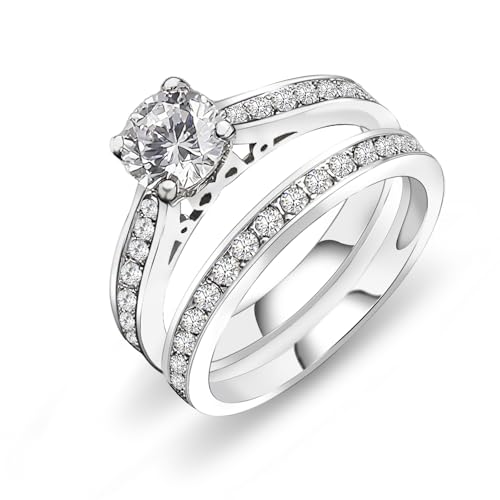
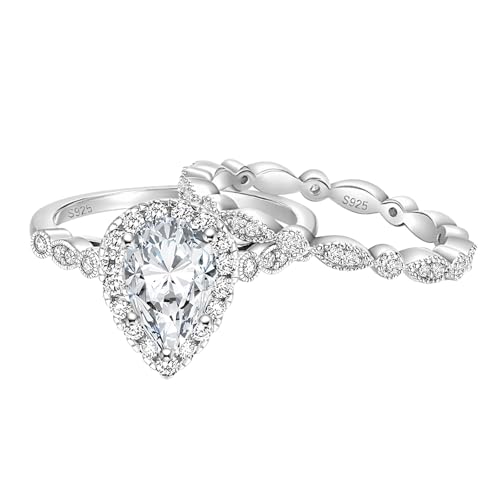
Live listings for the shortlist in this guide are pulled from Amazon below, so prices and availability are always current at the moment you look.



Putting the decision together
A sound shortlist process starts with the wearer’s day, moves through geometry and metal, and only then reaches stone selection and styling. Write down the non-negotiables first: maximum comfortable profile height, any metal sensitivities, whether the band must sit perfectly flush, and how much maintenance you will realistically arrange each year. Those four answers eliminate large portions of every catalogue immediately and turn an overwhelming scroll of similar photographs into a manageable set of candidates that genuinely fit the life the rings will live.
Within that narrowed field, compare construction details rather than headline descriptions. Prong count and shape, gallery openness, shank dimensions, sizing flexibility, and the seller’s inspection and repair arrangements separate durable designs from fragile ones more reliably than styling language does. Then compare stones on documented characteristics: material, proportions, grading source, and warranty for the stone itself. By the time you are choosing between two finalists, the differences that remain are mostly aesthetic, which is exactly where personal taste should have the final word.
Use the trial period as a genuine evaluation rather than a formality. Wear the set through ordinary days, check alignment and comfort repeatedly, look at the stones under daylight and indoor lighting, and confirm that clasps of gloves, sleeves, and pockets move past the rings without drama. If something bothers you during the trial, it will not improve with familiarity; exchange or adjust while the seller’s terms make that simple. The goal is a pair of rings that asks for nothing more than routine care and occasional inspection for decades.
For the couple who chooses carefully, a bridal set becomes the rare purchase that improves with knowledge: every detail, from the curve that closes the gap to the alloy chosen for sensitive skin, reflects a decision made on purpose rather than a default accepted under time pressure.