Our Top Picks


What's inside
- What counts as a watch with Arabic numerals
- Full numerals, partial numerals, and baton indices: the three dial families
- Legibility: why full numerals read faster
- Field watches: the natural home of the full-numeral dial
- Pilot watches: fliegers and the observation-watch heritage
- Dress watches with numerals: restraint instead of instruments
- Learning watches: full numerals as a teaching tool
- Case size: diameter, lug-to-lug, and why digits need room
- Quartz versus automatic versus hand-wound movements
- Crystal materials: mineral, sapphire, and acrylic
- Straps, bracelets, and everyday practicality
- Water resistance and the ATM scale, explained generally
- Common mistakes when buying a numeral dial watch
- How to choose: a decision sequence for this category
- Caring for a numeral dial watch
- Related dial traditions worth knowing
- How dials are made, and why finishing shows in the numerals
- Reading a specification sheet for a numeral watch
- Gift buying and second-hand considerations
- Check prices on Amazon
- Conclusion
As an Amazon Associate I earn from qualifying purchases. This post may contain affiliate links at no extra cost to you.
How the links on this page work: some links here are shopping links that may earn a commission if you buy through them, at no extra cost to you. That is how guides like this one are funded, and it never changes which styles and specifications get discussed.
What counts as a watch with Arabic numerals
A watch with Arabic numerals uses the familiar digits 1 through 12, or a selection of them, printed, painted, applied, or cut into the dial to mark the hours. The term Arabic here refers to the Western Arabic digit shapes used across most of the world today, as opposed to Roman numerals such as III, VI, and IX, or to plain markers with no digits at all. A full Arabic numeral dial carries all twelve digits around the dial, so every hour position is labelled with its number. That sounds like a small design detail, but it changes how the watch reads at a glance, how it feels stylistically, and who it suits, from a pilot checking time in a vibrating cockpit to a child learning to tell the time for the first time.
The category is broader than many buyers expect. At one end sit rugged field watches in the tradition of military-issue timepieces, with bold white digits on a matte black dial. At another sit classic pilot watches from German makers, whose dials descend directly from Second World War observation watches with large luminous digits designed to be read in poor light. Dress watches use numerals more sparingly and elegantly, sometimes in a slim serif typeface, sometimes with only a few digits balanced against markers. Children’s learning watches print every digit in bright colours and often add minute numbers around the outer edge. What unites them is that the numbers do real work: they are the primary way the dial communicates the hour, not decoration.
This guide explains how to tell a true full-numeral dial from the partial layouts that borrow the look, why legibility differs so much between digit styles, and how the usual buying decisions, including movement type, crystal material, case size, strap, and water resistance, apply within this category. The discussion draws on manufacturer specifications, published documentation and owner reports, and describes product families at the level of their documented features, because dial layouts, sizes, and movement choices vary across the long production runs typical of these designs.
Full numerals, partial numerals, and baton indices: the three dial families
A full-numeral dial prints or applies every hour digit from 1 to 12. Reading it requires no translation: the hand points at a number, and the number is the hour. The double-digit hours, 10, 11, and 12, take more dial space than single digits, so designers either shrink those numerals, accept a busier dial, or let the 12 sit slightly proud of the others. On well-designed dials the spacing still feels even because the typeface is chosen with narrow enough figures. Full-numeral dials dominate the field watch and learning watch categories, and they appear on pilot watches and some traditional dress watches as well.
A partial-numeral dial mixes a few digits with markers for the remaining hours. The best-known arrangement is the 3-6-9 layout, where Arabic digits mark three, six, and nine o’clock, a triangle or marker sits at twelve, and batons fill the rest. Explorer-style sports watches made this layout famous, and it gives a dial a sportier, more technical character than a full set of digits. Other partial schemes use even numbers only, odd numbers only, or digits at twelve, two, four, six, eight, and ten in an alternating pattern. Partial dials read quickly once the wearer is used to them, but they do ask the brain to interpolate the unmarked hours, which is exactly what a young learner or a tired pilot should not have to do.
Baton indices remove digits altogether. Slim rectangles, often applied metal with polished edges and luminous filling, mark the hours by position alone. Baton dials look clean and formal, and they dominate modern dress watches, but their legibility depends entirely on position memory and on the contrast between hand and dial. Comparing the three families side by side clarifies the trade: full numerals maximise explicit information, partial numerals balance information with a cleaner look, and batons maximise minimalism. None is objectively superior; they serve different eyes and different occasions. A buyer who specifically wants to read the exact hour instantly, to teach a child, or to keep a cockpit-style instrument on the wrist should insist on the full layout and not be talked into a 3-6-9 dial as close enough.
Printed, applied, and luminous numerals
How the digits are made matters as much as how many there are. Printed numerals are ink or paint applied directly to the dial surface. Printing allows fine detail, multiple colours, and the crisp stencil-like figures used on military-style dials, and it keeps the dial flat and the watch slim. Applied numerals are separate metal or plastic elements fixed to the dial, giving a three-dimensional effect that catches light and suits dressier watches; they cost more to produce and can, on poorly made watches, be aligned imperfectly. Luminous numerals are either printed in luminous compound or filled with it, so the digits themselves glow after exposure to light. Modern luminous materials charge under daylight or room light and fade gradually through the night. On pilot and field watches, fully luminous digits paired with luminous hands are the traditional solution for night reading. On some dials only the hands and the hour markers glow while printed digits stay dark, which still works because position carries the information, but a buyer who wants glowing numbers should confirm from the manufacturer’s description that the numerals themselves are luminous, not just the hands.
Typefaces are functional, not just decorative
Digit design shapes reading speed. Bold, open figures with generous spacing between strokes stay legible at small sizes and at oblique angles. Stencil-style digits, where bridges interrupt the figure, carry a military association and resist paint bleed in printing. Serif typefaces, with small finishing strokes, look classical and pair with polished dress-watch styling, but thin serifs can disappear at a distance. A distinctive quirk worth knowing is the numeral four: many traditional dials render it as IIII in Roman form for visual balance, but in Arabic form the figure is simply 4, and dial designers occasionally use an open-top 4 that can be misread as a 9 in poor light on very small dials. When comparing product photographs in manufacturer literature, zoom in on the 4, the 7, and the double digits; those are the figures that reveal whether a typeface was drawn for reading or merely for style.
Legibility: why full numerals read faster
Legibility is the product of several measurable things: the size of the digits relative to the dial, the contrast between digit and background, the distinctness of each figure, the length and contrast of the hands, and the amount of competing information on the dial. A full-numeral dial scores well on distinctness because each hour has a unique symbol. A hand pointing at the 7 is unambiguous even if the dial is tilted, partly obscured, or seen in peripheral vision. With batons, a hand pointing at the seventh marker requires counting or positional memory, which is slower and more error-prone under stress, fatigue, or vibration.
Contrast is the second pillar. The classic field-watch formula of white digits on a matte black dial persists because matte black absorbs reflections while white paint returns the maximum light. The reverse, black digits on a white or cream dial, reads equally well in daylight and is the standard for learning watches and many dress designs, but glossy white dials can glare under direct sun. Dial finish therefore matters: a matte or finely grained surface preserves contrast outdoors, while a sunburst or lacquered finish trades some contrast for beauty. Hands must hold up their side of the bargain. Sword, syringe, and broad dauphine hands with luminous inserts are easy to locate; thin stick hands over a busy full-numeral dial can vanish, particularly the minute hand reaching toward small double digits at the dial edge.
Size interacts with both. On a small dial, twelve digits crowd together and the double digits shrink, eroding the advantage. On a generously sized dial, digits can be large, widely spaced, and paired with a clear minute track. This is why the full-numeral style historically belongs to larger instrument watches, and why very small dress watches usually restrict themselves to a few applied numerals or none. Buyers with reduced vision often find that a mid-to-large full-numeral dial with high contrast outperforms a smaller baton dial even when the smaller watch has a cleaner look. Owner reports consistently emphasise trying the watch at arm’s length in ordinary room light, which is a more honest legibility check than a magnified product photograph.
A minute track completes the system. Most full-numeral dials print small minute markers around the chapter ring, and learning watches go further by numbering every five minutes, 05, 10, 15, and so on up to 60, around the outside of the hour digits. That outer numbering is a teaching scaffold: it lets a child connect the minute hand’s position with a number instead of counting individual minutes. On adult field and pilot watches the minute track is usually unnumbered but finely divided, supporting reading to the nearest minute and, on some models, to fractions of a minute for timing tasks.
Field watches: the natural home of the full-numeral dial
The field watch descends from military specifications that demanded a legible, robust, uncomplicated timepiece for soldiers. Those specifications effectively invented the modern full-numeral dial: large white Arabic digits on a black dial, a clear minute track, luminous hands and markers, a durable case, and a strap that could be replaced in the field. Civilian field watches keep that formula because it works. Hamilton’s Khaki Field family is the best-known modern expression of the style, offered across many years in hand-wound mechanical, automatic, and quartz forms, generally with the full set of Arabic hour digits, a 24-hour inner scale on many variants, and case sizes spanning compact to large. Timex’s Expedition line covers similar ground at the accessible end of the market, with full-numeral dials, quartz movements, and features such as the Indiglo night-light system that Timex documents across much of its range, where a button illuminates the whole dial.
Field watches reward buyers who check the details rather than the silhouette. The 24-hour inner scale, printed in smaller digits inside the main hours, helps wearers who use military time and reinforces the instrument character; it also adds dial density, which some eyes find busy. Hacking seconds, the ability to stop the second hand when setting the time, appears on many mechanical field watches and matters to buyers who synchronise with others. Case finishing is typically brushed rather than polished, hiding scratches from outdoor use. Lugs are usually drilled or fitted with standard spring bars so straps can be swapped with simple tools, and strap width follows common standards that manufacturers publish in their specifications.
For readers who also follow connected watches, the contrast is instructive: guides such as best analog smartwatches cover hybrid designs that hide smart functions behind traditional hands, while a field watch makes the opposite choice, giving up notifications entirely in exchange for years of autonomous running and a dial that never needs a firmware update. Both are legitimate answers to what a wristwatch should do; the full-numeral field watch is the answer for buyers who want time reading to be instant, mechanical or quartz-driven, and independent of a phone.
What to check in a field watch dial
Confirm that the dial is genuinely full-numeral, because some field-styled models quietly substitute markers at some hours. Check whether the luminous material covers the digits themselves or only the hands and pips. Look at the date window placement: on full-numeral dials a date window often replaces or crowds the 3, and good designs colour-match the date wheel to the dial so the interruption stays subtle. Finally, examine the minute track for complete, evenly printed divisions; a sloppy track undermines the precision the style promises.
Pilot watches: fliegers and the observation-watch heritage
Pilot watches are the other great home of the Arabic dial. The German Flieger tradition, from the Beobachtungsuhr or observation watches issued to navigators in the Second World War, produced two canonical dial types. The Type A dial carries Arabic digits for the hours with a triangle and two dots at twelve, an arrangement still used on classic pilot models. The Type B dial adds an inner hour scale and a prominent outer minute scale with large minute numerals, built for navigators who read minutes first. Laco and Stowa are the names most associated with keeping these designs in production, both being among the original-era German makers whose modern catalogues document Type A and Type B dial options across several case sizes, in hand-wound and automatic movements, with luminous digits in the historical style.
The pilot formula differs from the field formula in emphasis. Pilot dials tend to be larger, because the originals were worn over flight jackets and read in dim cockpits, and the minute track receives as much design attention as the hours. Crowns are often oversized or diamond-shaped for use with gloves, a detail modern makers retain. Cases lean toward brushed or bead-blasted finishes to kill reflections, and crystals on historically faithful models may be slightly domed. Where a field watch is a land instrument, a pilot watch is a cockpit instrument, and the dial typography reflects that: digits are as large as the dial allows, with the triangle at twelve giving an instant orientation cue even when the watch is glimpsed at an angle.
Buyers choosing between Type A and Type B should think about how they actually read time. Type A is calmer and reads like a conventional watch with exceptionally clear digits. Type B rewards wearers who time intervals and read minutes precisely, but its dual scales make the dial denser, and the hour hand points to a small inner scale that takes a day of wearing to internalise. Both are full-Arabic designs in spirit, though Type B’s main outer scale is minutes rather than hours, a nuance worth understanding before purchase. Makers’ own literature usually illustrates both dials clearly, and the choice between them is one of the few in watch buying that is purely about reading preference rather than budget or status.
Modern pilot watches beyond the German tradition
British and American aviation watches developed parallel conventions, often with full Arabic dials in a slightly softer typeface and cases sized for everyday wear rather than jacket sleeves. Many contemporary pilot-style watches across the industry borrow the triangle-at-twelve motif and large digits while shrinking the case to dimensions that fit under a shirt cuff. When a modern pilot watch is on your shortlist, the documented case diameter, lug-to-lug length, and crystal type tell you more about daily wearability than the aviation story in the brochure. The heritage explains the dial; the dimensions decide whether you will still be wearing it in a year.
Dress watches with numerals: restraint instead of instruments
Dress watches use Arabic numerals with a lighter touch. Instead of twelve bold digits, a dress dial might carry slim applied numerals at every hour in a serif or art-deco typeface, or reserve numerals for a few positions and pair them with fine batons. The effect depends on typography more than on any other single factor: a well-drawn deco numeral set, with its geometric curves and stepped lines, defines certain 1930s-inspired designs as surely as a logo would. Polished applied numerals catch light as the wrist moves, which suits evening wear, while printed numerals in black or blued ink on a silvered or cream dial give a quieter, vintage character.
Because dress watches prioritise thinness and understatement, their legibility compromises are deliberate. Hands may be slim, luminous material is often absent entirely, and the minute track may be reduced to small dots or omitted. That is acceptable for the role: a dress watch is read in lit rooms, at conversational distance from one’s own wrist, and its job includes not shouting. Buyers who need one watch for both office formality and weekend outdoor use should recognise that a dress-numeral dial will not match a field dial for quick reading in poor light, and choose which setting matters more. Within the dress category, full-numeral models are the more readable choice, and even-numerals-only layouts are a recognised middle path that keeps the dial airy while preserving numeric anchors at six positions.
Sector dials deserve a mention here. A sector dial divides the face into contrasting rings or segments, often with Arabic numerals in the outer chapter and a different finish in the centre. The style comes from early twentieth-century precision watches and has returned in many heritage collections. On a sector dial the numerals usually sit in a brushed or matte outer ring that reads clearly, while the centre carries the brand signature and sometimes a small seconds subdial. If a small seconds display replaces the 6, the dial is technically partial, another reminder to count the digits rather than trust the category label.
Learning watches: full numerals as a teaching tool
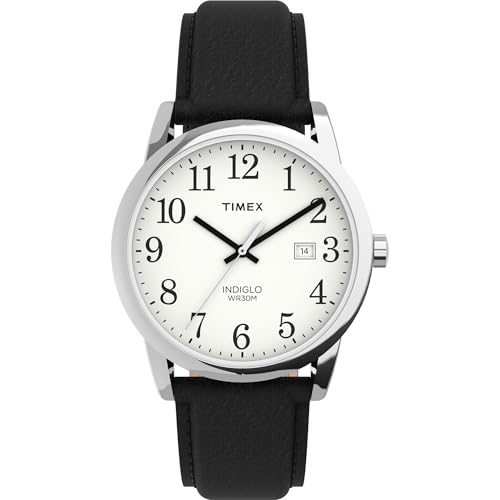
For children learning to tell the time, the full-numeral dial is not a style choice but the curriculum. A learning watch prints every hour digit, adds the five-minute numbers around the outside, and often labels the hands themselves with the words hour and minute or colours them differently so a child can distinguish them. Timex’s Easy Reader family and its children’s time-teaching designs are the widely recognised examples of the pattern, with clear digits, colour-coded minute information, and simple quartz movements in sizes intended for small wrists. Teachers and parents value the same features that pilots do, explicit numbers and high contrast, because a learner has no positional memory to fall back on.
Choosing a learning watch involves a few specific checks. The minute numbers should run in the same direction and colour logic as the teaching method used at school, and the dial should avoid cartoon clutter over the digits themselves; characters belong on the strap, not between the 4 and the 5. A second hand helps children grasp duration and counting seconds, and a clearly audible tick, present on many simple quartz models, reinforces the idea of seconds passing, though it may not suit a classroom drawer full of watches. Case and strap materials should tolerate playground treatment, and the strap should be adjustable in small increments because children’s wrists are slender. Readers comparing children’s connected options in guides such as best affordable kid smartwatches will notice that digital and smart devices sidestep teaching altogether by displaying the time as digits to be read rather than hands to be interpreted, which is precisely the skill an analogue learning watch exists to build.
There is also an adult version of this need. People relearning time-telling after illness, adults who grew up with phone clocks and never automatised analogue reading, and wearers with certain cognitive difficulties all benefit from explicit full-numeral dials with labelled minute tracks. The same learning-watch design language, in grown-up sizes and quieter colours, appears in easy-read ranges from several mainstream makers, and there is no reason to be embarrassed about choosing one: clarity is a specification, not a compromise.
Case size: diameter, lug-to-lug, and why digits need room
Case diameter is the headline measurement, taken across the case excluding the crown, and full-numeral watches span a wide span of sizes because their audiences do. Compact models in the mid-30-millimetre range suit smaller wrists and keep a classic proportion; mid-size models around 38 to 40 millimetres are the versatile centre of the market; large pilot models at 42 millimetres and above honour the instrument originals. Diameter alone misleads, though. Lug-to-lug length, the distance from the tip of one lug to the tip of the opposite lug, decides whether the case overhangs the wrist. A watch whose lugs extend beyond the wrist’s edges will wear uncomfortably and look oversized regardless of its diameter, while a larger-diameter watch with short, curved lugs can sit neatly.
Thickness interacts with style. Quartz movements allow slim cases that slide under cuffs, suiting numeral dress watches. Automatic movements with rotors need more height, and pilot watches accept that height as part of the instrument look. For full-numeral dials specifically, a bigger dial area is a functional benefit: digits can be printed larger, spacing breathes, and double digits stop crowding the minute track. When two watches share a diameter, the one with the thinner bezel shows more dial and usually reads better. Manufacturers publish diameter and thickness routinely; lug-to-lug appears less often in headline specifications but is commonly listed by the makers discussed here or measurable from their dimension diagrams.
Wrist fit also depends on strap behaviour. A stiff strap on long lugs can hold the case away from the wrist at the edges, while a soft fabric strap lets even a large field watch settle. Trying a size in person, or at minimum comparing lug-to-lug against a watch already owned, prevents the most common sizing regret. Children need the opposite end of the range: small diameters, short lugs, and light weight, because a heavy watch on a small wrist gets taken off and lost.
Quartz versus automatic versus hand-wound movements
The movement is the engine, and in this category all three mainstream types are well represented. A quartz movement uses a battery-powered quartz crystal oscillator, vibrating at 32,768 hertz, to regulate the hands with accuracy typically measured in seconds per month. Quartz watches are thinner, lighter, cheaper to service, and indifferent to being left unworn for weeks; they ask for a battery change every year or few years depending on the movement and features. Most Expedition-style field watches, learning watches, and accessible full-numeral models are quartz for these reasons. An automatic movement is mechanical, powered by a mainspring wound by a rotor that moves with the wrist. It needs no battery, sweeps the second hand smoothly, and carries the craft appeal that draws many buyers to Hamilton’s automatic Khaki Field variants or to automatic Fliegers from Laco and Stowa. Its accuracy is measured in seconds per day, it stops after a day or two unworn, known as its power reserve, and it needs periodic servicing as lubricants age. A hand-wound movement is the automatic’s simpler ancestor: the wearer turns the crown daily, the second hand may hack for precise setting, and the case can be thinner without a rotor. Hand-wound field and pilot reissues honour the original military watches, which were hand-wound by necessity.
Choosing between them is a lifestyle decision. A single-watch wearer who enjoys ritual and mechanical character will keep an automatic wound by wearing it. A buyer who rotates several watches, or who needs grab-and-go reliability for outdoor work, will appreciate quartz. Collectors of the Flieger tradition often prefer hand-wound movements for historical fidelity and for the daily crown-turning habit it builds. None of these choices changes the dial, which is why full-numeral models are such a good lens on the question: with the reading experience held constant, the movement decision becomes purely about ownership experience, servicing rhythm, and accuracy expectations, all of which manufacturers state in their movement specifications.
Two movement details deserve checking in the documentation. The first is hacking: whether the second hand stops when the crown is pulled for setting. The second is the power reserve figure for mechanical models, commonly in the region of 38 to 80 hours across the movements used in this category, which decides whether the watch survives a weekend unworn. For quartz models, check whether the battery type is a common cell listed in the manual, and whether the maker describes an end-of-life indicator, where the second hand jumps in multi-second steps to warn that the battery is nearly exhausted.
Crystal materials: mineral, sapphire, and acrylic
The crystal is the transparent cover over the dial, and three materials cover nearly the whole market. Mineral crystal is hardened glass. It resists scratches moderately well, shrugs off knocks that would crack a harder material, and is standard on accessible field and learning watches, including much of the Expedition class. Sapphire crystal is synthetic corundum, second only to diamond in hardness among common watch materials, and it resists scratching from almost everything except diamond and a few industrial abrasives. Sapphire is the standard expectation on mid-range and premium models, including many Hamilton, Laco, and Stowa references, and makers state it plainly in specifications. Its weakness is brittleness: a hard edge impact can shatter sapphire where mineral might only crack, though in ordinary use scratch resistance matters far more often. Acrylic, a clear plastic, survives on vintage-style reissues because it can be domed deeply, distorts numerals charmingly at steep angles, and can have scratches polished out with suitable compounds; it scratches easily in the first place, which is why mainstream production has largely moved on.
Coatings modify whichever material is chosen. Anti-reflective coating, applied to the underside or both sides of sapphire on many pilot watches, reduces glare and is a genuine legibility feature on a dial whose whole purpose is fast reading. A watch with an uncoated, highly reflective crystal can hide its excellent numerals under a mirror of sky at exactly the outdoor angles where a field watch earns its keep. Specification sheets note anti-reflective treatment when present; its absence on an otherwise premium pilot watch is worth a pause. Domed crystals, in any material, add depth and vintage character but introduce edge distortion, so buyers who prize perfectly flat reading should choose flat crystals, while buyers who prize the historical look accept the trade knowingly.
Straps, bracelets, and everyday practicality
Full-numeral watches are strap-friendly by tradition. Field watches popularised the fabric pass-through strap, which retains the watch even if one spring bar fails, because the strap threads under the case and over both bars. Leather straps suit pilot and dress-numeral models, with the thick, riveted leather of traditional Flieger straps at one extreme and slim polished dress leather at the other. Steel bracelets appear on some field and sports-numeral models and add weight, durability, and a more finished look. The practical checks are lug width, published by every maker, which governs the replacement market; quick-release spring bars, which make strap changes a fingernail job; and the strap’s adjustment range for small or large wrists.
Strap choice feeds back into legibility and comfort more than buyers expect. A strap that is too loose lets the watch rotate so the dial sits at the wrist’s edge, where digits are read at a distorting angle. A well-fitted strap keeps 12 at the top and the dial flat. For children, bright woven straps with hook-and-loop closures adjust finely and survive washing, which matters more than any horological consideration. For outdoor field use, fabric and rubber tolerate sweat and rain without damage, while leather asks to be swapped out before a wet weekend. Readers who split their wear between a traditional watch and a connected one, a pattern discussed in best active smartwatches, often standardise lug widths across both so a favourite strap can move between them.
Water resistance and the ATM scale, explained generally
Water resistance in watches is described with a rating expressed in atmospheres, abbreviated ATM, or in bar, or in metres, and the three describe the same idea: the pressure the watch’s seals were designed to withstand in a static laboratory test. One atmosphere corresponds to the pressure found at roughly ten metres of water depth, so the metre figure printed for a watch is a pressure equivalent, not a promise that the watch should be taken to that actual depth in moving water. Real swimming adds pressure spikes from arm movement and impact with the water, which is why industry guidance treats the printed scale conservatively: the lowest ratings mean splash resistance only, mid-range ratings are the ones manufacturers describe as suitable for swimming, and only watches built and marked as dedicated dive watches, with screw-down crowns and tested to diving standards, belong in scuba use. The exact suitability wording for any model comes from its own manual, and that manual, not the number alone, is the authority.
What matters for a full-numeral watch buyer is matching the rating class to the life the watch will lead. A dress-numeral watch will typically carry a modest rating intended for hand-washing and rain. A field watch is expected to shrug off weather and stream crossings, and makers position their ratings accordingly. A learning watch will be worn in baths, pools, and water fights regardless of what any adult advises, so its documented rating deserves a careful read before purchase. In all cases the rating assumes seals in good condition: gaskets age, crowns get knocked, and a battery change done without replacing and checking the gasket can quietly end a watch’s water resistance. Makers and service centres describe pressure checking as part of proper servicing for this reason. Pushers and crowns should not be operated while the watch is wet unless the design explicitly allows it, a caution repeated across manufacturers’ care guides.
Screw-down crowns, where fitted, must be fully screwed home before any water exposure; an unscrewed crown is an open door that no rating covers. Leather straps, however handsome on a pilot watch, are not water equipment and degrade with repeated soaking, so a watch intended for swimming should wear fabric, rubber, or steel. These general principles, rather than any single model’s number, are what keep a watch safe around water.
Common mistakes when buying a numeral dial watch
The first mistake is trusting the category label. Watches marketed with phrases about Arabic style or explorer layouts frequently turn out to be 3-6-9 partial dials, sector dials missing a digit to a subdial, or full dials where a date window swallows the 3. Count the digits in the manufacturer’s own dial photograph before anything else. The second mistake is judging legibility from that same photograph, which is lit perfectly, magnified several times life size, and shot dead-on. Legibility failures appear at real size, at an angle, under a sleeve edge, in dim corridors. Where a purchase cannot be handled in person, owner reports describing reading the watch at night or outdoors are the best proxy evidence available.
The third mistake is ignoring the hands. Buyers focus on the digits they searched for and overlook thin, polished, non-luminous hands that disappear against a silvered dial, or a second hand whose counterweight covers small digits. The fourth is buying pilot size for field purposes or the reverse: a 42-millimetre Flieger on a small wrist worn daily under cuffs becomes an irritation, while a dainty dress-numeral watch taken hiking invites damage its crystal and rating were never meant to face. The fifth is assuming luminous specification from a daytime photograph; lume must be described in the specifications, including which elements carry it. The sixth is neglecting strap width and lug-to-lug when ordering online, the two measurements that decide whether the watch sits as intended.
A subtler mistake is paying for the wrong kind of authenticity. Reissue culture means many dials copy historical details, including aged-colour luminous material that mimics decades of patina. That tinted lume looks wonderful and glows less brightly than fresh white material on some models, a trade the maker may or may not state clearly. Buyers whose priority is night reading should choose current-specification luminous dials; buyers whose priority is the vintage look should accept dimmer glow as part of the aesthetic they selected.
How to choose: a decision sequence for this category
Start with the reading job. If the watch must be read instantly under stress, outdoors, or by a learner, require a full twelve-digit dial with luminous digits or at least luminous hands and markers, and a complete minute track. If the watch is mainly for dressed settings, a partial or slim full-numeral dial in an elegant typeface serves better and wears thinner. Second, set the size from your wrist, using lug-to-lug against a watch you already own, and remember that dial area is a legibility feature in this category, so within comfort, the larger dial reads better. Third, pick the movement by lifestyle: quartz for set-and-forget accuracy and thinness, automatic for mechanical character in daily wear, hand-wound for tradition and ritual. Fourth, choose the crystal by risk: sapphire for long-term clarity against scratches, mineral for knock tolerance at accessible prices, acrylic only when vintage character is the point. Fifth, match the documented water-resistance class and strap material to the wettest day the watch will honestly face.
Within a shortlist, favour makers who publish complete specifications: dial layout description, case dimensions including lug-to-lug, movement calibre and accuracy range, crystal material and coatings, luminous elements, lug width, and water-resistance wording with care instructions. Hamilton, Timex, Laco, and Stowa all maintain detailed specification and manual libraries for their numeral-dial families, which is part of why they anchor this guide. A maker who will not state whether the numerals are luminous or what the crystal is made of is asking you to guess about the very features this category exists to provide. Readers whose shortlist also includes connected watches for expeditions may find best adventure smartwatches a useful contrast, since those products replace the printed dial entirely with screens, gaining maps and sensors while giving up the instant, power-free readability that keeps the full-numeral analogue watch relevant.
Caring for a numeral dial watch
Daily care is simple. Keep the crystal clean with a soft cloth, because a film of dust and fingerprints costs contrast that the dial designer worked to provide. Store mechanical models away from strong magnets where practical, since magnetised movements run fast, a fault any watchmaker can diagnose and demagnetise. Have water resistance checked when the battery is changed on quartz models and at service intervals on mechanical ones, and treat any condensation under the crystal as an urgent fault, because moisture attacks dial printing and luminous material first, and on a numeral watch the dial is the whole point. Leather straps last longer when rotated and kept dry; fabric straps can be washed and fully dried before refitting. When setting the time on a learning watch with a child, turn it into the lesson: ask them to read the hour digit the short hand has passed and the five-minute number the long hand points to, and the watch quietly does its teaching job every day.
Related dial traditions worth knowing
Two neighbouring traditions help buyers place the full Arabic dial in context. The first is the California dial, a half-and-half design in which the upper half of the dial carries Roman numerals and the lower half carries Arabic digits, with a triangle at twelve and bars at three and nine. The layout dates to the 1930s and 1940s and is associated with early dive and military watches; its mixed numerals were once explained as an anti-counterfeiting measure and are now a deliberate vintage statement. A California dial is not a full Arabic dial, and buyers searching for maximum clarity should note that its Roman upper half reintroduces exactly the symbol translation the Arabic dial avoids. As a style object, though, it shows how long makers have treated numeral choice as identity rather than mere labelling.
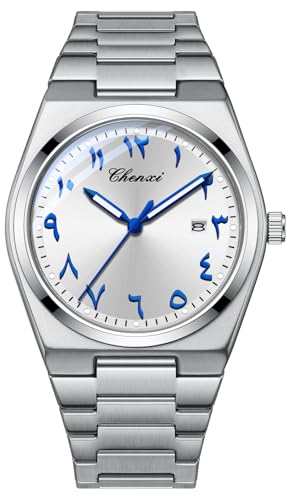
The second tradition is the Eastern Arabic dial, which uses the digit forms employed in much of the Middle East, where the shapes for numbers differ from the Western Arabic digits used in Europe and the Americas. Several Swiss and Japanese makers have produced Eastern Arabic editions for regional markets, with the hour digits rendered in those forms and sometimes with day and date wheels to match. For a wearer raised reading those digits, such a dial is the true full-numeral watch, instantly legible in the way this guide has described, while a Western-digit dial would be the foreign one. The lesson generalises: legibility lives in the match between symbol and reader, which is why learning watches for children in any market print the digit forms the child is being taught at school.
A third, smaller tradition is the regulator layout, in which hours, minutes, and seconds each occupy separate subdials or arcs. Regulators descend from precision workshop clocks used to set other timepieces, and their hour subdial often carries a compact set of Arabic digits. They are fascinating objects but poor answers to a search for an everyday full-numeral watch, because the main dial gives its space to the minute hand and the hour must be read from a small register. Knowing the term prevents a disappointing purchase when a listing’s photographs are admired without understanding the layout.
How dials are made, and why finishing shows in the numerals
A watch dial begins as a thin metal blank, usually brass, which is stamped or machined with feet that attach it to the movement and apertures for the date and hands. Surface finishing comes next: brushing, sunburst grinding, lacquering, galvanic colouring, or enamelling on premium pieces. Numerals are then printed in one or more passes through a pad-printing process, in which a silicone pad picks ink from an etched plate and stamps it onto the dial with great positional accuracy. Multi-colour dials, such as learning watches with differently coloured minute numbers, require a separate pass per colour, and registration between passes is one of the quiet quality markers in this category: misregistered minute numbers that drift against the minute track betray careless production instantly.
Applied numerals follow a different route. Each digit is formed separately, polished or finished, given tiny feet, and set into drilled holes in the dial, sometimes with adhesive assistance. The process explains both the cost and the appeal: applied digits cast minute shadows, catch light at angles where print would look flat, and give dress watches their jewellery quality. Their weakness is mechanical; a severe shock can, in rare cases, dislodge an applied element, and repair means dial work rather than a simple part swap. Luminous numerals add another process, since the luminous compound must be applied in a layer thick enough to glow usefully without spreading beyond the digit’s outline. Under magnification, the edge quality of luminous digits separates careful manufacture from crude work more reliably than any other single detail on the dial.
Enamel dials, found on a small number of premium numeral watches, fire powdered glass onto the blank at high temperature, producing a surface that will not fade and takes printing with a distinctive depth. Grand feu enamel, built in multiple fired layers, is the most labour-intensive version and is priced accordingly. For most buyers the practical takeaway is simpler: dial finishing is where the money in a numeral watch visibly goes, because the dial is the largest component and the one always in view. A buyer comparing two otherwise similar field watches should compare dial photographs at high magnification, looking at digit edges, minute-track evenness, and the alignment of the 12 with the marker above it. Those details predict daily satisfaction better than small differences in movement specification.
Reading a specification sheet for a numeral watch
Manufacturers’ specification pages follow habits worth learning. The dial line may say Arabic numerals without distinguishing full from partial, so treat photographs as part of the specification and count. Movement lines give the calibre name, which unlocks the maker’s movement documentation: jewel count, accuracy range, power reserve for mechanical calibres, and battery type for quartz. Accuracy figures are stated as ranges, for example a number of seconds per day in either direction for mechanical movements, and they describe the movement as delivered and regulated, not a guarantee for every wearing pattern, since position, temperature, and state of wind all influence mechanical rate. Quartz accuracy, stated per month, is far tighter and largely wearer-independent.
Crystal lines state material and sometimes coating; case lines state diameter, thickness, and material, with lug-to-lug and lug width appearing in fuller documentation or dimension drawings. Water-resistance lines pair the rating with care wording, and the manual expands it into permitted activities; read the manual version. Weight, often quoted with the standard strap, matters for children and for buyers who dislike heavy watches, and pilot watches on thick leather can weigh more than their diameter suggests. Finally, warranty and service information tells you how the maker expects the watch to be maintained: service intervals for mechanical movements are commonly measured in years, and a maker who publishes service pricing and turnaround openly is signalling confidence in its aftercare. None of this requires specialist knowledge, only the habit of reading past the headline photograph to the documents the maker already publishes.
Gift buying and second-hand considerations
Full-numeral watches make unusually safe gifts because the recipient’s taste in dial layout is easy to predict from their life: the outdoors enthusiast, the trainee pilot, the grandparent who values clarity, the child ready for a first real watch. When buying for someone else, favour the versatile middle of every range discussed here, a mid-size case, a neutral dial colour, a strap that adjusts widely, and quartz running gear if the recipient has never owned a mechanical watch and would not enjoy its routines. Include the manual and keep the purchase paperwork, since warranty service and battery changes both go more smoothly with documents in hand.
On the second-hand market, numeral dials offer one forensic advantage: dial originality is comparatively easy to judge. Reprinted or refinished dials, common on older field and pilot watches, usually betray themselves in digit shapes that differ subtly from the maker’s documented typeface, in luminous material that does not match the hands, or in minute tracks with uneven spacing. Listings for established families from Hamilton, Laco, Stowa, and Timex can be cross-checked against the makers’ own archive photographs and manuals, and a seller who welcomes that comparison is offering useful information by doing so. Check also that a vintage pilot watch’s large crown turns smoothly and that a learning watch’s strap, the part that wears out first, is replaceable in a standard width, which keeps an otherwise sound older watch in daily service for years.
Check prices on Amazon
Live listings for the shortlist in this guide are pulled from Amazon below, so prices and availability are always current at the moment you look.



Conclusion
A full Arabic numeral dial is the oldest interface in wristwatches and still the clearest: twelve honest numbers, a hand for each unit of time, and nothing between the eye and the answer. Choose the layout that matches how you read, size the case to your wrist rather than to a photograph, and let movement, crystal, and water resistance follow the life the watch will actually live. Do that, and the watch on your wrist will answer the question it exists for, at a glance, in a crowd, in the rain, at the exact moment a small voice beside you asks what the long hand is pointing at, and you both look down and read the number together.