Our Top Picks


What's inside
- Why a spare battery decision matters more on an action camera
- Reading capacity claims without being misled
- Firmware warnings and what they actually mean
- The Enduro benchmark and cold-weather chemistry
- Recording load: why 5.3K and 4K expose weak cells
- Charging inside the battery versus charging in a cradle
- Doors, seals, and the waterproofing question
- Cycle life and how quickly spares age
- Recognising a swollen pack before it damages the camera
- Contacts, thermistors, and the information a pack reports
- Older generations: Hero 5 to Hero 8 and Session realities
- How many spares to carry, and a sensible buying order
- What the percentage gauge can and cannot tell you
- Heat management during long recordings and charging
- Weight, balance, and mount behaviour nobody lists
- Travel rules, shipping limits, and spare etiquette
- Reading seller listings like an engineer
- Pairing spares with cards, mounts, and shooting plans
- When the original pack is the smarter purchase
- Time-lapse, night work, and other edge duties
- Two-battery bundles, triple bundles, and false economy
- Environmental cost and the case for fewer, better packs
- Check prices on Amazon
- A pre-trip checklist distilled from the evidence
As an Amazon Associate I earn from qualifying purchases. This post may contain affiliate links at no extra cost to you.
Links leaving this page can earn this site a commission from the retailer involved, and that payment never reshuffles the rankings or softens a drawback described below. Nothing here comes from handling the packs in person. Instead, each judgement traces back to manufacturer specification sheets, published compatibility documentation, and patterns that keep surfacing across owner feedback, which is exactly the evidence a careful buyer can verify before ordering.
Why a spare battery decision matters more on an action camera
An action camera drains its cell faster than its tiny size suggests. Recording at 5.3K or 4K with stabilisation, GPS, voice control, and a bright rear screen all drawing at once can empty a healthy pack in well under ninety minutes, and cold wind on a ski lift or a boat shortens that window further. Because the camera usually sits on a helmet, a chest mount, or the end of a pole, swapping power is rarely convenient mid-activity, so the quality of the spare in your pocket directly decides how much of the day gets recorded. Third-party packs promise the same shape and contacts for less money per unit, which makes carrying three or four realistic, yet the savings only hold up if capacity claims, firmware behaviour, and low-temperature performance stay close to the original equipment.
Start by accepting that not every Hero generation shares a battery. The Hero 9, Hero 10, Hero 11, Hero 12, and Hero 13 families use the larger Enduro-style pack identified as AHDBT-901, a 1720 mAh cell rated around 6.6 watt-hours in original form. Hero 5, Hero 6, Hero 7, and Hero 8 cameras use the smaller AABAT-001 format at 1220 mAh. The little cube-shaped Session models and the Hero 4 generation belong to still older families with different contacts and latches. A listing that blurs those generations together is a warning sign, because a pack that physically squeezes into a tray can still present the wrong voltage curve, the wrong thermistor behaviour, or a door that refuses to seal against water.
Reading capacity claims without being misled
Capacity appears in two units and both deserve scrutiny. Milliamp-hours describe charge at the cell voltage, while watt-hours describe actual energy, and watt-hours are the fairer comparison whenever listings mix nominal voltages. An original Enduro pack pairs 1720 mAh with roughly 6.6 watt-hours, so a third-party listing claiming 2000 mAh should also state a watt-hour figure near 7.7 if the arithmetic is honest at the same nominal voltage. When the watt-hour number is missing, oddly low, or identical across packs with different milliamp-hour claims, the larger number is usually marketing arithmetic rather than extra energy. Manufacturer datasheets for the underlying cylindrical or pouch cells explain why: raising capacity in a fixed volume requires thinner separators or different chemistry, each with trade-offs the listing rarely mentions.
Owner feedback adds a second layer to the capacity question. Reports repeatedly describe unbranded packs delivering noticeably shorter 4K recordings than the original pack in the same camera on the same settings, even when the printed rating matches or exceeds the original. Heat is the usual companion symptom, with the camera warning about temperature sooner on demanding modes. Neither pattern proves a particular unit is mislabelled, since age, storage, and charge history all matter, but the recurrence across many sellers suggests buyers should weight the watt-hour figure, the stated cell origin, and the return terms more heavily than a headline milliamp-hour number printed in large type on the box artwork.
Firmware warnings and what they actually mean
GoPro firmware on several Hero generations checks information reported by the battery, and cameras have historically displayed warnings when a pack cannot identify itself the way original equipment does. Published release notes and support documentation treat that behaviour as a compatibility boundary rather than a suggestion. A warning does not always stop recording, yet some firmware versions have limited features, nagged on every power-up, or refused to update while an unrecognised pack was fitted. Third-party makers respond by adding identification circuitry that answers the camera correctly, which is why two visually identical packs from different production runs can behave differently in the same body after an update changes the questions the camera asks.
Practical buying therefore includes a firmware question that listings seldom answer directly. Check the seller documentation for the exact Hero models and firmware ranges the pack claims to support, and favour sellers who publish update notes when camera firmware changes. Owner reports describe a familiar cycle: a pack works silently for months, a camera update arrives, and warning banners appear the next morning. That sequence does not mean the update broke a good battery; it means the identification handshake tightened. Keeping one original pack in the kit solves two problems at once, giving the camera a known-good cell for firmware updates and giving you a reference runtime against which every spare can be judged honestly.
The Enduro benchmark and cold-weather chemistry
The Enduro pack exists because standard lithium-ion cells lose usable capacity as temperature falls. GoPro published the Enduro as its cold-weather answer, claiming longer runtime in freezing conditions and faster charging than the earlier standard pack for the same Hero 9 through Hero 12 bodies. Third-party alternatives borrow the Enduro name shape and colour cues freely, but the chemistry inside is what matters, and listings rarely disclose low-temperature discharge curves. A pack built from ordinary cells can match the Enduro rating on a warm desk and still sag badly at minus ten degrees, because internal resistance rises in the cold and the camera reaches its low-voltage cutoff while charge remains trapped in the cell.
Skiers, snowboarders, and winter riders dominate the cold-weather complaints in owner feedback, and their workaround is consistent regardless of brand: keep spares warm in an inside pocket, rotate them through the camera, and expect a rested pack to recover some indicated charge as it warms. That behaviour is normal electrochemistry, not a defect unique to third-party cells. Where cheaper packs separate themselves is recovery consistency. Reports describe some units returning close to original runtime after warming, while others stay short or trigger shutdowns under the combined load of 5.3K recording and stabilisation. If winter use is your main purpose, published low-temperature specifications and a seller who states an operating range plainly are worth more than an extra hundred claimed milliamp-hours.
Recording load: why 5.3K and 4K expose weak cells
High-resolution modes punish a weak pack in ways 1080p never will. The sensor, processor, stabilisation, and media writing all peak together, so current draw stays high and voltage sag under load becomes the limiting factor rather than stored charge alone. A tired or low-grade cell can show half charge on the gauge and still let the camera shut down during a demanding clip, because the voltage dipped below cutoff under load and recovered once recording stopped. Owner reports of sudden shutdowns with charge remaining almost always cluster around the highest frame rates, the widest fields of view, and cold or ageing packs, which is a load problem wearing a capacity costume.
That load behaviour also explains why runtime comparisons copied between listings mislead. A runtime figure gathered at 1080p with stabilisation off says little about a day filmed at 4K60. When comparing candidates, look for runtime statements tied to a named resolution, frame rate, and feature set, ideally from the manufacturer documentation for the camera itself, which publishes expected recording times per mode for the original pack. A third-party maker who quotes only a single best-case runtime without settings is asking you to assume the gentlest conditions. Discount that number mentally, and plan your carry count around the mode you actually film, with one extra pack beyond the arithmetic as insurance against sag, cold, and the clip you did not plan to take.
Charging inside the battery versus charging in a cradle
Two charging philosophies compete in this category. Some third-party packs carry a USB-C port on the pack itself, so the cell charges from a cable without any dock, which suits travellers who want to top up from a power bank in a lift queue. Others rely on external dual or triple cradles that accept two or three packs at once and draw from a single USB supply. Each approach carries compromises. A port on the pack adds a rubber cover that must seat perfectly before the camera goes near water, adds circuitry inside a volume that could otherwise hold cell material, and usually charges one pack slowly. A cradle keeps the pack sealed and simple, charges several units overnight, but becomes one more object to pack and one more cable standard to keep track of.
Charge speed claims deserve the same scepticism as capacity claims. A cradle fed from a low-output USB port splits that output across every occupied bay, so three packs together charge far more slowly than one pack alone. Manufacturer documentation for powered hubs states input ratings for a reason: a cradle wanting five volts at two amps cannot deliver its fastest cycle from a weak laptop port. Owner feedback repeatedly traces overnight disappointment to the supply rather than the cradle, with packs still short of full at dawn because the shared adapter never delivered its rated current. Match the cradle to a supply that meets its stated input, and treat simultaneous fast charging of three packs as a feature that only exists when the power source cooperates.
Doors, seals, and the waterproofing question
On recent Hero models the battery shares its compartment with the memory card, and the side door forms part of the waterproof seal. A pack fractionally thicker than specification can strain that door, prevent the latch from seating, or leave the camera technically closed but no longer sealed to its rated depth. Fit complaints in owner feedback often mention doors that bulge, latches that need unusual force, or packs that swell later and become difficult to extract. Those are not cosmetic issues on a camera marketed for swimming, surfing, and rain. Before trusting any spare underwater, fit it, close the door gently, confirm the latch sits flush, and never force a compartment that resists, because the seal you compromise protects the entire camera, not just the battery bay.
Extraction tabs deserve a glance as well. Original packs include a pull tab proportioned for gloved or wet fingers, and better third-party copies reproduce that tab faithfully. Cheap copies sometimes use thinner material that tears after a few removals, leaving a pack seated deep in the compartment with nothing to grip. In cold conditions, when plastic stiffens and fingers lose dexterity, that small textile detail decides whether a swap takes ten seconds or ends the session. It is a useful proxy for overall manufacturing care: a maker who copies the tab, the contact plating, and the housing tolerances accurately is more likely to have copied the cell specification accurately too, while sloppy externals rarely hide meticulous internals.
Cycle life and how quickly spares age
Every rechargeable pack fades with use, and manufacturer cell datasheets express that fade as cycles to a retained-capacity threshold, commonly around eighty percent after several hundred full cycles under controlled conditions. Real action-camera use is harsher than the controlled pattern: deep discharges during long recordings, charging immediately while warm, storage fully charged between trips, and freezing days followed by warm rooms. Third-party listings seldom publish cycle ratings, which leaves buyers inferring longevity from owner feedback instead. The recurring pattern there is divergence over time. Packs that matched the original when new sometimes fall behind after a season, while better-documented brands hold their runtime more predictably across the same calendar.
You can slow that fade with habits that cost nothing. Avoid storing packs fully charged for months; a partial charge near half is kinder during long gaps between trips. Let a cold pack warm gradually before charging, and let a hot pack cool after a long recording before it goes on the cradle. Number your packs with a marker and rotate them so one unit does not absorb every cycle while others sit unused, since calendar ageing and cycle ageing compound differently. When a pack that once finished a familiar route now dies well short of its old mark on identical settings, treat that as its retirement signal for critical filming, however healthy it still looks on the charger indicator.
Recognising a swollen pack before it damages the camera
Swelling is the failure mode that turns a cheap spare into an expensive repair. A pouch or prismatic cell generates gas as it degrades, and the housing expands, sometimes subtly enough that the first symptom is a door that needs more pressure or a pack that drags against the compartment walls on removal. Lay the pack on a flat surface and look along its faces: any rocking, doming, or seam separation means the cell inside has changed shape. Never charge a swollen pack, never force it into the camera, and never puncture or squeeze it back to size. Manufacturer safety documentation across the lithium industry is unanimous on this point, and the camera maker warranty language treats damage from a deformed third-party pack as outside its responsibility.
Disposal follows from that same guidance. A swollen or retired pack should go to a battery recycling collection point with its contacts taped, stored beforehand in a cool dry place away from metal objects that could bridge the terminals. Owner reports occasionally describe swollen packs discovered only after a trip, wedged firmly enough to need tools, which risks shorting contacts during extraction. Checking each pack monthly during the season, and before any trip where spares travel in luggage, catches deformation while removal is still easy. Also remember that airlines restrict spare lithium cells to cabin baggage with protected terminals, a rule that applies identically to original and third-party packs and that shapes how many spares you can realistically carry on a flight-based trip.
Contacts, thermistors, and the information a pack reports
The gold contacts on the pack do more than carry current. Modern Hero cameras read temperature and identity data through the battery interface, and that data feeds thermal protection, charge control, and the percentage gauge you trust during a recording. A third-party pack with a poorly calibrated temperature sensor can report optimistic readings that let the camera run hotter, or pessimistic readings that trigger early thermal warnings on ordinary days. Gauge behaviour in owner feedback reflects this: some spares drop from full to empty in uneven steps, lingering at high percentages then collapsing, which indicates the camera is estimating state of charge from a voltage curve the pack was never characterised against. None of this makes such a pack unusable, but it changes how you plan, because the gauge becomes an estimate to manage around rather than a measurement to trust.
Contact plating quality shows up over months rather than days. Thin or poorly finished contacts oxidise, especially after salt water or humid storage, and intermittent contact produces the maddening fault where a camera restarts when bumped. Cleaning contacts gently with a dry cloth and storing packs in a dry case prevents most of it. When comparing listings, photographs of the contact area are worth studying: recessed, evenly plated contacts with clean moulding around them suggest controlled manufacturing, while flash, uneven colour, or misaligned printing on the label suggest the opposite. Sellers who publish the pack weight also help, because a pack substantially lighter than the original at identical claimed capacity has found that saving somewhere, and cell material is the heaviest component inside.
Older generations: Hero 5 to Hero 8 and Session realities
Owners of Hero 5 through Hero 8 cameras shop in a different corner of this market. The AABAT-001 format is smaller, older, and widely copied, and the original packs are scarcer, so third-party supply keeps many of those cameras useful. The same checks apply with adjusted numbers: 1220 mAh and roughly 4.7 watt-hours define the original benchmark, and claims far above that in the same housing deserve the same arithmetic test. Firmware warnings also have a longer history on these bodies, and some third-party lines were built specifically to answer the identification checks of later Hero 7 and Hero 8 firmware, so version-specific compatibility notes matter more here, not less, because the installed base runs many different firmware builds.
Session owners face the opposite problem: those cameras sealed their battery inside the body, so no swappable spare exists and runtime planning means external USB power or a second camera. That sealed design is a useful reminder that battery strategy differs by generation, and advice written for Hero 11 owners transfers poorly to a Session or a Hero 4 with its removable but entirely different pack and rear door arrangement. Before ordering anything, photograph your current pack, copy its model code exactly, and match that code in the listing rather than trusting a headline that lists many Hero numbers. Model codes survive marketing; compatibility grids in listing images frequently do not, and return shipping for a wrong-format pack costs more than the minutes spent checking.
How many spares to carry, and a sensible buying order
Carry count follows from your longest recording day, not from a bundle size a seller prefers. Work backwards from published per-mode runtimes for the original pack, assume a third-party spare delivers somewhat less under load and cold, and count the swaps your activity realistically allows. A skier who passes the lodge at lunch can rotate two packs through a warm pocket and a charger. A kayaker sealed into a boat for six hours needs every swap to happen on the water with cold hands, which argues for fewer, better packs and a housing routine practised at home. Memory capacity interacts too, since a card that fills before the batteries empty changes the swap order entirely. best action camera sd cards
A sensible buying order emerges from everything above. First confirm the model code and generation. Then compare watt-hours rather than headline milliamp-hours. Next check firmware compatibility notes against your current camera build, and keep one original pack for updates and reference runtimes. After that, choose your charging philosophy, port-in-pack convenience or a multi-bay cradle fed by an adequate supply, and inspect fit, door seal, and extraction tab on arrival before the return window closes. Finally, adopt the storage and rotation habits that protect cycle life, and inspect for swelling on a schedule. Buyers who follow that order rarely feature in the disappointed owner reports, because each known failure mode gets checked at the moment it is cheapest to walk away.
Value in this category is therefore not the lowest price per pack but the lowest cost per reliable recording hour across a season. A slightly dearer spare with honest watt-hours, documented firmware support, stable cold behaviour, and a housing that respects the waterproof door will out-record a bargain pack that sags at 5.3K, argues with updated firmware, and swells by spring. The specifications and owner patterns needed to tell those apart are all published or observable without special equipment: a flat surface for swelling, the camera settings menu for firmware, the listing arithmetic for capacity, and one reference original pack for runtime truth. Use them in that spirit, and let the mountain, the reef, or the trail supply the drama while your batteries stay boringly predictable.
What the percentage gauge can and cannot tell you
Camera battery gauges estimate remaining energy from voltage, temperature, and a learned model of the original cell, so any substitute pack inherits an estimator tuned for different internals. Expect the displayed percentage to behave politely at the start of a recording and less politely near the end, where a substitute cell with higher resistance loses voltage faster than the model predicts. Experienced owners therefore plan swaps by elapsed recording time on a known mode rather than by the gauge alone, treating the percentage as a rough weather report instead of a fuel measurement. Keeping a small notebook or phone note of runtimes per pack, per mode, across the first few outings builds the personal dataset that no listing can supply, and it quickly exposes which spares deserve front-line duty.
That personal log also settles arguments about whether a pack is fading. Memory flatters old equipment, while a dated record of minutes recorded at 4K60 in similar temperatures does not argue back. When a pack loses a clear margin against its own early entries on identical settings, the decline is documented rather than suspected, and warranty or return conversations gain evidence. Sellers with serious support processes respond better to that kind of record than to a general complaint about short life, because the numbers isolate the pack from camera settings, card speed, and weather, each of which can shorten a recording day without the cell being at fault at all.
Heat management during long recordings and charging
Action cameras concentrate electronics into a sealed pebble, so heat generated by the processor has few escape routes and the battery shares that warm environment. Substitute packs with higher internal resistance add their own warmth to the compartment, narrowing the margin before thermal protection trims frame rates or ends a recording. Published camera documentation already warns that high resolutions, still air, and direct sun shorten sessions, and owner feedback shows substitute packs reaching those limits sooner on static tripod work than on moving mounts where airflow cools the body. If your filming style involves long static clips in warm rooms, favour packs whose listings discuss thermal behaviour plainly, give the camera shade and airflow where the shot allows, and consider lower frame rates for ambient footage that gains nothing from maximum settings.
Charging heat deserves equal respect. A pack that feels distinctly warm on a cradle is announcing resistance, age, or an over-enthusiastic charge rate, and repeated hot charging accelerates the fade described in cycle-life documentation. Charge on a hard surface away from bedding and paper, keep cradle vents unobstructed, and retire any unit that grows hot during ordinary charging at room temperature, since that symptom rarely improves. Travellers charging inside vehicles should remember that a parked cabin in sun can exceed the recommended charging range printed in camera manuals, so the glovebox is a poor charging station even when its cable reach is convenient. Shade, ventilation, and patience cost nothing and repay themselves in pack longevity across every brand tier.
Weight, balance, and mount behaviour nobody lists
A few grams sound trivial until the camera hangs from a helmet side mount for six hours. Substitute packs occasionally differ in weight from the original despite identical external dimensions, because cell density and internal framing vary, and that difference shifts how a mount vibrates and how a neck feels by late afternoon. Cyclists and motorcyclists in owner discussions notice it first, reporting that a slightly heavier pack can change the buzz transmitted through a chin mount at certain speeds. None of this disqualifies a pack, yet it argues for weighing spares on a kitchen scale when they arrive and grouping similar weights together for balance-critical mounts. Listings that publish weight earn trust here as elsewhere, since a stated figure can be verified in seconds and a maker willing to be checked on small things usually tolerates checking on large ones.
Balance also interacts with waterproof housings and frame mounts that clamp around the camera body. A pack that sits fractionally proud can alter how the camera seats in its frame, changing button access and port-door clearance in ways that only appear when gloves enter the story. Dry-fit every new spare in every mount you own before a trip, operate the door and buttons with the gloves you actually wear, and note which pack-and-mount combinations feel wrong. That ten-minute rehearsal at home replaces a cold, wet improvisation later, and it belongs to the same family of checks as the door-seal inspection: fit is a specification, even when the listing treats dimensions as a formality copied from the original product page.
Travel rules, shipping limits, and spare etiquette
Air travel imposes a shared rulebook on every lithium spare regardless of branding. Aviation guidance places loose spare cells in cabin baggage, requires terminals protected against short circuit, and sets watt-hour ceilings that ordinary action-camera packs sit far below, so quantity and protection become the practical questions rather than eligibility. Individual pack sleeves, the original retail blister, or tape over contacts all satisfy the protection principle, while a pocketful of loose packs rattling against keys satisfies nothing. Photographers who travel with many spares often dedicate a small pouch with separate slots, which also speeds security screening because an organised pouch reads as deliberate equipment rather than clutter. Keep the pouch accessible, since screening staff may ask to see the cells, and carry purchase documentation for large kits when crossing borders where questions about equipment value arise.
Shipping a faulty or retired pack follows stricter rules than carrying a healthy one, and courier guidance generally forbids posting damaged or swollen lithium cells through ordinary channels. That is another reason the monthly swelling inspection matters: a pack retired early travels legally and cheaply to a recycling point in your own vehicle, while a pack discovered deformed during a move creates a disposal problem at the worst moment. Retail take-back schemes and municipal hazardous-waste collections both accept camera cells, and staff there prefer contacts taped and each pack bagged separately. Build that small errand into the end of each season, clearing retired spares before new purchases arrive, so the kit never accumulates anonymous ageing cells whose history nobody in the household can reconstruct.
Reading seller listings like an engineer
A careful listing answers questions in a predictable order: exact model code, supported camera generations, rated watt-hours, charging method, operating temperature range, weight, and warranty terms. When several of those fields are missing while the page overflows with lifestyle photography, the seller is marketing an appearance rather than a specification. Cross-check any runtime claim against the camera maker published figures for the original pack on the same mode, and treat a claim exceeding the original by a wide margin, from a pack of identical size and similar weight, as arithmetically implausible until proven otherwise. Cell energy density improves slowly across the industry, and no anonymous listing has quietly doubled it. Screenshots of the specification table, saved at purchase, also protect you if the listing text changes later during a dispute about what was promised.
Review sections need the same engineering scepticism. Sort feedback by recent date, because pack internals change between production runs and praise from three years ago may describe a different cell entirely. Look for comments naming a camera model, a firmware version, a filming mode, and a temperature, since those specifics can be compared with your own situation, while one-line enthusiasm cannot. Recurring mentions of door fit, swelling after a season, or warnings appearing after camera updates carry more signal than average scores, which blend delivery speed and packaging into the number. A seller who replies to critical comments with concrete compatibility information, rather than apologies alone, is displaying the support culture you will depend on if a pack misbehaves after your camera next updates.
Pairing spares with cards, mounts, and shooting plans
Battery planning fails in isolation when the rest of the kit follows different arithmetic. A fast card that records an entire day is wasted if power runs out by lunch, and a bag of spares is wasted if the only card fills during the morning. Work the numbers together: published per-mode runtimes give minutes per pack, the card capacity at your chosen bitrate gives minutes per card, and the smaller figure schedules your swaps. Divers, riders, and skiers each face different swap costs, since some can open the camera anywhere while others must reach shelter, a boat, or a lodge before touching the door seal. Plan swap points around those shelters rather than around percentages, because a pack changed early in a warm room serves better than a marginally longer pack changed with wet hands in spindrift.
Charging infrastructure at the destination completes the plan. A hut with one socket, a boat with an inverter, and a hotel with a desk full of outlets each support different cradle strategies, and the in-pack USB charging style earns its keep precisely where cradles and sockets are scarce. Photographers heading off-grid often split the difference, carrying a cradle for base camp and one port-equipped pack for opportunistic top-ups during the day. Whatever the mix, label cables and keep the camera charging lead distinct from phone leads if the connectors differ, since a pocket of similar-looking cables at midnight in a tent is its own small failure mode. Preparation of this unglamorous kind is what separates a kit that merely owns enough batteries from a kit that reliably records the whole trip.
When the original pack is the smarter purchase
Third-party value collapses in a few recognisable situations. If you film professionally where a missed clip carries contractual weight, the documented firmware behaviour and predictable cold performance of original packs justify their price as insurance. If you dive to rated depths regularly, the door-seal tolerance argument strengthens, because the cost of a flooded camera dwarfs years of battery savings. If your camera is under warranty and its maker documentation ties coverage to approved power sources for certain failures, that clause belongs in the arithmetic too. None of these situations indict substitute packs for ordinary recreational filming, where the savings fund extra spares and the risks stay modest, yet pretending the premium buys nothing is as mistaken as pretending substitutes match it in every dimension that matters.
A hybrid kit resolves the tension for many owners: original packs for the dives, the paid work, and the firmware-update sessions, substitute packs for training days, time-lapses, and the loaner camera a friend borrows. That division also creates the reference standard discussed earlier, since every substitute can be compared against a known original on the same route and settings. Over a season the hybrid approach generates the clearest possible buying evidence for your own conditions, replacing generic internet opinion with personal records. Future purchases then follow your data rather than the loudest listing, which is the quiet destination this entire guide has been steering toward: a small, well-understood power kit matched to one camera, one climate, and one way of filming.
Time-lapse, night work, and other edge duties
Long time-lapse sessions invert the usual priorities. Current draw falls dramatically compared with high-frame-rate video, yet the session may run for hours unattended, so predictable discharge and honest low-charge behaviour matter more than peak strength. A substitute pack whose gauge collapses suddenly near the end can terminate a sunset sequence minutes before the light peaks, which owner feedback mentions with particular bitterness because the failure wastes an entire evening rather than a single clip. For unattended work, favour the pack with the most gradual, best-documented discharge behaviour in your own runtime log, even if another spare wins on headline capacity, and consider external USB power where the camera position allows a cable without compromising the shot or the weather sealing strategy you have chosen.
Night filming adds cold to that equation in most climates, because temperatures fall exactly when sessions lengthen. The warming rotation described for winter sports applies in miniature here: a spare kept close to the body outperforms a theoretically larger spare left in a cold bag. Astrophotography and traffic-trail sessions also expose a subtlety in some substitute packs, where aggressive power-saving electronics in the pack itself interact oddly with the camera idle states between interval frames. Reports of missed frames at long intervals, absent at short intervals on the same pack, point toward that interaction. Anyone planning interval work should rehearse the exact interval, card, and pack combination at home across a full discharge, because the failure only appears deep into a session and never during a five-minute demonstration on the kitchen table.
Two-battery bundles, triple bundles, and false economy
Bundles shape buying behaviour in this category, packaging two or three packs with a cradle at a combined price that discourages per-unit arithmetic. Evaluate bundles by dividing the total by the number of packs only after confirming that every pack in the box shares the same model code, capacity rating, and production standard, since mixed-quality bundles exist where one strong pack fronts for weaker siblings. Inspect each unit on arrival with the same flat-surface, contact, and fit checks rather than sampling one and shelving the rest, because return windows close while unexamined spares sit in a drawer. A bundle that survives individual inspection and delivers consistent runtimes across all its units is genuine value; a bundle whose third pack runs short from its first week has simply sold you two packs and a paperweight at a three-pack price.
Bundle cradles deserve the same per-unit suspicion. Multi-bay units sometimes charge bays at different rates by design, filling one bay quickly and the remainder slowly, which is acceptable when documented and confusing when discovered accidentally before a dawn departure. Rotate packs through bays across several charges to learn whether a short runtime follows a particular pack or a particular bay, a simple experiment that separates battery faults from charger faults without any instruments. Keep the bundle receipt and specification screenshots together, since warranty claims on one failed unit from a set often require evidence of the whole purchase. Sellers with mature support operations handle single-unit failures from bundles routinely, while evasive sellers suddenly discover that bundles are indivisible, which is information worth having before the next purchase rather than during a dispute.
Environmental cost and the case for fewer, better packs
Every lithium pack carries an environmental cost in mining, manufacture, and transport, and a pack discarded after one season wastes that investment entirely. Buying fewer, better-documented spares and maintaining them with the storage and rotation habits described throughout this guide is therefore both an economic and an environmental position. A kit of three reliable packs rotated evenly can outlast two successive kits of four neglected bargains while sending half as many cells to recycling. When a pack does retire, the recycling stream recovers valuable metals only if the pack actually reaches it, so the taped-contacts, separate-bag routine at a proper collection point completes the ownership story responsibly. Makers who publish take-back information and expected service life are signalling the same long-view values, and that signal correlates with the documentation quality this guide has used as a buying compass from the start.
Second-hand action cameras complicate that picture usefully. A used Hero often arrives with a bundle of ageing spares of unknown provenance, and the disciplined response is audit rather than optimism: inspect every inherited pack for swelling, run each through a timed recording on a familiar mode, and retire any unit whose behaviour diverges sharply from the group. Inherited packs with no readable labels or codes should leave service regardless of apparent health, because their history cannot be reconstructed and their failure modes cannot be anticipated. Starting a used camera with one fresh, documented pack, original or reputable substitute, establishes the reference runtime that makes every later judgement possible. That single disciplined purchase frequently teaches more about the camera real condition than a week of casual filming on mystery cells.
Check prices on Amazon
Live listings for the shortlist in this guide are pulled from Amazon below, so prices and availability are always current at the moment you look.

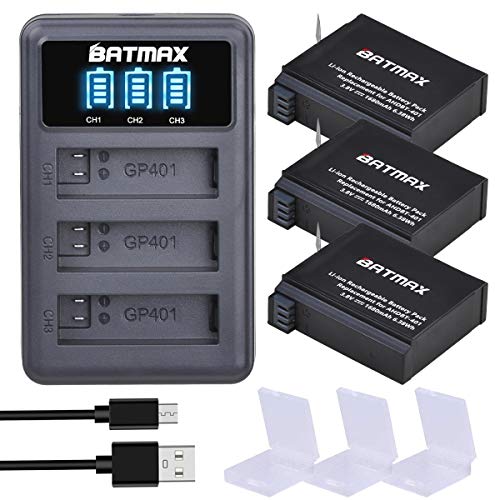
Suptig Battery (2 Pack) and Daul Charger for Gopro Hero 3 Hero 3+ and Gopro AHDBT 301 AHDBT 302


A pre-trip checklist distilled from the evidence
Condensed into routine, the guidance in this guide becomes a short pre-trip sequence. Confirm each pack model code against the camera generation. Charge through the cradle or cable arrangement you will actually use on the trip, not a different one borrowed for convenience. Run one timed recording on your primary filming mode with the pack you trust least, and compare it against your log. Inspect housings on a flat surface, wipe contacts, and verify that every door closes flush without force. Pack spares in individual slots with terminals protected, place the original pack where firmware updates and reference checks can find it, and set a calendar reminder for the monthly swelling inspection during the season. None of these steps requires equipment beyond a scale, a cloth, and a notebook, yet together they intercept nearly every failure pattern that owner feedback repeats.
After the trip, the closing routine matters as much as the opening one. Note which packs underperformed while memory is fresh, discharge or top up each unit toward a partial storage charge rather than leaving them brim full or empty, and store the set somewhere cool and dry with the log kept alongside. Retire failures promptly through recycling instead of letting them drift back into the rotation during a rushed packing session months later. Over several trips these two small rituals compound into a power kit whose behaviour you can predict on the first morning of a holiday rather than discover on the last afternoon. Predictability, more than any single specification, is what a battery purchase is really buying, and it is available to any owner willing to measure twice and film once.
How altitude, humidity, and salt air join the story
Mountain filming adds thin air to cold, and thin air cools electronics less effectively even while ambient temperatures fall, a combination that surprises travellers whose cameras overheat at altitude on bright static shots yet freeze their packs on windy descents an hour later. Managing both extremes on the same day argues for shade discipline during summit time-lapses and pocket-warming during rides down, using the same spare in opposite roles. Coastal filming introduces salt aerosol, which creeps into contact interfaces and door seals and accelerates the oxidation described earlier. A fresh-water wipe of the camera exterior, thorough drying before opening any compartment, and contact inspection after beach trips belong in the maintenance rhythm for substitute and original packs alike, because corrosion does not check branding before it raises resistance and begins stealing runtime from the next session.
Humidity works more slowly but just as surely during storage. A kit shelved in a damp basement or a boat cabin invites contact film and label decay that eventually obscures the model codes this guide relies on. Silica gel inside a sealed storage case, refreshed or dried periodically, keeps the microclimate honest, and a photograph of each pack label stored on your phone preserves identification even if the printed original fades. These small environmental habits rarely appear in listings, yet owner feedback from coastal and tropical regions returns to them insistently, usually written by someone whose packs failed electrically perfect but mechanically unreadable, unidentifiable, and therefore untrustworthy for the firmware-sensitive cameras they served.
What to do in the first week with a new spare
Treat the first week with any substitute pack as a probationary period with a defined syllabus. Day one covers inspection: flat-surface check, contact photography, door fit, latch feel, and weight recorded beside the model code in your log. The first charge happens on your normal cradle or cable at room temperature, with a mental note of any unusual warmth. Then comes a timed reference recording on your most-used mode, indoors at a stable temperature, producing the baseline figure every later outing will be compared against. A second timed run outdoors in realistic conditions completes the syllabus, because a pack that matches its indoor baseline outside has earned front-line status, while a pack that only performs on the desk has revealed its assignment: gentle duties, time-lapses, and backup-of-backup service.
Keep the packaging and paperwork until that probation ends, since returning a pack that failed its syllabus is straightforward with materials intact and awkward without them. Note the seller response quality during any exchange as carefully as the replacement unit behaviour, because support culture predicts your experience across the pack whole service life better than any single unit can. A maker who swaps a questionable unit promptly and asks sensible questions about camera model and firmware is a maker whose next production run deserves consideration. By contrast, a seller who blames the camera reflexively for every symptom has announced how your swelling claim or firmware complaint will be handled later, and the wisest response is to let that first return also be the last transaction.
One further distinction separates careful substitutes from anonymous ones: documentation continuity. A maker who maintains a stable product page across years, archives compatibility notes for older firmware, and keeps the same model designation attached to the same specification gives owners a thread to follow when questions arise seasons later. Anonymous listings, by contrast, often vanish and reappear under new names with altered internals, severing every thread at once. Prefer the maker you can find again. That findability functions as an informal warranty beyond any printed term, because a business planning to answer questions next year builds packs differently from a business planning to be unfindable by then, and the difference shows in cell selection, housing tolerances, and the honesty of the watt-hour arithmetic printed on the label.
Finally, remember that the camera itself keeps receipts. Its settings menu records the firmware build, its file timestamps reconstruct recording durations, and its behaviour across a season quietly grades every pack you own. Owners who consult those receipts before shopping stop buying batteries by hope and start buying them by evidence, matching each new spare to a documented gap in the rotation: cold margin for winter, port charging for travel, or sheer count for long event days. That evidence-led habit is the real subject underneath every section of this guide, from model codes to swelling checks, and it transfers intact to whatever camera generation replaces the one in your hand today, because cells will keep ageing, firmware will keep evolving, and careful owners will keep out-recording careless ones on identical budgets.
There is also a etiquette of evidence worth adopting when discussing spares with other owners, in club forums, lift queues, and comment threads alike. Share the camera model, the firmware build, the filming mode, the temperature, and the pack age whenever you report a runtime, because a number stripped of those companions helps nobody and misleads many. Ask for the same companions before acting on anyone else report, however confident its tone. Communities that normalise that discipline become remarkably accurate buying guides in aggregate, surfacing which substitute lines tolerate new firmware, which cradles charge honestly, and which listings quietly changed cells mid-season. Your own log, kept in that same spirit, is both a private tool and a contribution waiting to be shared, and the owners who keep such logs are consistently the ones whose kits never ruin a day.
Keep that log somewhere it survives a phone upgrade, whether a paper notebook in the camera bag or a simple file backed up with your footage archive, because its value grows with every season it honestly covers.
For the rider weighing a pocketful of spares before first lift, the deciding image is simple: the last run of the day, light fading, gauge honest, door sealed, and a warm spare waiting that you trust without thinking.