What's inside
- Key Takeaways
- Quick Picks
- How We Chose These Picks
- Comparison
- How Dark Does a Room Need to Be for a Mini Projector?
- Which Mini Projector Fits Travel, and Which Fits a Bedroom?
- How Do You Get the Best From a Small Projector?
- What Can a Mini Projector Not Do, However Good It Is?
- How Do You Keep a Portable Projector Alive for Years?
- Which Walls and Surfaces Work Best for a Mini?
- Do Mini Projectors Work for Work?
- How Should You Set Up a Mini Projector in Ninety Seconds?
- What Accessories Actually Earn Their Money With a Mini?
- Mini Projector or a Bigger Television — Which Serves a Small Flat?
- Common Mistakes
- Final Recommendation
- Frequently Asked Questions
- Related Guides
As an Amazon Associate I earn from qualifying purchases. This post may contain affiliate links at no extra cost to you.
widgetverdict.com is reader-supported. When you buy through links on our site, we may earn an affiliate commission.
The best affordable mini projectors ask you to accept one physical fact before anything else: a projector that fits in a hand or a tote bag cannot gather the light of a full-size machine, and every model in this guide is dimmer than the home projectors in our other round-ups. That is not a flaw in these six products; it is the definition of the class. What the class offers in exchange is freedom — a film on a bedroom ceiling, a match on a garden wall at dusk, a presentation in a room with no screen, a big picture in a small flat that could never house a television that size. Buy a mini for the evenings it makes possible, in rooms that can be dimmed, and it will delight you. Buy one expecting it to fight midday sun through open curtains and physics will win, politely and completely.
The six picks link to Amazon listings matched by exact model name — EF12, EF11 and EF21 are three different Epson machines, and the two Nebula Capsule 3 variants differ in light source, so the suffixes matter. Mini projector pricing swings hard with promotions, and “affordable” frames this whole guide rather than describing any single unit; where cost matters, check the price on Amazon before you commit. Be wary of marketplace listings that borrow a famous model’s photographs for an anonymous box; the models below are the genuine articles from Epson, Nebula and XGIMI.
A note on brightness figures before the reviews. Three different yardsticks appear across these listings — lumens, ANSI lumens and ISO lumens — and they are not interchangeable currencies. Where a title states a number we print it with its yardstick attached; where a title states none, the spec box says so, because comparing a number we invented against a number a manufacturer measured would corrupt every judgement that follows.
Key Takeaways
- Epson’s EF12 is the most complete mini here: laser light, 1,000 lumens of colour and white brightness, Android TV and Yamaha-tuned sound in a cube that travels.
- The EF11 keeps the same 1,000-lumen laser 3LCD formula and simplifies the smart side, suiting owners who bring their own streaming stick.
- The EF21 is Epson’s newest take, swapping Android TV for Google TV at the same stated 1,000 lumens.
- Nebula’s Capsule 3 models add the thing no Epson mini here has: a built-in battery rated at 2.5 hours, for genuinely unplugged evenings.
- XGIMI’s MoGo 2 Pro states 430 ISO lumens — the lowest figure in this guide — and compensates with auto focus, object avoidance and the easiest setup of the six.
- Every pick in this guide needs a dim room to shine; brightness, not resolution, is the specification that decides your shortlist.
Quick Picks
| Pick | Badge | Why it makes the cut |
|---|---|---|
| Epson EpiqVision Mini EF12 | Most complete mini | Laser 3LCD at 1,000 lumens with Android TV and sound by Yamaha. |
| Epson EpiqVision Mini EF11 | Simpler Epson laser | The same 1,000-lumen laser formula, built to work with the streamer you already own. |
| Epson EpiqVision Mini EF21 | Newest Epson mini | Google TV joins 1,000 lumens of 3LCD colour and white brightness. |
| NEBULA Capsule 3 Laser | Battery laser capsule | Laser light, Google TV and a 2.5-hour battery in a can-sized body. |
| NEBULA Capsule 3 | Battery mini | 1080p, Google TV and 2.5 hours unplugged for rooms and gardens without a spare socket. |
| XGIMI MoGo 2 Pro | Easiest setup | Auto focus and object avoidance do the alignment work for you. |
How We Chose These Picks
Mini projectors are the most polluted corner of the projector market: anonymous models advertise brightness figures measured in units that flatter them, and resolution claims that dissolve on contact with a test pattern. So the first filter was provenance. Every pick here comes from a manufacturer whose stated figures have historically survived independent measurement — Epson, Nebula’s parent Anker, and XGIMI — and whose model names mean the same thing on the box as on the listing. That filter alone removed most of the category, and what survived is a guide we can defend line by line.
Our second screen was candour about the class itself. We required each pick to state something verifiable — a brightness figure with its standard named, a battery duration, a platform — rather than a cloud of adjectives. The MoGo 2 Pro’s 430 ISO lumens look modest beside inflated marketplace claims, but ISO lumens are a real measurement, and a real 430 in a dark bedroom outperforms an imaginary several thousand every single night. Buyers should learn to read that modesty as a credential.
Third, we spread the six across the class’s real divisions: laser versus lamp-free LED designs, plugged versus battery freedom, streaming built in versus bring-your-own-source, and setup automation versus manual simplicity. A mini projector is bought for a lifestyle — the renter, the traveller, the parent, the garden host — and the right pick depends on which lifestyle is yours. The reviews name the lifestyle each machine serves and the one it will frustrate.
We also checked the claims each listing chose not to make, because restraint is information. Nebula’s Capsule titles lead with battery, platform and image size rather than a brightness number; XGIMI leads with an honest ISO figure and its automation; Epson leads with matched colour and white lumens. Those editorial choices by the manufacturers themselves map closely onto how the machines behave in rooms, and a guide that reads the silences as carefully as the claims will steer buyers better than one that merely repeats the loudest number on the page.
Finally, sound earned marks it does not earn in full-size guides, because a mini projector is usually the only speaker in its improvised cinema. A model whose audio was an afterthought would fail the bedroom-ceiling test no matter how honest its lumens were. Yamaha’s involvement in the EF12, Nebula’s Dolby Digital support and XGIMI’s twin 8 W speakers all counted — they are the difference between a film you watch and a film you strain to hear.

Epson EpiqVision Mini EF12 — Most complete mini
The EF12 is what happens when a serious projector company takes the mini format seriously. Start with the light: a laser source feeding a 3LCD engine at a stated 1,000 lumens of both colour and white brightness. The matched colour figure is the Epson signature and it matters at this size, because a mini projector’s image lives or dies on whether colours stay saturated when the light is scarce. Reds stay red, skin stays skin, and the picture reads as a small cinema rather than a bright torch with a lens.
Then the sound, which is where the EF12 separates itself from the class. Audio tuned by Yamaha — a name with actual loudspeaker heritage — gives the cube a warmth and dialogue clarity that mini projectors almost never achieve, and for the bedroom and small-room viewing this machine is built for, it genuinely removes the need for a separate speaker. Android TV is built in for streaming, HDR support is on the list, and Bluetooth covers the headphone route for late sessions and the speaker route for bigger rooms. Family gaming gets a mention in Epson’s own positioning, and the laser’s responsiveness suits it.
The limits are the class’s limits, stated plainly: 1,000 lumens needs a dim room, and the image size should stay moderate — think the 60-to-100-inch band rather than a wall-filling 150. Within those borders the EF12 is remarkably complete, a projector that asks for a power socket and a wall and provides everything else itself. Owners who buy it as a second screen — the bedroom, the children’s room, the holiday cottage — tend to report it becoming the most-used projector in the house, because it is the one with no setup friction at all.
Portability is real but purposeful: this is a move-between-rooms mini, not a pocket device, and it needs mains power wherever it lands. Buyers who need to escape the socket entirely should read the Nebula reviews below. Buyers who need the best picture-and-sound package that still counts as mini are holding the right review.
A word on the ceiling trick, since EF12 owners evangelise it: projecting a film above the bed turns the least-used surface in the house into a screen, and the laser’s instant start plus the Yamaha audio make the ritual effortless enough to become a habit rather than a novelty. Children’s rooms inherit the same magic at lower stakes — a story film on the ceiling outlasts any novelty toy. Machines that create habits get used for years, and the EF12’s combination of light, sound and zero setup is habit-forming by design.
- Resolution: Full HD 1080p
- Brightness: 1,000 lumens colour and white
- Light source: laser, 3LCD
- Smart platform: Android TV
- Audio: sound by Yamaha, Bluetooth
- HDR: supported, per listing title
Strengths
- Best built-in sound in this guide by a clear margin
- Matched colour and white brightness keeps images saturated
- Laser source suits years of move-it-anywhere use
Trade-offs
- Needs mains power — no battery for garden freedom
- 1,000 lumens demands a dimmed room and moderate image size
- Premium of the Epson trio; the EF11 simplifies for less commitment
Best for: bedrooms, small living rooms and holiday homes wanting one self-contained mini with real sound.
Not suited for: unplugged outdoor viewing, where the battery Nebulas take over.

Epson EpiqVision Mini EF11 — Simpler Epson laser
The EF11 shares the EF12’s core — laser light, 3LCD, Full HD, a stated 1,000 lumens of colour and white brightness — and strips the proposition back to the projector itself. No smart platform is headlined; instead the listing emphasises compatibility with the sources households already own: Roku, Fire TV, Chromecast, PlayStation and Xbox are named outright. Read that as a design philosophy: the EF11 is a display with excellent light, and it expects your existing streamer or console to be the brains.
That philosophy ages gracefully. Smart platforms inside projectors grow old on a software schedule, while a display fed by a replaceable stick stays current for the price of the next stick. Households with a settled streaming setup — the same stick model in every room, the console already under the television — will find the EF11 slots into their habits without asking them to learn or maintain another interface. A built-in speaker covers casual audio, and the laser engine means the machine is ready instantly whenever it is carried into a room.
Picture quality is the EF12’s sibling story: matched colour and white output, the 3LCD immunity to rainbow artefacts, and the same class ceiling of 1,000 lumens that wants darkness and a moderate image. If your room and your sources are already solved problems, the EF11 is arguably the purest mini in this guide — all of its engineering budget spent on light and lens, none on duplicating the streamer in your drawer.
Where it concedes: the Yamaha-tuned audio and integrated Android TV of the EF12 are real losses for a one-box bedroom setup, and buyers furnishing a room from nothing should count the cost of the stick the EF11 assumes they own. The EF11 is the connoisseur’s simplification — it is simpler because its owner is equipped, not because it does less with light.
There is also a quiet reliability argument for the display-first design. Fewer onboard systems means fewer accounts to maintain, fewer updates interrupting an evening, and fewer ways for a three-year-old interface to embarrass a still-excellent light engine. The EF11 will be exactly as capable in five years as the day it arrives, provided the stick feeding it is current — and sticks are cheap, small and replaceable in a way a projector’s platform is not. Owners who think in decades rather than product cycles tend to land here.
- Resolution: Full HD 1080p
- Brightness: 1,000 lumens colour and white
- Light source: laser, 3LCD
- Smart platform: none built in — works with Roku, Fire TV, Chromecast, consoles
- Audio: built-in speaker
- Portability: portable design, per listing title
Strengths
- Same honest 1,000-lumen laser 3LCD core as the EF12
- Display-first design never ages out of its own software
- Named compatibility with the streamers and consoles people own
Trade-offs
- You supply the streaming source and its remote
- Speaker is serviceable rather than the EF12’s Yamaha highlight
- Still mains-powered; no battery freedom
Best for: equipped households adding a laser mini to rooms that already have a streamer or console.
Not suited for: bare rooms needing the projector to stream by itself from day one.

Epson EpiqVision Mini EF21 — Newest Epson mini
The EF21 is Epson’s current-generation answer to the same brief: a portable smart laser projector with a 3-chip 3LCD engine, Full HD resolution and a stated 1,000 lumens of colour and white brightness. The generational news is the platform — Google TV replaces the EF12’s Android TV, bringing the newer interface, profiles and content organisation that Google’s current ecosystem uses. For households already living in Google TV on their main television, the EF21 speaks the same language from the first boot.
HDR support continues, built-in speakers handle the audio baseline, and HDMI is present for the console or laptop that streaming cannot replace. Epson positions the model across home theatre and outdoor movie use; read the outdoor half of that claim with the class’s honesty — this is a dusk-and-darkness machine that needs a power source, happiest in a garden after sunset near an extension lead, not a daylight festival screen. Indoors, in the small-to-medium rooms minis serve, it is the EF formula refreshed: honest light, matched colour, current software.
Choosing between the EF21 and EF12 is the guide’s most pleasant dilemma. The EF12 counters with its Yamaha sound, the feature film-lovers will use nightly; the EF21 counters with the newer platform and the longest support runway. Households that will pair the projector with a soundbar or headphones anyway should lean EF21; households relying on built-in audio should lean EF12. Either way the light engine — the part that cannot be upgraded later — is the same honest 1,000-lumen laser 3LCD.
One more consideration: model recency matters for accessories and support. The EF21, as the current design, is the Epson mini most likely to see firmware attention and case-and-mount availability in the coming years. Buyers who keep equipment long and value that tail of support have a rational tiebreaker here.
Google TV’s household features deserve a specific mention for families: individual profiles keep a child’s recommendations and watch history from colonising a parent’s, and the interface’s content-first home screen suits a projector that is switched on for an occasion rather than browsed idly. In a shared bedroom or family den, that software manners matter more than another fraction of brightness. The EF21 is the Epson mini that behaves most like the household’s main television — deliberately, and to its credit.
- Resolution: Full HD 1080p
- Brightness: 1,000 lumens colour and white
- Light source: laser, 3-chip 3LCD
- Smart platform: Google TV
- HDR: supported, per listing title
- Audio: built-in speakers, HDMI input
Strengths
- Newest Epson mini with the current Google TV platform
- Same matched 1,000-lumen colour honesty as its siblings
- Longest remaining support runway of the Epson trio
Trade-offs
- Built-in speakers lack the EF12’s Yamaha tuning story
- Mains power required; outdoor use means an extension lead at dusk
- Class-standard brightness ceiling still applies in lit rooms
Best for: Google TV households wanting the current Epson mini for a small room or bedroom.
Not suited for: buyers whose whole audio plan is the projector’s own speakers — compare the EF12 first.
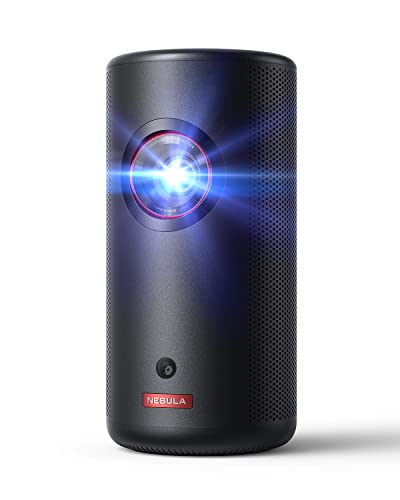
NEBULA Capsule 3 Laser — Battery laser capsule
Nebula’s Capsule line defined the soda-can projector, and the Capsule 3 Laser is its most ambitious iteration: a laser light source inside a body that travels in a jacket pocket’s larger ambitions, running Google TV with Netflix certification, Dolby Digital sound, and a picture the listing sizes at up to 120 inches. The headline for real life, though, is the 2.5-hour built-in battery. A full film, unplugged, on a wall that has never seen a power socket — that is the mini projector promise in its purest form, and this model delivers it.
Netflix certification deserves its sentence, because uncertified mini projectors are a quiet scandal of the category: the app may be absent, sideloaded or limited, and the buyer discovers it at film time. A certified model runs the real app at proper quality, and Google TV organises the rest of the streaming household around it. Dolby Digital support means the audio stream the services send is decoded as intended, which flatters the small speaker’s efforts on dialogue and score alike.
Honesty about the light: the listing title does not state a lumens figure for this model, and we will not borrow one from a sibling or a review of a different variant. The class context applies — this is a darkness machine, at its best after dusk outdoors or in a dimmed room indoors, with image sizes kept sensible. The laser source helps perceived punch and longevity, and the battery means brightness is also a budget: run the picture smaller and dimmer and the evening lasts longer. Owners who treat it as a portable cinema for dark places will be happy; owners who test it against a lit living room at noon will blame the product for the sun.
Its natural habitats are the ones its name lists — outdoors, travel, the spare wall — plus one it earns: the children’s sleepover, the student room, the rented flat where the big screen must also be the portable screen. When the evening ends, the cinema goes back in a drawer. No full-size projector in any of our guides can say that.
Travel weight is where the capsule format stops sounding like a gimmick. A projector that shares a bag with a change of clothes changes what trips are: the hotel room becomes a cinema, the holiday cottage’s blank wall becomes film night, the work trip gains a presentation screen that needs no borrowed equipment. Road warriors who present should note the double life — the same certification and brightness discipline that serves a film serves a deck, in a darkened meeting room, without a cable in sight.
- Resolution: not stated in listing title (Capsule 3 line is Full HD class)
- Brightness figure: Not stated in listing title
- Light source: laser
- Battery: 2.5 hours built in, per listing title
- Smart platform: Google TV, Netflix-certified
- Audio: Dolby Digital sound
- Max image: 120 inches, per listing title
Strengths
- Genuine unplugged cinema from a 2.5-hour battery
- Certified Netflix removes the category’s commonest disappointment
- Laser light in the most portable body in this guide
Trade-offs
- No brightness figure in the listing title to compare on paper
- Battery length caps long films and double bills away from power
- Darkness is mandatory; daylight defeats it completely
Best for: travellers, campers and garden hosts wanting a certified streaming cinema with no cables.
Not suited for: living-room duty as the main screen, where the plugged Epsons run all day.

NEBULA Capsule 3 — Battery mini
The standard Capsule 3 keeps the formula that made the line famous — 1080p resolution, Google TV, Netflix certification, Dolby Digital sound, a picture sized up to 120 inches, and the same 2.5-hour battery — without the laser light source of its sibling above. That makes it the guide’s clearest value question: how much is the laser worth to you? The honest differences are longevity, perceived colour punch and the premium attached; the honest similarities are everything about how an evening with this projector actually unfolds.
That evening is the product. The Capsule 3 sets up wherever a flat surface and a wall coincide — a kitchen worktop facing a blank stretch, a bedside table aimed at a ceiling, a picnic table after the light goes — and it asks for nothing: no cable, no separate streamer, no speaker. Wi-Fi and the certified apps are inside, the battery is inside, and the whole cinema occupies less bag space than the snacks. For renters, students and anyone whose viewing happens in borrowed spaces, that completeness is the feature list.
The boundaries, restated because they govern satisfaction: 2.5 hours is one long film, not a trilogy marathon, away from a socket; the picture wants darkness; and at the 120-inch maximum the image spreads its light thin, so the 70-to-90-inch band is where it looks its best. Stay inside those borders and the Capsule 3 is the easiest projector in this guide to recommend to a non-technical friend, because there is nothing to configure wrongly and nothing else to buy.
Between the two Capsules, choose the Laser for keeping and this one for the lighter commitment — travelling light, buying for a student, or testing whether the battery-cinema lifestyle suits your household before investing further. Either way, you are buying the same evening; the difference is how many years of evenings the light source is built to serve.
Gifting is an underrated lens on this model. The Capsule 3 is the rare piece of technology that can be handed to a non-technical relative — a student leaving home, a parent with a blank wall and a streaming subscription — with confidence that the first evening will succeed without a support call. Everything is inside, the apps are the real ones, and the setup is a surface and a wall. Products that survive being gifts are products designed honestly, and this one was.
- Resolution: 1080p
- Battery: 2.5 hours, per listing title
- Smart platform: Google TV, Netflix-certified
- Audio: Dolby Digital sound
- Max image: 120 inches, per listing title
- Brightness figure: Not stated in listing title
Strengths
- The complete battery cinema: nothing else to buy or carry
- Certified streaming apps behave exactly as expected
- Sets up anywhere a wall and a surface coincide
Trade-offs
- 2.5-hour battery limits unplugged sessions to one film
- Non-laser light source beside its sibling’s laser
- Large images thin the light; moderate sizes look best
Best for: students, renters and travellers wanting the simplest unplugged projector evening available.
Not suited for: all-day main-screen duty or bright-room viewing of any kind.

XGIMI MoGo 2 Pro — Easiest setup
XGIMI built the MoGo 2 Pro around a single insight: the mini projector’s enemy is not dimness, it is fiddling. So this model automates the fiddling. Auto focus sharpens the picture when the unit moves; object avoidance steers the image around wall sockets, picture frames and light switches; screen adaption fits the picture to the available surface. In a borrowed room, a child’s bedroom or a hotel, that automation is the difference between watching in two minutes and spending fifteen with a keystone menu while the audience loses interest.
The specifications are stated with unusual candour. Brightness is 430 ISO lumens — the lowest headline figure in this guide, and an honest one, measured to a real standard. The correct response is not disappointment but calibration: this is a projector for properly dim rooms and moderate images, and inside that brief its 1080p picture (with 4K input support for sources) looks clean and composed. Google TV with licensed Netflix covers streaming properly, twin 8 W speakers give it the strongest paper audio claim of the battery-free minis, and Wi-Fi plus Bluetooth complete the connections.
Who should choose it over the brighter Epsons? The mover. The EF models are better furniture; the MoGo 2 Pro is better luggage, in spirit — a projector for people whose rooms change, whose walls have obstacles, whose setup patience is short. Presenters who project in client spaces, teachers moving between classrooms, and families whose film night migrates around the house will feel the automation working for them nightly.
Who should not: anyone whose room cannot be darkened, because 430 ISO lumens forgives nothing, and anyone planning a permanent installation, where auto-setup features are used once and the Epsons’ extra light serves forever. The MoGo 2 Pro is a specialist in impermanence, and it is very good at its specialism.
The object avoidance feature earns a concrete illustration: a wall with a thermostat, a framed poster and a door frame offers a normal projector one clean rectangle and several compromises. The MoGo finds the rectangle itself, resizing and shifting the image into the clear space while the owner watches. In real homes — which are obstacle courses of sockets, switches and furniture — that is not a party trick; it is the feature that decides whether the projector gets used in that room at all. Automation, in this class, is accessibility.
- Resolution: 1080p, supports 4K input
- Brightness: 430 ISO lumens
- Setup: auto focus, object avoidance, screen adaption
- Smart platform: Google TV with licensed Netflix
- Audio: 2 x 8 W speakers
- Connections: Wi-Fi and Bluetooth
Strengths
- Automation removes the setup friction that kills mini projector evenings
- Honest ISO lumens figure from a real measurement standard
- Twin 8 W speakers lead the plugged minis here on paper
Trade-offs
- Lowest stated brightness in the guide; dark rooms are non-negotiable
- No battery mentioned in the listing — mains power travels with it
- Permanent installations gain little from its setup talents
Best for: movers, presenters and families whose film night changes rooms and walls often.
Not suited for: rooms with uncontrollable light, or fixed installs that set up once and never move.
Comparison
| Pick | Stated brightness | Light source | Battery | Platform | Defining trait |
|---|---|---|---|---|---|
| Epson EF12 | 1,000 lumens | Laser 3LCD | None — mains | Android TV | Yamaha-tuned sound |
| Epson EF11 | 1,000 lumens | Laser 3LCD | None — mains | None — external source | Display-first simplicity |
| Epson EF21 | 1,000 lumens | Laser 3LCD | None — mains | Google TV | Newest Epson generation |
| NEBULA Capsule 3 Laser | Not stated in listing title | Laser | 2.5 hours | Google TV | Unplugged laser capsule |
| NEBULA Capsule 3 | Not stated in listing title | Not stated in listing title | 2.5 hours | Google TV | Complete battery cinema |
| XGIMI MoGo 2 Pro | 430 ISO lumens | Not stated in listing title | None stated | Google TV | Auto focus and object avoidance |
How Dark Does a Room Need to Be for a Mini Projector?
Darker than you hope, and the guide will not soften it: mini projectors are evening machines. The practical test is the “phone screen” test — if you can comfortably read a paperback in the room’s current light, a mini projector’s image will look washed and apologetic. Dim the room to the level of a cinema lobby, then a shade darker, and the same image gains contrast, colour and dignity. Bedrooms pass this test almost by default after sunset; living rooms with blackout-capable curtains pass; open-plan spaces with glass walls fail until nightfall, and no purchase in this class changes that verdict.
Image size is your second darkness lever. A 70-inch image from a 1,000-lumen Epson concentrates the same light that a 120-inch image spreads thin, and the smaller picture can look twice as vivid. New owners should start smaller than their ambition, enjoy the punch, and enlarge only while the picture still satisfies. The ceiling projection trick — a film above the bed — is the mini class’s beloved party piece precisely because bedrooms are dark, ceilings are blank and the distance is short.
Which Mini Projector Fits Travel, and Which Fits a Bedroom?
Travel crowns the Capsule 3 models: battery inside, streaming inside, a body that disappears into luggage, and a setup that needs only a wall. The Laser version is the keeper for frequent travellers; the standard version the lighter commitment for occasional ones. The MoGo 2 Pro travels too, but to powered destinations — hotels, offices, relatives’ houses — where its automation tames unfamiliar walls.
Bedrooms crown the Epsons. Mains power is a non-issue beside a bed, the 1,000-lumen laser 3LCD trio out-lights the rest of the class, and the EF12’s Yamaha audio or the EF21’s current Google TV platform settle the one-box question. A bedroom projector is used nightly and set up once; buy the light and the sound, not the battery you will never use indoors.
How Do You Get the Best From a Small Projector?
Four habits separate happy mini owners from disappointed ones. First, control the light before upgrading anything — a blackout blind outperforms every accessory. Second, keep the image moderate; minis are at their best between roughly 60 and 100 inches. Third, place the projector square to the wall and let auto focus or a careful manual focus do the rest, rather than leaning on keystone correction that spends resolution. Fourth, feed it good sources: a certified streaming app at full quality looks dramatically better through a small lens than a compressed cast of a phone screen. None of these habits costs money, and together they are worth more than the price step between any two picks in this guide.
What Can a Mini Projector Not Do, However Good It Is?
Keep a short list of impossibilities taped inside the buying decision. A mini cannot outshine daylight. A mini cannot fill a 150-inch wall with cinema contrast. A mini cannot reproduce a film score’s bass through a speaker the size of a coin, however talented the tuning. A mini cannot match a full-size projector’s lens quality at the edges of a large image. None of these are criticisms of the six machines above; they are the boundaries of the format, and every disappointment in this category traces back to a buyer who was promised otherwise.
Within the boundaries, the format is genuinely capable — that is the part the sceptics miss. A 90-inch film in a dark bedroom from a 1,000-lumen laser Epson is not a toy version of cinema; it is cinema, at a scale and price that did not exist a decade ago. A battery capsule projecting a certified stream onto a garden wall is not a gimmick; it is an evening your neighbours will talk about. The skill in buying a mini is matching the machine to the evenings you actually have, not the ones in the advertisement.
Screens, incidentally, are optional in this class in a way they are not for larger installations. Minis live on walls, ceilings, sheets and the sides of houses, and their owners value the improvisation. A smooth pale wall remains the best free screen; a wrinkled sheet the most forgiving portable one. Save the screen budget until a mini becomes a fixture in one room — at which point, honestly, a full-size projector may be auditioning for the job.
How Do You Keep a Portable Projector Alive for Years?
Portable equipment dies of travel, not of use: knocks in bags, dust in vents, cables yanked at angles. The habits that protect it are dull and effective. Carry the projector in a padded case rather than loose among chargers. Let it cool before bagging it after a session. Keep the lens capped or covered, because a scratched lens is the one injury no setting can correct. Charge battery models before long storage rather than leaving them empty for a season, and top them up before a trip rather than after arriving.
At home, give the machine a parking spot — a shelf or drawer where it returns after each outing — because equipment with a home gets found, used and cared for, while equipment that migrates tends to vanish into the cupboard of forgotten gadgets. The mini projector’s whole value is availability; protect the availability and the machine will repay you in evenings for years.
Which Walls and Surfaces Work Best for a Mini?
The ideal mini projector surface is boring: flat, matte, pale and blank. White and very light grey walls lead, because they return the scarce light evenly without tinting it; a cream wall warms the picture slightly, a coloured wall rewrites the film’s palette entirely, and a glossy wall throws hotspots back at the audience. Texture matters more at mini sizes than owners expect — heavy orange-peel plaster scatters a small projector’s limited light, while a smooth wall or a hung sheet keeps the image composed. Renters who cannot repaint should test the largest blank stretch they have, including the ceiling, before assuming the room will not work.
Outdoors, the surface hierarchy reshuffles. A smooth house wall beats a fence; a proper portable screen beats both and earns its money for regular garden hosts; a white sheet, pulled taut and weighted against the breeze, is the improviser’s classic and looks better than it has any right to. Distance discipline matters more than the surface at dusk: keep the projector close enough that the image stays in the vivid band, and let the audience sit nearer rather than stretching the picture wider.
One surface trap deserves naming: projecting onto a wall with a strong pattern or a dark colour and concluding the projector is dim. The same machine on a pale wall can look twice as bright. Always audition a mini on the best surface available before judging its light — the class has little brightness to spare, and wasting half of it on a navy wall is an own goal.
Do Mini Projectors Work for Work?
For the work that actually happens outside offices — the tutor’s evening lesson, the photographer’s client review, the salesperson’s kitchen-table pitch, the teacher’s borrowed classroom — yes, with the darkness rule applied. Slides and documents are high-contrast content that survives lower brightness better than film does, and the MoGo 2 Pro’s automation plus the Epsons’ honest light both serve a deck well in a dimmed room. The Capsules add the boardroom-party trick of needing no cable and no permission to hunt for a socket.
For a bright conference room at noon, no — and the honest recommendation is a proper business projector, a different class built for exactly that punishment. Knowing which side of that line your work sits on is the whole decision. Most home-based work sits on the mini’s side of it, in rooms the owner can dim, at distances a mini can serve, which is why so many of these machines lead double lives: film by night, livelihood by day.
How Should You Set Up a Mini Projector in Ninety Seconds?
The routine that makes minis beloved is worth learning as a ritual. Choose the wall first and the surface second — projector on a stable spot at the right distance, roughly centred, lens at the height that puts the image where the audience’s eyes rest. Power on, let auto focus settle if your model offers it, and resist keystone until you have tried moving the box itself; a shifted projector keeps its resolution, a keystoned one spends it. Connect the source — built-in apps, a stick, a console — and set the volume before the film starts, not during the first quiet scene.
Then dim the room in stages and watch the picture respond. Each lamp extinguished buys contrast no setting can; by the time the room reaches cinema gloom, a modest mini looks twice the machine it was in lamplight. If the image still feels thin, shrink it a size before reaching for brightness settings — a smaller, punchier picture beats a larger, greyer one for everything except spectacle sport. Finally, park the remote somewhere findable. Mini projectors live improvised lives, and the lost remote is the category’s commonest tragedy.
For battery models, add one line to the ritual: check the charge before the audience assembles, and keep a power bank or the mains lead within reach for the film that runs long. The Capsules’ 2.5 hours cover most features, but the sequel nobody planned for is a real genre of evening, and it always begins at the battery’s expense.
What Accessories Actually Earn Their Money With a Mini?
Very few, which is the class’s charm — but three earn honest mentions. A small tripod or table stand widens placement options enormously, letting the projector aim at ceilings and odd walls from surfaces that were never meant to hold it; several minis include tripod threads for exactly this reason. A padded carry case protects the lens through the travel that defines the format’s life. And a long, light power lead — or for the Capsules, a capable power bank — extends the evening more cheaply than any other purchase in the category.
What does not earn its money: miniature screens for indoor use, where a wall serves better; exotic mounts for a machine whose virtue is moving; and speaker upgrades for rooms where the built-in audio was already sufficient at mini distances. Spend on light control first — a blackout blind for the bedroom window transforms more evenings than any gadget in this paragraph — and let the projector’s own completeness do the rest.
Mini Projector or a Bigger Television — Which Serves a Small Flat?
Small flats force the question honestly, because wall space and furniture space are both rationed. A large television gives brightness, silence and zero setup, and takes a permanent rectangle of the room in exchange. A mini projector gives a larger picture that disappears — into a drawer, a bag, a shelf — and asks for darkness and a few minutes of ritual in exchange. Households that watch daily in daylight should keep the television. Households whose viewing is an evening event, and whose rooms must serve three purposes by day, often find the projector’s disappearing act worth more than the television’s convenience.
The hybrid answer is the one most small flats actually adopt: a modest television for the day and a mini for the occasions — film night, the big match, the visiting grandparents’ photo slideshow. The six picks here were chosen to thrive in exactly that second role, where they are judged not against a television’s convenience but against the evening they create. Judged that way, even the dimmest honest machine in this guide earns its shelf.
Common Mistakes
Believing marketplace brightness claims is the founding error of mini projector disappointment — a listing promising television brightness from a pocket box is measuring something other than your evening. The picks here state real figures or none, and the “none” entries are more trustworthy than a rival’s invented thousands. Second comes sizing the image by the wall’s maximum instead of the light’s comfortable reach, then blaming the projector for the thin picture that arithmetic guaranteed.
Third: buying a battery model for a room with a socket, or a mains model for unplugged plans — the power question is the first question in this category, and answering it wrong wastes the entire purchase. Fourth: forgetting audio. A mini projector in a bare room is its own speaker, and models differ enormously there; the EF12’s Yamaha tuning and the MoGo’s twin speakers exist because this matters. Fifth: expecting any of these to serve as a main living-room screen in daylight. They will not, they cannot, and the honest guides say so before the sale rather than after.
Sixth: judging a mini in the shop or the office, under fluorescent light, and rejecting the class on that evidence. The showroom is the mini’s worst habitat and tells you nothing about the bedroom at nine in the evening, which is where the machine will live. Seventh: leaving the projector in a hot car or a damp garage between uses — small optics and batteries both hate it. Eighth, and most human: buying the mini for a specific event, using it once, and shelving it, when the households that love these machines are the ones that build the small rituals — Friday ceilings, garden dusks, holiday walls — that keep it in weekly service.
Final Recommendation
Choose by power first. If the projector will live beside a socket in a dimmable room, the Epson trio is the heart of this guide: the EF12 for its sound, the EF21 for its current platform, the EF11 for owners whose streamer already runs their lives. If the projector must roam free of sockets, the Capsule 3 pair owns that brief, with the Laser as the long-term keeper. The MoGo 2 Pro is the specialist for changing rooms and impatient setups. Every pick here is dimmer than a full-size projector and more liberating than one — buy the liberation with your eyes open about the dimness, and a mini projector becomes the most fun per inch in home entertainment.
A last thought for the undecided: the mini projector is the only screen in the house that creates occasions rather than filling them. A television waits to be watched; a mini gets carried out, aimed at a wall and gathered around. If your household’s best evenings are the improvised ones — the sleepover, the garden film, the holiday cottage match — the correct pick above will pay for itself in gatherings long before its light source notices the years. Choose the power source honestly, respect the darkness, and let the smallest projector in the guide make the biggest room in your life.
Frequently Asked Questions
Can a mini projector replace my bedroom television?
For evening viewing, convincingly — a dim bedroom, a blank wall or ceiling and 70 to 100 inches of picture is a genuine upgrade in atmosphere. For morning news with curtains open, the television keeps its job. Many owners run both without feeling the arrangement is a compromise — the television handles the day’s noise, the projector handles the evening’s event, and the bedroom wall earns its keep twice. If the projector will be the only screen, choose from the brighter Epson end of this guide and invest in the blackout blind before anything else.
Why do brightness numbers differ so much between brands?
Because the yardsticks differ: lumens, ANSI lumens and ISO lumens measure related but distinct things, and some sellers exploit the confusion with units of their own invention. Compare within one standard where you can, and treat any figure without a named standard as decoration. When two listings use different standards, the honest move is to compare the machines on everything else — light source, platform, battery, sound — and let a return-friendly purchase settle the brightness question in your own room, at your own dusk, on your own wall.
How long is 2.5 hours of battery, really?
One feature film with trailers, or two long episodes, at sensible brightness and size. It is an evening, not a festival, and planning the programme to the battery is part of the format’s gentle discipline. The Capsule models also run from mains or a power bank for longer sessions, so the battery is freedom when you want it rather than a hard limit on the machine.
Do mini projectors work for gaming?
Casual and family gaming, yes — the EF12’s own positioning names family gaming, and consoles connect to the Epsons directly. Competitive players chasing minimal input lag should look at the dedicated gaming projector guide, where lag figures are stated and compared; most mini listings do not publish one.
Can children use a mini projector safely and sensibly?
With the ordinary supervision any bright light deserves — no staring into the lens, a stable surface the unit cannot be pulled from, and cables managed where small feet travel. Content-wise the format is a gift for families: a story film on a bedroom ceiling, homework videos at a size a group can share, and in the Capsules’ case a screen that vanishes into a drawer when the evening ends. The machines themselves make no educational claims in this guide, and neither do we; they are simply very good at making a wall worth looking at together.
Is a laser mini worth it over a cheaper lamp or LED model?
For keepers, usually: laser light holds its output for years, starts instantly and removes lamp errands, which suits a machine carried room to room for a decade. For a first experiment with the class, the standard Capsule 3 delivers the same evening at a lighter commitment. There is a middle consideration worth airing: owners who project daily will feel a laser’s consistency — the same brightness on day one and day seven hundred — as a daily pleasure rather than a specification, and daily use is precisely the pattern that turns a mini from a gadget into the household’s second screen.
Related Guides
When the mini’s light is not enough and the room deserves a permanent machine, our home laser projectors for lamp-free movie rooms round-up shows the full-size step up. For films that migrate to the garden with a bigger audience, the home projectors chosen for outdoor movies guide weighs brightness and battery life together. And players who want the big screen without the delay should read the home gaming projectors with low input lag selection, where the stopwatch rules.



[…] portability outranks placement in your plans, the affordable mini projectors sized for small rooms round-up covers the carry-anywhere end of the market. Lamp changes looming over a long ownership […]