What's inside
- Key Takeaways
- Quick Picks
- How We Chose These Picks
- How Do You Measure a Mid Tower for Cooler Clearance?
- Why Do Mid Towers Cluster Around the Same Clearance?
- The Best CPU Coolers That Will Fit a Mid Tower, Pick by Pick
- Does the Side Panel Itself Change the Fit?
- What Else Besides Height Decides Fit in a Mid Tower?
- How Do You Install a Tower in a Mid Tower Without a Struggle?
- How Do the Six Picks Compare on Shape and Specification?
- Will Today’s Fit Survive Tomorrow’s Upgrades?
- What Are the Most Common Mistakes When Fitting a Cooler in a Mid Tower?
- Final Recommendation
- Frequently Asked Questions
- Related Guides
As an Amazon Associate I earn from qualifying purchases. This post may contain affiliate links at no extra cost to you.
widgetverdict.com is reader-supported. When you buy through links on our site, we may earn an affiliate commission.
Where to buy: the six coolers below link to checked Amazon listings, and each was chosen against the one measurement that decides this category — the clearance your mid tower actually offers above its socket, in millimetres, with the panel closed.
The mid tower is the default case of PC building, and its one tyrannical specification is cooler clearance: the distance from the processor’s surface to the inside of the side panel. Everything else in a build can be rearranged, but a cooler that stands taller than that distance simply does not fit, and the discovery is always made at the worst possible moment — with the motherboard mounted, the paste applied, the cables routed and the evening already spent. The search for the best cpu coolers that will fit mid tower cases is therefore a measurement exercise before it is a performance one, and this guide treats it that way — leading with the one pick whose listing states its height outright, and describing the rest by their shapes, so you can match them against your own case’s stated clearance with a ruler rather than with hope.
That stated figure belongs to ID-COOLING’s FROZN A620 PRO SE: 157mm, printed in its listing alongside a 260W rating. Around it, the shortlist spans the shapes a mid tower is asked to house — two further twin towers of moderate stance, a compact double tower with a 250W rating, and two slim single towers that fit essentially anywhere the format exists. Where a listing does not print a height, this guide does not invent one; it tells you the shape, the fan arrangement and the class of case the shape belongs in, and leaves the final millimetres to the two documents that know them: your case manual and the maker’s specification page.
Read the guide in that spirit and it becomes a procedure rather than a ranking. Find your clearance figure. Note your memory height and your processor’s class. Then walk the six picks in order, striking out any whose shape or envelope fails one of your three numbers, and buy the strongest survivor. Owners who shop that way almost never return a cooler, and the ones who do can usually name the step they skipped — which is the most useful thing a buying guide can teach.
Key Takeaways
- Measure first: your case manual’s stated cooler clearance is the gate every pick must pass.
- The FROZN A620 PRO SE lists its height outright at 157mm, with a 260W rating and six heat pipes.
- Twin towers fit most mid towers, but their front fans overhang memory slots — RAM height is the second measurement.
- The Pure Rock Pro 3 Silver is a compact double tower with a stated 250W TDP rating.
- Slim single towers — Assassin X120 Refined SE and Hyper 212 Black II — are the fit-anywhere options.
- The Phantom Spirit 120 EVO brings seven 6mm heat pipes for mid towers housing hotter processors.
Quick Picks
| Pick | Badge | Why it earns its place |
|---|---|---|
| ID-COOLING FROZN A620 PRO SE | The measured one | Its listing states 157mm and 260W outright, with six heat pipes and dual 120mm fans. |
| Thermalright Peerless Assassin 120 SE | The twin-tower default | Six heat pipes and twin 120mm fans in the moderate stance most mid towers are built around. |
| Thermalright Assassin X120 Refined SE | The slim single | Four heat pipes and a TL-C12C PWM fan in a single tower that asks little of any case. |
| Cooler Master Hyper 212 Black II | The safe fit | A slim tower with AM5/AM4 and LGA1851/1700 support named in its listing. |
| be quiet! Pure Rock Pro 3 Silver | The compact double | A compact double-tower frame with a 250W TDP rating and quiet 120mm PWM fans. |
| Thermalright Phantom Spirit 120 EVO | The hot-chip twin | Seven 6mm heat pipes and dual PWM fans listed to 2150RPM for processors that work hard. |
How We Chose These Picks
Selection began with the mid tower’s reality rather than the coolers’ reputations, because in this category reputation is the one specification that cannot close a side panel. The format’s clearance clusters in a band that excludes the tallest flagship towers and welcomes everything beneath them, so the shortlist was built from designs whose shapes live in that band: twin towers of moderate stance, a deliberately compact double tower, and single towers slim enough to be beneath discussion. Any cooler whose appeal depended on dimensions its listing would not state and whose shape suggested the tall extreme of the market was left to guides with taller cases to serve.
Facts in the detailed sections come from the listings and nowhere else. One height is printed in this guide — the FROZN’s 157mm — because one listing prints it. Two TDP ratings appear, 260W and 250W, because two listings state them. Pipe counts, fan models and socket lists are likewise quoted only where the listing offers them. For every other dimension, the guide describes shape and class and instructs the buyer to confirm the exact figure against the maker’s specification before ordering. In a category defined by fit, that restraint is not caution theatre; it is the entire editorial method.
The six were finally arranged to answer the mid tower owner’s actual sequence of questions. Will it fit — answered by shape and the one stated height. Will it clear my memory — answered pick by pick. Will it cool my processor class — answered by pipes, fans and the two stated ratings. A cooler that answers all three for your build is the right cooler, whatever its position in anyone’s ranking.
Excluded, with intent, were the tallest flagship towers regardless of their reputations. A fit guide that smuggles in a cooler its own readers’ cases cannot house has failed before the first pick is read, and the flagship class is served by the aftermarket and quiet guides on this site for the cases that can take it. Also excluded were coolers whose listings offered neither a stated figure nor a recognisable shape class — in a category bought by measurement, an unmeasurable product is not a pick, it is a lottery ticket.
How Do You Measure a Mid Tower for Cooler Clearance?
Start with the case manual, which states a maximum CPU cooler height measured from the processor’s heatspreader to the side panel. That figure is your budget. Spend it with a margin: a cooler that consumes the entire budget leaves nothing for the fan cable’s route, the panel’s flex when it latches, or the difference between the manual’s reference motherboard and yours. Experienced builders keep a few millimetres unspent as a matter of policy, the way they keep a few watts unspent in a power supply. The margin is not wasted space; it is the part of the budget that absorbs every small lie the other documents tell, and in a category measured in single millimetres, small lies are the only kind there are.
If the manual is lost, measure the machine you have. With the processor seated, measure from its surface to the plane of the closed side panel — a ruler is awkward, so use a strip of card marked against the panel’s inner face, or a stack of coins built up until the panel just touches. Record the number and distrust it slightly; home measurement errs, and it should err on the side of a shorter cooler. Then read the cooler’s own specification from the maker’s page, not from a retailer’s summary, because summaries copy each other’s errors with enthusiasm.
Remember the second and third clearances while the ruler is out. Memory height matters wherever a tower’s front fan overhangs the slots, which is most twin towers: a fan raised to clear tall sticks adds exactly the millimetres you were budgeting. And the first expansion slot’s distance matters for the widest towers on some boards. A mid tower build measured in all three dimensions before ordering is a build that assembles in one sitting, which is the whole ambition of this guide.
One more measurement habit separates the calm builders from the returning ones: write the numbers down, with the source beside each. Case clearance from the manual, cooler height from the maker’s page, memory height from the kit’s specification, and the margin you intend to keep. Four figures on one line of a notebook is the entire engineering document of a successful build, and when a later upgrade reopens the fit question — a taller memory kit, a different cooler — the document is still there, answering in seconds what memory would answer in worries.
Why Do Mid Towers Cluster Around the Same Clearance?
The format’s dimensions are not an accident; they are the residue of a thousand compromises between desk footprints, motherboard standards and graphics card lengths. A mid tower must be wide enough for a tall cooler and a cable channel behind the tray, narrow enough to remain a mid tower, and the industry has settled where those pressures balance. That settlement is why the twin-tower class in this guide exists at its size: cooler makers design for the band the cases offer, and case makers design for the coolers they expect, in a feedback loop that has made the mainstream of both markets unusually compatible.
The exceptions live at the format’s edges, and buyers should know which edge their case occupies. Airflow-showcase mid towers with glass and wide cable chambers sometimes give generously; compact mid towers marketed on footprint quietly give less, occasionally drifting toward figures that exclude mainstream twin towers entirely. Neither is a defect — but the second group is where fit guides earn their existence, because a case can be honestly sold as a mid tower and still demand the slim singles in this list. The manual’s figure, again, is the only trustworthy census of which group your case belongs to.
There is a historical comfort available here: the mid tower has been the default for so long that its band is the most documented in all of PC building. For any popular case, someone has published photographs of these exact cooler classes installed, with the memory clearance and the panel gap visible. A buyer who searches their case’s name alongside a pick’s shape will usually find the answer photographed rather than argued — the community’s tape measure, shared.
That documentation cuts both ways, and a careful buyer reads it critically: a photograph proves a cooler fit one builder’s example of the case, with that builder’s motherboard and memory, and case revisions happen. Treat photographs as strong evidence and the manual’s figure as the verdict, in that order of consultation and the reverse order of authority. The combination — community proof checked against the printed number — is as close to certainty as this category offers before the parcel arrives.
The Best CPU Coolers That Will Fit a Mid Tower, Pick by Pick

ID-COOLING FROZN A620 PRO SE — The measured one
Begin with the number, because this pick is the number: the FROZN A620 PRO SE’s listing states a height of 157mm. Set that against the clearance figures mid tower manuals actually print and its significance lands — 157mm sits inside the allowance of a large share of the format, including cases that exclude the tallest flagship towers by a handful of millimetres. A buyer with a manual that says 160mm does not need this guide’s opinion about the FROZN’s fit; the arithmetic is the opinion, and it is favourable.
The hardware behind the number is a full twin-tower specification: six heat pipes, dual 120mm fans described as quiet with a 27.2dB figure in the listing, and a stated rating of 260W. That combination is why the pick leads this guide rather than merely appearing in it. Plenty of coolers fit a mid tower by being small; the FROZN fits while bringing the fin mass, pipe count and rating of the class above the slim singles. It is the answer for the owner whose case measured just short of flagship territory and who declines to let those millimetres dictate a lesser machine.
The standard twin-tower caveat applies — the front fan overhangs the memory slots, so check your sticks’ height and budget the fan’s possible rise into your clearance arithmetic. Do that sum honestly and the FROZN is the most completely specified purchase in this category: the one cooler here whose fit you can prove from your chair, before the box is open and the paste is out.
Its stated noise figure deserves a word of method, because this guide elsewhere declines to quote such numbers. The 27.2dB in this listing is the maker’s own claim for this product, printed where buyers can hold the maker to it, and it is quoted here as a listing fact rather than as a cross-brand comparison. What it signals — dual fans tuned to stay in a low register while a 260W envelope is served — matches the hardware’s shape, and owners can verify the character, if not the decimal, in their own room.
- Height stated in listing: 157mm
- Rating stated in listing: 260W
- Heat pipes: 6; fans: dual 120mm, listed at 27.2dB
- Layout: dual tower
Strengths
- Stated 157mm height makes fit provable in advance
- 260W rating with six heat pipes
- Full twin-tower capacity inside mid tower allowances
Trade-offs
- Front fan overhang requires memory height checks
- Still too tall for genuinely slim cases
- Twin-tower width crowds smaller motherboards’ top slot area
Best for: a mid tower whose manual states clearance in the low 160s of millimetres. Not suited for: a slim case whose allowance sits well below 157mm.
Thermalright Peerless Assassin 120 SE — The twin-tower default
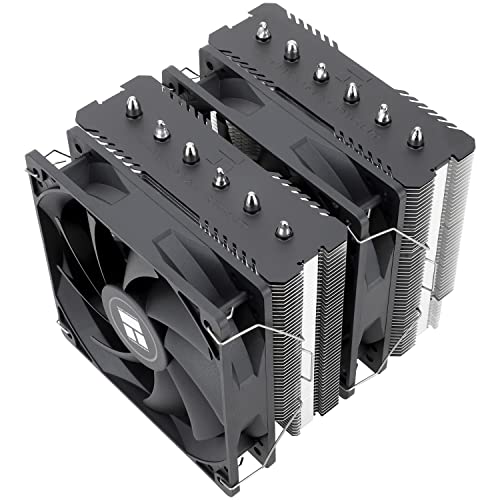
The Peerless Assassin 120 SE is the twin tower the mid tower format seems to have been designed around: six heat pipes with AGHP technology, two fin stacks, and twin 120mm PWM fans listed up to 1550RPM, in a stance that the mainstream of the format accommodates as a matter of routine. Its listing does not print a height in the material this guide works from, so the instruction is the category’s standard one — confirm the exact figure on the maker’s page against your manual — but its shape places it in the moderate twin-tower class that mid towers exist to house.
Its fit story has the usual twin-tower second act: the front fan over the memory. With standard-height DDR sticks the assembly sits as designed; with tall heatspreaders the fan rides up its clips and the total height grows by the amount of the rise. Mid tower owners should perform that arithmetic with their actual memory kit, because the Peerless Assassin’s popularity means a large share of the format’s builds perform exactly this sum, and the forums are full of its answer: standard memory, no drama.
As a cooling proposition it remains the segment’s value anchor — flagship-shaped capacity at a midrange tier — and in a mid tower that proposition compounds, because the case itself is the value format of PC building. The pairing is coherent: a sensible case, a sensible tower, and a processor cooled with headroom to spare, all without a single component auditioning for a showcase. Most mid tower owners should start their deliberation here and require a specific reason to move.
One more fit consideration belongs to this pick because of its popularity: graphics card length is unaffected by any air tower, but the tower’s rear fin stack and the case’s rear exhaust fan become neighbours in tighter mid towers, and a very thick rear fan can crowd the stack’s back edge. It is a thirty-second check with both parts in hand — and like every check in this guide, it is cheaper before the paste than after it.
- Heat pipes: 6, AGHP technology
- Fans: dual 120mm PWM, listed up to 1550RPM
- Layout: dual tower, moderate stance
- Fit notes: confirm stated height on maker’s page; mind memory overhang
Strengths
- Twin-tower capacity in the format’s mainstream shape
- Moderate fan ceiling keeps noise low
- Value tier matches the mid tower ethos
Trade-offs
- Check the exact height on the maker’s specification page
- Front fan overhang affects tall memory kits
- No stated TDP rating in the listing
Best for: the mainstream mid tower build with standard-height memory. Not suited for: a case at the narrowest end of the mid tower format.

Thermalright Assassin X120 Refined SE — The slim single
The Assassin X120 Refined SE is the fit-first entry in Thermalright’s own range: a single tower with four heat pipes, a TL-C12C PWM fan, an aluminium heatsink cover and AGHP technology in the pipes. Single towers are the mid tower’s insurance policy — their stance is slim enough that clearance stops being a question, and their fin stack leaves the memory slots entirely alone. For a build whose case sits at the format’s narrower end, or whose owner simply refuses to measure anything twice, this is the shape that ends the deliberation.
Refined is the operative word in its name, and it shows in the details a slim tower lives by: a finished top cover instead of exposed pipe ends, a fan that is a named, specified part rather than an anonymous spinner. In a windowed mid tower — which is most of them now — the single tower is the visible object above the socket, and this one presents itself like equipment rather than scaffolding. Four heat pipes set its honest ceiling: mainstream processors, gaming and office loads, the broad middle of what mid towers are built to run.
It will not follow a flagship processor into sustained all-core work with the same composure as the twin towers here, and it does not pretend otherwise. Its bargain is the opposite one: complete fit certainty, total memory freedom, a finished appearance, and cooling matched to the processors most mid towers actually contain. Owners who value a build that assembles without a single clearance negotiation will find that bargain priced exactly right.
The slim single also has a future-proofing argument of an unusual kind: because it asks so little of the case, it is the pick most likely to survive a case change in either direction — down to a narrower mid tower, or across to a different format entirely if the owner’s taste migrates. Coolers are rarely the component that blocks a rebuild, but when one does, it is always a tall twin tower meeting a smaller case. The X120’s owner will never have that meeting.
- Heat pipes: 4, AGHP technology
- Fan: TL-C12C PWM
- Layout: single tower, aluminium heatsink cover
- Fit notes: slim stance; memory slots left clear
Strengths
- Slim single tower fits the format’s narrow end
- No memory overhang at all
- Finished cover suits windowed cases
Trade-offs
- Four pipes cap sustained flagship performance
- Single fan works harder than twin-fan designs
- Less headroom for a future processor upgrade
Best for: a narrower mid tower or a builder who wants fit to be a non-question. Not suited for: sustained all-core loads on a flagship processor.

Cooler Master Hyper 212 Black II — The safe fit
The Hyper 212 Black II earns its place in a fit guide on two kinds of certainty. The first is shape: a slim single tower with four heat pipes and one PWM fan, a silhouette that has been fitting into mid towers for so long that the format’s designers effectively plan around it. The second is print: its listing names AMD AM5 and AM4 plus Intel LGA1851 and LGA1700 support outright, so the socket question — the fit question’s quieter sibling — is answered in the same document that sells the cooler.
For the mid tower owner, that combination makes this the zero-research purchase, and zero-research purchases have genuine value in a category full of arithmetic. The tower clears memory of any height, leaves the top expansion slot breathing room, and installs with the simplicity a single fan and a mature mounting system provide. Its black finish disappears into the dark interiors mid towers now favour, which is why so many of them are found there.
The ceiling is the family’s known one: four pipes and a single fan serve mainstream processors completely and flagship sustained loads partially. But a fit guide should honour what this cooler is — the answer when the case is narrow, the memory is tall, the processor is mainstream and the builder’s patience for measurement is finite. In the mid tower’s long history, that description covers an enormous number of beloved machines.
There is also a serviceability dividend to the slim tower that fit guides rarely mention: everything else in the case stays reachable. Memory swaps, M.2 installs, a graphics card change — none of them require unclipping a fan or working around a fin stack, because the Hyper 212’s footprint minds its own business. In a machine that will be upgraded piecemeal over years, which is the mid tower’s natural life, that reachability compounds quietly into hours saved.
- Heat pipes: 4
- Fan: single PWM
- Sockets named in listing: AMD AM5/AM4, Intel LGA1851/1700
- Layout: slim single tower
Strengths
- Slim tower fits effectively every mid tower
- Current sockets named in the listing itself
- Full memory clearance, simple install
Trade-offs
- Four-pipe ceiling on sustained loads
- Single fan spins faster than twin-fan rivals
- Little headroom for processor upgrades
Best for: a mainstream build in any mid tower, with any memory kit. Not suited for: a flagship processor under sustained all-core work.

be quiet! Pure Rock Pro 3 Silver — The compact double
The word doing the work in this pick’s listing is compact: a double-tower cooler in a compact frame, carrying a stated 250W TDP rating and two silent 120mm PWM fans. Compact is a fit claim before it is anything else — be quiet! is telling the mid tower owner that twin-tower capacity has been packaged with the format’s clearances in mind, rather than shrunk as an afterthought. For a buyer whose manual’s figure sits below the twin-tower mainstream, that claim, verified against the maker’s stated dimensions, is the difference between twin towers and settling.
The 250W rating does the processor-matching work: it frames the cooler for the performance mainstream, the chips mid towers most often house, with headroom above their sustained draw. The fans’ quiet tuning suits the format’s typical placement — on or under a desk, in a room that is also used for something else. And the silver finish suits the professional mid towers that still exist in numbers: the office and studio machines whose owners want capacity without a gaming aesthetic.
Confirm the exact dimensions on the maker’s page, as with every pick here whose listing leads with shape rather than a printed height. What the shape promises is a twin tower that respects the format, and what the rating promises is an envelope matched to its processors. A mid tower build that needs both promises kept — fit and capacity, without flagship bulk — is the build this cooler was drawn for.
The compact frame pays one more dividend inside a mid tower specifically: air space. A double tower that does not fill the case’s whole width leaves the front intake’s path to the graphics card less obstructed, and leaves the owner’s hands a working corridor during every later upgrade. Fit, in other words, is not only about whether the panel closes; it is about whether the machine remains pleasant to own afterwards, and compactness is the pick’s answer to both questions.
- Rating stated in listing: 250W TDP
- Fans: 2 silent 120mm PWM
- Layout: double tower, compact frame
- Fit notes: verify stated dimensions against your manual
Strengths
- Compact frame aimed at the format’s clearances
- 250W rating matches performance processors
- Quiet-tuned fans for desk-side machines
Trade-offs
- Dimensions need verifying on the maker’s own page
- Compact frame leaves less fin area than full towers
- Silver finish suits only some build themes
Best for: a mid tower needing twin-tower capacity in a disciplined frame. Not suited for: a case at the format’s absolute narrowest extreme.

Thermalright Phantom Spirit 120 EVO — The hot-chip twin
The Phantom Spirit 120 EVO is the pick for the mid tower whose processor outgrew the mainstream: seven heat pipes of 6mm diameter and dual PWM fans listed up to 2150RPM, in Thermalright’s twin-tower shape. The mid tower is often treated as a modest format, but plenty of them house high-core-count processors doing serious sustained work, and those builds need a cooler whose ceiling is high while its stance stays inside the format’s band. The EVO is that combination — the keenest hardware in this guide that still speaks the mid tower’s language.
Its fan ceiling deserves the same reading as in the Ryzen guide’s context: 2150RPM is headroom, and headroom is only as loud as the curve that spends it. Tuned with a ceiling reserved for genuine sustained loads, the EVO’s extra reach is insurance; left on a board’s eager default profile, it will announce itself. The seven pipes, meanwhile, do their work silently at every speed, spreading a concentrated hotspot across both fin stacks so the fans’ effort is shared by the whole heatsink.
Fit homework is the standard twin-tower set: confirm the maker’s stated height against your manual, and account for the front fan’s relationship with your memory. Do both and the EVO gives a mid tower something the format is not supposed to have — a cooler with flagship appetites that closes inside a mainstream case, leaving the side panel’s opinion out of the build entirely.
Buyers stepping up to the EVO from a slim single should expect the build’s centre of gravity to change in a good way: the processor stops being the component whose temperature is managed and becomes the one whose performance is simply available, at length, in a case that was never marketed as a workstation. That transformation — a mainstream case doing serious work — is the mid tower’s oldest party trick, and the EVO is its current instrument.
- Heat pipes: 7 × 6mm
- Fans: dual PWM, listed up to 2150RPM
- Layout: dual tower
- Fit notes: confirm stated height; mind memory overhang
Strengths
- Seven pipes for hot, concentrated loads
- High fan ceiling gives tuned curves real reserves
- Twin-tower stance inside the format’s band
Trade-offs
- Full-speed fans are plainly audible
- Stated dimensions should be checked before ordering
- More cooler than mainstream processors need
Best for: a mid tower housing a high-core-count processor under sustained loads. Not suited for: a quiet-first build that will never tune its fan curve.
Does the Side Panel Itself Change the Fit?
It does, in ways the clearance figure only partly captures. A tempered glass panel is rigid and flat, which makes it an honest boundary: the manual’s number means what it says, and a cooler inside the figure will not touch it. A mesh or perforated panel can breathe directly over the cooler — a genuine thermal gift to a tower whose fans sit close beneath it — but some mesh panels bow fractionally inward under their own mounting pressure, spending a millimetre the specification did not mention. A solid steel panel with sound-damping material applied inside is the quiet trap: the damping layer has thickness, and cases are not always measured with it fitted.
The practical response is the margin this guide keeps prescribing, now with its reasons itemised. A few millimetres absorb the damping layer, the mesh’s bow, the fan cable that must cross the tower’s shoulder, and the panel’s own latch travel. Builders sometimes read margin advice as timidity; it is actually an inventory of small physical facts, each measured in the same units as the cooler. The panel test at installation — held in place, unlatched, inspected — is the final audit of all of them at once.
Glass has one more fit consequence worth knowing before the build, not after: it makes the cooler’s height visible. A twin tower that fills the window is a design statement whether its owner intended one or not, and the slim singles’ restraint reads differently behind glass than the twin towers’ architecture. Fit is a physical question first, but in a windowed mid tower it is also the question of what the machine will look like every day — and the picks here were chosen to give both answers well.
A final panel note for owners of older cases: replacement and third-party panels exist for popular mid towers, and swapping a solid panel for glass — or the reverse — changes the boundary the cooler was measured against by the new panel’s thickness and mounting. Re-run the clearance sum after any panel change, however cosmetic it seems. The number of builds surprised by a decorative upgrade is small, but every one of them was surprised in exactly the same way.
What Else Besides Height Decides Fit in a Mid Tower?
Width, in two directions. A twin tower’s fin stacks spread across the socket, and on some motherboards the stack’s edge approaches the first expansion slot closely enough that a thick graphics card’s backplate enters the conversation. The check is quick — the board’s layout is fixed, the cooler’s width is published, and a dry fit settles what arithmetic suggests — but it belongs in the pre-order routine for any twin tower in this guide. Length matters at the case’s other axis too: nothing here is a radiator, but a tower’s fans and the case’s rear exhaust fan share a neighbourhood, and a rear fan already mounted can crowd a tall tower’s back edge on compact boards.
Depth of the case behind the motherboard tray is the unglamorous third direction, because mounting hardware lives there. Backplates and bracket screws need their millimetres behind the board, and a case with a shallow cable channel or a side panel that bulges inward under cable pressure can steal them. It rarely decides a purchase, but on a rebuild into a kept case it explains the occasional mysterious resistance at the last screw — and the fix, routing the thick cables away from the socket’s backplate zone, is free.
Memory remains the most common second failure, and it deserves repeating in a fit guide: the measurement that matters is not the tower’s height alone but the tower’s height with its front fan raised over your actual memory kit. Builders who buy the memory and the cooler in the same order should read both products’ dimensions in the same sitting. The builds that fail this check are never failed by exotic parts — they are failed by two ordinary parts whose ordinary dimensions were never introduced to each other.
Power supply placement writes the last line of the fit story in older mid towers, where the supply mounts at the top rear and its cables descend past the cooler’s neighbourhood. Modern bottom-mount layouts have mostly retired the problem, but a builder refreshing an older case should trace the cable runs before choosing the widest twin tower: the fins do not care about the cables, but the builder’s knuckles, during every later service, will.
How Do You Install a Tower in a Mid Tower Without a Struggle?
The mid tower’s gift is working room, and the install should use it in the right order. Fit the cooler to the motherboard before the board goes into the case whenever the build allows; the format’s cases are roomy by ITX standards but still tighter than an open bench. Route the EPS power cable along the top of the case before the tower occupies that airspace, because a twin tower’s fin stack makes the top edge of the board a place fingers visit reluctantly afterwards.
Paste, pressure and headers follow the universal discipline: pea-sized application, alternating corners, fans to CPU_FAN with the twin towers’ splitter so both fans share one curve, PWM mode confirmed. Then, before the side panel closes, perform the fit guide’s sacrament — hold the panel in place without latching it and look at the gap. A panel that sits flush with the cooler beneath it is a panel that will flex against the fan under vibration; the few millimetres of margin this guide keeps recommending earn their keep exactly there. Latch it, run a sustained load, and confirm the temperatures level off in the closed case, which is the only configuration that counts.
Photograph the finished interior before the panel goes on for the last time. The photograph is the build’s service manual: fan orientation, cable routes, the splitter’s position, the front fan’s height over the memory — all recorded in the configuration that worked. Every future upgrade begins by consulting it, and the builder who keeps it never has to reconstruct a working arrangement from memory and hope.
How Do the Six Picks Compare on Shape and Specification?
| Pick | Shape | Heat pipes | Fans | Stated figure |
|---|---|---|---|---|
| FROZN A620 PRO SE | Dual tower | 6 | 2 × 120mm | 157mm, 260W |
| Peerless Assassin 120 SE | Dual tower | 6 | 2 × 120mm PWM | 1550RPM ceiling |
| Assassin X120 Refined SE | Single tower | 4 | TL-C12C PWM | AGHP pipes |
| Hyper 212 Black II | Single tower | 4 | 1 × PWM | AM5/AM4, LGA1851/1700 |
| Pure Rock Pro 3 Silver | Double tower, compact | — | 2 × 120mm PWM | 250W TDP |
| Phantom Spirit 120 EVO | Dual tower | 7 × 6mm | Dual PWM | 2150RPM ceiling |
The stated-figure column is this guide’s honesty made visible: one height, two ratings, a socket list, two fan ceilings. Everything else about fit is shape, and shape is what the rows above it describe. A buyer who reads the table that way — figures where figures exist, shapes where they do not, and a ruler over both — has understood the category better than most of the marketing written for it.
Read across the shapes row by row and a second pattern emerges: capacity in this guide is bought with width more than with height. The twin towers spread sideways into fin area the format can spare, while the slim singles decline the spread and keep the change. That is the mid tower’s own design philosophy reflected in its coolers — the format grows in the directions its desk footprint allows, and the products that thrive in it have learned the same lesson.
Will Today’s Fit Survive Tomorrow’s Upgrades?
A mid tower is a long-term container, and the cooler chosen for it should be audited against the upgrades the container will plausibly see. Memory is the first: a twin tower that fits today with its front fan at standard height may not fit the taller kit a future upgrade brings, which is an argument for standard-height memory as a platform decision, not merely a cooler decision. The slim singles in this guide are immune to the question entirely, and owners who swap memory often should weigh that immunity beyond its weight in any specification table.
Processors are the second audit. A cooler bought at the exact envelope of today’s chip leaves the next chip — very likely hotter, in the same socket — unhoused. The two rated picks here, at 260W and 250W, and the EVO’s seven-pipe headroom, exist partly as upgrade insurance: capacity bought once, in a shape already proven to fit, that the next processor inherits without a new measurement campaign. Insurance is only wasteful when the insured event is impossible, and a hotter processor in a kept case is among the most ordinary events in this hobby.
The case itself is the third audit, and it cuts the other way: a cooler chosen at the very top of one case’s allowance may not follow its owner to the next case, which could be narrower. Owners who change cases the way others change graphics cards should prefer the middle of the band — the mainstream twin towers and compact doubles — because the middle of the band is where both cases and coolers agree to meet, generation after generation.
None of these audits requires prophecy, only the notebook line this guide recommended earlier: clearance, cooler height, memory height, margin. An upgrade decision made against those four recorded figures takes a minute and cannot be ambushed, because the ambushes in this category are never new — they are the same three clearances, wearing a new component’s name. The fit you document is the fit you keep.
What Are the Most Common Mistakes When Fitting a Cooler in a Mid Tower?
The first is trusting the format’s name. “Mid tower” describes a market segment, not a dimension, and two cases wearing it can differ by enough millimetres to decide this entire purchase. The manual’s number is the case; the name is advertising. The second is measuring the cooler but not the memory, and discovering the front fan’s raised position in the middle of the build. The third is assuming a cooler that fit a previous case fits this one, a mistake that survives because it so often nearly works.
Fourth is buying the tallest cooler the arithmetic barely allows and leaving no margin for cables, panel flex or a future fan swap — fit that exact is fit that ages badly. Fifth is forgetting the rear exhaust fan and the top EPS cable until the tower is mounted over both. And sixth, the meta-mistake: treating fit as a problem to survive rather than a specification to design around. The builders whose mid towers assemble in one calm sitting are not luckier than everyone else; they are the ones who did the arithmetic while it was still free.
A seventh deserves naming because it arrives dressed as diligence: measuring a cooler’s height from a photograph or a retailer’s dimension field that quietly lists the box. Packaging dimensions circulate through marketplaces with remarkable persistence, and more than one builder has rejected a cooler that would have fit, or ordered one that could not, on the strength of a cardboard measurement. The maker’s specification page, and only that page, is the document of record — a rule this guide has followed for its own single printed height, and one worth adopting for every dimension in the build.
Final Recommendation
Start with the FROZN A620 PRO SE if your manual’s clearance sits anywhere near its stated 157mm: it is the one pick whose fit is provable from the listing itself, and its 260W rating and six pipes mean the proof comes with flagship-shaped capacity attached, rather than with the apology smaller coolers usually carry into a serious build with a demanding processor at its centre and a long evening of work ahead of it. The Peerless Assassin 120 SE is the twin-tower default for the format’s mainstream, the Phantom Spirit 120 EVO its hot-processor upgrade, and the Pure Rock Pro 3 Silver offers the compact, quiet route between them. When certainty matters more than capacity, the two slim singles — Assassin X120 Refined SE and Hyper 212 Black II — fit anywhere in the format and ask nothing of the builder at all, ever, in any build or rebuild or weekend rescue operation. Measure the case, respect the memory, leave the margin, photograph the result, and the side panel will close on the first try — which is the sound this entire category is really selling, and the sound of every upgrade that follows it.
Frequently Asked Questions
How do I find my mid tower’s cooler clearance?
Every mid-tower maker publishes a maximum CPU cooler height, usually in the manual and again on the product page. Compare that figure with the cooler’s height from its own maker — the FROZN A620 PRO SE’s listing states 157mm, for example — and keep a few millimetres of margin rather than planning to the exact number. If the case is second-hand and the manual is gone, the maker’s archived product page and a physical measurement of the seated processor to the closed panel will reconstruct the figure between them.
What if my case’s clearance falls between two picks?
Choose the cooler whose shape sits comfortably inside the figure, not the one that consumes it entirely. A compact double tower like the Pure Rock Pro 3 or a slim single tower trades a little capacity for a fit that tolerates cables, panel flex and your next memory kit. Margin is a feature; buy it deliberately. The capacity surrendered is theoretical in most builds — mainstream processors never spend it — while the margin is spent, gratefully, on the first afternoon.
Does memory height really change whether a cooler fits?
Yes, on twin towers. The front fan sits over the memory slots, and tall heatspreaders force it upward on its clips, adding its rise to the cooler’s effective height. Standard-height memory avoids the arithmetic entirely, which is why fit guides keep recommending it for twin-tower builds. If your heart is set on a tall kit, do the sum in writing before ordering either part: cooler height, plus the fan’s rise over your kit, against the case figure, with margin left over for the panel.
Can a mid tower cool a flagship processor?
Yes, with the right pick. The FROZN’s stated 260W rating and the Phantom Spirit EVO’s seven pipes and high fan ceiling are both aimed at hot processors, and both live in shapes the format houses. The constraint is rarely the case’s size; it is choosing a cooler whose envelope matches the chip’s sustained draw. Mid towers also give such builds room for the case fans that feed a hard-working tower properly, which is part of why the format punches above its reputation in workstations.
Why do some listings not state a cooler height?
Retail listings vary in completeness, and the maker’s own specification page is the authoritative source. This guide quotes a height only where the listing itself states one — 157mm for the FROZN — and directs buyers to the maker’s page for the rest, because a borrowed or guessed millimetre is how builds fail. When the maker’s figure and a retailer’s disagree, believe the maker, and when two of the maker’s own documents disagree, believe the one attached to the exact model revision you are buying.
Should I install the cooler before putting the motherboard in the case?
Whenever the build allows, yes. A mid tower is roomy compared with ITX, but a bench is roomier still, and mounting pressure, cable routing and clearance checks are all easier with the board out. The exception is a case whose layout you know well — and even then, the EPS cable should be routed before the tower goes on, because it is the one cable every tower in this guide makes harder to reach afterwards.
Related Guides
Fit is the first question; the neighbouring guides ask the next ones. When the machine in the mid tower is measured, mounted and cooled, the rest of the desk deserves the same care and the same habit of checking the stated figure before trusting it, starting with Best Car Chargers for the vehicle, Best Wireless Chargers for the phone, and Best Fast Chargers for everything that plugs in between.
Related guide: Best Quiet Pc Mid Tower Cases


