What's inside
- Key Takeaways
- Quick Picks
- How We Chose These Picks
- Comparison
- How Do You Size a Simulator Bay Around a Short Throw Projector?
- What Does the Launch Monitor Need From the Projector?
- How Bright Does a Sim Bay Really Need to Be?
- How Should the Bay Be Lit Around the Projector?
- Common Mistakes
- Final Recommendation
- Frequently Asked Questions
- Related Guides
As an Amazon Associate I earn from qualifying purchases. This post may contain affiliate links at no extra cost to you.
widgetverdict.com is reader-supported. When you buy through links on our site, we may earn an affiliate commission.
The best short throw projectors for golf simulators solve a geometry problem before they solve a picture problem. A golfer needs room to swing a driver without clipping a ceiling-mounted machine, room to stand close enough to read a fairway, and an impact screen wide enough to make a simulated course feel like a place rather than a poster. Short throw optics answer that geometry by building a huge picture from a few feet away, so the projector can live near the screen, ahead of the swing, instead of hovering above the golfer’s backswing where every waggle feels like a near miss.
Six machines are reviewed below, and they do not form one happy family. Two carry the BenQ name and were titled explicitly for golf simulation, one in laser and one in 4LED light. Three Optoma models bring gaming-projector reflexes to the sim bay, with low input lag language printed in their titles alongside short throw optics and laser light. The sixth is an unbranded 4K machine with Google TV and a stated 2600 ANSI lumens, included deliberately as the budget wildcard: it may suit a casual bay, but it is not a peer of the BenQ pair, and its review keeps that distance honest.
Throw language in this guide comes only from the titles themselves. Where a title says Short Throw, the review says short throw; where a title is silent about its lens, the review does not invent a ratio. Exact throw distances depend on screen width and on the manufacturer’s own charts, and the how-to section below teaches the sizing method in general terms so you can run the numbers for your own garage, spare room or garden studio before any box is ordered.
Brightness matters differently in a sim bay than in a cinema. Golf software is bright software: fairways at noon, white score overlays, pale skies. A bay also tends to keep some ambient light alive so players can see the ball, the mat and each other. The lumen figures quoted below are the figures the titles print, from the BenQ AH700ST’s stated 4000 lumens down through the Optoma range, and they should be compared as like-for-like claims within one buyer’s shortlist rather than as laboratory truths.
Finally, remember what the projector cannot do. It cannot read your swing; the launch monitor does that. It cannot soften a mishit or widen a fairway. Its whole job is to put a large, bright, believable course in front of the hitting mat and then disappear from your attention, and the picks below are judged on exactly that disappearing act.
Key Takeaways
- Short throw optics keep the projector ahead of the swing path, which is the entire safety argument in a home sim bay.
- The BenQ AH700ST pairs a stated 4000 lumens with laser light and a golf simulator title; the AH30ST is its 4LED sibling.
- Optoma’s three GT models print low input lag language in their titles, a gaming inheritance that suits fast sim software.
- The Optoma GT3900UHD is the only pick whose title claims true 4K UHD alongside its short throw laser design.
- The unbranded 4K wildcard states 2600 ANSI lumens and Google TV, and should be bought as a gamble, not as a BenQ equivalent.
- Screen width and throw distance must be planned together; the sizing method in this guide works for any bay.
Quick Picks
| Pick | Badge | Why it earns its place |
|---|---|---|
| BenQ AH700ST Short-Throw Laser Golf Simulator Projector | The purpose-built laser sim machine | A 4000-lumen Full HD short-throw laser DLP projector titled directly for golf simulator use. |
| BenQ AH30ST Short-Throw Golf Simulation Projector | The 4LED BenQ alternative | Full HD short-throw 4LED DLP optics in a projector whose title names golf simulation outright. |
| Optoma GT2400HDR Short Throw Gaming Laser | Gaming speed, sim ready | Full HD 1080p, a stated 4,200 lumens, short throw laser light and low input lag gaming language, golf simulation ready. |
| Optoma GT3900UHD 4K Short Throw Laser Projector | True 4K for the detail-obsessed bay | True 4K UHD, a stated 4,000 lumens, a 30,000-hour DuraCore laser claim and golf simulator ready billing. |
| Optoma GT2300HDR Short Throw Laser Projector | The quieter Optoma option | Full HD 1080p, a stated 3,600 lumens, short throw laser design and low input lag gaming wording. |
| 4K Projector for Golf Simulator (2600 ANSI, Google TV) | The no-brand budget wildcard | A 4K-titled Google TV machine stating 2600 ANSI lumens, HDR10, MEMC and HDMI 2.1 ARC, bought with open eyes. |
How We Chose These Picks
Golf had to be in the title, or the machine had to carry a credible route into a sim bay. The BenQ pair and the wildcard name golf simulation in their own listing titles, and the three Optoma models print Golf Simulation Ready or Golf Simulator Ready alongside their gaming credentials. A home theatre projector with no sim language and no short throw claim did not make this list, however lovely its film picture might be, because a bay is a workplace with a swing in it.
Short throw wording was treated as a title fact, never as an assumption. Five of the six titles say Short Throw outright. The wildcard’s title stays silent about its lens geometry while claiming ceiling mountability and auto focus, so its review positions it for bays where placement can be arranged around a standard lens, and flags the homework its buyer must do on the listing before committing.
Light source shaped the running-cost column. Laser appears in the AH700ST’s title and across all three Optoma models, with the GT3900UHD printing a 30,000-hour DuraCore laser figure. The AH30ST answers with 4LED light, a different solid-state route. Solid-state light suits sim duty because bays accumulate hours quickly: winter leagues, junior practice and late-night range sessions all draw on the same lamp account, and a light source measured in tens of thousands of hours changes the ownership mood.
Brightness claims were recorded exactly as printed and compared cautiously. The figures here span the wildcard’s 2600 ANSI lumens to the GT2400HDR’s stated 4,200 lumens, with differing units and conventions between brands. The reviews treat each figure as its maker’s claim, useful for ranking within a shortlist, useless as a promise about any individual garage.
Responsiveness closed the assessment. Sim software renders a ball flight the moment the launch monitor reports impact, and a projector that lags behind that report makes every shot feel like a dubbed film. Low input lag language appears in all three Optoma titles and as low latency wording in the wildcard’s, while the BenQ titles make no lag claim at all; the reviews honour that silence rather than filling it.

BenQ AH700ST Short-Throw Laser Golf Simulator Projector — The purpose-built laser sim machine
BenQ builds simulator projectors as a product line rather than as an afterthought, and the AH700ST’s title reads like a specification written by someone who has stood in a bay. Short-throw, laser, DLP, Full HD, 4000 lumens, golf simulator: every noun in that string answers a question a sim builder actually asks. There is no streaming platform, no lifestyle language, no attempt to sell the machine as a patio toy. That focus is the review’s foundation.
Laser light suits the rhythm of practice. A bay session might last twenty minutes between other jobs, and laser switches on at full brightness without a lamp’s warm-up etiquette, then switches off without a cooling guilt trip. Across a winter of short, frequent sessions, that manners difference decides whether the bay gets used daily or saved for weekends, and daily use is where a simulator earns its floor space back.
The stated 4000 lumens address the bay’s ambient-light reality. Golfers keep some light on: they need to see the ball at address, read a glove, find a tee. A bright image holds the fairway’s contrast against that working light, so the simulated course stays a place to aim at rather than a pale suggestion behind the hitting mat. Treat the figure as BenQ’s claim, and it still ranks the AH700ST among the stronger lights in this guide.
Installation hardware is a quiet part of the BenQ proposition. A machine designed for bays expects to be ceiling-mounted close to a screen that will be struck by golf balls thousands of times, and it expects the vibration that travels through a building each time a driver meets a ball at full speed. Alignment that survives that environment is a build-quality question, and specialist machines are built by people who know the environment exists. Generalist projectors can be excellent and still be surprised by a sim bay; this one was born in one.
Full HD resolution invites one honest paragraph. At sim distances, where the player stands perhaps ten feet from a very wide screen, 1080p spreads its pixels broadly, and fine text on score overlays will look softer than it would on a television. Most players accept that trade instantly, because the sense of standing on a tee comes from scale and brightness rather than from pixel density. Players who cannot accept it should read the GT3900UHD review below, where the 4K argument lives.
Short throw placement is the safety core. The machine sits close to the screen, ahead of the hitting position, so a full driver swing unfolds behind it rather than beneath it. Ceiling strikes and shadow-casting both recede as problems. The exact distance for a given screen width belongs to BenQ’s own throw chart, and the sizing section later in this guide shows how to use such a chart before drilling a single hole.
A word about winter, because winter is when this machine will justify itself. Outdoor golf shuts down, range balls freeze, and the bay becomes the household’s sporting centre: a league on Tuesdays, a junior’s lessons on Saturdays, a long-drive contest whenever friends visit. A projector bought for that season must tolerate being the room’s hardest-worked appliance, switched on daily, dusted weekly, and expected to align perfectly after every enthusiastic celebration near the screen. Laser light and a specialist maker’s build are the two title facts that speak to that workload, and the AH700ST holds both.
Ownership support matters in this class, because a sim projector is closer to sports equipment than to a television: it will be aligned, realigned, dusted and questioned. A specialist line from a maker that publishes simulator guidance is a calmer thing to own than a generic box, and that calm is part of what the AH700ST’s price of admission buys, whatever the current listing figure happens to be.
Before ordering, confirm the throw distance for your screen width on the listing or BenQ’s documentation, and check the current price on Amazon while you are there, because a bay built around the wrong distance is an expensive geometry lesson.
- Light source: laser, per listing title
- Brightness: 4000 lumens stated (title truncated as “4000-Lumen”)
- Resolution: Full HD stated
- Optics: Short-Throw stated in title
- Engine: DLP stated
Strengths
- Purpose-titled for golf simulation by a specialist maker
- Laser light suits short, frequent practice sessions
- Strong stated brightness for a working, lit bay
Trade-offs
- Full HD rather than 4K at very wide screen sizes
- No input lag figure is printed in its title
- No streaming platform, so a PC or source is required
Best for: a dedicated bay where the projector’s only job is golf, done properly, several times a week.
Not suited for: a room where the projector must double as the household’s streaming cinema.

BenQ AH30ST Short-Throw Golf Simulation Projector — The 4LED BenQ alternative
The AH30ST is the other BenQ answer to the same room, and the difference begins in the light engine. Its title specifies 4LED DLP rather than laser, a solid-state design with its own ownership character: instant switching, long service life and colour behaviour that LED engines are known for. A buyer comparing the two BenQ machines is really choosing between two mature light technologies wearing the same short-throw, golf-titled uniform.
Full HD appears again, with the same honest consequence as its sibling: at bay scale the picture trades pixel density for size, and the trade suits the content. Golf courses are landscapes, not spreadsheets. Fairway contours, bunker edges and green shading read clearly at 1080p across a wide screen, and the overlays that matter most, distance and score, are drawn in large type by the software itself.
The title prints no lumen figure, and this guide will not supply one from a sibling model or a foreign listing. Brightness homework therefore lands on the buyer: read the figure on the current listing, compare it against the ambient light in your own bay, and remember that a bay with controlled lighting forgives a dimmer machine while a sunlit garden studio forgives nothing. BenQ’s silence in the title is a gap to fill with research, not a defect to invent around.
There is a budgeting honesty to choosing the AH30ST that deserves naming. Sim builders routinely overspend on the launch monitor, because its numbers feel like the product, and underspend on the image, which is the part they actually look at for hours. A BenQ sim projector at the gentler end of the line corrects that balance without leaving the specialist fold: the money saved against the laser flagship can fund a better impact screen, and a better screen improves every round more than a marginal specification ever will.
Short throw placement carries the same safety argument as the laser model. The projector lives near the screen, clear of the swing, and the golfer’s shadow stays off the fairway. In compact bays, a spare bedroom or a single garage space, that closeness is often the difference between a workable simulator and an abandoned plan, because a long-throw machine would need mounting depth the room simply does not have.
LED light changes the session rhythm in a way golfers feel. Practice often happens in fragments, ten balls before work, a quick nine at lunch, and an engine that wakes instantly and sleeps without fanfare fits fragmented practice better than one that prefers long, planned sessions. The AH30ST reads as the BenQ for the grazers rather than the marathoners.
Picture character needs a golfer’s translation. LED engines have a reputation for calm, saturated colour, and a golf course is a study in greens: fairway stripes, fringe, rough, putting surfaces, each a different shade the software uses to teach the eye distance. A machine that separates those greens cleanly helps a player read a virtual approach the way they would read a real one. The AH30ST’s title cannot prove that character, but its 4LED specification is the right pedigree for it, and buyers who value colour calm over headline brightness will understand the trade this BenQ is offering.
Support and documentation follow the same specialist logic as its sibling. BenQ’s simulator line exists because the company courts this exact buyer, and alignment guides, throw charts and mounting advice for bays are part of that courtship. A generalist brand can match a specification; matching the surrounding knowledge is harder.
Read the listing’s full specification for the brightness figure and the throw chart before you decide between the two BenQ picks, and verify the delivered price on the same visit, because the right choice between them depends on numbers this title leaves off its own headline.
- Light source: 4LED, per listing title
- Resolution: Full HD stated
- Optics: Short-Throw stated in title
- Engine: DLP stated
- Brightness figure: Not stated in the listing title — verify with the manufacturer documentation
Strengths
- Solid-state LED light with instant-on practice manners
- Specialist golf titling from the same BenQ sim line
- Short throw suits single-garage and spare-room bays
Trade-offs
- Title prints no brightness figure to plan around
- Full HD pixel density at the widest screen sizes
- No lag or gaming figures in its title
Best for: a compact bay used in short, frequent practice bursts by a player loyal to the BenQ sim line.
Not suited for: a bright, glass-walled studio where a verified high lumen figure must anchor the plan.
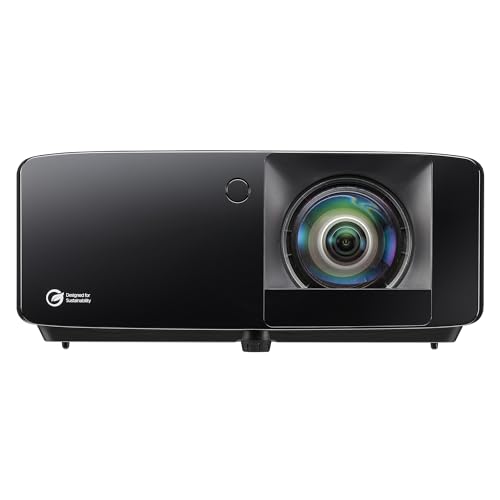
Optoma GT2400HDR Short Throw Gaming Laser — Gaming speed, sim ready
Optoma arrives at the golf bay from the gaming room, and the GT2400HDR’s title tells that story in order: Full HD 1080p, 4,200 lumens, short throw, laser, low input lag gaming, golf simulation ready. The order matters. This is a gaming projector that has been certified in its own wording as ready for the sim, rather than a sim projector borrowing gaming clothes, and buyers whose bay doubles as a games room will find that priority order suits them exactly.
The stated 4,200 lumens are the largest figure printed anywhere in this guide. Numbers across brands are not laboratory-comparable, yet within a buyer’s planning they still signal intent: Optoma expects this machine to fight ambient light. A bay that shares duty with a family garage, doors opening, daylight leaking, is precisely the environment such a claim addresses.
Low input lag language speaks to the sim experience at its most delicate moment. The launch monitor reports the strike, the software renders the flight, and any delay the projector adds sits between the player’s ears as wrongness, a sense that the ball left late. Gaming-bred projectors are engineered around that delay, and while the title prints no millisecond figure, the design priority is stated in plain words.
Multiplayer evenings test a different specification: patience. Four golfers rotating through a simulator league generate four setups, four warm-up routines and a great deal of standing around near the projector. A machine that wakes instantly, focuses the room’s attention on a bright, large image and never asks for a lamp check between rounds keeps the league’s social engine running. The GT2400HDR’s title reads like it was written for that rota, brightness for the room, speed for the software, endurance for the calendar.
Laser light and short throw complete the practical pair. The laser wakes instantly for a lunchtime nine and shrugs off thousands of hours of league play, while the short throw lens keeps the cabinet near the screen and out of the swing’s airspace. HDR in the model name adds a picture-processing claim that film nights in the same room can enjoy, though the title offers no format detail beyond those three letters.
Where the BenQ pair speak only golf, this Optoma speaks two languages, and bilingual machines always ask a small tax: the buyer must confirm the sim-specific details, throw distance for a chosen screen width above all, from the listing and Optoma’s charts rather than from golf-specific packaging. That homework is light, and the reward is a machine that pulls double duty without apology.
Noise is the unlisted specification every bay owner discovers in week one. A projector working hard a few feet from the hitting mat joins the room’s soundscape, and gaming-derived machines are usually engineered with an ear for living-room distances, which a sim bay resembles more than it resembles a cinema. The title cannot quote a fan figure, so the practical advice is placement: near the screen, behind the enclosure’s acoustic shadow where possible, and away from the player’s head. The GT2400HDR’s brightness headroom helps here too, since a machine run below its maximum mode is generally a quieter machine.
Households splitting the room between a junior golfer’s practice and a teenager’s console will recognise this pick as the household diplomat. It refuses to make the room choose, and its title’s spread of claims, brightness, speed, laser endurance, reads like a negotiation settled in everyone’s favour.
Confirm the throw chart and the current listing price during the same visit, and measure your screen width twice before either, since a short throw lens rewards precision at the planning stage more than forgiveness afterwards.
- Resolution: Full HD 1080p stated
- Brightness: 4,200 lumens stated
- Light source: laser stated
- Optics: Short Throw stated in title
- Gaming: low input lag wording, golf simulation ready
Strengths
- Largest stated brightness figure in this guide
- Gaming-bred low lag design suits sim software timing
- Laser endurance for heavy league and practice hours
Trade-offs
- No millisecond lag figure printed in its title
- Full HD rather than 4K resolution
- Sim-specific guidance must come from charts, not golf packaging
Best for: a shared room where golf practice and console gaming take turns under the same ceiling.
Not suited for: a purist bay where every component must be golf-only equipment.
Optoma GT3900UHD 4K Short Throw Laser Projector — True 4K for the detail-obsessed bay
True 4K UHD is this projector’s opening argument, and the word True is doing deliberate work in the title. Optoma distinguishes this machine from the pixel-shifted and support-only claims that crowd the projector market, and in a golf bay the distinction has a visible address: the score overlay, the wind readout, the small print of a flyover graphic, all rendered on a screen wide enough to walk into. Sharpness at that scale stops being a luxury and becomes legibility.
The supporting figures are stated plainly. Four thousand lumens headline the brightness, the DuraCore laser carries a 30,000-hour claim, HDR compatibility is named, low input lag gaming language appears, and the golf simulator ready billing closes the title. Few listings in this guide pack their whole case into one sentence as efficiently, and the efficiency itself signals a manufacturer speaking to buyers who compare specifications for a living.
Thirty thousand hours deserves translating into golfer’s time. A bay used two hours a day, every day, consumes roughly seven hundred hours a year; the laser claim therefore describes a light source that outlasts several sets of clubs, a couple of launch monitors and possibly the garage itself. Lamp economics never enter the conversation, and winter leagues can run nightly without anyone watching an hour counter.
Course flyovers are this machine’s party piece. Simulation software opens famous holes with cinematic aerial passes, and a true 4K image at bay scale turns those passes from a loading screen into a moment the room watches in silence. Players who host golf society friends, or who simply love the game’s geography, will find the sharpness paying rent in those thirty seconds before every round, long before the score overlay’s small print enters the argument.
Short throw geometry protects the investment. A premium projector hanging above a backswing is an anxiety with a power cable; the same machine placed near the screen, ahead of the player, becomes part of the room’s furniture. The GT3900UHD’s title puts Short Throw in the middle of its claims, and for a machine at this level that placement is not a convenience but a condition of ownership.
HDR compatibility will matter most when the bay rests from golf. A room with a huge screen, a 4K laser and controlled light will inevitably host film nights and streamed sport, and HDR wording in the title suggests the machine will not embarrass itself when the content changes. Golf remains the headline; versatility is the dividend.
Resale thinking is not vulgar in a build of this size; it is prudent. Bays evolve: monitors upgrade, enclosures widen, and a true 4K short throw laser from a major gaming line holds a second-hand audience among both golfers and home cinema builders. A machine whose title reads like a complete specification sheet, resolution, brightness, laser life, lag, tends to keep explaining itself to the next owner without the seller’s help. That residual clarity is part of what the premium buys, alongside the picture.
The honest cost of all this is complexity at setup. A true 4K image rewards precise alignment, because its pixels expose a tilted corner or a soft edge that 1080p would forgive. Budget an unhurried evening for mounting and alignment, use the manufacturer’s throw chart for your screen width, and the machine will repay the care every round afterwards.
Serious buyers should read the listing’s full specification for throw and connectivity, then note the asking figure on Amazon during the same visit, since at this level the projector competes with the launch monitor for the title of the bay’s most considered purchase.
- Resolution: True 4K UHD stated
- Brightness: 4,000 lumens stated
- Light source: DuraCore laser, 30,000-hour claim stated
- Lens: short throw geometry named in the title
- Extras: HDR compatible, low input lag gaming, golf simulator ready
Strengths
- True 4K sharpness for overlays and flyover detail
- Laser life claim measured in decades of bay use
- Complete title: brightness, HDR and lag all addressed
Trade-offs
- 4K precision demands careful, patient alignment
- Premium positioning within this guide’s six
- No streaming platform named in its title
Best for: a committed bay owner who reads score overlays from the mat and wants cinema-grade sharpness at sim scale.
Not suited for: a temporary bay that will be dismantled and rebuilt each season.
Optoma GT2300HDR Short Throw Laser Projector — The quieter Optoma option
The GT2300HDR is the GT2400HDR’s calmer sibling, and its title trims the same formula by a few hundred lumens: Full HD 1080p, 3,600 lumens, short throw, laser, low input lag gaming, golf simulation ready. Nothing in that sentence is a compromise a bay will feel nightly. It is the same gaming-bred, laser-lit, short throw design, tuned for rooms whose light is a little more controlled and whose ambitions are a little less theatrical.
Three thousand six hundred stated lumens remain a strong figure for a garage bay with the door shut and the blinds drawn, which describes most home sims most of the time. The brighter sibling earns its premium in hostile light; this machine earns its place in ordinary light, and ordinary light is where the majority of rounds are actually played. Choosing between the two Optomas is therefore a question about your room, not about your seriousness.
Upgraders should look at this model with particular care. Many home bays begin with a borrowed or ageing projector and a growing sense that the image is the weak link. The GT2300HDR is the natural first serious replacement: laser light ends lamp anxiety, short throw geometry fixes the mounting compromises the old machine imposed, and the stated brightness covers the room as it is rather than as the owner wishes it were. It is an unglamorous, correct decision, and sim builds run on those.
Low input lag wording carries the same sim significance here as in the brighter model. Ball flight that begins when the strike is still ringing in the player’s hands keeps the illusion intact, and a gaming lineage is the surest sign in a title that the maker engineered for that moment. Golf software cannot fix a slow display; it can only be betrayed by one.
HDR rides in the model name without elaboration in the title, so credit it as a stated compatibility and move on. The laser light source is the ownership headline after the lag: instant sessions, no lamp drawer, and an hour budget generous enough that a household can stop rationing the bay for guests and juniors.
Short throw placement completes the family resemblance. Near the screen, ahead of the swing, out of harm’s way: the geometry that makes a home bay feel safe is present here in the title’s own words, and a compact room gains the same freedom it would gain from the range’s brighter members.
Consider the coaching evening as this machine’s examination. A parent films a junior’s swing, the software replays it on the big screen seconds later, and the lesson lives or dies on whether the replay feels immediate and the image stays readable under the bay’s working lights. A gaming-bred projector with a strong stated output was designed for exactly that loop of action and instant replay, even though its designers were imagining controllers rather than seven-irons. Cross-training of that kind is a virtue, not a dilution.
Where this pick quietly wins is in the total build. A sim bay’s budget must also cover the impact screen, the mat, the enclosure and the launch monitor, and a projector that leaves more of the fund standing for those items, while surrendering nothing the room will notice, is often the build’s smartest line item.
Compare the two Optoma listings side by side on screen width and throw before deciding, and take the current figure from Amazon at that moment rather than from memory, since sibling models drift apart and together in price across a season.
- Resolution: Full HD 1080p stated
- Brightness: 3,600 lumens stated
- Light source: laser stated
- Optics: Short Throw stated in title
- Gaming: low input lag wording, golf simulation ready
Strengths
- Same laser, short throw formula as its brighter sibling
- Low lag gaming design protects ball-flight timing
- Leaves more of the bay budget for screen and monitor
Trade-offs
- Fewer stated lumens for sunlit or open-door bays
- Full HD rather than 4K resolution
- HDR claim arrives without format detail in its title
Best for: a light-controlled garage bay balancing projector spend against screen, mat and monitor costs.
Not suited for: a bay in a bright conservatory or open barn where every lumen is contested.

4K Projector for Golf Simulator (2600 ANSI, Google TV) — The no-brand budget wildcard
Every shortlist deserves one honest gamble, and this unbranded machine is it. Its title promises a great deal: 4K billing for golf simulator, home theatre and gaming, 2600 ANSI lumens, Google TV with apps, HDR10, MEMC motion processing, low latency wording, Dolby Audio, HDMI 2.1 with ARC, auto focus and ceiling mountability. Read that list again and notice what it lacks: a maker’s name, and any statement about throw. This review therefore treats the machine as a wager with interesting odds, never as a cut-price BenQ.
The throw silence is the wager’s centre. Nothing in the title claims short throw geometry, so a buyer must establish the lens’s behaviour from the listing’s detail before building anything around it. If the machine needs a long run to fill a wide screen, the bay must have that depth behind the player, with the swing to accommodate, or the plan changes. Homework first, holes in the ceiling later.
Google TV is the wildcard’s genuine charm. A bay built around this machine gains a streaming brain for the room’s second life: streamed sport on the big screen, highlights between practice sessions, a film for the family on the enclosure’s rest days. The branded sim projectors above expect a PC to run the golf software anyway, so the platform matters less during rounds than during everything else the room does.
The 2600 ANSI lumens figure uses the standardised unit, which is to its credit, and it sets a realistic expectation: this is a projector for a bay whose light can be governed. Shut the blinds, kill the overheads, and a figure in this range fills a sim screen respectably. Ask it to fight a sunlit studio and the wager is lost before the first tee.
MEMC, the motion interpolation named in the title, earns a golfer’s footnote. Ball flight is a fast, small object crossing a bright field, and motion processing that smooths that crossing can help the eye follow a drive’s arc against a pale sky. The same processing is a matter of taste in film, where many viewers switch it off, so treat it as a tool with a correct job rather than a universal improvement, and test it with your own software during the verification week.
Auto focus, HDR10 and MEMC round out a feature list that reads generously for an unbranded box. Each is a title claim to be verified in the first week’s use, while returns are still simple. That verification week is part of the purchase method for any no-brand machine: test the throw, test the focus, test the latency with your own software, and let the machine prove its paperwork.
There is one more honest use for a machine at this level: the trial bay. Golfers unsure whether a simulator will earn permanent floor space can build a provisional version, mat on the floor, net behind, this projector doing the imaging, and learn their own habits across a season before committing to a specialist machine. If the habit sticks, the wildcard retires to bedroom or garden duty with its Google TV intact, and nothing about the purchase was wasted. If the habit fades, the household owns a perfectly serviceable streaming projector and a smaller lesson than a premium machine would have taught.
Who should take the gamble? A casual bay builder whose golf is social, whose screen is modest, whose room is dark and whose budget is being watched by the rest of the build.
Who should not? Anyone whose bay is a coaching studio, a club fitting room or a long-term installation where a maker’s support line matters more than a saving.
Treat the listing as the contract: read its throw and focus specifications line by line, confirm the price on Amazon at that sitting, and keep the packaging until the machine has survived a fortnight of your own rounds.
- Platform: Smart Google TV with apps stated
- Brightness: 2600 ANSI lumens stated
- Picture: 4K billing, HDR10 and MEMC stated
- Focus: auto focus stated; ceiling mountable
- Throw type: Not stated in the listing title — verify with the manufacturer documentation
Strengths
- Google TV gives the bay a streaming second life
- Brightness quoted in the standard ANSI unit
- HDMI 2.1 ARC and Dolby Audio named in title
Trade-offs
- No brand behind the specification or the support
- Throw geometry unstated, so placement is unproven
- 4K billing from an unbranded title needs verifying in use
Best for: a dark, modest, social bay where the budget is guarded and the owner enjoys proving a bargain right.
Not suited for: a coaching studio or club installation that needs a maker’s support behind it.
Comparison
| Pick | Headline facts from its listing title | Bay it suits first |
|---|---|---|
| BenQ AH700ST | Short-throw laser DLP, Full HD, 4000 lumens, golf simulator | A dedicated, frequently used practice bay |
| BenQ AH30ST | Short-throw 4LED DLP, Full HD, golf simulation | A compact bay used in short practice bursts |
| Optoma GT2400HDR | 1080p, 4,200 lumens, short throw laser, low input lag, golf ready | A bright shared room splitting golf and gaming |
| Optoma GT3900UHD | True 4K UHD, 4,000 lumens, 30,000-hour laser, golf ready | A premium bay where overlay legibility matters |
| Optoma GT2300HDR | 1080p, 3,600 lumens, short throw laser, low input lag | A light-controlled garage build on a balanced budget |
| 4K Projector for Golf Simulator | 2600 ANSI, Google TV, HDR10, MEMC, auto focus | A dark, casual, budget-watched social bay |
How Do You Size a Simulator Bay Around a Short Throw Projector?
Start with the screen, because the screen is the room’s fixed truth. Decide the image width your space can hold with margins for the enclosure, then find the throw distance the projector’s own chart demands for that width. Short throw machines build a wide picture from a few feet, but a few feet is still a measurement, not a mood, and the chart for your chosen model is the only authority worth drilling for.
Work backwards from the hitting position next. The player needs a clear corridor for the longest club in the bag, the launch monitor needs its own prescribed patch of floor, and the projector, sitting near the screen, must stay ahead of all of it. Tape the plan on the floor before mounting anything: screen line, projector position, mat, monitor, stance. A roll of tape has saved more sim builds than any specification ever written.
Height closes the plan. A ceiling mount near the screen must clear both the enclosure’s top edge and the follow-through of the tallest player, and the image’s top edge must sit low enough that a lob wedge’s virtual flight feels believable. When the tape plan, the throw chart and the swing corridor all agree, the build can begin.
What Does the Launch Monitor Need From the Projector?
Very little directly, and that is the good news. The monitor reads the ball and club, the software renders the world, and the projector merely displays the result. The partnership frays only over timing and brightness: a projector that adds display delay makes the rendered flight feel detached from the strike, and a dim image in a lit bay makes the software’s noon fairways look like dusk.
Keep the signal chain short and honest. A direct HDMI run from the sim computer to the projector, with the projector’s gaming or low-lag mode engaged where one exists, protects the timing. Wireless casting has no place in a sim chain, however convenient it sounds during the build.
How Bright Does a Sim Bay Really Need to Be?
Bright enough that the fairway holds its contrast while the player can still see the ball at address. That balance is why the stated figures in this guide cluster in the thousands rather than the hundreds. A fully darkened bay can thrive at the lower end of the range; a bay with windows, pale walls or an open garage door should shop toward the stronger claims and budget for blinds as seriously as for lumens.
Screen material quietly multiplies whatever brightness arrives. A proper impact screen is built to take ball strikes first and reflect light second, so expect to want more projector than the same image would need on a cinema screen. When in doubt, favour the brighter claim and run it in a gentler mode; spare brightness can be surrendered, but missing brightness cannot be invented.
How Should the Bay Be Lit Around the Projector?
Lighting design is the sim builder’s cheapest image upgrade. The screen wants darkness in front of it and the player wants light at the mat, and those two wishes can both be granted by zoning: dimmable light over the hitting area, aimed downward, and no light source that spills directly onto the impact screen. A projector chosen from this guide will look a full class better in a zoned room than a brighter machine looks in a room lit like a kitchen.
Wall colour joins the conspiracy. Pale walls bounce projector light back onto the screen and wash the fairways out, which is why serious bays paint the screen wall and ceiling in deep, matte tones. Renters who cannot paint can hang dark fabric panels around the screen end of the room and recover much of the same contrast for the price of a curtain rail. Golfers understand this instinctively from the course: glare is the enemy of reading a green, indoors as much as out.
Finally, plan the room’s darkening for the hours you will actually play. A west-facing garage window that is harmless at noon can pour sunset straight onto the screen during the evening league, and the finest projector in this guide will lose that argument daily. Walk the room at playing time before the build, note where the light lands, and let blinds, panels and projector placement divide the problem between them.
Common Mistakes
Mounting the projector before measuring the swing is the classic bay disaster. A machine placed by picture logic alone can end up exactly where a driver passes at the top of the backswing, and the first full swing becomes a negotiation nobody wins. The tape plan exists to prevent that afternoon: projector position is a safety decision wearing a geometry costume.
Buying brightness by the biggest number on the page comes next. Lumen claims use different units and different honesty across brands, and a bay’s real needs are set by its own light leaks. Buyers who audit their room first, blinds, door seals, wall colour, choose better than buyers who simply chase the largest figure in a comparison table.
Forgetting the enclosure’s appetite for space is the third error. Nets, padding and frame depth eat into the room from every side, shrinking the throw and crowding the stance. Measure the room with the enclosure’s dimensions included, not with the bare walls, or the finished bay will feel like a cupboard with a golf problem.
An alignment evening spent before the first round saves every round after it. A short throw image magnifies small mounting sins into trapezoids, and ten patient minutes with a level and the projector’s adjustments, on the first night, repay themselves across thousands of rounds. Golfers tune their clubs; the bay deserves the same respect.
Final Recommendation
For a dedicated bay, the BenQ AH700ST is the guide’s anchor: purpose-titled, laser-lit, strongly specified, and backed by a maker that treats simulator owners as a constituency. Its 4LED sibling, the AH30ST, answers the same room in a gentler rhythm, suiting compact bays and fragmented practice, provided its buyer does the brightness homework its title leaves open.
The Optoma trio splits by room and ambition. The GT2400HDR brings the strongest stated light and gaming reflexes to a shared, brighter room; the GT3900UHD is the detail pick, a true 4K machine for owners who read overlays like instruments; the GT2300HDR keeps the same virtues in a calmer specification that leaves budget for the rest of the build. The unbranded wildcard stays what it was introduced as: a wager for dark, casual bays, bought with verification in mind and never mistaken for the branded machines above it.
Measure the room, tape the plan, and let the swing choose the projector; a bay built in that order will still be making golfers happy when the clubs in the bag have been replaced twice over.
And when the first drive of the first round climbs over a fairway you have never visited, rendered wall-wide in a room that smelled of paint and tape a month earlier, the geometry arguments in this guide will feel pleasantly abstract. That moment is the product. Everything above exists to protect it: the short throw that keeps the machine safe, the light that keeps the course legible, the speed that keeps the flight honest. Choose the pick that protects it in your room, and the simulator will stop being a project and start being a habit, the kind measured in seasons of league nights, winter lessons and personal bests recorded on a screen that never once asked to be noticed by the people playing in front of it, season after season, round after satisfying round.
Frequently Asked Questions
Why short throw for a golf simulator specifically?
Because the projector must sit somewhere, and the two candidate neighbourhoods are above the swing or beside the screen. Short throw optics choose the screen, building a wide image from a few feet away, which keeps the cabinet out of the backswing’s airspace and keeps the player’s shadow off the fairway.
Is Full HD enough for a simulator screen?
For most home bays, yes. The sense of presence comes from scale, brightness and believable rendering, and 1080p delivers all three at typical bay widths. Players who read small overlay text from the mat, or who run very wide screens, are the ones who will feel the GT3900UHD’s true 4K advantage.
Laser or LED light for a sim bay?
Both are solid-state answers to the same problem, lamp hours. Laser titles here carry the longest stated life claims, while the AH30ST’s 4LED engine suits short, frequent sessions with instant manners. Either outlasts a lamp in bay duty; choose by the rest of the title.
Can the wildcard’s Google TV run golf software?
Golf simulation software generally runs on a PC or a dedicated unit connected by HDMI, whatever the projector. Google TV’s role is the room’s second life, streaming sport and film, and that is how the wildcard’s review credits it, not as a launch monitor platform.
Should the projector be ceiling-mounted or placed low near the screen?
Both geometries appear in real bays. A ceiling mount near the screen keeps the machine clear of stray balls and curious children, at the cost of a ladder whenever alignment needs attention. A low placement on a protected stand or shelf in front of the hitting area makes adjustments trivial and keeps cables short, but it must be shielded from the occasional topped shot that escapes the mat at ankle height. Choose by your household: juniors and beginners argue for the ceiling, tinkerers and coaches argue for reach.
How far from the screen will the projector sit?
Only the manufacturer’s throw chart for your screen width can answer that for a specific model. Short throw designs work in feet rather than yards, but the exact distance is a specification to confirm on the listing before mounting, never a number to guess from a sibling model.
Related Guides
The bay is one room in a house full of screens, and the neighbouring questions are covered in their own guides: classroom projectors for another workplace where a big image must survive lit rooms, daytime projectors for the brightness-claims lesson in its purest form, and laser projectors for churches where long-throw installation machines serve the largest rooms of all.


