What's inside
- Key Takeaways
- Quick Picks
- How We Chose These Picks
- How Do the Six Compare Side by Side?
- How Does Throw Distance Actually Work?
- How Do You Set Up a Cinema in a Very Small Room?
- Which Light Source Suits a Small Room — Lamp or Laser?
- What Mistakes Do Small-Space Projector Buyers Make?
- Final Recommendation
- Frequently Asked Questions
- Related Guides
As an Amazon Associate I earn from qualifying purchases. This post may contain affiliate links at no extra cost to you.
widgetverdict.com is reader-supported. When you buy through links on our site, we may earn an affiliate commission.
Throw distance is the whole ballgame in a small room. A conventional projector needs metres of clear air between its lens and the wall to grow a picture worth watching; a bedsit, a box room, a nursery converted to a cinema on Friday nights offers perhaps two. The best projectors for small spaces solve that geometry in one of two ways, and the six picks in this guide divide neatly between them. Four are short-throw machines — full-size home projectors whose lenses build a large picture from a metre or two away, designed to sit on a low table between the sofa and the wall. The other two attack the problem from the opposite direction: a business-class short-throw built for meeting rooms that happen to be tiny, and a pocket pico that treats the ceiling as its screen and the bedside table as its cinema.
Short throw deserves a sentence of respect before the picks, because it is an optical achievement disguised as a convenience. Bending light sharply enough to fill a wall from arm’s length, while keeping the corners focused and the geometry honest, is harder lens work than throwing a picture down a long room. The reward is a room transformed: no projector behind your head, no shadow when someone crosses to the kitchen, no ceiling mount in a rented flat whose landlord has opinions. The cost is placement discipline — a short-throw picture is aligned in centimetres, and the furniture it sits on must hold still.
The picks also span a wider resolution range than a specification shopper might expect, and this guide states each one plainly. Four are 1080p machines. The ViewSonic is a WXGA business projector at 1280×800, included deliberately for its 0.5 short throw and its brightness in rooms that double as offices — its resolution is a trade, named in its section, not a detail to be discovered after delivery. The Kodak Luma 350 is a pico whose resolution its title does not state, and whose point is not sharpness at all but size, battery, and the ability to put a film on a ceiling from a jacket-pocket machine. Read each pick for the room it was chosen to serve.
One more framing before the table: in small spaces, smaller pictures are not failed pictures. A short-throw machine at eighty inches in a dark box room will look better — brighter, sharper, more cinematic — than the same machine stretched to its maximum in a room that cannot darken. The skill this category rewards is not buying the most lumens or the longest feature list; it is matching the machine’s geometry to the room’s geometry, and then letting the picture be exactly as large as the room wants it to be.
Key Takeaways
- Four picks are 1080p short-throw home projectors from BenQ and Optoma, built to throw a large picture from a low table a short distance from the wall.
- The ViewSonic PS502W is a WXGA 1280×800 business projector — its 0.5 short throw and 4000 lumens suit tiny dual-purpose rooms, and its resolution is a deliberate trade.
- The Kodak Luma 350 is a rechargeable pico: battery and pocket size are its point, brightness is its limit, and its title states no resolution figure.
- Throw ratios are claimed in this guide only where a title states them; where a title is silent, placement distances must be confirmed in the manufacturer documentation.
- In small rooms, a right-sized picture beats a maximum picture every time — geometry first, size second.
Quick Picks
| Pick | Badge | Why it is here |
|---|---|---|
| BenQ HT2150ST Short Throw Projector | Colour Purist’s Short Throw | 1080P short throw with 96% Rec.709 colour accuracy and low input lag for film and games in tight rooms. |
| Optoma GT1080HDR Short Throw Projector | Bright Game-Room Pick | 3800 lumens of 1080p short throw with 4K HDR input compatibility and a golf-simulator following. |
| BenQ TH671ST Short Throw | Household All-Rounder | 3000 lumens, dual HDMI, a built-in speaker, and a three-year warranty in a compact short-throw body. |
| Optoma GT2000HDR Short Throw Laser | Laser Compact Pick | An ultra-compact short-throw Full HD laser for rooms where even a normal projector body is too much furniture. |
| ViewSonic PS502W | Tiny Dual-Purpose Room Pick | WXGA business short throw at a stated 0.5 ratio with 4000 lumens for rooms that work by day and screen by night. |
| Kodak Luma 350 Portable Smart Projector | Pocket Pico Pick | A rechargeable pocket projector with onboard Android, Wi-Fi, and Bluetooth for ceilings and travel. |
How We Chose These Picks
The category’s defining variable is throw — how much picture a projector builds per unit of distance — so candidates were first sorted by whether their titles established a short-throw design or a genuinely portable one. Standard-throw living-room projectors, however good, were excluded: in the rooms this guide serves, they would need to sit where the viewer sits. Within the short-throw field, the picks were balanced across the two brands that dominate it, BenQ and Optoma, across lamp and laser light sources, and across the gaming and cinema emphases their titles declare.
Two inclusions were deliberate acts of range. The ViewSonic PS502W is a business projector, and it is here because small-space reality is full of rooms that are offices, classrooms, and spare rooms before they are cinemas — and because its title states its throw ratio, 0.5, with a precision the home models’ titles mostly leave to documentation. Its WXGA resolution is the price of admission and is labelled as such wherever the machine appears. The Kodak Luma 350 is here because some small spaces are not rooms at all but ceilings, tents, and hotel walls, and a pico with a battery answers those in a way no table projector can.
Specification discipline follows the fleet rule used throughout this site: a figure appears in this guide only if the listing title states it. That is why throw ratios are discussed confidently for the ViewSonic and in general terms elsewhere, why the Kodak’s resolution appears in its spec box as not stated in the title, and why gaming latency is praised in the words the titles use — low input lag — without invented millisecond figures where none are printed.

BenQ HT2150ST Short Throw Projector — Colour Purist’s Short Throw
The HT2150ST’s title makes one claim that separates it from most of the short-throw field, and it is a claim about colour rather than size: 96% Rec.709. Rec.709 is the colour standard that HD film and television are mastered to, and a projector that covers 96% of it is promising that the reds, greens, and skin tones on your wall are the ones the colourist approved — not an approximation stretched toward showroom vividness. In a small room, where the viewer sits close and the picture fills more of the visual field, that fidelity is not a connoisseur’s luxury. It is the difference between a film that looks like a film and one that looks like a demonstration.
The rest of the title assembles the classic short-throw brief: 1080P resolution, 2200 lumens, low input lag described as ideal for gaming, and streaming of Netflix and Prime Video named as the intended diet. The 2200-lumen figure is the modest one in this guide’s home tier, and it should be read as a room instruction: this is a machine for a room that can be darkened, where its colour accuracy will be visible, rather than for a sunlit dual-purpose space. In darkness, 2200 lumens at small-room picture sizes is ample light; in brightness, no colour gamut survives, because the wall itself becomes the brightest object in the image.
Gaming in a small room is where the short-throw format quietly shines, and the HT2150ST’s low-lag design serves it. The projector sits low and near the wall, the console beside it, the player on a sofa two metres from an image that fills the wall — an arrangement a long-throw machine cannot offer without occupying the player’s own seat. The title does not publish a millisecond figure, so this guide will not invent one; the claim as printed is low input lag, and the machine’s long reputation in the gaming-projector niche stands behind the words.
Ownership notes for this pick are the lamp-era notes: the light source is a consumable whose output fades across its life, filters want cleaning, and a small room concentrates fan noise closer to the viewer’s ears than a theatre does. None of these is a defect; all of them belong in a buyer’s expectations. What the HT2150ST offers in exchange is the most colour-serious picture in this guide at a size of room where colour is what the eye audits first.
Against the Optoma GT1080HDR beside it, the choice is a philosophy: BenQ’s colour fidelity and 2200 honest lumens against Optoma’s 3800-lumen brightness and HDR input compatibility. A dark room picks the BenQ. A brighter room, or a golf simulator, picks the Optoma. Small rooms make the decision easier than big ones do, because the room itself usually announces which philosophy it needs.
- Resolution: 1080P, as stated in the listing title
- Brightness: 2200 lumens, as stated in the listing title
- Colour: 96% Rec.709, as stated in the listing title
- Format: short throw, as stated in the listing title
- Gaming: low input lag, as described in the listing title
- Throw ratio: Not stated in the listing title — verify with the manufacturer documentation
Strengths
- 96% Rec.709 coverage is the strongest colour-accuracy claim in this guide.
- Short throw plus low lag makes small-room gaming genuinely immersive.
- A film-first picture character that rewards darkened rooms.
Trade-offs
- 2200 lumens asks for a room that can darken; bright dual-purpose spaces should look at the brighter picks.
- No throw ratio is published in the title, so placement distances need the documentation.
- The lamp is a consumable, unlike the laser pick below.
Best for: a darkenable small room where film colour matters more than raw brightness.
Not suited for: sunlit rooms that cannot be shaded, where its stated 2200 lumens will be fighting the windows.

Optoma GT1080HDR Short Throw Projector — Bright Game-Room Pick
The GT1080HDR’s title reads like a specification written by its owners: Full HD 1080p, short throw, 3800 lumens, 4K HDR compatible, low input lag gaming, home entertainment — and golf simulator ready. That last phrase is the tell. Golf simulators are the short-throw format’s most demanding civilian application: the projector must build a large, bright, geometrically honest picture from very close to the screen, in a garage or spare room with light enough to see a ball by, while a player swings a club inside the throw zone without casting a shadow. A machine that built its following there has proven its geometry and its brightness in conditions harsher than any film night.
The 3800-lumen figure is the strongest stated output among this guide’s lamp-based home picks, and in small spaces brightness buys a particular freedom: the room need not be a cave. A spare room with curtains rather than blackout blinds, a games room with a lamp on, a garage — the GT1080HDR’s output holds a watchable, punchy picture where the HT2150ST would ask for more darkness. The trade is the mirror of the BenQ’s: this is a brightness-led machine, and viewers whose first priority is colourist-grade fidelity in a dark room should weigh the BenQ’s Rec.709 claim accordingly.
The 4K HDR compatibility phrase needs its standard translation, and this guide applies it without exception: compatible means the projector accepts a 4K HDR signal and displays it on its 1080p panel. That is a useful feature — modern consoles and players default to 4K HDR output, and a projector that accepts the signal gracefully saves menu archaeology — but the picture on the wall is a 1080p picture, and buyers should want it for what it is: sharp, bright, and honest at small-room sizes.
Gaming is the other half of this machine’s identity. Low input lag is claimed in the title without a printed figure, and the golf-sim and gaming framing around it tells you the design intent: this is a projector built to respond. In a small room, where the screen is close and large in the visual field, response is immersion — the racing game that fills your peripheral vision is only fun if the car answers the wheel. Film viewers benefit from the same discipline in motion handling, though they should set the picture modes for cinema rather than for play.
Placement, finally, is the GT family’s long-standing party trick: very short throw distances that let the machine sit almost beneath the picture’s bottom edge. In the smallest rooms that translates to a table against the wall and a picture above it, with the entire floor left to the humans. Confirm the exact distances in the documentation, as the title states no ratio, and measure your table before the machine arrives.
- Resolution: Full HD 1080p, as stated in the listing title
- Brightness: 3800 lumens, as stated in the listing title
- Signal handling: 4K HDR compatible (input support), as stated in the listing title
- Format: short throw, as stated in the listing title
- Gaming: low input lag, as described in the listing title
- Named use in the title: golf simulator ready
- Throw ratio: Not stated in the listing title — verify with the manufacturer documentation
Strengths
- 3800 stated lumens tolerate rooms that cannot fully darken.
- A golf-simulator pedigree proves its short-throw geometry under hard conditions.
- 4K HDR input compatibility smooths life with modern consoles and players.
Trade-offs
- Its displayed picture is 1080p; the 4K phrase describes the input, not the panel.
- Brightness-led tuning concedes the colour-fidelity argument to the HT2150ST in dark rooms.
- No throw ratio is published in the title.
Best for: a small games room, garage cinema, or golf-sim space where light cannot be fully banished.
Not suited for: anyone reading “4K HDR compatible” as a native 4K picture, because the panel is 1080p and the title says so.

BenQ TH671ST Short Throw — Household All-Rounder
The TH671ST is the pick that sounds most like a household appliance and least like a hobby, and its title explains the appeal: 3000 lumens, 1080p, short throw, low input lag, auto vertical keystone, dual HDMI, a built-in speaker, console gaming named outright, and a three-year warranty. Where the HT2150ST argues colour and the GT1080HDR argues brightness, the TH671ST argues completeness — the machine a family buys when the projector must serve films, consoles, and the occasional presentation of holiday photographs without a supporting cast of accessories.
The built-in speaker is the feature specification shoppers underrate and households use daily. In a small room, a projector’s own speaker is closer to adequate than in any other setting: the distances are short, the volumes modest, and the alternative — a soundbar on a table that already holds the projector, the console, and the drinks — crowds a space that has no crowd room. The speaker will not satisfy a film-sound enthusiast, and Bluetooth or a compact bar remains the upgrade path, but for the school-night documentary and the children’s film it removes the last setup step between the box and the picture.
Dual HDMI performs the same quiet service for sources. Console on one port, streaming stick or player on the other, and the projector stops being a device that must be re-cabled per activity — a friction that, in small rooms where the machine sits within arm’s reach of the sofa, would otherwise be paid nightly. Auto vertical keystone forgives the low table that is not quite level with the picture’s ideal centre, and the three-year warranty, stated in the title, outlasts the cover offered by most of the value class by years.
The 3000-lumen figure places it between its two stablemates in this guide — brighter than the colour-led HT2150ST, short of the GT1080HDR — and that middle position suits the middle reality of small rooms: curtains rather than blackout, evening rather than midnight, a picture sized to the wall the room actually has. Low input lag is claimed without a printed figure, as with its rivals here, and console gaming is named in the title as an intended use rather than an afterthought.
Choose the TH671ST when the room’s life is mixed and the buyer’s patience for accessories is short. It is not the colour purist’s BenQ nor the brightness champion’s Optoma; it is the one whose title reads like a checklist of the things a household will actually touch, each one present, none of them exaggerated.
- Resolution: 1080p, as stated in the listing title
- Brightness: 3000 lumens, as stated in the listing title
- Format: short throw, as stated in the listing title
- Connections named in the title: dual HDMI
- Setup aid: auto vertical keystone, as stated in the listing title
- Sound: built-in speaker, as stated in the listing title
- Warranty: 3 years, as stated in the listing title
- Throw ratio: Not stated in the listing title — verify with the manufacturer documentation
Strengths
- Speaker, dual HDMI, and keystone cover the household’s daily frictions in one box.
- 3000 lumens suit the curtained, evening reality of most small rooms.
- A three-year warranty stated in the title outclasses the value tier’s cover.
Trade-offs
- It concedes the colour argument to the HT2150ST and the brightness argument to the GT1080HDR.
- Built-in sound is adequate in a small room, not a substitute for a soundbar on film night.
- No throw ratio is published in the title.
Best for: a mixed-use small room — films, consoles, family viewing — bought as one complete appliance.
Not suited for: colour-critical viewing in a fully dark room, where the HT2150ST’s Rec.709 claim is the better BenQ for the same wall.

Optoma GT2000HDR Short Throw Laser — Laser Compact Pick
The GT2000HDR’s title is the shortest in this guide, and its economy is itself a statement: an ultra-compact short-throw Full HD home laser projector. Four facts, no figures. Yet those four facts assemble a machine with a clear reason to exist in small spaces. Ultra-compact answers the room whose table is a shelf and whose shelf is already spoken for. Short throw answers the distance. Full HD answers the resolution question at the class standard. And laser answers the ownership question that lamp machines leave open — the consumable, the fading output, the replacement ritual — with a light source built to hold its brightness across years of evenings.
Laser light in a small room carries a second, less advertised benefit: immediacy. Lamp projectors warm up and cool down on their own schedule, and their lamps prefer not to be cycled casually; a laser machine reaches full brightness quickly and shrugs at being switched on for a single episode and off again. Small-space projectors live episodic lives — the spare room’s film, the children’s Saturday cartoon, the match at a friend’s flat — and a light source that treats short sessions as normal use fits that life better than one engineered for marathons.
The HDR in the model name, read with this guide’s standing discipline, describes signal compatibility rather than a native HDR panel performance claim, and the title itself makes no resolution claim beyond Full HD. Buyers should therefore set expectations precisely: a 1080p-class picture, thrown very short, from a very small laser body. Within those expectations, the machine’s proposition is strong, because the small-room variables it optimises — footprint, throw, light-source longevity — are the variables small rooms actually test.
Everything this title leaves out must be gathered before purchase, and the spec box below lists the absences honestly: no brightness figure, no throw ratio, no latency claim, no connection list. For a buyer comparing on paper, that makes the GT2000HDR the documentation pick — the one whose full listing and manufacturer pages must be read before it can be ranked against the BenQ and Optoma lamp models above, whose titles publish more. This guide includes it because its four stated facts answer a real small-space brief that no other pick here answers as directly: the least possible projector, with the longest-lived light, at the shortest throw.
Rooms that will love it are easy to picture. The studio flat where the projector lives in a drawer and emerges for film night. The nursery-to-cinema conversion where the machine must vanish before morning. The second room that cannot justify furniture for a hobby. In each, the GT2000HDR’s compactness is not a compromise accepted but the feature purchased.
- Resolution: Full HD, as stated in the listing title
- Light source: laser, as stated in the listing title
- Format: ultra-compact short throw, as stated in the listing title
- Brightness: Not stated in the listing title — verify with the manufacturer documentation
- Throw ratio: Not stated in the listing title — verify with the manufacturer documentation
- Connections: Not stated in the listing title — verify with the manufacturer documentation
Strengths
- Laser light removes the lamp consumable and holds brightness across years.
- Ultra-compact body serves rooms where a standard projector is too much furniture.
- Quick, casual on-off behaviour suits the episodic life of small-space viewing.
Trade-offs
- The title publishes no brightness, throw, or connection figures; documentation must fill the gaps.
- HDR in the name is a compatibility signal, not a panel performance claim.
- Specification-led buyers cannot rank it from the title alone against the fuller-titled picks.
Best for: a studio flat or second room where the projector must be tiny, laser-lit, and quick to appear and vanish.
Not suited for: shortlists that need brightness and throw figures printed in the title before consideration, since this title states neither.

ViewSonic PS502W — Tiny Dual-Purpose Room Pick
Full disclosure, in the place it belongs: the PS502W is a business projector. Its title says so — business, classroom, conference room — and this guide includes it in a small-spaces roundup with its identity and its trade stated in the open. The trade is resolution: WXGA, 1280×800, a widescreen business format that sits below the 1080p of the home picks. The compensation is a package no home model here matches for a dual-purpose room: a stated 0.5 short throw ratio, 4000 lumens, dual HDMI alongside VGA, RS232, and USB, a built-in speaker, vertical keystone, and ViewSonic’s business support culture behind it.
The 0.5 throw ratio is the headline for small spaces, and it is the only throw ratio any title in this guide actually prints. A 0.5 ratio means the picture’s width is twice the distance from lens to wall: stand the projector one metre back and the image spans two metres. In a box room, a small classroom, or a home office whose desk wall is the only wall, that geometry is the difference between a cinema and a compromise. It also explains the business design brief — meeting rooms are small spaces with tables in the middle — and why the machine transfers to dual-purpose domestic rooms so naturally.
The 4000-lumen output serves the same rooms in their daytime personality. A home office that screens films at night must present spreadsheets at noon, and a classroom does not darken for a video. Business brightness is bought for exactly that ambient light, and the PS502W carries the strongest stated figure in this guide. The honest corollary is that business tuning favours legibility and punch over cinema colour subtlety; film viewers will find a competent, bright picture rather than the HT2150ST’s colourist manners, and should choose with their evenings, not their afternoons, if film is the priority.
The WXGA resolution deserves its own plain paragraph. At 1280×800, the panel shows less detail than the 1080p picks, and on films the difference appears in fine texture and in the softness of small text — subtitles remain perfectly legible, but the last degree of sharpness is not there. For presentations, teaching material, and streamed video at small-room sizes, the format is entirely serviceable, which is why an entire business class runs on it. The buyer must simply purchase it as what it is: a brightness-and-throw champion with a resolution trade, not a 1080p machine in a business suit.
Connections complete the dual-purpose case. Dual HDMI for the laptop and the stick, VGA for the elderly machine that still appears in classrooms and offices, RS232 for control systems, USB, and a speaker for the room’s own voice. If your small space earns its keep by day and screens by night, the PS502W is the pick that refuses to make you choose which life the projector serves.
- Resolution: WXGA 1280×800, as stated in the listing title
- Brightness: 4000 lumens, as stated in the listing title
- Throw ratio: 0.5 short throw, as stated in the listing title
- Format: short throw business projector, as stated in the listing title
- Connections named in the title: dual HDMI, VGA, RS232, USB
- Setup aid: vertical keystone, as stated in the listing title
- Sound: built-in speaker, as stated in the listing title
Strengths
- A stated 0.5 throw ratio builds a two-metre picture from one metre — the strongest small-space geometry here.
- 4000 lumens serve the room’s daytime life as presentations and teaching.
- The connection set covers modern and legacy sources without adapters.
Trade-offs
- WXGA 1280×800 resolution is a visible step below the 1080p home picks on film detail.
- Business tuning prioritises legibility over cinema colour subtlety.
- It is a business machine in a home guide, included for throw and brightness, with that trade explicit.
Best for: a small home office, classroom, or dual-purpose room that presents by day and screens films by night.
Not suited for: film-first rooms where 1080p is a floor, because this panel is WXGA and its title says so.
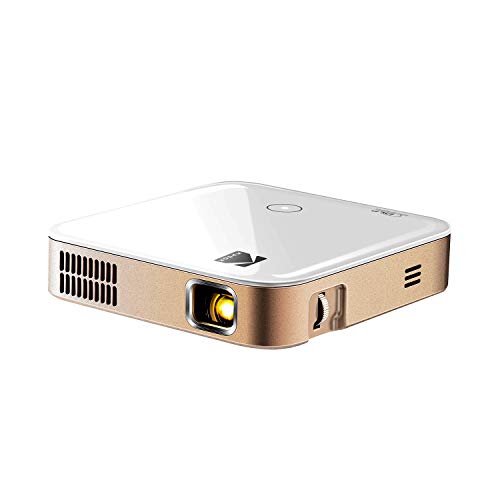
Kodak Luma 350 Portable Smart Projector — Pocket Pico Pick
The Luma 350 ends the guide at the opposite end of the size spectrum from everything before it: a pocket projector, in its title’s own words, with onboard Android, Wi-Fi and Bluetooth, a rechargeable battery, a tripod mount, and keystone correction. Its natural surfaces are ceilings, tent canvas, hotel walls, and the blank patch above a child’s bed. Its natural audience is the person for whom the projector must travel in a jacket or a tote and answer to no socket. Judged as a small projector, it would fail; judged as a pico, it is one of the most coherent designs in this guide — and the judging frame is the buyer’s first responsibility.
Brightness is the pico class’s defining limit, and this guide states it as plainly for the Kodak as for any machine: its title publishes no brightness figure, and no pico’s output fills a lit room or a large wall. What the battery buys is placement freedom within darkness — the ceiling above the bed, where the picture can be modest and the room fully dark, is the Luma’s home geometry, and there a pico picture is a genuinely magical thing: a film floating where the ceiling rose used to be, from a machine that was in a pocket an hour ago. Set the size to what the darkness flatters and the Luma delights; stretch it across a bright living-room wall and it will look like a rumour.
The onboard Android and the wireless pair make it self-contained in the way the convenience class promises: streaming without a stick, sound out over Bluetooth to a speaker or headphones, content mirrored from the iPhone its title names as compatible. The tripod mount is a small detail with outsized value in this class — a pico’s worst enemy is the wobbling stack of books, and a mini tripod turns any table, shelf, or floor into a stable, aimable perch. Keystone correction then squares what the perch could not.
Kodak’s name on a pico also carries a modest assurance the no-name end of the pico class cannot offer: a known brand’s retail presence and support. That will not turn the Luma into a home cinema, and nothing in this guide dresses it up as one. It makes it the considered way to buy the pico experience — the ceiling cinema, the travel picture, the children’s den — with the class’s limits understood and priced in.
Buy it as a second projector or a travel projector and it will be loved. Buy it as your only machine for a bright room and the physics will overrule the brochure. The Luma 350 is in this guide because small spaces include spaces that move, and for those, it is the right shape of answer.
- Class: portable smart pico projector, as stated in the listing title
- Platform: onboard Android, as stated in the listing title
- Wireless: Wi-Fi and Bluetooth, as stated in the listing title
- Power: rechargeable battery, as stated in the listing title
- Mounting: tripod mount, as stated in the listing title
- Setup aid: keystone correction, as stated in the listing title
- Resolution: Not stated in the listing title — verify with the manufacturer documentation
- Brightness: Not stated in the listing title — verify with the manufacturer documentation
Strengths
- Pocket size and a rechargeable battery make it the only truly go-anywhere pick here.
- Onboard Android plus Wi-Fi and Bluetooth make it self-contained without a stick.
- The tripod mount solves the pico class’s wobble problem properly.
Trade-offs
- Brightness is the pico limit: dark rooms and modest sizes only, with no figure published in the title.
- Resolution is not stated in the title and must be verified in the documentation.
- It is a companion or travel machine, not a bright living room’s main display.
Best for: ceiling cinema in a bedroom, travel, and children’s dens — anywhere darkness is guaranteed and size is modest.
Not suited for: bright rooms or large walls, where a pico’s unstated output gives no promise the picture can survive.
How Do the Six Compare Side by Side?
| Pick | Resolution per title | Brightness per title | Light / format | Small-space argument |
|---|---|---|---|---|
| BenQ HT2150ST | 1080P | 2200 lumens | Lamp short throw | 96% Rec.709 colour for dark small rooms |
| Optoma GT1080HDR | 1080p | 3800 lumens | Lamp short throw | Brightness and golf-sim geometry |
| BenQ TH671ST | 1080p | 3000 lumens | Lamp short throw | Speaker, dual HDMI, complete household kit |
| Optoma GT2000HDR | Full HD | Not stated in title | Laser ultra-compact short throw | Smallest body, longest-lived light |
| ViewSonic PS502W | WXGA 1280×800 | 4000 lumens | Business short throw, 0.5 ratio | Dual-purpose rooms, day and night |
| Kodak Luma 350 | Not stated in title | Not stated in title | Battery pico | Ceilings, travel, and pockets |
The table’s shape is the guide’s argument in miniature: four ways to be a serious short-throw home machine, one business projector whose stated throw ratio beats them all on geometry while conceding resolution, and one pico that abandons the table entirely for the ceiling. The right row is the one whose small-space argument matches the sentence you would write about your own room.
How Does Throw Distance Actually Work?
Throw ratio is the one number that governs this entire category, so it deserves a plain explanation. The ratio divides the distance from lens to wall by the width of the picture produced. A ratio of 0.5 — the ViewSonic’s stated figure — means half a metre of distance per metre of picture width, so a metre of distance yields a two-metre-wide image. A conventional long-throw projector might need three or four metres for the same width. Everything in small-space projection is downstream of that division: where the furniture goes, whether anyone’s shadow crosses the picture, whether the room can host a cinema at all.
Because only one title in this guide prints its ratio, the practical method for the other five is measurement plus documentation. Decide the picture width your wall and seating want. Read the manufacturer’s stated distance for that width. Then measure your room — wall to the front of the table, not to its back, since the lens sits at the machine’s front — and confirm the machine can live at that distance with its cables and its ventilation respected. A projector placed at the wrong distance does not fail politely; it produces a picture too big for the wall or too small for the evening, and no keystone setting refunds the geometry.
Height matters as much as distance in this format. Short-throw lenses project upward at an offset, expecting the machine to sit below the picture’s bottom edge on a low table or stand. A table of the wrong height pushes the picture into the ceiling or the skirting, and vertical keystone — present on several picks here — should be the fine adjustment, not the rescue. Measure the table as carefully as the throw, and the setup becomes arithmetic instead of improvisation.
How Do You Set Up a Cinema in a Very Small Room?
Choose the wall with the fewest obligations. In a small room the screen wall competes with doors, radiators, windows, and shelves; the best wall is the blankest one, ideally opposite the seating and free of a window that would sit behind the viewers and leak light around their heads onto the picture. Paint or hang the smoothest surface you can — short-throw angles forgive texture less than long-throw ones, because the light rakes across the surface and prints every bump.
Seat closer than instinct suggests, and size the picture to the seat. Immersion in a small room comes from the picture filling your view, which a modest picture achieves at a short distance as surely as a huge one does across a hall. This is the small room’s secret advantage: it reaches cinema geometry with an eighty-inch picture, at brightness levels every machine in this guide can honour, with the viewers near enough that 1080p detail — and even the ViewSonic’s WXGA — resolves kindly.
Sound deserves the same placement care as light, because a small room’s acoustics are intimate: hard walls close together bounce a projector’s fan and a speaker’s output into the same small volume the audience occupies. A modest speaker at the picture end of the room, playing at a modest level, will sound clearer than a powerful one beside the sofa, and a film watched at neighbour-friendly volume in a small room loses nothing — the screen is close, the dialogue is close, and the room itself does half the work a large theatre buys with wattage.
Manage the light with the seriousness of a larger theatre, because the small room’s surfaces are closer and bounce light back faster.
A curtain over the one window, a door closed against the hallway, matte rather than glossy paint near the wall — each is cheap contrast. Then put the sound near the picture: a small speaker or the projector’s own, at the wall end of the room, so voices arrive from the faces. The small room forgives modest equipment and punishes careless placement; arrange it once, carefully, and it will outperform rooms three times its size that were arranged by hope.
Which Light Source Suits a Small Room — Lamp or Laser?
Small rooms interrogate a light source differently than theatres do, and the lamp-versus-laser question deserves a hearing on small-room terms before the mistakes section closes the guide. The lamp machines in this guide — both BenQs, the GT1080HDR, and the ViewSonic — share a set of manners: they take a short while to reach full brightness, they prefer their sessions in long stretches, their output fades gradually across the lamp’s life, and the lamp itself is a replaceable consumable whose cost belongs in the ownership budget. None of that is hidden, and for a room that hosts two long film nights a week, the lamp’s economics are perfectly sane: the consumable is amortised across exactly the usage it was designed for.
The laser pick, the GT2000HDR, inverts those manners. It reaches brightness quickly, tolerates being switched on for one episode and off again without the thermal courtesies a lamp prefers, and holds its output across a service life that dwarfs a lamp’s. In a small multi-purpose room, where the projector’s sessions are frequent, short, and opportunistic — the spare room’s documentary while dinner cooks, the children’s half-hour cartoon, the match highlights at lunch — that tolerance is not a specification. It is the difference between a machine that fits the room’s rhythm and one that must be planned around.
Heat and noise refine the choice further. Every projector exhales warm air and a fan’s opinion, and in a small room both arrive at the audience undiluted by distance. Lamp machines at full brightness run their cooling honestly and audibly; in a box room, eco modes and sensible placement — never in a sealed cubby, never beside the viewer’s ear — are part of the purchase decision, not afterthoughts. Laser designs are not silent, but their quick, consistent output makes their behaviour easier to arrange a small room around.
The deciding question is therefore about rhythm, not technology prestige. Ask how the room actually lives: long scheduled sessions argue for the lamp picks, whose titles publish the fuller figures and whose colour and brightness claims lead this guide. Short, frequent, spontaneous sessions argue for the laser’s manners. Buyers who answer honestly rarely regret either technology; buyers who buy the prestige word and ignore the rhythm regret it weekly.
One last small-room variable belongs in this section because it interacts with both light sources: the ceiling. In the smallest rooms the ceiling is often the largest unobstructed surface, and two picks here — the pico by design, and any short-throw aimed upward from a low perch — can use it. Ceiling projection flatters modest brightness, because the room can be made fully dark and the audience is reclined at the ideal distance. It is the small room’s bonus surface, and households that discover it often find their projector used twice as often as the wall-only plan predicted.
What Mistakes Do Small-Space Projector Buyers Make?
Buying a standard-throw projector for a short-throw room is the founding error, and it is usually made by shopping on resolution and price while ignoring the throw column entirely. The machine arrives, demands three metres the room does not have, and spends its life on a shelf behind the sofa projecting over the viewers’ heads at a size the wall never wanted. In this category, geometry is the first specification; everything else is a preference.
The second mistake is maximising picture size. Small rooms reward the opposite instinct: a picture the light can fill, at a distance the eye can take in whole. Buyers who stretch a short-throw machine to its widest setting in a bright box room manufacture the washed, soft image they then blame on the projector.
Ignoring the table is the third. A short-throw projector’s alignment lives and dies by the stability and height of what it stands on; a wobbling side table or a stack of books converts every door slam into a trapezoid. The pico’s tripod mount and the home machines’ need for a solid low stand are the same lesson at two scales: give the lens a still, level world and it will give you a rectangle.
The fourth mistake is forgetting ventilation and ears. Small rooms concentrate a projector’s exhaust heat and fan noise near the audience, and a machine wedged into a shelf cubby will cook itself while serenading the front row. Leave the vents their breathing room, prefer the picks whose design suits episodic use if your sessions are short, and remember that in a small room the projector is a member of the audience — seat it accordingly.
Final Recommendation
Match the machine to the room’s sentence. A dark, film-first small room belongs to the BenQ HT2150ST and its Rec.709 colour. A brighter games room or a golf-sim corner belongs to the Optoma GT1080HDR. A household that wants one complete appliance takes the BenQ TH671ST; a studio that needs the projector to vanish takes the laser GT2000HDR. A room that works by day as an office or classroom takes the ViewSonic PS502W, WXGA trade and all, for its stated 0.5 throw and daylight strength. And the space that is not a room at all — the ceiling, the tent, the hotel — takes the Kodak Luma 350. Measure the throw, respect the darkness, size the picture to the seats, and a small room stops being a limitation and becomes the reason the cinema works. There is a particular pleasure in a cinema that hides inside an ordinary room without announcing itself all day — the table that is just a table until Friday evening, the wall that is just a wall until the lights go down — and every pick in this guide exists to protect that pleasure at its own price of admission.
Frequently Asked Questions
How close does a short-throw projector need to sit?
It depends on the model’s throw ratio and your picture width. The one ratio stated in this guide, the ViewSonic’s 0.5, builds a picture twice as wide as the distance — a two-metre image from one metre. For the other picks, the manufacturer documentation states the distance for each picture size, and that table, plus your tape measure, is the authority to trust.
Is WXGA good enough for films?
The ViewSonic’s 1280×800 panel is a business format: entirely serviceable for streamed video, teaching material, and films at small-room sizes, with subtitles perfectly legible, but visibly short of 1080p in fine detail. It earns its place here on throw ratio and brightness for dual-purpose rooms. A film-first buyer should take one of the 1080p picks.
Can a pico projector like the Kodak really show a film?
Yes — in its element. In a fully dark space, at a modest size, on a ceiling or a wall a short distance away, a battery pico produces a watchable, charming picture. Its limits are brightness and scale: a lit room or a large wall will defeat it, which is why this guide frames it as a travel and ceiling machine rather than a living-room display.
Do I need a screen in a small room?
A smooth, matte wall serves every pick here, and small rooms often lack the wall furniture for a fixed screen. A screen buys uniformity and a defined edge, and remains a worthwhile upgrade, but the short-throw geometry and a well-prepared wall will carry most small-room cinemas happily.
Will a short-throw projector work for gaming?
The format suits gaming unusually well — the machine sits by the wall, the console beside it, and nobody’s shadow crosses the picture. Three picks here claim low input lag in their titles, though none prints a millisecond figure; casual and most committed players will be well served, and tournament-level players should verify exact figures in the documentation.
Can I use a short-throw projector on a ceiling?
Ceiling viewing is the small room’s bonus geometry. A pico like the Kodak, aimed upward from a bedside perch or a tripod, is designed for exactly that posture, and any of the table machines can serve a ceiling session in a pinch if it can be aimed safely and stably. The ceiling is usually the room’s largest blank surface, it asks for no furniture rearrangement, and a fully dark bedroom flatters modest output. Check the machine’s keystone range for the angle, keep the perch stable, and the ceiling becomes the screen the room was hiding.
How do I keep a short-throw picture aligned in a rented room?
Alignment is a furniture problem before it is an optics problem. Give the projector a solid, level, low stand that nobody bumps — a media unit rather than a folding table — and mark its position once it is aligned, so a cleaning day does not cost you the rectangle. Avoid ceiling mounts and wall fixings that a lease forbids; the format’s whole advantage is that it needs neither. If the picture must be re-squared after a move, use zoom and position first and keystone last, in that order, every time.
Lamp or laser for a small room?
Lamp models in this guide publish the fuller specifications and the lower entry commitment, with a consumable to replace across the years. The laser GT2000HDR trades those published figures for a light source that holds brightness, starts fast, and tolerates episodic use. Frequent short sessions argue laser; specification-led buying argues lamp.
Related Guides
For the room that is smaller still and shared with a roommate, our guide to a projector for a dorm room applies the same geometry to tighter walls and stricter hours. Readers stepping up in ambition should continue to our roundup of native 4K projectors, where the panels are genuine 4K and the rooms are usually larger. And the journey properly begins with our companion guide to food photography cameras for readers outfitting the rest of a small creative studio.


