What's inside
- Key Takeaways
- Quick Picks
- How We Chose These Picks
- Comparison
- Why Does Fan Noise Matter More in a Bedroom Than Anywhere Else?
- How Should You Read a Decibel Claim on a Projector Listing?
- Where Should a Quiet-Seeking Owner Place the Projector?
- Which Picture Settings Help a Room Stay Quiet?
- How Do You Test a Projector for Noise During the Return Window?
- How Does a Projector Sound Different Across a Whole Evening?
- What Role Do Curtains, Carpets and Furniture Play in Perceived Noise?
- Should Couples With Different Noise Tolerance Share One Setting?
- How Long Should a Nightly Session Run Before Heat Changes the Sound?
- Common Mistakes
- Final Recommendation
- Frequently Asked Questions
- Related Guides
As an Amazon Associate I earn from qualifying purchases. This post may contain affiliate links at no extra cost to you.
widgetverdict.com is reader-supported. When you buy through links on our site, we may earn an affiliate commission.
Bedrooms expose fan noise in a way living rooms never do, which is why shoppers searching for the best quiet projectors need a different kind of honesty from a guide. A projector that seems civilised during an afternoon action film can dominate a quiet drama at midnight, when dialogue drops to a murmur and the room itself falls silent. This round-up therefore separates machines whose listing titles actually promise low noise from machines whose titles say nothing about sound at all, and it refuses to invent decibel figures for either group.
Three picks below carry a noise promise in their own titles. One calls itself low noise outright, another repeats that promise beside a 1080P label and modern wireless, and a third prints a low fan noise claim with a figure under thirty decibels. The remaining three picks are serious home theatre machines from XGIMI and BenQ whose titles talk about lumens, colour and HDR while staying silent on acoustics. Both groups belong here, but for different readers, and each review states plainly which group its machine sits in.
Noise also depends on decisions the buyer controls. A projector perched on a headboard shelf behind the pillows will always sound louder than the same machine mounted ahead of the seating, and a bright mode driving the light engine hard will usually ask more of the cooling system than a gentler evening setting. Placement, picture mode and viewing distance belong in any honest conversation about quiet projection, so the guides after the reviews treat those choices as part of the purchase rather than as afterthoughts.
Linked names in this guide lead to the Amazon listings, where you can check price on Amazon and read the full seller description. Figures quoted here come only from the listing titles themselves. Where a title gives a decibel figure, the review repeats it as a title claim. Where a title gives none, the spec list records that silence in words instead of filling the gap with a number borrowed from a different model, a different year or a reviewer’s memory.
Key Takeaways
- Only three titles in this guide promise low noise: the Low Noise Mini Projector, the KHQ 1080P Mini Projector and the Smart Projector Android 14 with its low fan noise claim.
- The Smart Projector Android 14 is the sole pick printing a decibel figure in its title, stated as low fan noise under thirty decibels.
- XGIMI Horizon Ultra and both BenQ picks say nothing about noise in their titles, so no decibel figure is claimed for them anywhere in this guide.
- Mini projectors sit close to the audience by design, which makes a stated low noise design more valuable in a bedroom than raw picture specifications.
- Seat position relative to the projector changes perceived noise more than most buyers expect, so placement advice matters as much as the machine chosen.
- LED light in the two BenQ picks removes lamp changes from ownership, a separate comfort from acoustic comfort that heavy viewers feel across years.
Quick Picks
| Pick | Badge | Why it earns its place |
|---|---|---|
| Low Noise Mini Projector for Home Theater | Low noise promised in the name itself | A portable mini whose title leads with low noise and covers laptop, DVD, phone, HDMI and USB sources for indoor and outdoor use. |
| KHQ 1080P Mini Projector (Low Noise) | Bedroom mini with electronic focus | A 1080P mini projector stating low noise, Wi-Fi 6, Bluetooth 5.1, electronic focus and pictures up to two hundred inches. |
| Smart Projector Android 14 (Low Fan Noise) | The only printed decibel claim here | A native 1080P smart projector whose title states low fan noise under thirty decibels beside Android 14 and six hundred ANSI lumens. |
| XGIMI Horizon Ultra 4K | Premium picture, silent title on sound | A 4K Dolby Vision machine with 2300 ISO lumens and Harman Kardon speakers, included for picture-led buyers who will manage placement themselves. |
| BenQ HT4550i 4K HDR LED | Bright LED cinema anchor | A 3200-lumen 4K HDR LED projector with Android TV, Netflix, Chromecast and HDR10+ for a settled theatre room. |
| BenQ HT2060 1080p HDR LED | Colour-led Full HD LED theatre | A 1080p HDR LED projector with wide colour, lens shift, 1.3x zoom and twin 5W speakers for film-first rooms. |
How We Chose These Picks
Acoustic evidence came first, and it had to come from the title. A machine earned the quiet label only when its own listing title used low noise or low fan noise wording, because a buyer’s ears deserve evidence rather than vibes. That rule admitted three compact machines and excluded a long list of otherwise capable projectors whose sellers chose to talk about brightness instead. Readers can audit the rule themselves in seconds by reading the titles quoted in the sources file.
Picture-led machines were admitted under a separate, clearly labelled logic. Some households shop for quiet projection but watch mostly in a family room where a ceiling-mounted theatre projector sits far from every ear, and for those readers the XGIMI and BenQ reviews offer serious pictures with an explicit warning: their titles promise nothing about sound, so placement and a listening test during the return window carry the acoustic decision. Labelling that gap honestly serves those readers better than pretending the guide found six whispering machines.
Bedroom practicality shaped the rest of the scoring. Small rooms reward projectors that focus easily, connect to a phone or laptop without a rack of boxes, and throw a watchable picture from a nightstand or a low shelf. Electronic focus, wired screen mirroring, Bluetooth audio for a nearby speaker or headphones, and broad source compatibility all earned credit because each one removes a nightly friction that would otherwise matter more than a specification buried in a manual.
Light source and ownership rhythm completed the picture. LED engines in the BenQ pair promise long, lamp-free service suited to a permanent installation, while the minis trade that permanence for portability between bedroom, living room and garden. Neither pattern is quieter by definition, and this guide never claims otherwise. What differs is how a household lives with the machine across years, and the reviews keep that long view separate from the acoustic question that titles this guide.
Finally, every figure in every spec list below traces back to a title. Lumens appear where titles print them, speaker wattage appears where titles print it, and noise rows say either what the title claims or that the title states nothing. That discipline is the guide’s contract with the reader: nothing here needs to be taken on trust, because every claim can be checked against the listing that made it.

Low Noise Mini Projector for Home Theater — Low noise promised in the name itself
Few product names make their pitch as directly as this one. Low noise sits at the front of the title, before home theatre, before portability, before the long list of compatible sources, and that ordering tells a bedroom shopper exactly which frustration the maker set out to solve. A mini projector lives within arm’s reach of its audience, often on the same nightstand that holds the water glass and the phone charger, so cooling sound is not a background detail for this class of machine. It is the detail, and this listing treats it that way.
Source compatibility fills out the rest of the title: laptop, DVD player, phone, HDMI and USB. That breadth suits the way small projectors actually get used, which is opportunistically. A laptop supplies a downloaded film one night, a phone supplies photos the next, and an older DVD player still earns its shelf space when a favourite disc never made the jump to streaming. A machine that accepts all of them without adapters or arguments becomes the household’s default big screen surprisingly quickly.
Indoor and outdoor use are both named, and the black and white finish suggests a machine meant to be seen sitting out rather than hidden in a cabinet. Outdoors, of course, fan noise stops mattering almost entirely, because gardens come with their own soundtrack of traffic, insects and neighbours. Indoors at midnight the same machine must earn its low noise name, and buyers should test it exactly there: quiet dialogue, volume low, projector at its real nightly distance from the pillows, during the first evenings while returning it remains painless.
What the title does not give is equally worth noting. No resolution figure, no brightness figure and no decibel number appear, so this review claims none of them. Shoppers who need a stated native resolution for smaller text or detailed viewing should weigh the KHQ and the Android 14 smart projector below, whose titles commit to 1080P language. Shoppers whose evenings are films and series watched from bed, and whose current projector sounds like a small hairdryer, will recognise this machine’s priorities immediately.
Daily handling favours the unhurried. A portable mini asks for no mount, no ladder and no permanent cable run, so a household can audition it in three rooms across one weekend and learn where it truly belongs. That audition matters for noise more than for any other trait, because rooms differ: a soft furnished bedroom absorbs sound that a bare spare room throws back at the listener. Let the machine prove its name in the room where it will actually live.
Care routines stay simple at this end of the market. Keep the vents unobstructed, resist the urge to perch the projector on bedding that can slump against an intake during the night, and give the lens an occasional gentle clean. Owners who treat airflow as part of the setup, rather than as fine print, protect both the picture and the quiet they bought, since a struggling cooling system is rarely a silent one.
- Noise claim: low noise stated in listing title
- Form: mini, portable, black and white finish
- Sources named: laptop, DVD, phone, HDMI, USB
- Use settings named: indoor and outdoor
- Resolution figure: Not stated in the listing title — verify with the manufacturer documentation
- Brightness figure: Not stated in the listing title — verify with the manufacturer documentation
Strengths
- Low noise leads the product name itself
- Five source types named in one title
- Portable form suits nightstand and garden alike
Trade-offs
- No decibel figure printed in its title
- No resolution figure printed in its title
- No brightness figure printed in its title
Best for: a bedroom viewer whose current mini projector sounds intrusive during quiet scenes.
Not suited for: a buyer who needs a stated native resolution figure before ordering anything.
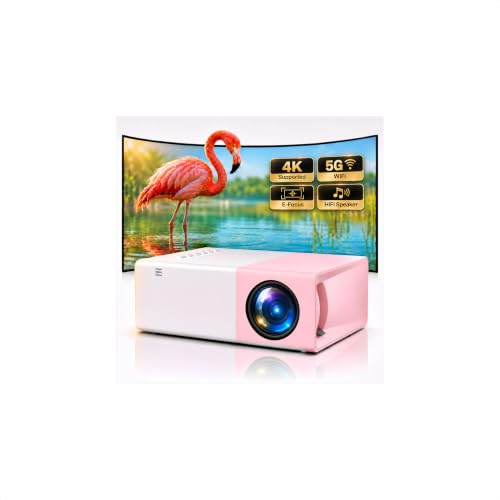
KHQ 1080P Mini Projector (Low Noise) — Bedroom mini with electronic focus
KHQ aims this mini squarely at the bedroom, and its title reads like a checklist written by someone who has actually set one up on a dresser. Low noise appears early, 1080P leads the name, and the supporting cast includes Wi-Fi 6, Bluetooth 5.1, electronic focus, wired screen mirroring and a picture size reaching two hundred inches. Each item answers a small nightly annoyance, and together they describe a machine designed to disappear into a routine rather than demand one.
Electronic focus deserves more attention than it usually gets in this class. Manual focus rings on mini projectors often sit stiff or loose, and adjusting one after the machine is positioned can nudge the whole projector out of alignment. Focusing electronically from where the viewer sits keeps the image where it was aimed, which matters doubly in a bedroom where the projector may be repositioned between a nightstand, a shelf and a tripod across a single week.
Wireless arrives in two flavours with distinct jobs. Wi-Fi 6 handles the network side for streaming-era sources, while wired screen mirroring offers a cable route for a phone when the home network is busy or the router sits far from the bedroom. Bluetooth 5.1 opens the audio door: a nearby Bluetooth speaker can carry dialogue with more presence than a mini projector’s own sound, and late-night listeners can consider headphone routes where the setup allows, keeping both the picture large and the household asleep.
The two hundred inch ceiling in the title should be read as an outer boundary rather than a bedroom recommendation. Mini projectors serve best at sizes where their light can hold a convincing picture in a darkened room, and a bedroom wall rarely offers two hundred inches in any case. At the modest sizes bedrooms actually allow, a 1080P-class mini delivers the relaxed, cinema-like softness most viewers want from bed, where the goal is immersion rather than pixel inspection.
Calling this a 2026 upgraded model, as the title does, signals a maker iterating on a crowded design, and the upgrades chosen here are telling: focus, wireless and noise rather than a louder brightness boast. That restraint suits the room it targets. A bedroom projector succeeds when nobody in the bed mentions the projector at all during the film, and every feature in this title points at that kind of invisibility.
Setup advice for this KHQ is mostly about restraint. Darken the room properly, keep the image size honest, place the machine where its vents breathe freely, and let electronic focus do the final sharpening after the picture warms up. Households upgrading from an older, louder mini will likely notice the acoustic difference in the first quiet scene, which is precisely the scene to use as a personal test before deciding the machine has earned its place.
- Noise claim: low noise stated in listing title
- Resolution language: 1080P in listing title
- Wireless: Wi-Fi 6 and Bluetooth 5.1 stated
- Focus: electronic focus stated
- Mirroring: wired screen mirroring stated
- Maximum display: up to 200 inches stated
Strengths
- Low noise and 1080P promised in one title
- Electronic focus avoids disturbing the aim
- Both Wi-Fi 6 and wired mirroring routes
Trade-offs
- No decibel figure printed in its title
- No ANSI lumen figure printed in its title
- Two hundred inch claim exceeds bedroom sense
Best for: a bedroom that wants wireless streaming, Bluetooth audio and focus adjusted from the bed.
Not suited for: a bright living room needing a stated ANSI brightness figure for daytime sport.

Smart Projector Android 14 (Low Fan Noise) — The only printed decibel claim here
Precision is this smart projector’s calling card. Its title does not merely say low noise; it says low fan noise and attaches a figure, under thirty decibels, which makes it the only pick in this guide whose acoustic promise a buyer can quote. That specificity deserves respect and scrutiny in equal measure. Respect, because the seller has committed to a number. Scrutiny, because decibel claims depend on measurement distance and picture mode, and the listing itself is where a careful buyer confirms the conditions attached to the figure.
Around that claim sits a thoroughly modern specification. Android 14 is built in with apps, so the projector streams without a stick or a laptop joining the setup. The title states native 1080P with 4K decoding, a pairing that describes a Full HD picture able to accept higher-resolution sources gracefully. Six hundred ANSI lumens is printed as well, and the ANSI wording matters: it is a measured dialect of brightness rather than the unqualified lumen figures common in this class, so it can be compared more meaningfully against other ANSI-rated machines.
Wi-Fi 6 and Bluetooth 5.4 complete a wireless picture a generation ahead of the KHQ above, and for a bedroom that means quick connections to the home network and flexible audio pairing. Built-in apps change the nightly ritual most of all. One remote, one power cable and a wall produce a film, which lowers the activation energy of using the projector until it stops being an event and becomes simply how the household watches things in that room.
Buyers should still hold two honest caveats. A built-in Android platform ages on a software timetable the owner does not control, while a dumb projector fed by a replaceable stick can refresh its brains cheaply. And a decibel figure, however welcome, describes the seller’s test conditions, so the bedroom audition still matters: quiet scene, real distance, first week. Neither caveat cancels the appeal. They simply mark this as the pick for buyers who value a stated number and a self-contained machine, and who will verify both promptly.
The CinePro black finish named in the title suits a room where the projector stays visible on a shelf, and the home positioning in the title keeps expectations grounded. This is a projector for bedrooms and living rooms rather than auditoriums, and its specification reads coherently at that scale: enough stated brightness for darkened rooms, a Full HD native picture, current wireless, and the guide’s only quantified promise of quiet.
Households comparing this machine against the two minis above should notice what the extra specification buys in confidence. Every major question a buyer asks — how loud, how bright, how sharp, how connected — receives a printed answer in this title. That completeness is itself a feature, because it lets a household decide from evidence before the box arrives, instead of discovering the answers across a fortnight of evenings.
- Noise claim: low fan noise under 30dB stated in title
- Platform: Android 14 with built-in apps
- Resolution language: native 1080P, 4K decoding
- Brightness: 600 ANSI lumens stated
- Wireless: Wi-Fi 6 and Bluetooth 5.4 stated
- Finish: CinePro black, per title
Strengths
- Only decibel figure printed in this guide
- Native 1080P wording plus 4K decoding
- Android 14 removes the separate streamer
Trade-offs
- Decibel conditions need confirming on the listing
- Built-in platform ages on a software schedule
- Brightness suits darkened rooms, not daylight
Best for: a buyer who wants the acoustic promise stated as a number and streaming built inside.
Not suited for: a sunlit open-plan room where six hundred ANSI lumens must fight daylight.

XGIMI Horizon Ultra 4K — Premium picture, silent title on sound
Honesty requires a clear label at the top of this review: the Horizon Ultra’s title says nothing about fan noise, and this guide claims nothing about its acoustics. It earns its place for the reader whose quiet problem is really a placement solution — a projector mounted on a ceiling or set on a rear shelf, far enough from every seat that picture quality, not a noise promise, should drive the choice. Readers shopping strictly for a stated low noise design should stay with the three picks above.
Judged as a picture machine, the title is formidable. 4K with Dolby Vision, 2300 ISO lumens, dual light technology, active 3D and a picture reaching two hundred inches describe a flagship-leaning home theatre projector. Dolby Vision support matters for households whose streaming libraries carry it, because tone mapping decided scene by scene flatters exactly the dark, quiet films where a projector’s fan would be most noticeable — even though, again, this title makes no promise about that fan.
Sound output, by contrast, is specified proudly: two 12W Harman Kardon speakers. Built-in audio of that stated scale changes the acoustic conversation in a different way, since dialogue and score reproduced with presence can mask a modest amount of mechanical sound at ordinary volumes. That is an observation about listening, not a noise rating, and buyers for whom silence between lines matters should still audition the machine with the volume low before the return window closes.
Wi-Fi and Bluetooth are both stated, keeping the Horizon Ultra convenient despite its size and ambition. This is not a nightstand mini; it is a settled-room machine that asks for a deliberate position and repays it with the strongest picture specification in this guide. Households building one main viewing room, rather than moving a projector between beds and gardens, are its natural audience.
Placement is where this pick’s acoustic story gets written. Ceiling mounting ahead of the seating, or a high rear shelf with clear airflow, puts distance between the cooling system and every ear, and distance is the most reliable noise treatment ever discovered. Owners who install with that principle in mind, and who keep vents and filters clean across the years, give a powerful machine its best chance to stay unobtrusive during quiet passages.
Consider this XGIMI the guide’s picture-first detour, included because many quiet-projector shoppers actually watch in rooms where a flagship can be placed far away. If your room offers no such distance — if the projector must sit beside the bed — the honest recommendation points back up this page to the machines whose titles promise quiet outright.
- Noise claim: Not stated in the listing title — verify with the manufacturer documentation
- Resolution language: 4K with Dolby Vision stated
- Brightness: 2300 ISO lumens stated
- Light: dual light technology stated
- Speakers: 2 x 12W Harman Kardon stated
- Maximum image: 200 inches stated
Strengths
- Dolby Vision and 4K lead its title
- Stated 2300 ISO lumens for real rooms
- Twin 12W Harman Kardon speakers stated
Trade-offs
- No noise promise anywhere in its title
- Settled-room size, not a portable mini
- Active 3D needs glasses the title does not bundle
Best for: a main viewing room where the projector can sit or hang well away from seating.
Not suited for: a bedside shelf within arm’s reach of the pillows, where an unstated fan becomes the soundtrack.

BenQ HT4550i 4K HDR LED — Bright LED cinema anchor
BenQ’s HT4550i also arrives with a title silent on noise, and the same labelling rule applies: no decibel figure is claimed for it here. What its title does claim is a serious cinema specification — 4K HDR, LED light, 3200 lumens, Android TV with Netflix, Chromecast built in, HDR10+ alongside HDR10 and HLG, and Dolby Digital Plus. For a dedicated room where the projector hangs from a ceiling mount ahead of the seats, that specification argues the case while distance handles the acoustics.
Brightness at a stated 3200 lumens is the headline working figure. A room with curtains rather than blackout discipline, or a household that keeps a lamp burning during sport, asks more of a projector than a midnight cinema does, and this BenQ is specified for those mixed conditions. LED light holds that output steadily across years without a lamp dimming toward replacement, which suits a permanent installation expected to serve nightly.
Streaming completeness stands out even among smart rivals. Android TV with Netflix named directly, plus built-in Chromecast, covers both the app-led household and the phone-casting household in one machine. HDR format coverage is similarly thorough on paper, with HDR10+ joining the more common HDR10 and HLG, so film collectors with varied libraries find their formats acknowledged rather than approximated.
The built-in speaker mentioned in the title will start a room off, though a theatre built around a 3200-lumen picture usually graduates to external sound. That graduation also serves quiet-seeking owners indirectly: speakers near the screen anchor dialogue at the picture, letting overall volume sit lower during night viewing, which keeps any mechanical sound from the projector comparatively further beneath the soundtrack.
Installation discipline defines ownership here. A ceiling mount, a measured throw, a screen sized to the room and a first-week listening test from the main seats — that sequence turns the HT4550i from a specification into a settled appliance. Buyers willing to do that work get BenQ’s home theatre lineage and a bright LED picture. Buyers wanting a machine for the nightstand should not mistake this anchor for a bedroom mini, however quiet their room makes it seem.
Long service is the quiet virtue nobody hears. LED light removes lamp purchases and the gradual dimming that pushes owners toward brighter, harder-working picture modes late in a lamp’s life. A machine holding its output year after year asks the same of its cooling in year four as in week one, which is the steadiest acoustic footing a powerful projector can offer, even with no figure printed in its title.
- Noise claim: Not stated in the listing title — verify with the manufacturer documentation
- Resolution language: 4K HDR, ultra 4K wording in title
- Brightness: 3200 lumens stated
- Light source: LED stated
- Platform: Android TV with Netflix, Chromecast
- HDR: HDR10+, HDR10 and HLG named
Strengths
- Stated 3200 lumens suits mixed lighting
- Netflix and Chromecast both built in
- LED light removes lamp replacements
Trade-offs
- No noise promise anywhere in its title
- Ceiling-anchor scale, not a portable machine
- Built-in speaker is a starting point only
Best for: a dedicated theatre room with a ceiling mount and mixed film, sport and streaming duties.
Not suited for: a renter who needs a projector that moves between nightstand and garden each weekend.

BenQ HT2060 1080p HDR LED — Colour-led Full HD LED theatre
The third title in this guide with nothing to say about noise belongs to BenQ’s HT2060, a 1080p HDR LED theatre projector whose argument is colour and placement rather than resolution or acoustics. Its title names DCI-P3 and Rec.709 wide colour gamut coverage, vertical lens shift, 2D keystone, a 1.3x zoom, S/PDIF and HDMI 2.0, twin 5W speakers, 3D support and a gaming-flavoured figure of 8.3ms at 120Hz. That is a film lover’s checklist, and it deserves reading as one.
Lens shift is the feature film rooms quietly prize most. Shifting the image vertically without tilting the machine keeps geometry honest from a ceiling mount or a high shelf, and pairing it with a 1.3x zoom gives the installer genuine freedom about where the projector lives. For the noise-conscious, that freedom has a side benefit: a projector that can sit further from the seating, because its lens tools forgive the distance, will always intrude less on quiet scenes than one forced to perch nearby.
Colour claims lead the title for a reason. Wide gamut coverage aimed at DCI-P3 and Rec.709 speaks to viewers who watch films as films, where a costume drama’s palette and a western’s dust carry meaning. At 1080p the HT2060 concedes the resolution contest to the 4K picks above, and on very large screens that concession shows. At the screen sizes most living rooms actually hold, many viewers trade that surplus detail gladly for colour behaviour and LED steadiness.
The 8.3ms at 120Hz figure gives casual and rhythm-game players a stated number to work with, unusual in a colour-led title, while S/PDIF offers a clean digital audio route to a soundbar or receiver. Twin 5W speakers handle news, sport and children’s viewing without waking the external system. Taken together, the specification describes a machine that integrates into a real rack of equipment instead of demanding to replace it.
Ownership follows the LED pattern of its larger sibling: no lamp ledger, steady output, and a picture that looks the same in its third year as in its third week. A household that projects nightly accumulates that steadiness into real value, and a household that mounts once and rarely adjusts anything will appreciate lens shift every time furniture moves and the image needs a small, dignified correction.
Acoustically, the HT2060 must be judged the same way as the other two silent titles: by placement and by audition. Put it on a mount or a distant shelf, test it with the quietest film you own during the first week, and let your own ears in your own room deliver the verdict its title declines to give. Film-first buyers who follow that process gain the guide’s most colour-serious Full HD option.
- Noise claim: Not stated in the listing title — verify with the manufacturer documentation
- Resolution language: 1080p HDR stated
- Light source: LED stated
- Colour: DCI-P3 and Rec.709 gamut named
- Lens tools: vertical shift, 2D keystone, 1.3x zoom
- Audio: S/PDIF, HDMI 2.0, 2 x 5W speakers
Strengths
- Wide colour gamut leads its title
- Lens shift plus zoom ease real installs
- LED light with a stated gaming figure
Trade-offs
- No noise promise anywhere in its title
- 1080p concedes detail on huge screens
- Theatre scale, not a bedside machine
Best for: a film-first living room that values colour and lens shift over a 4K badge.
Not suited for: a very large screen where 1080p detail visibly runs out from the front row.
Comparison
| Pick | Headline facts from its listing title | Room it suits first |
|---|---|---|
| Low Noise Mini Projector for Home Theater | Low noise, portable, laptop/DVD/phone/HDMI/USB | A bedroom with the projector on the nightstand |
| KHQ 1080P Mini Projector (Low Noise) | Low noise, Wi-Fi 6, Bluetooth 5.1, electronic focus, 200 inch | A bedroom streaming from bed |
| Smart Projector Android 14 (Low Fan Noise) | Low fan noise under 30dB, native 1080P, 600 ANSI lumens | A self-contained bedroom setup |
| XGIMI Horizon Ultra 4K | 4K Dolby Vision, 2300 ISO lumens, 2 x 12W speakers, noise not stated | A main room with distant placement |
| BenQ HT4550i 4K HDR LED | 3200 lumens, LED, Android TV, HDR10+, noise not stated | A ceiling-mounted theatre room |
| BenQ HT2060 1080p HDR LED | 1080p HDR LED, DCI-P3 colour, lens shift, noise not stated | A film-first living room |
Why Does Fan Noise Matter More in a Bedroom Than Anywhere Else?
Distance collapses in a bedroom. Living room projectors often sit behind or above an audience spread across sofas, while a bedroom mini may rest a metre from the listener’s head, and sound intensity falls quickly with distance, so that metre decides everything. Night also lowers the competition: no traffic through the walls, no conversation, no kettle, just dialogue recorded at whisper level for dramatic effect, competing against a cooling fan that never signed the drama’s contract.
Content changes at night too. Daytime sport and cartoons carry constant sound that covers mechanical noise without effort, while the films adults choose after midnight trade in pauses, rain, breathing and silence used deliberately. A projector that passes the cartoon test can fail the midnight test completely, which is why this guide insists on auditioning with the quietest material a household owns rather than the loudest demo available.
How Should You Read a Decibel Claim on a Projector Listing?
Treat a printed figure as a promise with conditions, not as a physical constant. Decibel readings depend on how far the microphone sat from the machine, which picture mode was running, and whether the room itself contributed reflections. The Android 14 smart projector above states low fan noise under thirty decibels in its title, and that claim is genuinely useful — it gives the buyer a number to hold the seller to — but the listing’s own detail is where the measurement basis belongs, and a careful shopper reads it there.
Comparisons only work inside one dialect. A figure measured at a metre in an ordinary mode cannot be set against a figure measured across a room in an economy mode, and titles rarely volunteer their methods. Use printed numbers to shortlist, then let the bedroom audition decide, because your room, your distance and your quietest film are the only test conditions that will ever actually apply to your evenings.
Where Should a Quiet-Seeking Owner Place the Projector?
Ahead of the audience beats behind it, and distance beats everything. A ceiling mount or high shelf in front of the seating puts metres and furniture between fan and ear, while a headboard shelf places the machine at the single worst address in the room. Mini projectors complicate the advice because they often must sit near the bed, which is exactly why their stated low noise designs matter and why the three promised picks lead this guide.
Airflow is the second placement law. A projector wedged between books or draped near bedding works harder to cool itself, and harder cooling rarely whispers. Leave the clearances the manual asks for, keep intakes away from soft furnishings, and clean filters on schedule. Owners who respect airflow protect the quiet they paid for; owners who smother a machine slowly convert it into the loud projector they were trying to avoid.
Which Picture Settings Help a Room Stay Quiet?
Gentler picture modes generally ask less of a light engine than the brightest showcase settings, and many households find their evening mode both pleasanter to watch and easier to live beside. The honest method is empirical: run your favourite quiet scene in each mode during the first week, sit where you will actually sit, and note which setting lets the dialogue own the room. Keep that mode for night viewing even if a brighter one wins the afternoon.
Screen size plays a supporting role. A modest image in a dark bedroom needs less light than a wall-filling one, so resisting the largest possible picture can buy calm along with better contrast. Bedrooms reward restraint in size more than any other room, because the audience lies close, the wall is near, and the difference between a sensible image and a maximal one is mostly fatigue — visual and acoustic alike.
How Do You Test a Projector for Noise During the Return Window?
Choose evidence, not impressions. Pick the quietest scene you own — a whispered conversation, a night exterior, a slow documentary passage — and play it at your real night volume with the projector in its real position. Sit in silence for the pauses. If your attention keeps leaving the scene for the machine, the machine has failed your test regardless of what any title claimed, and the return window exists precisely for that discovery.
Repeat the test on the second or third evening rather than trusting the first, because installation excitement forgives almost anything on night one. Also test the mode you will genuinely use, not a gentler mode you might switch to in theory. A projector should be judged in its working clothes, at its working distance, on your working weeknights, since those are the conditions it must survive for years.
How Does a Projector Sound Different Across a Whole Evening?
Fresh ears at seven in the evening judge noise kindly, because the household around them is still awake and noisy itself. By eleven, the same fan competes with nothing except the film, and by the final episode of a slow series the listener has also grown tired, which lowers tolerance further. This drift explains a familiar pattern in owner reports: a projector praised as silent in its first week gets described as intrusive a month later, even though the machine has not changed at all. The room changed, the hour changed and the listener changed, while the cooling system simply kept doing its job.
Planning for the drift beats discovering it. When you audition a machine, deliberately test it at the latest hour you realistically watch, with the rest of the household settled, rather than during a cheerful Saturday afternoon setup session. A projector that passes the eleven o’clock test will pass every earlier hour without discussion. A projector that only passes the afternoon test has told you something important too, and it has told you while returning it is still a simple decision rather than a reluctant compromise you will renegotiate nightly.
Content libraries drift across an evening as well. Families often begin with news, sport or a comedy at full conversational volume, then slide toward drama, documentary or a slow film as the night deepens. The projector does not know the schedule, so the buyer’s settings should: many owners keep a brighter, more relaxed configuration for the early hours and a gentler night configuration saved for the late programme, switching as the room’s mood switches. That small habit aligns the machine’s hardest working hours with the hours when nobody is listening closely.
What Role Do Curtains, Carpets and Furniture Play in Perceived Noise?
Rooms either absorb sound or return it. A bedroom with a carpet, heavy curtains, a upholstered headboard and wardrobes full of clothes swallows a surprising amount of mechanical sound before it reaches the listener, while a spare room with hard floors, bare walls and a metal bed frame hands every whisper of fan noise straight back, sometimes with interest. Two owners can therefore describe the identical projector in opposite terms and both be reporting their rooms truthfully, which is why this guide keeps returning to the audition rather than to other people’s verdicts.
Softening a room helps the picture at the same time, which makes it the rare improvement with two rewards. Curtains that tame reflections also darken the wall behind the screen and deepen perceived contrast. A rug that absorbs fan sound also steadies the image’s acoustic companion, the dialogue, by stopping it bouncing around hard surfaces. Even the humble act of closing a wardrobe door or hanging a thick throw can shift a borderline projector from noticeable to forgotten, especially in the small rooms where minis live.
None of this rescues a machine placed badly. Furnishing absorbs sound travelling through air; it does little for vibration travelling through a shared shelf into a bed frame, and nothing for a fan straining against a blocked vent. Treat the room as the second line of defence and placement as the first, in that order, and a quiet-titled projector gets the conditions its design assumed when the seller chose those words for the listing.
Should Couples With Different Noise Tolerance Share One Setting?
Partners rarely share an ear. One viewer registers a fan within seconds and cannot unregister it, while the other genuinely never notices the same sound across an entire trilogy. Arguing about who is right wastes the evening, because both reports are accurate descriptions of different nervous systems. The practical answer is arrangement rather than verdict: seat the sensitive listener furthest from the machine, keep the projector on the far side of the bed or the room where the layout allows, and let the less sensitive partner handle any mid-film adjustments near the hardware.
Volume strategy helps the partnership too. Dialogue reproduced clearly at a moderate level masks more mechanical sound than a louder but muddier presentation, which is why a small Bluetooth speaker placed near the screen can calm a room that sheer volume never could. The KHQ and the Android 14 smart projector both state Bluetooth in their titles, and couples divided over fan noise often find that repositioning the sound, rather than replacing the projector, ends the disagreement entirely.
How Long Should a Nightly Session Run Before Heat Changes the Sound?
Short auditions flatter cooling systems. A projector showing a twenty-minute clip from cold has barely settled into its working temperature, while the same machine two hours into a double bill has fans managing a fully warmed light engine and a room that has itself grown warmer from the audience and the hardware together. Judge quiet across a full evening’s arc: a feature film, a pause, then another episode, listening again near the end when the machine is honestly warm and your own patience is honestly thinner.
Breaks help more than owners expect. A few minutes powered down between a film and a late episode lets heat leave the cabinet and gives the second session a calmer start. Households building a nightly ritual around a mini projector often build that pause in naturally — drinks, conversation, a chapter of a book — and discover the projector sounds fresher afterward for reasons that are thermal rather than imaginary.
Common Mistakes
Believing every projector in a quiet round-up
carries a quiet promise ranks first. Three titles here promise low noise and three promise nothing about sound, and a buyer who skims past that distinction may install a superb theatre machine beside a bed and blame the guide, the brand and the room in that order. Read the noise row of each spec list before reading anything else, because that row is the entire point of this particular search.
Comparing decibel figures across listings as if they shared a laboratory comes next. Different distances, modes and rooms produce numbers that look comparable and are not. A stated figure is a starting point for one machine, never a league table across brands. Households that treat it as a league table end up returning the honestly labelled projector and keeping the vaguely labelled one, which is the opposite of what the evidence supported.
Placing a mini projector on bedding, cushions or a crowded nightstand shelf invites the third mistake. Soft surroundings block airflow, reflect nothing useful and let vibration travel into furniture that acts like a sounding board. A small hard shelf, clear vents and a few centimetres of breathing room cost almost nothing and repay themselves every quiet scene for the life of the machine.
Judging noise during a loud demo is the fourth error, and shops encourage it because action scenes flatter everything. Explosions forgive fans, brightness and weak speakers simultaneously. Insist on quiet material, at night volume, from your seat. A seller confident in a low noise design will understand the request immediately, since it is the only test that measures what the buyer actually came to measure.
Finally, forgetting that ears adapt and rooms change. A projector acceptable in a carpeted winter bedroom may intrude in a bare summer room with windows open and furnishings rearranged. Revisit the audition when the room changes character, and use the placement and mode lessons in this guide before concluding the machine itself has grown louder with age.
Final Recommendation
Start with the promise, not the picture. If the projector will live within a few feet of your head, choose among the three titles that promise quiet: the Low Noise Mini for sheer source flexibility, the KHQ for electronic focus and modern wireless in the bedroom, or the Android 14 smart projector when a printed decibel figure and built-in apps settle the argument. Each keeps the acoustic claim where it belongs, in the seller’s own words.
If the projector will hang from a ceiling or sit across a family room, the calculus changes and the picture-led picks earn their hearing. The Horizon Ultra brings the strongest stated picture and speakers, the HT4550i brings brightness and streaming completeness for a settled theatre, and the HT2060 brings colour and lens shift for film-first rooms. All three demand the same condition: placement with distance, and a quiet-scene audition while returning them is still easy.
For a single bedroom recommendation, the Android 14 smart projector is the easiest to defend, because it is the only machine here whose seller quantified the quiet, and its native 1080P picture, ANSI-rated brightness and built-in apps remove the other nightly frictions in the same box. Verify its figure on the listing, test it with whispers in week one, and it should disappear into your evenings exactly as a bedroom projector should.
A projector earns the word quiet in your room, at your distance, during your quietest film — never on a specification sheet alone, which is why the three promised picks, the three honestly silent ones and your own first-week audition together make the only verdict worth trusting. Trust the audition over every advertisement, including the honest ones, because your bedroom’s acoustics, your seating and your hearing together form a combination that no laboratory anywhere has ever tested on your behalf before tonight.
Frequently Asked Questions
Which pick actually states a decibel figure?
Only the Smart Projector Android 14. Its title states low fan noise under thirty decibels. The other two low noise picks use the words without a number, and the XGIMI and BenQ titles say nothing about noise at all.
Are the BenQ and XGIMI picks loud?
This guide makes no claim either way, because their titles make none. Judge them by placement distance and by a quiet-scene audition during the return window, which is the only honest method available for a silent title.
Does LED light make a projector quieter?
Not automatically, and this guide never claims it does. LED light removes lamp replacements and holds output steadily across years. Noise depends on cooling design and placement, which is why the LED picks here still carry unstated noise rows.
What is the best position for a bedroom mini projector?
On a small hard shelf or tripod with vents completely clear, as far from the pillows as the room and the image size allow. Avoid bedding and crowded surfaces, which block airflow and can carry vibration into furniture.
Can Bluetooth headphones solve projector noise?
Headphones move the soundtrack to your ears and can make fan sound irrelevant for a solo viewer, where the projector and source support the pairing. They help one listener, though, and do nothing for a partner watching without them.
How large should a bedroom image be?
Smaller than the maximum any title advertises. A modest image in a dark room needs less light, looks richer and suits close lying-down viewing. Let the wall and the seating decide, not the two hundred inch ceiling in a product name.
Related Guides
Bedroom viewing connects naturally to family viewing, so our round-up of projectors chosen with children in mind continues the story, the guide to projectors for genuinely large screens covers the opposite end of the size argument, and the collection of projectors with a real television tuner explains the antenna question in full.


