What's inside
- Key Takeaways
- Quick Picks
- How We Chose These Picks
- Why Do Silence and Airflow Fight — and Where Is the Truce Line?
- Which Sounds Does a Case Actually Control?
- Six Settlements Between Quiet and Air, Examined
- How Do You Set Up a Quiet Airflow Build, Step by Step?
- What Role Do the Room and the Desk Play in Perceived Silence?
- How Does a Quiet Build Age — and What Maintenance Keeps It Quiet?
- Which Pick Suits Which Kind of Listener?
- Mechanisms Compared — Where Does Each Pick Find Its Quiet?
- What Mistakes Do Quiet-Build Shoppers Keep Making?
- Final Recommendation
- Frequently Asked Questions
- Related Guides
As an Amazon Associate I earn from qualifying purchases. This post may contain affiliate links at no extra cost to you.
widgetverdict.com is reader-supported. When you buy through links on our site, we may earn an affiliate commission.
Where to buy: quiet and airflow pull in opposite directions, so the six listings below are linked with their mechanisms named honestly — one pick states sound-dampening panels in its title, several state mesh and fan engineering, and one beloved wooden-front case states no dampening at all and is praised here only for what it actually does.
The best silent pc cases with great airflow are built on a contradiction, and this guide will not pretend otherwise. Silence wants a sealed box: thick panels, no openings, sound trapped where it is born. Airflow wants the opposite: open mesh, direct paths, fans breathing without obstruction. Every case in this category is a negotiated settlement between those two demands, and the quality of a pick is the quality of its negotiation — how much air it moves per unit of noise it releases, and how honestly its listing describes the terms.
The settlements on offer here differ in kind. The Antec P7 S is the one pick whose title claims sound-dampening side panels outright, paired — pointedly — with a dual side mesh front intake, as if Antec wanted the contradiction printed on its own label. The be quiet! entries negotiate through fan engineering: the Pure Base 501 Airflow through optimised air pressure and fitted 140mm PWM fans, the Dark Base Pro 701 through its Silent Wings 4 fans and mesh front, the older Pure Base 600 through an adjustable top cover that lets the owner choose the evening’s terms. The CORSAIR 7000D Airflow negotiates through sheer volume and a high-airflow front panel. And the Fractal Design North negotiates through materials and mesh side panels — an airflow case with a walnut front, included because its breathing is excellent and its looks unmatched, with the explicit note that dampening is not among its claims.
That note matters enough to repeat as a rule for the whole guide: no pick is credited with sound dampening unless its title says so. Only the P7 S says so. The others earn their quiet the indirect way — larger fans turning slower, mesh that lets air move without turbulence at low speeds, interiors roomy enough that nothing needs to spin desperately. Indirect quiet is real quiet, but it is a different mechanism, and buyers comparing a dampened case against an airflow case deserve to know which mechanism their money is buying.
Key Takeaways
- Only the Antec P7 S claims sound-dampening panels in its title; every other pick here achieves quiet indirectly, through fans, mesh, and volume.
- The Fractal Design North is an airflow case with a walnut wood front and mesh side panels — beautiful and free-breathing, but not a dampened case.
- be quiet! fields three different negotiations: the 501 Airflow’s pressure-optimised compact design, the Dark Base Pro 701’s Silent Wings 4 bundle, and the Pure Base 600’s adjustable top cover.
- The CORSAIR 7000D Airflow is the full-tower answer — a high-airflow front panel and a spacious interior that lets big fans turn slowly.
- Fan size and count in the title are the shopper’s best quiet proxies: 140mm PWM fans at low speed move air more calmly than small fans at high speed.
Quick Picks
| Pick | Badge | Why it earns its place |
|---|---|---|
| Antec P7 S Mid-Tower ATX Case | The dampened one | Sound-dampening side panels stated in the title, a dual side mesh front intake, four PWM fans, and 360mm top radiator support. |
| be quiet! Pure Base 501 Airflow Case | Compact pressure design | Two preinstalled 140mm PWM fans and an airflow layout tuned for optimised air pressure in a compact ATX tower. |
| be quiet! Dark Base Pro 701 Case (White) | The flagship negotiator | A mesh front, three pre-installed Silent Wings 4 fans, and a fan and ARGB controller with a PWM and ARGB hub. |
| CORSAIR 7000D Airflow Full-Tower Case | Volume as a strategy | A high-airflow front panel, a spacious full-tower interior, and three 140mm AirGuide fans with a PWM repeater. |
| Fractal Design North PC Case (Mesh Side) | The beautiful breather | A genuine walnut wood front, mesh side panels, and two 140mm Aspect PWM fans in an ATX airflow mid tower. |
| be quiet! Pure Base 600 ATX Tower | The adjustable veteran | Two pre-installed fans, an adjustable top cover, repositionable drive slots, and support for water cooling up to 360mm. |
How We Chose These Picks
The selection applied one evidentiary rule with unusual strictness: dampening is a claim, and claims require title evidence. That rule admitted exactly one dampened pick and forced the rest of the field to qualify on airflow engineering — which is, on reflection, the honest shape of this market. Most cases that owners describe as quiet are airflow cases with good fans, and a guide that relabelled them as dampened would be laundering reputation into specification.
The remaining filters were fan evidence and spread. Included fans were counted from titles, sizes noted where stated, and mesh claims distinguished from glass ones. The six survivors span the negotiation’s whole range: one dampened case, three fan-engineered be quiet! designs at different ages and scales, one full-tower volume play, and one materials-led airflow case whose inclusion is argued openly rather than assumed. Where a title leaves a figure unstated, the spec box records the gap in that pick’s own phrasing.
A final judgement to declare: this guide scores quiet as a system property, not a case property alone. The case sets the ceiling — panel construction, fan quality, airflow path — while the owner’s fan curves and component choices decide where beneath that ceiling the machine lives. Every pick analysis below therefore separates what the case contributes from what the builder must still do, because a dampened case with screaming curves is a loud machine wearing a quiet coat.
Why Do Silence and Airflow Fight — and Where Is the Truce Line?
Sound escapes through openings, and air requires them; that single sentence is the whole physics of the category. A fan behind a solid, insulated panel is muffled but starved, so it spins faster to move the same air, and faster fans make more of the noise the panel exists to trap. A fan behind open mesh breathes easily and turns slowly, but its voice — and the graphics card’s, and the coil whine’s — leaves through the same holes the air entered. Every design in this guide is a position taken on that trade, whether its maker describes it that way or not.
The truce line, where the best designs operate, is low-speed air movement. Large fans at low revolutions move meaningful air with little noise, mesh with a direct path lets them do it without pressure heroics, and roomy interiors keep hot components from demanding emergency fan speed. This is why the titles’ fan details matter so much here: 140mm fans recur across the 501 Airflow, the 7000D, and the North like a motif, because the industry has quietly agreed on the truce’s terms even where its marketing has not.
Dampening plays a different role in the truce: it addresses the sounds airflow cannot fix. Coil whine, drive vibration, and the high-frequency edge of fan noise pass through mesh unimpeded; panels with dampening mass absorb a share of them at the cost of the sealed side’s breathing. The P7 S’s design — dampened sides, mesh front intake at both flanks — is the truce drawn as a floor plan: seal the sides that face the room, open the front that faces the air. Understanding that floor plan is worth more than any single product choice in this category.
Which Sounds Does a Case Actually Control?
Fan noise is the case’s home turf: its character is set by fan size, blade design, mounting, and the speed the airflow path demands. A case that breathes easily lets its fans loaf; a case that suffocates makes even premium fans audible. This is the sense in which airflow cases are quiet cases — not by trapping sound, but by never requiring its production. The Silent Wings 4 fans in the Dark Base Pro 701 represent the other half of the discipline: blades and motors engineered to be calm at the speeds they will actually run.
Component noise is the case’s harder problem. A graphics card’s fans sit deep in the interior, and their sound exits through whatever openings the design provides; dampened panels blunt the direct path to the listener, mesh sides wave it through. Coil whine — the load-dependent electrical singing some cards produce — is nearly immune to airflow engineering and only modestly dented by dampening; its real fixes live at the component level. Honest expectations matter here: no case in this guide can silence a whining card, and any guide promising otherwise is selling the case as a cure for a component’s character.
Vibration is the third sound, and the most curable. Spinning drives and loosely mounted fans turn panels into sounding boards; solid construction, decent mounting, and — in the Pure Base 600’s case — drive arrangements that can be repositioned all reduce the rattle that owners often misidentify as fan noise. When a “loud case” turns out to be a vibrating one, the fix is mechanical sympathy, not a new case — a fact worth knowing before this category takes your money.
Six Settlements Between Quiet and Air, Examined
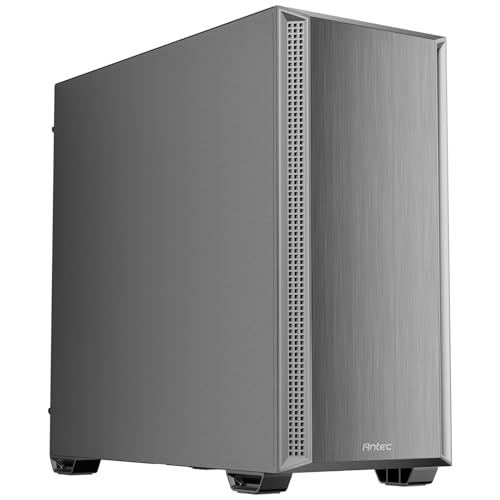
Antec P7 S Mid-Tower ATX Case — The dampened one
The P7 S holds the guide’s only explicit dampening claim, and its title wastes no time making it: sound-dampening side panels, in print, beside a dual side mesh front intake and four included PWM fans. Read that combination as a design argument. The sides — the panels that face the room and the listener — are sealed and treated; the front breathes through mesh at both flanks, feeding the interior without asking the side panels to open. It is the truce from the earlier section, manufactured.
The supporting specification keeps the argument coherent. Four PWM fans arrive fitted, so the airflow side of the bargain starts funded; 360mm of top radiator support gives a liquid plan for the processor; and a USB Type-C port at the 3.2 Gen 2 generation keeps the front panel current. A mid-tower ATX footprint keeps the whole proposition at ordinary desk scale — this is not a flagship’s negotiation, conducted with flagship volume, but a mainstream case that chose its sides carefully, in both senses.
The honest limits are the dampening mechanism’s own. Treated side panels blunt the sounds that travel sideways; the mesh front remains an open door for the sounds that travel forward, and a whining card will still be heard through it, more softly than through glass but heard. Dampening also adds its thermal tax on the sealed sides, which the mesh intake is designed to repay. Buyers whose noise problem is specifically side-facing — a PC beside a sofa, a desk against a shared wall — are this case’s natural owners; buyers whose problem is a loud card should read the fan-engineered picks with equal care.
- Dampening, as the title words it: sound-dampening side panels
- Intake design named in the title: dual side mesh front intake
- Fans named in the title: four PWM fans included
- Radiator support named in the title: 360mm at the top
- Connectivity named in the title: USB Type-C 3.2 Gen 2
- Form named in the title: mid-tower ATX
Strengths
- The only title-stated dampening in the guide, aimed at the panels that face the listener.
- The dual-flank mesh intake repays the sealed sides’ thermal tax by design rather than by hope.
- Four fitted PWM fans and top radiator room make it complete for air or liquid plans.
Trade-offs
- Front-facing sound still exits through the mesh intake — dampening here is directional, not total.
- Sealed side panels place the full breathing duty on the front path, so filters want regular attention.
- Mid-tower volume caps the low-speed-fan strategy below the full-tower picks’ ceiling.
Best for: a gaming or work PC sitting beside living space, where side-facing noise is the complaint and a mesh front is an acceptable voice. Not suited for: a buyer expecting dampening to erase a graphics card’s coil whine, because no panel treatment in this class cures a component-level sound at its source.

be quiet! Pure Base 501 Airflow Case — Compact pressure design
The 501 Airflow negotiates through pressure. Its title promises a compact ATX midi tower with two preinstalled 140mm PWM fans and an interior optimised for air pressure — a phrase worth unpacking, because pressure-optimised design means the case’s intake path is shaped to push air deliberately across the components rather than merely admitting it. In a compact enclosure, where components crowd and lazy airflow leaves hot pockets, that deliberateness is the difference between two fans sufficing and two fans disappointing.
The 140mm fan size is the quiet half of the design. Two large fans, turning at the moderate speeds a well-pressured path allows, move the air a compact gaming build needs while staying in the calm register be quiet! has made its name on. Vertical GPU installation support appears in the title as well — a presentational option that also changes the card’s relationship to the intake path — and a USB 3.2 Gen.2 Type C port keeps the front panel modern. The compact footprint is the pick’s other argument: this negotiation fits desks and rooms the 7000D’s full tower cannot enter.
Compactness writes the trade-offs. Two fans is a fitted minimum that heavy builds may extend; the interior’s room for radiators and long cards is compact-class, and the title publishes neither a radiator figure nor a card ceiling, so liquid and flagship-card plans need the manufacturer’s dimensions. Buyers who want the brand’s discipline at full scale should look at the Dark Base Pro 701; buyers who want it in a smaller, pressure-tuned box have found their pick.
- Airflow design, as the title words it: optimised air pressure in a compact midi tower
- Fans named in the title: two preinstalled 140mm PWM fans
- Graphics provision named in the title: vertical GPU installation
- Connectivity named in the title: USB 3.2 Gen.2 Type C
- Dampening status: the 501 Airflow’s title claims airflow engineering and makes no sound-dampening statement, so its quiet should be credited to fan size and path design rather than to treated panels
- Radiator support: no radiator dimension is printed in this listing’s title, so loop planners should pull sizes from be quiet!’s specification page
Strengths
- Pressure-optimised airflow makes two large fans do deliberate work in a compact interior.
- 140mm PWM fans are the truce’s favourite hardware — meaningful air at calm speeds.
- The compact footprint brings the brand’s quiet discipline to smaller desks and rooms.
Trade-offs
- No dampening is claimed; a noisy component’s voice leaves through the airflow path unblunted.
- Two fitted fans may need supplementing in a high-heat build.
- Compact dimensions and unpublished radiator figures add a measurement step for ambitious plans.
Best for: a compact gaming build in a bedroom or study, where calm fans and a tuned air path matter more than panel treatment. Not suited for: a builder whose primary noise source is component whine aimed at the listener, because an airflow case without dampening offers that sound a clear exit.

be quiet! Dark Base Pro 701 Case (White) — The flagship negotiator
The Dark Base Pro 701 is the negotiation conducted with a flagship’s resources, in white. Its title assembles the full apparatus: a mesh front and airflow-optimised design, three pre-installed Silent Wings 4 fans, a fan and ARGB controller, a PWM and ARGB hub, and a tempered glass side. Where the 501 tunes a compact box, the 701 orchestrates a large one — the hub and controller are the tell, because they exist to run many fans as one calm system rather than as a committee of individual decisions.
Silent Wings 4 fans are the brand’s statement hardware, engineered for the low-noise end of the speed range where this category lives. Three fitted units give the mesh front a working intake corps from day one, and the controller puts their pace — and the lighting’s — under the owner’s hand, which is where quiet is ultimately decided. The mesh front states the design’s priority honestly: this flagship breathes first and trusts its fans to be quiet, rather than sealing the box and trusting its panels.
The glass side and the white finish complete a case that expects to be looked at, which raises the familiar showcase duties — cable care, component aesthetics — inside a machine also expected to be barely heard. Its title publishes no radiator dimension, so liquid builders take one documentation step; and buyers should register that for all its flagship apparatus, the 701 claims airflow optimisation, not dampening panels. Its quiet is engineered at the fan, which for most builds is exactly where quiet is cheapest to buy.
- Airflow design, as the title words it: mesh front, airflow optimised
- Fans named in the title: three pre-installed Silent Wings 4 fans
- Control hardware named in the title: fan and ARGB controller, PWM/ARGB hub
- Panel named in the title: tempered glass side
- Finish named in the title: white
- Dampening status: be quiet!’s title for the 701 speaks of airflow and fan engineering without claiming dampened panels, so credit its hush to the Silent Wings hardware and the mesh-led path
Strengths
- The hub-and-controller setup lets many fans behave as one calm, centrally governed system.
- Silent Wings 4 fans are purpose-built for the low speeds this category rewards.
- A mesh-front flagship in white serves rooms where the PC is both heard and seen — and must behave in both senses.
Trade-offs
- Glass and mesh both pass component noise; there is no dampened barrier in this design.
- Radiator sizing is absent from the title, adding a verification step for liquid plans.
- Flagship apparatus — hubs, controllers, lighting — rewards owners who enjoy running a system, not just owning one.
Best for: a high-end build in a living space, where fan governance, mesh breathing, and a white glass presentation must coexist. Not suited for: a buyer seeking treated panels as the quiet mechanism, because this flagship’s title promises airflow engineering and leaves dampening to the P7 S.

CORSAIR 7000D Airflow Full-Tower Case — Volume as a strategy
The 7000D’s negotiation is conducted in cubic capacity. A full-tower ATX case with a high-airflow front panel and a spacious interior does not need its fans to hurry: three 140mm AirGuide fans with a PWM repeater arrive fitted, the front panel admits air across a broad face, and the interior’s volume means hot components sit in a reservoir of cool air rather than in each other’s exhaust. Corsair calls the fans AirGuide because their frames shape the flow they produce — a small engineering sentence that fits the case’s whole philosophy of moving much air, gently, on purpose.
Scale is also the cable and cooling story. A spacious interior swallows long cards, tall coolers, and elaborate loops without the compromises compact cases negotiate daily, and easy cable management is claimed in the title as a designed feature rather than a hope. For the builder whose quiet problem is really a heat problem — a flagship card and processor in a mid-tower, fans screaming at the ceiling of their range — the 7000D’s answer is to remove the ceiling. The same build, given room, runs its fans at the calm end of their curves and becomes the quiet machine its owner originally wanted.
The costs of volume are literal: a full tower is furniture, claiming floor or desk territory permanently, and its title claims airflow rather than any dampening — a loud component in a big mesh-fronted box is a loud component with excellent ventilation. Buyers should also note the PWM repeater’s implication: the case expects a fan population beyond the fitted three, and the budget for a fully dressed 7000D should include the additional fans its spaciousness invites.
- Airflow design, as the title words it: high-airflow front panel in a full-tower ATX case
- Fans named in the title: three 140mm AirGuide fans with PWM repeater included
- Interior, as the title words it: spacious, with easy cable management
- Dampening status: Corsair’s title for the 7000D advances airflow and capacity claims only; nothing in it describes sound-dampening treatment, so expect quiet to arrive via slow-turning fans in a roomy box
- Radiator support: the listing title does not print a radiator size for this tower, so liquid builders should consult Corsair’s documentation for the positions their loop needs
Strengths
- Volume plus a high-airflow front lets powerful hardware run its fans at calm speeds — the truce at full scale.
- Three fitted 140mm fans and a repeater give the cooling system a governed starting population.
- The spacious interior ends the fitment negotiations that compact quiet builds endure.
Trade-offs
- A full tower’s footprint is a permanent room decision, not a desk accessory.
- No dampening is claimed, so component voices exit through the airflow path untreated.
- Fully populating its fan capacity is an additional purchase the title’s three fitted fans only begin.
Best for: a flagship-powered build whose fans currently scream in a smaller case, where room to breathe is the entire prescription. Not suited for: a small desk or a noise problem rooted in coil whine, because cubic capacity cannot help either — the whine will simply be very well ventilated.

Fractal Design North PC Case (Mesh Side) — The beautiful breather
The North requires the guide’s clearest act of labelling, so let it happen in the first sentence: this is an airflow case with a genuine walnut wood front and mesh side panels, and it is not a sound-dampened case — its title claims no dampening, and none will be invented for it here. What it claims, and delivers by design, is breathing: mesh sides that admit air along the interior’s whole flank, two included 140mm Aspect PWM fans, a Type C USB port, and an ATX mid-tower form wrapped in the most admired furniture-grade front in the industry.
Mesh sides change the airflow geometry in a way worth understanding. A front-intake case pulls air through one face and drags it across the components; the North’s mesh flanks let the interior inhale along its length, shortening the path to the card and board. At low fan speeds — the speeds this category cares about — that distributed intake is a genuine strategy, and the two Aspect fans are sized at the truce’s preferred 140mm. The walnut front, meanwhile, does the room a service no specification measures: this is the case that non-PC people compliment, the one that lets a gaming machine live in a designed living room without apology.
The trade is stated in the labelling: mesh sides are open doors for sound in both directions, and the North’s quiet is entirely of the indirect kind — good fans, easy breathing, no component asked to shout. Owners whose components are themselves calm will find the result genuinely hushed; owners hoping the walnut conceals acoustic treatment will be disappointed by physics. Buy it as the beautiful airflow case it declares itself to be, and it will not disappoint at all.
- Airflow design, as the title words it: mesh side panels on an ATX airflow mid tower
- Front material named in the title: genuine walnut wood
- Fans named in the title: two 140mm Aspect PWM fans included
- Connectivity named in the title: Type C USB
- Finish named in the title: Charcoal Black
- Dampening status: Fractal’s title for the North describes wood, mesh, and fans — and pointedly no sound-dampening panels — so this pick’s quiet is the indirect, airflow-led kind only
Strengths
- Mesh flanks give the interior a distributed intake that suits low-speed, low-noise fan operation.
- The walnut front makes it the one pick here that improves a room by being looked at.
- Two fitted 140mm PWM fans start the calm-air strategy without further purchases.
Trade-offs
- No dampening exists in this design — component noise exits through the mesh unimpeded.
- Two fans is a starting set; hot builds will add more and should budget for it.
- Wood is a living finish that asks for the care furniture asks for, not the neglect steel tolerates.
Best for: a design-led living room or studio build whose components are already civilised, and whose owner values breathing and beauty over panel treatment. Not suited for: a buyer shopping specifically for sound dampening, because this case’s title offers walnut and mesh — and dampening is simply not among its materials.

be quiet! Pure Base 600 ATX Tower — The adjustable veteran
The Pure Base 600 is the elder of this field, and its title reveals a negotiation style the newer picks have largely abandoned: adjustability. Alongside two pre-installed fans, repositionable HDD slots, and a removable ODD cage, it offers an adjustable top cover — a panel the owner can set for the evening’s priority, trading airflow for quiet in hardware rather than in fan curves alone. In a category built on a contradiction, a case that lets the owner re-negotiate nightly has a certain philosophical honesty the fixed designs cannot match.
Water cooling support up to 360mm appears in the title, giving the veteran a liquid path that many of its contemporaries lacked, and the repositionable drive slots reflect an era when storage still lived in the case in quantity — a flexibility modern builders can repurpose as clearance for long cards or cleaner air paths. The removable ODD cage is a period detail with a present use: out it comes, and the front path opens. Age, in this design, reads less as obsolescence than as a record of problems the maker once solved mechanically.
The candour paragraph: two pre-installed fans of an earlier generation will not match the Silent Wings 4 hardware in the 701 for refinement, the title claims no dampening panels, and the front connectivity belongs to its period. Buyers choosing the 600 are choosing its adjustability and its proven, flexible interior at a veteran’s position in the range — a rational choice for a mixed-use machine whose owner genuinely will move that top cover with the workload, and a nostalgic one for anyone who will set it once and forget it exists.
- Adjustability, as the title words it: adjustable top cover
- Fans named in the title: two pre-installed fans
- Cooling support named in the title: water cooling up to 360mm
- Storage flexibility named in the title: repositionable HDD slots, removable ODD cage
- Dampening status: the Pure Base 600’s listing title makes no dampening claim for its panels, so its quiet rests on fan behaviour and the top cover’s setting rather than on treated surfaces
- Form named in the title: ATX midi tower, black
Strengths
- The adjustable top cover lets one case serve a quiet evening and a rendering night without compromise by decree.
- Repositionable storage and a removable cage give its interior a second life as clearances change.
- 360mm water cooling support keeps a liquid plan open in a veteran design.
Trade-offs
- Its two fitted fans belong to an earlier generation than the flagship picks’ hardware.
- No dampening is claimed in the title, despite the brand’s quiet reputation — reputation is not specification.
- Period details like the ODD cage are flexibility for some buyers and archaeology for others.
Best for: a mixed-use machine whose workload swings between silent desktop duty and heavy sessions, where a movable top cover earns its keep weekly. Owners who set a case once and never touch it again waste this design’s main trick, an adjustable top cover meant to be repositioned as workloads change.
How Do You Set Up a Quiet Airflow Build, Step by Step?
Begin with the fan population the case gives you and resist adding more until the temperatures demand it. Fit the included fans in their intended positions, route their leads to the board or hub that will govern them, and set a single conservative curve before the first game or render. A build commissioned calmly can be tuned upward in knowledge; a build commissioned at full speed teaches its owner nothing except that it can be loud. The governed picks — the 701 with its hub and controller above all — exist to make this discipline a setting rather than a resolution.
Give the intake path its dignity. Mesh fronts and flanks only breathe as well as their surroundings allow, so position the case with clearance at its intake faces, keep its filters on a cleaning rhythm, and never let a wall or a cabinet side sit flush against the surface the design inhales through. The North’s mesh sides make the point geometrically: a flank against a wall is half the strategy annulled. Quiet builds fail at the margins of placement more often than at the centre of specification.
Soak-test with real work and honest ears. Run the heaviest ordinary workload for half an hour, then judge the machine from the seat where it will be lived with — not from beside the case, where every machine sounds earnest. Adjust the curve’s middle, where life happens, rather than its extremes. Then leave it alone for a month. The quiet build’s final virtue is stability: a negotiation concluded, a machine that stops asking for attention, a room that forgets the computer is working. That forgetting is the product this entire category sells, and it is worth buying deliberately — with the mechanism named, the fans counted, and the room considered — rather than by accident.
What Role Do the Room and the Desk Play in Perceived Silence?
A case radiates sound into a room, and the room edits what arrives. Hard floors and bare walls return fan noise with interest; soft furnishings absorb the high frequencies that make fan sound feel sharp. The same build measures identically in both rooms and bothers its owner in only one of them. Buyers chasing quiet should therefore spend one thought on placement before spending money on panels: a machine under a desk, on a mat, away from the corner where two walls amplify it, starts its life several decibels of perception ahead of the same machine on a hard floor in a corner.
Distance is the cheapest dampening ever sold. Sound falls with the square of the journey, so a tower moved from desk surface to floor — where the full-tower picks naturally live — hands its listener a quieter machine without changing a single fan. The trade is the showcase’s visibility, which is why this guide’s glass picks exist for the owners who refuse it. Neither choice is wrong; both are acoustic decisions wearing furniture’s clothes, and making them consciously is most of what separates a quiet setup from a quiet purchase.
How Does a Quiet Build Age — and What Maintenance Keeps It Quiet?
Fans age audibly before they age mechanically. A bearing that was silent in year one may develop a tick or a hum in year three, and in a quiet build — where the whole point is a low noise floor — one ageing fan becomes the loudest object in the room. The maintenance habit that matters is listening on purpose: a monthly moment with the machine idling, noting any new voice in the chorus, catches the failing fan while it is still a replacement rather than a resentment. Governed systems make the diagnosis easier, since a hub lets each fan be slowed or stopped in turn until the voice identifies itself.
Dust is the second ageing agent, and its mechanism is thermal before it is acoustic. Filters and mesh load gradually, intake resistance rises, temperatures follow, and the fan curve — doing its job — raises speeds to compensate. The machine grows louder across a season so slowly that the owner adapts, until a visitor asks why the computer is audible and the owner hears it fresh. The cleaning rhythm that prevents this is unglamorous and short: filters out, mesh brushed, interior blown clear, on a calendar rather than on a suspicion.
The third agent is the owner’s own upgrading. A hotter card or a hungrier processor changes the thermal bargain the case originally negotiated, and the quiet build’s settings — curves tuned for the old components — silently become the wrong settings. Every significant component change deserves the soak-test ritual again. Quiet, in the end, is not a feature purchased once but a settlement renewed whenever the machine changes, which is why the cases here were chosen for headroom: the negotiation is easiest to renew in a box that was never at its limit.
Which Pick Suits Which Kind of Listener?
The side-sleeper — the owner whose PC shares a room with rest — should start at the P7 S, because its dampened sides address the direct path between machine and pillow, and its mesh front keeps the sealed design thermally honest through long evenings. The open-plan worker, whose machine sits across a living space and runs all day, is better served by governed airflow: the Dark Base Pro 701’s hub keeps a many-fan system at one calm pace, and the machine’s voice stays a room tone rather than an event.
The performance-first owner, whose hardware is hot and whose current case forces its fans to shout, needs volume before treatment — the 7000D’s strategy — because no panel can absorb noise that better airflow would never have produced. The small-desk owner takes the 501 Airflow’s compact pressure design; the schedule-driven owner, quiet by night and mighty by weekend, takes the Pure Base 600’s adjustable cover; and the design-led owner takes the North, knowing its quiet is the kind that calm components grant. Six listeners, six settlements — the guide’s whole argument is that the match matters more than the ranking.
Mechanisms Compared — Where Does Each Pick Find Its Quiet?
| Pick | Quiet mechanism per title | Fitted fans per title | Airflow claim per title |
|---|---|---|---|
| Antec P7 S | Sound-dampening side panels | Four PWM | Dual side mesh front intake |
| be quiet! Pure Base 501 Airflow | Fan size and pressure-tuned path | Two 140mm PWM | Optimised air pressure |
| be quiet! Dark Base Pro 701 | Silent Wings 4 fan engineering | Three Silent Wings 4 | Mesh front, airflow optimised |
| CORSAIR 7000D Airflow | Volume and slow-turning fans | Three 140mm AirGuide | High-airflow front panel |
| Fractal Design North | Indirect — easy breathing only | Two 140mm Aspect PWM | Mesh side panels |
| be quiet! Pure Base 600 | Adjustable top cover, fan behaviour | Two pre-installed | Up to 360mm water cooling |
Read the fitted-fan column as a budget statement as well as a cooling one: the picks arriving with three or four fans fitted ask the least of the owner’s wallet afterward, while the two-fan picks assume either a modest build or a supplement the owner plans knowingly. Neither is a defect — but a comparison that ignores the supplement compares half-prices against whole ones.
Only one row in the mechanism column describes sound being absorbed. The other five describe sound being avoided — by fan size, fan engineering, volume, path design, or an adjustable cover — and avoidance, practised well, is most of what owners actually experience as a quiet PC. Choose the row whose mechanism matches your dominant noise, and the table has done its work.
What Mistakes Do Quiet-Build Shoppers Keep Making?
A fifth mistake is chasing the noise floor into component territory the case cannot influence — replacing a case to cure a power supply’s fan, a cooler’s pump note, or a drive’s seek chatter that a moment’s diagnosis would have located precisely. Quiet shopping rewards the owner who first stands beside the running machine, listens component by component, and writes down which voice actually offends. That list, and not a search ranking, is the true brief for everything this category sells.
The first is buying the word “silent” as a property rather than a system outcome. A case sets a ceiling; components and curves decide the lived result, and the owner who installs a flagship card with an aggressive factory curve into the finest case here will own a loud machine with excellent provenance. The second mistake is sealing a hot build: dampened panels and closed covers tax airflow, and a build that responds by spinning its fans to their ceiling has traded a little panel absorption for a lot of fan production — the contradiction collecting its debt.
Third is ignoring fan size in favour of fan count. Two 140mm fans at calm speed will out-quiet four small fans at speed in most real builds, which is why the titles’ size figures deserve more attention than their counts. Fourth is placing the finished quiet PC in a loud position — inside a closed cabinet that traps heat and forces fan speed, or on a hard floor that returns vibration as hum. The room is part of the acoustic design, and it is the only part no listing can sell you.
Final Recommendation
Name your dominant noise, then choose its mechanism. If the complaint is a machine’s general voice leaking sideways into living space, the Antec P7 S is the pick whose title promises the relevant treatment, with the mesh intake to keep its sealed sides honest. If the complaint is fan roar under load, the answer is airflow headroom: the Dark Base Pro 701’s governed Silent Wings system for a flagship build, the 7000D’s sheer volume for the hottest hardware, the 501 Airflow’s pressure-tuned compactness for smaller desks. If the workload itself swings, the Pure Base 600’s adjustable cover remains a quietly brilliant answer. And if the room’s beauty is non-negotiable and your components are already calm, the North breathes and glows in walnut — bought, always, as the airflow case it declares itself to be. Silence and airflow never stop negotiating; the right case is simply the negotiator whose terms match the sounds you actually live with. Make the match by mechanism rather than by reputation — dampening where sound must be absorbed, airflow where sound must never be produced, volume where heat is the true author of noise — and the machine that results will earn the only review this category cannot fake: a room that no longer notices it.
Frequently Asked Questions
Can a case make a loud graphics card quiet?
It can reduce the card’s contribution, never erase it. Dampened panels blunt the direct sound path, easy airflow lets the card’s own fans run slower, and a roomy interior stops the card from recycling its exhaust — together, a meaningful softening. But the card’s fans and any coil whine originate inside the component, and their character survives every case in this guide in some measure. Buyers with a genuinely loud card should treat the case as the second fix and the card’s fan curve — or the card — as the first.
Are more fans always quieter?
More fans at lower individual speeds can move the same air more calmly than few fans at speed, which is the logic behind governed multi-fan systems like the Dark Base Pro 701’s hub arrangement. But each fan is also a sound source and a vibration source, and an unmanaged crowd of them at mismatched speeds can chorus rather than hum. The governing matters more than the count: one controller, one curve philosophy, fans sized generously for the duty.
Does liquid cooling make a build quieter than air?
It relocates the noise rather than abolishing it — a radiator’s fans still move air, and a pump joins the cast — but it often wins the exchange, because radiator fans can be large, slow, and positioned at the case’s edge while the processor’s heat leaves directly. Several picks here reserve top radiator room for exactly that strategy, the P7 S at 360mm among them. The honest summary: liquid is a quiet tool when the build’s loudest sound was a small cooler fan working hard, and a neutral one otherwise.
Why is the Fractal North in a silent-case guide if it has no dampening?
Because owners experience it as a quiet case, and the guide’s job is to explain why without mislabelling it. Its mesh sides and 140mm fans let components run at low speeds, which is the indirect route to quiet that most real builds actually travel. It is included with its mechanism stated in every section — airflow, not absorption — so a buyer who needs dampening chooses the P7 S with open eyes, and a buyer who needs beauty with breathing chooses the North the same way.
How should fan curves be set in a quiet build?
Lazy at idle, patient under load. The curve should hold fans near their calm floor through desktop work, rise reluctantly through gaming loads, and reserve the top of the range for temperatures that genuinely threaten the hardware. Every case here rewards that philosophy, because each was designed around low-speed air movement; an aggressive curve imposed on them is an owner overriding the negotiation the case was built to conduct. Set the curve once, soak-test it under a real workload, and let the machine be boring thereafter.
Is a glass side panel compatible with a quiet build?
Compatible, with expectations set correctly. Glass is a respectable barrier to direct sound — better than open mesh, short of treated panels — and the Dark Base Pro 701 pairs its glass side with mesh-led breathing and governed fans to workable effect. What glass cannot do is absorb; it reflects sound inside the case and passes a share through, so a glass build’s quiet still depends on its fans behaving. Choose glass when the view matters and the components are calm; choose treated or solid panels when the view is negotiable and the components are not.
Where should a quiet PC sit in a shared living room?
On a soft surface if possible, away from corners, with its intake faces breathing free room air and its exhaust given a path that does not cross the seating. The floor beside a desk — the natural home of the full-tower picks — beats the desktop for distance and for keeping the machine’s voice below ear level. Avoid enclosed cabinets entirely: a quiet case in a closed cabinet becomes a hot case, and a hot case becomes a loud one, in a sequence this guide has now described from three directions because it ruins more quiet builds than any component choice.
How do I tell whether my noise problem is airflow or components?
Run the machine at idle, then under a graphics load, then under a processor load, and note which transition brings the offending voice. Noise that arrives with fan speed and scales smoothly is airflow’s territory, and a case from this guide addresses it directly. Noise that appears at a specific load type regardless of fan speed — a whine under graphics load, a chatter under disk activity — belongs to a component, and the case can only soften its journey to your ears. Ten minutes of this listening, before any purchase, is the cheapest diagnostic in the category.
What is the single most effective quiet upgrade for an existing build?
Fan governance, applied honestly: one curve, set lazy at idle and patient under load, run through one controller or hub so the fans behave as a system. It costs nothing on a governed pick and little on any other, and it routinely buys more perceived quiet than a case swap performed without it — which is why this guide treats the case as the ceiling and the curve as the address beneath it. Owners who do both, in that order, are the ones whose machines disappear into the room’s background and stay there.
Do I need to replace my components to get a quieter PC?
Usually not first. The order of operations that serves most owners is curve, placement, case, and only then components — because the first three are cheap or free and routinely account for most of the perceived noise. A card that whines or a cooler that screams at modest loads will eventually indict itself through that process, and replacing it then is a diagnosis rather than a guess. The cases in this guide are the third step done properly: each raises the ceiling enough that the remaining noise honestly belongs to the components, which is all a case can fairly be asked to prove.
Related Guides
Quiet machines connect to the rest of the batch naturally: the best top-mount radiator pc cases guide covers the towers whose liquid plans pair with low-speed fan strategies, the best dual pc cases roundup examines enclosures where two machines’ noise must be managed at once, and the best inverted gaming pc cases collection looks at layouts that change which panel — and which sounds — face the listener.


