What's inside
- Key Takeaways
- Quick Picks
- How Did We Choose These Hiking Chargers?
- Why Do Rated Watts Shrink on the Trail?
- Why Does the Power Bank Sit Between the Panel and the Phone?
- How Do Season and Latitude Change the Calculation?
- What Should a Group or a Family Carry Differently?
- How Do You Care for a Folding Panel So It Lasts?
- Which Hiking Chargers Deserve a Closer Look?
- Which Charger Wins on Weight per Watt?
- How Should You Build a Charging Routine on a Multi-Day Walk?
- How Should You Test a New Panel Before Trusting It on a Trip?
- What Are the Most Common Mistakes When Charging on the Trail?
- What Else Competes for the Same Grams in Your Pack?
- Final Recommendation
- Frequently Asked Questions
- Related Guides
As an Amazon Associate I earn from qualifying purchases. This post may contain affiliate links at no extra cost to you.
**[widgetverdict.com] is reader-supported. When you buy through links on our site, we may earn an affiliate commission.**
Every gram in a rucksack argues for its place, and a solar panel has to argue harder than most. This guide to the best hiking solar chargers compares six folding panels from 10W to 45W, judged on the trail’s own terms: weight against watts, folded size against the pack it must ride in, and whether the panel’s output survives the stop-start reality of walking under a moving sky. Two brands dominate the shortlist — FlexSolar and BigBlue each appear twice with genuinely different models — and the sections below treat each model on its own merits rather than as a brand bundle.
All six are sold through Amazon marketplace listings, and all six share one honest limitation that belongs at the front of the guide: a panel’s rated watts are measured under ideal midday sun, and a hiker’s day is mostly not that. Morning light through trees, a panel draped over a pack at a walking angle, cloud building by afternoon — real trail harvest is a fraction of the box number. The hikers who get value from these panels plan around that fraction instead of resenting it, and the planning pattern is simple: the panel charges a power bank while you walk and rest, and the bank charges your phone while you sleep.
Key Takeaways
- Weight per watt is the trail metric that matters: the BigBlue 25W panel states 0.84 lbs outright, the lightest full-size proposition in this guide.
- Small panels (10W and 14W) are phone-and-torch top-up tools for day hikes and short trips, not expedition power.
- The 30W to 45W panels can genuinely refill a power bank across a rest day or a long lunch in strong sun, and the FlexSolar 40W adds a DC output for small power stations at a basecamp.
- Charging a phone directly from a moving panel invites constant interruptions; charging a bank first is the pattern every experienced trail user settles on.
- Waterproofing varies by model and is stated per pick — IP68, IP67, IPX5 and IPX4 all appear in this lineup, and they are not interchangeable promises.
- FlexSolar’s two entries are different models — a 10W four-fold panel and a 40W panel with DC output — and are reviewed separately below.
Quick Picks
| Pick | Badge | Why it earns its place |
|---|---|---|
| FlexSolar 10W Foldable | Featherweight Top-Up | A four-fold 5V USB panel with IP67 sealing, small enough to forget in a pack until a phone needs it. |
| BigBlue 25W Ultra-Light Panel | Best Power-to-Weight | 25W at a stated 0.84 lbs with USB-A and USB-C and IP68 sealing — the thru-hiker’s arithmetic favourite. |
| SOLUPUP 30W Foldable Solar Panel Charger | Two-Port Mid-Size | 30W with USB-C and USB-A for bank-plus-phone duty at a basecamp, in an IPX5 shell. |
| FlexSolar 40W Foldable Panel | Basecamp Workhorse | 40W with USB-C, USB-A and DC outputs, able to feed a small power station as well as banks and tablets. |
| GEYOTO 45W Solar Panel Charger | Fastest Trail Charging | 45W with PD 25W over USB-C and IP68 sealing, for walkers running modern fast-charging phones and tablets. |
| BigBlue 14W Solar Panel | Simple Day-Hike Panel | A single USB-A port at 5V/2.4A maximum and an IPX4 build — the uncomplicated option for short trips. |
How Did We Choose These Hiking Chargers?
We filtered for panels a hiker would actually carry, which removed the rigid and semi-rigid panels that dominate the wider solar category and left the folding fabric-style chargers. Within that group, every pick had to state its wattage and its outputs in the listing title, because a trail purchase made on vague specifications is a purchase that disappoints at the first rest stop. Panels whose titles hid their port provision entirely were set aside.
Weight evidence was the second filter, applied honestly: where a title states a weight, as the BigBlue 25W does with its 0.84 lbs, we print it. Where a title is silent, the spec boxes below say the figure is not stated rather than borrowing a number from a sibling model — a real risk in this category, where one brand sells near-identical panels at several wattages. Hikers comparing listings should hold every seller to the same standard and treat an unstated weight as a question to resolve before purchase, since the whole point of the product is carrying it.
The third filter was the output set. A modern trail kit runs on USB-C increasingly — phones, head torches, satellite messengers, cameras — so panels offering only a single legacy USB-A port had to justify themselves on simplicity, as the BigBlue 14W does. Panels with USB-C, and especially the GEYOTO’s PD 25W, reflect where device charging is going. The FlexSolar 40W’s DC output earned its place for a different reason: basecamp walkers and bikepackers increasingly carry a small power station, and a trail panel that can feed one bridges two worlds.
Finally, sealing. Trail weather is not optional, so every pick states some level of water resistance in its title, and we report the exact rating per model. IP68 and IP67 are strong promises; IPX5 and IPX4 are shower-level promises. The difference decides whether a panel rides out a storm on the outside of a pack or gets buried inside it.
Why Do Rated Watts Shrink on the Trail?
A panel’s rating assumes the sun square overhead, a clear sky, and the panel held at the perfect angle, still. A hiker offers it none of those for most of the day. Draped over a rucksack, the panel points wherever the trail points; walking north in the morning, a pack-top panel faces away from the southern sun entirely. Under trees, output falls to a murmur. Even at a lunch stop, the angle a hiker bothers to set is approximate, and the sun moves off it within the hour.
The realistic planning figure for a panel carried on a pack is a quarter to a third of its rating averaged across walking hours, rising toward half or better during a deliberate stationary charge at midday in open country. That arithmetic is why the wattage ladder in this guide should be read generously: a 25W panel on the trail behaves, across a day, like the steady companion a 10W panel appears to be on paper, and a 10W panel behaves like a top-up trickle. Buy a size up from the one your spreadsheet suggests, or plan a stationary charging hour into each day — the experienced approach is usually both.
Heat plays a part too. Solar cells lose a little efficiency as they bake, and a black panel on a black pack in still midday air runs hot. A breeze, a lighter-coloured pack, or propping the panel so air moves behind it all claw back small percentages. None of this is a reason to skip solar; it is a reason to size and schedule it like a hiker — conservatively, with margin.
Why Does the Power Bank Sit Between the Panel and the Phone?
Direct charging fails on trails for a mundane reason: phones are fussy negotiators. When a cloud crosses or the panel tilts into shade, output collapses, the phone drops the charge session, and when the sun returns the two devices must find each other again. Some phones handle hundreds of these micro-interruptions gracefully; others waste meaningful energy on each renegotiation or simply refuse to resume until re-plugged. A hiker discovers which kind of phone they own on the first cloudy ridge, which is late.
A power bank is not fussy. It accepts whatever the panel offers, in whatever rhythm the sky provides, and banks it. Then, in the tent, the phone charges from the bank at a steady rate while its owner sleeps. The bank also decouples the day’s geography from the phone’s needs: the panel harvests on the sunny ridge at noon, the phone feeds in the shaded valley camp at night. Every pick in this guide is best used this way, and the wattage you need drops once the bank absorbs the intermittency — another reason the mid-size panels satisfy most walkers.
Choose the bank for the trip length and keep it boring: enough capacity for two to three full phone charges, charged from the wall before departure, and treated as the buffer the panel refills rather than as a second device to nurse. Walkers who also prepare home emergency power will find the same buffer-first thinking scaled up there to panels and stations for a house rather than a rucksack.
How Do Season and Latitude Change the Calculation?
A panel that feels generous in a desert summer can feel stingy in a northern autumn, and the difference is not the panel. Day length sets the harvest window: a long June day offers twice the charging hours of a short November one at the same latitude, and the sun’s height sets the intensity within those hours. Winter sun arrives at a low slant that a pack-top panel, tilted by the walker’s posture rather than by intention, captures poorly. Snow glare compensates a little — reflected light off snowfields is real — but the winter walker should plan on the bank doing more of the work and the panel doing less.
Latitude works the same way at larger scale. Routes near the equator deliver strong, near-vertical sun in every season, and even the smaller panels in this guide perform close to their promise there. Routes at high latitudes, or in deep mountain valleys where the sun clears the ridge for only a few hours, compress the harvest into a midday window that the stationary lunch charge happens to match well. Forest canopy is the third geography: a week under unbroken trees in any season is a week of dappled, partial output, and walkers planning such routes should carry the bank capacity for the trip and treat the panel as a bonus rather than a supply line.
The practical translation is a sizing habit: choose the panel for the worst sun of the trip, not the best. A route that mixes open ridge days with forest days will average out kindly for a 25W or 30W panel; a route that is forest throughout wants either a much larger bank charged before departure or the acceptance that devices will be rationed by the final days. Solar rewards the pessimist with a charged phone.
What Should a Group or a Family Carry Differently?
Groups change the arithmetic in two directions at once. More walkers means more phones, but it also means the charging system can be shared and specialised: one walker carries the larger panel, another carries the bigger bank, and the group’s devices queue through a single, better system instead of four mediocre ones. The FlexSolar 40W and GEYOTO 45W make their strongest case here — as group panels at a shared camp, their headroom serves four phones in rotation across an evening in a way no 10W panel can.
The queue needs manners and a system. Agree the order before the trip — navigation devices and the emergency communicator first, phones second, luxuries last — and let the bank be the single source everyone draws from, rather than letting each walker plug into the panel ad hoc during the day. A group that treats its harvest as a common store with a priority list never has the argument that a group of individual solar owners eventually has, usually on the evening the weather turns.
Families with children should add one more device to the priority list honestly: the tablet or speaker that keeps a tired child content in a tent during a rain day is, on that day, essential equipment. Size the bank for it without embarrassment. The weight split across adults makes the larger panels practical for family basecamps in a way they never are for solo walkers, and a panel spread at a family camp, feeding a bank that feeds everyone, is this technology at its most cheerful.
How Do You Care for a Folding Panel So It Lasts?
Folding panels fail at their folds and their connectors, rarely at their cells. Fold along the maker’s creases rather than inventing tighter folds, and never roll a panel that was designed to fold — the repeated bending of cell interconnects is cumulative damage that shows up months later as a dead section. Store the panel flat or loosely folded, dry, out of the compression that a tightly strapped pack lid applies for a whole off-season.
Keep the surface clean with water and a soft cloth; grit wiped dry across the surface scratches the protective layer and taxes output forever after. Check the output at home before each season with the simplest test there is — a phone or bank that visibly gains charge in midday sun — so a panel that died in storage is replaced from a shop rather than discovered at a trailhead. Connectors deserve a brush-out and a look for corrosion or bent pins at the same inspection.
At home between trips, the panel can earn its keep on a windowsill keeping the emergency bank topped, which doubles as a standing test that the whole system works. Gear that is used lightly all year fails less mysteriously than gear that sleeps for eleven months and is asked to perform in the twelfth.
Which Hiking Chargers Deserve a Closer Look?
Six panels, in ascending order of ambition. The small two are day-hike insurance; the middle pair are the multi-day mainstream; the large two serve basecamps, tablets and small stations. Weights are printed only where the listing title states them.

FlexSolar 10W Foldable — Featherweight Top-Up
The smallest panel in this guide folds in four — the title says “4-Fold” outright — and offers a 5V USB output for phones, flashlights and power banks, inside an IP67 waterproof build. Ten watts is a modest harvest and this panel should be bought with modest expectations: it is the charger for the walker who wants a dead phone to become a usable phone across a long lunch, and a power bank to gain rather than lose ground across a sunny day.
Its virtues are the virtues of smallness. A four-fold 10W panel disappears into a pack lid or a map pocket, weighs little enough that the title’s silence on the exact figure matters less than it would at larger sizes, and the IP67 sealing is genuinely strong for the class — this is a panel that can ride out rain on a pack’s exterior without anxiety. FlexSolar frames it for camping, hiking and backpacking as small emergency power, and that framing is accurate: think of it as the solar equivalent of the emergency blanket, carried for the day things go sideways.
What it cannot do is run a modern multi-device trail life. A phone, a watch, a head torch and a camera will outspend its harvest by a wide margin, and its single 5V USB output — no USB-C, no fast-charge protocol is claimed — means one device at a time at standard pace. Walkers with that device load should step up to the 25W class at least, and treat this panel as the day-hike and backup option it is.
- Rated output: 10W, four-fold design
- Output stated in title: 5V USB
- Sealing: IP67 waterproof
- Intended devices: phones, flashlights, power banks, battery packs
- Weight: the title does not print one — at this size the omission is minor, but check the listing if every gram is accounted
Strengths
- Four-fold format packs smaller than anything else in this guide.
- IP67 sealing is the strongest weather promise among the small panels here.
- Honest positioning as small emergency power rather than a full charging solution.
Trade-offs
- Ten watts tops up; it does not sustain a multi-device kit.
- A single 5V USB output means standard charging pace and one device at a time.
- No USB-C, so modern devices charge through an adapter or a legacy cable.
Best for: day hikers and minimalist overnighters who want emergency phone power that folds into a pocket and shrugs off rain.
Not suited for: multi-day walkers running several USB-C devices, whose daily spend will outrun a 10W harvest by mid-afternoon.
Look for this one under the FlexSolar name with “10W” and “4-Fold” together — those tokens separate it cleanly from the maker’s 40W model reviewed below.

BigBlue 25W Ultra-Light Panel — Best Power-to-Weight
This is the panel the arithmetic favours. BigBlue’s title states the two numbers a hiker needs in one breath — 25W and 0.84 lbs — and adds USB-A and USB-C ports and IP68 waterproofing. Twenty-five watts at well under a pound is the strongest power-to-weight proposition in this guide, and for a backpacker counting grams across a week-long carry, that ratio is the entire argument: enough harvest to keep a phone-and-bank system comfortably ahead, at a weight penalty smaller than a filled water bottle.
The port pair matters as much as the watts. USB-C serves the current generation of phones and banks directly; USB-A keeps older torches, cameras and a partner’s legacy devices in play without adapters. IP68 is the highest sealing rating in this lineup — a step beyond the FlexSolar panels’ IP67 — which suits a panel designed to live strapped to the outside of a pack through whatever the week delivers.
The honest caveats are about context rather than the panel. Twenty-five trail watts still shrink to single figures under forest canopy, and no weight is saved if the walker then carries an oversized bank to match an oversized expectation. Pair it with a mid-size bank, give it a stationary hour at lunch when the route allows, and this panel covers the standard modern trail load — phone, torch, watch — with room to spare on open routes.
- Rated output: 25W
- Weight stated in title: 0.84 lbs
- Outputs stated in title: USB-A and USB-C
- Sealing: IP68 waterproof
- Fast-charge protocol: no PD wattage is printed in the title — check the listing if your phone’s fast-charge speed is a priority
Strengths
- The best stated watts-per-pound figure in this guide, and the only sub-pound panel at 25W.
- USB-A and USB-C together cover mixed-generation trail kits without adapters.
- IP68 sealing leads the lineup for a panel that lives on a pack’s exterior.
Trade-offs
- No PD figure in the title, so fast-charge performance is a listing-level question.
- Forest and winter routes will still tax its harvest; it is efficient, not magical.
- At 25W it feeds banks and phones, not the small power stations the 40W pick can serve.
Best for: weight-conscious backpackers on multi-day routes whose kit is a phone, a bank, a torch and a watch.
Not suited for: basecamp setups with tablets and a small power station, which need the FlexSolar 40W’s output set and headroom.
Search for this panel by “BigBlue 25W” plus “0.84 lbs” — the weight figure is unique to this model and filters out the maker’s heavier panels instantly.

SOLUPUP 30W Foldable Solar Panel Charger — Two-Port Mid-Size
SOLUPUP’s 30W panel occupies the sensible middle: more harvest than the ultralight class, two outputs — USB-C and USB-A — for simultaneous bank and phone duty at a rest stop, and an IPX5 waterproof rating. Thirty watts in stationary midday sun is a genuinely useful basecamp figure, capable of refilling a mid-size power bank across a long lunch and a lazy afternoon while its owner reads, cooks or dries socks.
The IPX5 rating deserves a precise reading. The IPX scale’s 5 denotes protection against water jets — rain and splashes, confidently — but it is a step below the immersion-tested ratings of the IP67 and IP68 panels in this guide. For a panel that works at camp and rides inside the pack during the worst weather, IPX5 is a reasonable specification; for a panel strapped outside through a day of driven rain, the stronger-sealed picks are the safer buy. The title does not state a weight, which at 30W is a more meaningful omission than at 10W — resolve it on the listing before committing, especially if the alternative is the BigBlue’s stated 0.84 lbs at 25W.
SOLUPUP is a lesser-known name than BigBlue or FlexSolar, and the article makes no claim about the brand beyond this listing. What the listing offers is a well-judged specification at the size most weekend walkers actually need, and the two-port provision means a couple can charge a bank and a phone together rather than queueing devices across a short rest.
- Rated output: 30W foldable panel
- Outputs stated in title: USB-C and USB-A
- Sealing: IPX5 waterproof
- Intended use per title: camping, hiking, backpacking phone charging
- Weight: not printed in the title — the listing check that matters most for this pick
Strengths
- Thirty watts is the first size in this guide that refills a bank decisively at a rest stop.
- Two ports allow bank-plus-phone charging in parallel.
- IPX5 covers rain and splashes for camp-based use without fuss.
Trade-offs
- IPX5 is a tier below the immersion-rated panels for exterior carry in storms.
- The unstated weight blurs its comparison with the BigBlue 25W until the listing is read.
- No DC output, so small power stations are outside its brief.
Best for: weekend backpackers and couples who charge at camp and want a 30W harvest with two ports working at once.
Not suited for: walkers who carry the panel outside the pack through all weather, and station owners needing a DC feed.
Find this listing by the SOLUPUP name with “30W” — the brand is distinctive enough that the pair of tokens lands directly on it.

FlexSolar 40W Foldable Panel — Basecamp Workhorse
The second FlexSolar in this guide is a different animal from the 10W opener: a 40W folding panel with USB-C, USB-A and DC outputs, described in its title as waterproof and aimed at phones, power banks and tablets. Forty watts moves the conversation from top-ups to throughput. At a basecamp or on a bikepacking setup, this panel can refill a substantial bank across the day, keep a tablet alive for route planning and media, and — through the DC output — feed a small power station, which none of the smaller picks here can claim.
That versatility is bought with size and weight, and the title’s silence on weight should be read as the panel’s main open question. A 40W folding panel is a deliberate carry, suited to walkers whose route includes rest days, to paddlers and riders whose craft carries the load, and to basecamp trips where the walk-in is short and the stay is long. Thru-hikers counting every gram will find the BigBlue 25W the better expression of their priorities, and this guide says so without hedging.
The title calls the panel waterproof without printing an IP number, a small vagueness worth noting: the maker’s 10W model states IP67 explicitly, this one does not state a figure in its title, so the listing page carries that answer. In every other respect the specification is the most complete in the guide — three output families, tablet-class appetite, station compatibility — and for the right trip it is the panel that ends charging anxiety rather than managing it.
- Rated output: 40W foldable panel
- Outputs stated in title: USB-C, USB-A and DC
- Intended devices: phones, power banks, tablets; DC output suits small power stations
- Sealing: described as waterproof in the title, with no IP figure printed — confirm the rating on the listing
- Weight: not stated in the title, and at 40W it is a figure to verify before a long carry
Strengths
- The only pick here with a DC output, opening the door to small power stations at camp.
- Forty watts refills large banks and tablets at a pace the smaller panels cannot match.
- Three output families let one panel serve a whole group’s devices at a rest stop.
Trade-offs
- The largest carry in this guide, in bulk if not in a stated weight.
- No IP figure in the title, unlike the same maker’s 10W model.
- Overkill for a phone-only day kit, where its size buys nothing the 14W or 25W panels lack.
Best for: basecamp walkers, bikepackers and paddlers carrying tablets or a small station, who charge for a group.
Not suited for: gram-counting thru-hikers, for whom the BigBlue 25W delivers the essential harvest at a stated 0.84 lbs.
Distinguish this FlexSolar by searching “40W” with “DC” — the DC output is the token that separates it from the maker’s 10W four-fold panel.

GEYOTO 45W Solar Panel Charger — Fastest Trail Charging
GEYOTO’s panel is the largest and the most protocol-aware in this guide: 45W of panel, a USB-C output with PD 25W fast charging, a USB-A alongside it, IP68 waterproofing, and a pocket-size claim in the title that should be read as enthusiasm rather than measurement. The PD 25W figure is the headline for modern device owners — it means a current phone or a small tablet can accept a genuinely fast wired charge when the sun is strong, rather than the standard-pace trickle that older panels impose.
Hold that promise up to trail light honestly. PD 25W is available when the panel is producing near its best — stationary, angled, in strong sun. On a pack in motion, output will sit far lower and the phone or bank will draw what is offered at whatever rate the negotiation settles on. The panel’s real advantage across a whole trip is its ceiling: during the deliberate charging hour, it fills a bank faster than anything else here, and across broken weather it harvests more from every bright interval.
IP68 matches the best sealing in this guide, which suits the panel’s size — a 45W fold is likely to ride outside the pack or across the top of it. The title gives no weight, and at this size the figure matters; the listing holds it. GEYOTO is another smaller name in this category, and as with the SOLUPUP, the judgement here rests on the stated specification: on paper, this is the panel for the walker whose devices are new, thirsty and fast-charge capable.
- Rated output: 45W panel
- Outputs stated in title: USB-C with PD 25W fast charging, plus USB-A
- Sealing: IP68 waterproof
- Intended devices: phones, tablets, power banks
- Weight: not printed in the title — at 45W, verify it on the listing against your carry budget
Strengths
- PD 25W over USB-C is the only explicit fast-charge protocol in this guide.
- The 45W ceiling harvests the most from every bright interval and shortens the stationary charging hour.
- IP68 sealing suits exterior carry on long routes.
Trade-offs
- Fast charging arrives only in strong, steady sun; moving output will be far below the PD figure.
- The largest panel here, with an unstated weight to resolve before purchase.
- No DC output, so the station-feeding role belongs to the FlexSolar 40W instead.
Best for: walkers with current fast-charging phones and tablets who build a stationary charging stop into each day.
Not suited for: ultralight purists, and basecampers who need a DC feed for a small power station.
Search this one by the GEYOTO name with “45W” and “PD 25W” — the protocol figure is unique to this listing in the current trail panel field.
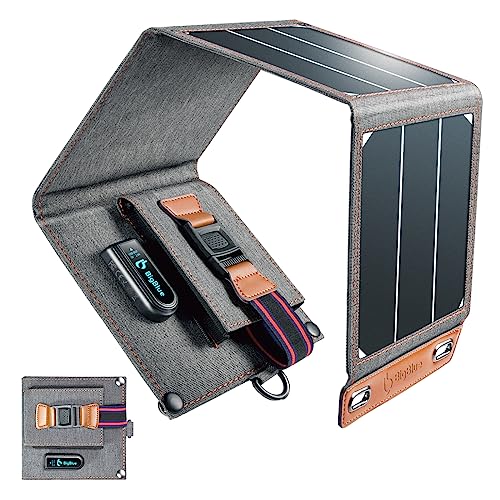
BigBlue 14W Solar Panel — Simple Day-Hike Panel
BigBlue’s smaller panel is the elder design in this guide, and its title reads like it: a 14W panel with a single USB-A port rated at 5V/2.4A maximum, IPX4 waterproofing, and a compatibility list that names the iPhone X, 8 and 7 generations alongside tablets and Samsung and LG phones. Those model names date the listing, and buyers should read them as history rather than as a limit — a USB-A port at 5V/2.4A charges any device that accepts standard USB power, including current phones through a USB-A cable, just at standard rather than fast-charge pace.
Judged as what it is — a simple, single-port panel for short trips — it has a clear place. Fourteen watts in good sun keeps a phone and a torch ahead of their drain on a day hike or a one-night camp, the single port removes every decision, and IPX4 covers splashes and light rain, which is the weather most day hikes actually meet. It is the panel to lend to a friend, to keep in a car kit, or to buy when the trip is short and the budget for charging gear is smaller than the budget for everything else.
Its limits are the modern ones. No USB-C means adapters or legacy cables for current devices; no fast-charge protocol means patience; IPX4 means it goes inside the pack when the weather turns serious rather than riding outside through it. Walkers building a multi-day system should start at the 25W BigBlue instead — the same brand’s answer to a harder brief — and let this panel serve the shorter trips it was framed for.
- Rated output: 14W panel
- Output stated in title: single USB-A port, 5V/2.4A maximum
- Sealing: IPX4 waterproof
- Compatibility named in title: iPhone X/8/7 era devices, tablets, Samsung and LG phones — read as standard USB charging for any device
- Weight: not printed in the title; check the listing if comparing gram-for-gram with the 25W model
Strengths
- One port and no decisions — the simplest panel in this guide to use and to lend.
- Fourteen watts covers a phone-and-torch load on short trips in decent sun.
- IPX4 handles the splashes and light rain of ordinary day-hike weather.
Trade-offs
- USB-A only, at standard pace — current devices charge slowly and may need a legacy cable.
- IPX4 is the lightest weather promise in this lineup.
- The dated phone list in the title reflects the listing’s age, even though the port itself is universal.
Best for: day hikers and one-night campers with a phone and a torch to keep alive, who value simplicity over speed.
Not suited for: multi-day USB-C kits and fast-charge phones, which the BigBlue 25W and GEYOTO 45W serve directly.
Find this listing by “BigBlue 14W” — the wattage separates it from the same maker’s 25W ultra-light panel at a glance.
Which Charger Wins on Weight per Watt?
| Panel | Rated watts | Weight stated | Outputs | Sealing |
|---|---|---|---|---|
| FlexSolar 10W Foldable | 10W | Not in title | 5V USB | IP67 |
| BigBlue 25W Ultra-Light | 25W | 0.84 lbs | USB-A, USB-C | IP68 |
| SOLUPUP 30W | 30W | Not in title | USB-C, USB-A | IPX5 |
| FlexSolar 40W | 40W | Not in title | USB-C, USB-A, DC | Waterproof (no figure in title) |
| GEYOTO 45W | 45W | Not in title | USB-C PD 25W, USB-A | IP68 |
| BigBlue 14W | 14W | Not in title | USB-A 5V/2.4A max | IPX4 |
The table makes one gap obvious: only the BigBlue 25W states its weight in its title, which is why it anchors the weight-per-watt argument. For the other five, the listing page holds the figure, and a hiker comparing two of them should pull both weights before deciding — at panel sizes above 25W, a few hundred grams either way outweighs a few watts either way. Sealing, ports and price-band will usually break any remaining tie.
Two neighbouring guides cover the loads at either end of a walker’s charging life: the Best Battery Chargers for Snowmobiles deals with the maintainer chargers waiting in the garage for the vehicle that drove you to the trailhead, and the Best Chargers for Motorola Phones covers the wall chargers that refill everything quickly the night before a trip.
How Should You Build a Charging Routine on a Multi-Day Walk?
Start the day with the bank full and the phone at whatever the night gave it. Clip or strap the panel to the pack’s top or back face before setting off — the face that sees the sky on your route’s general heading — and run the cable to the bank inside a pocket, so the connection is sheltered and the cable cannot snag on branches. From then on, forget the system until lunch; checking it hourly produces anxiety, not watts.
Lunch is the harvest’s main event. Given a choice of rest spots, take the sunny one; spread the panel flat or angled on a rock, a pack or a groundsheet, plug the bank in, and let the full stop work. An hour of deliberate stationary charging in midday sun commonly gathers more than the whole morning of walking with the panel draped. Eat slowly. This is the one scheduling concession solar asks of a walker, and most find it improves the day rather than interrupting it.
In camp, the direction of flow reverses: the bank feeds the phone, the torch tops up from whichever port is free, and the panel is folded away dry before dew settles on it. If the next day’s forecast is poor, ration accordingly — phone on low-power mode, torch on its lower settings — because a bank husbanded through a grey day is worth more than a panel hoped at a grey sky. Walkers heading home to larger laptops and desks will find the wall-side counterpart in our guide to the Best USB-C Chargers for MacBook Pro, where the same PD protocol that the GEYOTO panel offers at 25W appears at mains scale.
How Should You Test a New Panel Before Trusting It on a Trip?
Give the panel one honest rehearsal at home. On a sunny day, set it out at midday with the bank you will carry, note the bank’s level, leave the system alone for two hours, and note the level again. That single measurement — crude, specific to your panel, your bank and your sky — is worth more than every estimate in this guide, because it converts the panel from a rating into a known daily ration. Repeat it once on a cloudy day if you can; the pair of numbers brackets what the trip will offer.
Test the carry as well as the charging. Strap the panel to the loaded pack and walk an hour with it: does it flap, slip, shade itself against the pack’s curve, or swing its cable into your legs? Mounting problems are free to fix at home — a different strap point, a carabiner, a shorter cable — and miserable to improvise at altitude. Test the connectors with gloves on, too, if the trip is a cold one; small ports and numb fingers are a combination worth rehearsing.
One more rehearsal is worth the ten minutes it takes: practise the whole system at dusk. Set the panel up in fading light, watch how quickly its contribution falls away, and note the moment when the bank stops gaining and starts merely holding. That dusk test teaches the day’s real boundary — the hour after which solar is finished and the evening belongs to stored power — and it is better learned in a garden than on a ridge with the temperature dropping.
Finally, test the failure mode. Unplug everything, drain the phone to the level that worries you, and run the full recovery — panel to bank, bank to phone — as you would in camp. Knowing the sequence in your hands, rather than in theory, is what makes the system feel like equipment instead of cargo when the weather closes in on day four.
What Are the Most Common Mistakes When Charging on the Trail?
The founding mistake is plugging the phone straight into the panel for the whole day and concluding that solar “doesn’t work.” The interruptions of a moving panel make direct charging the worst configuration available; the bank-first pattern exists because experienced walkers measured the difference. The second mistake is sizing by the box number — expecting 25 rated watts to behave like 25 delivered watts — and then carrying a bank too small to buffer the reality.
A third mistake is chasing the sun at the expense of the walk: re-aiming the panel at every stop, backtracking to sunny spots, restructuring the day around a gadget. The panel serves the trip, not the reverse, and the lunch-hour pattern gathers most of the available harvest for a few minutes of total effort. Fourth comes cable neglect — a frayed lead or a grit-filled port discovered on day three, when the nearest replacement is a town away. Inspect and clean connections before departure, and carry the cable that matters most as a spare.
The fifth mistake is weather optimism about sealing. An IPX4 panel left strapped outside through a storm, or an unrated connection soaked at a river crossing, can end a trip’s power system in an afternoon. Know your panel’s rating — each pick above states its own — and stow accordingly when the sky stops bluffing.
What Else Competes for the Same Grams in Your Pack?
Solar is not the only answer to trail power, and a fair guide should name the rivals. The simplest rival is a bigger bank: for a three-day trip, carrying a second power bank charged from the wall is lighter than any panel in this guide and entirely weatherproof. Solar starts winning as trips lengthen past the point where carried capacity runs out — roughly the four-to-five-day mark for a phone-based kit — and it wins outright on open-ended journeys where resupply is uncertain. The second rival is rationing: a phone in low-power mode, used for navigation checks rather than entertainment, can stretch a single bank across a week, and some walkers prefer that discipline to any hardware.
The honest comparison is therefore trip-shaped. Short trip, small load: bank only. Long trip, sunny route: panel plus bank, sized from this guide. Long trip, dark forest or deep winter: bank capacity and rationing, with the panel as a bonus if its weight is already justified. Choosing the wrong branch of that decision is how panels end up carried resentfully for a week without being unfolded — the fate this guide’s sizing sections exist to prevent.
Final Recommendation
For most multi-day walkers, the BigBlue 25W is the panel this guide would hand over first: a stated 0.84 lbs, both USB generations, IP68 sealing and a harvest that keeps a phone-and-bank system ahead on open routes. Day hikers should take the FlexSolar 10W for its four-fold packability or the BigBlue 14W for its simplicity, and spend the savings on boots. Basecamp and group walkers should take the FlexSolar 40W for its DC output and headroom, while owners of current fast-charging phones who build a charging hour into each day will get the most from the GEYOTO 45W’s PD 25W ceiling. The SOLUPUP 30W remains the quiet middle choice for couples charging two devices at camp. Whichever panel rides on your pack, remember that on the trail the sun is a companion with its own schedule — plan the day so you are both walking the same direction, and your devices will never be the reason the trip ends early.
Frequently Asked Questions
Can a hiking solar panel charge my phone directly, or do I need a power bank?
Directly works in steady, strong sun, and the panels here all offer the ports for it. In broken light or on the move, direct charging interrupts constantly and wastes energy, so the reliable pattern is panel to bank while you walk, bank to phone in the tent. For a single sunny day hike, direct charging from the smaller panels is a reasonable shortcut.
How many watts do I actually need for a week-long trip?
For a phone, a head torch and a watch, the 25W class with a mid-size bank covers most routes with a daily stationary charging stop. Heavier device loads — cameras, tablets, a satellite communicator in frequent use — point to the 30W to 45W panels. Forest-heavy and high-latitude winter routes deliver less sun per day and argue for the larger end of the range or a bigger bank carried from the start.
What do the IP ratings on these panels really mean for rain?
IP68 and IP67 describe sealing tested against immersion, and are the strongest promises in this guide; IPX5 covers water jets and confident rain; IPX4 covers splashes and light rain. The ratings describe the panel, not its cable connections, so even a well-sealed panel deserves sheltered connectors in a storm.
Why do two panels from the same brand appear in this guide?
Because they are different products aimed at different trips. FlexSolar’s 10W four-fold is a pocket emergency panel; its 40W model is a basecamp panel with a DC output. BigBlue’s 14W is a simple day-hike panel with a single USB-A port; its 25W ultra-light is a multi-day panel with USB-C and a stated weight of 0.84 lbs. Each is reviewed on its own specification.
Will a panel charge under trees or on an overcast day?
It will produce something, and that something is much less than its rating — deep shade and heavy overcast can leave a panel delivering a small fraction of its fair-weather output. On such days the bank’s stored charge carries the system, which is why the bank should start every trip full from a wall socket rather than relying on the first day’s sky.
Is a bigger panel always better for a long trip?
Only up to the point where the bank and the day’s sun become the limits. A 45W panel cannot harvest more than the daylight offers, and it cannot store more than the bank holds; past that point its extra watts buy nothing but weight. The balanced system — panel sized to refill the bank across a day’s realistic sun, bank sized to carry the devices through a grey day — outperforms an oversized panel paired with an undersized bank on every route.
Should the panel ride inside or outside the pack while I walk?
Outside, if the weather and the panel’s sealing allow it — a panel inside a pack harvests nothing, and the walking hours are too valuable to waste on routes with good sun. Outside carry asks for a secure strap at two points so the panel cannot swing or fold over itself, and for the cable to run protected into a pocket. In heavy rain beyond the panel’s rating, or in thick brush that would tear at it, stow it inside and accept the lost harvest as the price of arriving with an intact panel.
How long does a folding panel last before its output fades?
The cells themselves degrade slowly, over years of sun exposure, and a well-kept panel should serve many seasons before any fade is noticeable in trail use. In practice, folds, connectors and cables retire panels first, which is why the care section of this guide concentrates on creases and ports. A panel that is folded kindly, stored dry and tested each spring has no fixed expiry a hiker needs to plan around.
Can I charge two devices from one panel at the same time?
Where the panel offers two ports, as the BigBlue 25W, SOLUPUP 30W, FlexSolar 40W and GEYOTO 45W do, yes — with the understanding that the panel’s total output is shared between them, so each device draws less than it would alone. In weak light, charge one device at a time, ideally the bank, rather than splitting a small harvest into two unsatisfying trickles.
How do I stop the cable and connectors failing mid-trip?
Inspect them before departure, keep grit out of the ports with the panel folded around them, route the cable inside a pack pocket rather than dangling, and carry a spare of the one cable your system cannot live without. Most trail charging failures are connector failures, and nearly all of them were visible before the trip began.
Related Guides
Complete the picture with the Best Battery Chargers for Snowmobiles for the vehicle waiting at the trailhead, the Best Chargers for Motorola Phones for fast charging before and after the trip, and the Best USB-C Chargers for MacBook Pro for the laptop that edits the photos when you get home.


