What's inside
- Key Takeaways
- Quick Picks
- How We Chose These Picks
- What Actually Separates Qi, Qi2 and Qi2.2 in Daily Use?
- Which Shape Fits Your Surfaces — Pad, Stand or Station?
- How Does Wireless Charging Treat a Battery Over Years of Nights?
- Which Anker Charger Belongs in Which Room?
- What Should You Check in the Sixty Seconds Before Ordering?
- How Do the Six Anker Chargers Compare Side by Side?
- When Is Slow Charging Actually the Right Answer?
- What Mistakes Do Buyers Make With Wireless Chargers?
- How Should You Set Up a Wireless Charger for Its Fastest Honest Speed?
- How Do These Chargers Cope in a Shared, Multi-Phone Home?
- Final Recommendation
- Frequently Asked Questions
- Related Guides
As an Amazon Associate I earn from qualifying purchases. This post may contain affiliate links at no extra cost to you.
[widgetverdict.com] is reader-supported. When you buy through links on our site, we may earn an affiliate commission.
Where to buy: every charger in this guide is an Anker model sold through Amazon, and each name below carries a link to its listing so you can confirm the exact variant — pad, stand, two-pack or three-in-one station — before ordering. Anker sells several near-identical-looking chargers under similar numbers, so the listing check matters more here than with most brands.
Searching for the best anker wireless chargers sounds like it should be a five-minute job, because one brand means one catalogue and no cross-shopping between rival ecosystems. In practice Anker’s own range is where the confusion lives. The company sells a flat Qi2 pad in a two-pack, two older 10W models that share the 313 name, a magnetic two-in-one stand, and two Prime stations built on the newer Qi2.2 standard with 25W output — six chargers that overlap in photos yet behave very differently on a nightstand. Picking well is less about the brand and more about which of Anker’s three charging generations your phone actually belongs to.
That generational split is the spine of this guide. The oldest pair here, the 313 stand and pad, speak plain Qi at up to 10W and predate magnetic alignment entirely; they are honest, simple chargers for phones that sit still. The middle pair — the Zolo pad and the MagGo stand — are Qi2 devices, which means magnets that snap the phone into the one position where 15W is genuinely delivered rather than promised. The two Prime models move to Qi2.2 and 25W, add Apple Watch charging, and treat heat as a design problem to be engineered away rather than endured. Everything else in this article — stands versus pads, adapters included or not, two-packs versus single units — hangs off that three-step ladder.
One warning before the picks: Anker’s listings are unusually explicit about what is missing from the box, and buyers still miss it. Three of the six chargers below ship without a wall adapter, and one of them, the Zolo, also excludes Pixel phones in its own title. A wireless charger fed by an underpowered brick is a slow charger wearing a fast charger’s clothes, so the adapter question runs through every pick section that follows.
Key Takeaways
- Qi2 is the dividing line in Anker’s range: magnetic alignment and 15W on the Zolo and MagGo, plain Qi at 10W on the older 313 pair.
- The two Prime stations step up to Qi2.2 and 25W, add Apple Watch charging, and are the only picks here that include a wall adapter.
- Three of the six chargers ship with no adapter in the box; budget for a suitable USB-C brick or the rated speed will never arrive.
- The Zolo pad is a two-pack and the only pick whose listing title rules out Pixel phones outright.
- Stands suit desks and nightstands where the screen stays visible; pads suit pockets, bags and flat, forget-about-it charging.
- Case thickness and alignment decide real-world speed more than the wattage printed on the box.
Quick Picks
| Pick | Badge | Why it earns its place |
|---|---|---|
| Anker Zolo Wireless Charger (Qi2) | Two-pack value pick | Qi2 magnetic alignment at 15W, sold as a pair so a nightstand and a desk can be covered in one order. |
| Anker 313 Wireless Charger Stand | Bedside stand classic | An upright 10W Qi stand that keeps the phone readable for alarms and video calls. |
| Anker 313 Wireless Charger Pad | Simple flat pad | A no-magnets, no-fuss 10W pad for phones and AirPods that are set down and left alone. |
| Anker MagGo 2-in-1 Charging Stand | Phone-and-buds stand | Qi2 15W magnetic charging for an iPhone up top with a pad below for AirPods. |
| Anker Prime 3-in-1 Charging Station | Flagship desk station | Qi2.2 at 25W with a smart display, active cooling and spots for phone, watch and buds. |
| Anker Prime 3-in-1 Foldable MagSafe Charger | Travel three-in-one | The 25W Prime formula folded down to palm size for bags, with the adapter included. |
How We Chose These Picks
We limited the field to Anker’s own wireless chargers and then sorted them by the standard they are built to, because that single fact predicts speed, alignment behaviour and phone compatibility better than any marketing label. Plain Qi models were judged as steady overnight and desk chargers and were never credited with magnetic snap or 15W delivery. Qi2 models were judged on alignment and their 15W ceiling. Qi2.2 models were judged as flagship stations, where watch charging, cooling and the included adapter all count.
Box contents were treated as a first-class criterion rather than a footnote. A charger listed with no adapter was marked down for buyers who would otherwise feed it from an old 5W phone brick, and the two Prime models earned credit for including theirs. We also paid attention to the shape of each charger — pad, stand, station, folding travel unit — because wireless charging is a furniture decision as much as an electrical one: the right charger is the one that fits the surface where the phone actually sleeps. Finally, explicit listing exclusions were taken at face value; when a title says a charger is not for Pixel, this guide repeats that rather than softening it.
One more filter deserves naming: honesty of the listing itself. Anker prints its exclusions — no adapter, not for Pixel, not MagSafe-compatible, non-battery — directly in its product titles, which made this guide easier to write truthfully and makes the brand easier to buy from safely. Where a title was silent about a capability, we have not invented it; where a title made a claim, the pick was judged against that claim and nothing grander. That discipline is why the 313 pair can be recommended without embarrassment in a guide that also contains 25W flagships: each charger here is praised only for what its own listing says it does.
Readers comparing charging ecosystems across brands may also want our guides to Best CTEK Battery Chargers for the vehicle side of the charging world, and the sections below return to that contrast between slow, careful charging and fast, convenient charging more than once.
What Actually Separates Qi, Qi2 and Qi2.2 in Daily Use?
The three standards in this guide differ in two ways that matter every single day: how the phone is positioned, and how much power the charger is allowed to push once it is positioned. Plain Qi, the standard behind the two 313 models, has no magnets. You set the phone down, the coils negotiate, and if the phone sits a few millimetres off centre the session runs slower and warmer without telling you. Qi2 added a magnetic ring modelled on Apple’s MagSafe, so the phone clicks into the correct spot every time, and it raised the mainstream ceiling to 15W. Qi2.2 raises that ceiling again to 25W for compatible phones and tightens how chargers manage heat at the higher output.
In lived terms, the gap shows up in small moments. A Qi pad by the bed charges overnight perfectly well, because eight hours forgives any alignment sin. The same pad on a kitchen counter, used for twenty-minute top-ups between tasks, delivers noticeably less than its rating if the phone lands casually. A Qi2 pad removes that lottery: the snap tells your hand the phone is placed correctly before your eyes check. And a Qi2.2 station matters most for the newest phones whose batteries and charging curves can actually use 25W; on an older handset the extra headroom simply goes unused, which is why this guide never recommends the Prime stations as speed upgrades for phones that predate the standard.
Heat is the quiet third difference. Wireless charging wastes more energy as warmth than a cable does, and warmth is what phone batteries like least. The Prime station’s active cooling and the foldable Prime’s AirCool design exist because 25W through the air generates enough heat to throttle a session on a warm day. At 10W the problem mostly disappears, which is one more reason the humble 313 pair remain sensible overnight chargers despite their age.
Which Shape Fits Your Surfaces — Pad, Stand or Station?
Start where the phone sleeps. On a nightstand, a stand earns its keep: the screen faces you, the alarm is readable, and a half-awake hand finds the phone without sweeping a flat pad onto the floor. At a desk, a stand doubles as a video-call mount and keeps notifications in peripheral vision. A pad wins wherever the phone should disappear — an entryway tray, a workshop bench, the bottom of a bag — and pads travel better because there is nothing to fold, prop or snap off.
Stations are a different commitment. A three-in-one like the Prime replaces three cables and three bricks with one object and one adapter, which is genuinely tidier, but it also fixes your charging geography: phone, watch and buds now live wherever the station lives. Households that charge in two rooms often do better with the Zolo two-pack’s spread — one pad in each room — than with one magnificent station and a nightly migration of devices toward it. Think in rooms and routines first, wattage second; the picks below are ordered so each shape gets a fair hearing.

Anker Zolo Wireless Charger (Qi2) — Two-pack value pick
The Zolo is the charger that quietly makes the strongest arithmetic argument in this guide: it is a Qi2 magnetic pad, certified for 15W fast charging, and it arrives as a two-pack. Two rooms get proper magnetic charging from a single order, which suits the way phones actually live — one pad where you sleep, one where you work. The magnets do the Qi2 trick of removing alignment guesswork, and because it is MagSafe-compatible, iPhones from the 12 series onward snap on with the same confidence as Apple’s own puck, while AirPods cases charge on it as a second duty.
Two exclusions in the listing title deserve to be read as part of the product, not as fine print. There is no adapter in the box, so each pad needs a USB-C wall charger capable of feeding a 15W wireless session — an old low-output brick will quietly cap what the pad can do. And Anker states plainly that this pad is not for Pixel, a warning that reflects how Google’s phones handle magnetic alignment and charging negotiation on third-party Qi2 pads. Treat both lines as specifications. Fed properly and paired with a compatible iPhone, the Zolo is the least complicated route into Qi2 that Anker sells.
Living with the Zolo clarifies what Qi2 actually bought the wireless world. It is not the wattage — plenty of older pads promised similar numbers — it is the certainty. A phone placed at midnight by a tired hand charges at the rate the box describes, because the magnets refuse the half-centimetre compromises that plain Qi accepts silently. The two-pack format also changes household behaviour in a way single chargers do not: once two rooms have pads, the phone stops travelling with a cable, and the low-battery shuffle between floors quietly ends. Owners of magnetic cases get the full effect; owners of plain slim cases still get the snap through the case, provided the case is not armour-thick. In a range full of flagships and fossils, the Zolo is the current that runs through the middle — the standard most phones sold today were designed around.
- Standard: Qi2 certified, MagSafe-compatible magnetic alignment
- Rated output: 15W fast charging
- Compatibility per listing title: iPhone 18 Pro through 12 series, AirPods and more; not for Pixel
- Pack contents: two pads, black; no adapter included
Strengths
- Two Qi2 pads in one purchase cover the two places a phone charges most.
- Magnetic snap ends the overnight misalignment that silently slows plain Qi pads.
- Flat, low profile suits nightstands, desks and entryway trays equally.
Trade-offs
- No adapter included, so the true setup needs a suitable USB-C brick for each pad.
- Listing title excludes Pixel phones outright.
- A pad gives no viewing angle; the screen lies flat and face-up.
Best for: iPhone households wanting Qi2 speed in two rooms from one order.
Not suited for: Pixel owners, who are excluded by the listing itself, or anyone needing a stand’s viewing angle.

Anker 313 Wireless Charger Stand — Bedside stand classic
The 313 stand is the elder of this guide — a Qi-certified upright charger rated at 10W maximum, from the years before magnets entered the conversation. Its case rests on posture. Propped at a viewing angle, the phone stays useful while it charges: the alarm clock is legible at 3 a.m., a video call can run hands-free, and a recipe stays on screen in the kitchen without the handset lying in the flour. For phones of its era — the listing names iPhone generations from the 8 through the 15, plus Galaxy S23 and S22 lines — 10W is a respectable desk-and-bedside pace.
Its compromises are equally of its era. The included cable is Micro-USB, a connector most drawers have finally purged, and no adapter is included, so the stand wants a USB brick of your own. There is no magnetic alignment, which on a stand matters less than on a pad — gravity and the stand’s ledge hold the phone in roughly the right place — but thick cases still shift the coil sweet spot. Judged as what it is, a simple upright Qi charger for a phone that lives in one spot, it remains coherent; judged as a fast charger for a new flagship, it is simply outclassed by the Qi2 models above and below it in this guide.
There is a demographic this stand serves better than any flagship in the guide: the person whose phone is a clock, a radio and a lifeline rather than a hobby. Grandparents video-calling from a kitchen counter, night-shift workers sleeping by day with the alarm facing them, anyone whose phone spends its charging hours performing a second job as a display — for them the stand’s angle is the feature and 10W is simply the pace of a device that was never in a hurry. Its very datedness becomes a kind of compatibility, because the phones it was designed alongside are still in those hands. Newer handsets charge on it perfectly well too, just at the older standard’s pace, and a household mixing generations of phones will find it the least confusing object on this page: everything Qi sits down, everything Qi charges.
- Standard: Qi certified, no magnetic alignment
- Rated output: 10W maximum
- Compatibility per listing title: iPhone 15 through 8 generations, Galaxy S23 and S22, and more
- In the box: stand with Micro-USB cable; adapter not included
Strengths
- Upright angle keeps alarms, calls and timers visible while charging.
- The ledge-and-gravity hold makes alignment less fussy than a flat Qi pad.
- Simple one-device design with nothing to configure or pair.
Trade-offs
- 10W ceiling is slow beside the 15W and 25W models in this guide.
- Micro-USB cable feels dated and adds a legacy cable to the drawer.
- No adapter in the box.
Best for: a fixed nightstand or desk spot where the screen must stay readable.
Not suited for: owners of the newest phones expecting magnetic snap or 15W delivery.
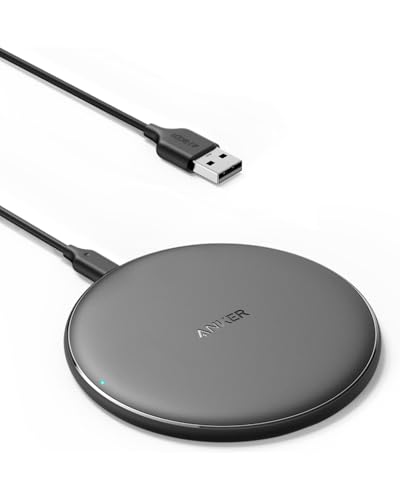
Anker 313 Wireless Charger Pad — Simple flat pad
If the 313 stand is the elder, the 313 pad is the minimalist: a flat Qi disc rated at 10W, listed for Samsung, iPhone and AirPods, and described by Anker with unusual honesty as not MagSafe-compatible. That single disclaimer is the key to buying it happily. Nothing snaps, nothing aligns; you learn the pad’s centre by feel within a week, the way you learn a light switch in the dark. For overnight charging and for earbuds, that informality costs nothing, because time is abundant and AirPods cases are forgiving about placement.
The pad’s flatness is also its travel argument. It slips into a bag pocket where a stand would need folding or would shed its cable, and on a shared surface — a hallway console, a guest-room dresser — it reads as furniture rather than gadget. No adapter is included, and the 10W rating means a large phone set down at midnight with a nearly empty battery is the use case, not a handset that needs rescuing before a train. Buyers with magnetic-case phones should know the case’s ring does nothing here; the pad predates that ecosystem and charges straight through ordinary slim cases by induction alone.
The pad also has a second career that stands cannot apply for: it is the charger you lend. A flat Qi disc works with whatever a guest sets on it, asks no questions about cases or ecosystems, and returns to the drawer without a hinge or a head to fold. Rental properties, spare rooms and office hot-desks all run on this logic. Its discipline is placement — the first week teaches the centre by a couple of slow mornings — and after that apprenticeship the pad asks nothing more of its owner for years. In a guide where every other pick is defined by a standard it speaks or a device it adds, the 313 pad is defined by absence: no magnets, no angle, no display, no second device. For the surfaces where charging should be invisible, absence is the specification.
- Standard: Qi certified; listing states it is not MagSafe-compatible
- Rated output: 10W fast wireless charging as listed
- Compatibility per listing title: Samsung, iPhone and AirPods
- In the box: pad; AC adapter not included
Strengths
- Dead-simple flat design that disappears on shared household surfaces.
- Works for phones and AirPods without any alignment ritual.
- Packs flat for travel better than any stand in this guide.
Trade-offs
- No magnets, so careless placement charges slowly without warning.
- 10W output makes it an overnight charger, not a top-up charger.
- Adapter must come from your own drawer.
Best for: overnight phone charging and AirPods duty on a tidy, shared surface.
Not suited for: MagSafe-case users expecting a magnetic click, or anyone in a hurry.

Anker MagGo 2-in-1 Charging Stand — Phone-and-buds stand
The MagGo stand answers a specific piece of bedside arithmetic: an iPhone and a pair of AirPods Pro, two devices, two cables, one socket. Its magnetic head is Qi2 certified and delivers 15W to a MagSafe-compatible iPhone — the listing names the 18 Pro and 17 generations — while a second charging surface at the base handles the earbuds. The phone floats at a reading angle; the buds sit below like luggage at its feet. As a piece of nightstand urban planning, it is the most economical object in this guide.
Notice what it does not claim. There is no watch charger here — this is a two-in-one, and Apple Watch owners will still keep a puck somewhere. No adapter is included either, so the stand’s 15W promise depends on the brick you supply. The black finish and upright silhouette suit a desk as readily as a nightstand, and at a desk the arrangement arguably works even better: phone up where a call can see it, buds refuelling underneath between meetings. Within Anker’s range it sits exactly between the single-device Zolo and the three-device Prime stations, and for the large group of users whose daily carry is precisely phone-plus-buds, that middle is the correct address.
What the MagGo understands, and the single-device picks cannot, is that earbuds fail differently from phones. A phone announces its hunger all day; AirPods die silently inside their case and are discovered dead at the gym door. A base pad that refuels the case every night removes an entire category of small disappointment, which is why two-in-one stands convert households out of proportion to their specifications. The stand’s other quiet virtue is cable discipline behind furniture: one run down the back of the nightstand instead of two, one adapter socket instead of a strip. Buyers sometimes ask whether the base pad could charge a second phone instead of buds; treat it as a buds surface as the listing frames it, sized and powered for a case, and the stand will meet every expectation it set.
- Standard: Qi2 certified, MagSafe compatible
- Rated output: 15W wireless fast charging for the phone surface
- Devices: iPhone on the magnetic head, AirPods Pro on the base pad
- In the box: stand, black; adapter not included
Strengths
- Charges the phone-and-buds pairing from one footprint and one cable run.
- Qi2 magnetic head gives full 15W alignment confidence on the nightstand.
- Stand angle keeps the phone usable for standby clocks and calls.
Trade-offs
- No Apple Watch charging; watch owners keep a separate puck.
- Adapter not included, despite the two-device appetite.
- Fixed two-device layout cannot grow with a third gadget.
Best for: iPhone and AirPods owners who want one tidy stand instead of two cables.
Not suited for: Apple Watch wearers, who need the three-in-one Prime models instead.

Anker Prime 3-in-1 Charging Station — Flagship desk station
The Prime station is where Anker’s wireless range stops apologising for physics. It is built on Qi2.2 with 25W for the phone — the listing names the iPhone 18 Pro and 17 series — and it attacks the heat that 25W wireless charging generates with TEC active cooling, the same thermoelectric approach used in miniature fridges. A smart display reports the session back to you, which sounds like garnish until the first time it explains why a charge is running slowly. Dedicated spots for an Apple Watch and AirPods Pro complete the three-in-one layout, and the adapter is included, a sentence only this pick and its folding sibling get to carry in this guide.
This is a desk anchor, not a traveller. The cooling, the display and the three-device footprint all assume a permanent home with a socket behind it, and the reward is a single object that ends the nightly cable census for a fully Apple household. It also reframes what the older picks are for: after living with a cooled 25W station, the 313 pair read as what they always were — steady, slow, room-temperature chargers for phones in no rush. If your phone supports the newer standard and your watch and buds charge beside it nightly, this is the top of Anker’s own ladder and the natural end of the search.
The display deserves a paragraph of its own, because information changes behaviour. A plain pad that charges slowly gives you nothing to act on; a station that shows the session’s state turns a vague suspicion into a diagnosis — case too thick, phone seated oddly, room too warm — and a diagnosis into a fix. Over months that feedback loop teaches a household its own charging habits, which is a strange thing to say about a bedside object, yet it is the honest difference between a charger and a charging station. The TEC cooling plays the same long game thermally: by holding temperatures down during the fastest part of the curve, it protects both the session’s speed tonight and the battery’s temperament across seasons. This is the pick for the reader who reads the rest of this guide and keeps asking for the numbers.
- Standard: Qi2.2, MagSafe compatible
- Rated output: 25W wireless charging for the phone
- Extras per listing title: smart display, TEC active cooling
- Devices: iPhone, Apple Watch and AirPods Pro; adapter included
Strengths
- 25W Qi2.2 output with active cooling sustains speed that passive pads throttle away.
- Phone, watch and buds charge in one fixed, tidy location.
- Adapter included, and the display makes slow sessions explainable.
Trade-offs
- Station footprint and permanence rule it out for travel bags.
- Phones older than the Qi2.2 generation cannot use the extra output.
- It is the most committed purchase here: one ecosystem, one spot.
Best for: a settled desk or nightstand serving iPhone, Apple Watch and AirPods together.
Not suited for: travellers, or households split across Android phones.

Anker Prime 3-in-1 Foldable MagSafe Charger — Travel three-in-one
Take the Prime formula — Qi2.2 certification, 25W for the phone, three devices — and fold it flat. The foldable Prime is described in its own listing as palm-sized, and that phrase does real work: this is a three-in-one station that closes into a slab and goes into a wash bag, then opens on a hotel nightstand into phone stand, watch charger and buds pad in one motion. Anker’s AirCool design handles the warmth of a 25W session in a body too small for the desktop station’s TEC hardware, and the adapter is included, which matters doubly on the road where a forgotten brick is not in the next room.
The listing also states, in parentheses and without embarrassment, that this is a non-battery device: it is a charger, not a power bank, and it does nothing away from a socket. That honesty defines its traveller precisely — someone whose trips run hotel to office to airport lounge, always within reach of mains power, who wants the home routine rebuilt in miniature each night. For that routine it is arguably the most complete object in this guide. Campers and long-haul passengers who need stored energy should look at power banks instead; our guide to Best Hand Crank Chargers covers the far end of that off-grid spectrum.
The folding mechanism is the engineering story here, and it cuts both ways in the best sense. Hinges let one object be two shapes — slab for the bag, station for the desk — and Anker has clearly designed the fold as the product rather than as a compromise, since the closed unit is the palm-sized object the listing leads with. In use, the routine becomes a small ceremony travellers come to like: arrive, unfold, set phone and watch down, and the unfamiliar room has one familiar corner. The AirCool approach suits this duty, shedding heat passively through the body rather than asking a fan to work in a silent hotel room at 2 a.m. If your travel is weekly rather than yearly, this pick stops being an indulgence and becomes the piece of home that fits in a pocket.
- Standard: Qi2.2 certified, MagSafe compatible
- Rated output: 25W for the phone
- Design per listing title: palm-sized, foldable, travel-ready, AirCool
- Devices: iPhone, Apple Watch and AirPods; adapter included; non-battery (mains powered)
Strengths
- Full three-in-one charging that folds to palm size for a bag.
- 25W Qi2.2 phone charging matches the desktop Prime’s headline speed.
- Adapter included — one less thing to forget before a trip.
Trade-offs
- Non-battery design means it is dead weight away from a wall socket.
- Folding hinges add moving parts a fixed station does not have.
- Watch and buds spots are sized for Apple’s ecosystem only.
Best for: frequent travellers who rebuild a phone-watch-buds routine in hotels.
Not suited for: anyone needing stored power away from mains, since it holds no battery.
How Does Wireless Charging Treat a Battery Over Years of Nights?
Battery anxiety follows wireless charging around like a rumour, so it deserves a straight answer built from the physics rather than from folklore. Every charge cycle ages a phone battery a little, wired or wireless; the variables that genuinely matter are heat and time spent sitting at a full charge. Wireless charging converts some of its energy to warmth at the pad, which is why a phone on a pad feels warmer than the same phone on a cable, and why the charging world treats cooling — the Prime station’s TEC hardware, the foldable model’s AirCool design — as a longevity feature rather than a luxury.
The practical habits matter more than the hardware tier. Overnight charging on a 10W 313 is gentle in one specific way: the phone reaches full charge and then idles for hours, and modern phones manage that idle with optimised-charging features that hold the battery below full until near your wake time — enable those features and the slow charger becomes a kind one. Fast wireless charging earns its place in the daytime, in the top-up windows where 15W or 25W changes what a twenty-minute pause can restore. The pattern this guide recommends is therefore a rhythm rather than a product: slow and cool at night, fast and deliberate by day, and any charger that runs noticeably hot to the touch moved off the nightstand and investigated — brick, case and placement, in that order — before it is blamed on the standard it speaks.
There is also a mechanical kindness to wireless charging that rarely gets mentioned: the phone’s charging port stops being a daily wear item. Cables fray, ports collect pocket lint and loosen over years of plugging; a household that charges wirelessly at home and keeps cables for the car and the road extends the tidy life of the handset itself. That is not a reason to buy the flagship station, but it is a genuine part of why the pad-and-stand habit sticks once a household adopts it.
Which Anker Charger Belongs in Which Room?
Walk the house and the picks assign themselves. In the bedroom, the contest is between the MagGo stand and the Prime station, and the deciding question is whether a watch sleeps there too. Phone and buds only: the MagGo’s two surfaces close the subject. Phone, watch and buds: the Prime station’s three spots end the cable census, and its display faces the bed like a small, informative clock. A guest bedroom, where visitors arrive with unknown phones, is 313 pad territory — flat, brand-agnostic within the Qi world, and undemanding about alignment rituals explained at midnight.
At the desk, posture wins again. The 313 stand and the MagGo both hold a phone at reading angle, but the MagGo’s magnets make it the better colleague for anyone who lifts and replaces the phone twenty times a day, because every replacement lands correctly without a glance. The kitchen counter belongs to a pad — the Zolo’s second unit, typically — since stands collect splashes at their hinges and a flat pad wipes clean. The hallway or entryway tray is the other natural Zolo post, the place a phone lands with the keys.
Travel redraws the map entirely. The foldable Prime exists for the bag, and its inclusion of an adapter is the detail road warriors feel most: one slab, one brick, three devices, rebuilt on any hotel nightstand on earth. What stays home is everything with a fixed footprint. Households that buy in this order — bedroom first, then desk, then the bag — rarely end up with a charger they regret, because each purchase answers a room’s actual routine instead of a wattage headline.
What Should You Check in the Sixty Seconds Before Ordering?
First, your phone’s generation and its wireless standard. An iPhone from the 12 series onward can use the magnetic alignment of the Qi2 and Qi2.2 picks; earlier Qi phones charge on any pick here but snap onto nothing. Second, your case: measure nothing, just ask whether it is magnetic, ordinary-slim, or armour — the third category argues for a night of testing before a second charger is bought for another room. Third, the socket situation at the intended surface, because three of these chargers arrive without an adapter and the surface with no spare socket is a charger waiting to disappoint.
Fourth, count the devices that will genuinely charge in that spot — not the devices you own, the devices that sleep there. A station bought for a watch that actually charges in the bathroom is a pad’s job bought at a station’s footprint. Fifth, read the listing title of the exact pick once more for its exclusions: the Zolo’s Pixel warning and the foldable Prime’s non-battery note are both printed in their titles, and both have generated returns from buyers who read the photographs instead. Sixty seconds of this arithmetic is the cheapest accessory in the entire guide.
How Do the Six Anker Chargers Compare Side by Side?
| Pick | Standard | Phone output | Devices served | Adapter |
|---|---|---|---|---|
| Anker Zolo (Qi2) | Qi2, magnetic | 15W | Phone or AirPods, two pads | Not included |
| Anker 313 Stand | Qi | 10W max | One phone, upright | Not included |
| Anker 313 Pad | Qi, no magnets | 10W | Phone or AirPods, flat | Not included |
| Anker MagGo 2-in-1 | Qi2, magnetic | 15W | iPhone plus AirPods | Not included |
| Anker Prime Station | Qi2.2, magnetic | 25W | iPhone, Watch, AirPods | Included |
| Anker Prime Foldable | Qi2.2, magnetic | 25W | iPhone, Watch, AirPods | Included |
Read the table as three eras sharing a logo. The Qi pair trade speed for simplicity and remain the overnight answer. The Qi2 pair are the present tense of the range: magnetic certainty at 15W, split between a two-pack of pads and a two-device stand. The Qi2.2 pair are the flagship tier, where the wattage rises, cooling becomes a feature with a name, and the adapter finally appears in the box. Choosing is mostly deciding which era your phone belongs to, then which shape your furniture prefers.
When Is Slow Charging Actually the Right Answer?
Wireless marketing trains buyers to treat wattage as virtue, but a charging day has two different jobs in it, and only one of them rewards speed. The overnight job is really about readiness at 7 a.m., and every pick in this guide — including the 10W pair from the Qi era — completes it with hours to spare. Judging an overnight charger by its wattage is like judging a pillow by its top speed. The daytime job is the opposite: the forty minutes between arriving home and leaving again, the lunch break before a long afternoon, the airport pause. There, the difference between 10W trickling through a misaligned coil and 25W delivered by a cooled Qi2.2 station is the difference between leaving with a phone that survives the evening and one that spends it in low-power mode.
This is why the strongest setups in this category are usually pairs rather than single heroes: a slow, cool, forgiving charger where the phone sleeps, and a fast, magnetic one where the phone pauses. The Zolo two-pack accidentally embodies the philosophy — one pad can live at the bedside while its twin handles the desk’s top-up traffic — and the Prime foldable adds the third location, the road, to the same logic. Buyers who insist on one charger for every job end up with a compromise that is needlessly fast at midnight and disappointingly slow at noon. Match the pace to the pause, and even the oldest pick in this guide has honest work to do.
There is a budget logic buried in the same observation. Money spent moving an overnight charger from 10W to 15W buys almost nothing a sleeper can perceive, while the same money spent adding a second charging location buys the end of the cable-carrying habit. Anker’s range, read properly, is a map of locations first and speeds second — which is why this guide has organised itself around rooms, routines and device counts, and treated the wattage ladder as the supporting detail it actually is.
What Mistakes Do Buyers Make With Wireless Chargers?
The recurring error is feeding a fast pad from a weak brick and concluding that wireless charging itself is slow. A Qi2 pad rated at 15W can only deliver what its input allows, and the no-adapter picks in this guide make that trap easy to fall into: check the brick’s USB-C output before blaming the pad. The second error is case blindness. Very thick cases, cases with metal plates, and wallets stacked with cards all widen the gap between coil and phone; magnetic cases designed for MagSafe-style alignment help Qi2 and Qi2.2 models, while on the 313 pad a chunky case can shift the phone out of the sweet spot entirely.
Third, buyers charge phones on pads in direct sun or beside radiators and then wonder at throttled, warm sessions — wireless charging already runs warm, and ambient heat compounds it, which is precisely the problem the Prime station’s active cooling exists to solve. Fourth, stand buyers forget landscape: a phone propped for video in portrait-only stands can slide or sit off-coil, so check how your stand holds the phone in the orientation you actually use. Finally, there is the Pixel-and-Zolo mistake, the simplest in this guide because the listing itself prints the warning: read exclusions in titles as specifications, not as legal padding.
How Should You Set Up a Wireless Charger for Its Fastest Honest Speed?
Begin with the brick. Pair each no-adapter pick with a USB-C wall charger whose output comfortably exceeds the pad’s rating, and use the cable that came in the box where one is supplied. Place pads on hard, flat surfaces — a pad half-hanging off a book charges the book’s corner more faithfully than the phone. On magnetic models, let the snap finish: set the phone down, feel the pull, and give it a small settle rather than sliding it into place, because a half-seated magnetic connection is the Qi2 era’s version of misalignment.
Placement has a social dimension too. A charger that lives where the phone lands — the tray by the door, the corner of the desk nearest the chair — gets used; a charger exiled to a tidy but unnatural spot becomes decor within a month. When a household reports that wireless charging “didn’t stick”, the autopsy almost always finds geography, not technology: the pad was put where it looked best instead of where hands already go. Before returning a charger that seems disappointing, move it to the phone’s natural landing zone for one week and re-judge it there.
Then manage heat like it matters, because it does. Keep chargers out of sunbeams, off radiators and away from the warm exhaust of laptops. If a phone comes off the pad hot and barely charged, change one variable at a time — case off, brick swapped, position centred — and you will find the culprit within two nights. Households standardising on one ecosystem can also simplify the whole problem: readers maintaining vehicles alongside phones often pair this guide with Best Schumacher Battery Chargers, where the same patience-first charging philosophy applies at twelve volts.
How Do These Chargers Cope in a Shared, Multi-Phone Home?
Single-person logic breaks in a household, because charging spots become commons. The pad by the door serves whoever comes home emptiest; the nightstand stand serves whoever sleeps on that side. Multi-phone homes should therefore think in terms of coverage rather than ownership: two modest pads in the two highest-traffic landing zones outperform one flagship station in a room only one person uses. This is the Zolo two-pack’s deepest argument, deeper than its price-per-pad — it is sold in the exact unit a household consumes charging locations.
Guests complicate the picture in a way that flatters the older picks. A visiting phone of unknown brand and case thickness needs the most forgiving charger in the house, and that is the flat Qi pad, which asks nothing about magnets or ecosystems. Keeping a 313 pad in the guest room or on the hallway console is the hospitality equivalent of a spare phone cable in every connector — unglamorous, universally compatible, and remembered fondly. Meanwhile the magnetic picks serve the residents, whose cases and habits are known quantities.
The failure mode to avoid is the single-station household bottleneck, where one beautiful three-in-one anchors every device to one room and the family orbits it at bedtime like a watering hole. Stations work when routines genuinely converge on one spot; when they do not, the honest architecture is distributed — a stand where one person sleeps, a pad where everyone lands, a folding station in the bag of whoever travels. Anker, perhaps accidentally, sells exactly one pick for each of those posts, and this guide’s ordering quietly follows that map.
Final Recommendation
Most iPhone owners should start at the Zolo two-pack: Qi2 alignment, 15W, two rooms covered, and no features paid for twice. Add the MagGo stand if AirPods charge beside the phone nightly and a viewing angle earns its space. Step up to the Prime station when a watch joins the routine and the desk is permanent, or to the foldable Prime when that same routine travels. Keep the 313 pair in perspective — they are the right answer for a spare room, an older phone, or any spot where slow and steady is the whole job description. Anker’s range rewards buyers who match the charger to the phone’s generation and the room’s routine, in that order. Do that, and whichever of these six lands on your nightstand will feel less like a gadget purchase and more like a small piece of household infrastructure — noticed only on the rare morning it is missing, which is the highest compliment a charger can earn.
Frequently Asked Questions
Does a Qi2 charger work with a phone that only supports Qi?
Yes, within limits. Qi2 chargers remain compatible with Qi phones, but a phone without the magnetic ring gets no snap alignment and may charge at plain Qi speeds rather than the 15W headline. The magnets are the experience; the wattage follows the phone’s own support.
Why does my wireless charger feel slower than the rating suggests?
Usually one of three reasons: the wall brick feeding it is underpowered, the phone sits slightly off the coil, or heat is throttling the session. The Prime station’s display and active cooling exist to expose and address the third cause; the first two are fixed with a stronger adapter and a centred placement.
Can these chargers work through a phone case?
Slim cases are generally fine, and magnetic cases designed for MagSafe-style systems actively help the Qi2 and Qi2.2 picks align. Very thick cases, metal plates and card-filled wallet cases are the usual failures; if charging turns intermittent, test one night without the case before replacing any hardware.
Is the Zolo really unsuitable for Pixel phones?
Anker’s own listing title says so, and this guide treats that as a specification rather than a suggestion. Pixel owners should choose a charger whose listing names their phone as supported instead of testing an explicit exclusion.
Do I need a three-in-one station if I only charge a phone?
No. A station earns its footprint when a watch and earbuds charge in the same place every night. Phone-only users get the same charging quality from the Zolo pad or MagGo stand, with money and nightstand space left over.
Can one adapter feed a charger through a power strip behind furniture?
Yes, and it is how most of these chargers will actually live. Just keep the adapter itself ventilated rather than buried in bedding or insulation, and remember that a pad fed through a switched strip goes dark when the strip is switched — a common cause of the mysterious uncharged morning.
Should I replace a working 313 charger with a Qi2 model?
Only if the replacement solves a problem you actually have: slow daytime top-ups, nightly misalignment, or a new phone whose magnetic case is going to waste. If your 313 charges your phone fully by morning and the phone lives in one spot, the upgrade buys convenience rather than capability — pleasant, but optional, and the old charger remains perfect for a guest room.
Why does the 313 stand use Micro-USB when everything else is USB-C?
Because it is a design from an earlier generation of Anker’s range, and the listing says so plainly by naming the cable. The cable is included, so the stand works out of the box with any USB brick; the cost is carrying one legacy cable in an otherwise USB-C drawer.
Related Guides
Charging decisions rarely stop at the nightstand, so continue with Best CTEK Battery Chargers for vehicle batteries, Best Schumacher Battery Chargers for the workshop end of the spectrum, and Best Hand Crank Chargers for power when there is no socket at all.
Related guide: Best Upright Wireless Fast Chargers
Related guide: Best Android Wireless Chargers


