What's inside
- Where to Buy Voice-Acting Monitoring and Microphone Gear
- Key Takeaways
- Quick Picks
- How Did We Assemble a Shortlist of the Best Headsets for Voice Acting?
- Why Do Voice Actors Monitor on Closed-Back Headphones?
- How Should a Beginner Divide a First Booth Budget?
- The Six Picks in Detail
- How Do Directed Sessions Change What You Need?
- What Does a Voice Actor’s Listening Test Look Like?
- Monitoring Meets Microphones: The Voice-Acting Line-Up Compared
- How Do You Set Up a Home Booth Around These Picks?
- What Mistakes Do New Voice Actors Make With Gear?
- How Does Voice Type Change the Right Pairing?
- Can Voice Actors Share One Booth Chain Between Two Performers?
- Final Recommendation
- Frequently Asked Questions
- Related Guides
As an Amazon Associate I earn from qualifying purchases. This post may contain affiliate links at no extra cost to you.
[widgetverdict.com] is reader-supported. When you buy through links on our site, we may earn an affiliate commission.
Where to Buy Voice-Acting Monitoring and Microphone Gear
Each pick in this guide to the best headsets for voice acting is sold through Amazon, and the product names in the Quick Picks table and the detailed reviews link to the listings so you can inspect exactly what each box contains before ordering — a step that matters in this category, where a headphone, a headset and a microphone kit are three different purchases wearing similar photographs. If you are assembling a booth from nothing, read the two kit reviews before choosing headphones, because the pairing logic runs through the whole guide. Performers who also take directed sessions over ordinary meeting apps may want Best Corded Headsets for Online Meetings open in a second tab for the communication side of the desk.
Let us settle the architecture first, because the best headsets for voice acting are, strictly speaking, not headsets at all. Professional voice work separates the two jobs: closed-back monitor headphones let the performer hear themselves and the cue track without any of that sound leaking into the recording, while a separate microphone — a dedicated mic or a microphone kit — captures the voice at a quality no headset boom can reach. Four of the six picks below are monitoring headphones in that tradition. The remaining two are microphone kits from MAONO and FIFINE, included because a booth needs both halves, and they are reviewed strictly as kits, never as headsets. One genuine headset with a detachable boom, the talomen, bridges the two worlds for hybrid creators.
That separation is not snobbery; it is physics and economics. Physics, because a microphone positioned on a stand at the correct distance captures a voice more fully than one dangling by a cheek. Economics, because separate components can be upgraded separately as a career grows — headphones this year, microphone next — instead of replacing a combined unit whenever one half disappoints.
Key Takeaways
- Voice acting separates monitoring from capture: closed-back headphones for hearing, a separate microphone or kit for recording.
- Leakage is the enemy — sound escaping the earcups prints onto the track, which is why closed-back designs dominate this list.
- The HD 280 Pro states 32dB of attenuation in its title, the strongest isolation claim among these picks.
- The MAONO and FIFINE entries are microphone kits, not headsets; FIFINE includes no headphones, MAONO bundles one as a starter.
- The talomen is the single true headset here, its detachable boom serving sessions, podcasts and streams rather than final capture.
- Room treatment still outranks gear: every pick in this guide performs better in a quiet, soft-furnished space.
- Keep the same test page of copy for every chain you try; a fixed reference exposes differences between pairings faster than any specification.
Quick Picks
| Pick | Badge | Why it made the list |
|---|---|---|
| Sennheiser HD 280 Pro | The isolation benchmark for booth work | Closed-back monitoring with a stated 32dB attenuation and a booth-friendly coiled cable. |
| Audio-Technica ATH-M30x | Closed-back all-rounder for tracking and mixing | The M-series all-rounder for tracking and editing, with a locking adapter and travel pouch. |
| OneOdio A71 Studio Headphones | Foldable wired monitor with both jack sizes | Foldable wired monitor carrying both jack sizes for interfaces, laptops and recorders. |
| talomen Studio Monitor Headphones with Boom Mic | Monitor headphones with a detachable boom for hybrid creators | Studio earcups plus a detachable boom for performers who also podcast and stream. |
| MAONO AU-A04H USB Microphone Kit with Headphone | A recording kit: condenser USB mic bundled with a headphone | A cardioid condenser USB microphone kit, with a headphone bundled for first monitoring. |
| FIFINE T669 Studio Microphone Kit | A recording kit with boom arm and shock mount included | A condenser USB microphone kit whose boom arm and shock mount build a booth foundation. |
How Did We Assemble a Shortlist of the Best Headsets for Voice Acting?
The shortlist follows the architecture described above, so its criteria differ from an ordinary headset guide. Monitoring headphones qualified only if their titles described closed-back studio designs intended for recording, tracking or monitoring — leisure headphones with plush sound need not apply, because a flattering headphone hides the flaws a performer must hear. Isolation claims were weighed where titles stated them. Connection practicality mattered: booths run on interfaces with large jacks and laptops with small ones, and performers travel.
The two microphone kits qualified on the capture side: condenser microphones, cardioid behaviour where stated, USB simplicity for home studios, and bundles that solve real beginner problems — MAONO by completing the chain with a headphone, FIFINE by including the arm and shock mount that make placement and vibration control possible. The talomen earned the headset slot by putting studio earcups first and making its boom detachable, which keeps the monitoring-first principle intact.
Everything was then checked against the performer’s actual week: auditions at short notice, long editing sessions, directed sessions over calls, and the occasional final booking recorded at home. A pick that served only one of those well had to argue its case — and the reviews below record those arguments honestly, limits included.
Why Do Voice Actors Monitor on Closed-Back Headphones?
Because an open headphone is a small loudspeaker playing into a live microphone. During a take, the performer hears a cue track, a director, or their own voice fed back for confidence. Any of that sound escaping the earcup reaches the microphone and embeds itself in the recording, where it cannot be cleanly removed. Closed-back cups seal the sound in. They also seal the room out, letting the performer monitor at sensible volumes in a flat above a street, which protects both the take and the performer’s hearing.
The second reason is honesty. Studio monitor headphones aim for an unvarnished sound, so the performer hears the take as the editor will. Consumer headphones that boost bass and sparkle treble make every read sound richer than it is — a pleasant lie that collapses at the client’s speakers. Voice work is a truth business conducted through other people’s playback equipment, and monitoring is where the truth gets checked.
How Should a Beginner Divide a First Booth Budget?
Spend first on the space, even if the spending is time rather than money: the quietest corner, soft furnishings, a door that closes. Then secure capture and monitoring as a pair. A microphone kit such as the MAONO or FIFINE entries covers capture; if the kit lacks headphones, add a closed-back monitor from this list rather than borrowing leisure headphones, because leakage will sabotage the microphone you just bought. Performers whose work will be mostly directed sessions and podcasts can consider the talomen as the flexible centre of the setup. And keep the upgrade path open: separate components mean the first purchase never has to be thrown away, only promoted to backup duty. Readers equipping a general call desk alongside the booth will find the fleet view in Best Wireless Call Center Headsets a useful contrast in priorities.
The Six Picks in Detail

Sennheiser HD 280 Pro — The isolation benchmark for booth work
Every voice actor learns the same lesson in their first serious session: the microphone hears your headphones. If sound leaks out of the earcups, it prints onto the recording as a ghost of the backing track or the director’s voice, and no editing fully removes it. The HD 280 Pro exists to prevent that lesson from being expensive. Its title states closed-back construction and 32dB of attenuation, figures that describe a headphone sealing the wearer’s ears away from the room in both directions — your cue track stays in, the room stays out.
Sennheiser positions the model for studio and live monitoring, recording and fieldwork, and that working heritage shows in the priorities. This is not a headphone tuned to flatter music; it is tuned to tell the truth about a voice. For voice acting, truth is the entire requirement. You need to hear the mouth click, the breath that lands too loud, the plosive that will annoy an editor, at the moment you make them — not in a note from the client three days later. A monitoring headphone that sweetens the sound is actively working against the performer.
The coiled cable deserves its own paragraph because booth ergonomics are unglamorous and decisive. A coil stretches when you lean toward the mic for an intimate line and contracts when you sit back, keeping slack off the floor and out of the chair castors. In a home booth built inside a closet or a treated corner, where every movement is close to fabric and stands, that cable behaviour prevents the small tugs and rustles that ruin takes.
Attenuation of the stated figure also protects long sessions in imperfect spaces. A home studio is rarely silent: a refrigerator hums through the wall, traffic breathes outside. Closed-back isolation cannot fix a bad room — the microphone still hears the room, and treating the space remains the performer’s first job — but it keeps the performer’s own monitoring honest at lower volumes, which protects hearing across a career of six-hour recording days.
Against the Audio-Technica below, the HD 280 Pro is the sterner, more isolation-led tool; the M30x counters with a friendlier all-round studio profile and a carrying pouch for location work. Neither has a microphone, and that is correct: at this level of voice work the microphone is a separate, deliberate purchase, which is why this guide pairs its headphones with the two microphone kits reviewed further down.
Choose the HD 280 Pro if your booth is built, your microphone is chosen, and what you lack is monitoring you can trust at full concentration. It has been the default answer in project studios and location kits for years because the job it does — sealed, honest, durable monitoring — is the job voice work actually requires.
Session veterans add one more virtue to the HD 280 Pro’s ledger: predictability across years. Studios keep pairs of this model precisely because a performer who learned their voice on one set hears the same truth on any other set, in any booth, in any city. Freelance voice work involves recording in unfamiliar rooms on unfamiliar chains; a monitor whose character you already know removes one variable from a day full of them. That familiarity compounds — you stop second-guessing the headphones and spend the session’s attention on the performance, which is where the money is.
Mini spec box
- Design in title: Closed-back studio and live monitoring headphones
- Attenuation stated in title: 32dB attenuation
- Cable in title: Coiled cable
- Uses in title: Monitoring, recording and fieldwork
Strengths
- 32dB attenuation stated in the title keeps cue tracks out of the microphone
- Truthful monitoring tuning exposes mouth noise and plosives while you can still fix them
- Coiled cable suits the close quarters of booths and treated corners
Trade-offs
- No microphone, by design — it must be paired with a separate mic or kit
- Firm closed-back seal can feel warm during very long sessions
- Utilitarian studio styling makes no attempt at leisure appeal
Best for: voice actors with a treated space and a chosen microphone who need sealed, honest monitoring.
Not suited for: beginners wanting one box that records and monitors with nothing else to buy.
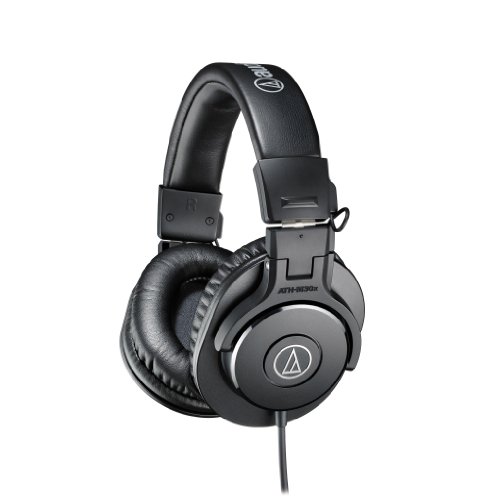
Audio-Technica ATH-M30x — Closed-back all-rounder for tracking and mixing
The ATH-M30x is the member of Audio-Technica’s M series that working beginners actually buy, and its title explains the appeal: professional studio monitor headphones with closed-back over-ear earcups, a screw-on adapter and a carrying pouch, aimed at studio tracking, mixing and field recording. Translate that into voice-acting terms and you get a headphone that can record a session in the morning, help you edit it in the afternoon, and travel to a location job in its pouch the next day.
Closed-back over-ear construction is the non-negotiable part for voice work, for the same leakage reason that governs the Sennheiser above. What differs is emphasis. The M30x is voiced as an all-round studio tool rather than a pure isolation instrument, which makes it a comfortable recommendation for performers who split their time between recording and the long editing hours that follow. Editing is where voice actors actually spend most of their lives — comping takes, trimming breaths, cleaning silence — and a monitor that stays pleasant and truthful across four hours of waveform is worth as much as one that seals a fraction tighter.
The screw-on adapter sounds like trivia until you have lost a push-on adapter mid-session. Studio interfaces and headphone amps use the larger jack; computers and portable recorders use the smaller one. A threaded adapter that locks onto the plug ends the pocket-checking ritual and survives being packed and unpacked daily, which the included pouch encourages. Field recording in the title is not filler: voice actors increasingly record auditions and even final work in treated spaces away from home, and a monitor that travels safely earns its place in the bag.
Compared with the HD 280 Pro, the M30x trades a measure of stated isolation for versatility and an easier long-session manner. Compared with the OneOdio below, it brings a dedicated studio pedigree and the discipline of a line built for tracking rooms. There is no microphone here either — deliberately. Like the Sennheiser, this headphone assumes the performer will choose a microphone separately and seriously, and the two kits later in this guide exist for exactly that pairing.
For a first serious monitor purchase in a home booth, the M30x is the calm recommendation: closed-back where it counts, honest where it matters most, and packaged for a working life rather than a shelf.
The M30x also deserves credit as an editing companion in a way spec sheets never capture. Editing voice is an exercise in tiny judgements — is that breath natural or noisy, does this edit click, is the room tone consistent between takes recorded an hour apart. Those judgements are made hundreds of times per session, at low volumes, over hours. A monitor that remains accurate at low volume and comfortable at hour four is not a luxury in that workflow; it is the instrument the workflow runs on. The M30x’s all-round studio brief was written for exactly that long, quiet labour.
Mini spec box
- Design in title: Closed-back over-ear earcups
- Included in title: Screw-on adapter, carrying pouch
- Uses in title: Studio tracking, mixing, field recording
- Series: ATH-M professional monitor line
Strengths
- Closed-back over-ear design keeps monitoring out of the recording
- Screw-on adapter and pouch suit performers who work in more than one space
- All-round studio voicing serves editing hours as well as tracking
Trade-offs
- Isolation is not the headline figure it is on the HD 280 Pro
- No microphone included, so a separate mic or kit is required
- Cable and adapter discipline still matter — spares are a working cost
Best for: developing voice actors who record and edit their own work across home and location setups.
Not suited for: performers who want a built-in microphone for streaming-style convenience.

OneOdio A71 Studio Headphones — Foldable wired monitor with both jack sizes
The OneOdio A71 approaches the voice actor’s problem from the direction of practicality. Its title promises Hi-Res wired over-ear studio headphones for recording, monitoring and mixing, with a foldable design and both 3.5mm and 6.35mm jacks for connection to PC, computer and DJ gear. Read that as a working brief: one headphone that plugs into the interface at the desk, the laptop on the road and the recorder in the field, then folds into a bag without a fuss, a separate case or a prayer that it survives the journey intact.
Dual jack sizes are a bigger deal in real studios than marketing suggests. Interfaces, mixers and headphone amps standardise on the large jack; laptops, phones-as-recorders and portable gear use the small one. A performer who carries both connection options natively never faces the session-killing discovery that the one adapter they own is in another building. For audition culture — where a self-tape or voice audition can be requested with a same-day deadline — that readiness is a professional asset, not a convenience.
The foldable build supports the same mobile brief. Voice work has left the big studio: auditions happen in treated closets, hotel-room blanket forts and borrowed corners. A monitor that folds travels in a smaller bag, survives more journeys, and can be the single headphone a performer owns for both the home setup and the road kit. The over-ear wired design keeps the essentials in place — no battery to die before a deadline, no wireless link anywhere near a recording chain.
Honesty about positioning matters here. The A71’s title reaches across DJ work, mixing and general studio use; it is a versatile monitor rather than a voice-booth specialist like the HD 280 Pro, whose stated attenuation figure has no counterpart in this title. A performer recording in a well-treated, quiet space will find the A71’s balance of features entirely sufficient. A performer fighting a noisy building should weight the Sennheiser’s isolation claims more heavily.
As with both models above, there is no microphone, and for voice acting that remains the correct architecture: monitor with headphones chosen for honesty, record with a microphone chosen for your voice. The A71 is the value-conscious way to secure the monitoring half of that equation.
Audition economics give the A71 one more argument. Most auditions are unpaid, time-sensitive and recorded wherever the performer happens to be, and the performers who book work are often simply the ones whose home setup lets them deliver a clean read within the hour. A foldable monitor that lives in the go-bag, speaks both jack sizes and never needs charging quietly raises the number of auditions a performer can say yes to. Over a year, that readiness is a career feature disguised as a headphone feature.
Mini spec box
- Design in title: Hi-Res wired over-ear studio headphones
- Connections in title: 3.5mm and 6.35mm jacks
- Build in title: Foldable design
- Uses in title: Studio recording, monitoring and mixing; DJ and PC work
Strengths
- Both 3.5mm and 6.35mm connections named in the title cover interface and laptop alike
- Foldable design suits audition travel and small home-booth storage
- Wired over-ear build keeps batteries and wireless links out of the recording chain
Trade-offs
- No attenuation figure is stated in the title, unlike the HD 280 Pro
- Broad DJ-and-studio brief is less booth-specialised than the Sennheiser
- No microphone — a separate mic or kit purchase is still required
Best for: mobile voice actors and audition-heavy performers who record in several spaces.
Not suited for: performers in noisy buildings who need the strongest stated isolation.
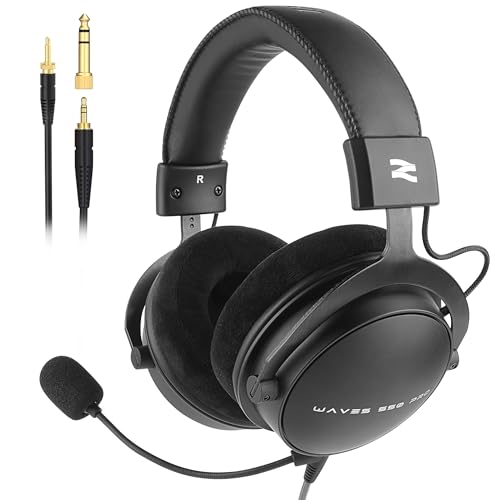
talomen Studio Monitor Headphones with Boom Mic — Monitor headphones with a detachable boom for hybrid creators
The talomen entry is the one true headset in this guide, and its title says exactly why it belongs in a voice-acting roundup anyway: studio monitor headphones for recording, wired and over-ear, with a detachable boom microphone, presented as a professional monitoring headset for podcast, broadcast, streaming and audio mixing. That combination — real monitoring earcups plus a boom that comes off — maps onto the hybrid working life many modern voice performers actually lead.
Consider the shape of that life. Mornings might be pure voice work: commercials and narration recorded into an interface with a dedicated microphone, where the talomen’s boom stays detached in its drawer and the earcups do monitoring duty. Afternoons might be a podcast recording, a broadcast interview or a streamed table read, where the director or co-host is on a call and the performer needs to speak and monitor through one device. Rebuilding the setup between those two modes wastes the day; a detachable boom collapses the changeover to seconds.
The monitoring-first design is what separates this from an ordinary call headset wearing a studio costume. The earcups are the headline — over-ear studio headphones for recording — and the microphone is the accessory. That ordering matters for voice actors evaluating it honestly: judge it as monitoring headphones that can join a call, not as a call headset that claims studio blood. For directed sessions over conferencing apps, where the client listens through the call anyway, the boom’s convenience can outweigh a separate microphone’s refinement, and the performer still hears themselves through proper cups.
Where are the limits? A boom microphone on a headset, however serviceable, is not the instrument a voice actor uses for final broadcast or game work; the dedicated kits below exist because a condenser microphone on a stand captures a voice with a fullness a boom cannot match. Treat the talomen as the flexible middle of a performer’s kit — excellent for sessions, podcasts, streaming and practice — with final-deliverable recording still routed through a proper microphone when the job demands it.
For the performer whose income genuinely mixes those modes, that honesty makes the talomen more useful, not less: one purchase covers the communicating half of the week properly, while the budget for a serious microphone stays intact.
Directors, interestingly, are fans of performers who show up with a setup like the talomen’s for remote sessions. A boom guarantees the microphone is always at a consistent distance from the mouth — the variable that ruins more remote sessions than any other — and proper monitoring cups mean the performer hears direction clearly the first time. Session time is billed in small units and a director’s patience in smaller ones still; a performer whose audio is simply never the problem becomes the performer who gets called again. The talomen’s hybrid design serves that professional reputation directly.
Mini spec box
- Design in title: Wired over-ear studio headphones with detachable boom microphone
- Role in title: Professional monitoring headset for podcast, broadcast, streaming and audio mixing
- Microphone: Detachable boom mic
- Uses in title: Recording, podcast, broadcast, streaming, mixing
Strengths
- Detachable boom converts monitoring headphones into a session headset in seconds
- Over-ear studio earcups keep monitoring quality ahead of call-headset norms
- One device covers directed sessions, podcasts and streaming without re-rigging
Trade-offs
- Boom microphone is for sessions and streaming, not final broadcast capture
- Less of a pure isolation specialist than the HD 280 Pro
- Performers who never take calls gain nothing from the boom’s flexibility
Best for: hybrid performers mixing voice sessions with podcasts, broadcasts and streams.
Not suited for: purists building a single-purpose booth around one dedicated microphone.
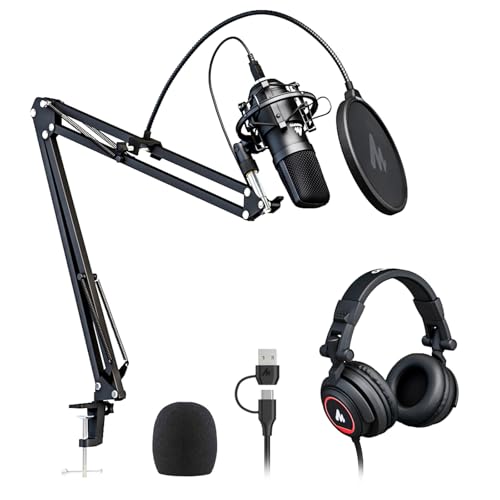
MAONO AU-A04H USB Microphone Kit with Headphone — A recording kit: condenser USB mic bundled with a headphone
This pick must be introduced precisely, because its category is the whole point: the MAONO AU-A04H is a USB microphone kit that bundles a headphone — it is not a headset. Nothing attaches the microphone to the headphones, and nothing should, because each half has its own correct position in the booth. What the box offers a voice actor is the other half of the booth equation: a vocal condenser microphone with a cardioid pattern, specified in the title at 192kHz/24Bit, connected over USB to a Mac or Windows computer, with a headphone included so the performer can monitor what the microphone hears. The title names voice-over among its uses outright.
Cardioid is the pattern word that matters. A cardioid condenser picks up sound mainly from the front — where the performer’s mouth is — and rejects much of the room behind it. In the imperfect spaces where home voice work happens, that directionality is a genuine ally: less refrigerator, less corridor, more voice. Condenser sensitivity is the other half of the bargain. A condenser hears detail — the texture that separates a professional read from a phone memo — and it hears the room too, which is why this kit still rewards a treated corner, a closet of clothes, blankets on stands: the unglamorous scenery of every good home recording.
The bundled headphone closes the monitoring loop without a second purchase, letting a beginner record with direct monitoring from day one and upgrade the headphones later if the work grows. USB connection keeps the chain short: no interface to buy before the first audition, no gain staging mysteries beyond the kit itself. For a performer testing whether voice work will become income, that completeness is the argument — the kit converts a laptop and a quiet corner into a functioning audition studio.
Set its role clearly against the headphones above. Those are monitoring instruments for performers who already own a microphone. This kit is the starting point for performers who own neither, and its microphone — not the bundled headphone — is the component that will define their sound. A performer who later buys an HD 280 Pro for monitoring keeps this microphone in service; the two purchases stack rather than replace each other.
Voice-over is named in the title alongside recording, YouTube and streaming, and that breadth suits the kit’s station in life: the first serious step, honestly specified, with the microphone doing the important work and the performer free to concentrate entirely on the read itself.
One more beginner truth belongs in this review: the first microphone teaches technique. Because the MAONO kit’s cardioid condenser rewards close, consistent placement and punishes wandering distance with audible changes, a new performer learns microphone craft simply by listening to their own practice takes. That education transfers to every microphone they will ever use, including the expensive ones in commercial studios. A forgiving, heavily processed microphone would hide those lessons; this kit’s honest condenser delivers them daily, which is exactly what a developing voice actor needs from a first purchase.
Mini spec box
- What it is: USB microphone kit with headphone — a microphone bundle, not a headset
- Microphone in title: 192kHz/24Bit vocal condenser cardioid studio mic
- Compatibility in title: Mac and Windows
- Uses in title: Recording, YouTube, streaming, voice-over
Strengths
- Cardioid condenser microphone targets the voice and rejects much of the room behind it
- USB connection and bundled headphone make a complete first recording chain
- Voice-over is named in the title as an intended use, not an afterthought
Trade-offs
- It is a microphone kit, not a headset — the mic stands separately from the headphone
- Bundled headphone is a starter monitor; serious performers may upgrade it later
- Condenser sensitivity still demands a treated, quiet recording space
Best for: newcomers to voice-over who need a complete, honest first recording setup.
Not suited for: performers who already own a studio microphone and need only monitoring.
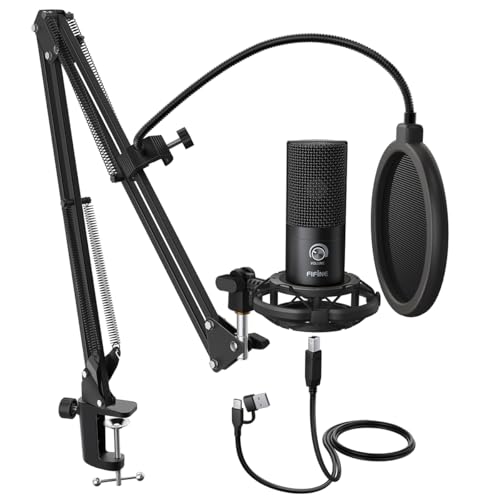
FIFINE T669 Studio Microphone Kit — A recording kit with boom arm and shock mount included
The FIFINE T669 is the second microphone kit in this guide, and like the MAONO it must be named correctly: it is a studio condenser USB microphone kit for voice overs — a microphone bundle with an adjustable boom arm stand and a shock mount — not a headset, and it includes no headphones at all. Its role in a voice actor’s setup is to be the voice-capture half of the booth, paired with one of the monitoring headphones reviewed above. Judged in that role, its bundle makes unusual sense.
The included hardware is the story. A shock mount suspends the microphone so that desk bumps, keyboard thumps and floor vibrations do not travel up the stand and into the recording as low rumble — the kind of noise beginners chase for weeks without identifying. An adjustable boom arm stand positions the microphone at mouth height, close to the performer, and swings it away when the desk returns to ordinary life. Close placement is not a detail: a microphone near the mouth captures more voice and less room, which is the cheapest sound-quality upgrade in all of recording, and the arm makes that placement effortless to repeat every session.
USB connection keeps the T669 in the same beginner-friendly territory as the MAONO kit: plug into the computer, select it in the recording software, and work. The title names voice overs first among its uses, alongside recording and podcasting, and the kit’s design follows that ordering — everything included serves the capture of a single voice in a small space.
The differences from the MAONO kit define the choice between them. MAONO bundles a headphone, completing the chain for someone starting from nothing. FIFINE bundles the mounting hardware instead, assuming the performer has or will choose monitoring headphones separately — and this guide would steer that choice to the closed-back models above. A performer building a booth for the long term often prefers FIFINE’s allocation, because arms and shock mounts stay in service through later microphone upgrades, while a starter headphone is outgrown.
Neither kit replaces room treatment, and neither pretends to. What the T669 offers is the mechanical foundation of a home booth — microphone, isolation from vibration, repeatable placement — at the moment a voice actor is deciding to take the work seriously.
The boom arm deserves a final word about session psychology. A microphone that swings into place in one motion makes recording feel like a switch the performer flips — desk becomes booth, ordinary hour becomes session. Rituals of that kind genuinely help performance, the same way a booth door closing helps in a big studio. And when the session ends, the arm swings the microphone out of the way and the desk is a desk again. For home workers whose booth shares space with their life, that reversible transformation is worth as much as any electrical specification in the kit.
Mini spec box
- What it is: Studio condenser USB microphone kit — a microphone bundle, not a headset
- Included in title: Adjustable boom arm stand, shock mount
- Uses in title: Voice overs, recording, podcasting, gaming, streaming
- Connection in title: USB computer microphone
Strengths
- Shock mount blocks desk and floor vibration from reaching the recording
- Adjustable boom arm makes close, repeatable microphone placement effortless
- Voice overs lead the use list in the title, matching the kit’s design
Trade-offs
- It is a microphone kit, not a headset — no headphones are included
- USB connection suits computer recording rather than standalone studio chains
- A treated space remains essential; the kit cannot fix a reverberant room
Best for: voice actors building a lasting home booth who will choose monitoring headphones separately.
Not suited for: buyers wanting one box containing both a microphone and headphones.
How Do Directed Sessions Change What You Need?
A directed session rearranges the performer’s priorities for a few hours. The client or director listens through a call or a dedicated session link, gives notes in real time, and expects the performer to adjust and re-deliver immediately. In that setting, communication reliability joins capture quality at the top of the list: the performer must hear direction crisply, respond without a tangle of equipment, and keep the microphone placement identical across twenty takes of the same line.
This is the talomen’s natural habitat, and also the reason many performers keep two chains — a session chain built for communication, and a delivery chain built for capture. The monitoring headphones in this guide serve both, because hearing direction clearly is the same skill as hearing your own take clearly. What changes is the microphone’s job: on a directed call, consistency beats ultimate fidelity; on a delivered file, fidelity is the product. Knowing which job today’s work requires is a professional skill in itself, and the gear should make switching between the two jobs a matter of minutes.
What Does a Voice Actor’s Listening Test Look Like?
Before trusting any of these picks with paid work, run the performer’s version of a listening test. Record a page of copy that includes whispers, projected lines, a laugh and a long breathy passage — the extremes expose a chain faster than ordinary reading. Monitor the recording take through the headphones, then edit it, then listen again the next morning with fresh ears. Morning listening is merciless and therefore valuable: flaws you forgave at midnight announce themselves plainly at nine.
Then play the edited file through ordinary speakers and a phone. Clients and audiences will hear your work on exactly such devices, and a chain that only sounds good on your monitors is a chain that lies by omission. The picks in this guide were chosen for honest monitoring precisely so that this final check holds no surprises: what you approved in the booth is what the world receives.
Monitoring Meets Microphones: The Voice-Acting Line-Up Compared
| Pick | Category | Microphone | Monitoring side | Defining trait |
|---|---|---|---|---|
| Sennheiser HD 280 Pro | Monitoring headphone | None — pair with a mic or kit | Closed-back, 32dB attenuation stated | Coiled cable |
| Audio-Technica ATH-M30x | Monitoring headphone | None — pair with a mic or kit | Closed-back over-ear | Screw-on adapter, pouch |
| OneOdio A71 | Monitoring headphone | None — pair with a mic or kit | Over-ear wired, foldable | 3.5mm and 6.35mm jacks |
| talomen Monitor Headphones | Headset (detachable boom) | Detachable boom mic | Over-ear wired | Boom removes for pure monitoring |
| MAONO AU-A04H Kit | Microphone kit | Condenser cardioid USB mic | Bundled headphone for monitoring | 192kHz/24Bit stated in title |
| FIFINE T669 Kit | Microphone kit | Condenser USB mic | None included — choose your own | Boom arm stand, shock mount |
The category column is the most important one in this guide, and it is worth reading twice. Four picks capture nothing; they exist to be listened through. Two picks capture the voice and differ in what else they bring: MAONO completes a beginner’s chain with a bundled headphone, while FIFINE invests in the mechanical side — arm and shock mount — and leaves monitoring to a headphone chosen separately. One pick, the talomen, genuinely straddles the line, which is precisely why its boom detaches.
A sensible booth assembles one item from the capture side and one from the monitoring side, then stops buying and starts recording, because booths are judged by finished work rather than by inventory. The classic pairings write themselves: FIFINE’s kit under an HD 280 Pro for the isolation-led booth; MAONO’s kit as the single first purchase, with an M30x added when editing hours grow; the A71 travelling with either kit for performers who audition on the road. Performers building a phone-system desk for day-job calls as well can compare architectures in Best VoIP Headsets.
How Do You Set Up a Home Booth Around These Picks?
Choose the quietest enclosed space you have — a closet full of clothes is a classic for good reason — and put soft material on the surfaces nearest the microphone. Position the microphone first: on its stand or arm, roughly a hand’s width from your mouth, slightly off to the side so breath passes beside the capsule rather than into it. Set the recording level so your loudest laugh stays safely below distortion, then put the headphones on and record thirty seconds of ordinary speech and thirty seconds of silence.
Listen to the silence as carefully as the speech. Silence is where the room confesses: hum, traffic, a computer fan, the refrigerator two rooms away. Fix what you can physically — move the mic, close the door, record at a quieter hour — before reaching for software. Then record a page of real copy, edit it as a client would receive it, and listen on the same headphones you tracked with. That loop, repeated weekly, teaches more about your chain than any specification, and it is the loop every pick in this guide was chosen to serve faithfully, session after session, year after year.
What Mistakes Do New Voice Actors Make With Gear?
The founding mistake is buying a gaming or call headset for final voice work: the boom microphone’s capture cannot match a dedicated microphone, and the purchase has to be made twice. The second mistake is monitoring on open or leisure headphones and leaking cue audio into every take. The third is ignoring the room while upgrading equipment — a fine microphone in a bare kitchen sounds like a bare kitchen, faithfully. The fourth is placing the microphone too far away, then compensating with gain that amplifies the room along with the voice. And the fifth is skipping the test recording: thirty seconds of speech and silence, honestly listened to, would expose nearly every problem on this list before a client ever hears it.
How Does Voice Type Change the Right Pairing?
Voices are not interchangeable, and neither are the pairings that flatter them. A deep, resonant voice produces energy that a sensitive condenser captures gloriously and a small room punishes with boominess; that performer should weight close placement, the FIFINE kit’s arm discipline, and monitoring honest enough to hear the room creeping in. A bright, quiet voice faces the opposite problem — it needs the microphone close and the gain honest, with headphones that reveal whether breaths and mouth sounds are sitting at a professional level or an intrusive one.
Performers who specialise in character work and animation add a physical dimension: sessions involve movement, projection and sudden volume. For them, headphone fit that survives animation matters, cables that tolerate motion matter — the HD 280 Pro’s coiled cable earns another mention here — and a monitoring chain that does not need babying between takes keeps the performance’s energy alive. Commercial and narration specialists, by contrast, live at conversational level for hours, where long-session comfort and editing truthfulness dominate. Read the reviews above with your own specialism in mind; the right pairing is the one matched to the work you actually book.
One universal remains: whatever your voice, record the same test page on any new chain and compare it against your previous best. Your own back catalogue is the only reference library that matters, and it will tell you in ninety seconds whether a new pairing serves your instrument or fights it.
Can Voice Actors Share One Booth Chain Between Two Performers?
Households with two performers — partners, parent and teenager, flatmates splitting a treated corner — often ask whether one chain can serve both. With separate components, the answer is mostly yes, and this is another quiet dividend of the architecture this guide recommends. Headphones can be shared with a cushion wipe and a moment’s adjustment. A microphone kit on an arm can be swung and re-aimed between users in under a minute. What cannot be shared is calibration: each performer needs their own saved levels, their own test page, and their own notes on placement distance, because two voices in one chain are two different instruments.
Keep a small booth notebook — physical or digital — recording each performer’s microphone distance, gain setting and any room changes. Sessions then start from knowledge instead of archaeology. The pairings in this guide were chosen partly with this household reality in mind: nothing here is so personalised that a second performer cannot use it, and nothing requires an account, a pairing ritual or a per-user licence to change hands.
Final Recommendation
Build the booth the way the professionals do, in two halves. For monitoring, the HD 280 Pro is the isolation-led default, the ATH-M30x the versatile tracker-editor, and the OneOdio A71 the travelling performer’s friend. For capture, choose the MAONO kit if you are starting from nothing and want the chain complete in one box, or the FIFINE kit if you would rather invest in the arm and shock mount and pick your headphones yourself. Let the talomen serve the hybrid week of sessions, podcasts and streams. Whatever pairing you choose, treat the room, place the microphone close, keep a notebook of the settings that worked, and listen to your test silence before every important session — the gear in this guide rewards exactly those unglamorous, professional habits.
A closing word about practice, because gear guides rarely say it plainly: the chain in this article will not make a read good. It will make a good read audible, repeatable and deliverable, which is the gear’s entire job. Performers sometimes shop for equipment when they should be booking a coaching session, and the honest test is the test page — if the same flaw appears on every chain you try, the flaw is not in the chain. Buy the monitoring and capture tools that tell you the truth, then spend the remaining budget and hours on the instrument itself: the voice, the acting, the cold-reading speed. The equipment above will keep up with wherever that work leads, which is the highest compliment a buying guide can pay.
That is also why this guide resists declaring a single winner. A booth is a system — room, microphone, headphones, performer — and systems are matched, not crowned. The pairings suggested in the comparison section are starting points tested against the common situations; your test page delivers the final verdict for your voice.
Frequently Asked Questions
Can I record professional voice work on a headset microphone?
For directed sessions, podcasts and scratch tracks, a good headset boom is serviceable, and clients on a call hear the call’s quality anyway. For final deliverables — commercials, games, audiobooks — a dedicated microphone on a stand captures a fullness and detail that boom microphones do not match. That is why this guide treats capture and monitoring as separate purchases.
Why closed-back headphones specifically?
Because they seal in both directions. Your cue track and monitored voice stay out of the microphone, and room noise stays away from your ears so you can monitor at lower, safer volumes. Open-back headphones sound airy and lovely for mixing in quiet studios, but in a booth with a live microphone they are a leakage risk on every take.
Do I need an audio interface with these picks?
The monitoring headphones plug into whatever you record with — an interface, a recorder or a computer — using the jack sizes their titles describe. The two microphone kits connect by USB directly to a computer, so no interface is required to start. An interface becomes relevant later, if you move to microphones that need one.
Which kit should a complete beginner choose, MAONO or FIFINE?
Choose MAONO if you own nothing: its bundled headphone completes the recording chain in one purchase. Choose FIFINE if you already have, or plan to choose, proper closed-back monitoring headphones: its boom arm and shock mount are the parts of a booth you keep for years. Both are microphone kits; neither is a headset.
How much does room treatment really matter?
More than any single item in this guide. A modest microphone in a soft, quiet closet will out-record an expensive one in a tiled kitchen, because microphones capture rooms as faithfully as voices. Hang blankets, fill the closet, record when the building is quiet — then let the gear show what it can do.
Is a coiled or straight cable better in a booth?
Coiled, for most booths. A coil gives reach when you lean in and takes up slack when you sit back, keeping cable off the floor, out of chair wheels and away from the microphone stand where a tug becomes a ruined take. Straight cables suit fixed editing desks where the distance never changes. The HD 280 Pro’s coiled cable is named in its title because booth workers specifically ask for it.
Can I use these monitoring headphones for everyday music listening?
You can, and many performers do, but expect honesty rather than flattery. Studio monitors present music as it was made, without the bass emphasis leisure headphones add. Some listeners find that revelatory; others find it plain. Buy them for the booth first and treat any listening pleasure as a bonus.
How loud should I monitor while recording?
Quietly enough to stay comfortable for hours and loud enough to hear detail — and never so loud that sound escapes the cups toward the microphone. If you can hear your monitoring with the headphones held at arm’s length, it is too loud for booth work. Lower monitoring also protects the hearing your career depends on, which makes it a business decision as much as a comfort one.
What should I upgrade first as work grows?
Upgrade whichever half of the chain your recordings complain about. If clients’ notes mention room sound or thin voice, the capture side — microphone and space — comes first. If editing takes forever because you cannot hear detail, monitoring comes first. Separate components make this possible without starting over, which is the deepest reason this guide is built the way it is.
Related Guides
Continue around the desk: Best Wireless Call Center Headsets for queue work without cables, Best Corded Headsets for Online Meetings for plug-in meeting reliability, and Best VoIP Headsets for phone-system setups.


