What's inside
- Key Takeaways
- Quick Picks
- How Did We Choose Routers for a Household That Graduates?
- What Does a College Apartment Actually Ask of a Router?
- When the Internet Comes With the Apartment, What Then?
- Which Router Should Your Apartment Actually Buy?
- How Does the Household Survive Deadline Week and Finals?
- What Should Students Know About Security on a Shared Building’s Doorstep?
- Side by Side in the Shared House: Six Answers to One Lease
- How Should Roommates Set Up the Router in the First Week?
- What Mistakes Do Student Households Make With Routers?
- How Do Four Years of Devices Change the Right Answer?
- Final Recommendation
- Frequently Asked Questions
- Related Guides
As an Amazon Associate I earn from qualifying purchases. This post may contain affiliate links at no extra cost to you.
widgetverdict.com is reader-supported. When you buy through links on our site, we may earn an affiliate commission.
Where to buy: order through the Amazon listing attached to each model below, and split the receipt the way you split everything else in a shared apartment — agreed in the group chat, in writing, before the box arrives.
A college apartment runs a network with an unusual constitution: three or four adults, a dozen or more devices each counting phones twice, one internet bill divided by people who did not choose each other for their bandwidth habits, and a gaming console that believes, with some justification, that it is the household’s main character. The best routers for college apartments are the ones that govern that small republic fairly — covering a modest floor plan completely, keeping the 2 a.m. download from ruining the 2 a.m. ranked match, and costing little enough that buying one does not require a summit meeting.
Six routers are compared here, all of them real routers drawn from current listings — no storage boxes, shelves or other furniture that shares this search term’s vocabulary made the cut. Four are conventional home routers spanning the sensible price-conscious tiers: TP-Link’s Archer AX21 and Archer A8, NETGEAR’s R6700AX, and Amazon’s eero 6+ mesh unit. Two are travellers moonlighting in a role they suit surprisingly well — GL.iNet’s Opal and the Roam 6 — pocket routers that can run a small apartment’s network while also being the box a student carries home, abroad or into next year’s housing.
One honesty note belongs at the top. This guide is about apartments — housing where your network is your own business. Residency halls and dormitories are a different jurisdiction: many colleges restrict or forbid personal routers on their networks, and no router in this guide is worth a conduct meeting. Check your housing agreement first; if you live under dorm rules, the answer is the campus network plus, where allowed, a travel router used within its terms. Apartment dwellers, read on with a clear conscience.
Key Takeaways
- The Archer AX21 is the default answer: AX1800 Wi-Fi 6, gigabit ports and Easy Mesh expansion at a student-sensible tier.
- NETGEAR’s R6700AX matches it closely on paper, with a 1,500-square-foot coverage claim, 1.8 Gbps class, 20 devices and four gigabit ports, per its title.
- The eero 6+ is the set-and-forget mesh pick, rated for gigabit plans, 1,500 square feet and more than 75 connected devices.
- The Opal and Roam 6 travel routers suit studio apartments and students who move often — a whole small network in a pocket, with VPN skills included.
- The Archer A8 is the Wi-Fi 5 veteran: AC1900 with MU-MIMO and guest Wi-Fi for households whose devices are a generation older.
Quick Picks
| Pick | Badge | Why it earns its place |
|---|---|---|
| TP-Link AX1800 WiFi 6 Router (Archer AX21) | The default roommate router | Dual-band Wi-Fi 6 with gigabit ports, Easy Mesh growth and Alexa compatibility. |
| NETGEAR 4-Stream WiFi 6 Router (R6700AX) | Coverage-rated alternative | AX1800 class rated up to 1,500 square feet and 20 devices, with four gigabit ports. |
| Amazon eero 6+ Mesh WiFi Router | Set-and-forget mesh | A single mesh unit for gigabit plans covering up to 1,500 square feet and 75-plus devices. |
| GL.iNet Opal (GL-SFT1200) Travel Router | Studio and semester-abroad pick | AC1200 with three gigabit ports and OpenWrt VPN support in a 145-gram pocket box. |
| TP-Link AC1900 WiFi Router (Archer A8) | Wi-Fi 5 value veteran | AC1900 dual-band with MU-MIMO, gigabit ports and guest Wi-Fi for older device fleets. |
| Roam 6 AX1500 Travel Router | USB-C tethering traveller | Portable Wi-Fi 6 with USB-C, phone tethering, public Wi-Fi sharing and OpenVPN and WireGuard support. |
How Did We Choose Routers for a Household That Graduates?
By remembering that a college apartment is a temporary nation. Its citizens arrive with devices bought across several years and several budgets, its territory is small but densely furnished, its treasury is shared and closely watched, and its entire population turns over on a lease cycle. We therefore weighted value and fairness over flagship power: enough Wi-Fi 6 to serve current phones and laptops, gigabit ports for the console and the one desktop, coverage honest about apartment distances rather than suburban lawns, and setup simple enough that the household’s least technical member can reboot it without a ceremony.
Listing titles were the evidence, as throughout this batch. Device counts and coverage areas quoted below are the manufacturers’ own figures, printed in their titles, and they are treated as the claims they are — useful for comparing siblings, optimistic in the way of all such numbers, and no substitute for the brick wall between the router’s shelf and the far bedroom. Where a title is silent — and student-relevant details like quality-of-service controls are often silent — the spec box says so in this article’s own phrasing rather than borrowing a rival’s feature list.
We also made one structural decision deliberately: two of the six picks are travel routers. That is not padding. A striking number of students live in studios, sublet semester by semester, study abroad, and move every academic year — a life for which a pocket router that runs the whole apartment and then fits in a backpack is not a compromise but the correct tool. Their reviews say exactly where their ceilings are.
What Does a College Apartment Actually Ask of a Router?
Density, first of all. A three-bedroom apartment with four residents easily fields forty connected things by the end of the first semester: phones, laptops, tablets, watches, consoles, a television or two, smart plugs, a printer nobody can configure, and somebody’s smart speaker holding the household’s music hostage. They are not all busy at once, but the evening peak is real — lectures streaming in two rooms, a game downloading in a third, video calls home in the fourth. A router for this life needs the airtime manners of Wi-Fi 6 — OFDMA and MU-MIMO, the technologies that let a router speak to several devices in the time older designs spent on one — more than it needs a spectacular top speed.
Fairness is the second demand, and it is a political problem wearing a technical costume. One resident’s cloud backup can annex the whole connection at the exact hour three others need it. Routers answer with prioritisation and per-device controls of varying sophistication, but the household must still agree the constitution: the console gets its wired port, big downloads wait for the small hours, and the person who pays the bill gets the admin password and the casting vote. The technology in this guide can enforce an agreement; it cannot draft one.
The third demand is forgiveness. This router will be unplugged by a cleaner, reset by a well-meaning visitor, and asked to survive a party. It should come back from all three without a specialist’s intervention — which is why the eero’s managed simplicity and the mainstream TP-Links’ guided setup score in this guide alongside raw specification, and why the final recommendation weighs the 3 a.m. reboot test as heavily as any speed figure. Students comparing the wider router landscape for a gaming-heavy house may also enjoy best gaming routers asus, though its flagships answer a richer household’s question than this one.
When the Internet Comes With the Apartment, What Then?
Many student rentals include internet in the rent, delivered as a building network, a landlord’s router in a locked cupboard, or a single Ethernet port in the wall. Each arrangement changes what your own router is for. Behind a landlord’s router, your box creates your household’s private network — your devices find each other, your guests join your network rather than the building’s, and the landlord’s other tenants are politely outside. That is the access-point-and-router arrangement the travel picks perform beautifully and the home picks handle in their standard modes.
Where the wall port is the raw connection, your router is simply the router, and the full reviews below apply directly. Where the building offers only shared Wi-Fi, a travel router in repeater-style operation — the Opal’s and Roam’s home territory — can gather that shared signal and re-serve it as your apartment’s own network, subject always to the building’s terms. In every variant, the principle is the same: a college apartment deserves its own small, governed network rather than a loose seat on somebody else’s, and the price of that sovereignty, in this guide’s tiers, is one modest box and one honest conversation about the bill.
Which Router Should Your Apartment Actually Buy?

TP-Link AX1800 WiFi 6 Router (Archer AX21) — The household default
The Archer AX21 is the router this guide would hand to a group of students who asked for one recommendation and no homework. Its title lists the complete sensible specification: AX1800 dual-band Wi-Fi 6, gigabit ports, Easy Mesh compatibility for the day a far bedroom defeats it, Alexa compatibility, and a Certified for Humans designation that signals setup designed for ordinary people. In an apartment context those are not modest virtues — they are the exact virtues. Wi-Fi 6’s airtime manners serve the device crowd, the wired ports take the console and a desktop off the air entirely, and the whole thing can be administered by whichever resident drew the short straw.
Its ceiling is the ceiling of its class: AX1800 will not impress a house running multiple simultaneous high-bandwidth streams to current-generation devices in every room, and its coverage is apartment-scale rather than house-scale, which the guide counts as honesty rather than failure. If the household later moves to a larger place, Easy Mesh gives the AX21 a second life as the head of a small system rather than a trip to the recycling. For the median college apartment — three or four residents, one console, one shared bill — it is difficult to construct an argument for spending more, and easy to construct several for spending it on the internet plan instead.
- Wireless: AX1800 Wi-Fi 6, dual-band
- Wired: gigabit ports
- Expansion: Easy Mesh compatible
- Extras: works with Alexa; Certified for Humans device
- Model: Archer AX21, version 5 per the listing
- Per-device traffic controls: the listing title does not itemise them — check the listing’s feature detail if bandwidth treaties need technical enforcement
Strengths
- The complete student specification in one box, with nothing essential missing.
- Easy Mesh turns a future coverage problem into an addition rather than a replacement.
- Mainstream platform and setup that any resident can operate at 3 a.m.
Trade-offs
- AX1800 class is a ceiling a very device-dense, stream-heavy house can reach.
- Apartment-scale coverage assumes apartment-scale territory.
- Its fairness tooling must be verified in the detail pages, not assumed.
Best for: a typical three or four person apartment wanting one sensible router and no further meetings about it.
Not suited for: a large shared house whose far rooms and heavy streams outgrow a single AX1800 unit.
Most households can simply order the Archer AX21 from Amazon and spend the saved deliberation on the lease paperwork instead.

NETGEAR 4-Stream WiFi 6 Router (R6700AX) — The coverage-rated rival
NETGEAR’s R6700AX enters the same AX1800 arena as the TP-Link with its figures printed more boldly: Wi-Fi 6 up to 1.8 Gbps in aggregate class, a coverage rating of 1,500 square feet, capacity framed around 20 devices, and four gigabit ports. For an apartment, those numbers map neatly onto reality — 1,500 square feet is a generous apartment rather than a modest house, twenty devices is a realistic simultaneous load even if the household owns forty things in total, and four wired ports cover the console, the television, a desktop and a spare.
The honest reading of its device figure deserves a sentence, because it is the kind of number students quote at each other. Twenty devices in a manufacturer’s title means the load the design is framed around, not a bouncer’s limit — the forty-first gadget will still connect. What the figure usefully signals is intent: this router is sized for exactly the apartment class this guide addresses, neither a studio toy nor a suburban flagship wearing a costume. NETGEAR’s app-led setup will suit households that prefer phone-guided administration, and the brand’s long presence in student housing — generations of R6700-series boxes have served exactly this tenancy — counts as a quiet recommendation of its own.
- Wireless: Wi-Fi 6, 4-stream, AX1800 class up to 1.8 Gbps aggregate
- Coverage: up to 1,500 square feet, per the manufacturer’s title
- Capacity framing: 20 devices, per the title
- Wired: four gigabit ports
- Model: Nighthawk R6700AX
- Mesh expansion: the listing title does not advertise a mesh system — households expecting to expand should weigh the AX21 or eero first
Strengths
- Coverage and device figures sized honestly for the apartment class.
- Four gigabit ports wire the whole entertainment corner at once.
- A lineage of student-house service behind the model family.
Trade-offs
- No mesh story in the title, so a future far-room problem needs a different answer.
- Its twenty-device framing is a design centre, not a promise about forty busy gadgets.
- Same AX1800 ceiling as its TP-Link rival — the choice is ecosystem, not power.
Best for: a wired-console apartment that values NETGEAR’s app and printed coverage framing.
Not suited for: households already certain they will need mesh expansion next year.
Compare it directly with the default — see the R6700AX listing on Amazon and let the household vote with its phones in hand.

Amazon eero 6+ Mesh WiFi Router — The one nobody has to manage
The eero 6+ sells a different social contract: the network as a utility that administers itself. Its title promises support for internet plans up to a gigabit, coverage up to 1,500 square feet from this single unit, and connection for more than 75 devices — the largest device figure in this guide by a wide margin, reflecting mesh systems’ design centre in the gadget-stuffed modern home. Setup is app-guided to the point of ceremony-free, updates arrive on their own schedule, and the unit’s plain white puck aesthetics offend no landlord and no roommate.
For a student household, that managed character cuts both ways, and the review should say so. The eero is the pick least likely to be the subject of a house meeting, because there is the least to meet about — and also the pick that offers the least to the household’s resident tinkerer, whose custom configurations will find a deliberately shallow menu. Its single wired provision is leaner than the conventional routers’ port rows, so a household determined to wire console, television and desktop simultaneously should count ports before falling for the simplicity. As the network for a busy apartment whose residents have degrees to earn, though, its argument — set it up in September, think about it never — is the strongest in this guide.
- System: mesh Wi-Fi router, single unit (1-pack)
- Plan support: internet plans up to a gigabit
- Coverage: rated at 1,500 square feet in the manufacturer’s title
- Capacity: connects more than 75 devices, per the title
- Management: app-led, automatic updates in the eero manner
- Wired port schedule: the listing title does not enumerate ports — mesh units are lean here, so wired-everything households should verify the count on the listing
Strengths
- The largest stated device capacity here — built for the gadget census of a real student house.
- Administration so light the household may never learn it exists.
- Mesh growth is native: a second unit is a sibling, not a new system.
Trade-offs
- Tinkerers will find the configuration depth deliberately limited.
- Wired ports are few beside the conventional routers’ rows.
- Its managed model ties the household to the maker’s app and account world.
Best for: a device-stuffed apartment whose residents want Wi-Fi to be a utility, not a hobby.
Not suited for: a household that wants every machine wired and every setting exposed.
Peace-seekers can check the eero 6+ on Amazon — it is the pick most likely to still be un-discussed at graduation.
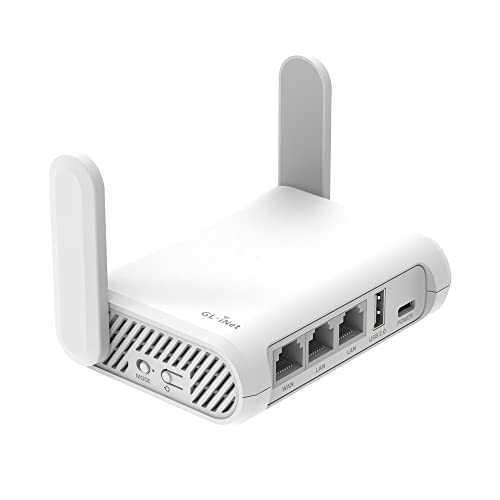
GL.iNet Opal (GL-SFT1200) Travel Router — The studio semester specialist
The Opal’s presence in an apartment guide needs its one-paragraph defence, after which it defends itself. A studio apartment is a room; a travel router is a room-scale network; the match is exact. The Opal brings AC1200 dual-band Wi-Fi, three gigabit ports — enough for a laptop, a console and a spare — and OpenWrt with OpenVPN and WireGuard across more than thirty supported services, in a 145-gram box. For the student whose housing changes every year, whose summers are elsewhere, and whose possessions must fit a car, the router that is also the travel router is not two compromises but one elegant object.
Its VPN competence has a specifically collegiate use beyond travel: the student working from cafés, libraries and other people’s networks can tunnel through the Opal there and at home with the same small box and the same learned routine. The ceilings are the travel ceilings — AC1200 radios will not serve a four-bedroom house’s worth of simultaneous streams, and a growing household should graduate to the AX21 class. But as the network of a studio, a sublet, or a first solo apartment, the Opal is arguably the most rational purchase in this entire guide, and its price tier lets the savings fund the deposit on next year’s place.
- Wireless: AC1200 dual-band Wi-Fi
- Ports: three gigabit Ethernet ports
- System: OpenWrt with OpenVPN and WireGuard; over 30 VPN services
- Weight: 145 grams stated
- Role in this guide: studio and mobile-student network
- Whole-house coverage: beyond a travel router’s design — larger apartments should choose the conventional picks
Strengths
- A complete small network that moves house as easily as its owner does.
- VPN skills the conventional picks do not offer at this tier.
- Three gigabit ports is generous wired provision for a box this size.
Trade-offs
- AC1200 radios cap a multi-resident, multi-stream household quickly.
- Its kingdom is one or two rooms, honestly stated.
- No mesh expansion path of the Easy Mesh or eero kind.
Best for: a studio dweller, a subletter, or a student whose address changes with the academic calendar.
Not suited for: a four-bedroom shared house needing one network to rule every room.
Mobile students should look at the Opal on Amazon as the router that graduates into a travel career.

TP-Link AC1900 WiFi Router (Archer A8) — The older-generation bargain hunter’s pick
The Archer A8 is the guide’s Wi-Fi 5 entry, and its case rests on a census question: what do the household’s devices actually speak? A student fleet assembled from hand-me-down laptops, last-generation phones, an older console and a smart television may contain nothing that can use Wi-Fi 6 at all — in which case the A8’s AC1900 dual-band specification, MU-MIMO, gigabit ports and guest Wi-Fi cover the real fleet completely, and the money saved against the Wi-Fi 6 picks is better spent on the plan, the cables or the deposit. Its title’s repetition of its own virtues is marketing; the virtues themselves are genuine.
The counter-argument is time. Devices turn over fast in student life — a new phone here, a current console there — and each arrival makes the Wi-Fi 6 picks’ case retroactively. The A8 also lacks the AX21’s Easy Mesh story, so its coverage is what one unit gives an apartment and no more. Buy it as a deliberate, census-based decision and it is the shrewdest purchase in the guide; buy it by accident, because it was cheapest on the page, and it may become next year’s hand-me-down itself. The guest Wi-Fi deserves its closing mention: in a house with a social life, a separate guest network is the difference between hosting friends and adopting their devices.
- Wireless: AC1900 dual-band Wi-Fi 5
- Technology: MU-MIMO stated in the title
- Wired: gigabit ports
- Guests: guest Wi-Fi supported
- Model: Archer A8
- Wi-Fi 6: absent by design and by generation — match it to a fleet that is likewise equipped
Strengths
- Covers an older device fleet completely, at a veteran’s tier.
- Guest Wi-Fi suits a house with an active social calendar.
- Gigabit wired ports keep the console honest regardless of wireless generation.
Trade-offs
- Every new Wi-Fi 6 device a resident buys weakens its founding argument.
- No mesh expansion story for a future larger home.
- Its airtime manners predate Wi-Fi 6’s crowd-handling improvements.
Best for: a household whose devices are honestly a generation old and whose budget has better uses.
Not suited for: residents carrying current phones and laptops who would use Wi-Fi 6 daily.
Census-first households can view the Archer A8 listing on Amazon and decide with their device list open beside it.

Roam 6 AX1500 Travel Router — For the student whose campus is everywhere
The Roam 6 closes the guide the way the Opal opened its argument, with mobility as a first principle — but where the Opal is the established traveller, the Roam is the phone-native one. Its title describes a portable Wi-Fi 6 travel router with USB-C 3.0, easy public Wi-Fi sharing, hotel, RV and travel approval, phone Wi-Fi tethering, multiple modes in one unit, and OpenVPN and WireGuard support. For the student whose real campus is a rotation of library, café, part-time job and a partner’s flat — with the apartment almost a docking station — a router built to gather whatever network the day provides, including the phone’s, and re-serve it as home is a genuinely collegiate tool.
In the apartment itself, its AX1500 Wi-Fi 6 class sits between the Opal’s radios and the conventional picks’ coverage ambitions: entirely sufficient for a studio or a small two-room flat, out of its depth as a whole-house answer for four bedrooms. Its USB-C alignment suits the one-charger student kit, though the listing’s detail should be checked for the exact power arrangement, as this guide noted in the portable roundup. Choose the Roam when the travelling life is the main fact and the apartment is one stop among many; choose the AX21 when the apartment is the main fact and travel is the exception. The semester-abroad student, notably, may need both arguments in different years.
- Wireless: AX1500 Wi-Fi 6, dual-band, portable format
- Power and data: USB-C 3.0 stated
- Tethering: phone Wi-Fi tether feature headlined
- VPN: OpenVPN and WireGuard named
- Modes: multi-mode in one; public Wi-Fi sharing
- Apartment coverage ambition: studio and small-flat scale — the conventional picks serve larger shared homes
Strengths
- Phone tethering as a headline input suits the everywhere-campus lifestyle.
- Wi-Fi 6 radios in a genuinely portable, USB-C aligned package.
- Full VPN protocol pairing for café and library working.
Trade-offs
- Room-scale design — a four-bedroom house is beyond its brief.
- A newer name beside GL.iNet’s long travel lineage.
- Power specifics require the listing beyond the title’s USB-C headline.
Best for: a mobile student whose network must assemble itself in a new place every few days.
Not suited for: a settled four-person house wanting one permanent, full-size router.
Everywhere-campus students can inspect the Roam 6 on Amazon and judge it against their weekly map of workplaces.
How Does the Household Survive Deadline Week and Finals?
Every student network has two seasons. In the ordinary season, the load is entertainment-shaped and forgiving: streams buffer politely, downloads finish whenever, and a brief stall is a joke rather than a grievance. Deadline season inverts the stakes. The same connection now carries a thesis uploading against a portal’s closing hour, three simultaneous video calls with supervisors, a group project assembling itself from five cloud folders, and one resident — there is always one — streaming a series to cope. The router that governed the ordinary season fairly will govern this one; the router that was merely fast will be found out.
Preparation is mostly calendar work. The household that knows its deadline map can schedule the avoidable loads around it: game updates and cloud backups in the small hours, the big dataset downloaded the weekend before rather than the morning of. Wired connections deserve reserving for the highest-stakes machine of the week — the treaty can name a rotating priority seat the way it names a bathroom schedule during a house party. And the admin resident should do the unglamorous checks early: firmware current, router ventilated and unburied, the provider’s own status page bookmarked, so that a deadline-week fault is diagnosed in minutes rather than debated for an hour in the group chat.
There is a social technology here too, and it outperforms any router feature: the household that announces its deadlines gets protected by its own constitution. A network governed by written rules and shared knowledge behaves, under pressure, like a much more expensive network. That, more than any specification in this guide, is the difference between the apartments that sail through finals and the ones that hold an inquiry afterwards.
What Should Students Know About Security on a Shared Building’s Doorstep?
An apartment network lives closer to strangers than a suburban one: the building’s other residents are physically near enough to see your network’s name, and the shared infrastructure of student housing — landlord routers, building switches, hallways full of other people’s gadgets — deserves a healthy, unparanoid caution. The basics cover most of the real risk. Use the modern security mode your router offers with a password that is not the address, the mascot or the semester. Keep the firmware updated; on the mainstream picks here that is a guided, painless ritual. Put visitors on the guest network, and let the household’s own devices live behind the router’s ordinary protections rather than exposed on a building-wide free-for-all.
The travel picks add one more layer for the student who works everywhere: a VPN tunnel for café, library and other people’s networks, so the essay and the bank session alike travel inside it. That habit, learned in college, is worth more than the hardware — it survives graduation, employers and several generations of routers. Security advice for students usually fails by being either terrifying or ignorable; the workable version is four habits — strong password, current firmware, guest network for guests, tunnel on strange networks — repeated until they are boring.
Side by Side in the Shared House: Six Answers to One Lease
| Pick | Wireless | Coverage claim | Household it fits |
|---|---|---|---|
| TP-Link Archer AX21 | Wi-Fi 6 AX1800 | Apartment scale, mesh-expandable | The typical shared apartment |
| NETGEAR R6700AX | Wi-Fi 6 AX1800 | Up to 1,500 sq. ft. | Wired-console households |
| Amazon eero 6+ | Mesh Wi-Fi 6 | Up to 1,500 sq. ft. | Device-stuffed, management-free |
| GL.iNet Opal | AC1200 | Room scale | Studios and movers |
| TP-Link Archer A8 | Wi-Fi 5 AC1900 | Apartment scale | Older device fleets |
| Roam 6 | Wi-Fi 6 AX1500 | Room scale | Mobile, phone-tethered students |
The table’s lesson is that “college apartment” conceals at least three different households: the settled shared flat, the studio, and the nomadic student’s base camp. The first household should buy from the table’s top half, the second from its travel rows, and the third should read the Roam’s review twice. Coverage claims cluster at the same 1,500-square-foot figure for the two conventional rivals and the eero, which tells you the apartment class has a consensus size — and that anything promising suburban acreage to a student flat is selling a map of somewhere else. Households whose gaming ambitions outgrow this table’s sensible tiers should keep reading into the gaming guide linked in our related reading below, while the student whose library sessions need tunnelling will find the VPN guide waiting there as well.
How Should Roommates Set Up the Router in the First Week?
Hold the five-minute summit before the box is opened. Agree the network name — something the whole building can see without embarrassment, because it will be visible to every neighbour for years — and a password that is strong, shared among residents, and written in the household’s shared notes rather than on a sticky note destined for the fridge’s public gallery. Decide who holds the admin account, where the router lives (central, high, and not in the metal cabinet the landlord provided), and which devices get the wired ports: the console and any desktop first, by acclamation.
Then do the technical ten minutes. Update the firmware before anything else joins the network. Turn on the guest network for visitors, so the social life does not colonise the household’s own devices. Walk each bedroom with a phone and confirm the signal honestly; if the far room is weak on day one, it will be weaker on deadline night, and the mesh conversation — an Easy Mesh addition to the AX21, a second eero — should happen while the semester is young. Finally, schedule the big recurring downloads for the small hours and write the download treaty into the same shared notes as the password. Networks, like kitchens, are governed by whoever writes the rules down first.
There is a grown-up version of this summit worth copying from the world of work. Offices write their network rules down — who administers, what gets priority, how the bill is owned — and the households that borrow that habit from best business class routers thinking, scaled down to a fridge-door document, argue about their internet roughly never. The technology differs by an order of magnitude; the governance lesson transfers intact.
What Mistakes Do Student Households Make With Routers?
Buying for the house they wish they had leads the list — a flagship sized for a suburban family home, installed in a two-room flat, while the internet plan stays at the tier that actually governs their evenings. The plan is the ceiling; the router is the room’s furniture; spend in that order. The second mistake is placement by convenience: the router exiled to the floor behind the television because the port was there, serving the whole apartment through a metal entertainment unit. The third is the shared-password sprawl — the household network’s password given to every visitor for four years, until the network’s population includes alumni in other time zones. The guest network exists; use it from the first party.
A fourth mistake is ignoring the lease’s fine print and the building’s own offer. Some rentals include a perfectly good connection that only needed the household’s own private network behind it — the travel picks’ party trick — and some housing agreements have views about personal routers that are cheaper to read in September than to litigate in November. A fifth is letting the router leave with the wrong roommate in June: decide at purchase whose it is, or that the household sells it and splits the proceeds with the same ceremony as the deposit. The technology in this guide is the easy half of a college network; the governance is the degree-level material. Students moving between rentals and relatives’ sofas will find the portable philosophy extended in best flashed vpn routers, where several of this guide’s travel names reappear wearing their tunnelling hats.
How Do Four Years of Devices Change the Right Answer?
A first-year household and a final-year household own different fleets, and a wise purchase anticipates the direction of travel. The first-year fleet is inherited: ageing laptops, phones one generation back, a console that has already survived two owners. By the final year it has been joined by current phones, a newer console or gaming PC, smart lighting somebody bought on a whim, and the accumulated gadgets of three birthdays. The router bought for the first fleet alone — the Archer A8’s honest bargain — may be straining by the third year, while the Wi-Fi 6 picks bought at the start simply absorb each arrival.
This is the practical argument for buying one generation ahead of the current fleet when the price difference is survivable: in student life the fleet refreshes faster than the tenancy. It is also an argument for the mesh-expandable designs, whose second act in a larger post-graduation flat is already written. The router is one of the few student purchases expected to survive the degree itself, and the household that treats it that way — mid-tier, current generation, expandable — rarely regrets the meeting at which it was chosen.
Conversely, beware the fleet audit performed by optimism. Count the devices that exist, weight the ones arriving within a year, and ignore the ones in the brochure of a life not yet lived. A router bought for a smart home that never materialises is just an expensive way to serve the same five gadgets; the Opal in a studio has launched more actual productivity than many a flagship idling in a cupboard.
Final Recommendation
For the settled shared apartment that this keyword mostly describes, buy the Archer AX21 and be done: it is the complete, fairly priced centre of the category, with a mesh path for the one problem it cannot solve alone. Households that prefer NETGEAR’s hand on the tiller lose nothing with the R6700AX, and households drowning in devices and allergic to administration should let the eero 6+ quietly run their lives. The studio dweller and the annual mover should skip the conventional shelf entirely — the Opal, or the Roam 6 for the phone-tethered life, will serve three addresses while a full-size router serves one. And the household whose fleet is honestly old should take the Archer A8’s bargain with its eyes open. The best routers for college apartments are the ones still governing fairly in the spring term — chosen for the household that actually signed the lease, not the one in the brochure.
Frequently Asked Questions
Are personal routers allowed in college housing?
In off-campus apartments, almost always yes — it is your network and your bill. In dormitories and residence halls, often no: many colleges prohibit personal routers on their networks or require registration. This guide addresses apartment living; dorm residents should read their housing agreement and use the campus network within its rules.
How fast an internet plan does a student apartment need?
Faster plans help most at the evening peak when every resident is active at once. As a household rule, the plan matters more than the router once the router is competent — every pick here can serve a gigabit-class plan’s local side or the apartment-scale part of one. If the budget forces a choice between a grander router and a faster tier, choose the tier.
Can one router cover a three-bedroom apartment?
Usually, if it is placed centrally and the walls are kind — the 1,500-square-foot claims on the R6700AX and eero describe exactly this territory. Brick, concrete and a router exiled to one end of the flat change the answer, which is why the mesh-expandable picks earn their keep: start with one unit, survey honestly in the first week, and add a node only on evidence.
Should the gaming console be wired in a shared apartment?
Yes, whenever a cable can reach. Wiring the console removes the household’s most latency-sensitive device from the contested air and frees wireless capacity for everyone else — the single cheapest fairness policy a student house can adopt. All four conventional picks here provide gigabit ports for exactly this treaty, and the travel picks carry enough ports for a studio’s console.
What happens to the router when the lease ends?
Whatever the household agreed in September — which is why this guide keeps recommending the agreement be written down. Common settlements: one resident buys the others out at a friendly valuation, the router is sold and split like the deposit, or it follows the resident whose name is on the internet account. Travel picks dissolve the question entirely, leaving with their owner like a laptop.
Is a travel router really enough for an apartment?
For a studio or a small one-person flat, genuinely yes — the Opal and Roam 6 run complete small networks with wired ports and VPN skills the big boxes lack. For a multi-bedroom shared house, no: their radios and coverage are room-scale by design. The honest boundary is the number of rooms and residents, and both reviews above mark it plainly.
One more first-week task, small enough to be forgotten and valuable enough to forbid forgetting: photograph the router’s label and the finished cable layout, and file both in the household notes. The label carries the model, the default credentials and the serial that any support conversation will demand; the photograph carries the answer to every future “which cable is the internet one” debate. In June, when the network is dismantled by tired people in a hurry, that photograph is also the setup guide for whoever inherits the box — the closest thing a student network gets to a handover ceremony.
And agree, while the summit is still sitting, what happens when the router itself fails in November: who orders the replacement, from whose card, and how the cost is split before it is split emotionally. A household that has pre-agreed its emergencies experiences them as errands. A household that has not experiences them as referendums — on fairness, on whose turn it is to pay, on whose download broke it. The five minutes of constitutional drafting this guide keeps recommending is the highest-value networking work a student will do all year, and none of it requires opening the box.
Summer deserves a plan too. Apartments empty at different speeds in June, and the network’s last month has its own small dramas: the resident who leaves first takes their name off the account, the one who stays inherits a connection sized for four, and the router itself faces the June referendum described in our questions below. Sublet summers add a twist — strangers inheriting the household network should get the guest network and a changed admin password, not the keys to the residents’ own digital rooms. Five minutes with the settings before the subletters arrive is the difference between hospitality and exposure, and the mainstream picks here all make that five minutes easy to spend.
For the student who stays through the summer in a half-empty flat, the same network suddenly feels luxurious: one resident, forty devices’ worth of headroom, and evenings when the whole connection serves a single screen. Enjoy it without redesigning anything. The constitution written for four governs one without amendment, and September’s returning crowd will find the network exactly as governed as they left it — which is, in the end, the entire ambition of this guide: a small republic of bandwidth that runs itself fairly, in term and out, while its citizens get on with the actual degree.
A final word on neighbours, because apartment routers live in a crowd and the crowd can be heard. Your network shares the air with every other flat’s network, and the evening rush in a student building is a genuine phenomenon — dozens of routers waking as hundreds of residents come home. Modern Wi-Fi 6 manners exist precisely for this density, which is one more reason the current-generation picks lead this guide. Be a decent citizen of that shared air in return: let the router choose its channels automatically unless you have evidence to intervene, keep transmit power at sane defaults, and remember that the neighbour whose network you can see is having the same evening you are. The best-governed apartment network in the building is also, usually, the best neighbour in it.
Budget the small print as well as the box. A decent Ethernet cable for the console, a short power strip with room for the router’s brick, and perhaps a shelf bracket to lift the router off the floor together cost less than the difference between any two picks in this guide, and together they do more for the network’s real performance than that difference would. Student budgets are allocated in meetings and spent in dribs; spend the dribs on placement and cabling, where they compound nightly, rather than on a specification tier whose benefits the apartment’s walls would confiscate anyway.
And when graduation finally dismantles the republic, let the record show that the little network did its whole job: it carried the lectures and the laughter, the deadlines and the downloads, the calls home and the championships, for four years, at the price of a textbook nobody resold. There are worse monuments to a degree. Choose the router that fits the household you actually have, write its constitution in the first week, and it will still be governing — fairly, quietly, at 3 a.m. — on the last night before the vans arrive.
One practical coda for the resident who inherits the admin account: change the admin password when residents change. Departed roommates are usually honest and occasionally careless, and a network whose administrators have all graduated is a network administered by its memories. The handover takes two minutes at the June summit — new admin password into the shared notes, departing residents’ devices forgotten from the list, guest password rotated for the new household. Treat it as seriously as returning the keys, because in every way that matters to the network, it is returning the keys.
Keep the receipt with the lease, incidentally. Student routers live hard lives in houses where everything is somebody else’s fault, and the household that can produce a purchase date settles the warranty question, the buyout valuation and the whose-was-it-anyway debate in a single gesture. File it in the same shared folder as the password and the photograph, and the little republic’s archive is complete: constitution, map, and title deed.
None of this governance requires the household’s most technical member to become its unpaid IT department, and the boundary is worth drawing in the same first-week summit: the admin resident configures the router once and keeps the notes, but the reboot, the guest password and the cable check are everybody’s skills, taught in five minutes and shared on purpose. A network that only one person can restart will restart, eventually, on the weekend that person is away — the apartment’s oldest story, retold every semester in every student building in the country.
Teach the reboot properly, while you are at it: power off, count to thirty, power on, wait the full two minutes these machines take to reassemble themselves before declaring anything broken. Half of all student network emergencies are a router interrupted mid-boot by an impatient second reboot, and the household that learns patience as its first diagnostic skill will need every other skill in this guide measurably less often.
The second diagnostic skill is knowing whose problem it is: if every device is down, suspect the router or the provider; if one device is down, suspect the device; if the wired console sings while the bedrooms complain, suspect geography and placement. That tiny decision tree, taped inside the cupboard door, resolves most incidents before the group chat has finished typing its first theories.
With those two skills and a written constitution, the household has effectively hired its router as intended: not as a gadget to be admired in September, but as the quiet civil service of the apartment, on duty every hour of the degree.
That is the standard to hold the purchase to at the till: not the fastest box the budget can reach, but the one whose governance the household will still be thanking in the spring.
Related Guides
For the neighbouring decisions a student household meets next: the workplace-grade view in best business class routers, latency-first machines for the serious gaming house in best gaming routers asus, and tunnelling for library and café working in best flashed vpn routers.


