What's inside
- Key Takeaways
- Quick Picks
- How We Chose These Picks
- What Does a Trickle Maintainer Actually Do All Day?
- Why Does the Charge Controller Matter More Than the Panel?
- How Much Stored Power Does a Weekend of Car Camping Need?
- Which Tool Matches the Job Waiting at Your Campsite?
- Putting Solar Maintainers, a Power Station and a Power Bank on One Table
- What Mistakes Do Car Campers Make With Power Gear?
- How Should You Set Up Camp Power on Arrival?
- Can a Maintainer and a Power Station Share One Trip Sensibly?
- How Does Weather Rewrite Every Solar Plan at Camp?
- What About the Cool Box, the Lights and Everything Else Plugged Into the Car?
- How Should Power Gear Be Stored and Cared for Between Trips?
- When the Car Is Also the Bedroom, What Changes?
- How Do Longer Trips Change the Arithmetic?
- What Should a First-Time Car Camper Buy First?
- Why Does Panel Placement Beat Panel Size at Camp?
- Final Recommendation
- Frequently Asked Questions
- Related Guides
As an Amazon Associate I earn from qualifying purchases. This post may contain affiliate links at no extra cost to you.
widgetverdict.com is reader-supported. When you buy through links on our site, we may earn an affiliate commission.
Where to buy: each item of gear here links to its Amazon listing; before ordering, match the kit’s connectors against your own vehicle, because clips, lighter plugs and OBD connectors are not interchangeable favours.
Car camping splits its power problem in two, and confusing the halves is how money gets wasted. Half one is the vehicle itself: a car that sits at a trailhead for three days, powering a cool box and interior lights from its starter battery, can easily reach the morning it will not start. Half two is your pocketful of devices, phones, watches, torches and cameras that want feeding each night. The best chargers for car camping address both halves, but with different tools, and this guide keeps the tools labelled honestly. Four of the six picks are solar trickle maintainers whose entire job is keeping a 12V vehicle battery topped up against slow drain; they do not fast-charge phones, and they were never designed to. One pick is a portable power station, which is not a charger at all but a battery you charge at home and spend at camp. One is a solar power bank that genuinely does charge phones, slowly by sun and properly by cable.
Read the reviews with that map in hand and every product falls into place. The maintainers compete on controller intelligence, weatherproofing and connector variety. The power station competes on stored capacity and output flexibility. The power bank competes on pocket convenience. A well-equipped car camper may end up owning one from each family; a casual one should buy for the failure they actually fear, the flat starter battery or the dead phone, and not confuse the two.
Charging while the engine runs is a different discipline, covered by the dashboard mounts in best car qi chargers, and the home end of the cable lives in best inexpensive wireless chargers. For gear chosen by toughness rather than watts, see best external hard drives durability.
Key Takeaways
- Four picks are 12V solar trickle maintainers: they keep a parked vehicle’s battery topped up and are not phone chargers.
- The Jackery Explorer 300 is a portable power station, a stored-energy battery for camp devices, not a charger for the car.
- The BLAVOR power bank is the only pick that charges a phone directly, by cable, wireless pad or its small solar face.
- FlexSolar’s kit carries the richest connector set: lighter plug, alligator clips, O-rings and an OBDII connector.
- SOLPERK and SUNER POWER both build MPPT controllers into 12V kits rated IP67 and waterproof respectively.
- Buy for the failure you fear: a maintainer prevents the no-start morning; stored power prevents the dark, silent campsite.
Quick Picks
| Pick | Badge | Why it earns its place |
|---|---|---|
| SOLPERK 20W 12V Solar Battery Charger Kit | The MPPT kit with the bracket | A 20W panel, MPPT controller, IP67 waterproofing and an adjustable mount for semi-permanent fitting. |
| Voltset 20W 12V Solar Panel Battery Charger Kit | The protection-minded maintainer | Smart controller and stated safety protections across cars, boats, trailers and motorcycles. |
| SUNER POWER 12W 12V Solar Battery Charger | The compact dash maintainer | A smaller 12W panel with a built-in smart MPPT controller for lighter-duty topping up. |
| FlexSolar 20W 12V Solar Panel Trickle Charger Kit | The connector completist | Four ways to reach a battery, including an OBDII connector for modern vehicles. |
| Jackery Explorer 300 Portable Power Station | The stored-power option | 292Wh of portable capacity for camp devices; a power station, not a vehicle charger. |
| BLAVOR Solar Power Bank 20000mAh | The pocket power bank | Phone and watch charging with four built-in cables, a flashlight and a solar top-up face. |
How We Chose These Picks
The candidate pool for this keyword mixes three product families that lazy guides blur together, so selection began by sorting, not ranking. Solar maintainers were kept only if their titles stated 12V battery maintenance with a charge controller, since a bare panel connected carelessly can overcharge the battery it claims to protect. The power station earned its place as the category’s reference point for stored camp power, and it is reviewed as a power station throughout, never dressed up as a charger. The power bank was chosen for its combination of solar input, built-in cables and wireless charging, the features a camper actually touches.
Every claim in the reviews traces to a listing title. Where a title does not state a connector, a rating or a protection, the spec boxes note the silence in their own words. Nothing here promises that a maintainer will resurrect a failing battery, and nothing promises phone-charging speed from a panel designed to sip sunlight into a car battery across a week.
What Does a Trickle Maintainer Actually Do All Day?
A parked vehicle battery loses ground constantly. The alarm, the keyless-entry receiver, the clock and the slow self-discharge of lead-acid chemistry all draw or leak small amounts, and a camping trip adds deliberate loads: doors open, lights on, a cool box cycling. A trickle maintainer replaces those losses at roughly the rate they occur. Its panel converts daylight into a modest current, its controller meters that current so the battery is held near full without being cooked, and the vehicle starts on the cold morning of departure as if it had been driven daily.
What a maintainer does not do is equally important. It will not fast-charge a phone, because its output is regulated for a 12V battery, not for a handset. It will not rescue a battery that has already failed internally; maintenance preserves health, it does not restore it. And it works at daylight’s pace, which is why panel wattages of 12W to 20W are sensible here: across a sunny day, that is ample to offset parasitic drain, while a bigger panel would mostly test the controller’s ability to say no. Judge these four kits as insurance with a solar face, and their specifications start to read correctly.
Why Does the Charge Controller Matter More Than the Panel?
The panel is a simple creature; it makes whatever power the light allows. The controller is the judgement between panel and battery. A good controller, and MPPT designs are the current benchmark, squeezes more usable energy from the panel in weak or angled light by tracking the panel’s most productive operating point, then tapers and floats the charge so the battery rests at full rather than being pushed past it. Overcharging is not a theoretical harm: it gases and dries a conventional battery and shortens the life of the very asset the kit was bought to protect.
This is why the reviews below name the controller in every spec box and treat phrases like smart controller and built-in MPPT as headline features rather than footnotes. Two of the maintainers state MPPT explicitly, one states a smart controller with safety protections, and one builds its controller in with four connection methods. When comparing kits that look similar in a photograph, the controller language in the title is the most reliable guide to which kit will treat a battery kindly across a whole season of weekends.
How Much Stored Power Does a Weekend of Car Camping Need?
That question belongs to the Jackery’s family, and it is answered in watt-hours, the currency of stored energy. Add up the camp’s nightly appetite honestly: two phones, a couple of lights, perhaps a camera battery and a small fan. Most couples’ device lists total a modest nightly draw, and a station in the class of the Explorer 300, with 292Wh on board, covers several such nights with room for a laptop session or a drone battery. The arithmetic changes completely if the plan includes heating, cooking or a large fridge, loads that belong to bigger stations or to the vehicle’s own systems with the engine’s help.
The discipline is to inventory before buying. Write the devices down, estimate their nightly consumption generously, multiply by the nights away, and compare the total against capacity with a margin for cold weather and optimism. Campers who skip this exercise buy either too little station and ration torchlight by the second night, or far too much and carry the weight penalty for years. The power bank, at the other end of the scale, answers a narrower version of the same question for one person’s phone and watch.
Which Tool Matches the Job Waiting at Your Campsite?
Six products, three jobs. The four maintainers guard the vehicle. The power station runs the campsite. The power bank rescues the person. Read each review inside its job description and the comparisons become fair; read across jobs and everything looks deficient, which says more about the reading than the products.

SOLPERK 20W 12V Solar Battery Charger Kit — The MPPT kit with the bracket
SOLPERK’s kit is the most installation-minded of the four maintainers. A 20W panel feeds an MPPT solar controller, the panel carries an IP67 waterproof rating, and an adjustable mount bracket is part of the package, a combination aimed at a vehicle, boat or RV that will keep the kit fitted rather than stowed. The title lists boats, cars, RVs, motorcycles and marine use, which fits the bracket logic: this is the maintainer for the vehicle that lives outdoors and sits unused between weekends.
IP67 is a serious weather claim, describing dust-tight construction and immersion resistance, and on a panel that may spend months on a roof or a boat deck it matters more than a watt or two of rating. The MPPT controller works hardest exactly where fixed installations suffer, in the angled, partial light of mornings and tree shade, harvesting what a simpler controller would leave behind. For a car camper, the bracket also solves the campsite geometry: angle the panel toward the day’s sun once, and the battery sips steadily while you are off hiking.
The commitment cuts both ways. A bracketed panel is a small project to fit and a visible addition to the vehicle, so renters and the commitment-shy should look at the dash-friendly SUNER POWER instead. And the standing honesty of this guide applies in full: this kit maintains a 12V battery, and your phone will get nothing from it directly. See the SOLPERK 20W kit listing for the bracket dimensions and cable details before planning the fitting.
- Job: 12V vehicle battery trickle maintenance
- Panel: 20W solar panel kit
- Controller: MPPT solar controller
- Weather rating: IP67 waterproof, per the listing title
- Fitting: adjustable mount bracket included
- Listed vehicles: boat, car, RV, motorcycle, marine and automotive use
- Phone charging: not this kit’s function; it maintains the vehicle battery
Strengths
- MPPT controller harvests weak and angled light efficiently.
- IP67 rating suits permanent outdoor exposure on roofs and decks.
- Bracket lets you aim the panel at the sun instead of accepting the car’s angle.
Trade-offs
- Bracket fitting is a small installation project, not a dashboard toss.
- A permanently mounted panel is visible and travels with the vehicle everywhere.
- Maintains the battery only; devices need their own charging plan.
Best for: RV, boat and second-car owners whose vehicles sit outdoors between trips.
Not suited for: renters, or anyone expecting a panel kit to charge their phone directly.
Voltset 20W 12V Solar Panel Battery Charger Kit — The protection-minded maintainer
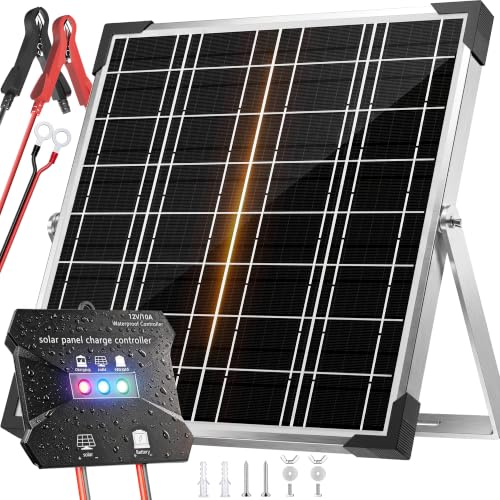
Voltset’s 20W kit leads its title with the words trickle maintainer and then spends its remaining space on the controller and protections: a smart charge controller, waterproof construction and safety protections, spread across an unusually wide parish of vehicles that includes trailers and trucks alongside cars, boats, RVs and motorcycles. That emphasis suits a buyer whose battery anxiety is really a battery-longevity anxiety, someone who has priced a replacement battery and would rather never meet that bill early.
Safety protections in this product family generally means the controller guards against the classic wiring and charging errors, reverse connections, overcharge and short circuits, and while the title does not enumerate them one by one, the explicit mention signals where Voltset spent its engineering attention. For a kit that may be connected by a tired camper at dusk, that protection layer is not decoration. It is the difference between a wrong connection being an embarrassment and being a repair.
The panel matches the SOLPERK at 20W, so daily harvest is comparable, and the choice between them turns on fitting style and controller philosophy rather than power. Voltset’s title does not mention a mounting bracket, so plan on a dash, roof or ground placement of your own devising. The Voltset 20W kit listing is the place to confirm the connector set included for your particular vehicle.
- Job: 12V battery trickle maintenance
- Panel: 20W solar panel
- Controller: smart charge controller
- Protections: safety protections stated in the title, details on the listing
- Weather: described as waterproof in the title
- Listed vehicles: car, boat, RV, marine, trailer, truck, motorcycle and automotive
- Phone charging: not offered; this kit serves the vehicle’s battery
Strengths
- Protection language signals a controller designed for real-world mistakes.
- The widest vehicle list of the four maintainers, trailers included.
- 20W harvest matches the strongest panels in this group.
Trade-offs
- No bracket mentioned, so mounting is your own arrangement.
- Protection specifics need the listing to confirm.
- Like every maintainer here, it will not revive a battery already failing.
Best for: owners of several vehicle types who want one protection-focused kit to rotate among them.
Not suited for: anyone wanting a fitted, bracket-mounted permanent installation out of the box.
SUNER POWER 12W 12V Solar Battery Charger — The compact dash maintainer
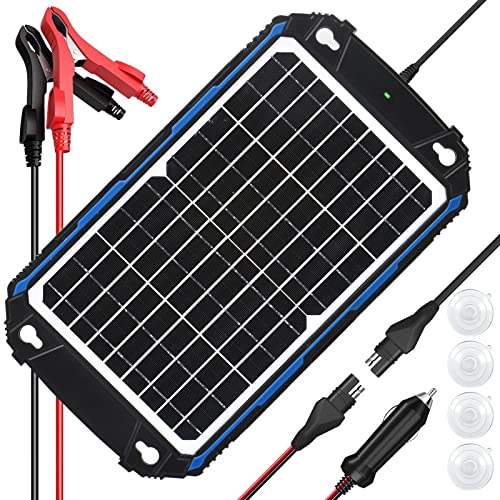
SUNER POWER takes the opposite path from the bracketed kits: a smaller 12W panel with an ultra-smart MPPT charge controller built in, waterproof construction, and a maintainer-pro framing aimed squarely at cars, boats, RVs and trailers that need topping up rather than rescuing. Twelve watts sounds modest until the job is stated correctly. Against the slow parasitic drain of a parked vehicle, a 12W panel in daylight is not modest at all; it is roughly matched to the loss it exists to cancel.
The smaller panel buys placement freedom. It can live on a dashboard behind the windscreen, accepting the slight loss through glass in exchange for zero installation and zero theft exposure, or ride on a roof for a long weekend and come home in the boot. The built-in controller removes the separate box and wiring decisions that make bigger kits feel like projects. For apartment dwellers whose car camps a dozen nights a year and street-parks the rest, this is the maintainer whose effort-to-benefit ratio makes sense.
Its limits are the mirror of its virtues. A vehicle with heavy standby drain, or a trip pattern that runs lights and a cool box hard each night, can out-draw 12W of winter daylight, and the battery then declines slowly despite the panel. In that pattern, step up to a 20W kit. The SUNER POWER 12W listing will confirm the leads and connectors supplied for your battery terminals.
- Job: 12V battery charging and maintenance
- Panel: 12W solar panel
- Controller: built-in ultra-smart MPPT charge controller
- Weather: waterproof construction, per the title
- Placement: compact panel suited to dashboard or temporary roof use
- Listed vehicles: car, automotive, boat, marine, RV and trailer
- Phone charging: outside this product’s purpose entirely
Strengths
- Built-in MPPT controller keeps the kit to one piece of hardware.
- Small panel fits a dashboard, avoiding any installation.
- Output is honestly sized to the maintenance job it advertises.
Trade-offs
- Heavy nightly loads can out-draw its 12W harvest in short winter days.
- Dashboard placement through glass trims the harvest further.
- No bracket for permanent angled mounting.
Best for: occasional car campers and street-parked cars needing gentle, installation-free upkeep.
Not suited for: power-hungry campsite setups drawing hard on the starter battery nightly.

FlexSolar 20W 12V Solar Panel Trickle Charger Kit — The connector completist
FlexSolar’s 20W kit is sold on reach. The panel and its built-in charge controller arrive with four ways to meet a battery: a cigarette lighter plug for the simplest dashboard routine, alligator clips for direct terminal work, O-ring terminals for a semi-permanent connection that stays bolted on, and an OBDII connector, the modern path that feeds the vehicle’s electrical system through its diagnostic port. Cars, trucks, tractors and boats are all named, and the connector spread explains why: each of those machines prefers a different door.
The OBDII option deserves its paragraph. On many modern vehicles the lighter socket is dead when the ignition is off, which silently defeats a lighter-plug maintainer, while the OBDII port offers a live route to the battery that also preserves the vehicle’s memory settings during any battery work. For owners of newer cars, that single connector can be the difference between a kit that works as parked and a kit that only works while someone sits in the driver’s seat. The O-rings, meanwhile, suit the tractor-and-boat crowd who want the connection made once, properly, and forgotten.
With 20W on the panel and a built-in controller, the electrical side matches the stronger maintainers here; the FlexSolar simply refuses to let connector compatibility be the reason a kit fails. Its title does not state a weatherproof rating, so an exposed permanent mounting deserves a question on the listing before you commit to it. Start at the FlexSolar 20W kit listing to check cable lengths against your engine bay.
- Job: 12V battery trickle charging and maintenance
- Panel: 20W solar panel
- Controller: built-in charge controller
- Connectors: cigarette lighter plug, alligator clips, O-ring terminals, OBDII connector
- Listed vehicles: car, truck, tractor and boat
- Weather rating: not stated in the title; verify on the listing if mounting outdoors permanently
- Phone charging: no; the kit’s outputs serve a 12V battery
Strengths
- Four connection methods cover vehicles from modern cars to tractors.
- OBDII route solves the dead-lighter-socket problem on newer vehicles.
- O-rings allow a fit-and-forget semi-permanent connection.
Trade-offs
- Weatherproofing is unstated, a question for permanent outdoor fitting.
- Connector abundance means spare leads to store tidily.
- Controller type is described more plainly than the MPPT rivals.
Best for: owners of newer cars, and anyone juggling several machines with one kit.
Not suited for: buyers wanting a stated immersion rating for an exposed roof mounting.

Jackery Explorer 300 Portable Power Station — The stored-power option
Let the label be exact: the Jackery Explorer 300 is a portable power station, not a charger. It does not maintain your car’s battery, and it does not gather meaningful power by itself at camp unless you add the optional solar panel its title mentions. What it does is carry 292Wh of stored energy from your home, where it charges from the wall, to a campsite, where it spends that energy through its outlets on phones, lights, laptops, cameras and small camp appliances. Judged as a charger it makes no sense; judged as a portable reservoir, it is the most capable product in this guide.
That reservoir changes what a car-camping weekend feels like. The vehicle’s battery is left alone to do its one essential job, starting the engine, while every discretionary load moves to the Jackery. Phones charge at proper speed from its ports in the evening, lights run without a thought about the drive home, and a laptop or drone battery stops being a negotiation. Jackery’s title also frames it for travel, hunting and blackout backup, and that home-emergency second life is real value: the same box that runs a campsite in October keeps a router and phones alive during a January power cut.
The honest costs are weight, forethought and the recharge question. A power station must be charged before the trip and rationed during it; it is a tank, not a tap. Campers who need the vehicle’s battery guarded should pair it with a maintainer rather than expecting it to substitute. Read the Jackery Explorer 300 listing for its outlet layout and charging inputs, and note the solar panel is optional and separate.
- Job: stored portable power for camp devices; not a vehicle battery charger
- Capacity: 292Wh, per the listing title
- Battery: described in the title as a backup LiFePO4 battery
- Recharging: from home power; solar panel optional and not included
- Listed uses: outdoors, camping, travel, hunting and blackout backup
- Vehicle battery maintenance: not a function of this product
- Phone charging: yes, from its stored capacity, at camp
Strengths
- Removes all device loads from the starter battery entirely.
- 292Wh covers several nights of phones, lights and small devices.
- Doubles as home blackout backup between trips.
Trade-offs
- Must be charged before departure; it gathers nothing alone at camp.
- Adds real weight and bulk to the car’s cargo.
- Does nothing to protect the vehicle’s own battery.
Best for: campers running several devices who want the starter battery left completely alone.
Not suited for: solving a vehicle battery that drains while parked, or ultralight packing lists.

BLAVOR Solar Power Bank 20000mAh — The pocket power bank
The BLAVOR is the only pick that fits in a jacket pocket and the only one whose solar panel faces the user’s own devices. Its 20000mAh cell charges phones by cable or by its wireless charging surface, charges an Apple Watch on its dedicated spot, carries four built-in cables so the right lead is always attached, offers 20W USB-C fast charging, shrugs off splashes with an IPX5 rating, and hides a camping flashlight in the bargain. As a campsite tool it is aimed at the person, not the vehicle.
Set expectations for its solar face correctly and it delights. A panel that small gathers energy slowly; its honest role is topping up across a sunny day on a dashboard or a pack lid, stretching the stored charge, not refilling an empty bank between breakfast and lunch. The bank’s real work is done by the capacity you charge at home and spend at camp, with the sun as a helpful supplement. The four built-in cables remove the classic campsite failure of the perfect power bank paired with the wrong lead left in a drawer at home.
Wireless charging on a power bank is a small luxury that suits tents: no cable to find in the dark, just set the phone on the bank and sleep. The flashlight, easily dismissed as a gimmick in a listing, earns its place the first time the main torch is at the bottom of a bag. Confirm the cable types match your handset family on the BLAVOR power bank listing before relying on the built-in set.
- Job: personal device charging at camp
- Capacity: 20000mAh
- Outputs: four built-in cables, wireless charging surface, watch charging spot
- Fast charging: 20W USB-C, per the listing title
- Weather: IPX5 waterproof rating
- Extras: camping flashlight built in
- Solar role: slow top-up harvesting; main charge comes from a wall before the trip
Strengths
- Built-in cables end the forgotten-lead failure at camp.
- Wireless surface and watch spot cover a phone-and-watch wearer fully.
- IPX5 shrugs off campsite splashes and light rain.
Trade-offs
- Solar harvesting is a supplement, never a full refill strategy.
- It does nothing for the vehicle’s battery.
- 20000mAh is a weekend ration for one person, not a group’s supply.
Best for: solo campers and couples guarding phones and a watch over a weekend.
Not suited for: running camp lighting for a group, or protecting the car’s starter battery.
Putting Solar Maintainers, a Power Station and a Power Bank on One Table
| Pick | True job | Energy figure | Charges a phone? | Guards the car battery? |
|---|---|---|---|---|
| SOLPERK 20W Kit | Battery maintenance | 20W panel, MPPT | No | Yes, its whole purpose |
| Voltset 20W Kit | Battery maintenance | 20W panel, smart controller | No | Yes, with stated protections |
| SUNER POWER 12W | Battery maintenance | 12W panel, built-in MPPT | No | Yes, for lighter drain |
| FlexSolar 20W Kit | Battery maintenance | 20W panel, built-in controller | No | Yes, via four connector types |
| Jackery Explorer 300 | Stored camp power | 292Wh capacity | Yes, from stored charge | No |
| BLAVOR Power Bank | Personal device charging | 20000mAh capacity | Yes, cable and wireless | No |
The two right-hand columns are the whole guide in miniature. Four products exist to make a parked car start reliably, and they cannot charge your phone. Two products exist to charge your devices, and they cannot help your car. Any review that blurs that line sets its readers up for a dark campsite or a silent ignition. Within the maintainer family, choose by fitting and connection: SOLPERK for a bracketed outdoor life, Voltset for protection emphasis, SUNER POWER for dashboard simplicity, FlexSolar for connector reach. Between the Jackery and the BLAVOR, choose by headcount: a campsite’s worth of devices, or one person’s pocket.
What Mistakes Do Car Campers Make With Power Gear?
The founding mistake is buying a maintainer to charge phones, then cursing it at a dark campsite; the second is buying a power station to save a draining car battery, then meeting the same no-start morning with a beautifully charged phone. Buy for the job. A third mistake is connecting a panel without a controller, or trusting an unknown controller, and slowly overcharging the battery across a season; every kit here was chosen partly because its controller is stated and central. A fourth is placement laziness: a panel flat under a roof box’s shadow or face-down in a footwell harvests a fraction of its rating, and the battery’s slow decline gets blamed on the kit.
Campers also forget the return leg. A maintainer needs daylight hours parked in the open to do its work, so a car that camps in a forest clearing and garages in darkness at home may need the panel’s help repositioned, not replaced. And nearly everyone overestimates solar on day one: these are maintenance currents measured across a day, not the wall-socket urgency of home charging. Set that expectation at purchase and the gear will feel miraculous; set it wrong and the same gear feels broken.
How Should You Set Up Camp Power on Arrival?
Arrive, park with the panel’s day in mind, and do the power chores before the tent chores, while light remains. If a maintainer rides with you, place or aim its panel for the morning sun, since a battery prefers to start recovering early, and connect it with the engine off and the leads in the order the kit’s instructions give. If the power station is the camp’s heart, set it in the tent’s driest, most central spot, off the groundsheet’s coldest patch, and agree the charging order for phones before everyone’s battery anxiety competes at midnight.
Then run one honest audit each morning. Glance at the vehicle: has anything been left drawing from it that belongs on the station? Glance at the station: what fraction remains, and does tonight’s plan fit inside it with margin? Glance at the panel: is it still angled at the sky it woke to, or has yesterday’s repositioning shadowed it? Three glances, thirty seconds, and camp power becomes a background comfort instead of the trip’s recurring negotiation. On departure day, disconnect in reverse order, coil leads dry, and let the maintainer, if it lives on the car, go back to its weekday post without ceremony.
Can a Maintainer and a Power Station Share One Trip Sensibly?
They complement rather than compete, and many experienced car campers run exactly that pairing. The maintainer stands guard over the starter battery, absorbing the insults of open doors, interior lights and a cool box, while the power station runs the deliberate loads of camp life. Each device is then sized for one honest job instead of both being oversized for two. The pairing also fails gracefully: if the station runs dry on the last night, the phones go hungry but the car still starts, which is the correct order of sacrifices. If the budget forces a sequence, buy the maintainer first when the vehicle is old or the trips are long, and the station first when the vehicle is new and the device list is long.
How Does Weather Rewrite Every Solar Plan at Camp?
Solar gear is sold in sunshine and used in weather. A maintainer rated at 20W delivers that figure under strong, direct, well-angled light; under the flat grey of an overcast day it may deliver a small fraction, and under tree canopy less again. This is not a defect to be angry about but a budget to plan around. A healthy vehicle battery carries several days of parasitic drain in reserve, so two dull days between sunny ones are a non-event for a maintained car. A week of rain in a forest clearing is a different calculation, and the camper who knows the forecast camps the car in the clearing’s sunniest edge and keeps discretionary loads off the starter battery entirely.
Cold rewrites the other side of the ledger. Batteries store and release energy less willingly as temperatures fall, and the morning a camper most needs a strong start is usually the coldest one. A maintainer that kept the battery near full through the trip is worth most exactly then, because a full battery resists the cold’s penalty better than a half-drained one. The power station and power bank feel cold too; lithium cells kept in a freezing car overnight deliver less and prefer to be warmed in a sleeping bag’s foot or a jacket pocket before heavy use. None of this requires new purchases, only the habit of treating weather as a participant in the power plan rather than as background scenery.
Rain adds a simpler test: what is actually waterproof. Among the maintainers, the SOLPERK states IP67 and the SUNER POWER and Voltset describe waterproof construction, while the FlexSolar’s title stays silent on the point, so its panel placement in a wet week deserves more shelter. The BLAVOR’s IPX5 covers splashes and light rain, which is campsite-realistic rather than storm-proof. Reading these ratings as a spectrum, and placing gear accordingly, is the difference between equipment that survives a wet trip and equipment that becomes a story about a wet trip.
What About the Cool Box, the Lights and Everything Else Plugged Into the Car?
The starter battery’s enemies at camp are rarely dramatic; they are domestic. A compressor cool box cycling through a warm afternoon is the largest single load most car campers impose, and it alone can justify either a maintainer’s daily harvest or a decision to run it only while driving. Interior lights left on for an evening’s card game, a boot light forgotten after unloading, doors standing open with their courtesy lamps burning: each is small, and together across three days they are the classic recipe for the silent ignition. The discipline that saves batteries is boring and total: know every load the car is carrying at camp, and move each one you can to the power station.
That audit has a pleasant side effect. Once the vehicle’s loads are listed honestly, the sizing questions in this guide answer themselves. A car carrying only its own parasitic drain needs the little SUNER POWER and nothing more. A car feeding a cool box nightly wants a 20W maintainer and a sunny parking spot. A camp whose lights, phones, camera and laptop all run nightly wants those loads on the Jackery, with the maintainer as the car’s private guard. Power anxiety at camp is almost always unlisted loads, not insufficient gear, and the list takes four minutes to write on the drive out.
How Should Power Gear Be Stored and Cared for Between Trips?
Maintainers ask for little: leads coiled without kinks, clips kept clean of corrosion, panels wiped before storage so grit does not scratch the face under a rubbing strap, and controllers kept dry. A kit stored in the car it serves is a kit that is present for the unplanned night away, which argues for the compact kits living in a boot corner permanently. Before the season’s first trip, give the panel ten minutes in real sun connected to the car and confirm the controller’s indicator behaves as its manual describes; faults found in the driveway are errands, while faults found at a trailhead are plot twists.
Stored-energy gear has its own etiquette. A power station or power bank left for months at completely full or completely empty ages faster than one left near the middle of its range, so the returning camper does one small kindness: note the level at unpacking and top up or run down toward the middle before the cupboard. Recharge fully the week before the next trip rather than the night before, and a forgotten cable or a faulty socket becomes a solvable problem instead of a departure delay. These habits are unglamorous, and they are most of what separates gear that serves for years from gear that disappoints in its second season.
When the Car Is Also the Bedroom, What Changes?
A growing share of car campers sleep in the vehicle itself, and that rearranges the power map in one important way: the car’s battery now works the night shift in the same room as its owner. Ventilation fans, a phone used as the alarm and reading light, perhaps a heated blanket on a low setting, all draw through the sleeping hours, and the sleeper wakes inside the machine whose starting is in question. The maintainer’s value rises in this pattern, because its daytime harvest is no longer offsetting mere parking drain but repaying a genuine nightly loan. The power station’s value rises too, since every load it absorbs is a load the sleeper’s engine never feels. What does not change is the order of priorities on the last morning: the drive home outranks every device in the car, and the camper who internalises that ordering, rationing the station on the final night and leaving the starter battery fat and rested, will never learn the trailhead lesson the hard way. Sleeping in the car also argues for the quietest kit: none of the solar maintainers makes a sound, and the BLAVOR’s flashlight saves the midnight fumbling that wakes a partner in a space the size of a wardrobe.
How Do Longer Trips Change the Arithmetic?
A two-night trip is a sprint that stored energy can win alone; a two-week road trip is a different sport. Across a fortnight, the power station’s tank logic weakens, because every recharge opportunity, a campsite hookup, a café stop, a driving day with the station plugged into the car, becomes part of the plan, and the station turns from a reservoir into a buffer. The maintainers, by contrast, grow stronger with trip length: their harvest is renewed daily for free, and the battery they guard faces its greatest cumulative drain on exactly the long, slow trips where driving days are short and parked days are many. The power bank settles into a supporting role, the personal reserve that survives even when the camp’s main systems are being rationed.
Long trips also punish fragile setups. A panel repositioned daily by hand will, by day nine, be positioned carelessly; a bracketed or dash-resident panel keeps its discipline without asking for yours. Cables chafe, clips wander off in grass, and the kit with the fewest loose parts, or with its connectors captive like the FlexSolar’s range of leads kept together, finishes the trip intact. Choosing for the long trip therefore means choosing boring reliability over peak specifications, a trade this guide endorses every time it appears.
What Should a First-Time Car Camper Buy First?
Start with the audit, not the order. One trip taken with a notebook, listing every device carried, every load the car fed, and the battery’s behaviour each morning, teaches more than any guide can about which of these six products your camping actually needs. Many first-timers discover their car shrugged off the weekend and their only real shortage was phone charge on the second evening, a problem the BLAVOR solves from a pocket. Others discover a starter battery that ends day two audibly tired, and for them a maintainer jumps the queue ahead of every comfort purchase. Buy in the order your own evidence ranks the risks, and the kit accumulates without a single wasted item, which is the true economy this category offers.
Why Does Panel Placement Beat Panel Size at Camp?
Between two neighbouring cars at the same campsite, the one with the smaller panel often ends the day ahead, because its owner angled the panel at the morning sun, moved it once at midday, and kept it clear of the roof box’s shadow, while the larger panel lay flat and shaded wherever it first landed. Solar harvest is geometry before it is wattage. A tilted panel facing the sun’s path can gather multiples of what a flat, shadowed one collects, and the camper’s two minutes of attention are the cheapest wattage upgrade in this entire guide. This is the practical case for the SOLPERK’s bracket and for the dashboard kits being parked nose-to-sun: both convert placement from a daily decision into a default. When you judge your own kit after a trip, audit placement before specifications; the fix is usually free.
Final Recommendation
Decide which morning you fear. If it is the silent turn of a key after three parked days, buy a maintainer: the FlexSolar for its connectors if your car is modern, the SOLPERK if the kit will live outdoors on a bracket, the Voltset if protection language reassures you, the SUNER POWER if you want the panel on the dashboard and no project at all. If the fear is a campsite of dying devices, buy the Jackery for a group’s worth of stored power or the BLAVOR for one person’s pocket, and charge either fully before you leave home.
The campers who sleep best are not the ones with the most watts; they are the ones whose gear matches the job so exactly that power never becomes the story of the trip. Buy the maintainer for the car, the stored power for the campsite, and the pocket bank for the person, and each morning of the trip will begin with the same small, unremarkable miracle: everything simply works.
Frequently Asked Questions
Will a solar maintainer charge my phone while it maintains the car battery?
No. The four maintainer kits in this guide deliver regulated current to a 12V vehicle battery and offer no phone output. Your phone’s options at camp are the vehicle’s own sockets while the engine runs, a power station, or a power bank. Buying a maintainer for phone duty is the commonest mistake in this category.
Can a trickle maintainer bring a flat battery back to life?
Maintenance and rescue are different trades. A maintainer offsets slow drain on a healthy battery and can very gradually lift a mildly discharged one across days of sun, but a battery that has gone flat from lights left on, or one failing internally, needs a proper charger, a jump, or replacement. If your battery needs rescuing often, the battery itself is the problem to solve.
Is the Jackery Explorer 300 a charger for my car?
No, and this guide labels it a power station throughout. It stores 292Wh charged at home and spends it on camp devices. It does not maintain or jump a vehicle battery. Its value at camp is precisely that your devices stop borrowing from the car, leaving the starter battery untouched for the drive home.
How long does the BLAVOR bank take to refill from its own solar panel?
Longer than a trip allows, which is why the panel is best understood as a top-up source that stretches stored charge across sunny days. Charge the bank fully from a wall before departure, let the sun slow the decline, and the combination comfortably covers a weekend of phone and watch duty for one person.
Does an OBDII maintainer work on every modern car?
The OBDII route suits many modern vehicles because the port provides a live path to the battery when lighter sockets sleep, but implementations vary by maker and model year. FlexSolar’s inclusion of clips, rings and a lighter plug alongside the OBDII connector is the practical answer: if one door is closed on your car, another in the same kit opens.
Can I run a cool box from these products?
A maintainer cannot run a cool box; it can only help the car battery survive one, by repaying part of the box’s daily draw in sunlight. A power station in the Explorer 300’s class can run a small efficient cool box for a limited stretch, but that load will dominate its 292Wh quickly, so most campers keep the box on the vehicle while driving, when the alternator pays, and treat parked hours as the battery’s rest. Plan the box first and the rest of the power system around it, because it is the load that rewrites every other number.
What size maintainer does a car that sits for weeks need?
The longer the parking, the more the controller’s manners matter and the less the panel size does, because the daily loss is small and the harvest has all day to replace it. For a vehicle stored outdoors for weeks, choose by controller quality and weather rating first, the SOLPERK’s MPPT and IP67 combination being the template, and by connector permanence second, where FlexSolar’s O-rings shine. Panel wattage within this guide’s range is the third consideration, not the first.
Is it safe to leave a solar maintainer connected for a whole season?
That is the use these kits are designed around, provided the controller is doing its regulating job and the connections stay clean and dry. Boats on moorings, motorcycles in garages and second cars on driveways live exactly this pattern for months at a time, which is why the vehicle lists in these kits’ titles read the way they do, naming precisely the machines that spend their lives waiting. The controller holds the battery at a float level rather than pushing charge indefinitely, which is the entire difference between maintenance and slow damage. A monthly glance at the terminals and the controller’s indicator turns season-long connection into a supervised routine rather than an act of faith.
Should the panel stay connected while I drive?
Most campers disconnect portable kits before driving and reconnect at camp, since a running alternator does the battery’s charging far faster than any panel here. Semi-permanent O-ring installations are designed to stay in place, with the controller managing the relationship. Follow your kit’s own guidance, and never let loose leads wander near belts, fans or pedals.
Related Guides
For the drive itself, the mounts in best car qi chargers keep a navigation phone fed, the home base is covered by best inexpensive wireless chargers, and rugged storage for the trip’s photos lives in best external hard drives durability.
Related guides
- Best 17 Laptops: The Complete Tier-by-Tier Guide to Big-Screen Machines
- Best 4K Monitors for MacBook Pro: USB-C Panels With Real Power Delivery
- Best Routers for Remote Work: VPN Gateways, Travel Routers and Home Wi-Fi That Holds a Call
- Best Sim Racing Monitors: Ultrawide Cockpits From 34-Inch OLED Speed to the 49-Inch Wrap


