What's inside
- Key Takeaways
- Quick Picks
- How We Chose These Picks
- Headsets on a Dispatch Floor: What Separates the Shift-Proof From the Merely Good?
- Why Does the Open Ear Matter So Much in a Dispatch Center?
- How Do You Fit and Set Up a Headset for a Twelve-Hour Shift?
- How Should a Center Stock Spares and Handle the 3 A.M. Failure?
- How Do You Protect a Dispatcher’s Hearing Across a Career?
- What Changes for Dispatchers Working From Home or Overflow Sites?
- How Should New Dispatchers Be Trained to Use a Headset?
- What Are the Most Common Mistakes When Equipping Dispatchers?
- How Do Hygiene and Sharing Rules Shape What a Center Should Buy?
- What Does a Recording-Ready Voice Actually Require?
- Final Recommendation
- Which Headset Should a Small Center Buy First?
- Frequently Asked Questions
- Related Guides
As an Amazon Associate I earn from qualifying purchases. This post may contain affiliate links at no extra cost to you.
widgetverdict.com is reader-supported. When you buy through links on our site, we may earn an affiliate commission.
A 911 dispatcher wears a headset the way a pilot wears a seatbelt: continuously, under pressure, with no acceptable failure mode in the middle of the event. The best 911 dispatcher headsets are therefore judged by a sterner rubric than any gaming or office guide uses. Voice clarity must survive a caller whispering from a closet and a radio channel crackling at the same moment. The fit must stay tolerable at hour eleven of a twelve-hour shift. One ear must stay open to the room — to the supervisor’s instruction, the partner’s aside, the second radio — because situational awareness in a dispatch center is a team sense, not a solo one. And when something breaks at 3 a.m., it must be replaceable in minutes from a drawer, not in days from a warehouse. This guide ranks six headsets against that rubric: three with verified listings you can order directly, and three covered in prose because our checked pool holds no listing we can attach to them, including two of the corded workhorses that real centers have issued for years.
Ordering the linked three is straightforward — follow the listing, check price on Amazon, and confirm whether the box holds the USB-A or USB-C adapter your consoles and workstations expect, because a headset that arrives with the wrong plug is a headset that misses its shift. The prose-only models are sold through public-safety and office-audio dealers; buy those by exact model and variant name, since monaural and binaural versions share model numbers in several lines, and the difference between one earcup and two is the entire point of this category.
A note on scope: dispatch work runs on infrastructure — consoles, radio interfaces, quick-disconnect cables, foot pedals and recorded lines — that varies by agency, and no headset purchase overrides your center’s approved equipment list. What follows is written for the decisions buyers actually control: personal-issue headsets where policy allows them, training and backup stock, home-based and overflow positions, and the shortlist an agency evaluates when a fleet comes up for renewal. Where a pick needs an adapter or a specific disconnect to join a console, we say so in its section rather than leaving the discovery to your first night shift.
Key Takeaways
- One-ear listening is the dispatch default for a reason: the open ear carries the room, the supervisor and the second channel.
- The Jabra Evolve2 65 is our top linked pick — all-day battery, a serious noise-cancelling microphone and comfort that survives long shifts.
- The Evolve2 65 Flex adds hybrid noise cancellation and a folding design for dispatchers who split time between the floor and focus work.
- The Poly Voyager 5200 is the single-ear specialist: featherweight, voice-command friendly and built for constant on-off wear.
- Corded quick-disconnect models remain the fleet backbone in many centers because a spare lives in a drawer and swaps in seconds.
- Buy the replacement story, not just the headset: spare cushions, spare cables and a same-week swap policy matter at 3 a.m.
Quick Picks
| Pick | Badge | Why it earns its place |
|---|---|---|
| Jabra Evolve2 65 | Best all-round dispatch headset | Up to 37 hours of battery, a noise-cancelling mic array and memory-foam comfort tuned for full shifts. |
| Jabra Evolve2 65 Flex | Best for focus between calls | Hybrid active noise cancellation and a fold-flat frame for dispatchers who also handle reports and training. |
| Poly Voyager 5200 | Best single-ear specialist | A discreet earpiece with wind-smart microphones and voice alerts, made for constant movement around the floor. |
| Poly EncorePro 520 | Corded fleet standard | A quick-disconnect binaural workhorse with a decade of dispatch-center service behind it. |
| Jabra Pro 920 | Best desk wireless range | DECT wireless with the longest practical roaming range here, for supervisors who leave the console. |
| Leitner LH270 | Best one-ear corded comfort | An over-the-head monaural design with a loyal following among career dispatchers. |
How We Chose These Picks
We weighted the criteria the way a shift does. Microphone performance came first, measured by the only test that matters: can a stressed caller, speaking quietly and quickly, be understood the first time — because in dispatch, asking a caller to repeat themselves costs seconds that belong to someone else. Noise cancellation at the microphone, not the earcup, does that work, and every pick here cancels aggressively where your voice is captured. Second came wearability across twelve hours: weight, clamping force, earcup material against skin, and whether the design leaves one ear open or seals both. Third, endurance and failure behavior — battery life across back-to-back shifts, and what happens when the headset dies anyway: a cable fallback, a fast swap, a spare in the drawer.
Fourth, we considered the ecosystem a center actually maintains: quick-disconnect standards, replacement cushions and cables that can be ordered as parts, warranty handling measured in days. A brilliant headset whose cushions are unavailable as spares is a fleet liability. Fifth, connection honesty — which picks join a PC-based console directly, which need an adapter for radio and phone interfaces, and which are really office headsets that dispatchers have adopted rather than dispatch-native designs. The six below are the models that hold up across all five filters, and their sections are candid about which filter each one merely passes rather than tops.
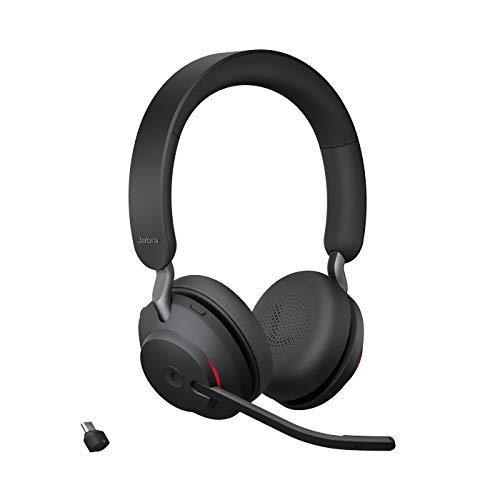
Jabra Evolve2 65 — Best all-round dispatch headset
The Evolve2 65 earns the top slot by being the headset with no disqualifying weakness across a dispatcher’s whole working day. Its microphone system — a three-microphone array working with Jabra’s noise-cancelling processing — is the headline for this use: it strips keyboard clatter, neighboring consoles and room echo out of your transmission, so the caller hears a calm, close voice even when the floor around you is at full volume. On the receiving side, the 40mm drivers render voices with the midrange clarity that matters when a caller is frightened, elderly, whispering or speaking through a bad phone connection — the four acoustic situations that define difficult calls.
Endurance is the second argument. The battery is rated up to 37 hours, which in dispatch arithmetic means a headset charged on Monday can cover shifts into Wednesday, and a forgotten charge is an inconvenience rather than an incident. Bluetooth pairing to two devices lets a dispatcher keep the console and a phone or tablet connected, and the USB adapter in the box gives a wired-grade link to the workstation with better range and stability than a laptop’s built-in radio. The busylight on the earcup — a red ring visible across the room — turns out to matter in centers too: it tells a supervisor approaching with a question that you are live on a call, without anyone raising a voice.
Comfort engineering is thorough: memory-foam cushions, a headband that spreads pressure, and a weight low enough that the headset genuinely disappears during the long middle hours of a shift. The honest trade-offs for dispatch specifically: this is a stereo, both-ears design, so the open-ear awareness this guide prizes must be managed by wearing it shifted or choosing the monaural variant in the same line where policy demands one ear free; it is a Bluetooth office headset at heart, so console and radio integration runs through the PC rather than a native quick-disconnect; and its microphone boom, while excellent, is a fixed arm rather than a replaceable part. As a personal-issue or workstation headset in a modern, PC-console center, it is the strongest all-round tool we can link you to.
- Microphone: three-mic array with strong noise cancellation for caller clarity
- Battery: up to 37 hours — multiple shifts per charge
- Fit: stereo memory-foam cushions; monaural variant exists in the line
- Connection: Bluetooth plus USB adapter for the workstation link
- Floor signal: integrated busylight shows the room you are on a call
Strengths
- Your voice stays calm and intelligible even on a loud floor.
- Battery endurance removes charging from shift planning.
- Comfort holds up across the full twelve hours, not just the first two.
Trade-offs
- Stereo cups seal both ears; one-ear awareness needs the mono variant or discipline.
- No native quick-disconnect for traditional console hardware.
- The boom is fixed, so a damaged mic means a whole-unit swap.
Best for: dispatchers in PC-console centers who want one premium headset for calls, training and admin work. Not suited for: centers requiring native quick-disconnect hardware, or strict one-ear policies without a mono variant.

Jabra Evolve2 65 Flex — Best for focus between calls
The Flex is the Evolve2 idea rethought for the dispatcher whose job alternates: live calls on the console, then reports, training modules and quality-review recordings in the gaps. Its defining addition is hybrid active noise cancellation — feedforward and feedback microphones working together to quiet the room’s constant machinery: HVAC, neighboring positions, the printer that serves a whole floor. Between calls, that cancellation turns a noisy center into a place where a narrative report can be written without re-reading every sentence. On calls, Jabra’s ClearVoice microphone processing does the complementary work on your transmission, keeping your voice forward and the floor behind it suppressed.
The frame folds — earcups rotating flat and the headband collapsing — so the headset lives in a drawer or a go-bag rather than claiming permanent desk territory, a small thing that matters in hot-desking centers and for dispatchers who split the week between a main floor and a backup site. Battery endurance is strong, the fit uses the same memory-foam approach as its sibling with a slightly softer clamp, and the charging stand available in the line turns the end-of-shift routine into dropping the headset on a pad. Wireless connection runs through Bluetooth with the included USB adapter for the workstation, and multipoint pairing keeps a phone in reach for the callback numbers and supervisor lines that live off-console.
Where the Flex concedes ground to the standard Evolve2 65: its cancellation and folding mechanism add cost, its maximum battery figure trails the simpler model’s, and like its sibling it is a stereo design that seals both ears — the one-ear doctrine needs the same management. It is also, unapologetically, an office-grade product: rugged enough for a desk job’s decade, but a center that issues headsets into a hard-use fleet pool should weigh the corded picks below for the shared spares drawer. For the individual dispatcher whose shift is half calls, half concentration, the Flex is the most thoughtful design in this guide.
- Cancellation: hybrid ANC for report-writing focus between calls
- Microphone: ClearVoice processing tuned for speech in noisy rooms
- Frame: folds flat for drawers, go-bags and hot-desking centers
- Battery: full-shift-plus endurance with an optional charging stand
- Connection: Bluetooth with USB adapter; two devices at once
Strengths
- Silences the room’s constant noise so admin work gets done on shift.
- Folding design suits shared desks and backup-site rotations.
- Caller-side voice clarity matches the best in this guide.
Trade-offs
- Costs more than the standard Evolve2 65 for features some roles never use.
- Stereo seal works against strict one-ear awareness policies.
- More mechanism to damage in a rough fleet-pool environment.
Best for: dispatchers balancing live calls with reports, training and review work. Not suited for: fleet pools buying for durability per dollar, or one-ear-only positions.

Poly Voyager 5200 — Best single-ear specialist
The Voyager 5200 is the purest expression of the dispatch doctrine in this guide: one ear on the call, one ear on the world, and almost nothing on your head at all. It is a single-ear Bluetooth earpiece of the classic over-ear-hook school, weighing so little that after the first hour the honest description is that you forget it — until it speaks a caller ID or a battery warning directly into your ear. For dispatchers who move — to the supervisor’s desk, the radio room, the map wall — and for the growing number working hybrid positions where the headset serves a phone-based console, that untethered lightness is not a luxury; it is the job description.
Its microphone system is the engineering story: four microphones with wind and noise processing that Poly refined over generations of mobile professionals, delivering a voice that stays composed outdoors, in a running vehicle or beside an open window — relevant for field supervisors, on-call staff and dispatchers who take overflow calls away from the main floor. Voice controls let you answer or ignore by speaking, caller announcements keep your eyes on the screen, and the optional charging case turns it into a system that lives in a pocket and works for days. Talk time per charge is a shift-friendly figure for its size class, though a twelve-hour day of continuous calls will want the case’s top-ups during breaks.
The compromises are inherent to the form. A single small earpiece cannot match a boom headset’s microphone placement, so in the loudest floor conditions the Evolve2 models transmit a cleaner voice; there is no stereo, no cushion, and nothing like noise cancellation for the listening ear; and a tiny device is easier to misplace than a headset on a hook — centers that issue them learn to love the charging case as a home base. Judged on its own brief — constant wear, constant movement, one ear always free — nothing else in this guide does the job as completely.
- Form: single-ear earpiece — the open ear is the design, not a setting
- Microphones: four-mic array with wind and noise processing
- Controls: voice answer/ignore and spoken caller announcements
- Endurance: shift-scale talk time, extended by the optional charge case
- Fit: over-ear hook, several tip sizes, worn all day by design
Strengths
- Total room awareness with the call always present.
- Featherweight comfort that survives the longest shifts.
- Voice quality outdoors and in motion leads this guide.
Trade-offs
- No boom means the loudest floors test its noise cancellation harder.
- Small size invites loss; the case is effectively mandatory.
- Listening side gets no help in a noisy room — one ear does all the work.
Best for: mobile dispatchers, supervisors and hybrid or overflow positions. Not suited for: the loudest fixed consoles, where a boom headset transmits better.
Poly EncorePro 520 — Corded fleet standard
If the headsets above are where dispatch audio is going, the EncorePro 520 is where a large share of it still lives. This is the corded, quick-disconnect binaural headset that centers have issued by the carton for years: a lightweight frame, two earcups, a bendable boom with a noise-cancelling microphone, and a disconnect plug halfway down the cable that is the whole philosophy in one part. Call audio stays live on the console side when you unplug to walk to the supervisor; a failing headset swaps for the drawer spare in seconds; the cable — the component that actually wears out — is a replaceable bottom half rather than a funeral for the whole unit. We cover it in prose because our pool holds no verified listing for it; public-safety audio dealers stock it, and the model name must be matched exactly, including the disconnect type your consoles use.
Its virtues are fleet virtues. There is no battery to manage, no pairing to drift, no firmware to schedule; it sounds the same on its first shift and its five-hundredth. The voice tube and microphone options across the EncorePro family let an agency standardize one frame and vary the pickup. The costs are the cord itself — a tether that wireless converts will not miss — and the absence of modern comforts like active cancellation. For a center equipping thirty positions with a spares drawer and a purchase order, this remains the rational backbone, with wireless headsets layered on top for the roles that move.
- Connection: corded quick-disconnect — the swap-in-seconds standard
- Fit: binaural lightweight frame with a bendable boom
- Maintenance: cables, cushions and parts sold separately for fleets
- Power: none required — no battery story at all
- Buying route: public-safety and office-audio dealers; match disconnect type
Strengths
- The fastest failure recovery in this guide: unplug, plug, back on the air.
- No batteries, no pairing, no updates — identical every shift.
- Fleet economics and parts support proven over years of issue.
Trade-offs
- The cord tethers you to the console completely.
- Both ears covered; one-ear positions need the monaural sibling model.
- No modern cancellation or wireless conveniences.
Best for: centers equipping many fixed positions with a spares-drawer philosophy. Not suited for: anyone who leaves the console mid-shift, or personal buyers wanting wireless.
Jabra Pro 920 — Best desk wireless range
The Pro 920 answers a specific dispatch problem: the working supervisor, trainer or senior dispatcher who must stay reachable by the console while walking the floor, checking the radio room or standing at the big map. It uses DECT rather than Bluetooth, and DECT’s gift is range — the kind measured in tens of meters through a building rather than the next room — paired with a dedicated, interference-shy band that does not compete with the building’s Wi-Fi. The base station joins the desk phone or console setup, calls transfer to the headset with a button, and the monaural design keeps the room in one ear while the call occupies the other. Our pool holds no listing for it, so it is covered in prose; Jabra’s business channel and office-audio dealers are the route, and the single-ear wearing style should be confirmed at order, as the line has offered multiple wearing options.
Battery endurance covers a working day of calls with margin, the microphone cancels noise respectably for a design of its generation, and the whole system has the fleet-friendly trait of dedicated hardware: no apps, no accounts, nothing to drift out of date except the battery, which is replaceable. Its limits are generational — no Bluetooth phone pairing, no PC software ecosystem, a base that speaks to desk systems rather than modern softphone-first consoles without the right interface. For a traditional center whose consoles are phone-based and whose supervisors roam, it remains a purpose-built answer that newer office headsets imitate with less range.
- Radio: DECT — the longest practical indoor range in this guide
- Fit: monaural, one ear open to the floor by design
- Base: desk-system connection with call control from the headset
- Battery: full working day, replaceable when it ages
- Buying route: business audio dealers; confirm wearing style
Strengths
- Roaming range Bluetooth cannot match inside a building.
- Dedicated band avoids Wi-Fi congestion entirely.
- Simple, durable, fleet-serviceable hardware.
Trade-offs
- No Bluetooth or modern app ecosystem.
- Desk-phone heritage needs checking against PC-first consoles.
- Voice processing trails the newest Jabra microphones.
Best for: roaming supervisors and trainers in phone-based centers. Not suited for: softphone-only positions, or buyers wanting one headset for console and mobile.
Leitner LH270 — Best one-ear corded comfort
Leitner occupies a particular place in dispatcher culture: a small American company whose headsets are recommended dispatcher-to-dispatcher, in break rooms and training classes, with the loyalty usually reserved for boots. The LH270 is its corded monaural over-the-head design — one earcup, a flexible boom, a quick-disconnect in the Leitner pattern, and a fit refined by a company that sells almost exclusively to people who wear headsets for a living. The single-ear format is the doctrine again: the room stays present, the headset stays light, and the whole apparatus asks so little of the wearer that a twelve-hour shift passes without the end-of-day headset headache that lesser designs schedule like a meeting.
We list it in prose because our verified pool carries no listing for it; Leitner sells direct and through specialist dealers, and its multi-year warranty and repair culture are part of the purchase — this is a company that expects to service what it sells, which fleet buyers will recognize as the trait that matters in year four. The LH270’s limits are the corded limits shared with the EncorePro, plus a smaller ecosystem: fewer local dealers, a disconnect standard that is Leitner’s own, and no wireless or Bluetooth story at any price. Within the one-ear corded niche, though, it is the comfort benchmark, and the number of career dispatchers who arrive at a new center asking for one by name is its review summary.
- Format: corded monaural — one ear covered, one on the room
- Fit: over-the-head band tuned for all-shift wear
- Support: long warranty and a repair-first company culture
- Connection: quick-disconnect in Leitner’s own pattern
- Buying route: direct from Leitner or specialist dispatch dealers
Strengths
- The most comfortable one-ear corded fit we know of.
- Built and serviced for a career, not a product cycle.
- Keeps full room awareness without any settings or discipline.
Trade-offs
- Corded, with a proprietary disconnect ecosystem.
- Smaller dealer network than the giant brands.
- No wireless, Bluetooth or cancellation features.
Best for: career dispatchers at fixed one-ear positions who prioritize comfort and longevity. Not suited for: roaming roles, or centers standardized on another disconnect system.
Headsets on a Dispatch Floor: What Separates the Shift-Proof From the Merely Good?
| Headset | Ears covered | Link | Failure recovery | Defining virtue |
|---|---|---|---|---|
| Jabra Evolve2 65 | Both (mono variant exists) | Bluetooth + USB adapter | Multi-shift battery; swap unit | Microphone clarity on a loud floor |
| Jabra Evolve2 65 Flex | Both, with ANC | Bluetooth + USB adapter | Strong battery; swap unit | Focus between calls |
| Poly Voyager 5200 | One, by design | Bluetooth earpiece | Charge case top-ups | Movement and total awareness |
| Poly EncorePro 520 | Both | Corded quick-disconnect | Seconds — drawer spare | Fleet backbone economics |
| Jabra Pro 920 | One, by design | DECT to base station | All-day battery; spare base units | Roaming range indoors |
| Leitner LH270 | One, by design | Corded quick-disconnect | Seconds — drawer spare | One-ear comfort over years |
The recovery column is the one purchasing officers should read twice. Every headset here will perform on day one; the question a center lives with is day four hundred, mid-shift, mid-incident. Corded quick-disconnect models answer with a drawer. Battery models answer with endurance large enough to make the question rare, plus a spare unit charged and waiting. Both philosophies are respectable — what fails a center is owning neither: a fleet of mid-battery wireless headsets with no spares and no fallback, discovering the gap during the busiest night of the year.
Night shifts deserve their own sentence in the fit discussion, because the headset interacts with fatigue rather than merely with anatomy. At 4 a.m. a heavy or hot headset becomes one more weight in a negotiation your alertness is already losing; the lightest designs in this guide — the Voyager above all, the LH270 among the corded — earn their keep in those hours out of proportion to their specifications. Centers scheduling headset trials should insist one trial unit works a full week of nights before the order is signed, since a headset approved entirely by day-shift evaluators has been approved by the wrong jury.
Why Does the Open Ear Matter So Much in a Dispatch Center?
Because dispatch is a team sport played through individual headsets. The room carries information no console delivers: a partner two seats down taking the second call from the same incident, a supervisor’s half-sentence that reprioritizes your queue, the radio across the room that mentions your street before your own channel does. A headset that seals both ears without cancellation discipline turns its wearer into an island — reachable only by tap on the shoulder, which startles, or by shout, which disturbs three other calls. The monaural tradition in dispatch is not nostalgia; it is an information architecture, and it is why three of the six picks here are one-ear designs and why the stereo picks are flagged for the management they require.
There is a hearing-conservation side as well. A dispatcher wearing one earcup at a sensible level, with the other ear resting in ordinary room sound, accumulates less listening fatigue across a shift than one sealed into stereo for twelve hours — and fatigue in this job is not discomfort, it is degraded comprehension on the next difficult call. Centers that issue stereo headsets increasingly pair them with a norm: one cup shifted off the ear during low-traffic periods, volume discipline always. The technology choice and the workplace habit are one decision, and this guide’s rankings assume you will make both halves of it.
Consoles add a layer worth naming: many positions run the headset alongside a foot pedal or a hand switch for transmit, speakers for the radio channels and a separate handset for administrative lines. A headset purchase that ignores that choreography — a boom that collides with the handset’s resting place, a wireless puck that wants the exact desk corner the pedal controller occupies — creates a daily friction no specification sheet mentions. Map the position’s physical layout before ordering, the way you would map the audio chain, and let the map veto otherwise excellent headsets. Dispatch ergonomics is a whole-desk discipline.
How Do You Fit and Set Up a Headset for a Twelve-Hour Shift?
Fit for the fourth hour, not the first. A headset that feels secure in minute five because it clamps will file its complaint by midnight; adjust for the lightest fit that stays put when you look down at the keyboard and turn to a second screen. Position the boom a couple of finger-widths from the corner of your mouth — closer eats plosives and breath, farther thins your voice and invites the noise cancellation to work on you instead of the room. Set your sidetone, the echo of your own voice in the earcup, to just audible: without it, dispatchers unconsciously raise their voices across a shift, and a center full of raised voices raises everyone’s floor noise in a spiral nobody chose.
Volume discipline is a setup step, not a virtue. Set the receive level on a normal call, then leave it; chasing loud callers with the volume knob trains the next quiet caller to blast you. Where the console allows, use its limiting and level management rather than your ears as the safety system. Finally, stage the failure kit before it is needed: spare headset or spare cable within arm’s reach, cushions replaced when they compress rather than when they disintegrate, and a personal note of your fit settings if the headset is shared between shifts — hot-seat positions reward the dispatcher who can restore a known fit in thirty seconds.
Mutual-aid and surge events stress the system in a different direction: borrowed positions, mutual-aid staff wearing unfamiliar headsets, a training room converted to consoles by noon. A fleet built on common models with common spares absorbs surge gracefully, because any headset fits any position and any dispatcher can troubleshoot any seat. A fleet of six personal favorites, however beloved, turns surge day into an adapter hunt. Standardization is unglamorous and occasionally unpopular with individuals; it is also the reason the fleet-standard picks in this guide exist as a category, and surge planning is where their value stops being theoretical.
How Should a Center Stock Spares and Handle the 3 A.M. Failure?
Plan for the failure as a scheduling fact. Corded fleets want a spare ratio that reflects reality — a headset and a bottom cable for roughly every several positions, cushions by the bag, and everything in one labeled drawer that the night shift can find without waking anyone. Wireless fleets want charged spare units, not boxed ones: a spare that needs four hours of charging is a spare for tomorrow, and the failure is tonight. Battery headsets earn a charging shelf with a rotation habit — units come off shift onto chargers, spares come off chargers onto heads — so state of charge is a property of the shelf, not a memory test for tired people.
Track failures the way centers track everything else: a simple log of what broke, when, and after how long in service turns anecdote into purchasing evidence within a year. Cables that die at the strain relief argue for a different bottom-cable supplier; cushions that perish in a season argue for a different material; a boom that snaps argues for a different issue policy. The headsets in this guide were chosen partly on this evidence culture — parts availability, warranty handling and service history — because a center’s real headset cost is the purchase price plus every minute a position sat degraded waiting for a replacement that should have been in a drawer.
How Do You Protect a Dispatcher’s Hearing Across a Career?
Dispatch rarely feels loud, which is exactly why its hearing risks go unmanaged. The exposure is not volume spikes but duration: a voice in one ear at a working level, twelve hours a day, two hundred shifts a year, across a thirty-year career. The defenses are procedural as much as technological. Keep receive levels at the lowest setting that gives effortless comprehension, and let the console’s compression handle the loud caller rather than your ears absorbing him. Alternate the covered ear where a monaural headset and policy allow it, so the load is shared across a week. Take the headset off during breaks — real breaks, away from the floor — because auditory rest is cumulative in your favor just as exposure is cumulative against you.
Headset choice supports the program. A microphone with strong noise cancellation lets you transmit at a natural speaking level instead of competing with the room, and a calm voice invites calmer callers, which lowers everyone’s volume in a feedback loop worth engineering. Sidetone set correctly stops the slow voice-raising spiral. A good seal or well-fitted cup means the receive level can sit lower for the same clarity — one more reason cushions are a hearing device, not a comfort accessory, and why their replacement schedule belongs in the safety budget rather than the stationery one. Centers that treat hearing as a career-length asset, and headsets as part of that system, keep experienced dispatchers — and experience is the resource no purchase order can expedite.
What Changes for Dispatchers Working From Home or Overflow Sites?
Everything the center used to provide becomes the individual’s problem: the quiet room, the spare headset, the second ear on the incident. Home-based dispatchers should replicate the center’s architecture in miniature — a primary headset and a charged or corded spare, a door that closes, and a household briefed that the person in the spare room is, for legal and practical purposes, on a recorded line. The linked picks suit this world well: the Evolve2 pair bring office-grade call quality to a home desk, the Voyager 5200 serves the overflow position that might be a kitchen table between other duties, and Bluetooth multipoint earns its keep when the work phone and the console are different devices in different rooms.
The home setup also reopens the one-ear question in a new form. Alone in a house, the open ear no longer carries a team’s information — it carries the doorbell, the dog and the smoke alarm, which are precisely what a home dispatcher still needs. The doctrine survives the move; only the room it listens to has changed. What does not survive is the spares drawer: the home dispatcher’s spare is the one they bought themselves before the night they needed it, and this guide’s recovery argument applies to a household of one with exactly the force it has in a center of fifty.
How Should New Dispatchers Be Trained to Use a Headset?
As a skill, explicitly, the way radio procedure is taught — because headset craft is radio procedure’s physical half. Trainees should practice the boring liturgy until it is automatic: fit check at shift start, boom position verified against a recorded test call, sidetone and receive levels set from the position’s card rather than by feel, the quick-disconnect or spare swap rehearsed with a timer running. Listening to their own recorded calls is the fastest teacher: a trainee who hears how their voice lands — too loud by hour six, boom drifted after the break, keyboard audible under a critical exchange — corrects in a week what a year of memos would not fix.
Trainers should also teach the headset as an instrument of caller management. A clear, calm, close-sounding voice measurably steadies frightened callers; a thin, distant, echoing one makes the dispatcher repeat questions and the caller repeat answers, and repetition is time. That is the operational case for the microphone quality this guide ranks first, and it lands harder in a training room than any specification: play two recordings of the same script through two headsets and let the class feel which dispatcher they would trust from a closet at 3 a.m. The lesson buys itself.
What Are the Most Common Mistakes When Equipping Dispatchers?
The first is buying for the demo instead of the shift: a headset evaluated for ten quiet minutes at a trade-show volume tells you nothing about hour eleven. Evaluate on the floor, on real calls, across a full rotation, with the dispatchers who will wear them voting with their actual heads. The second is sealing both ears by default because stereo looks modern on a purchase order, then discovering the awareness cost in a center that runs on overheard information. The third is ignoring the disconnect and adapter layer until installation day, when the new fleet meets the old consoles and neither speaks the other’s plug language.
Fourth, centers underbuy spares and overbuy features: cancellation and Bluetooth impress in the bid, but the 3 a.m. failure is answered by a drawer, not a specification. Fifth, they skip hearing and volume discipline as if it were a personal matter, when comprehension late in a shift is an operational metric. Sixth, personal-headset policies get written without a hygiene and replacement clause, and shared cushions become the grievance nobody budgeted for. And seventh, buyers forget the recording reality of dispatch: every word is kept, so a microphone that garbles is not merely an inconvenience — it is a gap in a legal record. Buy the microphone first; the rest of the headset is furniture around it.
Budget officers should hear the total-cost version of this guide plainly: the purchase price of a dispatch headset is typically the smaller half of its lifetime cost once cushions, cables, batteries, spares and the labor of degraded positions are counted. A model that costs a third more but halves the failure rate and doubles the parts life is the cheaper fleet — and the failure log, kept honestly for one year, will prove or refute that arithmetic for your center specifically. Buy the first year as an instrumented trial at fleet scale, and let your own data, rather than any guide including this one, write the renewal order.
How Do Hygiene and Sharing Rules Shape What a Center Should Buy?
In a hot-seat center the headset is shared equipment in the most literal sense — against skin, at the mouth, across three shifts a day — and purchasing that ignores the fact buys a grievance along with the hardware. The practical answers are well established: personal-issue cushions and windscreens on shared frames, wipe-down protocol between shifts with materials the manufacturer approves for the plastics involved, and enough units in the pool that a headset can rest and dry rather than passing warm from one head to the next. Foam windscreens are pennies and should be treated as consumables on a schedule, not as archaeology. Where policy and budget allow, personal-issue headsets end the question entirely, and the improvement in care that people take of their own issued equipment usually repays a share of the cost.
Buyers should read a headset’s datasheet with hygiene in mind: are cushions removable without tools, are replacements stocked as a line item, does the maker’s cleaning guidance permit the disinfectants a center actually uses? A sealed, unwipeable design that cannot be cleaned to a center’s standard is the wrong purchase however good its microphone, and this mundane filter is one reason the fleet-proven corded models persist — their parts culture was designed by decades of shared use. The dispatch floor runs on unglamorous disciplines, and the headset that respects them wins the fleet renewal.
One more constituency deserves a mention: the caller. Callers never see the headset, but they hear its consequences — a dispatcher who sounds near, calm and unhurried because their equipment is not fighting them. In the worst minutes of a stranger’s life, that sound is a clinical tool; it lowers voices, slows speech and improves the quality of the information a dispatcher can gather. Equipment budgets rarely list caller outcomes as a line item, but every trainer knows the phenomenon, and it is the deepest reason the microphone rankings in this guide are ordered the way they are.
What Does a Recording-Ready Voice Actually Require?
Every dispatch call is a record — replayed in courtrooms, quality reviews and public-records requests — so the dispatcher’s transmitted audio is evidence, and evidence has standards. A recording-ready voice is intelligible at the first hearing, level across the call rather than swelling and fading with head movement, and free of the floor’s competing noise. Achieving it is a chain: a noise-cancelling boom placed consistently, a console input gain set once and correctly, a dispatcher who speaks at a trained level, and a headset whose microphone does not compress shouts into distortion when an incident peaks — because incidents peak exactly when the record matters most.
Centers can audit the chain cheaply by sampling recordings monthly and scoring them the way a jury would hear them. The findings are usually mechanical, not personal: a position whose boom has drifted loose, a cushion perished so its wearer pushes volume, a spare headset of a different model quietly degrading one seat’s recordings. The picks in this guide were ranked with that audit in mind — microphones first, consistency always — because in this profession the headset’s output is not chatter. It is the transcript of somebody’s worst day, and it should be worthy of the replay.
Final Recommendation
For an individual dispatcher buying a personal headset for a modern PC-console position, the Evolve2 65 is the answer: the clearest voice, the longest battery and comfort that respects the full shift. Choose the Flex instead if your duties split between the console and concentrated desk work, where its cancellation earns its premium every single day. Choose the Voyager 5200 if your job moves — supervision, overflow, hybrid work — and one free ear is non-negotiable. For a center equipping a floor, the honest architecture is layered: corded quick-disconnect headsets like the EncorePro 520 and the LH270 as the backbone with a stocked spares drawer, DECT like the Pro 920 for the people who roam, and premium Bluetooth for the positions whose work justifies it.
Whichever layer you are buying for, run the same test before committing: one full shift, real calls, the actual console, and a deliberate mid-shift swap to the spare to prove the recovery story works while everyone is calm. A headset program that survives that rehearsal will survive the night it actually matters.
In dispatch, the best headset is the one nobody mentions at the end of the shift — because the caller was understood, the room stayed present, and nothing broke that a drawer could not fix.
Trial protocol, stated once for all of it: two weeks minimum, both day and night rotations, recordings sampled, failure drill rehearsed, and a written vote from the dispatchers who wore the finalists. Anything shorter measures the honeymoon, and headsets, like colleagues, should be hired for the ordinary Tuesday of month six rather than the interview.
Which Headset Should a Small Center Buy First?
Start where the pain is. A small center with modern PC consoles and personal workstations gets the most from issuing the Evolve2 65 to its dispatchers and keeping one charged spare per shift — the microphone improvement alone will be audible in the recordings within a week. A center on traditional phone-based consoles should build the corded backbone first — EncorePro or LH270 by position type — with spares stocked before the second position is converted, because a half-converted floor with no drawer is the worst of both worlds. Supervisors who roam get the Pro 920 or the Voyager, in that order of range, and only after the fixed positions are sound: mobility is a multiplier on a working system, not a substitute for one.
Sequence the spending across budget cycles rather than diluting it. Microphones and spares in the first cycle, comfort upgrades in the second, convenience features last — a center that follows that order hears the difference immediately and feels it at renewal time, when the failure log shows a fleet that degraded gracefully instead of expensively. And involve the dispatchers in the trial, formally: a headset chosen by the people who wear it arrives with advocates, while a headset imposed by a spreadsheet arrives with a drawer of quietly preferred old units that never quite got returned.
Frequently Asked Questions
Why do dispatchers prefer one-ear headsets?
Because the room is part of the job. The open ear catches a partner’s call on the same incident, a supervisor’s instruction and the second radio — information that never reaches the console screen. One-ear wear also reduces listening fatigue across a twelve-hour shift. Stereo headsets can serve where policy allows, but they ask the wearer to manage awareness deliberately.
Can I use an office headset like the Evolve2 on a dispatch console?
On PC-based consoles, generally yes — the USB adapter presents the headset as a standard audio device. On traditional radio and phone console hardware, an interface or adapter is usually required, and your agency’s approved list governs. Confirm the connection path with your center’s technical staff before purchasing for a position.
What is a quick-disconnect and why does it matter?
It is a plug partway down a corded headset’s cable that separates in a second. It lets a dispatcher walk away without removing the headset or ending the console’s side of the connection, and it lets a failed headset be swapped for a spare instantly. In fleet service, the disconnect is the difference between a ten-second hiccup and a position out of service.
How long should a dispatch headset last?
The frame and electronics should serve for years; the consumables — cushions, cables, batteries — cycle faster and should be budgeted as parts. Corded fleet models are built for exactly this pattern, with every wear item replaceable. Wireless models last as headsets until their sealed batteries fade, typically after several years of shifts, which is why spare-unit rotation matters.
Is noise cancellation important for dispatch?
At the microphone, it is close to essential: it keeps the floor’s noise out of a recorded call and lets a caller hear one calm voice. At the earcup, cancellation helps focus between calls — the Flex’s specialty — but on live calls many dispatchers prefer an open ear or a lighter seal so the room stays present. Buy cancellation for your voice first and your ears second.
Are Bluetooth headsets reliable enough for dispatch work?
For PC-console positions, the modern business Bluetooth headsets in this guide are proven in offices far larger than most centers, and their USB adapters provide a stable, managed link. The reliability disciplines are organizational rather than technical: charged spares, a rotation habit, and a corded fallback in the drawer for the day any radio misbehaves. Centers on traditional console hardware should keep the corded backbone and treat Bluetooth as the personal-issue layer it excels at being.
How do I stop my headset from hurting by the end of a shift?
Loosen it first — most end-of-shift pain is a fit set for security in minute five and never revisited. Reposition the band so weight rides the top of the head rather than the ears, confirm the boom is not pulling the cup forward, and swap cushions that have compressed flat, since a perished cushion concentrates pressure it used to spread. If pain persists across a week of honest adjustment, the design does not fit your head, and a different model is a health purchase, not an indulgence.
What should a spare kit for one position contain?
A complete spare headset or, for corded setups, a spare top and bottom cable; a fresh set of cushions; any adapter the position requires; and, for wireless, a charged unit rather than a boxed one. Add a note of the position’s fit and volume settings, and the whole kit fits in one labeled drawer per pod of consoles.
Related Guides
The cockpit is the dispatch floor’s closest cousin, and our affordable aviation headsets guide, where a clear voice at altitude is the whole brief covers the same priorities in a louder room. For the budget end of gaming and home use, the affordable gaming headsets roundup shows what careful money buys when features must be argued for. And the home-based version of the dispatch problem is handled in our affordable headsets for working from home, built around calls and concentration.


